CAS Accounting: What It Is, What to Charge, and How to Automate It
Most CAS accounting guides stop at the definition. This one goes further: real-world pricing tiers, adoption data from the TaxScout directory of 69,074 US preparers, and the specific automation steps that separate high-margin advisory firms from those that treat CAS as upgraded bookkeeping. Plus…
CAS accounting — short for client accounting services or client advisory services — is a recurring-engagement model in which a CPA firm delivers ongoing financial reporting, controller-level analysis, cash flow forecasting, and business advisory work, rather than one-time compliance filings. Pricing typically ranges from $500 to $5,000 per month depending on entity complexity and service scope. Automation of document collection, reconciliation, and reporting is what separates profitable CAS practices from those losing margin to scope creep.
CAS accounting has become one of the most searched terms in public accounting — but most of the articles ranking for it stop after two paragraphs of definition and a bullet list of services. That leaves firm owners with the questions that actually matter unanswered: What should you charge? Who is already doing this, and where? And which parts of a CAS engagement can actually be automated without sacrificing quality?
This guide covers all three. We start with a working definition and service taxonomy, move into real-world CAS pricing benchmarks and packaging tiers, examine adoption patterns using data from the TaxScout directory of 69,074 US preparers, and then walk through the specific workflow automation steps that protect margin. We close with a practical checklist — something no competitor piece offers — for transitioning a single legacy compliance client into a full CAS engagement. Whether you are just starting to offer CAS accounting or refining an existing practice, this guide gives you the full picture from definition to automation.
If you have read the other guides and still feel like you are missing the operational blueprint, this is the article for you. For broader context on running an advisory-forward practice, see our complete guide resources covering everything from onboarding to automation. CAS accounting sits at the intersection of technology and advisory services, and understanding how those two elements work together is essential before diving into the operational details below.
How to Transition a Legacy Compliance Client to a CAS Engagement
- Conduct a 30-minute discovery call to assess the client's current financial operations, accounting platform, and pain points.
- Map the client's needs to a CAS pricing tier and define the service scope in writing, specifying deliverables, frequency, and exclusions.
- Draft and execute a detailed CAS engagement letter covering deliverables, client data obligations, change order process, and billing terms.
- Set up the client in your practice management system with monthly pipeline stages, assigned team members, and AI context for entity structure and prior financials.
- Migrate document collection to a branded client portal and configure automated reminders for monthly document deadlines.
- Run the first month-end close as a documented template, capturing every step to serve as the repeatable playbook for that client tier.
- Deliver the first CAS report in a live walkthrough call, highlight two or three actionable insights, and use the client's questions to assess whether they are a candidate for a higher-tier advisory engagement. Following these steps consistently ensures that every CAS accounting engagement starts with a clear scope, realistic expectations, and the right technology stack in place.
What CAS Accounting Actually Means
CAS accounting is an umbrella term for a bundle of recurring services a CPA firm provides to business clients on an ongoing retainer basis. The AICPA defines Client Accounting and Advisory Services as the natural evolution of write-up work: the same underlying accounting tasks — bookkeeping, payroll, reconciliation — but delivered at higher frequency, with richer analysis, and tied to business decisions rather than compliance deadlines.
In practice, a CAS engagement can include any combination of the following: monthly or weekly bookkeeping and transaction categorization; financial statement preparation (income statement, balance sheet, statement of cash flows); payroll processing and payroll tax filings; sales tax calculations and filings; budgeting and cash flow forecasting; virtual controller or virtual CFO services; and strategic business advisory on topics ranging from pricing to capital structure. The scope is set at engagement start and documented in a written agreement — which is exactly why the engagement letter is so important in CAS: a vague scope is the root cause of most margin erosion. For firms evaluating their CAS accounting approach, this trade-off compounds over time.
The critical shift from pure compliance work is timing and cadence. A tax return is delivered once a year. A CAS engagement delivers value every month, which means clients perceive ongoing ROI rather than an annual invoice for a commodity product. That recurring relationship is also why CAS engagements tend to have significantly lower churn than compliance-only clients — the switching cost for a client whose books, payroll, and cash flow reporting all live in your systems is much higher than for a client who only gets a 1040 each spring. Each of these factors directly shapes how CAS accounting plays out in practice.
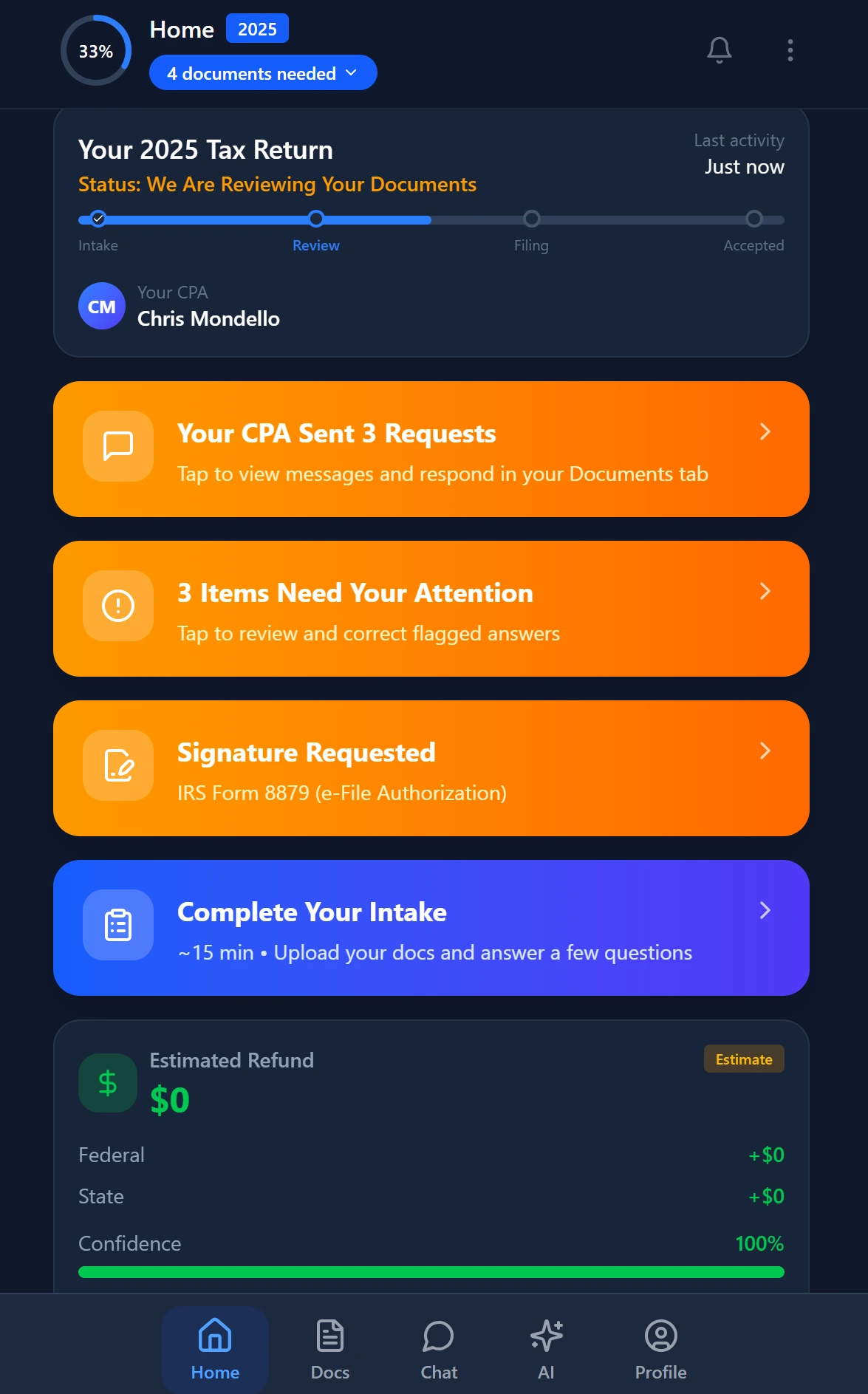
Smart intake auto-fills from uploaded documents and prior-year data

Click any extracted field to see its source highlighted on the original PDF
Services That CAS Firms Offer
Understanding the CAS service stack matters because pricing, staffing, and automation choices all depend on what is actually in scope. Most CAS practices organize their offerings into three tiers. Understanding CAS accounting in this context is what separates firms that scale from those that stall.
Foundational CAS: Accounting and Reporting
Foundational services are the ones that trace directly from traditional bookkeeping: recording transactions, reconciling bank and credit card accounts, categorizing expenses, and producing monthly financial statements. These are the highest-volume, most automatable components of a CAS engagement. Cloud accounting platforms like QuickBooks Online or Xero handle much of the transaction feed; the firm's job is exception review, categorization judgment, and financial statement sign-off. Payroll processing and payroll tax filings (Form 941 is due quarterly) often live here too, as does sales tax compliance for clients with nexus across multiple states. This is precisely where a deliberate CAS accounting strategy pays off.
Controller-Level CAS: Analysis and Oversight
The middle tier is where margin starts to widen. Controller-level work includes month-end close management, budget-versus-actual variance analysis, accounts payable and receivable oversight, job costing, and internal controls design. These services require a credentialed professional — usually a CPA or senior accountant — and cannot be fully automated, but they can be systematized with templates, checklists, and AI-assisted anomaly detection. This is also the tier that most justifies a price jump: clients in the $1,500–$3,000/month range are typically receiving controller-level oversight without the cost of a full-time hire. CAS accounting sits at the center of this decision — get it wrong and the rest unravels.
CFO and Advisory CAS: Strategy and Decision Support
The highest tier covers virtual CFO services — cash flow forecasting, scenario modeling, capital structure advice, KPI dashboards, and strategic planning. This work is almost entirely judgment-based, which means it resists automation but commands the highest fees. Virtual CFO engagements at established firms typically start at $3,000–$5,000 per month and can run significantly higher for complex entities. The advisory layer is also where AI research tools add the most leverage: a preparer who can answer a client's question about bonus depreciation on a new equipment purchase — 100% for qualified property acquired after January 19, 2025 under P.L. 119-21 — in real time during a planning call is delivering genuine CFO-equivalent value. When firms revisit their CAS accounting priorities, the gaps usually surface here.
Tired of CAS engagements that look profitable on paper but bleed margin through scope creep?
TaxScout gives your firm AI document processing, a branded client portal, e-signatures, and pipeline management on one flat-fee platform — so your CAS delivery is as systematic as your pricing.
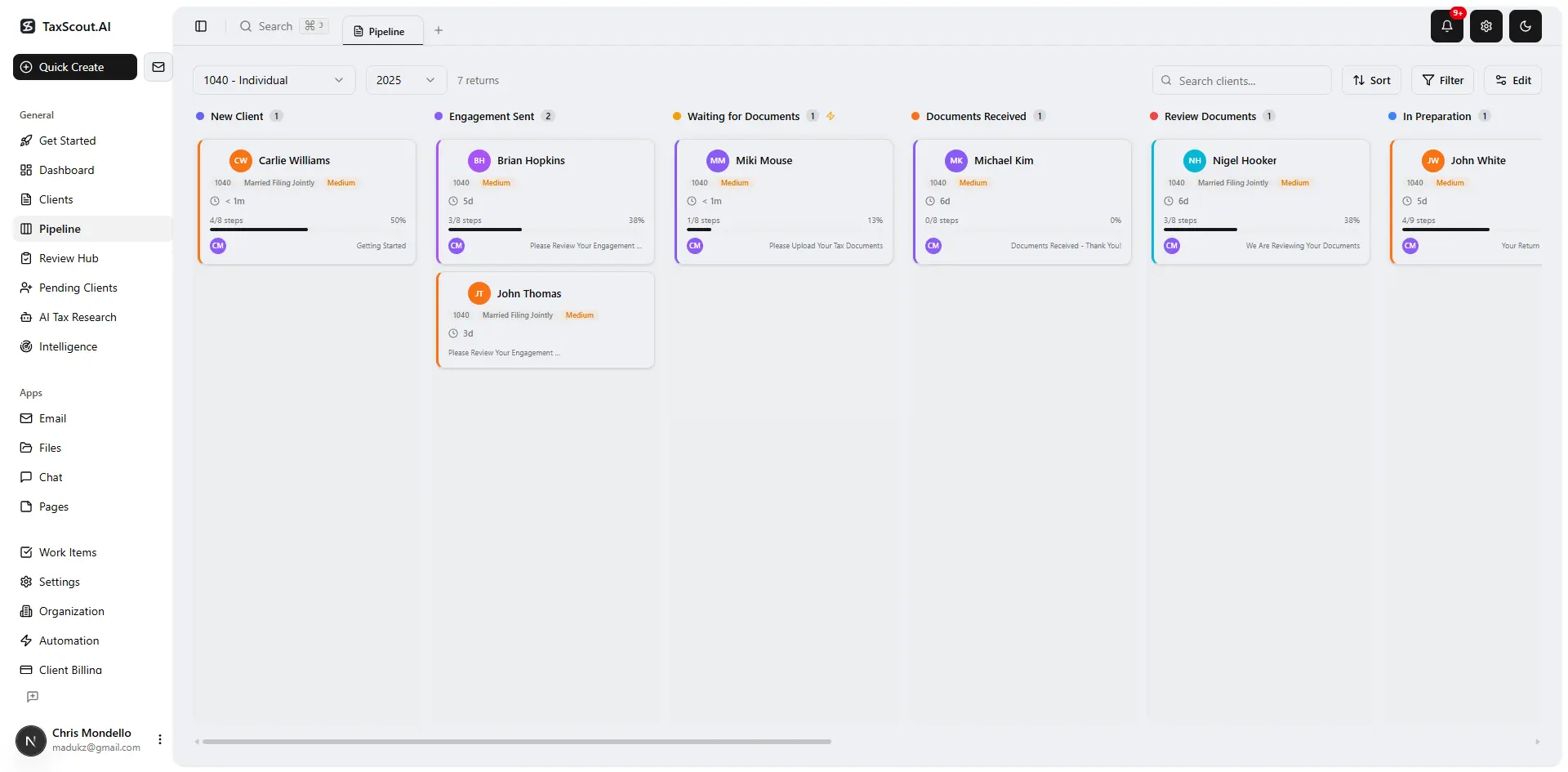
Track every return from intake to filed with drag-and-drop pipeline management
CAS Pricing Benchmarks and Packaging Tiers
CAS pricing is where most guides go silent. The reality is that pricing varies widely by scope, entity complexity, and firm positioning — but there are observable ranges that can anchor your packaging decisions. Based on published survey data from the Journal of Accountancy and practitioner communities, as well as the structure of the TaxScout preparer directory, the following tiers represent how most CAS firms currently package and price their offerings.
Starter CAS (Bookkeeping + Monthly Statements): $500–$1,200/month. Typically serves sole proprietors and micro-businesses with under $1M in annual revenue. Deliverables: monthly reconciliation, income statement, balance sheet, and a brief written summary. Staffed by a bookkeeper or junior accountant with CPA review. Automation potential is highest at this tier — much of the transaction work is handled by software.
Core CAS (Controller Services + Payroll): $1,200–$3,000/month. Serves small businesses with $1M–$5M in revenue, multiple employees, and more complex reporting needs. Deliverables add payroll, sales tax, budget-versus-actual analysis, and a monthly call. Requires a senior accountant or controller-level professional. This is the most common tier for mid-size CPA firms entering CAS.
Premium CAS (Virtual CFO + Advisory): $3,000–$8,000+/month. Serves growth-stage businesses that need strategic financial guidance. Deliverables include cash flow forecasting, scenario modeling, KPI dashboards, board-ready reporting, and direct access to a CPA partner. Pricing here is value-based rather than cost-plus — what you charge reflects the financial impact of the advice, not the hours logged.
The single most important pricing discipline in CAS is scope definition at the engagement start. As the Mango Practice team has noted, a $2,500/month engagement can still lose money when every ad hoc question, cleanup request, and one-off call is absorbed into the flat fee. The fix is a detailed service schedule in the engagement letter, combined with a formal change order process for out-of-scope requests. TaxScout's e-signature workflow supports both engagement letters and scope amendments, so the paper trail exists before the work begins. For a deeper look at recurring pricing models, see our guide on subscription pricing for CPA firms.

Your clients see your brand — OTP login, document upload, and real-time status
CAS Adoption Rates: Where Advisory-Forward Firms Are Clustering
How many firms have actually made the shift to CAS accounting? The answer depends on how you define the shift — but the TaxScout directory provides a useful lens. As of November 24, 2026, the TaxScout directory lists 69,074 US tax preparers matched against the IRS federal preparer directory. Of those, 32,228 hold a CPA credential and 11,109 are enrolled agents; the remainder hold a PTIN only or another credential.
CPA credential density matters for CAS because CPAs are the most likely practitioners to offer controller and CFO-level services — the top two tiers of the CAS stack. That 32,228-CPA subset represents the realistic addressable population for advisory-forward positioning, and it is not evenly distributed. Advisory-forward firms — those marketing CFO, controller, or strategic advisory services — tend to cluster in metro areas with high concentrations of founder-led businesses: greater New York, the San Francisco Bay Area, Austin, Chicago, and South Florida. Our earlier analysis of tax preparer deserts found that credentialed preparers are scarce in large swaths of Texas, Florida, New Jersey, North Carolina, and Massachusetts — meaning rural and exurban business owners in those states are chronically underserved, which is an opportunity for remote CAS practices.
AICPA PCPS surveys have consistently shown that CAS is the fastest-growing service line among firms with five or more team members, and that the median CAS revenue per firm has increased each survey year. The Bureau of Labor Statistics projects 6% growth in accounting and auditing occupations through 2033 — but the fastest growth is in advisory and analysis roles, not compliance preparation. The directional signal is consistent: CAS is not a niche; it is the direction the profession is moving.
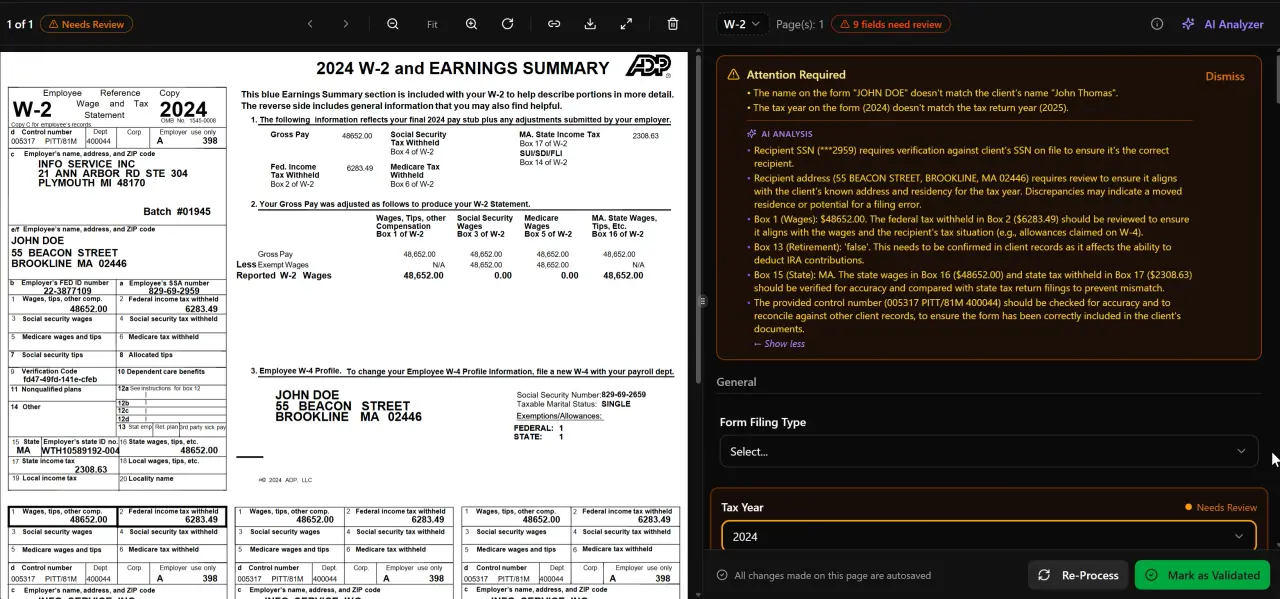
AI classifies, extracts, and validates every document automatically
Automation Bottlenecks That Kill CAS Profitability
Here is what the competitor pieces skip: the specific workflow failures that turn a well-priced CAS engagement into a margin drain. CAS profitability depends on three automation levers — document collection, reconciliation exception handling, and reporting assembly — and most firms have automated none of them completely.
Document collection is the first bottleneck. CAS clients need to deliver bank statements, payroll records, receipts, and loan documents every month. When the collection process runs on email and manual follow-up, a single slow client can consume hours of staff time per month. A branded client portal with automated reminders — TaxScout's portal uses OTP login so clients never forget a password — reduces collection friction dramatically. Pair the portal with a smart intake engine and the system can flag missing documents before the month-end close even begins.
AI document processing addresses the second bottleneck: getting data out of the documents once they arrive. TaxScout's AI document extraction processes recognized document classes — W-2s, 1099 series, K-1s, 1098 and 1095 series, 1040 schedules, and supporting records — through a 5-layer validation pipeline that includes AI extraction with confidence scoring, OCR cross-verification, 15 deterministic math rules, 18 post-extraction rules, and cross-document validation. For a CAS firm, this means bank statement totals, payroll summaries, and loan interest figures can be extracted and cross-verified automatically, with exceptions routed to a human reviewer rather than starting from scratch.
Reporting assembly is the third and most overlooked bottleneck. Many CAS firms spend two to four hours per client each month assembling the same financial package — pulling numbers from QuickBooks, pasting into Excel, formatting a PDF, and emailing it. This is where pipeline management with 12 customizable stages and AI task routing pays for itself: each CAS client moves through a defined monthly workflow (books closed → statements generated → variance analysis → client call scheduled → report delivered → invoice sent), and nothing falls through the cracks. TaxScout's invoicing via Stripe Connect Express means the invoice goes out automatically when the pipeline stage advances, not whenever someone remembers.
AI research agents add margin at the advisory tier. When a CAS client asks about the QBI deduction — permanent at 20% under P.L. 119-21, with a $400 minimum deduction applying when QBI exceeds $1,000 from an active business — your preparer needs a confident, current answer in minutes, not days. TaxScout's AI research agents search IRS, Treasury, Cornell Law, SSA, and Congress in real time, with client-context memory so the agent already knows the entity structure before the question is asked. For a fuller picture of what automation does and does not change in a CPA practice, see our guide on accounting automation for CPA firms.
CAS Accounting: TaxScout vs. Per-User Practice Management Platforms
| Capability | TaxScout (Firm Plan) | Canopy | Karbon |
|---|---|---|---|
| Pricing model | $149/mo flat, unlimited team members | $74/user/mo billed annually (checked 2026-11-22) | $59/user/mo billed annually (checked 2026-11-22) |
| AI document extraction | 5-layer pipeline, confidence scoring, cross-doc validation | Not a core feature | Not a core feature |
| Client portal (OTP login) | Included, branded | Included | Not included |
| E-signatures | Included (Documenso) | Included | Included |
| Invoicing / payments | Included (Stripe Connect Express) | Included | Limited |
| AI research agents | Real-time IRS/Treasury/Cornell search with client memory | Not included | Not included |
| Pipeline management | 12 customizable stages, kanban | Included | Included |
| Per-return credits | 500 credits/term, $4 per extra | N/A — per-user model | N/A — per-user model |
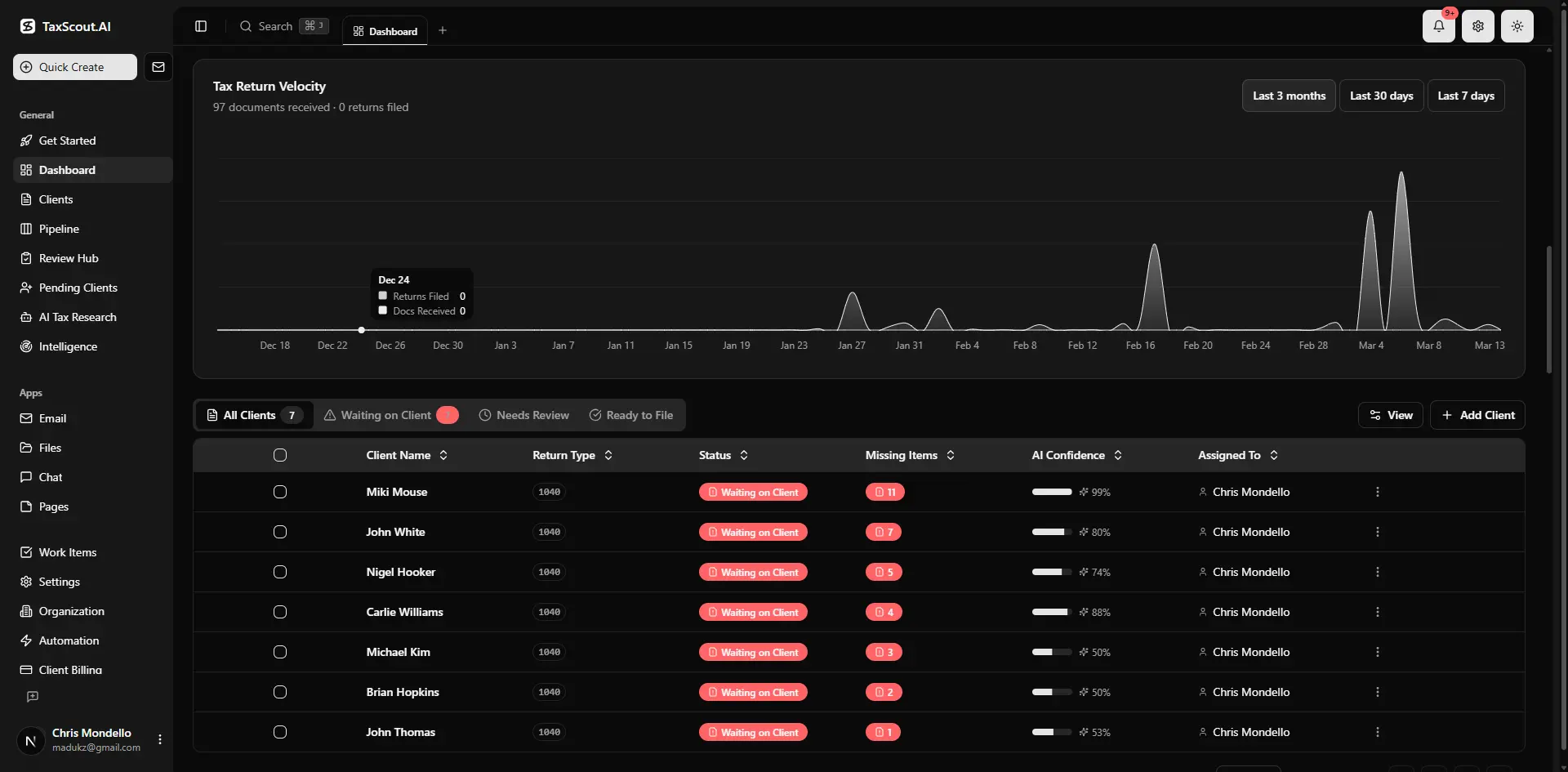
Real-time dashboard showing returns in progress, revenue, and upcoming deadlines
Review with AI assist — AI agents answer questions with full client context
How to Start a CAS Practice: A Transition Checklist for One Legacy Compliance Client
Every CAS practice starts the same way: one client. The fastest path to a successful CAS launch is converting a legacy compliance client you already know well — ideally a small business owner you have been filing taxes for, whose books you understand, and who trusts your judgment. Here is the step-by-step checklist no competitor piece includes.
Step 1: Assess the client's current financial operations. Before pricing anything, understand what exists. Do they have a cloud accounting platform? Who does the bookkeeping? How often do they look at a P&L? A 30-minute discovery call with a structured intake checklist (see our new accounting client checklist guide) surfaces scope, complexity, and pain points in one conversation.
Step 2: Define the service scope and select a pricing tier. Map the client's needs to your three tiers. Most legacy compliance clients who are sole proprietors or S-corps with one to five employees will start at the Starter or Core CAS tier ($500–$2,000/month). Write a specific service schedule: exactly which reports you will produce, at what frequency, and what is explicitly excluded.
Step 3: Draft and execute the engagement letter. A CAS engagement letter must be more detailed than a tax engagement letter. It should specify: deliverables and cadence, the client's data delivery obligations and deadlines, what happens when data arrives late, the change order process, billing terms, and termination provisions. Use e-signatures so the letter is executed before any work begins. Treasury regulations and IRS guidance on practitioner standards both underscore the importance of written engagement agreements.
Step 4: Set up the client in your practice management system. Create the client record, configure the monthly pipeline stages, and assign team members. In TaxScout, this also means establishing the client context in the AI memory — entity structure, prior-year financials, any known issues — so every future interaction starts with full context rather than a cold search.
Step 5: Migrate document collection to the portal. Ask the client to upload their first month's documents through the client portal rather than emailing them. This is a low-friction ask that immediately establishes the new working rhythm. Set up automated reminders so the portal nudges the client if documents have not arrived by the fifth business day of the month.
Step 6: Run the first month-end close as a template. Document every step you take — reconciliation sequence, exception notes, report format, commentary structure. This template becomes your firm's CAS playbook for that client tier, and eventually for every client at that tier. The workflow management investment you make on client one pays forward to clients two through twenty.
Step 7: Deliver the first report with a live walkthrough call. The first CAS report delivery is a trust-building moment. Walk the client through the numbers, highlight two or three insights they could not have seen without the analysis, and ask what questions they have been unable to answer about their business. The answers will tell you whether they are a candidate for an upgrade to the controller or CFO tier — and they will deepen the relationship in a way a tax return delivery never does.
Building Predictable Revenue and Delivery With CAS
The core promise of CAS accounting — the one that justifies the investment in systems and training — is predictable revenue. A 10-client CAS book at $1,500/month average is $180,000 in annual recurring revenue that arrives whether April 15 is busy or not. That revenue stability is what allows firm owners to hire ahead of demand, invest in technology, and stop the feast-or-famine cycle that dominates compliance-only practices.
But predictable revenue requires predictable delivery. If your CAS workflow depends on a specific person remembering to do something, it is not predictable — it is fragile. The firms earning strong margins on CAS are the ones who have systematized every repeatable step: document collection runs through the portal, extraction runs through AI, pipeline stages advance automatically, invoices go out on schedule, and the human professional's attention is reserved for judgment and client communication.
TaxScout's pipeline management supports 12 customizable stages with drag-and-drop kanban across your entire client roster. Combined with the communication hub for client-facing messages and the AI research agents for advisory-tier questions, the platform is designed specifically for the workflow that CAS requires. Because TaxScout is priced at a flat fee — $149/month for the Firm plan, unlimited team members, 500 return credits per term — adding a CAS team member does not increase your software cost the way per-user platforms do. For comparison, Canopy lists $74/user/mo billed annually, as of 2026-11-22, and Karbon lists $59/user/mo billed annually, as of 2026-11-22. At a five-person CAS team, those per-user fees add up fast.
If you are earlier in your practice-building journey, the how to start an accounting firm guide covers entity formation, licensing, and initial client acquisition in detail — a useful complement to the CAS-specific advice here. And if you are concerned about how AI tools fit into this workflow, our AI adoption guide for CPA firms addresses the stall points that prevent most firms from capturing the efficiency gains they were promised.
Ready to price your CAS engagements with confidence and deliver them without the chaos?
TaxScout gives your CAS practice AI document processing, a branded client portal, automated invoicing, and flat-fee pricing with no per-user surprises — everything you need to build predictable revenue.

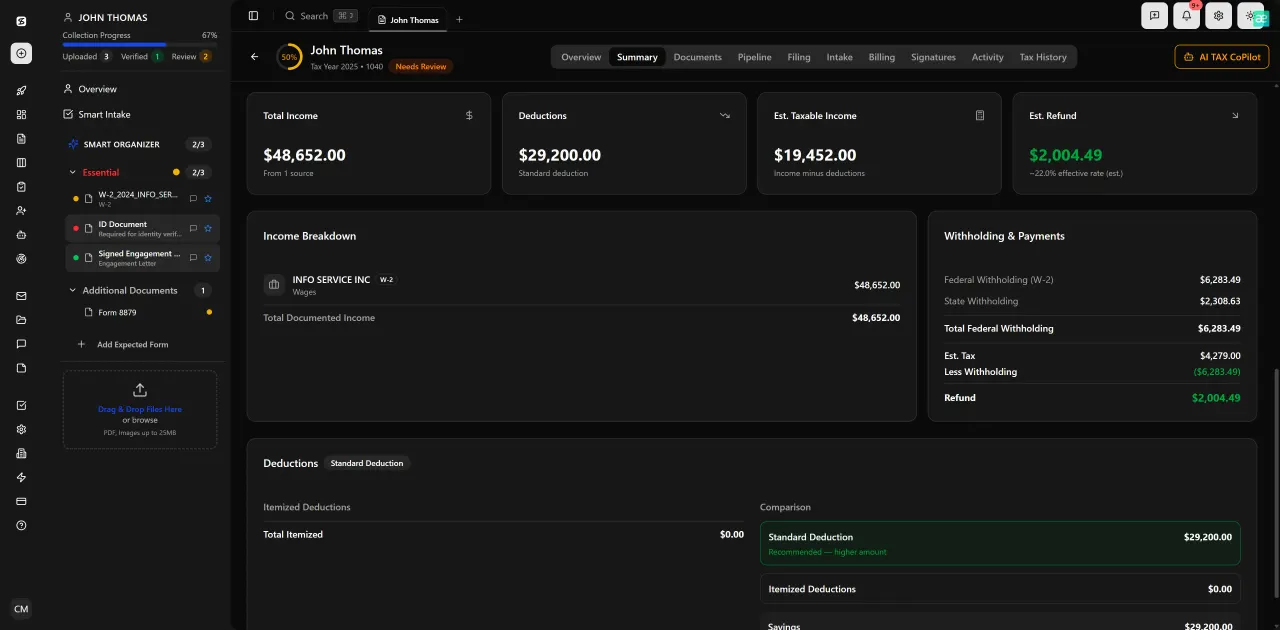
Every client gets organized documents, status tracking, and a complete history
Sources
- Journal of Accountancy: Client Accounting and Advisory Services
- IRS: About Form 941, Employer's Quarterly Federal Tax Return
- IRS: Circular 230 — Tax Professionals
- Bureau of Labor Statistics: Accountants and Auditors Occupational Outlook
- US Treasury: Tax Policy
Ready to see the difference? TaxScout gives your firm AI extraction, 5-layer validation, and complete practice management — on flat firm pricing with unlimited team members. → Book a 15-Min Demo — See It Live
Frequently Asked Questions
CAS stands for Client Accounting Services or Client Advisory Services — the terms are used interchangeably. It refers to a recurring-engagement model in which a CPA firm provides ongoing bookkeeping, financial reporting, controller-level analysis, payroll, and business advisory work to small and mid-size business clients, rather than one-time annual compliance filings.
Stay up to date
Get the latest tax tech insights delivered to your inbox.