How to Start an Accounting Firm: The Data-Backed Guide for CPAs and EAs
Most guides on how to start an accounting firm cover the same seven generic steps. This one goes further: real competition density data from 69,088 listed preparers, IRS PTIN market context, state-by-state saturation signals, and an honest accounting firm startup checklist built for CPAs and EAs…
If you search for how to start an accounting firm, you will find dozens of articles telling you to write a business plan, pick an entity structure, and 'choose your software wisely.' That advice is not wrong — but it skips the question most prospective firm owners actually ask first: Is there room for me in this market? Before you file your LLC paperwork or sign a lease, you need to know how many CPAs and EAs are already competing for the clients you want, what those competitors are charging, and whether your target geography is saturated or underserved.
The TaxScout preparer directory lists 69,088 US tax preparers matched against the IRS federal preparer directory. Of those, 32,239 hold CPA credentials and 11,112 are enrolled agents. That dataset gives prospective firm founders something no generic how-to guide can: a live snapshot of local supply before they invest in entity formation, licensing, and marketing. This guide walks through every standard step — entity choice, licensing for CPAs vs. EAs, Circular 230 obligations, niche selection, tech stack, pricing, and first-client acquisition — and layers real market intelligence on top of each one. Understanding the competitive landscape is one of the first steps when researching how to start an accounting firm in a specific market.
Whether you are a solo practitioner spinning out of a Big Four regional firm or an EA building a niche bookkeeping-plus-tax practice from scratch, the decisions you make in the first 90 days shape your pricing power and client mix for years. Use this guide alongside other guide resources to build a foundation that holds up under the pressure of your first busy season. Knowing how to start an accounting firm the right way means recognizing that early structural decisions have lasting consequences on growth and profitability.
Understanding the Market Before You Open an Accounting Practice
The IRS Preparer Tax Identification Number (PTIN) program requires virtually every paid preparer to hold a valid PTIN. The IRS publishes aggregate PTIN counts each filing season, which means you can estimate total national supply. But national figures obscure the local reality that matters for your practice. Anyone figuring out how to start an accounting firm should treat PTIN registration as one of the earliest non-negotiable compliance steps.
The TaxScout directory (data as of 2026-11-16, source: taxscout.ai/cpa) shows 69,088 listed preparers across the United States. Within that pool, 32,239 are CPAs — roughly 46.7% of all listed preparers — and 11,112 are enrolled agents. The remaining preparers hold PTINs only or carry state-only credentials such as an Oregon Licensed Tax Consultant or California CTEC registration. This distribution matters for two reasons: CPAs and EAs face different licensing costs and ongoing CE requirements, and their client bases overlap only partially. For firms evaluating their how to start an accounting firm approach, this trade-off compounds over time.
Before you open an accounting practice, run a simple density check. Pull your target metro or zip code range in the directory, count the credentialed preparers, and divide by the local population of small-business owners and individual filers. Markets where the ratio of CPAs per 10,000 tax-filing households is high — think Manhattan, San Francisco, or the northern suburbs of Chicago — will compress your pricing power and lengthen your client-acquisition runway. Markets where that ratio is lower often reward niche specialization because the generalist competition is thin. The Bureau of Labor Statistics Occupational Outlook for Accountants also shows projected growth rates by region if you want a forward-looking layer on top of current supply data. Each of these factors directly shapes how how to start an accounting firm plays out in practice.
This competitive intelligence step is what none of the standard accounting firm startup checklists include. Canopy, Financial Cents, and Jetpack Workflow all skip straight to entity formation. Starting with market data means your entity choice, your niche, and your pricing are calibrated to actual local conditions — not to a generic national template. Understanding how to start an accounting firm in this context is what separates firms that scale from those that stall.
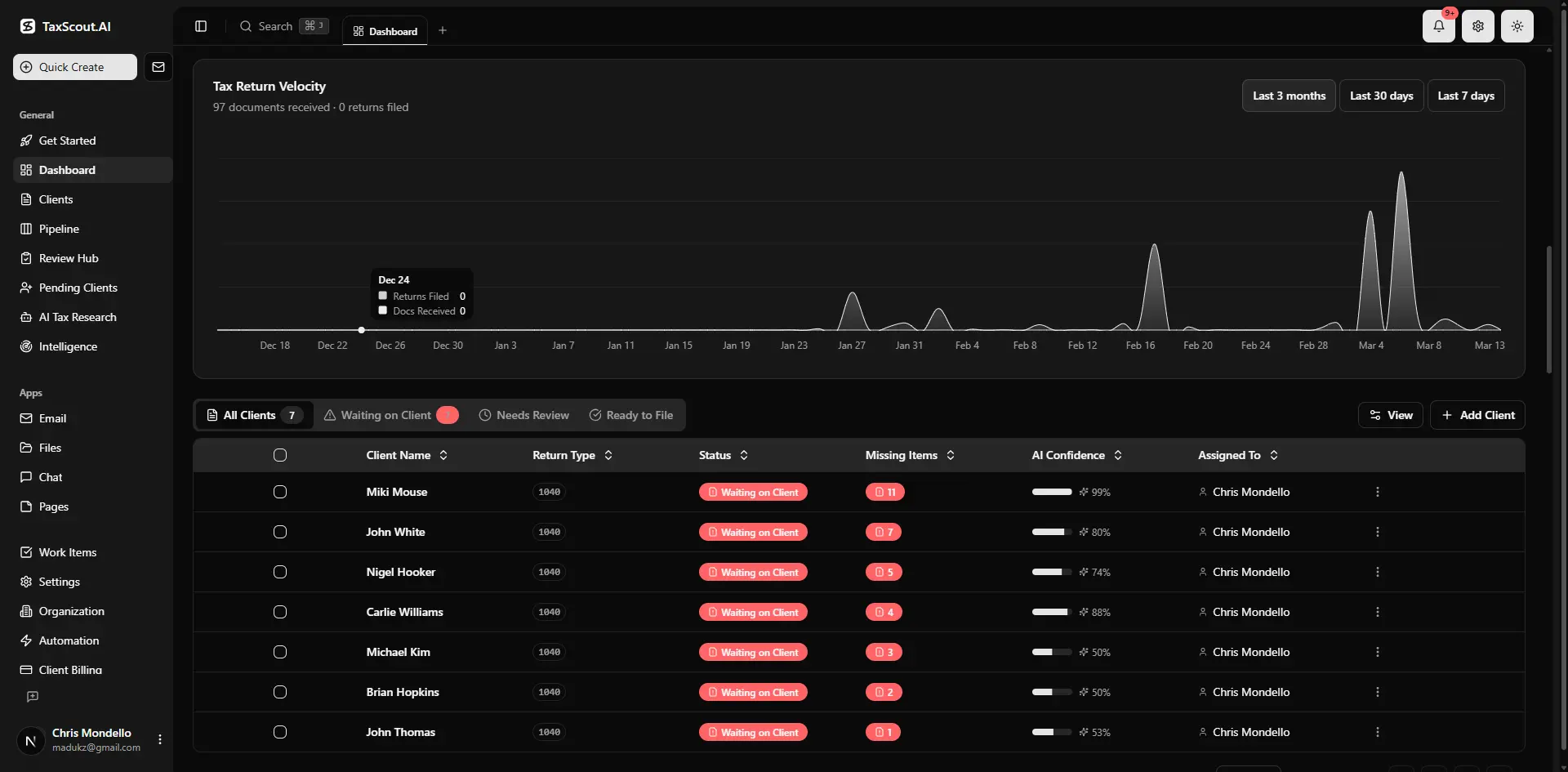
Real-time dashboard showing returns in progress, revenue, and upcoming deadlines
Choosing Your Entity Structure and Registering the Business
Most solo practitioners start as a single-member LLC because it separates personal and business liability while allowing pass-through taxation. If you plan to bring on partners quickly, a multi-member LLC or a professional corporation (PC) may be more appropriate — and many states require a PC or PLLC specifically for licensed CPAs. Check your state CPA society's guidance; for example, the California Society of CPAs publishes entity requirements for licensed practitioners that differ from general LLC rules. This is precisely where a deliberate how to start an accounting firm strategy pays off — founders who research entity requirements before filing avoid costly restructuring later.
The tax treatment of your entity interacts with your personal tax situation. Under current law, the 20% qualified business income deduction under IRC §199A is permanent following P.L. 119-21 (signed July 4, 2025) — it did not sunset after 2025. Accounting and tax services are generally specified service trades or businesses (SSTBs), which means the deduction phases out above the applicable threshold. Consulting a tax attorney or colleague before you finalize your entity structure is not optional; it is part of the CPA firm setup process. How to start an accounting firm sits at the center of this decision — get it wrong and the rest unravels.
Register your entity with your state's secretary of state, obtain a federal EIN from the IRS EIN application portal, and open a dedicated business checking account before you invoice your first client. Commingling funds is the fastest way to lose the liability protection your LLC provides. When firms revisit their how to start an accounting firm priorities, the gaps usually surface here.
If you are naming a firm after yourself, confirm that your state board of accountancy permits descriptive trade names. Some states restrict terms like 'and Associates' unless you actually have associates. These rules are administrative nuisances, but violating them can jeopardize your license.
Tired of juggling entity paperwork and software research at the same time?
TaxScout gives new accounting firms a full practice management platform — AI document extraction, client portal, e-signatures, and pipeline management — at a flat monthly rate with unlimited team members and no per-user fees.
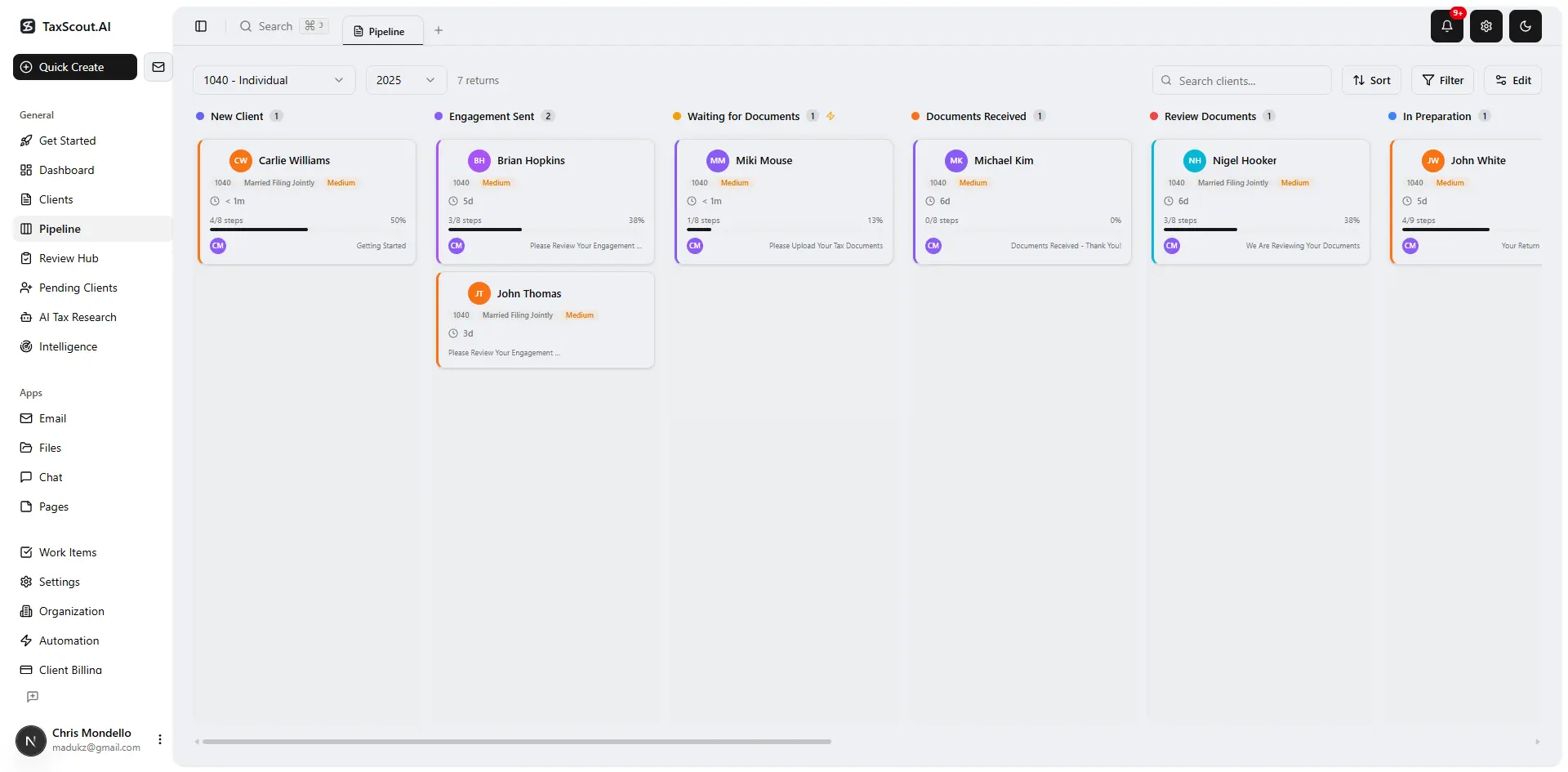
Track every return from intake to filed with drag-and-drop pipeline management
Licensing Requirements for CPAs and EAs Starting a Firm
CPA licensing is state-governed. You must hold an active CPA license in the state where you practice, or in a state with reciprocity if you operate across state lines. The Uniform CPA Exam administered by NASBA and the AICPA is the entry gate, but each state board sets its own experience and education requirements. Most states require 150 semester hours of education. Confirm your state's continuing education (CPE) requirements — typically 40 hours per year — and track them before your first renewal. For anyone mapping out how to start an accounting firm, understanding these licensing timelines early prevents frustrating delays between passing the exam and opening your doors.
Enrolled agents are licensed directly by the IRS rather than by individual states. To become an EA, you must pass the IRS Special Enrollment Examination (SEE) or have worked for the IRS for five years in a position requiring knowledge of the tax code. EAs must complete 72 hours of continuing education every three years, with at least 16 hours per year including 2 hours of ethics. Because EA status is federal, you can represent clients in any state — a significant advantage for a virtual accounting firm startup.
Both CPAs and EAs operating as paid preparers are subject to IRS Circular 230, which governs standards of practice before the IRS. Key obligations include the duty of competence, restrictions on contingent fees for original returns, and rules around written tax advice. Circular 230 violations can result in suspension or disbarment from practice before the IRS — which effectively ends your firm. Read Part 10 of the Treasury Regulations before you take your first client.
If you plan to offer audit or attest services, you need an active CPA license and must comply with peer review requirements under your state board. Enrolled agents cannot perform attest work. Many solo practitioners intentionally limit their scope to tax preparation, planning, and bookkeeping to avoid the peer review overhead, at least in the early years.
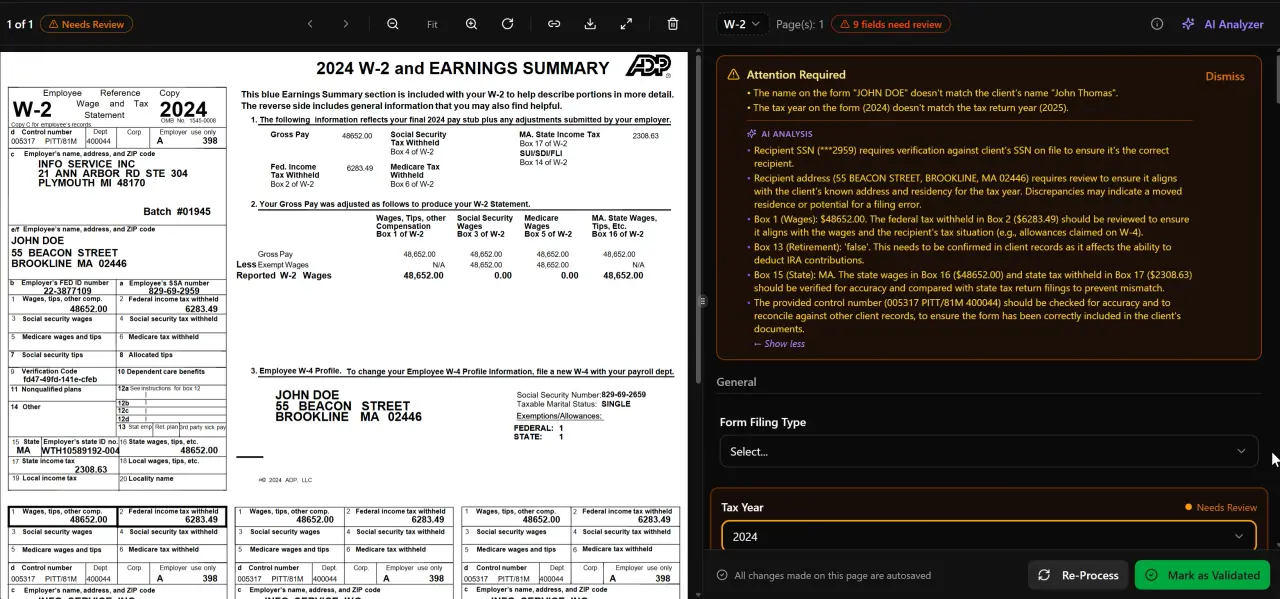
AI classifies, extracts, and validates every document automatically
Accounting Firm Niche Selection: Where the Data Points
Niche selection is the highest-leverage decision in your first year. A generalist firm competing against 32,239 CPAs nationally is invisible. A firm specializing in tax planning for real estate investors in Phoenix, or international tax for tech employees receiving RSUs, or S-corp optimization for medical practices in a mid-size metro, can charge 30–50% more and close clients faster because the value proposition is specific. Practitioners who have done their homework on how to start an accounting firm recognize that choosing the right niche early is what allows a small firm to command premium fees from day one.
The TaxScout directory data (69,088 preparers as of 2026-11-16) gives you a proxy for niche saturation: search for preparers who explicitly list specializations in your target area. If you find dozens of CPAs advertising themselves as real estate tax specialists in your metro, that niche is contested. If you find three, there may be an underserved pocket of demand. Combine that signal with IRS Statistics of Income data from IRS SOI Tax Stats to estimate the volume of returns in your target segment.
Common niches that work well for new solo practices include: small-business owners in a single industry vertical (restaurants, contractors, e-commerce sellers), high-income W-2 employees with equity compensation, real estate investors with rental portfolios, self-employed professionals (physicians, attorneys, consultants), and expatriates or foreign nationals with US filing obligations. Each niche has distinct document complexity, pricing tolerance, and referral density — factors that affect your tech stack choices as well as your marketing.
For a deeper look at how technology changes the economics of niche practices, see our post on accounting automation for CPA firms.
Smart intake auto-fills from uploaded documents and prior-year data
Accounting Firm Business Plan: The Financial Model That Actually Holds
An accounting firm business plan needs to answer one question your banker and your future self will both ask: how many clients, at what average fee, do you need to cover your fixed costs and pay yourself? Work backward from your target income. If you want $120,000 in owner distributions in year one and your fixed costs (software, insurance, office, bar dues, CPE) run $24,000, you need $144,000 in gross revenue. At an average fee of $1,200 per individual return plus advisory retainers, that is roughly 120 returns plus 10–15 retainer clients — a realistic goal for a focused solo practitioner in a medium-saturation market. This financial modeling exercise is one aspect of how to start an accounting firm that most online checklists gloss over but that experienced firm founders treat as foundational.
Build your pricing model before you build your marketing plan. The TaxScout directory shows fee ranges across active preparer profiles, which gives you a local benchmark rather than a national average. A solo CPA in rural Tennessee and a solo CPA in Palo Alto are not competing for the same clients, and their pricing should not look the same. Your accounting firm business plan should include: a 12-month cash flow projection, a break-even analysis, a pricing schedule by service type, and a client acquisition funnel with realistic conversion assumptions.
Professional liability (errors and omissions) insurance is a non-negotiable line item. Premiums for a solo practitioner typically start around $1,000–$2,000 per year for basic coverage, rising with revenue and service scope. CAMICO and Aon are common insurers for CPA firms; your state CPA society may offer group rates. Budget for it before you open, not after your first unhappy client.
Many new firm owners underestimate software costs. A complete tech stack — tax preparation software, practice management, document storage, e-signatures, billing — can easily exceed $5,000–$10,000 per year if you assemble it from separate vendors. Flat-rate platforms that bundle these functions change the unit economics significantly, especially for a solo or two-person practice. See the tech stack section below for specifics.

Click any extracted field to see its source highlighted on the original PDF
Building Your Tech Stack for a New Accounting Firm
The software layer of your CPA firm setup has four functional requirements: (1) a tax preparation engine that handles the return types you plan to file, (2) a practice management platform that tracks clients, deadlines, documents, and billing, (3) a secure client communication and document exchange channel, and (4) a research tool that keeps you current on tax law changes without requiring you to subscribe to multiple expensive services. Getting these four layers right is a core part of how to start an accounting firm that operates efficiently from the first filing season rather than patching together workflows under deadline pressure.
On the tax preparation side, TaxScout works alongside Drake, CCH Axcess, UltraTax CS, Lacerte, ProConnect, and ProSeries — so you are not forced to switch your existing preparer software. For AI document extraction, TaxScout's 5-layer validation pipeline processes W-2s, the full 1099 series, K-1s, 1098 and 1095 series, 1040 schedules, and supporting records with confidence scoring and cross-document validation. The split-screen PDF viewer lets you click any extracted field and see the source page instantly — a workflow that eliminates the manual verification pass that eats 20–30 minutes per return in traditional setups.
For client intake, TaxScout's AI intake engine is modeled on IRS Form 13614-C and uses a four-layer prefill system: document-first, prior-year, profile data, and AI gap analysis. That means your clients complete shorter questionnaires because the platform pre-populates what it already knows. For a new firm without prior-year data, the document-first layer still dramatically reduces client friction in year one.
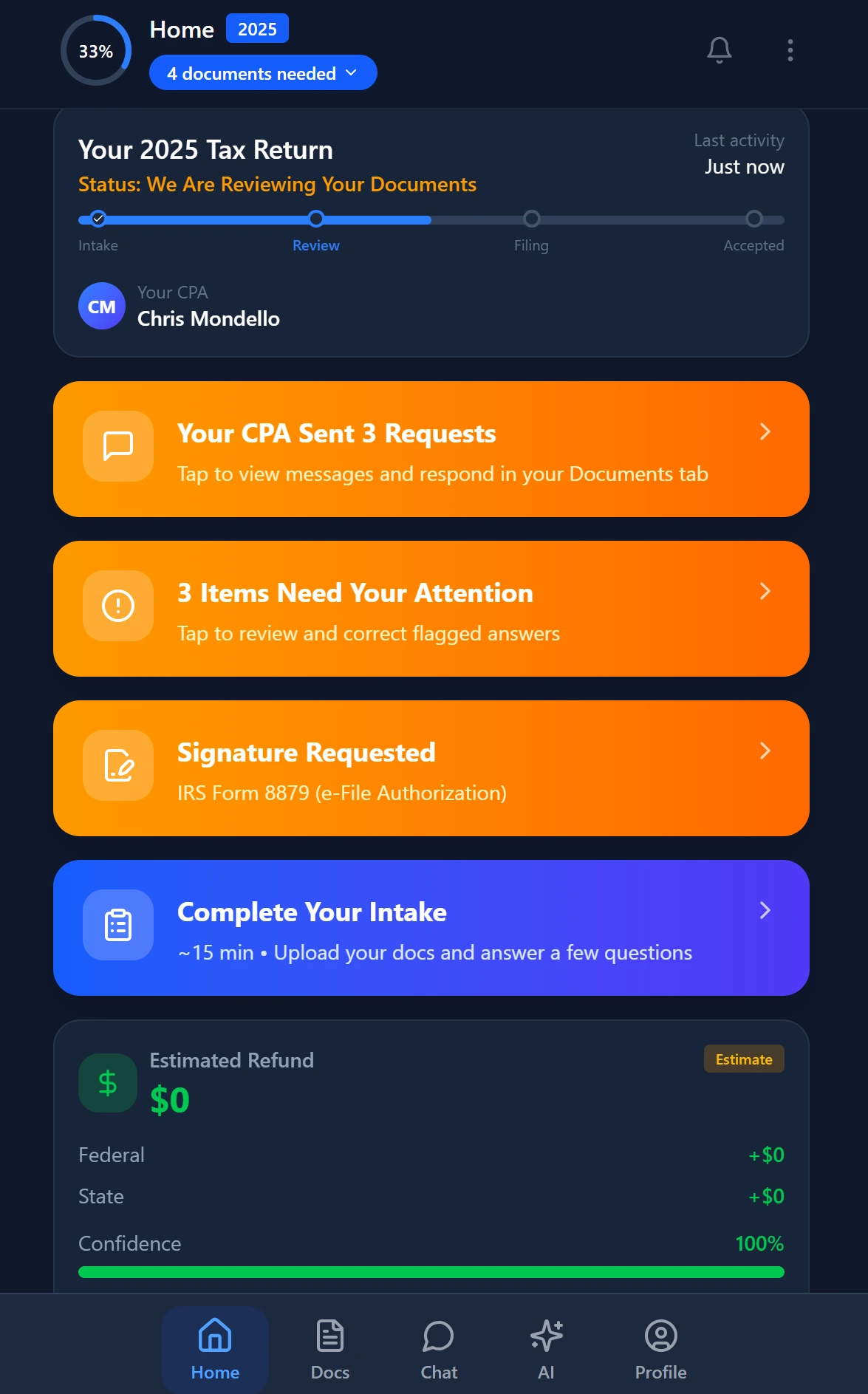
Practice management includes a 12-stage pipeline with drag-and-drop kanban, e-signatures via Documenso covering Form 8879, 4868, FBAR, engagement letters, and W-9s, and invoicing through Stripe Connect Express. The client portal uses OTP login — no passwords for clients to forget or reset — which eliminates one of the most common sources of client friction during tax season. The 9 specialized AI research agents search IRS, Treasury, Cornell Law, SSA, and Congress in real time, giving a solo practitioner research depth that previously required a subscription to a large professional library service.
Pricing for TaxScout Solo is $49/month with no commitment (or $470/year prepaid) for 150 return credits per term, unlimited team members, AI extraction, and an AI assistant. TaxScout Firm is $149/month (or $1,430/year prepaid) for 500 return credits, all 9 AI Research Agents, and the full PDF toolbox. Neither plan charges per-user fees — so adding a staff preparer or a part-time admin does not increase your monthly bill. Compare that to Karbon, which lists $59/user/mo billed annually as of 2026-08-01, or Canopy, which lists $74/user/mo billed annually as of 2026-08-01; at two users, those platforms already exceed TaxScout Firm's annual price.
Practice management platform cost comparison for a 2-person firm (annual billing)
| Platform | Per-User Price | 2-User Annual Cost | Notes |
|---|---|---|---|
| TaxScout Solo | $49/mo flat (no per-user fee) | $588/yr total | Unlimited team members, 150 return credits |
| TaxScout Firm | $149/mo flat (no per-user fee) | $1,430/yr prepaid | Unlimited team members, 500 credits, all AI agents |
| Karbon | $59/user/mo billed annually (checked 2026-08-01) | $1,416/yr (2 users) | Practice management only; no AI extraction |
| Canopy | $74/user/mo billed annually (checked 2026-08-01) | $1,776/yr (2 users) | Tax workflow automation from $34/client/year extra |
| TaxDome | $800–$1,200/seat/yr billed annually (checked 2026-07-31) | $1,600–$2,400/yr (2 users) | Essentials plan limited to 1 team member |
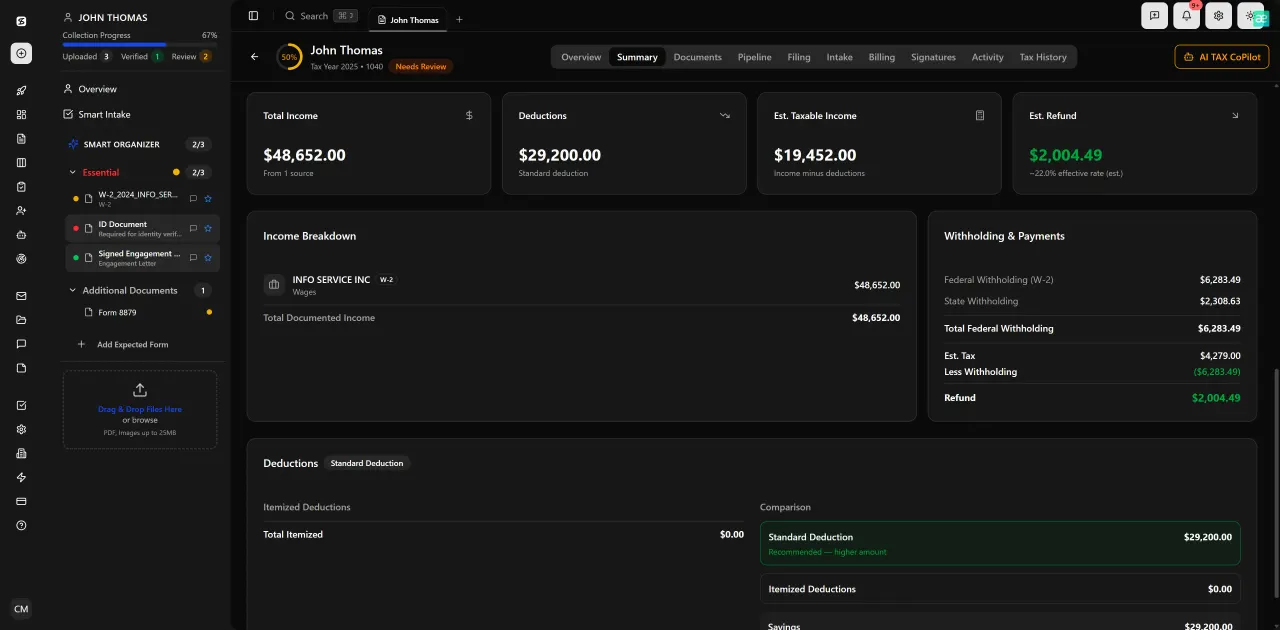
Review with AI assist — 9 agents answer questions with full client context
Accounting Firm Pricing: Setting Fees That Reflect Your Market
New firm owners almost always underprice. The three primary pricing models are flat fee per engagement, hourly billing, and retainer (subscription). Each has a different risk profile and client experience implication. For a detailed breakdown of fee architecture, see the three-tier pricing architecture glossary entry and the value-based pricing entry.
Flat-fee pricing is the dominant model for individual returns and small-business tax preparation because it removes the client's anxiety about meter-running and forces you to price based on complexity — which is ultimately what drives your time. A simple W-2 return with standard deductions takes 45 minutes; a Schedule C with home office, vehicle mileage, and a mix of 1099-NEC and 1099-K inputs takes three hours. Pricing those identically is a revenue leak. Build a fee schedule with tiers: base 1040, 1040 with one Schedule C, 1040 with multiple business entities, and so on.
Hourly billing remains appropriate for advisory work, IRS representation, and projects where scope is genuinely uncertain. Document your hourly rate in your engagement letter — typically $150–$350 for a solo CPA depending on market, complexity, and specialty — and require a retainer deposit before beginning hourly work.
Retainer models work best for clients who need ongoing bookkeeping, payroll processing, or monthly CFO-style advisory. A retainer of $400–$1,500 per month per client, billed automatically through Stripe, creates predictable cash flow that reduces the seasonal revenue volatility that burns out most new firm owners by year three. For more on this topic, see CRM for accountants and how recurring client relationships compound over time.
Whatever model you choose, publish your engagement letter terms clearly and obtain a signed copy before you receive any client documents. TaxScout's e-signature integration handles this at intake — the client signs the engagement letter in the same portal session where they upload their W-2s.

Your clients see your brand — OTP login, document upload, and real-time status
Client Acquisition for a New Accounting Firm
Your first ten clients will almost certainly come from your personal network — former colleagues, friends who have been using a franchise preparer, small-business owners you meet through local chambers of commerce or industry associations. This is not a scalable channel, but it is the fastest way to generate revenue and collect the testimonials you need to build credibility. Most practitioners who have researched how to start an accounting firm find that personal network outreach in the first 60 days outperforms any paid marketing channel by a wide margin.
After the first ten, referral networks and digital presence take over. The two channels with the highest ROI for a solo or two-person practice are: (1) Google Business Profile optimization for local search terms like 'CPA near me' or 'tax preparer for real estate investors [city]', and (2) active participation in professional associations and industry-specific forums where your target clients congregate. For a real estate niche, that might be a local landlord association. For tech-sector W-2 employees, it might be an online forum for RSU and equity compensation questions.
The TaxScout CPA landing page feature gives your firm a branded public profile that appears in directory searches by prospective clients. With 69,088 preparers listed in the directory, having a complete, optimized profile — credentials verified, specializations listed, reviews populated — meaningfully improves your discovery rate compared to a bare-bones listing.
Referral programs formalized through your practice management platform extend your reach without requiring ongoing marketing spend. TaxScout's referral program feature lets you systematize client referrals so they generate a predictable flow rather than sporadic one-offs. Even a modest rate of one referred client per existing client per year doubles your book in a few seasons.
For AI-driven firms specifically, AI adoption at CPA firms documents how practices using AI-assisted intake and document processing close clients faster because the onboarding experience is visibly different from a paper-and-email workflow.

Every client gets organized documents, status tracking, and a complete history
Circular 230, Data Security, and Staying Compliant While Growing
Circular 230 compliance is not a one-time checklist item — it is an ongoing obligation that shapes how you communicate with clients and how you document your work. The key areas for a new firm: due diligence requirements before signing a return, restrictions on preparing returns with positions that lack a reasonable basis, and rules around written advice to clients on significant tax matters. The IRS Office of Professional Responsibility publishes guidance at irs.gov/tax-professionals and enforces Circular 230 through practitioner censure, suspension, and disbarment proceedings. Understanding these requirements is a non-negotiable component of how to start an accounting firm that remains in good standing with regulators through its growth phases.
Data security is inseparable from professional responsibility. The IRS requires paid preparers to maintain a Written Information Security Plan (WISP) under the Gramm-Leach-Bliley Act's Safeguards Rule. The FTC updated the Safeguards Rule requirements, and IRS Publication 4557 provides a simplified WISP template for smaller firms. Having a WISP is not optional — the IRS has begun asking about it in preparer compliance visits.
TaxScout's security architecture includes encryption in transit and at rest, role-based access control with MFA, and data-subject deletion support. For a new firm, this means your compliance posture on data security is built in from day one rather than patched on after a client complaint. Full details are at /security.
As your practice grows and you add staff, role-based access becomes critical. A preparer should not have access to billing data; a front-desk coordinator should not be able to modify a completed return. Setting these permissions correctly in your practice management platform before you hire your first part-time assistant saves significant cleanup work later.
Ready to open your accounting practice with a tech stack built for the way CPAs actually work?
TaxScout gives new and growing firms AI document processing, a branded client portal, e-signatures, pipeline management, and 9 AI research agents — all at a flat monthly rate with no per-user fees and unlimited team members.
Frequently Asked Questions
Startup costs for a solo accounting firm typically range from $5,000 to $20,000 in the first year, depending on your state's licensing fees, professional liability insurance premiums (often $1,000–$2,000 for a solo practice), office setup, and software. Practice management platforms like TaxScout charge a flat monthly fee with no per-user fees — $49/month for Solo or $149/month for Firm — which keeps tech costs predictable as you grow.
Keep reading
Estate Tax Planning for CPAs: Guiding Clients Under the $15 Million Exemption
Jul 27, 2026 · 1 min read
CPA Adding RIA: How to Register an Investment Advisory Practice Alongside Your Tax Firm
Jul 17, 2026 · 1 min read
Late Filing Penalty Relief: How CPAs Reduce or Eliminate IRS Failure-to-File Charges
Oct 12, 2026 · 1 min read
Stay up to date
Get the latest tax tech insights delivered to your inbox.