Outsourced CFO Pricing: What CPAs Charge and Why
Outsourced CFO pricing remains one of the least-standardized service lines in public accounting, with rates that vary wildly depending on client revenue, engagement scope, and delivery model. This guide cuts through the confusion with real rate benchmarks segmented by client size, a clear…
Outsourced CFO pricing is one of the murkiest topics in CPA firm strategy — and that ambiguity costs firms real money. When a prospect asks 'what do you charge for CFO services?' and you hesitate, you've already lost negotiating leverage. Yet most published guidance conflates outsourced CFO services with virtual bookkeeping, controller work, or generic advisory retainers, leaving CPAs without the hard benchmarks they need to price confidently.
The outsourced CFO label carries a specific meaning in the market: strategic financial leadership delivered on a fractional or retainer basis for companies that aren't ready to hire a full-time CFO. According to the U.S. Bureau of Labor Statistics, the median annual wage for chief financial officers exceeds $200,000 — which means even a mid-market business paying a CPA $4,000 a month for outsourced CFO services is getting significant value relative to the alternative. That gap is your pricing anchor. Understanding outsourced CFO pricing starts with recognizing what the service actually includes: strategic financial leadership delivered on a fractional or retainer basis for companies that aren't ready to hire a full-time CFO.
This guide covers the mechanics of outsourced CFO pricing in detail: the three dominant fee structures, rate benchmarks broken down by client revenue band, how to frame pricing in proposals versus service agreements, and how AI-assisted delivery tools let a single CPA carry a larger book of outsourced CFO clients at healthy margins.
The Three Outsourced CFO Pricing Models
Most CPA firms settle into one of three outsourced CFO pricing structures, each with distinct trade-offs for margin predictability and client perception. Understanding the mechanics of each is the first step toward choosing the right fit for your practice.
Value-based pricing is increasingly favored by advisory-forward firms because it anchors the fee to outcomes rather than hours. If your cash flow modeling surfaces a $300,000 tax deferral opportunity or your covenant monitoring prevents a loan default, the value delivered dwarfs any hourly rate. The challenge is quantifying value upfront — something that requires a thorough discovery process. For firms evaluating their outsourced CFO pricing approach, this trade-off compounds over time.
Hourly Billing
Hourly billing for outsourced CFO work typically ranges from $175 to $450 per hour depending on firm size, market, and the seniority of the CPA delivering the engagement. The lower end applies to solo practitioners in secondary markets; the upper end reflects partners at regional firms in high-cost metros. Hourly billing is common for project-based engagements — capital raise prep, lender package assembly, or one-time financial model builds — but it underperforms on recurring advisory work because clients become fee-sensitive and start rationing their access to you. Hourly billing represents one of the most transparent models in outsourced CFO pricing, typically ranging from $175 to $450 per hour depending on firm size, market, and the seniority of the CPA delivering the engagement.
Monthly Retainers
Monthly retainers are the dominant pricing model for ongoing outsourced CFO services. A defined scope — financial reporting package, cash flow forecast, KPI dashboard, lender compliance, and executive-level calls — is delivered for a flat monthly fee. This model benefits both parties: the client gets predictable budgeting and your firm gets recurring revenue that doesn't disappear at tax season. CFO retainer fees in the current market range from $1,500 per month at the entry level to over $12,000 per month for complex, multi-entity clients. The key to retainer profitability is scoping carefully and building service-level boundaries into your engagement letter. Each of these factors directly shapes how outsourced CFO pricing plays out in practice.
Value-Based Fixed Fees
Value-based pricing ties the fee to a specific financial outcome or risk mitigated. A CPA who prices an outsourced CFO engagement at $30,000 for a 12-month contract tied to a client's Series A fundraise is applying value-based logic — the client's benefit (access to capital at better terms) justifies a fee that might look expensive on an hourly basis but is a fraction of the outcome's value. According to IRS Publication 535, ordinary and necessary business expenses are deductible, which means your client is effectively paying after-tax dollars for CFO services — a fact worth including in your proposal narrative to reframe sticker shock. Understanding outsourced CFO pricing in this context is what separates firms that scale from those that stall.
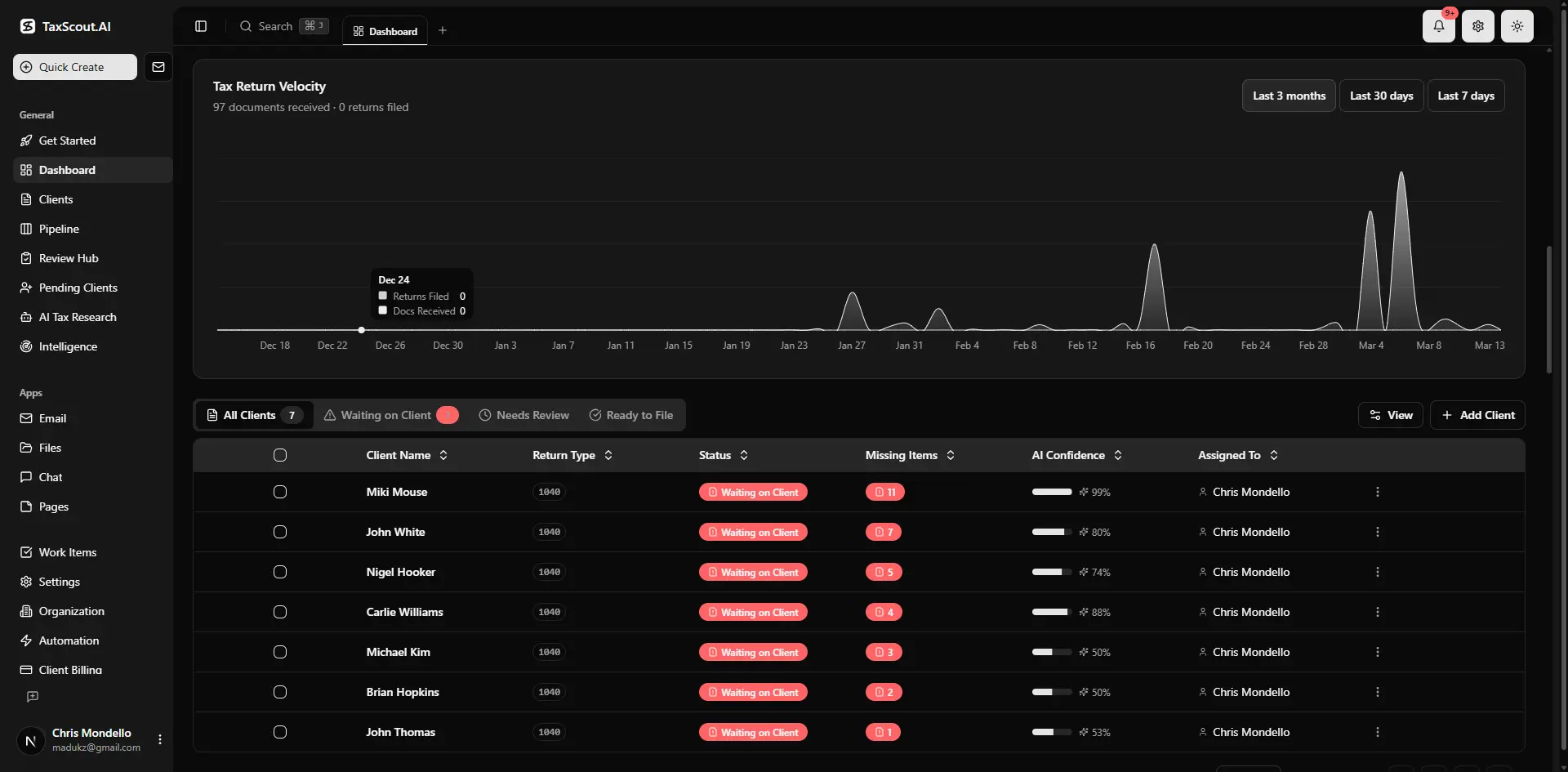
Real-time dashboard showing returns in progress, revenue, and upcoming deadlines
Outsourced CFO Rate Benchmarks by Client Revenue Band
The most practical way to set outsourced CFO pricing is to segment your rate card by client revenue. This is how experienced practitioners actually scope these engagements, and it aligns your fee with the complexity and stakes of the financial management work involved. No competitor resource currently offers this segmentation, so the benchmarks below are drawn from practitioner surveys, Journal of Accountancy advisory pricing data, and market observation.
These ranges are starting points. Adjustments are appropriate for industry complexity (manufacturing vs. professional services), transaction volume, multi-state compliance obligations, and whether the engagement includes equity or debt advisory components. For clients with pass-through entity structures or significant K-1 reporting, scope creep is common — build buffers into the initial retainer or use a tiered overage clause. This is precisely where a deliberate outsourced CFO pricing strategy pays off.
Sub-$1M Revenue: Fractional CFO for Small Business
Fractional CFO for small business clients — typically sub-$1M in annual revenue — is the entry point for this service line. At this size, the engagement is usually four to eight hours per month: a monthly close review, a simple rolling 13-week cash forecast, one executive call, and occasional lender or investor correspondence. Market rates for this tier run $1,500 to $3,000 per month. Some firms deliver this scope at a lower price as a loss leader to build a pipeline toward tax and compliance work, but that approach erodes the perceived value of CFO services. Price to the outcome, not the hours.
$1M to $5M Revenue: Core CFO Retainer Range
The $1M–$5M revenue band is where outsourced CFO engagements become genuinely profitable for CPA firms. Clients at this size typically need a monthly financial reporting package, variance analysis against budget, cash flow management, banking relationship support, and 8–12 hours of strategic time per month. CFO retainer fees for this tier generally range from $3,000 to $6,500 per month. The engagement often expands around year-end or during capital events, so building a scope-expansion clause into your service agreement protects margin when deliverables spike.
$5M to $20M Revenue: Full Scope CFO Advisory
Clients between $5M and $20M in revenue require deeper financial infrastructure: department-level budget management, lender covenant monitoring, scenario modeling, board-ready reporting, and often oversight of an internal accounting team. This tier commands $6,000 to $12,000 per month or more. At this revenue level, clients are comparing your retainer to the loaded cost of a full-time CFO (salary plus benefits plus equity), which typically exceeds $250,000 annually. The Small Business Administration reinforces the value of professional financial management for scaling businesses — use that framing in your discovery conversations. Your $8,500-per-month retainer is less than half the cost of the alternative.
Tired of pricing outsourced CFO engagements from gut instinct and hoping the client says yes?
TaxScout.ai gives CPA firms the AI-assisted financial workflow tools to deliver high-margin advisory services at scale — from automated reporting to client-context AI memory that makes every CFO call sharper.
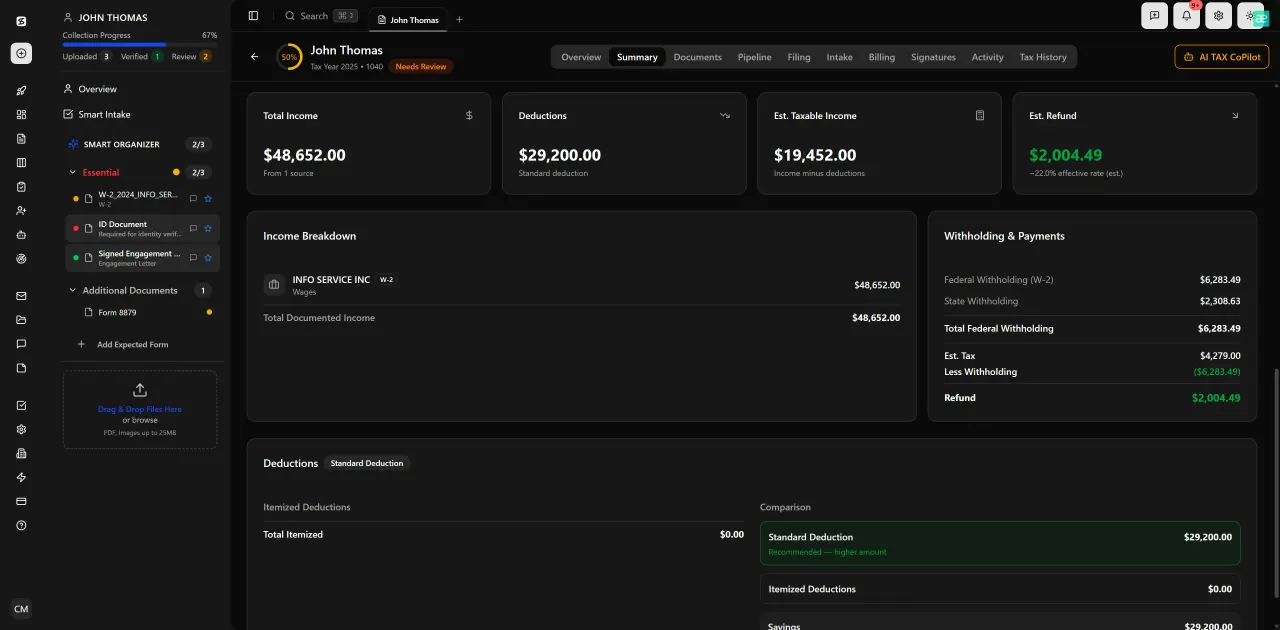
Review with AI assist — 9 agents answer questions with full client context

Click any extracted field to see its source highlighted on the original PDF
How to Present Outsourced CFO Pricing to Reduce Sticker Shock
The gap between quoting outsourced CFO pricing and closing the engagement often comes down to presentation, not the number itself. Clients who receive a proposal showing '$6,000/month' with no context reject it far more often than clients who receive a structured value narrative explaining what that investment replaces and produces.
Structure your proposal in three layers. First, establish the problem cost: quantify what poor financial visibility or the absence of a CFO has already cost the client — missed line of credit, overpaid taxes, or misread margin on a product line. Second, anchor to the alternative: reference the fully loaded cost of a W-2 CFO and note that your engagement delivers strategic financial leadership at 30–50% of that cost with no benefits overhead. Third, present the fee as a monthly investment with a defined deliverable list, not as a time-based bill. This framing connects directly to value-based pricing principles and removes the mental math of 'how many hours is that?'
On the service agreement side, separate the engagement letter from the pricing exhibit. The engagement letter defines the professional relationship and scope boundaries — reference your engagement letter template for CPA best practices. The pricing exhibit is a clean one-page schedule of services, monthly fee, and what triggers a scope expansion conversation. Clients find this structure cleaner than a combined document, and it makes annual fee increases easier to introduce because you're amending only the pricing exhibit.
Consider using your client portal to deliver the proposal digitally — this lets clients review it at their own pace, request clarifications via message, and e-sign the engagement letter without a follow-up call. Firms that use e-signatures for CFO engagement letters report faster close cycles because the signature step no longer requires scheduling coordination.
Expanding Margins Through AI-Assisted CFO Delivery
The traditional constraint on outsourced CFO capacity is CPA time. A senior CPA can realistically manage 8–12 active outsourced CFO clients before quality degrades — the monthly close reviews, forecast updates, and client calls consume most of their available hours. AI-assisted delivery changes that math materially.
Document extraction is the most immediate margin lever. A large portion of CFO engagement time is spent pulling numbers from source documents — bank statements, credit card feeds, payroll summaries, vendor invoices — and reconciling them into reporting packages. AI document extraction automates the intake and classification of these documents, reducing the time-per-client on data assembly from hours to minutes. TaxScout's extraction engine handles 180+ document types with a 5-layer validation pipeline including OCR cross-verification and 15 deterministic math rules, so the numbers arrive pre-validated rather than requiring manual checking. For a deeper look at how this works technically, the complete guide to AI document extraction for CPAs covers the architecture in detail.
Research and regulatory monitoring is another significant time drain in CFO engagements. Staying current on treasury.gov guidance, interest rate movements, banking covenant norms, and industry benchmarking data is essential for credible CFO advisory but is difficult to systematize manually. TaxScout's 9 specialized AI research agents run real-time searches across IRS, Treasury, Cornell Law, SSA, and congressional sources — surfacing relevant updates without the CPA spending hours on agency websites.
The compounding effect: a CPA who previously managed 8 outsourced CFO clients at an average $4,500/month retainer grossed $36,000/month from that service line. With AI-assisted document assembly and research reducing per-client hours by 30–40%, the same CPA can carry 11–12 clients at the same retainer — pushing gross revenue to $49,500–$54,000/month with no additional headcount. That margin expansion is the real business case for investing in AI-native practice management. See our accounting firm capacity planning guide for a full framework on applying this logic to your staffing model.
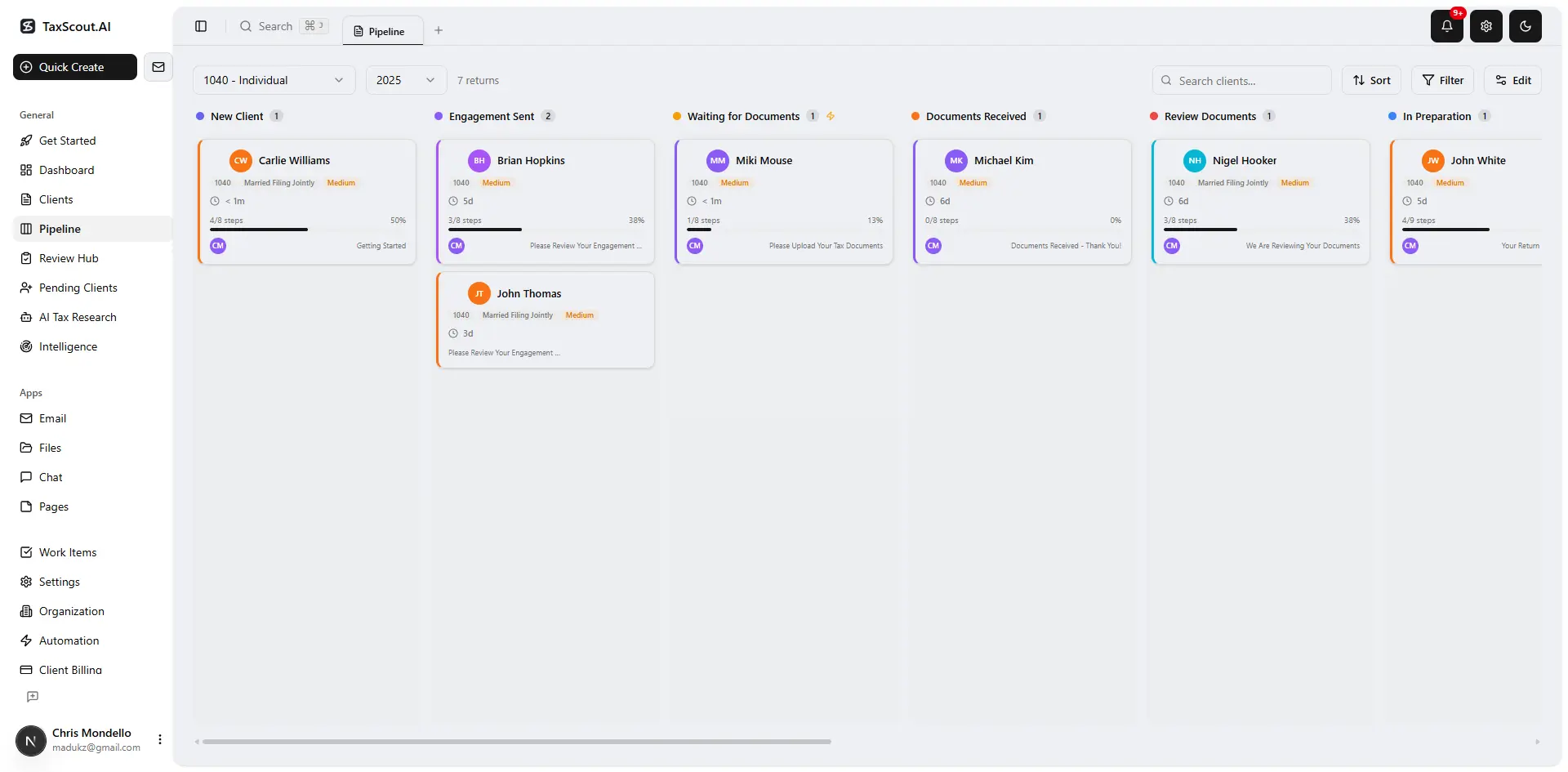
Track every return from intake to filed with drag-and-drop pipeline management
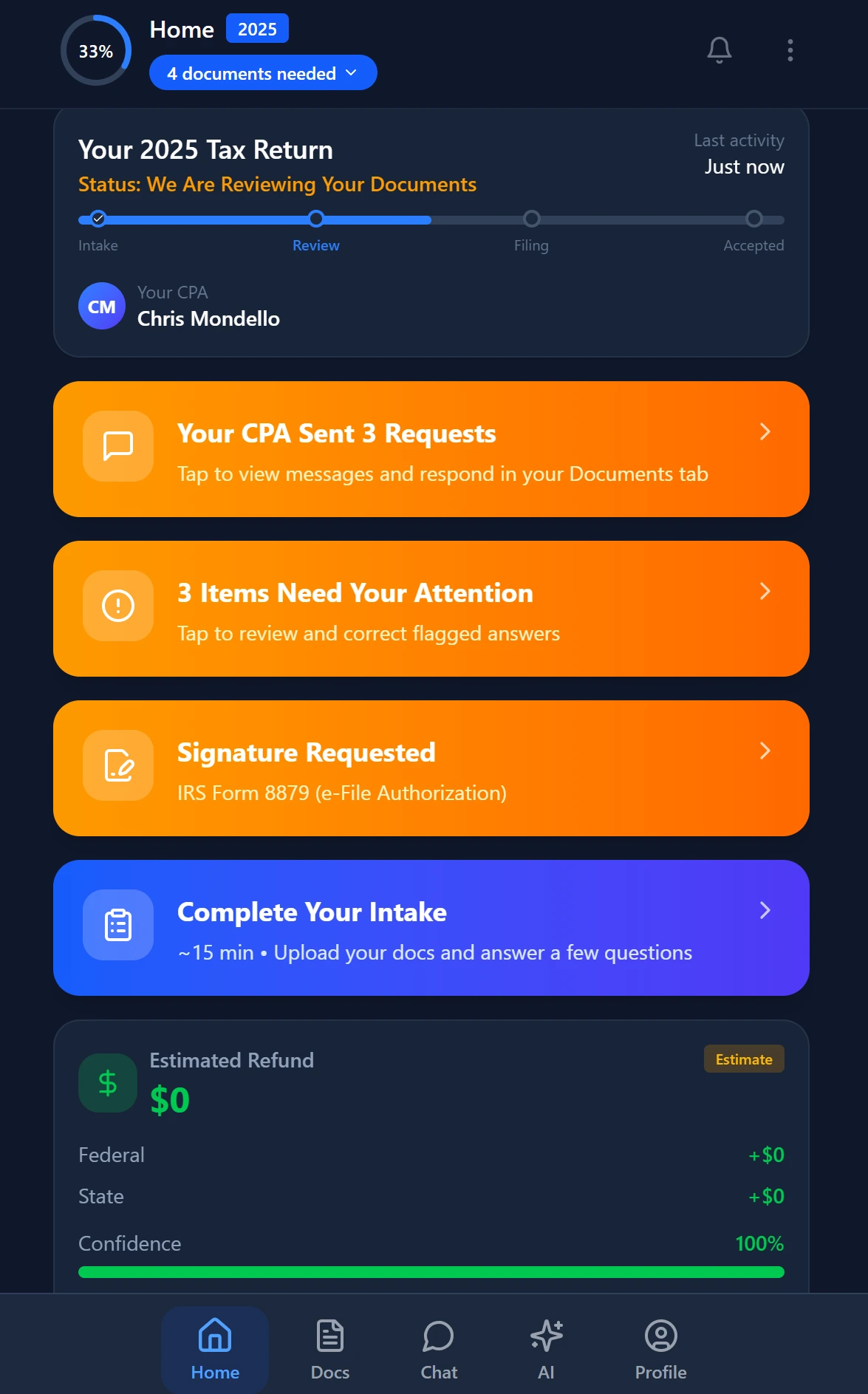
Smart intake auto-fills from uploaded documents and prior-year data
Structuring a Tiered Rate Card for Outsourced CFO Services
A tiered rate card gives your firm a consistent, repeatable pricing structure that prospects can compare against alternatives and staff can apply without escalating every scope question to a partner. Here is a practical three-tier structure that maps to the revenue bands above:
Tier 1 (CFO Essentials, $2,000–$3,500/month): designed for sub-$1M revenue clients. Includes monthly close review, rolling cash forecast, one executive call, and annual budget template. Scope cap: 6 hours/month.
Tier 2 (CFO Core, $4,000–$7,000/month): designed for $1M–$5M revenue clients. Includes full monthly reporting package, variance analysis, KPI dashboard, banking relationship support, and two calls per month. Scope cap: 12 hours/month.
Tier 3 (CFO Strategic, $7,500–$12,000+/month): designed for $5M–$20M revenue clients. Includes board-ready reporting, lender covenant monitoring, scenario modeling, department budget management, and ongoing availability. Scope cap: 20 hours/month with overage at an agreed hourly rate.
Publishing this structure — even in a simplified form — on your website or in your proposal template eliminates the awkward 'it depends' moment during discovery calls. Clients self-select into a tier, which anchors the conversation at a price point rather than starting from zero. Pair the rate card with a clear invoicing setup through Stripe Connect so retainers bill automatically on the first of each month — eliminating the collections friction that plagues hourly advisory billing. For more on automating the billing side of advisory services, see recurring invoicing for accounting firms.
Outsourced CFO Pricing Overview by Client Revenue Band
| Client Revenue | Typical Scope | Monthly Rate Range | Hours/Month |
|---|---|---|---|
| Under $1M | Cash forecast, close review, 1 call | $1,500 – $3,500 | 4 – 8 hrs |
| $1M – $5M | Reporting package, KPI dashboard, 2 calls | $3,000 – $7,000 | 8 – 14 hrs |
| $5M – $20M | Board reporting, covenant monitoring, modeling | $6,000 – $12,000+ | 14 – 25 hrs |
| Project-based | Capital raise prep, lender package, one-time model | $175 – $450/hr or fixed | Varies |

Your clients see your brand — OTP login, document upload, and real-time status
Outsourced CFO Pricing and Practice Management Infrastructure
Profitable outsourced CFO delivery isn't just about setting the right rate — it's about building the operational infrastructure to deliver consistently at that rate across multiple clients without letting quality slip. Practice management infrastructure is where most CFO-focused CPA firms leak margin: they price the engagement correctly but spend untracked hours on coordination, document chasing, and version control that erodes profitability.
Pipeline management with customizable stages lets your team track each outsourced CFO client through a defined monthly workflow — close documents received, model updated, report drafted, reviewed, delivered — without relying on memory or spreadsheets. TaxScout's 12-stage kanban pipeline is drag-and-drop and integrates directly with document intake, so when a client uploads their bank statement through the client portal, it auto-advances their pipeline card.
For firms comparing practice management platforms, the per-user pricing model common at competitors creates a direct headwind to CFO service line margins. At TaxDome, a 10-person firm pays approximately $500/month in platform fees; Canopy runs approximately $660/month for equivalent functionality. TaxScout's Prep Pro plan is $149/month flat — unlimited clients, 10 seats — which means the platform cost per outsourced CFO client is a fraction of what you'd pay on a per-user platform. See the full breakdown at /compare/taxdome-alternative or review TaxScout's pricing page for current plan details.
Security matters especially for CFO engagements because you're handling sensitive financial statements, banking data, and often personal financial information for business owners. TaxScout's AES-256-GCM encrypted SSN vault, 7-role RBAC, and 13-step DSAR anonymization process provide the security infrastructure that enterprise-grade clients in the $5M–$20M revenue band expect. The cybersecurity essentials guide for accounting firms covers how to communicate these protections to CFO-level prospects who ask security questions during due diligence.
Ready to build a profitable outsourced CFO service line without hiring additional staff?
TaxScout.ai's AI-native platform helps CPA firms deliver more advisory value per client — with AI document extraction, research agents, and automated pipeline tracking — all at a flat monthly fee that scales with your revenue, not your headcount.
Frequently Asked Questions
Monthly CFO retainer fees from CPA firms typically range from $1,500 to $12,000+ depending on client revenue size and engagement scope. Sub-$1M revenue clients generally pay $1,500–$3,500/month for basic cash flow oversight and reporting, while clients in the $5M–$20M range pay $6,000–$12,000/month for full strategic CFO support including board reporting, lender covenant monitoring, and scenario modeling.
Keep reading
Backdoor Roth IRA: How CPAs Execute the Strategy Without Triggering Pro-Rata Tax
Oct 12, 2026 · 1 min read
Amended FBAR Procedures: How CPAs Correct Foreign Account Errors Without Triggering Penalties
Oct 12, 2026 · 1 min read
Transparency in Coverage Final Rules: What CPA Firms Must Do Now
Oct 12, 2026 · 1 min read
Stay up to date
Get the latest tax tech insights delivered to your inbox.