How to Grow an Accounting Firm: A Practical Guide
Most accounting firm growth advice stops at referrals, pricing, and hiring — but those tactics don't fix the structural cap on revenue. This guide shows how to grow an accounting firm by rebuilding operations around automation and high-value advisory work. Learn the real moves that let CPA owners…
If you're wondering how to grow an accounting firm, you're probably a CPA owner staring at the same question every year after tax season ends — but most growth playbooks hand you the same five tactics: get referrals, raise prices, hire staff. None of them address the structural constraint that actually caps firm revenue: every billable hour is attached to a body, and there are only so many bodies you can afford.
The firms that break through that ceiling aren't just adding headcount. They're rebuilding around a different model — one where automation handles the compliance volume, AI handles the research, and CPAs spend their time on the work that commands $300 to $500 per hour instead of $75. Understanding how to grow an accounting firm means recognizing that the firms breaking through that ceiling aren't just adding headcount — they're rebuilding around a different model.
This guide covers how to grow an accounting firm by making that shift deliberately, using real operational changes rather than aspirational positioning.
Why Traditional Accounting Firm Growth Stalls
The compliance-first revenue model has a structural ceiling. You charge by the hour or by the form, your staff works 60-hour weeks in March and April, and growth means hiring another preparer to handle another 100 returns. Margins compress as salaries rise, and the work never gets less urgent. If you're serious about how to grow an accounting firm, the compliance-first revenue model is the first obstacle you'll need to rethink.
According to the Journal of Accountancy, the path to sustainable accounting firm growth runs through advisory services, technology-driven efficiency, and talent retention — not just adding compliance volume. Firms that shifted toward strategic advisory work reported stronger growth and lower staff burnout. For firms evaluating their how to grow an accounting firm approach, this trade-off compounds over time.
The math is stark: a firm billing 1,000 hours at $150/hour generates $150,000 in revenue from those hours. A firm billing 200 hours of advisory at $400/hour generates $80,000 from one-fifth the time — with room to serve more clients, develop new services, or simply give staff their lives back. That ratio is the core argument for the advisory-first model, and it's why automation and AI are central to how to grow an accounting firm in 2026.
There are four specific bottlenecks that keep firms trapped in the compliance ceiling: Each of these factors directly shapes how how to grow an accounting firm plays out in practice.
Document processing time. During tax season, experienced staff spend hours per day entering W-2s, 1099s, and K-1s by hand. That's senior CPA time going toward data entry that adds no strategic value. Understanding how to grow an accounting firm in this context is what separates firms that scale from those that stall.
Research latency. A client asks whether a QSBS exclusion applies to their situation. You spend 90 minutes pulling IRC sections and IRS guidance before you can even have the conversation. Multiply that across 30 advisory clients and you've consumed half a week. This is precisely where a deliberate how to grow an accounting firm strategy pays off.
Client communication overhead. Intake chasing, document reminders, invoice follow-ups, status updates — the administrative layer around a typical return runs 2–4 hours per client before a single number is reviewed. How to grow an accounting firm sits at the center of this decision — get it wrong and the rest unravels.
Pricing misalignment. Hourly billing penalizes your best CPAs for being efficient. The faster they work, the less revenue they generate. This creates a perverse incentive against the very efficiency gains that automation is supposed to deliver. When firms revisit their how to grow an accounting firm priorities, the gaps usually surface here.
Tired of watching senior CPA time disappear into data entry and document chasing? See how TaxScout automates the intake-to-preparation workflow — freeing your team for advisory work. → Book a 15-Min Demo — See It Live
How Niche Specialization Accelerates Accounting Firm Growth
Before you automate anything, you need to decide what you're actually optimizing for. Generalist practices can grow, but they grow slowly and compete on price. Accounting Today highlights niche specialization as one of the most reliable levers for commanding higher fees and creating differentiation that referral networks actually remember.
The logic is straightforward: a CPA who serves construction companies exclusively understands percentage-of-completion accounting, Section 179 on heavy equipment, workers' comp audit exposure, and prevailing wage compliance. A competitor who also serves restaurants, law firms, and e-commerce sellers cannot match that depth without significant research time per client. The specialist delivers more value, faster, and can justify fees that reflect that outcome.
The niche pricing dynamics work in your favor once you've built genuine vertical expertise — clients in specialized industries talk to each other, referrals carry prequalification built in, and your intake process becomes faster because you already know what documents and questions matter.
Practical specialization paths with strong advisory demand include:
- Healthcare providers (entity structuring, retirement plan optimization, billing compliance overlap)
- Real estate investors (cost segregation, 1031 exchanges, passive activity rules, opportunity zones)
- High-net-worth individuals (FTC planning, estate planning coordination, concentrated stock)
- Construction and contractors (job costing, bonding, percentage-of-completion elections)
- Startups and tech companies (R&D credits, QSBS, equity compensation tax planning)
Specialization also makes your automation investment more efficient. When 80% of your clients share the same document set and entity types, your extraction templates, validation rules, and intake flows all benefit from consistency.

Click any extracted field to see its source highlighted on the original PDF
Automation as the Foundation for Advisory Capacity
The most direct answer to how to grow an accounting firm without burning out your staff is: automate the repeatable compliance layer so your team can operate at the top of their license.
AI document extraction is where most firms see the fastest return. TaxScout processes W-2s, the full 1099 series, K-1s, 1098s, 1095s, and supporting schedules through a 5-layer validation pipeline — document quality routing, AI extraction with per-field confidence scoring from 0.0 to 1.0, OCR cross-verification using four matching strategies, 15 deterministic math rules, and 18 post-extraction validation checks including phantom 1099-INT hallucination detection and W-2 component explosion detection.
That means a return that previously required a staff member to manually key 60+ fields across a dozen documents can move through extraction and validation while that staff member works on something else. The split-screen PDF viewer lets the reviewer click any extracted field and see it highlighted on the original document — so review takes minutes rather than the hour that manual entry would have consumed.
The smart intake engine compounds this by eliminating most of the document-chasing cycle entirely. TaxScout's intake is modeled on IRS Form 13614-C with four-layer prefill: documents uploaded by the client auto-populate employer names, wages, and withholding; prior-year return data pre-populates recurring fields; and background AI gap analysis identifies missing information and generates prioritized questions rather than a generic checklist. Clients interact through a branded portal with OTP email login — no account creation, no password friction.
For the research side of advisory work, TaxScout's AI research agents run live searches across IRS.gov, law.cornell.edu, congress.gov, treasury.gov, and ssa.gov. This is not a static database with a knowledge cutoff — it's real-time regulatory retrieval. Nine specialized agents cover document intelligence, gap detection, tax calculation, risk assessment, filing specialists, validation, educational explanation, contextual Q&A, and orchestration. Client-context AI memory means the agents know each client's entity structures, filing history, and prior-year returns when you ask a question, so answers are grounded in that client's actual situation rather than generic guidance.
The compounding effect is what matters most: freeing advisory services capacity isn't just about doing compliance faster. It's about shifting what your highest-cost staff actually do with their time.
Moving from Hourly to Value-Based Pricing
Automation only translates to firm growth if your pricing model captures the value being created. A firm that cuts document processing time in half but keeps hourly billing has cut its own revenue. The shift to flat-fee, subscription, or value-based pricing is what converts efficiency gains into margin expansion.
The flat-fee billing dynamics for CPAs work particularly well once you have reliable scope definition — which is easier when your intake process is structured and your document extraction is consistent. When you know with confidence what a standard 1040 with rental property and one pass-through entity looks like in terms of preparation time, you can price it accurately without per-hour tracking.
For advisory services, subscription pricing aligns your incentives with client outcomes. A client paying $500/month for ongoing tax planning expects proactive contact, not just a bill. That expectation drives the advisory relationship you're trying to build, creates predictable cash flow, and makes the firm's value visible year-round rather than only at filing time.
The Bureau of Labor Statistics Occupational Outlook for Accountants and Auditors notes that demand for accounting services is driven partly by the complexity of tax regulations and financial planning needs — exactly the areas where advisory adds compounding value that compliance work cannot capture.
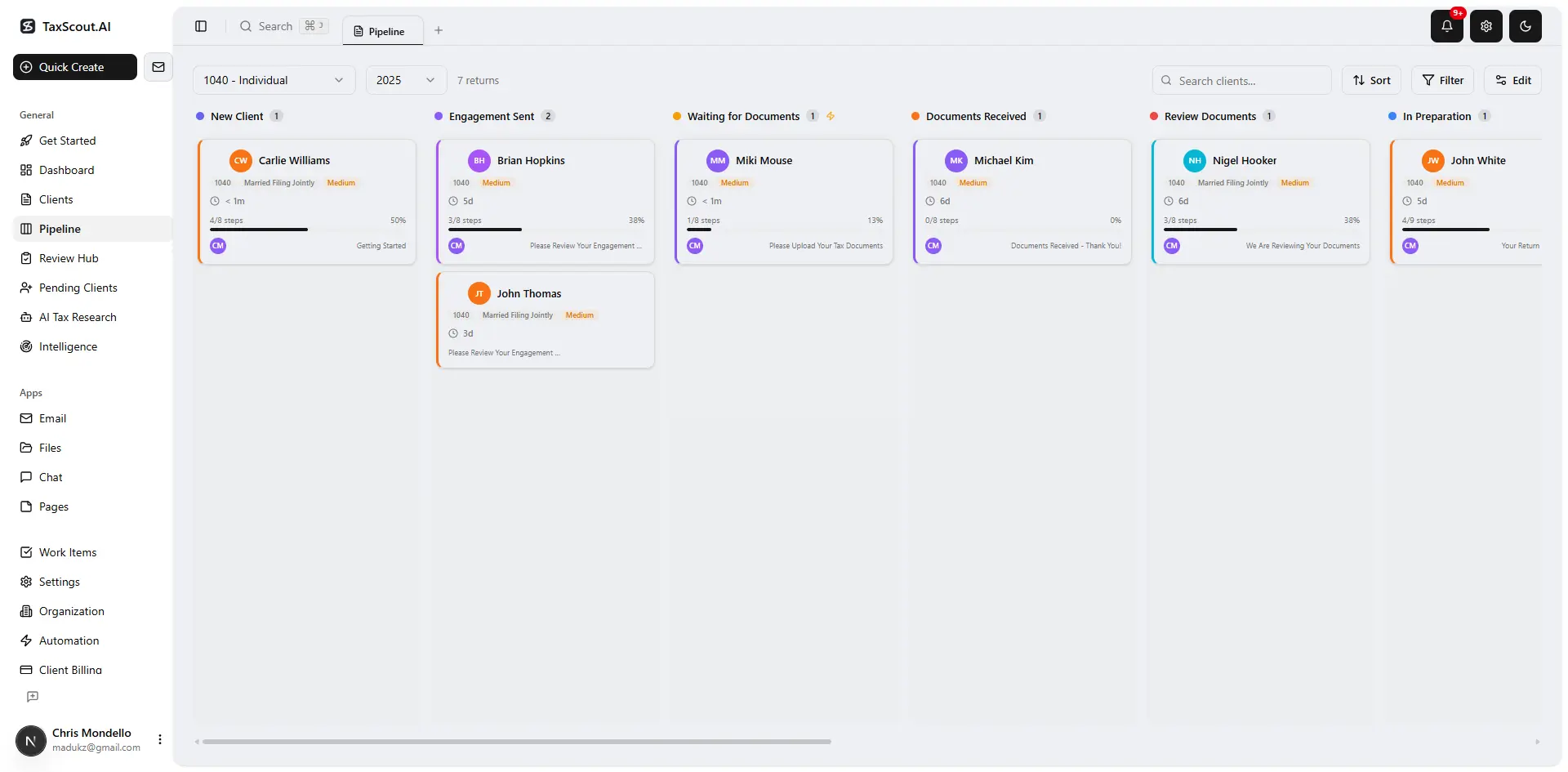
Track every return from intake to filed with drag-and-drop pipeline management
Talent Strategy: Competing Without Headcount
According to the AICPA's future of the profession analysis, firm growth is increasingly tied to attracting tech-savvy professionals who expect modern tools and meaningful work — not a career spent on manual data entry. This is both a threat and an opportunity.
The threat: if your firm runs on manual processes, your most capable junior staff will leave for firms that invest in automation — because they can see their own career ceiling from year one.
The opportunity: firms that automate the low-value work can offer their staff a faster path to client-facing, high-complexity work. A second-year CPA who is reviewing AI-extracted returns and supporting advisory meetings develops faster than one who is keying data for their first three seasons. That career differentiation is a real recruiting and retention lever.
The CPA firm hiring landscape has become increasingly competitive, with the U.S. accounting workforce contracting significantly through the early 2020s. Firms that can demonstrate technology investment — not as a buzzword, but as a live demonstration of what staff actually do with their time — have a tangible advantage in attracting candidates who have options.
Remote work infrastructure matters too. TaxScout's pipeline management, client portal, e-signatures via Documenso, and email integration (Gmail, Outlook, IMAP) mean that team members can execute their full workflow without being physically co-located. The pipeline management system supports 12 customizable stages from New Client to Filed, with drag-and-drop kanban, auto-advance when conditions are met, and loopback transitions with required notes — giving managers visibility into every return without requiring daily check-ins.
A Real-World Workflow: From Compliance to Advisory in One Season
Consider a 4-person CPA firm serving 300 individual returns and 40 small business clients. Their current model: two preparers spend peak season almost entirely on data entry and return assembly. One senior CPA reviews returns and handles client calls. The owner manages everything else.
After implementing structured automation, the workflow shifts:
Intake: New clients receive a booking link. They schedule, sign an engagement letter (which gates the appointment), and receive an intake link. They upload their documents through the branded portal. TaxScout's intake engine prefills from prior-year data, document uploads auto-populate wage and withholding fields, and AI gap analysis flags missing information before a staff member looks at the file.
Extraction and review: The extraction queue shows each document's confidence scores. High-confidence returns go straight to a preparer review queue — the preparer clicks fields to verify against the PDF, resolves any flagged discrepancies, and approves. Low-confidence items route to a brief manual review. Total time per return: significantly reduced from the manual baseline.
Research: The senior CPA gets a question from a rental property client about whether a short-term rental qualifies for the real estate professional exception. Instead of spending an hour pulling IRC §469 guidance, they query the AI research agents with the client's full context already loaded — entity structure, rental income, hours documentation from prior intake — and get a grounded answer with cited sources in minutes.
Advisory delivery: With preparation time compressed, the senior CPA has capacity for 15 advisory clients instead of 6. Each gets a quarterly call, proactive tax planning, and a subscription engagement. Revenue per advisory client runs 3–4x the compliance-only fee.
Invoicing: Stripe Connect Express handles billing through the client portal — branded invoices, credit card and ACH, automated overdue reminders. The owner spends zero time on collections follow-up.

Your clients see your brand — OTP login, document upload, and real-time status
Comparison: Per-Seat Platforms vs. Firm-Flat Pricing
| Feature | TaxScout | TaxDome | Canopy |
|---|---|---|---|
| AI document extraction with validation | 5-layer pipeline | Not available | Basic rename only |
| AI research agents | 9 specialized agents, real-time IRS | Not available | Not available |
| Pricing model | Per firm, unlimited team members | ~$800–$1,200/seat/year | $74/user/month billed annually (Standard, checked 2026-08-01) |
| Client portal | Branded, OTP login | Strong, mobile app | Yes |
| E-signatures | Documenso with KBA available | Yes, KBA included | Yes, KBA $1.25 each |
| Real-time IRS research | Live search across IRS.gov and 4 other sources | Not available | Not available |
| Pipeline management | 12-stage customizable kanban | Yes | Yes |
| Works with Drake/UltraTax/Lacerte | Yes — intake through prep, CPA files in their software | No direct integration model | No direct integration model |
TaxScout is priced per firm — TaxScout Solo at $49/month covers 150 return credits with unlimited team members; TaxScout Firm at $149/month covers 500 return credits with all 9 AI research agents, real-time IRS research, workflow automation, email sync, and advanced analytics. Overage returns are $4 each on both plans. TaxDome and Canopy price per seat — at Canopy's published $74/user/month for Standard (billed annually), a 4-person firm pays $296/month before any workflow automation add-ons. TaxDome's per-seat pricing means growth in headcount directly drives up your software cost.
The Growth Lever Most Firms Leave Untouched
The advisory-first model for accounting firm growth isn't a long-term ambition. It's executable in the next filing season if the operational prerequisites are in place — structured intake, automated extraction, research tools that don't require an hour per question, and pricing that captures the value of outcomes rather than hours.
The firms that delay are typically waiting for conditions that won't arrive on their own: a slow season with time to evaluate software, a staff hire who "gets technology," a client base that's ready to pay for advisory. Those conditions follow the operational changes, they don't precede them.
The complete guide to practice management in 2026 frames this as an AI-nativeness question: the distinction isn't between firms that use AI and firms that don't, it's between firms where AI is load-bearing infrastructure versus firms where it's a feature added to a manual workflow. The former compound their efficiency gains; the latter get marginal improvements.
Ready to move your firm from compliance volume to high-margin advisory? TaxScout gives your firm AI-native document extraction, research agents, and client automation on flat firm pricing — unlimited team members, metered on returns processed. → Book a 15-Min Demo
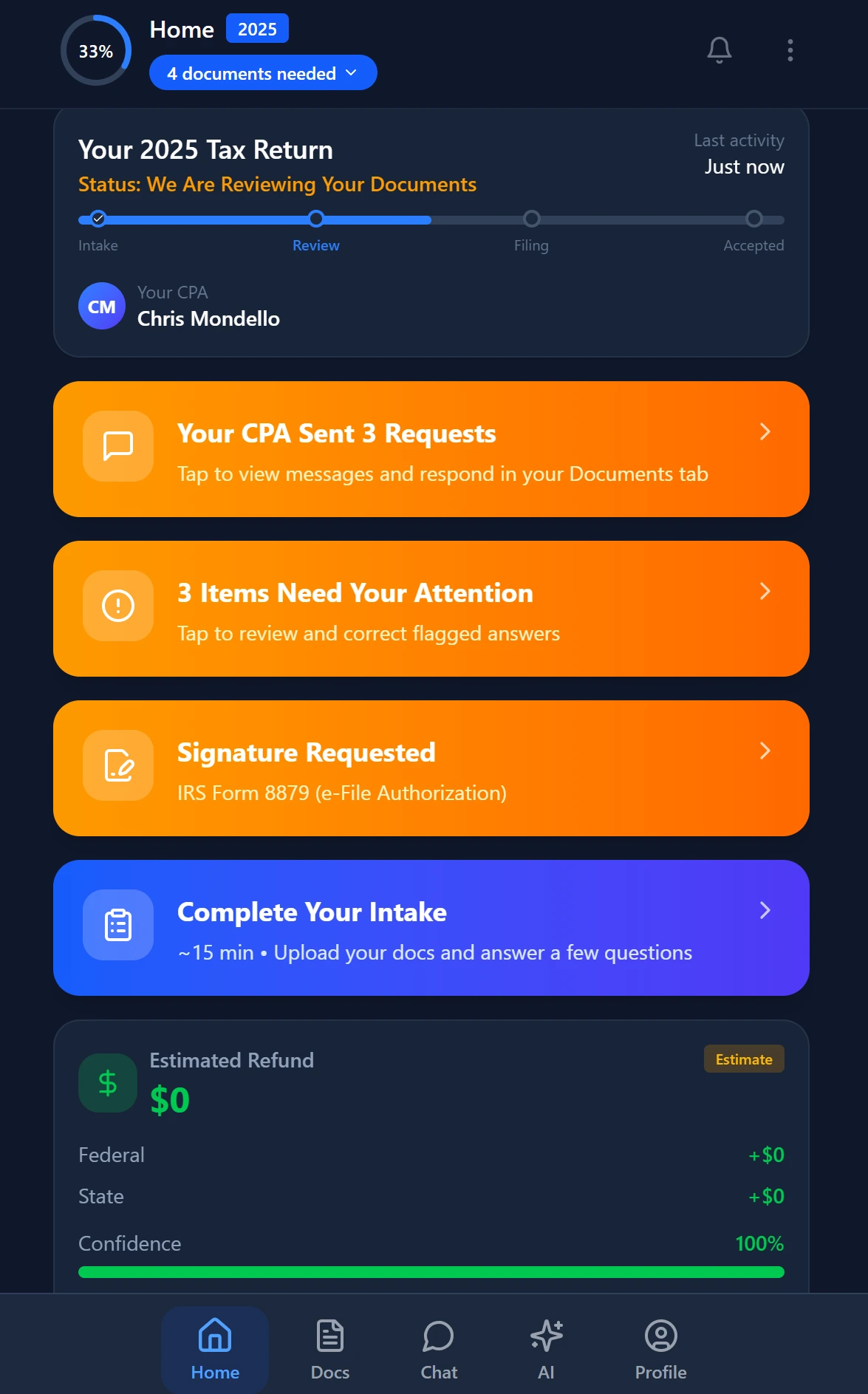
Smart intake auto-fills from uploaded documents and prior-year data
Frequently Asked Questions
The key is decoupling revenue from headcount by automating compliance work. TaxScout.ai handles routine tax research, document analysis, and return preparation tasks so existing staff can manage 3-4x more returns per season. Firms using this model report shifting 40-60% of staff time from $75/hour compliance work to $300-$500/hour advisory services — growing revenue without proportionally growing payroll.
Keep reading
Business Valuation for CPAs: How to Price a Client Company Without Hiring an Appraiser
Sep 18, 2026 · 1 min read
Equity Partner Compensation: How CPA Firms Structure Pay for Owners
Sep 18, 2026 · 1 min read
Accountant Shortage Solutions: How CPA Firms Survive the Talent Crisis Without Overpaying
Sep 18, 2026 · 1 min read
Stay up to date
Get the latest tax tech insights delivered to your inbox.