Business Valuation for CPAs: How to Price a Client Company Without Hiring an Appraiser
Most CPA blogs tell you to outsource business valuation. This guide flips that assumption, walking CPAs through the income, market, and asset approaches they can execute themselves for small business clients — and showing exactly where to draw the line before hiring a credentialed appraiser.
Business valuation for CPAs has long carried a reputation as specialist territory — something you refer out to a Certified Valuation Analyst or defer to a business broker when a client mentions selling or restructuring. That framing costs your firm real revenue and, more importantly, leaves clients without the advisor who already knows their books better than anyone.
The reality is that most small business valuation work — a $1.2M HVAC company updating a buy-sell agreement, a dental practice converting from a C corp to an S corp, or a family bakery preparing for an SBA-financed sale — does not require a CVA credential or a 60-page appraisal report. It requires a structured framework, a defensible methodology, and the judgment to know when the engagement outgrows your scope. Business valuation for CPAs handling everyday client engagements looks very different from the formal appraisal process most practitioners imagine.
This guide gives you that framework. You will learn how to apply the three core valuation approaches, calculate a seller's discretionary earnings (SDE) multiple, connect valuation outputs to specific tax outcomes, set fees for the work, and identify the precise thresholds at which a credentialed appraiser earns their invoice. Think of this as a practical field guide to business valuation for CPAs who need defensible numbers without the overhead of a full appraisal engagement.
Why Business Valuation Belongs in Your Advisory Practice
The average small business CPA already performs the analytical work that underlies a valuation: normalizing income statements, identifying non-recurring expenses, reviewing depreciation schedules, and modeling cash flow. What most CPAs lack is not the skill set — it is the vocabulary and the engagement structure to package that work as a billable valuation service. The good news is that business valuation for CPAs is largely a matter of organizing existing analytical skills into a recognized, repeatable methodology.
Consider the trigger events that create a valuation need for your existing clients. An owner wants to admit a new partner and needs a fair price for the equity. A spouse files for divorce and the business is a marital asset. An estate plan requires a defensible value for a gifting strategy under IRC §2512. A buyer's lender orders a business valuation as part of SBA 7(a) loan underwriting. Each of these situations brings the client back to you — or sends them to someone else. For firms evaluating their business valuation for CPAs approach, this trade-off compounds over time.
Adding valuation as a service line does not require you to earn a CVA designation overnight. The National Association of Certified Valuators and Analysts (NACVA) and the American Society of Appraisers both publish guidance on valuation standards, and CPAs in good standing with their state board can perform valuation analyses under their existing license for most small-business contexts. The critical distinction, covered later in this article, is between a "valuation analysis" prepared for advisory purposes and a "conclusion of value" required in litigation or formal estate tax filings. For other blog resources on building out your firm's advisory capacity, this same framework applies to services like cost segregation and niche pricing. Each of these factors directly shapes how business valuation for CPAs plays out in practice.
From a practice management perspective, valuation engagements are excellent candidates for flat-fee or value-based billing. If you are still defaulting to hourly rates, see our analysis of CPA firm pricing models for a framework that applies directly to advisory work like this. Understanding business valuation for CPAs in this context is what separates firms that scale from those that stall.
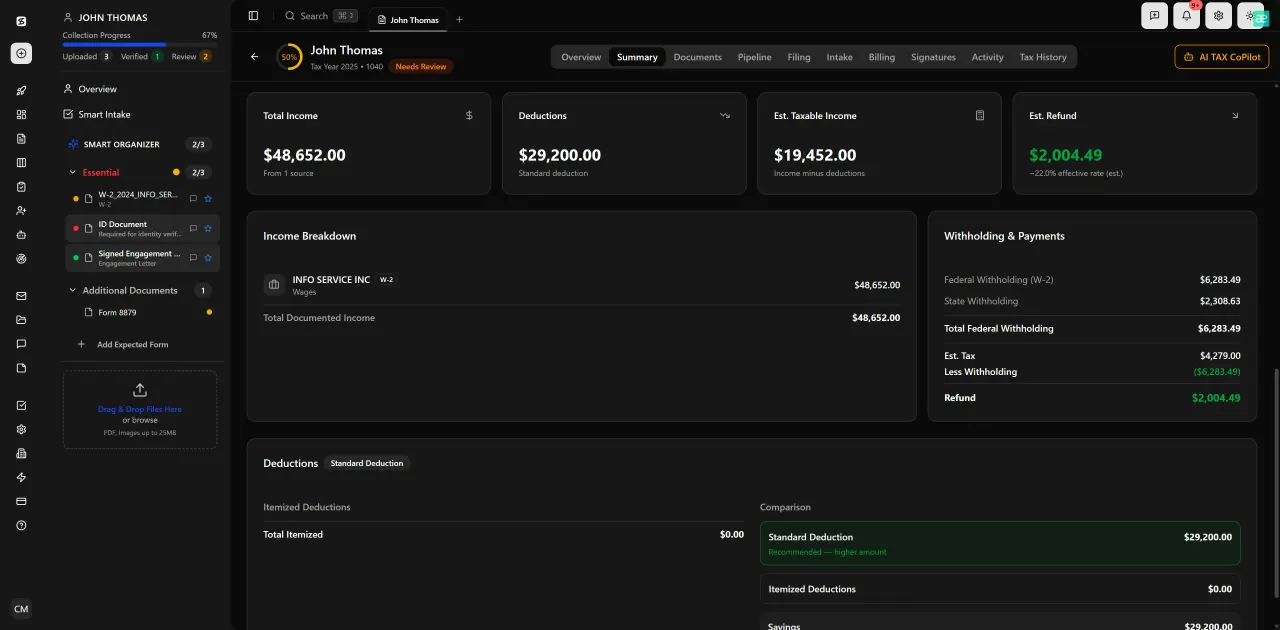
Review with AI assist — 9 agents answer questions with full client context
The Three Valuation Approaches CPAs Can Execute
Valuation theory recognizes three approaches: the income approach, the market approach, and the asset-based approach. For small businesses, all three are relevant, and your client's situation typically dictates which one anchors the engagement. This is precisely where a deliberate business valuation for CPAs strategy pays off — selecting the wrong anchor approach early can distort every downstream calculation.
Income Approach: Capitalizing Earnings or Discounting Cash Flow
The income approach values a business based on what it earns. For small businesses under roughly $5M in revenue, the most practical income method is capitalization of earnings, which divides a normalized single-period earnings figure by a capitalization rate. The formula is straightforward: Value = Normalized Earnings / Cap Rate. Business valuation for CPAs sits at the center of this decision — get it wrong and the rest unravels.
Normalized earnings start with EBITDA or net income reported on the tax return, then add back owner compensation above a market-rate replacement salary, personal expenses run through the business, one-time items, and depreciation on non-essential assets. This adjusted figure is sometimes called Seller's Discretionary Earnings (SDE), and it is the basis for the SDE multiple calculation used by most business brokers in the lower-middle market. When firms revisit their business valuation for CPAs priorities, the gaps usually surface here in the normalization process.
The capitalization rate is derived from a build-up model: start with a risk-free rate (typically the 20-year Treasury yield, currently available from U.S. Treasury), add an equity risk premium, a size premium, and a company-specific risk premium that accounts for customer concentration, owner dependency, and industry volatility. For a stable, owner-independent business with diversified revenue, a cap rate of 20–25% is defensible. For a high-dependency owner-operator business, 33–40% is more appropriate, which translates to a 2.5–3x SDE multiple.
Discounted cash flow (DCF) analysis is better suited to businesses with a predictable growth trajectory — think a SaaS company or a medical practice with recurring patient volume. DCF requires multi-year projections and an explicit terminal value calculation, which adds complexity. For most sub-$3M businesses, the added precision rarely justifies the work relative to capitalization of earnings.
Market Approach: Comparable Transactions and Revenue Multiples
The market approach values a business by reference to what similar businesses have sold for. Two data sources dominate this space for CPAs: the BizComps database and the Pratt's Stats / DealStats platform (now part of Business Valuation Resources), both of which compile actual transaction data segmented by NAICS code, revenue, and SDE.
When using transaction comps, match on industry, revenue range, and SDE margin. A restaurant selling at 2.1x SDE in BizComps is not a reliable comp for a manufacturing company. The market approach is strongest as a cross-check against your income approach result — if your capitalization of earnings produces a value meaningfully outside the comp range, investigate the gap rather than averaging the two.
Revenue multiples (e.g., 0.5x to 1.2x annual revenue) are a shorthand used by brokers, not a rigorous method. You can cite them in a client memo as market context, but they should not anchor a formal analysis because they ignore profitability differences entirely.
Asset-Based Approach: When to Use Net Asset Value
The asset-based approach values a business by summing the fair market value of its assets minus its liabilities. It is most appropriate when the business is capital-intensive (real estate holding companies, equipment-heavy operations), when earnings are negligible or negative, or when you are valuing a holding company rather than an operating entity.
For most profitable small operating businesses, the asset-based approach produces a floor value — it tells you the liquidation value, not the going-concern value. If your income approach produces a value below the adjusted net asset value, the business may be worth more dead than alive, which is itself a critical advisory insight for the client.
Tired of doing the analytical heavy lifting on advisory work in a system that treats every file as a loose PDF?
TaxScout's AI research agents and client-context memory let you deliver valuation-adjacent advisory services faster, with every document organized and searchable from the same platform you use for tax prep.

Click any extracted field to see its source highlighted on the original PDF

Your clients see your brand — OTP login, document upload, and real-time status
SDE Multiple Calculation: A Step-by-Step Example
Walk through a practical SDE multiple calculation for a landscaping company filing as an S corporation. The owner reports $420,000 in Schedule K-1 ordinary business income on her Form W-2 plus a $95,000 officer salary. The business shows $38,000 in personal auto expenses, $12,000 in cell phone charges for family members, and a $25,000 non-recurring insurance settlement included in revenue.
Step 1 — Start with reported net income: $420,000 + $95,000 officer salary = $515,000 combined owner benefit. Step 2 — Add back personal expenses: $38,000 + $12,000 = $50,000. Step 3 — Subtract non-recurring items: ($25,000). Step 4 — Subtract a market-rate replacement salary for the owner's role (assume $75,000 for a working owner-operator): ($75,000). Adjusted SDE = $515,000 + $50,000 − $25,000 − $75,000 = $465,000.
Step 5 — Select a multiple. Pull two to three BizComps transactions for landscaping companies in the $1M–$3M revenue range. Suppose the comps show a median of 2.8x SDE. Apply a slight downward adjustment for customer concentration (top three clients represent 40% of revenue). Indicated value: $465,000 × 2.6x = $1,209,000.
Step 6 — Cross-check with the income capitalization method. Using a 30% cap rate: $465,000 / 0.30 = $1,550,000. The gap between $1,209,000 and $1,550,000 is meaningful — investigate whether the comp selection is sound or whether your cap rate is too aggressive before delivering a conclusion. This kind of reconciliation is where business valuation for CPAs rewards careful, methodical judgment and is where a CPA earns their advisory fee.
For more on how normalized income flows into tax planning, see the IRS guidance on business income adjustments as a baseline for what the IRS scrutinizes when owner compensation is at issue.
Connecting Valuation to Tax Outcomes
The strongest argument for owning valuation work in-house is that the tax implications are inseparable from the value conclusion, and you are the professional best positioned to see both simultaneously. Here are the four most common scenarios where company valuation tax planning drives real client ROI.
S corporation election and built-in gains. When a C corporation elects S status, any appreciation in asset value at the conversion date becomes subject to the built-in gains (BIG) tax under IRC §1374 if those assets are sold within five years. IRC §1374 requires a fair market value determination at the date of conversion. A contemporaneous valuation you prepare at conversion time protects the client from IRS challenge later and creates a clear record for BIG tax exposure. This is one of the most high-leverage applications of business valuation for CPAs in everyday tax practice.
Estate and gift planning. Gifts of minority interests in family-owned businesses can qualify for valuation discounts — typically 15–35% — for lack of control and lack of marketability. The IRS Estate and Gift Tax regulations set the standard of value as fair market value, defined as the price a hypothetical willing buyer and seller would agree upon. A properly documented valuation analysis supporting a minority discount can save clients significant estate tax at the applicable unified credit rate.
Buy-sell agreements. A buy-sell agreement that specifies a fixed price or a formula price can create a binding estate tax value under Treasury Regulation §20.2703-1 if it meets the three-part test for a bona fide business arrangement. Helping clients draft or update a buy-sell agreement with a defensible formula — rather than an arbitrary fixed price set ten years ago — is pure advisory value that starts with the valuation framework you already understand.
M&A preparation and purchase price allocation. When a client sells, the allocation of purchase price to specific assets under IRC §1060 and IRS Form 8594 determines the character and timing of gain recognition. A CPA who performed the pre-sale valuation is ideally positioned to advise on the allocation negotiation and its tax consequences — a service combination that standalone appraisers cannot replicate.
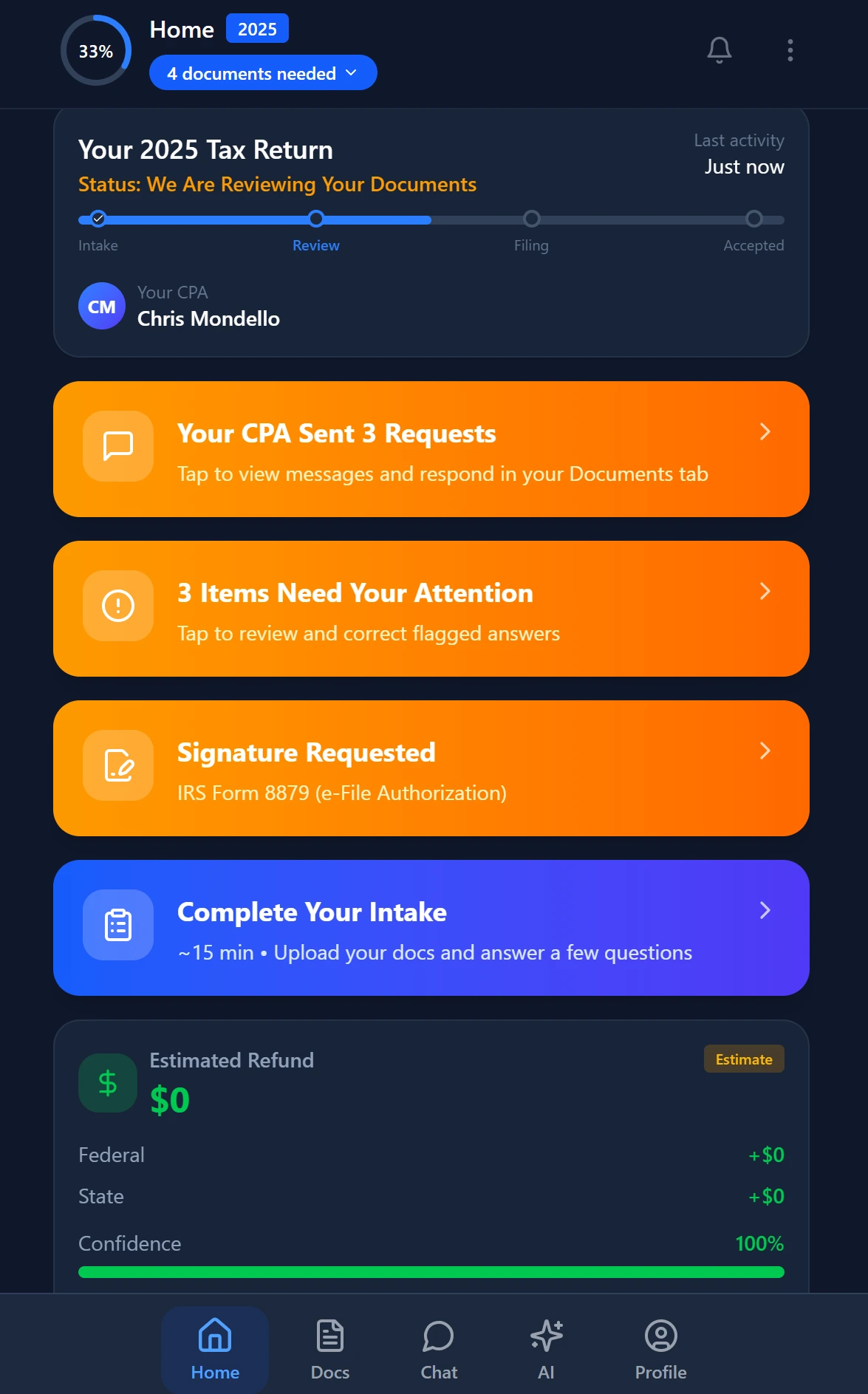
Smart intake auto-fills from uploaded documents and prior-year data
When to Bring in a Credentialed Appraiser
Being clear about scope boundaries is not a weakness — it is what keeps your E&O coverage intact and your client relationship protected. Here are the specific thresholds that should prompt a referral to or co-engagement with a CVA, ABV, or ASA.
Litigation context. Any valuation that will be used in divorce proceedings, shareholder disputes, or business interruption insurance claims requires a credentialed appraiser who can withstand Daubert scrutiny as an expert witness. Your analysis can inform the retained expert, but it should not serve as the primary exhibit.
Estate tax returns with significant values. The IRS requires a qualified appraisal for estate and gift tax returns claiming charitable deductions or noncash contributions above $500,000. For minority interest discounts on estates above the applicable exclusion amount, the risk of IRS challenge warrants a credentialed appraiser's signature on the report.
Complex capital structures. A business with multiple classes of equity, preferred interests, waterfall distributions, or convertible debt requires option-pricing models or probability-weighted expected returns analysis that goes beyond standard CPA practice. The same applies to intangible asset valuations under ASC 805 for GAAP financial statement purposes.
ESOP transactions. Department of Labor regulations impose strict fiduciary requirements on ESOP trustee valuations. An independent, credentialed appraisal is not optional — it is a legal requirement.
For engagements that fall clearly within your scope, consider co-branding the deliverable with a referring appraiser relationship you develop over time. They get overflow work; you retain the client relationship and the tax planning billings. Knowing these boundaries is as important to a successful business valuation for CPAs practice as knowing the methodology itself.
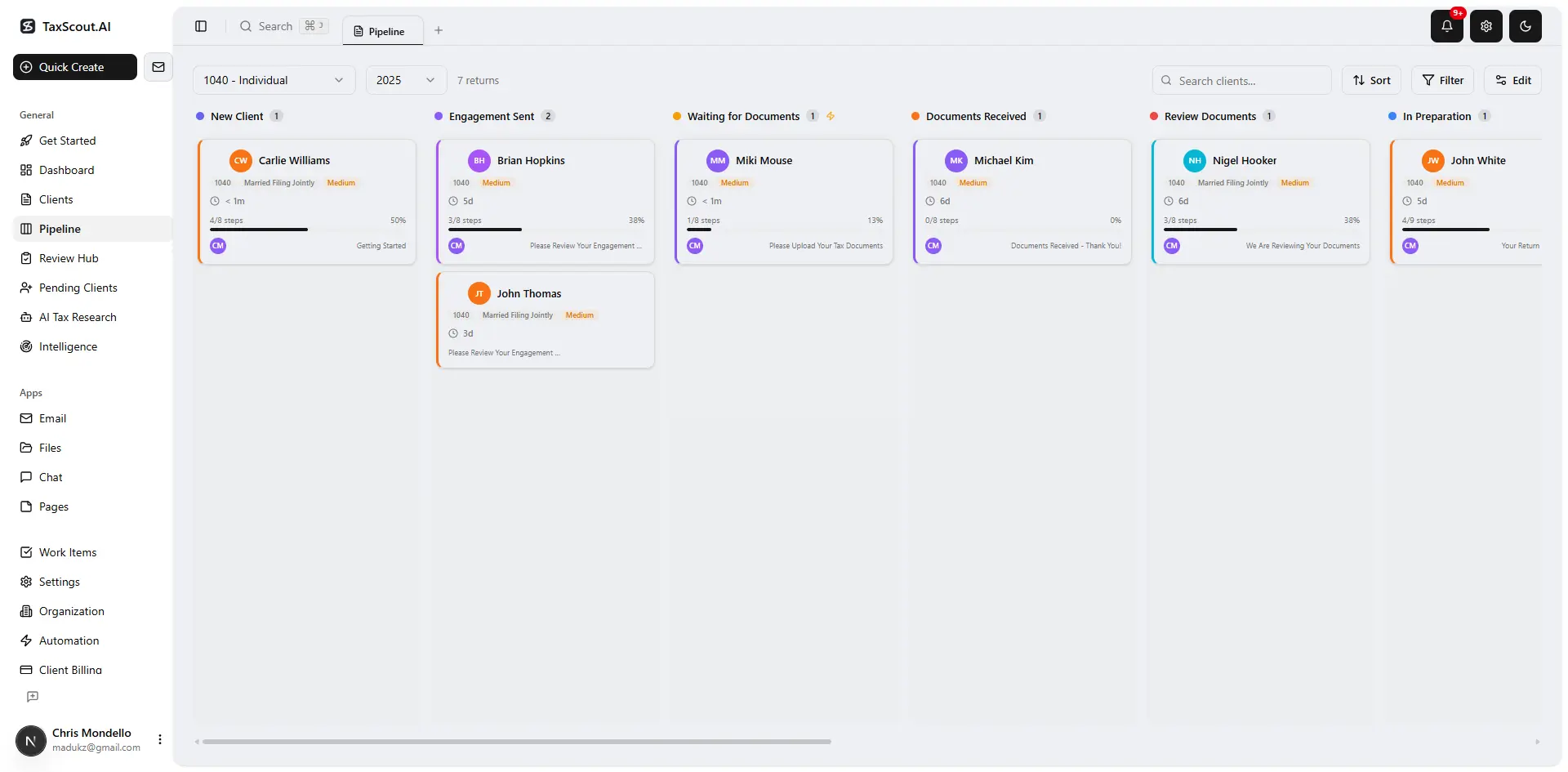
Track every return from intake to filed with drag-and-drop pipeline management
How to Price Valuation Work as a CPA
Standalone business appraisers typically charge $3,500–$7,500 for a small business valuation report and $8,000–$25,000+ for a complex or litigation-grade engagement. As a CPA delivering a valuation analysis (not a formal appraisal report), your pricing should reflect that you are providing a well-documented analytical opinion, not a credentialed conclusion of value.
A defensible fee structure for CPA business appraisal work at the small-business level: $1,500–$2,500 for a preliminary valuation memo supporting an internal decision (buy-sell update, partner admission, gifting strategy planning); $2,500–$5,000 for a full valuation analysis with documented methodology, comp selection, and reconciliation across two approaches; $500–$1,500 for an annual value update on an existing engagement. These fees sit below appraiser rates while delivering the advisory relationship the client actually needs.
Bill this work on a flat-fee basis with a written engagement letter specifying the standard of value (fair market value vs. investment value), the intended use, and an explicit disclaimer that the analysis is not a formal appraisal under USPAP. If you are integrating this into a broader advisory package, see our niche pricing strategy guide for how to bundle valuation with M&A advisory or succession planning without undercharging.
One often-overlooked revenue source: annual maintenance. A buy-sell agreement with a formula-based price needs to be recalculated every year or two. If you built the formula, you should be the one running the update — and charging for it. This recurring engagement model is one of the most sustainable ways to build business valuation for CPAs into a firm's long-term revenue mix.
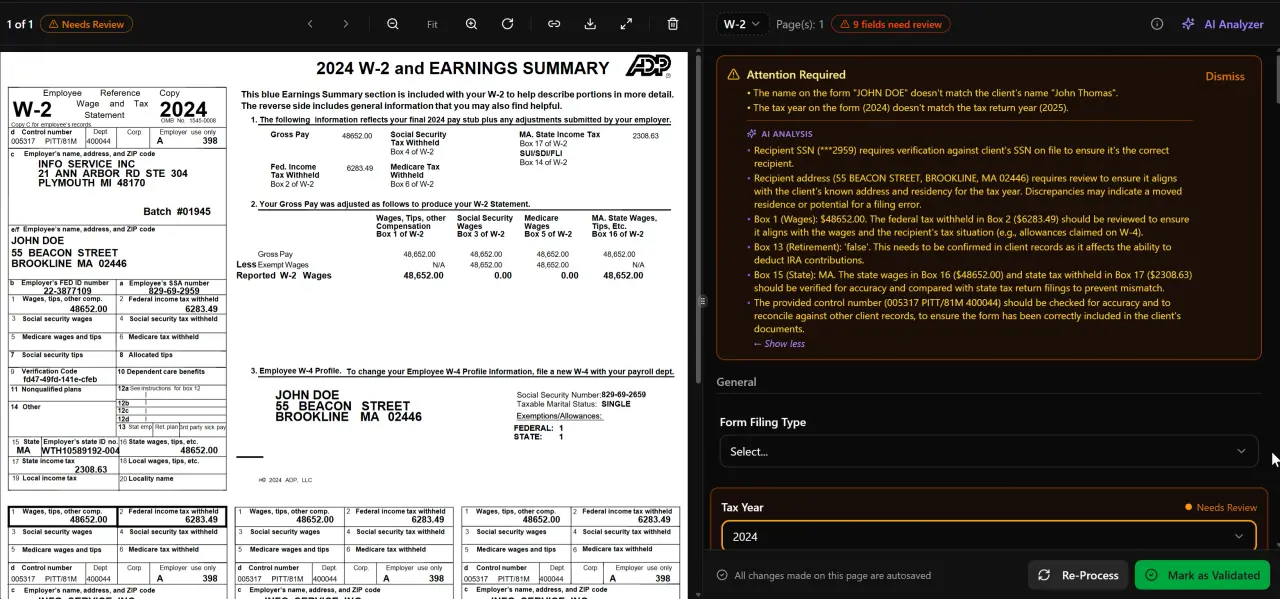
AI classifies, extracts, and validates every document automatically

Every client gets organized documents, status tracking, and a complete history
Building a Repeatable Valuation Workflow in Your Practice
The operationally hardest part of adding valuation services is not the methodology — it is the document intake and workpaper organization. A valuation engagement requires at least three years of business tax returns, a current year profit and loss statement, depreciation schedules, a list of owner add-backs with documentation, and supporting records for any unusual items. Gathering that file from a small business client without a structured intake process is a recurring headache.
TaxScout's AI document extraction and smart intake tools are built for exactly this kind of multi-document engagement. The platform processes W-2s, K-1s, 1040 schedules, and supporting records through a 5-layer validation pipeline — document quality routing, AI extraction with confidence scoring, OCR cross-verification, 15 deterministic math rules, and cross-document validation — so you spend your time on the analytical work, not chasing clean numbers from a pile of PDFs.
For managing the valuation engagement itself, the pipeline management feature supports 12 customizable stages with drag-and-drop kanban, so you can build a dedicated valuation workflow separate from your tax prep pipeline. Engagement letters with scoped disclaimers can be sent and executed via e-signatures without leaving the platform.
The client-context AI memory feature is particularly useful for valuation work: entity structures, prior-year financials, and filing history are retained across the engagement, so when you are recalculating a buy-sell formula two years later, the context is already there. See our post on AI accounting productivity for how these tools compound across advisory service lines. You can also explore TaxScout's full platform to see how these workflows connect in practice.
Ready to stop referring out valuation work and start capturing that advisory revenue yourself?
TaxScout gives your firm the document infrastructure, AI research tools, and pipeline management to deliver valuation-grade advisory engagements without adding headcount.
Frequently Asked Questions
Yes, in most states a licensed CPA can prepare a valuation analysis for advisory purposes — such as informing a buy-sell agreement update, supporting a gifting strategy, or preparing a client for a potential sale — under their existing CPA license. The distinction is between a valuation analysis (an analytical opinion) and a formal appraisal report issued under USPAP standards, which typically requires a credentialed appraiser. For litigation, estate tax filings above the exclusion amount, and ESOP transactions, a credentialed appraiser is required.
Stay up to date
Get the latest tax tech insights delivered to your inbox.