Your Smartest Associate Knows Every Client. Every Rule. Every Form.
Attach any client to a chat and ask tax questions in plain English. The AI already knows their W-2 income, their filing status, their dependents, and every document they've uploaded. It searches IRS.gov in real time for the latest rules — then gives you a sourced answer specific to that client. Not a generic chatbot. A CPA-grade research partner.
The Problem: Tax Research Is Stuck in 2010
You Google an IRS question. You get a blog from 2019, a TurboTax article for consumers, and a Reddit thread with wrong advice. So you dig through IRS.gov manually, cross-reference the IRC, read a 50-page Revenue Procedure, and hope you didn't miss a recent update. An hour later, you have an answer — but you're still not sure it applies to THIS client. Because your research tool doesn't know your client. TaxGPT and ChatGPT can answer tax questions, but they don't know that your client has $142K in 1099-NEC income, three rental properties, and a spouse filing jointly. They give you textbook answers when you need client-specific guidance.
The Solution: AI That Knows Your Client AND the Latest Tax Law
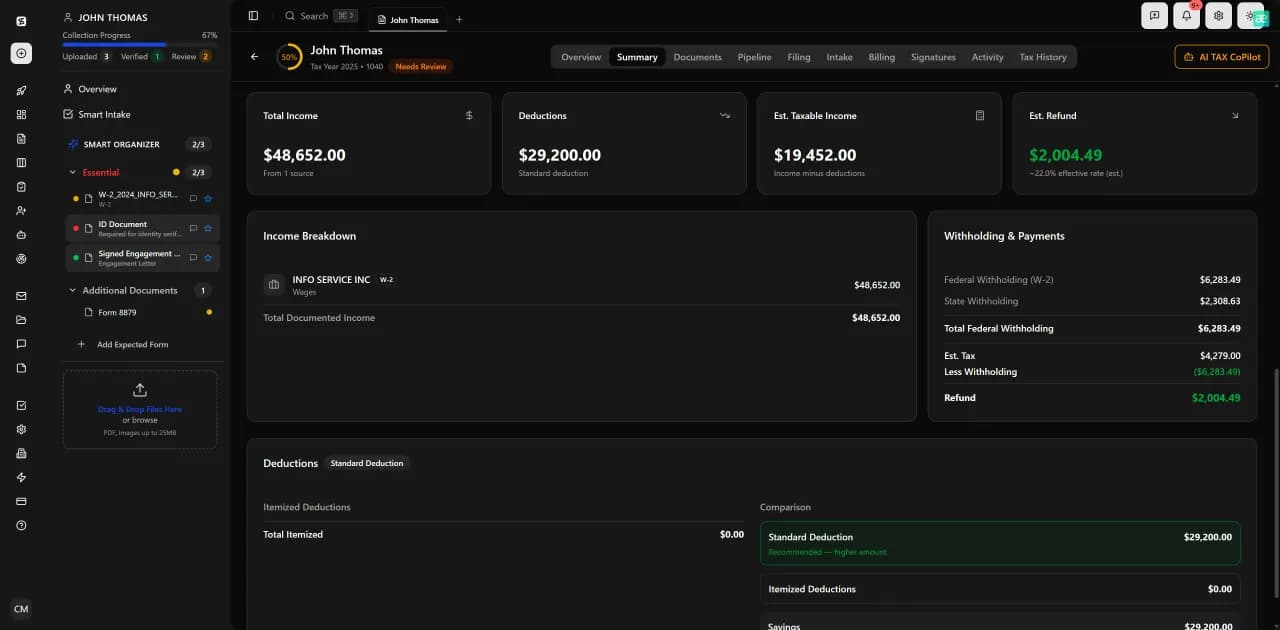
TaxScout combines two things no other tool we have reviewed has together: (1) Your client's actual data — every document they uploaded, every field extracted, their filing status, dependents, income sources, and prior-year history. (2) Real-time IRS research — live search across irs.gov, IRC, Revenue Procedures, and IRS Publications — not a stale knowledge base. When you ask "Does this client qualify for the QBI deduction?", the AI doesn't give you a generic explanation. It looks at the client's actual numbers and tells you the specific answer with IRS citations.
What the AI Knows About Each Client
All data is automatically loaded when you attach a client — zero manual entry.
9 Specialist Agents — One Conversation
You don't pick an agent — just ask your question. The Orchestrator routes to the right specialist.
Document Intelligence
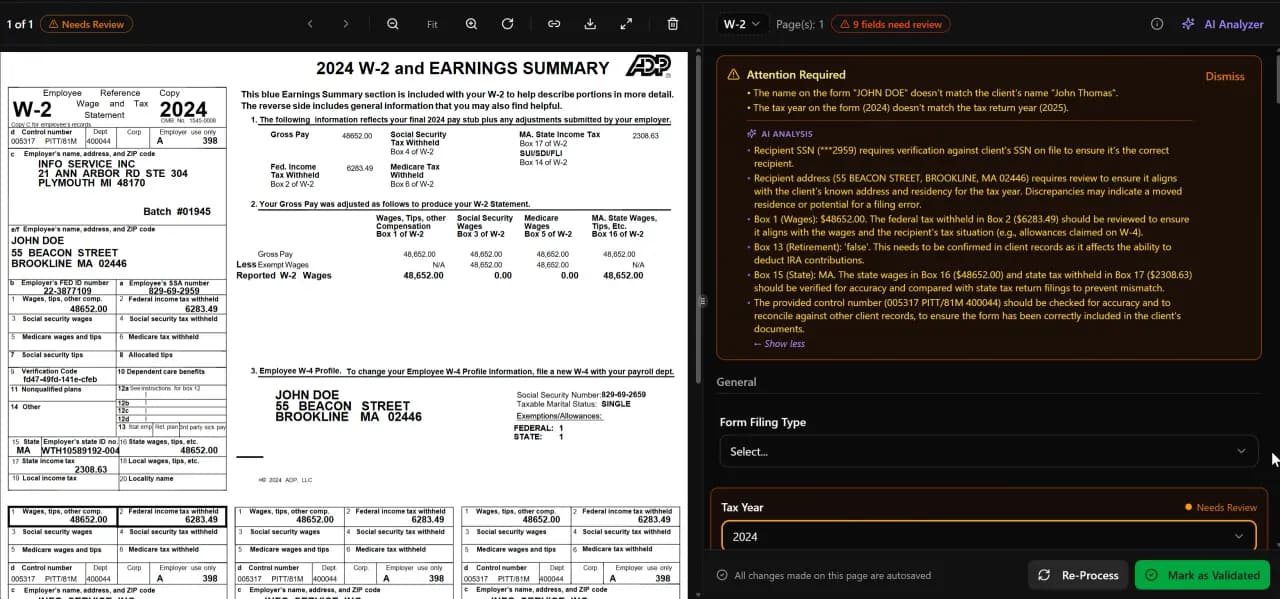
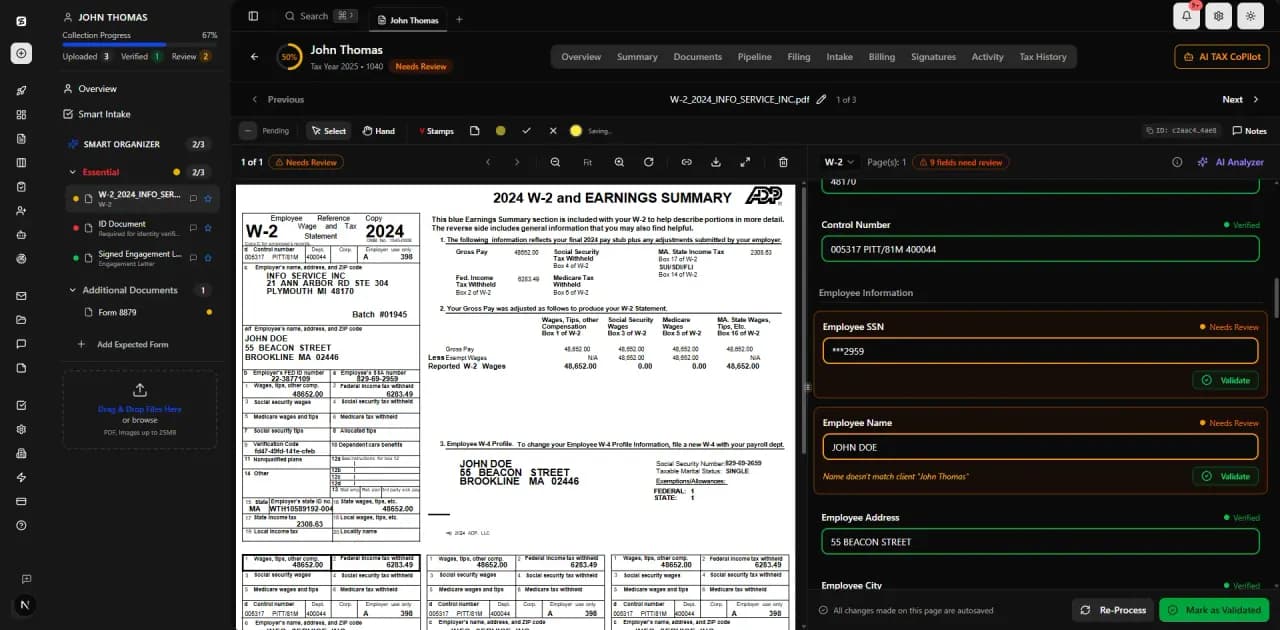
Answers questions about uploaded docs with field-level detail
"What's the total income on this consolidated 1099?"
Gap Detection
Identifies missing documents based on client profile and prior year
"What's still missing before I can file?"
Tax Calculator
Estimates refund/owed from extracted data
"Estimate the tax liability based on current documents"
Risk Assessment
Evaluates audit triggers and compliance red flags
"Any audit red flags on this return?"
Filing Specialist
Filing guidance, deadlines, extensions, FBAR/FATCA
"Does this client need to file FBAR?"
Validation
Cross-checks calculations against source documents
"Do the W-2 amounts match the Schedule C?"
Educational
Explains tax concepts in CPA-appropriate depth
"Explain passive activity loss limitations for this rental"
Contextual Q&A
Handles follow-ups with full conversation memory
"What about their spouse's income?"
Orchestrator
Routes your question to the right specialist automatically
Just ask — it figures out who handles it
Real-Time IRS Research (Not a Static Database)
Authority-only sources: irs.gov, law.cornell.edu, congress.gov, treasury.gov, ssa.gov. Never blogs, TurboTax, or Reddit.
Quick Mode
Simple facts: rates, limits, deadlines, thresholds
Google Search grounding against IRS.gov. Instant answers with source links.
Deep Mode
Complex regulatory: IRC sections, Rev. Procs., special topics
Reads full IRS publications, Revenue Procedures, and IRC sections. Page-level citations.
Auto Mode
Default — AI decides based on complexity
Classifier detects complexity. IRC sections, trusts, depreciation, AMT → auto-escalates to Deep.
Connects to Regulatory Intelligence
AI Tax Research and the Regulatory Intelligence Hub work together to create a revenue cycle.
Example: Section 199A Qualification
How It Works
Select a Client
Click the client picker in the chat. The AI instantly loads their full profile: documents, extracted data, dependents, intake answers, and prior-year data.
Ask in Plain English
Type your question naturally. The AI classifies your intent and routes to the right specialist agent automatically.
Get a Sourced, Client-Specific Answer
Every answer includes client-specific numbers from their documents, IRS citations linking to authoritative sources, and follow-up intelligence the AI spotted.
vs. Competitors
TaxGPT is standalone — you type in client info and ask questions. ChatGPT gives generic answers with no client data. TaxScout's AI already knows your client from extracted documents, searches IRS.gov in real time with authority-only citations, and connects to your practice management — create engagement letters, email clients, and add tasks from the chat. Plus, Regulatory Intelligence automatically finds affected clients when rules change.
Frequently Asked Questions
Three fundamental differences: (1) TaxScout's AI already has your client's documents, extracted data, dependents, and filing history — you don't re-type anything. (2) It searches IRS.gov and authoritative sources in real time with authority-only citations — it will never cite a blog or Reddit. (3) It's integrated with your practice — create engagement letters, email clients, and add tasks directly from the research chat.
See AI Tax Research in Action
Book a 15-minute walkthrough and see how it fits your firm.