Subscription Pricing for CPA Firms: How to Stop Trading Hours for Dollars
Most CPA firms understand the concept of subscription pricing but stall when it comes to operationalizing it. This playbook walks you through building pricing tiers, sequencing client migrations, defending scope creep, and automating recurring billing so the model actually reduces — not multiplies…
Subscription pricing for CPA firms means charging clients a fixed monthly or annual fee for a defined service bundle instead of billing by the hour. It delivers predictable recurring revenue, rewards operational efficiency (including AI automation), and deepens advisory relationships by removing the per-question billing barrier. Building it successfully requires defined pricing tiers, a phased client migration sequence, explicit scope guardrails in engagement letters, and automated recurring billing so the model does not create more admin than it replaces. Understanding how subscription pricing CPA firms can implement varies widely, from simple flat-fee tax packages to fully bundled advisory retainers. The real-world results of subscription pricing CPA firms have actually achieved, however, tell a more nuanced story than those early vendor case studies suggested.
Subscription pricing for CPA firms has been a hot topic since roughly 2021, when a wave of concept pieces from practice management vendors promised that moving away from hourly billing would transform your firm's revenue predictability. Five years later, most of those articles are still on the internet — and most CPA firms are still billing by the hour. The gap between concept and execution is not motivation; it is a missing operational playbook. For firms evaluating their subscription pricing CPA firms approach, this trade-off compounds over time.
The fundamental problem with the hourly model is not that clients dislike it. Many clients accept hourly rates without complaint. The problem is what it does to the firm: revenue that fluctuates with tax season peaks, write-downs that penalize efficiency, and an incentive structure that punishes your best staff for working fast. When a senior associate finishes a return in two hours instead of four, the firm earns half as much. That is the wrong math. This is precisely why subscription pricing CPA firms adopt tends to realign incentives, rewarding speed and smart systems rather than billable hours logged.
This guide is the operational complement that the concept pieces never delivered. You will find concrete frameworks for building subscription tiers, a sequenced approach to migrating existing clients without revenue disruption, specific guardrails against scope creep, and a clear explanation of how modern AI-native practice management platforms handle the recurring billing mechanics that make subscription pricing sustainable at scale. Each of these factors directly shapes how subscription pricing CPA firms plays out in practice.
How to Launch Subscription Pricing at Your CPA Firm
- Audit your current client roster by complexity and annual revenue to identify which clients belong in Core, Plus, and Premier tiers.
- Define the included deliverables for each tier explicitly — number of returns, advisory calls per quarter, response time SLA, and any ancillary services.
- Set tier prices by taking average annual revenue per complexity bucket, adding a 15–25% advisory availability premium, and rounding to a clean number.
- Update your engagement letter template to enumerate tier scope with enough specificity that out-of-scope requests are unambiguous, and deploy e-signatures.
- Onboard all new clients immediately onto subscription tiers with no hourly option presented.
- Convert high-engagement existing clients in a Phase 2 conversation framed as a service upgrade, not a billing change.
- Activate automated recurring billing through a Stripe-integrated platform so monthly charges, retries, and receipts require no manual touchpoints.
- Review tier definitions and prices annually, adjusting for service mix changes and new advisory capabilities. Understanding subscription pricing CPA firms in this context is what separates firms that scale from those that stall.
Why the Hourly Billing Model Caps CPA Firm Growth
According to the TaxScout directory, 69,074 US tax preparers are listed against the IRS federal preparer directory, of whom 32,228 are CPAs. That is a significant pool of credentialed professionals, yet the Journal of Accountancy has documented a persistent pipeline shortage that is forcing firms to do more with existing staff. The hourly model compounds this pressure: every hour of admin work — generating invoices, chasing receivables, reconciling payments — is an hour not spent serving clients. This is precisely where a deliberate subscription pricing CPA firms strategy pays off, turning administrative drag into a solvable systems problem rather than a permanent tax on firm capacity.
The core structural problem with time-and-billing is that it ties revenue directly to hours recorded rather than to value delivered. A firm that invests in AI document extraction and cuts processing time by 40% under an hourly model earns 40% less on each return. The same efficiency gain under a subscription model expands margin without changing the invoice. That asymmetry is why fast-growing firms are migrating to flat fee or tiered subscription structures. Subscription pricing CPA firms sits at the center of this decision — get it wrong and the rest unravels.
The IRS Taxpayer Advocate Service has consistently noted that taxpayer access to credentialed preparers is uneven across the country — a finding our own analysis of tax preparer deserts confirmed at the state level. Firms that solve the capacity equation through pricing model innovation, not just headcount, are better positioned to absorb demand without burning out staff. When firms revisit their subscription pricing CPA firms priorities, the gaps usually surface here — often in the form of underpriced compliance work that leaves no margin for advisory expansion.
There is also a client experience argument. Clients on hourly billing tend to self-censor questions because every email feels like a meter running. Clients on a subscription retainer communicate freely, which surfaces planning opportunities earlier and deepens the advisory relationship. That behavioral shift is worth more than the revenue predictability on its own.
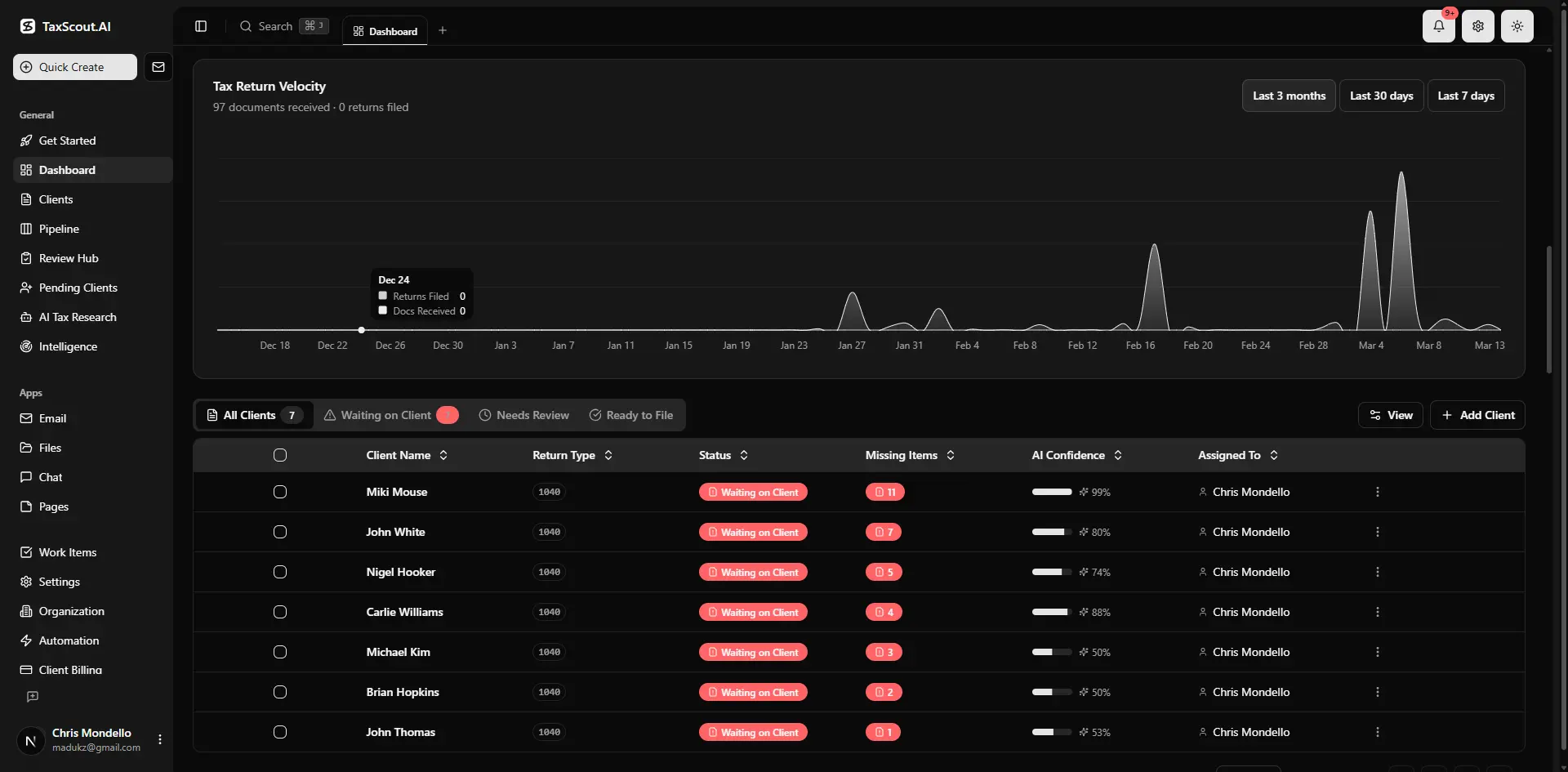
Real-time dashboard showing returns in progress, revenue, and upcoming deadlines

Click any extracted field to see its source highlighted on the original PDF
Building Your Three-Tier Subscription Architecture
A workable three-tier pricing architecture for a CPA firm looks like this: a Core tier for compliance-only clients, a Plus tier that adds year-round advisory touchpoints, and a Premier tier for clients who want proactive planning, priority response, and virtual CFO services. The exact names are less important than the principle — each tier must have a clearly bounded scope and a price that reflects that scope, not the hours you expect to spend. The firms that execute subscription pricing CPA firms most successfully are the ones that treat tier architecture as a living document, not a one-time setup exercise.
Start with your current client roster and cluster clients by complexity and service consumption. Look at the last 12 months of time records and ask: which clients generated the most write-ups? Those are candidates for Plus or Premier. Which clients contact you only at tax time and rarely request anything outside the engagement? Those are Core. The goal is not to force every client up the tier ladder but to price them correctly for the service level they already consume.
For each tier, document the included deliverables explicitly: how many returns, how many advisory calls, response time SLAs, and any ancillary services such as quarterly estimated tax calculations or state registrations. This documentation becomes the scope guardrail discussed in a later section. Without it, subscription pricing becomes open-ended retainer billing, which is a different problem entirely.
Pricing the tiers requires anchoring to value, not cost. A simple starting formula: take your current average annual revenue per client in each complexity bucket, add 15–25% to reflect the advisory availability premium clients pay for predictability, and round to a psychologically clean number. A Core individual return client who generates $800–$1,200 per year might land at a $99/month tier. A small-business owner consuming $5,000–$8,000 annually might fit a $449/month Plus tier. These are illustrative ranges — your market, niche, and geography will shift the numbers, but the construction logic holds.
Tired of rebuilding invoices from scratch every month just to maintain a subscription model?
TaxScout automates recurring billing through Stripe Connect Express so your subscription pricing runs itself — no manual invoice tracking, no scope guesswork.
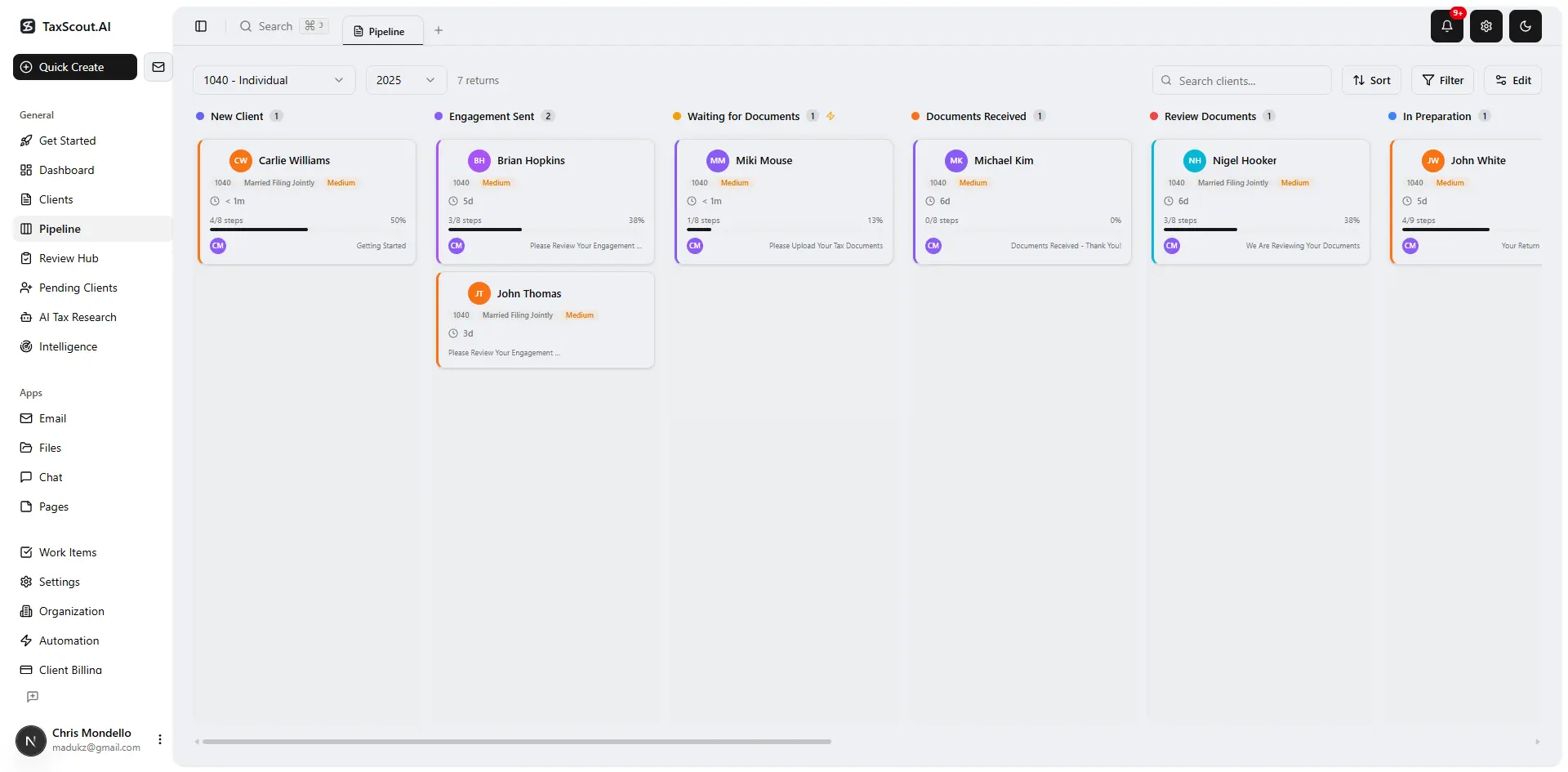
Track every return from intake to filed with drag-and-drop pipeline management
Client Migration Sequencing Without Revenue Disruption
The migration from hourly to subscription is where most playbooks go silent. The fear is real: if you reprice 30 clients simultaneously and several push back or leave, you have created a revenue gap before the new model has gained traction. The solution is a phased migration sequence that starts with the clients most likely to accept the change and uses their success stories to smooth the transition for the rest of the roster.
Phase 1 targets new clients exclusively. Any prospect onboarded after you decide to migrate goes straight onto subscription tiers. There is no negotiation, no comparison to a previous hourly rate, and no migration friction. This is the cleanest onboarding possible and it starts building your subscription revenue base immediately. The new accounting client checklist should be updated to include the subscription tier selection step during intake.
Phase 2 targets your highest-engagement existing clients — the ones who call frequently, ask planning questions, and already consume more than compliance-only service. These clients are most likely to see the subscription as a benefit, not a price increase, because you are formalizing a service level they already experience. Present the conversation as a service upgrade announcement, not a billing change. Frame the advisory call SLA and priority response as the headline. Done well, this phase often produces the clearest proof that subscription pricing CPA firms can adopt does not just stabilize revenue — it actively improves client retention.
Phase 3 covers the remaining hourly clients. By this point, you have testimonials from Phase 2 clients and a live track record. For price-sensitive clients, consider a grandfather rate for 12 months — slightly below the published tier price but still on the subscription structure. The administrative efficiency of subscription billing is worth the modest discount in the short term. Clients who absolutely refuse any form of subscription can remain on hourly if the relationship justifies it, but they should represent a diminishing share of the roster.
One critical sequencing note: do not migrate a client mid-engagement. If you are three months into a complex return, finish the engagement at the agreed terms, then present the new structure for the following year. Changing pricing mid-work erodes trust and invites disputes.
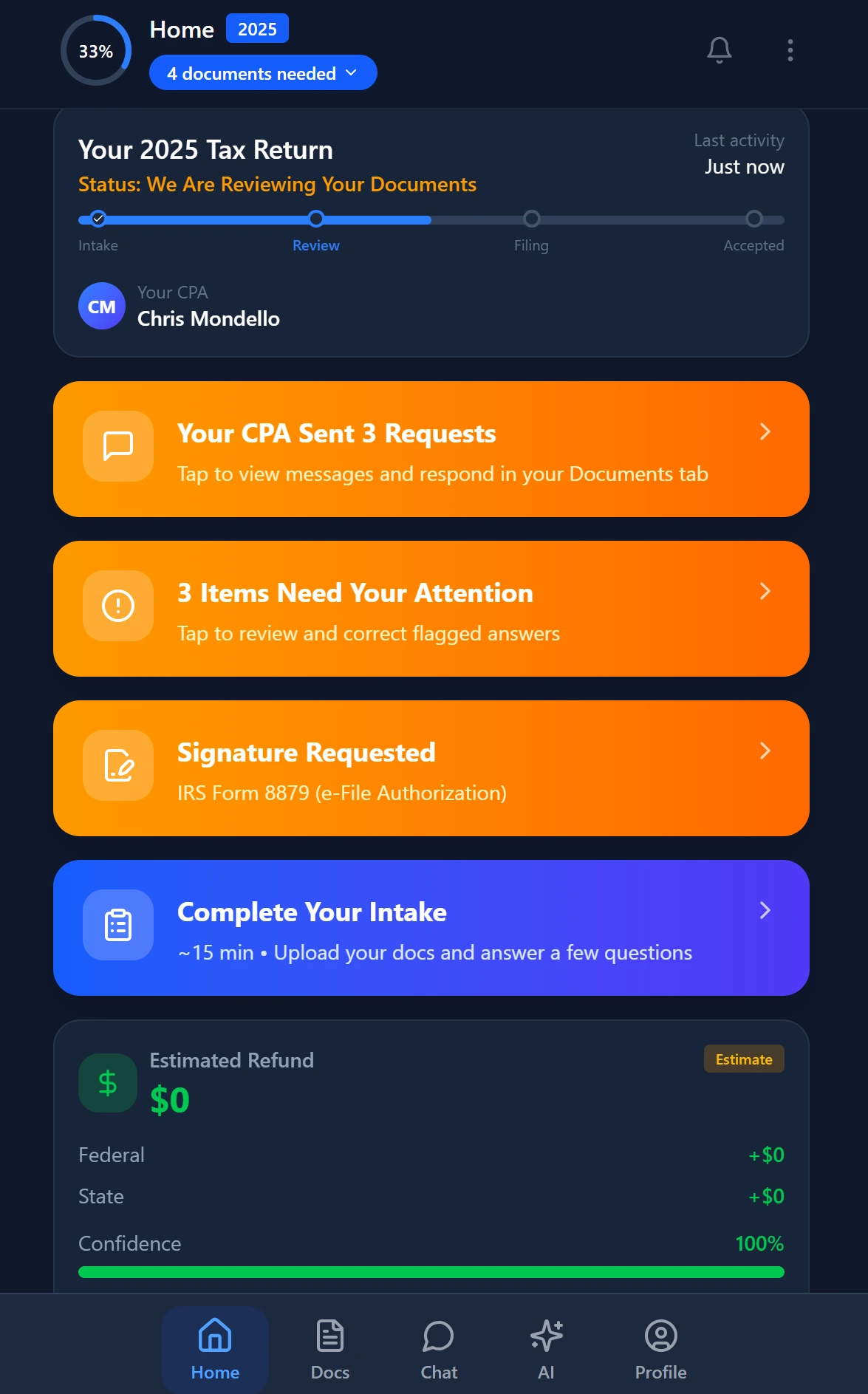
Smart intake auto-fills from uploaded documents and prior-year data
Scope Creep Guardrails That Actually Hold
Scope creep is the subscription model's existential threat. Without hourly billing to act as a natural gate, some clients will treat a flat-fee retainer as unlimited access. Left unmanaged, this collapses the margin advantage that made subscription pricing attractive in the first place. The guardrails are partly contractual and partly operational.
On the contractual side, your engagement letter must enumerate included services with enough specificity to make exclusions obvious. "Unlimited tax questions" is not a deliverable — "two advisory calls per quarter, each up to 45 minutes, on topics related to your personal and business tax strategy" is. E-signatures through a platform like TaxScout make it easy to issue updated engagement letters when scope changes, creating a documented trail that protects the firm if a dispute arises. For more detail on engagement letter construction, the write-off billing glossary entry explains how undocumented scope expansion flows directly to write-downs.
On the operational side, the most effective guardrail is a client-visible service log. When clients can see what has been delivered against their tier, two things happen: scope expansion requests become more considered (they can see the value already received), and genuine out-of-scope requests become easier for you to identify and price as add-ons rather than absorb silently. A transparent client portal with delivery history serves this function without requiring a separate tracking spreadsheet.
For requests that fall outside the subscription scope, have a standing add-on rate card ready. A notice response, a mid-year amended return, or an urgent state registration should have a published flat fee or hourly rate that you can reference immediately. This eliminates the awkward "let me think about what to charge" moment and positions the out-of-scope work as a natural extension of the relationship rather than an unexpected bill. Firms that handle this well find that subscription pricing CPA firms sustain long-term are built on exactly this kind of transparent, pre-negotiated boundary structure.

Your clients see your brand — OTP login, document upload, and real-time status
How AI Automates Recurring Billing in Practice
The irony of the early subscription pricing concept pieces is that they advocated for recurring revenue without acknowledging that recurring billing — if managed manually — creates as much admin as the hourly invoicing it replaces. Generating 300 monthly invoices, tracking which clients have active payment methods, reconciling failed charges, and updating amounts when clients change tiers is a real workload. Without automation, a solo practitioner or small firm can easily spend eight to ten hours per month on billing mechanics alone.
TaxScout's invoicing module connects directly to Stripe Connect Express, which handles subscription charge scheduling, automatic retries on failed payments, and receipts without any manual touchpoint from the firm. When a client upgrades from Core to Plus, the proration and new recurring charge update in one workflow step. The firm never touches a spreadsheet or manually re-enters payment information.
The AI layer extends this further. TaxScout's email integration — supporting Gmail OAuth, Outlook Graph, and IMAP/POP3 — classifies inbound client messages and flags those that describe out-of-scope requests. Combined with client-context AI memory that stores entity structures, filing history, and prior-year data, the system can surface a summary of what a client has already consumed in the current subscription period, giving staff the context to have a confident scope conversation without digging through notes. This kind of automation is what distinguishes an AI-native platform from a billing tool with a subscription checkbox.
For firms evaluating accounting automation, the billing layer is often underweighted relative to document processing automation. Both matter. Document automation reduces preparation time per return; billing automation ensures that the revenue model scales proportionally with client volume rather than adding linear admin overhead. That combination is what makes subscription pricing CPA firms can realistically sustain — not just adopt in theory, but operate profitably at scale.
Subscription pricing model: hourly billing versus flat-fee subscription versus tiered subscription
| Dimension | Hourly Billing | Simple Flat Fee | Tiered Subscription |
|---|---|---|---|
| Revenue predictability | Low — varies by season and scope | Medium — fixed per engagement | High — recurring monthly/annual |
| Efficiency incentive | Penalizes fast work | Neutral | Rewards AI-driven throughput |
| Scope management | Self-regulating (time is the gate) | High risk of scope creep | Managed by tier definitions |
| Client relationship | Transactional; clients self-censor | Transactional; fixed deliverable | Advisory; open communication |
| Admin overhead | Invoice per job | Invoice per engagement | Automated recurring charge |
| Migration complexity | None (status quo) | Low for new clients | Medium; phased migration needed |
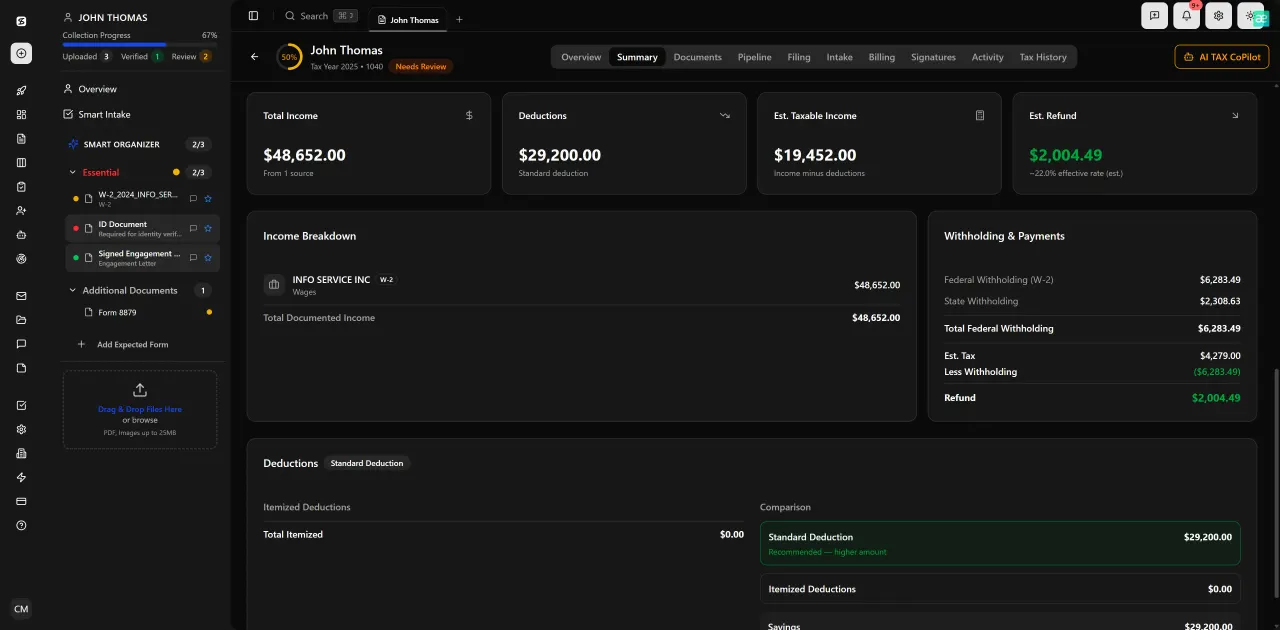
Review with AI assist — AI agents answer questions with full client context
Subscription Pricing Across Different Firm Sizes
The mechanics of subscription pricing look different depending on whether you are a solo practitioner, a small firm of two to ten people, or a mid-size firm with 20 or more staff. Solo practitioners have the most to gain from predictable cash flow — a single bad month under hourly billing can disrupt personal finances in a way that a larger firm can absorb. The TaxScout Solo plan at $49/month (or $470/year prepaid) with unlimited team members and AI extraction is sized for exactly this scenario: the technology overhead of running a subscription model is covered without a per-user cost that scales against the revenue lift. See TaxScout pricing for the full tier comparison.
For small firms, the primary risk in subscription migration is concentration — if three clients represent 60% of revenue and two of them decline to migrate, the model is undermined before it starts. The phased migration approach described earlier is especially important at this scale. Begin with new client acquisition and low-concentration clients to build a base of subscription revenue before approaching the top accounts.
Mid-size firms face a different challenge: internal adoption. Staff accustomed to logging time against every activity may resist a model where time tracking serves only internal capacity planning rather than client billing. The pipeline management tools in TaxScout — 12 customizable stages with drag-and-drop kanban — can bridge this gap by providing workflow visibility that replaces the informational role that time sheets used to play, without keeping the billing dependency on hours logged. For additional context on how AI-ready firms structure their overall operations, other blog resources cover the full practice management stack.
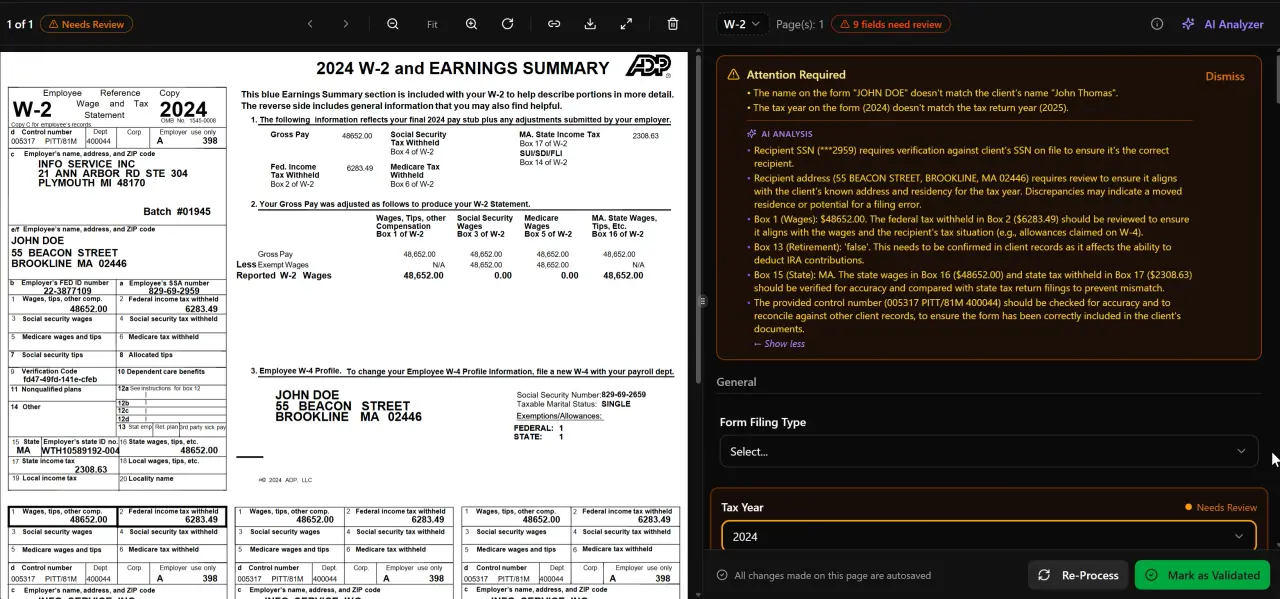
AI classifies, extracts, and validates every document automatically
Value-Based Pricing and the Advisory Revenue Layer
Subscription pricing and value-based pricing are not the same thing, but they reinforce each other. Value-based pricing means anchoring the fee to the economic outcome delivered, not the time spent. A subscription retainer that includes proactive tax planning for a small business owner is worth pricing against the tax savings that planning generates — if your advisory work consistently identifies $15,000–$30,000 in annual savings, a $700/month Premier tier is not expensive; it is a 2–4x return on investment for the client. This is where subscription pricing CPA firms use at the advisory tier separates itself most clearly from commodity compliance work.
The virtual CFO service model is the natural ceiling of this progression. At the advisory tier, the CPA firm is not just preparing returns — it is the client's financial co-pilot, reviewing monthly financials, flagging cash flow anomalies, and running scenario models ahead of major decisions. This work is genuinely hard to price by the hour because the highest-value moments (catching a costly mistake before it happens, identifying a planning window) are often brief but consequential. A monthly retainer that reflects this ongoing availability is the appropriate pricing structure.
The AI research agents in TaxScout support this advisory layer by providing real-time search across IRS, Treasury, Cornell Law, SSA, and Congressional sources. When a client calls with a question about the IRC §199A QBI deduction or the implications of a proposed entity restructuring, the advisor can run a research query in seconds and respond authoritatively in the same conversation — a capability that justifies the advisory premium without requiring hours of offline research. The QBI deduction itself is now permanent under P.L. 119-21, providing a stable planning tool that advisors can build recurring advisory conversations around.
Ready to build a subscription model that runs on AI instead of spreadsheets?
TaxScout gives CPA firms unlimited team members, Stripe-powered recurring billing, AI intake, and a client portal — starting at $49/month with no per-user fees.
Sources
- IRS Taxpayer Advocate Service — 2024 Annual Report to Congress
- Journal of Accountancy — The State of the CPA Pipeline
- IRC §199A as amended by P.L. 119-21 — Cornell Law
- IRS Rev. Proc. 2025-32 — Inflation Adjustments for Tax Year 2026
Ready to see the difference? TaxScout gives your firm AI extraction, 5-layer validation, and complete practice management — on flat firm pricing with unlimited team members. → Book a 15-Min Demo — See It Live

Track firm performance with real-time analytics and client activity monitoring
Frequently Asked Questions
Subscription pricing for CPA firms is a billing model in which clients pay a fixed monthly or annual fee for a defined bundle of services — compliance preparation, advisory calls, and planning deliverables — rather than being billed by the hour. The firm earns predictable recurring revenue, and clients get unlimited access within the defined scope without watching a clock.
Stay up to date
Get the latest tax tech insights delivered to your inbox.