Phantom Income Tax: How CPAs Protect Partnership Clients From Surprise Bills
Phantom income tax catches partnership clients off guard and erodes CPA-client trust overnight. This operational playbook shows CPAs how to identify at-risk K-1 clients, communicate proactively, and build an AI-assisted flagging workflow that surfaces phantom income scenarios before year-end…
Phantom income tax is one of the most predictable surprises in a CPA's practice — and one of the most avoidable. When a partner receives a K-1 showing $40,000 of allocated income but the partnership distributed nothing, that client faces a real tax liability funded entirely out of pocket. The situation is common in real estate limited partnerships, S corporations with debt basis limitations, and any arrangement involving cancellation of debt income. Yet most clients never see it coming.
For CPAs, the operational challenge is not understanding the tax law — it is building the practice infrastructure to detect phantom income scenarios early, communicate them before clients open their tax bills, and capture the advisory value of doing so. Reviewing K-1s at filing time is too late. By the time a Schedule K-1 lands in your pipeline, the taxable event has already occurred, the cash is already gone, and the client is already frustrated. The real risk of phantom income tax hits hardest when clients receive unexpected bills for income they never saw in their bank accounts.
This guide is not an explainer for investors. It is an operational playbook for CPAs who manage K-1-heavy portfolios and want a repeatable system — including AI-assisted workflows — that flags at-risk clients before year-end, protects client relationships, and captures the advisory time that phantom income planning actually demands. A repeatable system for identifying phantom income tax exposure before year-end is what separates reactive preparers from trusted advisors.
What Phantom Income Tax Looks Like Across Client Types
Phantom income tax arises whenever a taxpayer recognizes gross income for federal purposes without a corresponding cash distribution to fund the liability. The IRS defines gross income broadly under IRC § 61 as income from whatever source derived, which means allocated partnership income, forgiven debt, and imputed interest can all trigger phantom income without a dollar changing hands.
In partnership and S corporation contexts, the mechanism is pass-through allocation. A real estate limited partnership that generates $500,000 of taxable income — from depreciation recapture, gain on asset sales, or simply operating income — allocates that income to partners on Schedule K-1 regardless of whether distributions were made. The partner's tax obligation is real; the cash to pay it is not automatically there. Each of these scenarios can trigger a phantom income tax liability for partners who received little or no cash distribution to cover the resulting bill.
Three client profiles generate the highest phantom income tax exposure in a typical CPA practice: real estate syndication investors with passive income allocations, S corporation shareholders whose stock or loan basis has eroded, and borrowers who received debt forgiveness that qualifies as cancellation of debt income under IRC § 108. Each scenario has a different detection point, a different planning window, and a different communication approach.
Real Estate Partnerships and Phantom Income
Phantom income real estate situations are especially common in the fourth year or later of a syndicated deal. Early years often show paper losses driven by bonus depreciation and cost segregation. When those losses are exhausted, or when the partnership sells an asset, the income allocation can swing sharply positive. A client who received $0 in distributions but is allocated $60,000 in gain faces a tax bill they almost certainly did not plan for. If you serve clients who invest in real estate funds, check our cost segregation studies guide for the depreciation timing context that sets up these reversals. For firms evaluating their phantom income tax approach, this trade-off compounds over time.
S Corporation Basis Erosion
S corporation shareholders can only deduct losses to the extent of their stock and loan basis under IRC § 1366(d). When a shareholder's basis has been fully eroded by prior loss deductions and the S corp later generates income, that income is taxable even if the corporation retains the cash for working capital or debt service. CPAs who track basis year-over-year can identify the inflection point before it happens. Those who do not often discover the problem at filing time. Each of these factors directly shapes how phantom income tax plays out in practice.
Cancellation of Debt Income
When a lender forgives a debt, the forgiven amount is generally included in the debtor's gross income unless an exclusion applies. The IRS Publication 4681 covers insolvency and bankruptcy exclusions, but qualification requires documentation prepared in advance of filing. A client who receives a Form 1099-C in January has already incurred the income; the only remaining question is whether an exclusion applies. Proactive CPAs who know a client's debt restructuring is in progress can gather the insolvency worksheet data before year-end closes. Understanding phantom income tax in this context is what separates firms that scale from those that stall.
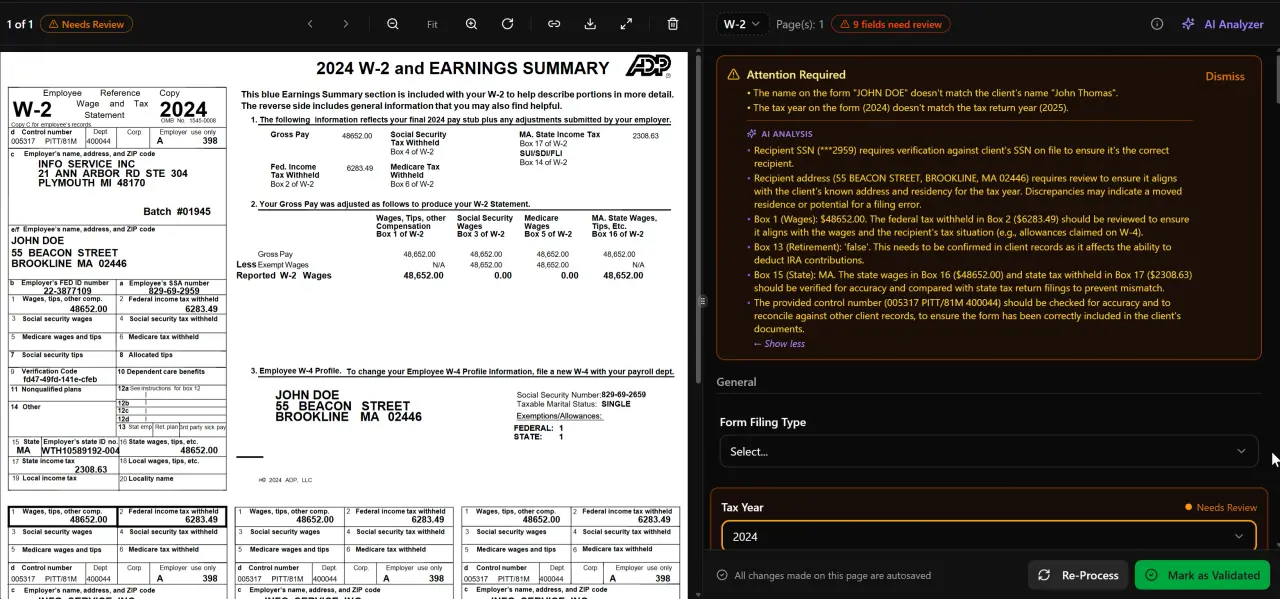
AI classifies, extracts, and validates every document automatically
Why Most CPA Firms Discover Phantom Income Too Late
The structural problem is that phantom income tax information flows to CPAs passively and late. Partnership K-1s routinely arrive in February or March, weeks after the January 31 W-2 and 1099 rush. By then, the client's estimated tax obligations for the prior year are already set, fourth-quarter estimates have been paid or skipped, and the damage is done.
Firms that rely on document receipt as the trigger for phantom income conversations are always reacting. The client call — "Why do I owe $18,000? I didn't get any money" — comes after the tax return is prepared. That conversation is harder than it needs to be, and the advisory time spent explaining, recalculating, and sometimes amending prior-year estimates is typically not captured in any engagement scope. This is precisely where a deliberate phantom income tax strategy pays off.
The content gap in competitor articles mirrors the workflow gap in most practices: they explain what phantom income is, but not how to build a system that proactively surfaces it. Other blog resources on TaxScout's site address adjacent planning topics, but phantom income demands its own operational framework because the detection window is the entire year — not just filing season.
Tired of discovering phantom income surprises at filing time instead of in October?
TaxScout's AI research agents and client-context memory help CPAs flag at-risk K-1 clients early — before year-end distributions close the planning window.
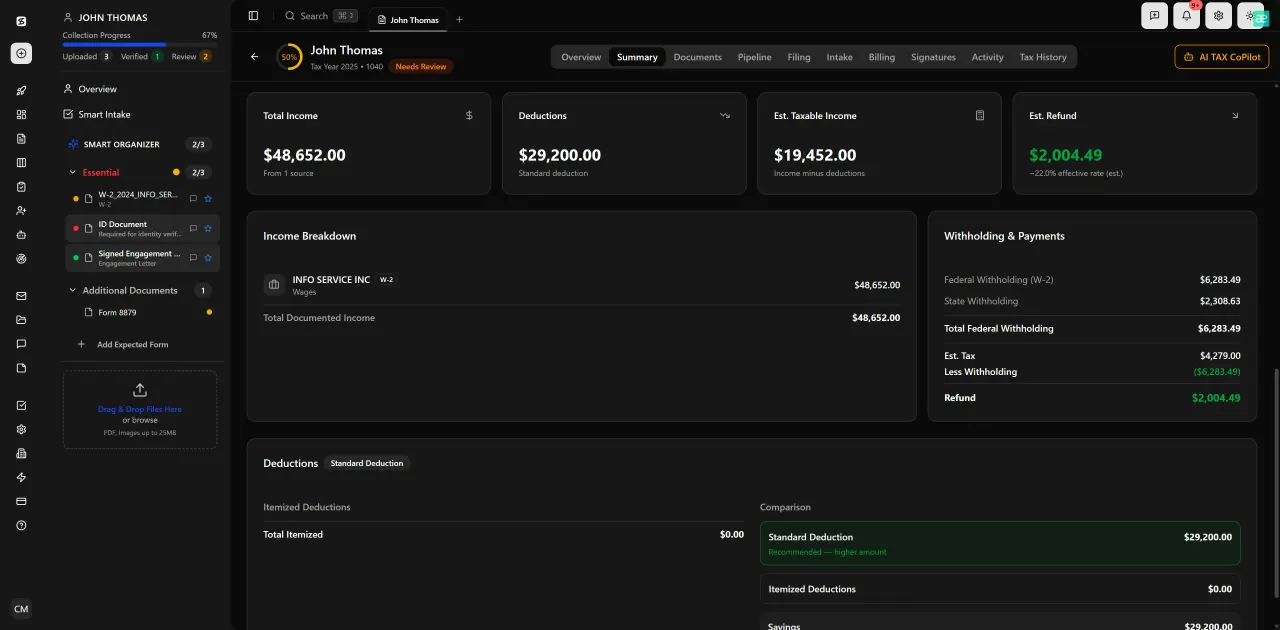
Review with AI assist — 9 agents answer questions with full client context
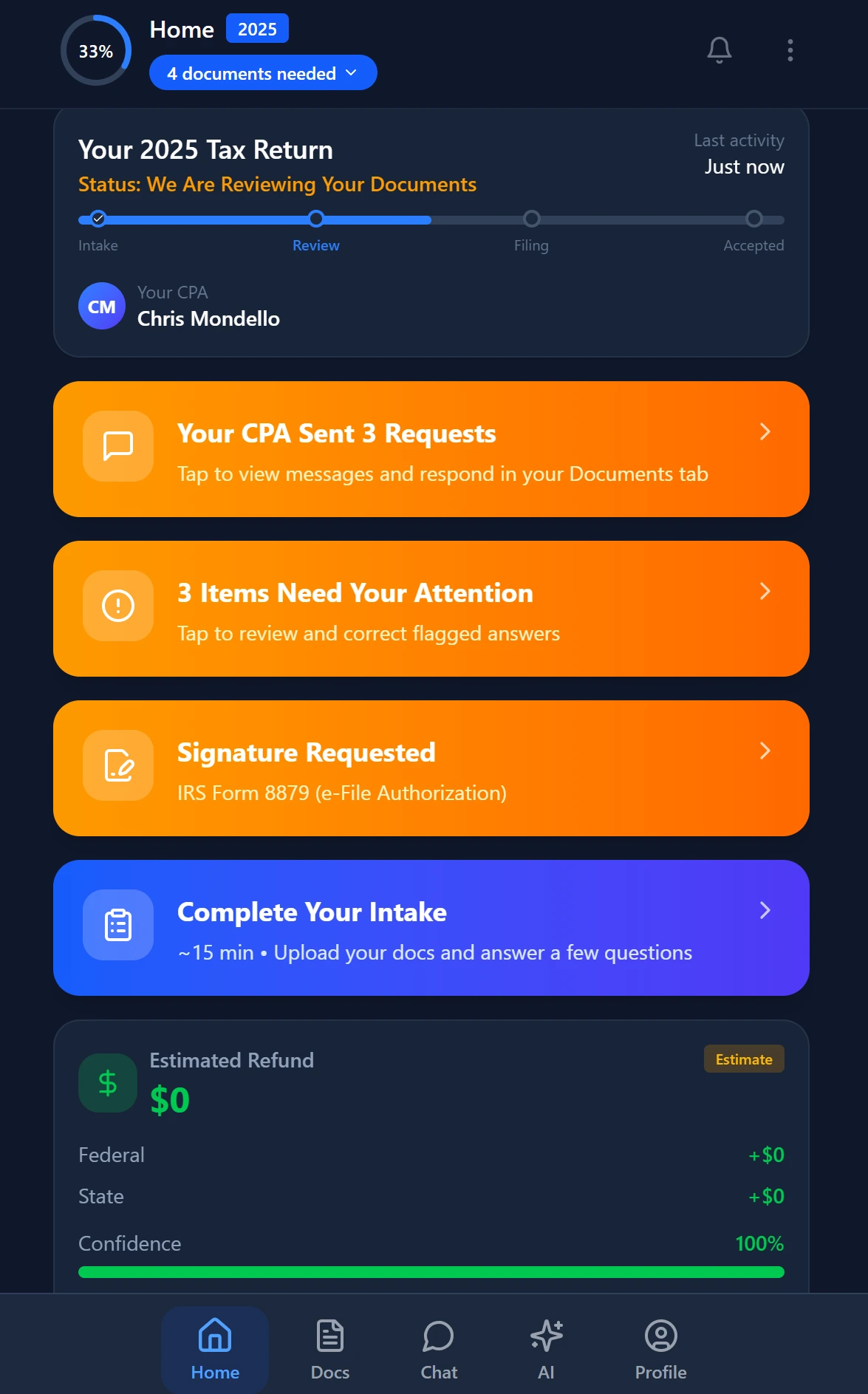
Smart intake auto-fills from uploaded documents and prior-year data
Building a Phantom Income Early-Warning Workflow
An effective early-warning system for phantom income tax operates in three phases: portfolio screening in Q3, client communication in October through November, and year-end documentation before the partnership closes its books. Each phase requires different inputs and produces different deliverables.
Phase one is portfolio screening. Pull your client list and filter for anyone who received a K-1 last year from a partnership, S corporation, or trust. For each entity, note whether the prior-year K-1 showed income or loss, whether the client has a pattern of passive income allocations, and whether any debt restructuring events occurred during the year. This screen does not require the current-year K-1 — it uses last year's data as a forward indicator.
Phase two is client communication. For clients who flag as at-risk, send a proactive note in October asking three questions: Has the partnership made any distributions this year? Have you received any correspondence about debt forgiveness or loan restructuring? Do you expect the partnership's income to be materially different from last year? The answers let you recalibrate estimated tax payments before the fourth-quarter deadline. The IRS estimated tax guidance covers the underpayment penalty thresholds that make Q4 corrections worthwhile.
Phase three is year-end documentation. Once the partnership's year-end numbers are in sight — usually by mid-December for calendar-year entities — request a preliminary income allocation from the general partner or managing member. You do not need the final K-1; a preliminary allocation letter or email is sufficient to adjust Q4 estimates and update the client's tax projection. For clients with AI document extraction workflows already in place, preliminary documents can flow directly into the review pipeline without manual data entry.
AI-Assisted Flagging of At-Risk Partnership Clients
Manual portfolio screening works, but it does not scale. A CPA managing 200 individual returns with K-1 activity cannot personally review every entity's prior-year allocations in September. AI-assisted workflows change this constraint by turning prior-year document data into proactive flags.
TaxScout's AI research agents can query IRS and Treasury guidance in real time to surface applicable exclusions, basis rules, and planning thresholds relevant to each client's situation. Combined with the platform's client-context memory — which retains entity structures, filing history, and prior-year K-1 data — the system can flag clients whose prior-year K-1 income exceeded distributions by a threshold you define, clients whose basis is approaching zero based on accumulated loss deductions, and clients who had COD income in prior years that may recur.
This is the workflow gap that no competitor has addressed in their content: not just explaining phantom income, but showing how a CPA's practice management platform can surface the risk across an entire client book without requiring the practitioner to manually inspect each file. The AI tax intelligence tools in TaxScout are designed specifically for this kind of proactive research across a K-1-heavy portfolio.
For firms already using AI document extraction for CPAs, the K-1 data captured during filing season becomes the input for the following year's screening. The prior-year K-1 allocation, the distribution amount, and the ending capital account balance are extracted and stored in the client record — available for screening queries without re-scanning documents.
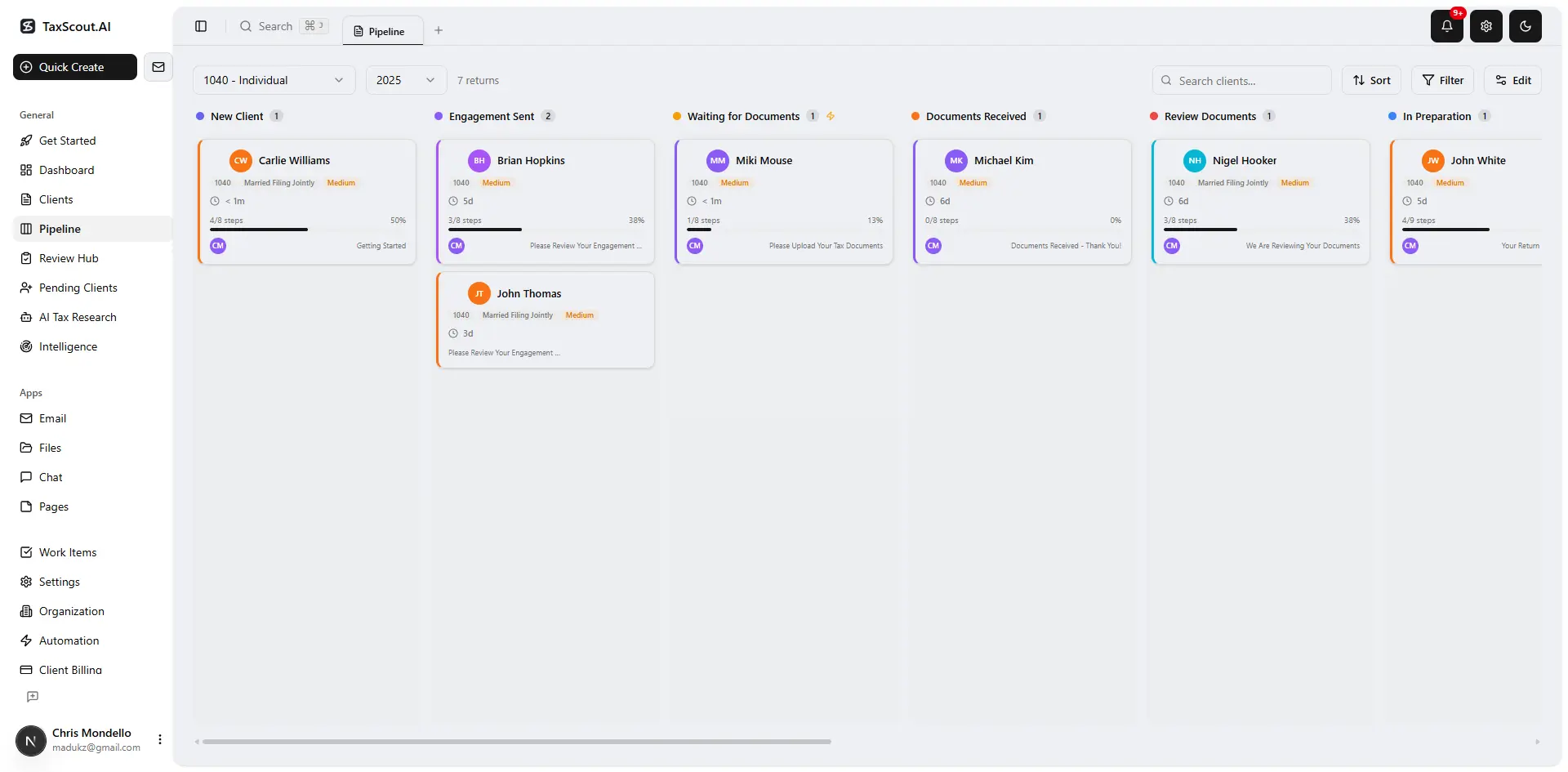
Track every return from intake to filed with drag-and-drop pipeline management

Click any extracted field to see its source highlighted on the original PDF
Communicating Phantom Income Tax to Clients Without Losing Trust
Even a technically correct explanation of phantom income can damage client relationships if it arrives after the liability is locked in. The communication objective is to deliver three things simultaneously: an explanation of what happened, a quantification of the tax impact, and a set of options the client can act on. Without all three, the conversation feels like bad news with no resolution.
The explanation should connect to the client's specific investment. "Your K-1 from Elm Street Partners shows $42,000 of income allocated to you. The partnership retained that cash for debt service rather than distributing it. Under federal tax law, the allocation creates taxable income whether or not you received the cash." This framing is factual, avoids technical jargon, and anchors the problem in the client's actual documents rather than abstract tax theory.
The quantification should show the marginal impact on their return. Pull the prior-year return as a reference and estimate the additional tax owed using the client's marginal rate plus applicable net investment income tax under IRC § 1411 if the income is passive. A one-page projection is more persuasive than a paragraph of explanation and gives the client something to share with their financial advisor.
The options depend on timing. If it is still Q3 or early Q4, the client can increase withholding on other income sources, make a Q4 estimated payment, or — in rare cases — request a partnership distribution before year-end. If it is January, the options narrow to documenting any available exclusions and determining whether a prior-year underpayment penalty applies. For clients dealing with debt forgiveness, the SSA insolvency test documentation and the IRS Form 982 election should be in the file before the return is prepared.
Proactive communication also protects the CPA. If a client later claims they were not warned about a large tax liability, the October outreach email or portal message is documented evidence that the risk was surfaced and communicated. TaxScout's client portal and communication hub maintain a timestamped thread of all client correspondence, which is important for professional liability purposes.
Phantom Income Planning and Engagement Scope Creep
One dimension of phantom income that almost no CPA content addresses is what it costs the practice in unplanned advisory time. When a surprise tax liability surfaces at filing, the CPA typically spends one to three hours explaining the situation, recalculating estimates, preparing projections, and managing the client's emotional response. None of that time is usually in scope for a standard individual tax preparation engagement.
The connection to flat fee billing for CPAs is direct: if your engagement letter defines scope as "preparation of Form 1040 and applicable schedules," phantom income advisory work falls outside it. But most CPAs absorb the time anyway to protect the relationship, which means the phantom income problem becomes a profitability problem in addition to a planning problem.
The solution is twofold. First, explicitly scope K-1 review and phantom income monitoring in your engagement letter for any client with partnership, S corporation, or trust K-1 activity. A line item for "partnership income allocation analysis and estimated tax projection" — priced separately or bundled into a higher-tier service — ensures the advisory work is authorized and compensated. Second, capture the time when it happens. Even if you do not charge for it this year, the data supports a scope conversation at renewal.
TaxScout's pipeline management with 12 customizable stages lets you create a dedicated phantom income review stage that fires automatically for any client with prior-year K-1 activity. When that stage triggers in September, the CPA or a staff member follows the review checklist, documents the findings, and generates the client communication — all within the same platform that tracks the time and connects to invoicing if additional fees apply.
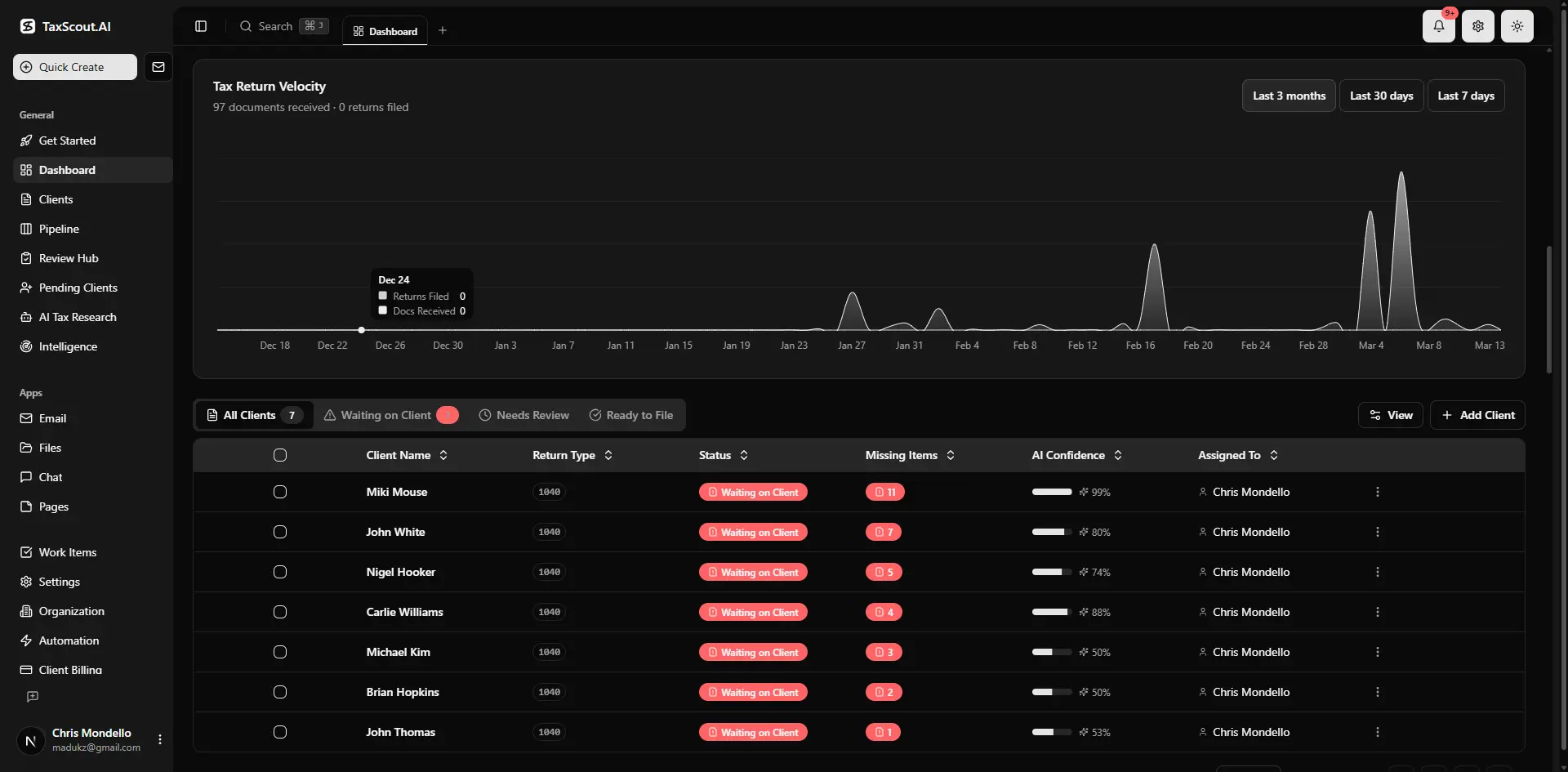
Real-time dashboard showing returns in progress, revenue, and upcoming deadlines
Phantom Income Planning Workflow: Reactive vs. Proactive CPA Practice
| Workflow Stage | Reactive Practice | Proactive Practice with TaxScout |
|---|---|---|
| Detection | K-1 arrives at filing; phantom income discovered during return prep | Prior-year K-1 data screened in Q3; at-risk clients flagged before year-end |
| Client Communication | Explanation call after return is prepared; client surprised | October outreach with projected impact and options; client prepared |
| Estimated Tax | Underpayment may already be locked in; penalty likely | Q4 estimated payment adjusted before January 15 deadline |
| COD Income | Form 1099-C received in January; insolvency documentation scrambled | Debt restructuring tracked during year; insolvency worksheet prepared pre-filing |
| Engagement Scope | Advisory time absorbed without charge; profitability eroded | K-1 advisory scoped and priced in engagement letter; time tracked |
| Documentation | Notes in tax software only; no timestamped client record | Correspondence in client portal; timestamped for professional liability |

Track firm performance with real-time analytics and client activity monitoring
Practical Steps for CPAs Managing K-1-Heavy Portfolios
If you want to operationalize a phantom income tax workflow this year, start with a one-time portfolio audit. Export your client list, filter for anyone with K-1 income in the prior year, and categorize them by risk level: high risk (K-1 income exceeded distributions or basis is near zero), medium risk (K-1 income close to distributions, or first year of investment), and low risk (established pass-through with consistent distribution history matching allocations).
For high-risk clients, create a task in your pipeline to initiate outreach by October 1. The outreach template should include three questions about distributions, debt events, and income expectations. For medium-risk clients, schedule a December check-in after the partnership's preliminary numbers are available. Low-risk clients can follow the standard K-1 receipt workflow with no additional steps.
Update your engagement letter template to include a K-1 advisory line item for any client classified as medium or high risk. Reference the IRS underpayment penalty rules under IRC § 6654 as the justification for proactive planning — the penalty exposure alone typically justifies the advisory fee several times over. For state-level exposure, review state-specific rules that may impose their own estimated tax requirements on pass-through income.
Finally, document your process. If a client later disputes a phantom income liability, your documented workflow — the Q3 screening, the October outreach, the December projection, the engagement letter language — is the professional record that demonstrates competent service. TaxScout's file management and security infrastructure ensure that documentation is retained, searchable, and accessible without depending on a practitioner's personal email archive.
Ready to stop absorbing unplanned phantom income advisory hours without capturing the value?
TaxScout gives CPA firms the AI-powered early-warning workflows, client portal communication, and pipeline management to turn reactive K-1 season into a structured advisory service.
Frequently Asked Questions
Phantom income tax occurs when a taxpayer is required to recognize taxable income — typically through a partnership K-1 allocation — without receiving a corresponding cash distribution. Because the tax liability is real but the cash is not in the client's hands, many clients are shocked when they owe a large balance at filing. The surprise is usually avoidable with proactive communication and Q4 estimated tax adjustments.
Keep reading
Energy Tax Credits for CPAs: How to Claim IRA Incentives for Business Clients
Oct 23, 2026 · 1 min read
Partnership Guaranteed Payments: How CPAs Handle SE Tax and Deductibility
Oct 22, 2026 · 1 min read
Guidance Under Section 355 Concerning Device and Active Trade or Business Partial Withdrawal
Oct 22, 2026 · 1 min read
Stay up to date
Get the latest tax tech insights delivered to your inbox.