Buy-Sell Agreement Valuation: What CPAs Must Review Before a Partner Exit
When a business owner faces a partner death, disability, or voluntary exit, buy-sell agreement valuation errors can trigger IRS challenges, estate tax disasters, and costly litigation. This guide walks CPAs through the IRC 2703 traps, cross-purchase vs. entity-redemption basis decisions, and the…
Buy-sell agreement valuation is one of the highest-stakes advisory engagements a CPA will ever touch — yet most agreements sit in a client's filing cabinet for years without a meaningful review. The moment a triggering event arrives — a partner's death, a disability claim, a retirement, or a forced buyout — every ambiguity in that document becomes a tax exposure, a valuation dispute, or a litigation risk. CPAs who position themselves as the quarterback of that review protect their clients and build a defensible, recurring advisory service line.
The practitioner-focused gaps in this area are significant. Most published guidance on buy-sell agreements is written for the business owner, not for the CPA analyzing the structure. IRS scrutiny under IRC Section 2703 — the rule that can invalidate a contractually fixed price for estate tax purposes — remains underreported in accounting blogs despite being a predictable landmine in estate plans built around artificially low agreement prices. And the tax basis step-up difference between a cross-purchase and an entity-redemption structure is a planning decision worth tens of thousands of dollars that rarely appears in client engagements until it is too late. Buy-sell agreement valuation is one of the most technically demanding areas a CPA will encounter, yet most published guidance on buy-sell agreements is written for the business owner, not for the CPA analyzing the structure.
This guide is written specifically for CPAs working with closely held business clients. Whether your client is negotiating a first agreement or a triggering event is already imminent, the framework below covers valuation methodology review, IRC 2703 compliance, structure selection, funding verification, and how AI-assisted document review can accelerate your work without sacrificing accuracy. For additional practice management resources, see our complete advisory content library. This guide is written specifically for CPAs working with closely held business clients who need a rigorous framework for buy-sell agreement valuation, whether your client is negotiating a first agreement or a triggering event is already imminent.
Why Buy-Sell Agreement Valuation Fails Without CPA Oversight
Attorneys draft buy-sell agreements, but attorneys are rarely equipped to evaluate whether the embedded valuation formula produces a defensible fair market value, whether the funding mechanism actually covers the purchase obligation, or whether the structure creates unintended income tax consequences. The CPA who fails to review the agreement before it is signed — or who assumes the client's business attorney handled every financial nuance — is leaving a professional liability gap wide open. Attorneys draft buy-sell agreements, but buy-sell agreement valuation requires a CPA's analytical lens to determine whether the embedded formula produces a defensible fair market value, whether the funding mechanism actually covers the purchase obligation, or whether the structure creates unintended income tax consequences.
The most common valuation failure modes CPAs encounter include: fixed-price agreements that were set at formation and never updated, book-value formulas that ignore intangibles and goodwill, EBITDA multiples with no industry comparables anchoring them, and appraisal clauses that name a single appraiser selected by the selling party. Each of these can produce a price that bears no resemblance to actual fair market value at the time of the triggering event. Firms that lack a consistent buy-sell agreement valuation process are especially vulnerable to these formula failures compounding over time.
The IRS is not a passive observer. Under IRC Section 2703, a buy-sell agreement price will be disregarded for estate tax purposes unless the agreement meets a three-part test: it must be a bona fide business arrangement, it must not be a device to transfer property to natural objects of the transferor's bounty, and its terms must be comparable to those negotiated at arm's length by unrelated parties. An agreement that fails this test means the IRS will substitute fair market value — potentially at a much higher figure — creating an estate tax bill the estate cannot pay because the buyout price was contractually too low. Each of these factors directly shapes how buy-sell agreement valuation plays out in practice.
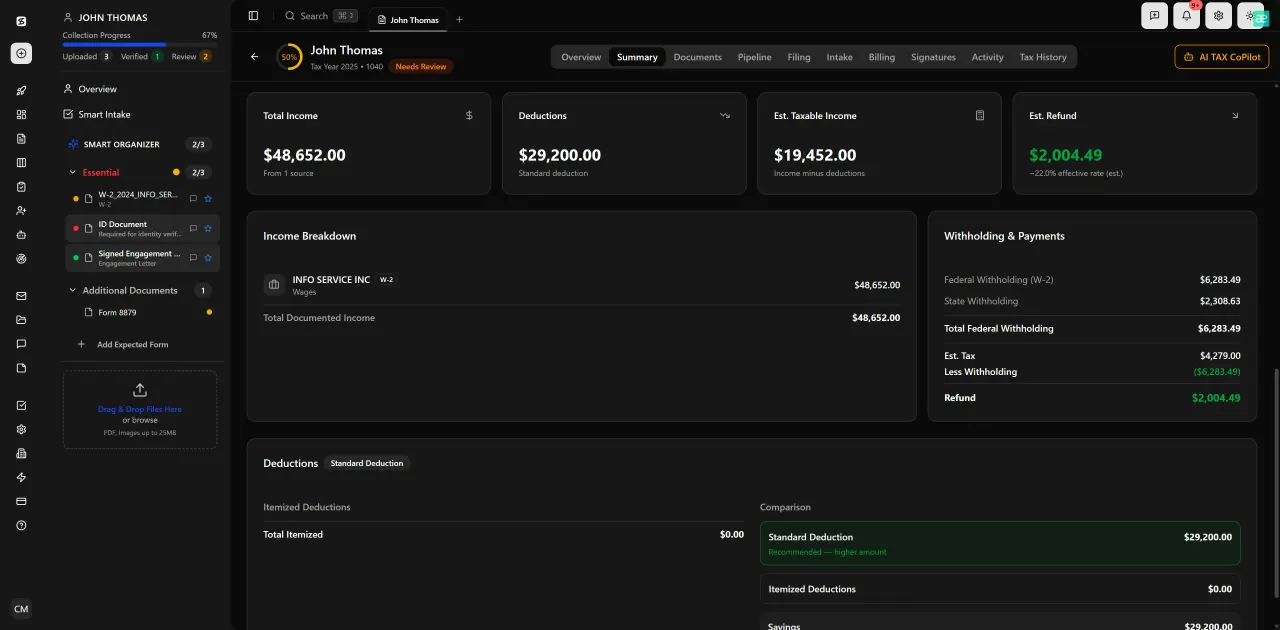
Review with AI assist — 9 agents answer questions with full client context
IRC 2703 and the Valuation Freeze Trap CPAs Must Audit
The IRC 2703 buy-sell rules are not theoretical. The Treasury regulations under Section 2703 make clear that a restriction on the right to sell or use property is disregarded when valuing the interest for transfer tax purposes unless all three statutory requirements are satisfied. For a CPA advising an estate-planning-sensitive client, the review checklist must include a direct analysis of whether the agreement's pricing mechanism would survive IRS scrutiny. Understanding buy-sell agreement valuation in this context is what separates firms that scale from those that stall.
The arm's-length comparability prong is where most agreements fail. An agreement between family members or long-term partners who set a price at formation without referencing industry transaction multiples, certified business appraisals, or documented market comparables will have difficulty demonstrating that comparable terms could be found between unrelated parties. CPAs should document in their work papers why the formula used — whether book value, capitalized earnings, or discounted cash flow — reflects a market-consistent methodology. This is precisely where a deliberate buy-sell agreement valuation strategy pays off, because the documentation standard is higher than most initial engagements anticipate.
Practically, this means a CPA review of a buy-sell agreement should include: (1) identifying the valuation trigger and formula language in the agreement; (2) comparing the formula output to an independent valuation estimate using current financials; (3) determining whether the gap between formula price and estimated FMV is material enough to raise a Section 2703 red flag; and (4) recommending an update clause — typically a mandatory annual or biennial revaluation — to keep the price defensible over time. Partners frequently resist these clauses because they create uncomfortable conversations, but the alternative is a far more expensive IRS dispute. For clients navigating complex state-level transfer tax rules alongside federal exposure, the CPA should also consult state tax authority guidance applicable to the entity's domicile. Buy-sell agreement valuation sits at the center of this decision — get it wrong and the rest unravels.
Tired of manually tracking buy-sell review items across email threads and scattered PDFs? When firms revisit their buy-sell agreement valuation priorities, the gaps usually surface here.
TaxScout's AI research agents and pipeline management give CPA advisory teams a structured, repeatable workflow for high-stakes client engagements — without the per-seat costs.

Click any extracted field to see its source highlighted on the original PDF

Your clients see your brand — OTP login, document upload, and real-time status
Cross-Purchase vs. Entity Redemption: The Basis Step-Up Decision
The structural choice between a cross-purchase agreement and an entity-redemption agreement is one of the most consequential tax planning decisions embedded in any buy-sell arrangement — and it is consistently underanalyzed in initial drafts. In a cross-purchase structure, the surviving owners personally purchase the departing partner's interest, which means their cost basis in the business steps up to the purchase price. In an entity-redemption structure, the company itself buys back the interest, and the remaining owners' basis in their shares does not increase.
That basis difference has real dollar consequences at the next exit event. If the surviving partners eventually sell their interests, a cross-purchase structure reduces their taxable gain by the full amount they paid for the predecessor's share. An entity-redemption structure leaves them with their original, lower basis — resulting in a higher capital gain tax at their eventual sale. For S-corporations, partnerships, and LLCs taxed as partnerships, the IRC Section 754 election can partially address the entity-redemption basis problem by allowing a step-up in the entity's inside basis, but the election must be in place and the mechanics must be verified with current financials. Proper buy-sell agreement valuation at the time of the triggering event is what makes this basis comparison meaningful — without a defensible price, the step-up calculation itself is unreliable.
Life insurance funding adds another layer of complexity to this decision. Under a cross-purchase arrangement funded with life insurance, each partner owns a policy on every other partner's life. For a four-partner firm, that means twelve policies — an administrative burden that grows combinatorially. Under an entity-redemption arrangement, the company owns a single set of policies on each partner's life. However, IRS Notice 2008-34 and subsequent guidance have addressed the tax treatment of split-dollar life insurance and entity-owned policies in ways that require careful review. CPAs should also evaluate whether the death benefit proceeds are includable in the gross estate under IRC Section 2042, particularly when the decedent held any incidents of ownership in the policy.
A practical CPA review matrix for this decision should evaluate: entity type and whether a 754 election is active, number of partners and the insurance policy proliferation problem, whether any partner is uninsurable (which makes insurance-funded cross-purchase unworkable), the relative marginal tax rates of the surviving partners, and projected holding periods before the next exit event. This is a billable advisory service that most CPA firms undercharge or fail to offer systematically.
Cross-Purchase vs. Entity Redemption: Key Tax and Operational Differences
| Factor | Cross-Purchase | Entity Redemption |
|---|---|---|
| Buyer of departing interest | Surviving owners personally | The entity itself |
| Basis step-up for survivors | Yes — full purchase price | No — unless IRC 754 election active |
| Life insurance ownership | Each partner owns policies on others | Entity owns all policies |
| Insurance policy count (4 partners) | 12 policies | 4 policies |
| Death benefit estate inclusion risk | Lower (owner not insured) | Higher — review IRC 2042 |
| Administrative complexity | High (scales with partner count) | Lower |
| S-Corp / C-Corp AMT consideration | Not applicable at entity level | C-Corps: CAMT on death benefit proceeds |
Funded Buy-Sell Agreements: Verifying the Money Is Actually There
A beautifully drafted buy-sell agreement is worthless if the funding mechanism fails at the moment of a triggering event. CPAs frequently discover that life insurance policies funding a buy-sell agreement have lapsed, that policy face amounts have not been updated since the agreement was drafted a decade ago, or that disability buyout insurance was never purchased at all. A funded buy-sell agreement review is one of the most concrete, near-term-value advisory services a CPA can deliver, and it is inseparable from a rigorous buy-sell agreement valuation — because a funding gap analysis requires knowing what the business is actually worth.
The CPA's funding verification checklist should include: (1) obtaining current in-force illustrations for every policy tied to the agreement; (2) comparing current face amounts to the estimated buyout obligation under the agreement's valuation formula; (3) confirming policy ownership and beneficiary designations match the agreement's structure (cross-purchase vs. entity-redemption); (4) reviewing whether premium payments are current and whether any policy is in a grace period; and (5) identifying disability buyout coverage and confirming the waiting period, benefit duration, and definition of disability align with the agreement's disability trigger language.
For clients with significant goodwill or enterprise value growth since the agreement was last updated, the funding gap can be substantial. A $2 million face-value policy written in 2015 may cover only a fraction of a business now valued at $8 million using current market multiples. The IRS does not accept unfunded obligations as a reason to reduce estate tax liability — the estate owes tax on fair market value regardless of whether the surviving partners can actually pay the contractual price. Reviewing the cost segregation studies guide alongside the buy-sell review can also surface depreciation recapture exposures that affect the after-tax value the selling partner actually receives.
A best practice is for the CPA to conduct a funded buy-sell agreement review on a biennial cycle, ideally aligned with the financial statement review or compilation engagement. This creates a natural touchpoint for the valuation formula update, funding gap analysis, and structure review — and it is far easier to present as a standing engagement rather than a one-time project.

Track every return from intake to filed with drag-and-drop pipeline management
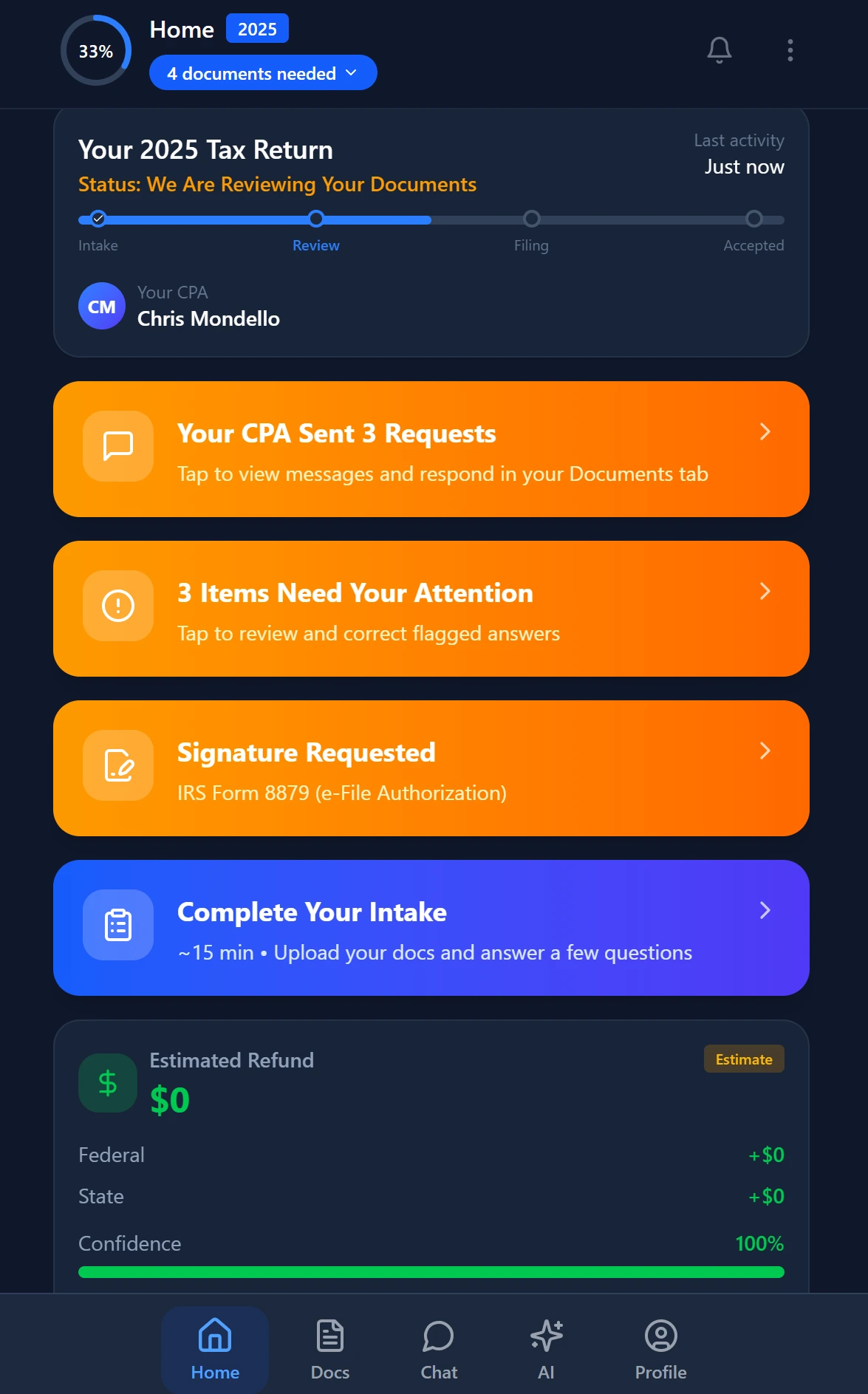
Smart intake auto-fills from uploaded documents and prior-year data
How AI-Assisted Document Review Reduces Missed Valuation Clauses
Buy-sell agreements are dense legal documents — often 30 to 80 pages — and the critical valuation provisions can be buried in exhibit schedules, amendment riders, or cross-referenced operating agreement sections that were never consolidated. Manual document review under time pressure creates real risk of missing a valuation formula buried in Exhibit B or a triggering event definition that uses a non-standard disability threshold. AI-assisted document review changes this workflow materially, particularly for firms managing buy-sell agreement valuation engagements across a large client portfolio.
TaxScout's AI document extraction and AI research agents allow CPA advisory teams to ingest multi-document client packages — the buy-sell agreement, the operating or shareholder agreement, prior-year returns, K-1s, and insurance policy summaries — and surface the specific provisions that require professional judgment. The split-screen PDF viewer with click-to-source field highlighting means the reviewing CPA can see the extracted clause next to the source document in context, reducing the risk of acting on a misread provision.
The AI research agents also enable real-time cross-referencing against current IRS guidance and Treasury regulations during the review. When a CPA is evaluating whether a valuation formula satisfies the IRC 2703 arm's-length comparability standard, being able to pull the current regulatory text and relevant case law without leaving the workflow reduces both research time and the risk of citing superseded guidance. For a deeper look at how AI document processing works in practice, the AI document extraction guide for CPAs covers the technical architecture in detail.
From a pipeline management perspective, firms that systematize buy-sell agreement reviews as a named service offering — with a defined intake checklist, a document collection stage, a review stage, and a client deliverable stage — can track these engagements across the portfolio alongside tax preparation work. The 12 customizable pipeline stages in TaxScout's kanban board allow the same team managing 1040 returns during tax season to maintain visibility on advisory engagements without a separate project management tool.
Building a Repeatable Buy-Sell Review Service for CPA Firms
The advisory opportunity here extends well beyond a single engagement. Every closely held business client on a CPA's roster is a candidate for buy-sell agreement review — and most have never had a CPA look at their agreement with a tax lens. According to SBA data on small business ownership, the majority of small businesses with multiple owners operate without a current, funded buy-sell agreement. That is a large addressable population within most CPA portfolios, and buy-sell agreement valuation is the analytical core of what makes each of those reviews billable and defensible.
A structured service offering for this engagement might include three tiers: a document review and risk assessment (identifying IRC 2703 exposure, funding gaps, and structural mismatches); a planning memo with recommended changes (covering valuation methodology, structure selection, and funding targets); and an implementation coordination engagement (working with the client's attorney and insurance advisor to execute the recommended changes). Each tier is separately engageable and separately billable — aligning well with value-based pricing models that many CPA firms are adopting in advisory lines.
For firms already using flat-fee billing, a buy-sell review service priced at a fixed annual retainer creates predictable revenue and a clear client retention mechanism. Business owners who understand that their CPA is actively monitoring their succession plan are far less likely to move to a lower-cost competitor at tax season. The engagement also creates natural cross-sell pathways to estate planning, retirement plan optimization, and entity structure reviews.
Client intake for these engagements is simplified when the CPA firm has a structured document collection process. TaxScout's smart intake engine and branded client portal allow firms to deploy a custom document request list — requesting the buy-sell agreement, operating agreement, prior returns, and insurance policy summaries — with OTP-authenticated secure upload, no password required for the client. The e-signature workflow handles engagement letter execution via Documenso before document collection begins, establishing scope and fee terms cleanly.
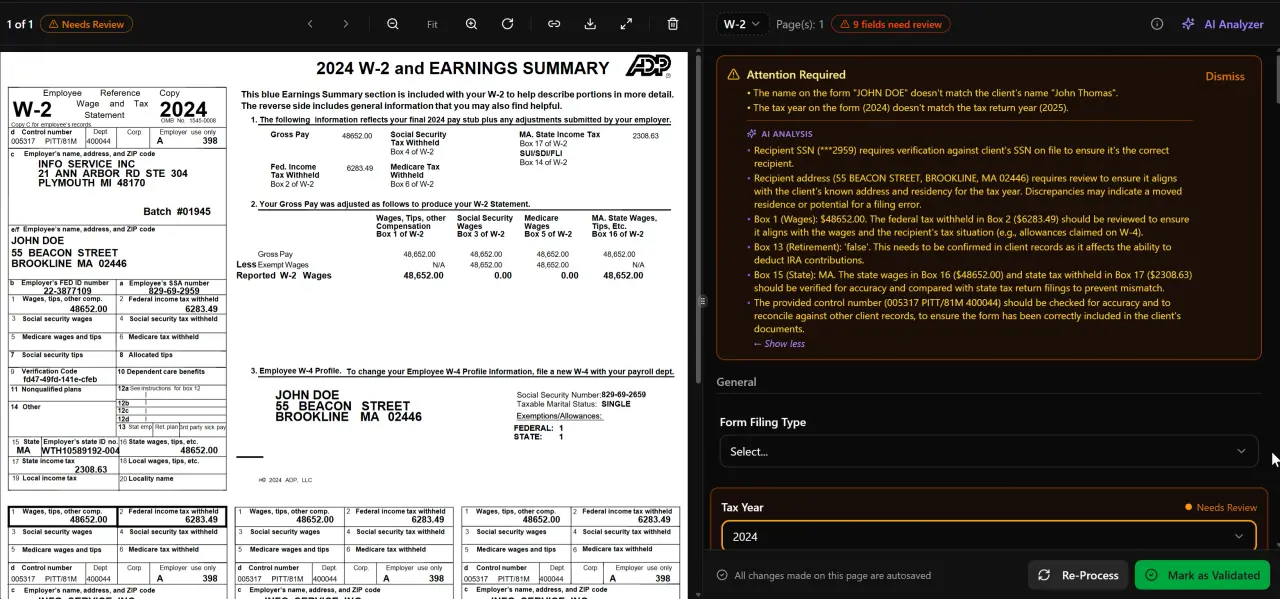
AI classifies, extracts, and validates every document automatically

Every client gets organized documents, status tracking, and a complete history
Partner Exit Tax Planning: What the CPA Must Model Before Closing
When a triggering event is actually imminent — a partner has announced retirement, a disability claim has been filed, or a death has occurred — the CPA's role shifts from advisory to urgent modeling. Partner exit tax planning at this stage requires the CPA to rapidly assess: the character of the gain to the selling partner (ordinary income vs. capital gain, including IRC 751 hot asset analysis for partnerships); the tax impact on the surviving partners and the entity; the treatment of any deferred compensation, earnout, or installment obligations; and whether the transaction qualifies for any available elections or timing strategies. A completed buy-sell agreement valuation is the prerequisite for all of this modeling — without a defensible price established before the event, the tax analysis has no stable foundation.
For S-corporation clients, the sale of shares by a departing shareholder is generally capital gain at the shareholder level, but the entity must verify that the transaction does not inadvertently create a second class of stock or trigger an inadvertent S-election termination. For partnerships and LLCs, the IRC 751 hot asset rules mean that ordinary income lurks inside capital-transaction packaging — and a CPA who models only capital gain for the selling partner without running a 751 analysis is leaving the client exposed to an unexpected tax bill. The BLS data on business ownership transitions underscores how frequently these events occur — making preparedness a competitive advantage for advisory-oriented CPA firms.
Installment sale treatment under IRC Section 453 is frequently available in entity-redemption buyouts and can spread the selling partner's gain over the payment period — but it must be elected on the return for the year of the sale and it does not apply to recaptured depreciation, which is taxable in full in the year of the transaction. The CPA should also confirm whether any state tax obligations arise from the exit, particularly in states that tax nonresident income from pass-through entity sales differently from the federal treatment. See the IRS guidance on installment sales for the current mechanics and limitations.
Ready to systematize buy-sell review as a billable advisory service without adding overhead?
TaxScout gives CPA firms AI research agents, structured pipeline management, and a secure client portal — all at a flat price with no per-seat fees and unlimited team members.
Frequently Asked Questions
IRC Section 2703 requires that a buy-sell agreement price be disregarded for estate tax purposes unless the agreement is a bona fide business arrangement, is not a device to transfer value to family members below market, and reflects terms comparable to arm's-length negotiations between unrelated parties. If the agreement fails this test, the IRS will substitute fair market value — often significantly higher than the contractual price — creating an estate tax obligation the estate may not be able to fund.
Keep reading
Energy Tax Credits for CPAs: How to Claim IRA Incentives for Business Clients
Oct 23, 2026 · 1 min read
Partnership Guaranteed Payments: How CPAs Handle SE Tax and Deductibility
Oct 22, 2026 · 1 min read
Guidance Under Section 355 Concerning Device and Active Trade or Business Partial Withdrawal
Oct 22, 2026 · 1 min read
Stay up to date
Get the latest tax tech insights delivered to your inbox.