Cost Segregation Studies: How CPAs Unlock Hidden Depreciation for Clients
Cost segregation studies are one of the most powerful accelerated depreciation strategies available to real estate clients — yet most CPAs leave them on the table. This guide walks through how to identify qualifying properties, coordinate with engineers, and document results on the return, all…
Cost segregation studies sit at the intersection of engineering, tax law, and client advisory — and most CPA firms are not offering them. The typical firm prepares the depreciation schedule exactly as the closing statement suggests: 39 years for commercial real estate, 27.5 years for residential rental property, and moves on. Meanwhile, a cost segregation study could reclassify 20–40% of that building's cost basis into 5-, 7-, or 15-year property, generating tens of thousands of dollars in first-year deductions. That tax savings often dwarfs the annual compliance fee the firm charged.
The CPA literature on cost segregation is almost entirely written for property owners, not for practitioners. That gap matters: the advisor who knows how to spot an eligible property, initiate a study, and fold the results into the return is the one who earns the planning engagement, the referral, and the higher fee. This guide is written for that advisor — covering how to identify candidates in your existing client base, how the engineer workflow actually operates, how to handle the interplay with bonus depreciation and Section 179, and how to document everything cleanly on the return. Yet the firms consistently winning high-value real estate clients have built repeatable workflows around cost segregation studies, turning what most practitioners treat as a niche specialty into a core advisory offering.
The upside extends beyond the tax savings itself. Offering cost segregation as a packaged advisory service gives compliance-heavy firms a natural on-ramp into higher-margin work without hiring specialists. The engineering is outsourced; your role is identifying opportunity, coordinating the engagement, interpreting results, and delivering a recommendation clients will act on. Done well, a single cost segregation conversation can reframe how a client thinks about the value of their CPA relationship. Firms that position cost segregation studies as a standard part of their real estate client onboarding consistently report stronger retention and higher average engagement fees than those who treat it as a one-off project.
What Cost Segregation Studies Actually Do
Depreciation under the standard straight-line method treats a commercial building as a single 39-year asset. A cost segregation study disaggregates that building into its component parts — electrical systems, plumbing, flooring, land improvements, specialty lighting, and more — and assigns each component the shortest defensible recovery period under IRS Rev. Proc. 87-56 and the MACRS asset class tables. Components classified as 5- or 7-year personal property can qualify for 60% bonus depreciation in 2024 under current Tax Cuts and Jobs Act phase-down rules, accelerating deductions that would otherwise stretch across four decades. This is precisely why cost segregation studies can unlock depreciation deductions in years one through five that would otherwise be spread across nearly four decades under the default method.
The result is a front-loaded deduction profile. A $2 million office building acquired in 2024 might have $350,000–$500,000 of its cost basis reclassified into short-life categories. With 60% bonus depreciation applied, that translates to $210,000–$300,000 of incremental first-year depreciation above the straight-line baseline — before any Section 179 election. For a client in the 37% bracket, that is a real tax deferral worth $77,000–$111,000 in year one alone. For firms evaluating their cost segregation studies approach, this trade-off compounds over time.
Critically, cost segregation is not a gray area. The IRS Audit Techniques Guide for Cost Segregation explicitly acknowledges the technique's validity and outlines what documentation is required to defend the allocations. A study prepared by a qualified engineer using the detailed engineering approach or the engineering cost estimate approach is the defensible standard the IRS expects. Each of these factors directly shapes how cost segregation studies plays out in practice.

Click any extracted field to see its source highlighted on the original PDF
Identifying Qualifying Properties in Your Client Portfolio
The most practical first step is a portfolio scan, not a technical deep dive. You are looking for three conditions: a depreciable real property asset, sufficient basis to make the study fee economical, and a client who has taxable income to absorb the accelerated deductions. As a rough rule of thumb, properties with a depreciable basis above $500,000 generate enough reclassified depreciation to justify a study fee that typically runs $5,000–$15,000 for a single asset. Understanding cost segregation studies in this context is what separates firms that scale from those that stall.
Property types with the highest reclassification potential include hotels and hospitality assets (often 25–35% of basis qualifies as 5- or 7-year), restaurants and food service facilities (15–30%), manufacturing and warehouse facilities (10–20%), and medical or dental offices (15–25%). Retail strip centers and multi-family residential properties are also strong candidates. A client who recently acquired, constructed, or significantly renovated a commercial property and has not yet had a study performed is your highest-priority conversation. This is precisely where a deliberate cost segregation studies strategy pays off.
Do not overlook look-back opportunities. Under Rev. Proc. 2002-9, a taxpayer who has never performed a cost segregation study on a property can catch up all missed depreciation in the current tax year via a Form 3115 change in accounting method — without amending prior returns. Properties acquired as far back as 1987 are eligible. For a client who purchased a $3 million building five years ago and never had a study done, the catch-up adjustment can be enormous. This is a powerful conversation opener during annual review meetings. Cost segregation studies sits at the center of this decision — get it wrong and the rest unravels.
During intake and onboarding, property ownership signals are often buried in documents that clients upload without context — Schedule E rental income, Form 4562 depreciation schedules, K-1s from real estate partnerships. TaxScout's AI document extraction reads all of these at intake and surfaces them in a structured view, making it far easier to spot a client who owns commercial real estate and has never flagged it as an advisory opportunity. Our AI intake engine can flag properties above basis thresholds automatically, turning a manual portfolio review into a systematic process that runs every time a new client or document enters the system. When firms revisit their cost segregation studies priorities, the gaps usually surface here.
Tired of spotting cost segregation opportunities only after tax season ends?
TaxScout's AI intake flags real estate holdings and depreciation schedules at document upload — so you never miss a high-value advisory conversation.
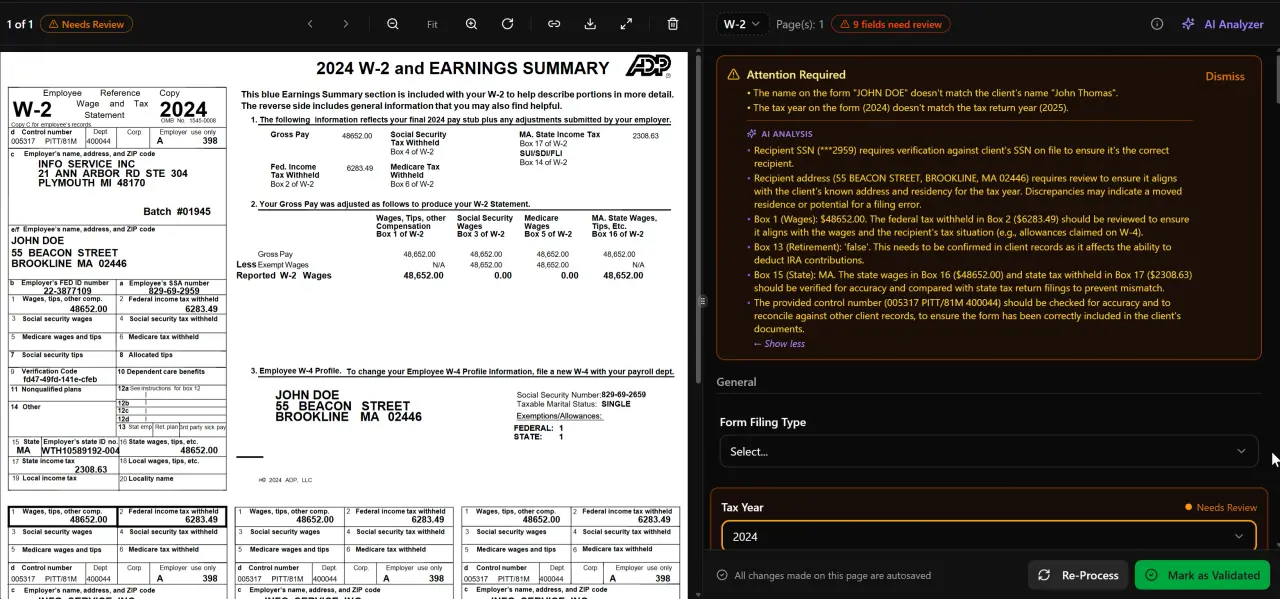
AI classifies, extracts, and validates every document automatically
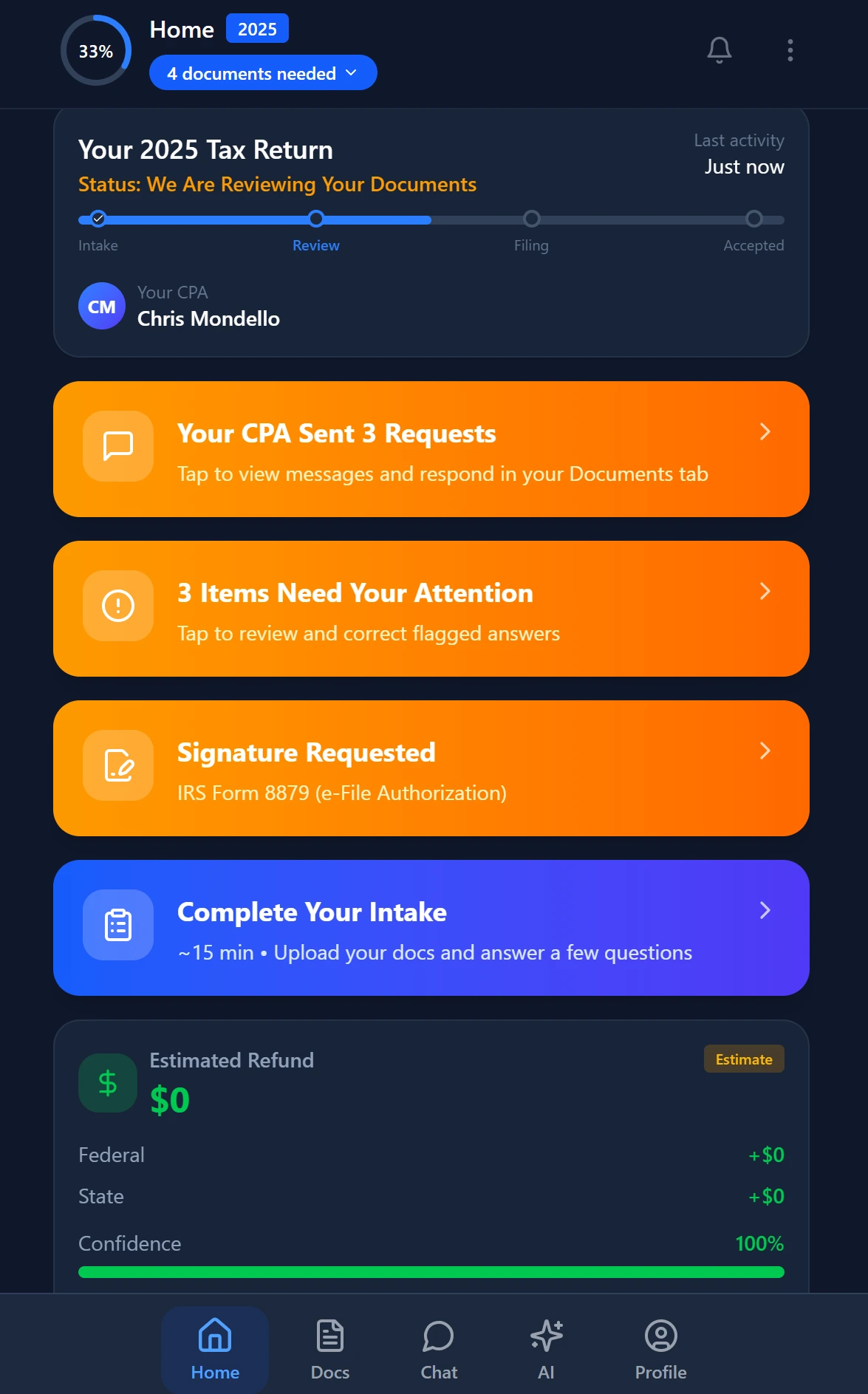
Smart intake auto-fills from uploaded documents and prior-year data
How to Coordinate With a Cost Segregation Engineer
The CPA's role in a cost segregation engagement is to identify the opportunity, frame the analysis for the client, and integrate results into the return. The engineering work is performed by a third-party specialist — typically a firm with both engineering credentials and tax experience. Selecting the right vendor matters: the IRS has disallowed studies performed exclusively by CPAs without engineering credentials, as well as rule-of-thumb studies that do not rely on actual cost data. Look for firms that use the detailed engineering approach, employ licensed engineers or architects, and provide a report that ties every reclassification to actual construction cost data or Marshall Valuation Service unit costs.
The information handoff is straightforward. The engineer needs the closing or settlement statement, construction cost detail (if applicable), architectural drawings or floor plans, a property description, and the placed-in-service date. Most established cost segregation firms have a standard document request list. Once they have what they need, turnaround is typically two to four weeks for a standard commercial asset. You receive a detailed report allocating each component to an asset class, along with a workpaper file that maps to IRS asset class descriptions.
From there, your job is to load the allocated cost basis figures into your tax preparation software — Drake, CCH Axcess, Lacerte, UltraTax CS, or ProSeries — as separate assets on Form 4562, applying the applicable MACRS method and convention for each class. If bonus depreciation applies, confirm the election (or non-election) is consistent with the client's overall tax position. TaxScout works alongside all of these platforms, and you can use TaxScout's PDF tools to OCR and extract line items from the engineer's report directly into your workpaper, eliminating manual retyping. You can also explore other blog resources covering document management and AI-assisted tax workflows for more on streamlining the preparation phase.
Retain the engineer's report in the client file permanently — not just for the current year, but because any future disposition of a reclassified asset will require basis allocation documentation to compute gain or recapture correctly. For firms running a paperless workflow as described in our guide to paperless accounting, storing the report with version control in a client-linked document vault is the right practice.
Section 179 vs Cost Segregation: Choosing the Right Tool
CPAs often conflate Section 179 and cost segregation because both accelerate depreciation, but they operate differently and serve different planning goals. Section 179 allows an immediate expensing election for qualifying personal property up to the annual dollar limit ($1,220,000 in 2024, phased out above $3,050,000 of total qualified property placed in service), but it cannot create or increase a net operating loss — the deduction is limited to taxable income from active business. Cost segregation, by contrast, reclassifies property into shorter recovery periods and then applies MACRS or bonus depreciation; it can generate or increase an NOL, which may be carried forward.
The practical decision tree: if the client has a property cost below the Section 179 dollar limit and sufficient active business income, a Section 179 election on the reclassified personal property components may be simpler and fully as effective. If the property is large, the client has passive income to absorb an NOL, or the goal is to maximize first-year deductions beyond the Section 179 cap, cost segregation with bonus depreciation is the right structure. For a client with both a $5 million commercial acquisition and an active trade or business generating $2 million of income, the combination of cost segregation reclassification plus a Section 179 election on the qualifying personal property components and 60% bonus depreciation on the remainder typically produces the optimal result.
The passive activity rules under IRC Section 469 add another layer. If the accelerated depreciation generates a passive loss, the client needs sufficient passive income to absorb it — or needs to qualify as a real estate professional under IRC Section 469(c)(7) to convert the loss to active. Understanding the client's activity classification before recommending a study is essential due diligence, not optional. TaxScout's AI research agents can run a real-time search across IRS guidance and case law on passive activity classification issues, giving you a defensible memo to attach to the recommendation.

Your clients see your brand — OTP login, document upload, and real-time status
Documenting Accelerated Depreciation on the Return
Once the engineer's report is in hand and the tax preparation decision is made, the documentation workflow is methodical. Each reclassified asset is entered as a separate asset on the depreciation schedule with its allocated cost, placed-in-service date, asset class, recovery period, and applicable MACRS convention (generally half-year unless the mid-quarter convention is triggered). Bonus depreciation elections — or elections out of bonus depreciation — are made at the asset class level on Form 4562, Part II. If a Section 179 election is combined, it flows through Part I.
For a Form 3115 catch-up (look-back study on a property already in service), the net Section 481(a) adjustment — the cumulative difference between depreciation actually claimed and depreciation that would have been claimed under the corrected method — is reported as a negative Section 481(a) adjustment on the return, which is a one-time deduction in the year of change. The Form 3115 itself is filed with the return and a copy sent to the IRS National Office. Most tax software has a Form 3115 module; populate it with the change number (typically No. 7 for depreciation), the item being changed, and the 481(a) amounts. The IRS's own guidance on accounting method changes outlines the procedural requirements in detail.
For pass-through entity clients — partnerships, S corporations, LLCs — the accelerated depreciation flows to the partners or shareholders on their K-1s. Confirm that the K-1 properly reflects each partner's share of the Section 179 deduction, bonus depreciation, and any 481(a) adjustment. The QBI deduction calculation may also be affected if the depreciation reduces qualified business income — run the W-2 wage and UBIA of qualified property limitations before finalizing.
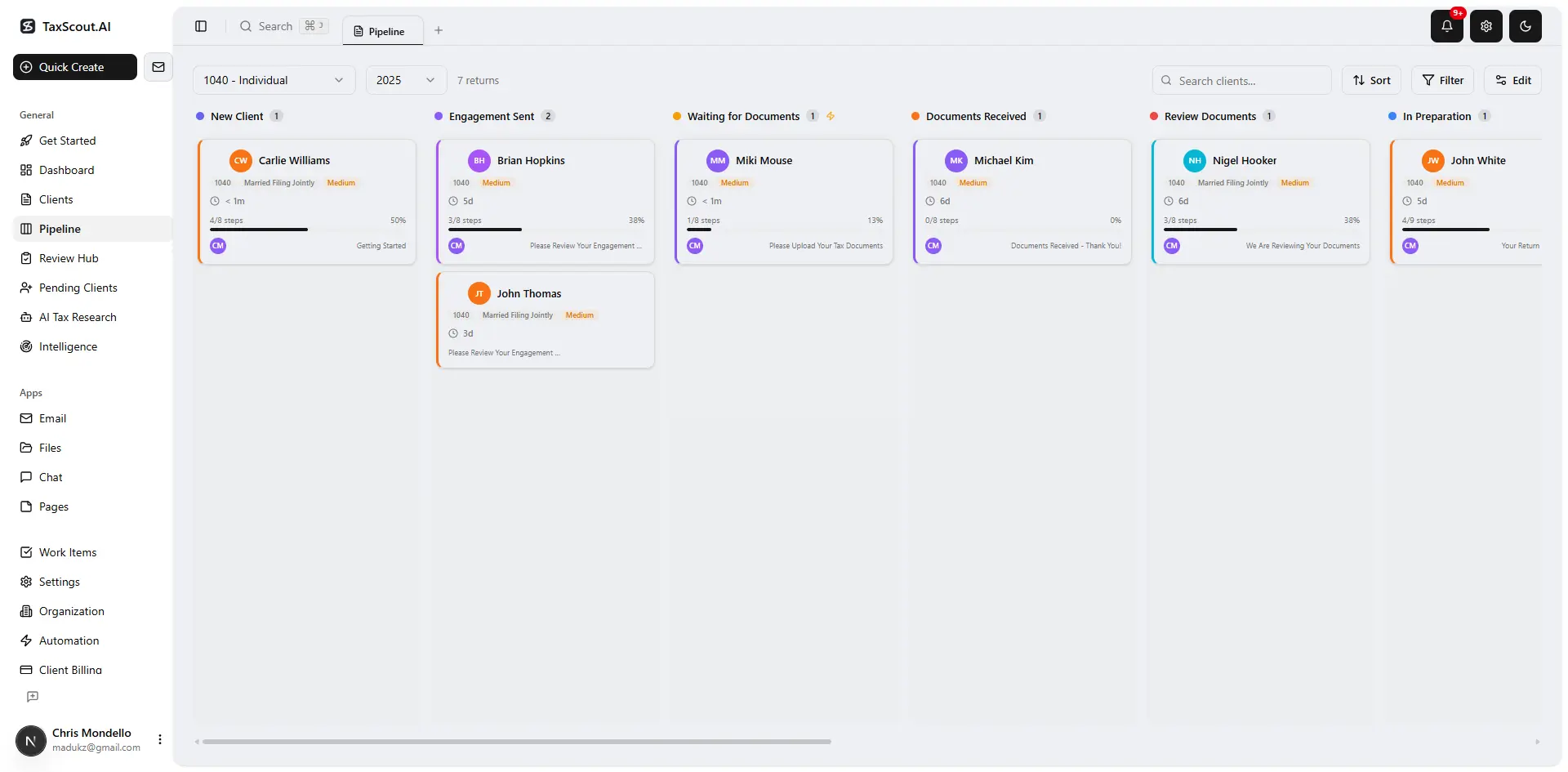
Track every return from intake to filed with drag-and-drop pipeline management
Packaging Cost Segregation Advisory as a Firm Revenue Line
The advisory opportunity here is real and largely uncaptured by compliance-focused firms. A cost segregation recommendation is a natural flat-fee add-on service: you charge a coordination and analysis fee — typically $500–$2,500 depending on property complexity — separate from the engineer's study fee, which the client pays directly to the engineer. Your fee covers the portfolio review, recommendation memo, coordination with the engineer, integration of results into the tax return, and a follow-up consultation on passive activity and QBI implications. That is a clear, bounded scope of work that most clients will view as a bargain given the tax savings delivered.
Positioning matters. Frame the conversation around net return on investment, not tax complexity: 'We identified an opportunity to generate $85,000 in additional first-year deductions on the Riverside Drive property. The study costs roughly $8,000 and our coordination fee is $1,500. You net $75,500 in incremental deductions this year.' That is a conversation that earns trust, justifies higher fees, and generates referrals to other real estate investors in the client's network. For firms building out advisory pricing, the frameworks in our flat fee billing guide apply directly to packaging this kind of service.
Systematizing the discovery process is what separates firms that do one or two cost segregation studies per year opportunistically from firms that run it as a repeatable service line. Build a checklist: during every new client onboarding and every annual review, flag any commercial real estate asset on Schedule E, Form 4797, or the K-1 package that has not been cost-segregated. Set a basis threshold — $500,000 is a reasonable floor — and treat every property above it as a mandatory review item. TaxScout's pipeline management and client management tools let you create a custom stage specifically for 'cost segregation review pending,' so no qualifying property falls through the cracks during a busy season. You can also use the AI accounting productivity guide to see how AI-assisted workflows reduce the time cost of running these systematic reviews.
Cost Segregation vs. Standard Depreciation: First-Year Impact Example (Commercial Building, $2M Basis, 2024)
| Scenario | Year-1 Depreciation | Incremental Deduction | Tax Savings at 37% |
|---|---|---|---|
| Standard 39-year straight-line | $51,282 | — | — |
| Cost seg + 60% bonus (25% reclassified) | $348,718 | $297,436 | $110,051 |
| Cost seg + 60% bonus (35% reclassified) | $461,282 | $410,000 | $151,700 |
| Look-back catch-up (5 years, 30% reclassified) | $600,000 (481(a)) | $600,000 (one-time) | $222,000 |
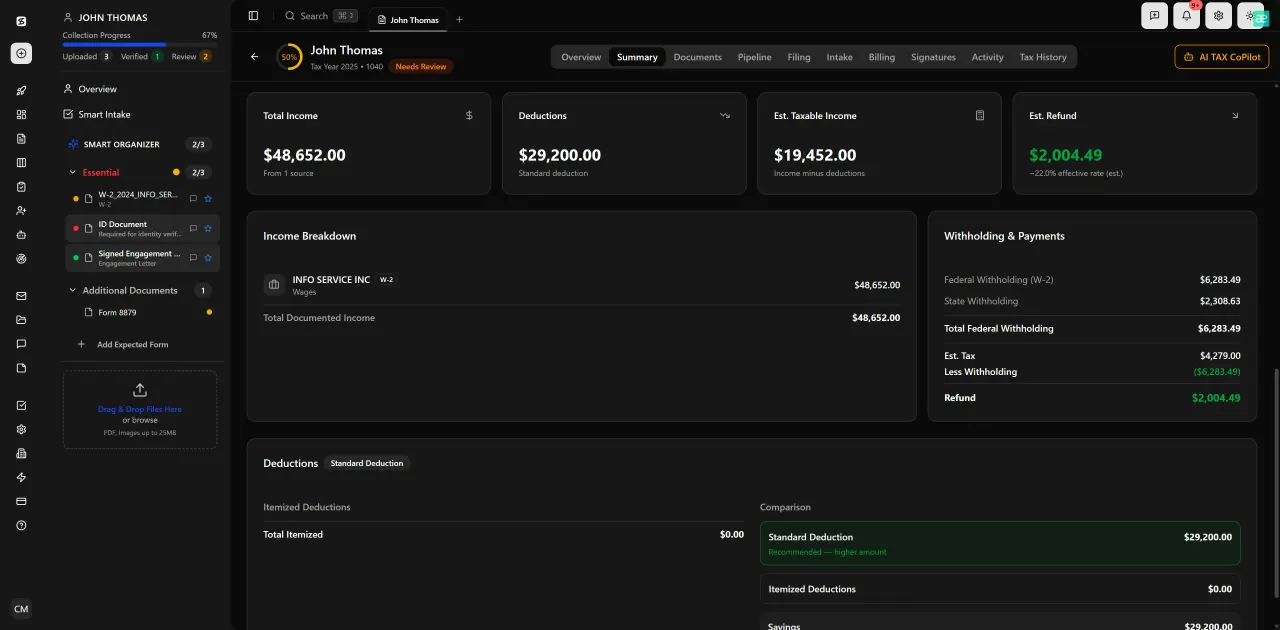
Review with AI assist — 9 agents answer questions with full client context
Using AI to Identify Cost Segregation Candidates at Intake
One of the most underappreciated efficiency gains in modern CPA practice is the ability to surface advisory opportunities during document intake — before the return is even assembled. When a client uploads prior-year returns, Schedule E, or depreciation schedules through TaxScout's client portal, the platform's AI document extraction reads the asset class, basis, and placed-in-service date from every line of Form 4562 automatically. That data is immediately available for review in the split-screen PDF viewer with click-to-source field highlighting, so you can see at a glance whether a commercial property is sitting on a 39-year straight-line schedule without a cost segregation study.
The AI research agents can then run a real-time search on current bonus depreciation rates, Rev. Proc. look-back eligibility, and any pending legislative changes to TCJA depreciation provisions — giving you an up-to-date memo to attach to your client recommendation without spending an hour on research. For firms handling multi-state clients, the agents also surface state conformity issues: many states, including California as detailed in our California tax changes guide, do not conform to federal bonus depreciation, which affects how cost segregation benefits flow at the state level and may require separate state depreciation schedules.
The combination of AI-assisted intake, automated document extraction, and real-time research creates a workflow where cost segregation screening happens as a background process rather than a manual project. Firms that implement this approach typically identify two to three times more cost segregation candidates per tax season than those relying on practitioner memory alone — and the incremental effort per candidate is minimal. That is the definition of moving from compliance to advisory without adding headcount. See our pricing page to understand how TaxScout's flat, per-firm pricing scales this capability to firms of any size.
Ready to turn every commercial real estate document into an advisory trigger?
TaxScout extracts depreciation schedules at intake, surfaces cost segregation candidates automatically, and keeps your firm running on one flat monthly fee — no per-user charges.

Every client gets organized documents, status tracking, and a complete history
Frequently Asked Questions
Most cost segregation professionals use a depreciable basis of $500,000 as a practical floor. Below that threshold, the study fee ($5,000–$15,000 for a single asset) may consume a disproportionate share of the tax benefit. For properties above $1 million, the return on investment is almost always compelling, particularly when bonus depreciation is available.
Keep reading
Tangible Property Regulations: How CPAs Apply Capitalization vs Expensing Rules
Oct 15, 2026 · 1 min read
QSBS Exclusion: How CPAs Maximize Section 1202 Gains for Startup Investors
Oct 15, 2026 · 1 min read
Section 1202 QSBS Exclusion: How CPAs Shelter Startup Gains for Founder Clients
Oct 15, 2026 · 1 min read
Stay up to date
Get the latest tax tech insights delivered to your inbox.