State Tax Nexus for Growing Clients: How Small CPA Firms Manage Multi-State Compliance
When a business client hires their first remote employee in another state or crosses a sales threshold in a new market, multi-state tax obligations follow immediately. This guide walks small CPA firms through a repeatable workflow for identifying nexus triggers, managing state registrations, and…
State tax nexus for growing clients has become one of the most time-consuming compliance challenges small CPA firms face today. A client lands a wholesale contract with a distributor in Ohio, hires a customer-success rep who works from her home in Colorado, and suddenly you're staring at potential income tax, franchise tax, and sales tax obligations in two states you've never filed in — all while trying to close out a stack of 1040s.
The problem accelerates faster than most practitioners expect. The South Dakota v. Wayfair decision in 2018 opened the economic nexus floodgates, and nearly every state now has a threshold — often $100,000 in sales or 200 transactions — that can trigger an obligation with zero physical presence required. Remote work has compounded the issue: a single W-2 employee living across a state line can create income tax withholding requirements, a corporate income tax filing obligation, and sometimes even property tax exposure. Understanding state tax nexus for growing clients starts here, because the Wayfair decision turned what was once a manageable compliance issue into a rapid-fire exposure risk that can catch even well-run businesses off guard.
This guide is written for small and mid-size CPA firms that handle business clients across industries. You'll find a practical, stage-by-stage workflow for identifying nexus exposure, prioritizing registrations, communicating obligations to clients, and deciding — honestly — when a matter exceeds your bandwidth and a referral is the right move. Managing state tax nexus for growing clients is exactly the challenge this guide addresses, giving your firm a repeatable framework rather than a scramble each time a client crosses a new state's threshold.
Understanding the Four Main Nexus Triggers
Before building any workflow, your team needs a shared vocabulary for nexus types. Most client situations will involve one or more of the following four triggers, each with distinct registration and filing consequences. When it comes to state tax nexus for growing clients, having your entire team aligned on these trigger definitions is what separates firms that catch exposure early from those that discover it during an audit.
Physical presence nexus is the oldest standard. An office, warehouse, inventory stored in a third-party fulfillment center, or employees physically working in a state all create it. Even a salesperson who occasionally visits clients in a state can establish physical presence under many state rules. For firms evaluating their state tax nexus for growing clients approach, this trade-off compounds over time.
Economic nexus is now the dominant trigger for sales tax. After Wayfair, states moved quickly to adopt their own thresholds. Most mirror the $100,000 revenue / 200-transaction standard, but not all — check the specific state's Department of Revenue rules, since some states have already repealed the transaction count test while others have lowered the revenue threshold. Economic nexus is also expanding into corporate income tax in some states, though the constitutional guardrails there remain unsettled. Each of these factors directly shapes how state tax nexus for growing clients plays out in practice.
Payroll and remote employee nexus is the trigger that catches the most growing clients off guard. A single W-2 employee working from home in a new state almost always creates: (1) a withholding registration requirement, (2) a state unemployment insurance account, and sometimes (3) a corporate income or franchise tax filing obligation based on payroll-factor apportionment. The IRS Publication 15 covers federal withholding, but each state has its own registration timeline — many require registration before the first paycheck. Understanding state tax nexus for growing clients in this context is what separates firms that scale from those that stall.
Click-through and affiliate nexus applies primarily to e-commerce clients who pay commissions to in-state affiliates or referral partners for driving sales. This trigger is less common post-Wayfair since economic nexus now catches most sellers, but it can still apply in states that haven't fully aligned their rules. This is precisely where a deliberate state tax nexus for growing clients strategy pays off.
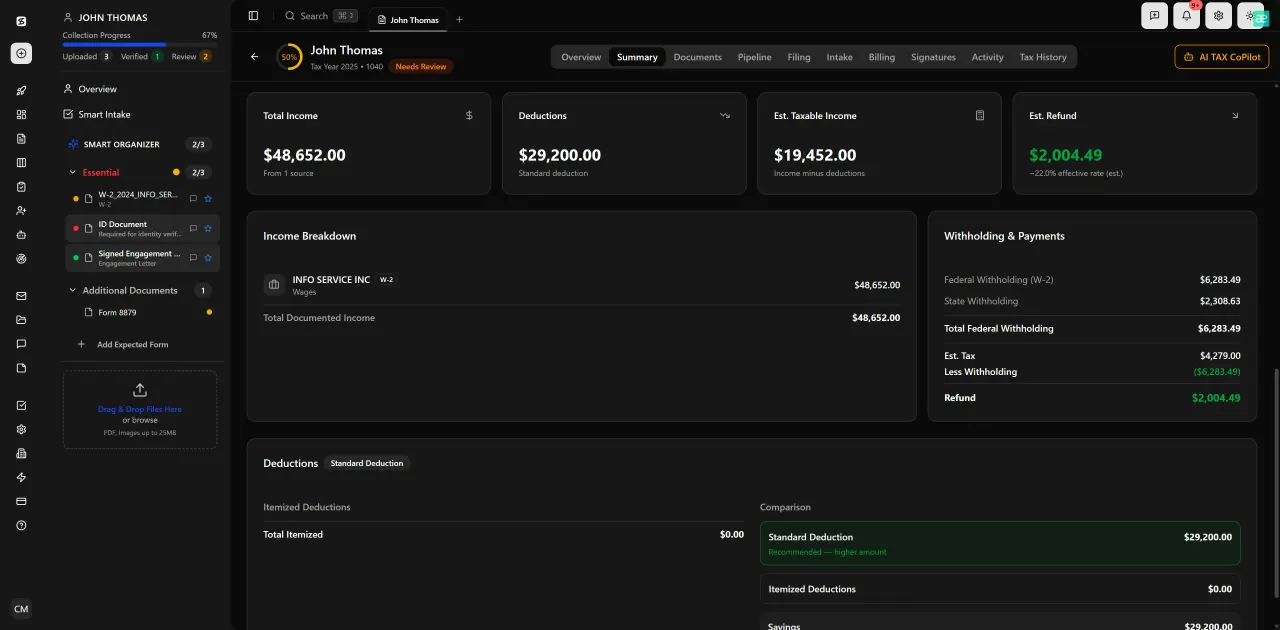
Review with AI assist — 9 agents answer questions with full client context
A Stage-by-Stage Nexus Identification Workflow
A repeatable process protects both your clients and your firm. The following four-stage workflow is designed to be run at least annually for every business client with revenue above $500,000 or with any out-of-state employees, contractors, or inventory. State tax nexus for growing clients sits at the center of this decision — get it wrong and the rest unravels.
Stage 1 — Data collection. Pull the client's prior-year general ledger and segment revenue by ship-to state and billing address. Most accounting software can export this. Also collect payroll records broken out by employee work-location state, a list of all warehouses and fulfillment centers (including third-party logistics providers), and a list of states where independent contractors performed services. If your firm uses AI document extraction, prior-year K-1s and 1099s can be automatically classified and cross-referenced against the client's entity structure to surface income flowing through states you may not have flagged. When firms revisit their state tax nexus for growing clients priorities, the gaps usually surface here.
Stage 2 — Threshold analysis. Map each state's economic nexus threshold against the client's revenue. For sales tax, cross-reference against the Streamlined Sales Tax Project's threshold guide at streamlinedsalestax.org and each state's Department of Revenue. For income tax, identify whether the state uses a factor-presence nexus standard (common thresholds: $500,000 in sales, $50,000 in payroll, or $50,000 in property within the state). Document your findings in a nexus exposure matrix — a simple spreadsheet with states in rows and triggers (physical, economic, payroll, affiliate) in columns. Addressing state tax nexus for growing clients at the threshold analysis stage ensures you catch obligations before they become penalties.
Stage 3 — Registration triage. Not every exposure requires immediate action, but you need a clear prioritization framework. Immediate (within 30 days): states where the client is already over threshold and has been collecting no tax. Short-term (60-90 days): states where threshold crossing is projected within the current year. Monitor-only: states where the client is below threshold but approaching it. Document the triage decision and get client sign-off, both to drive action and to limit your liability if the client delays.
Stage 4 — Ongoing monitoring. Set calendar reminders or automate threshold alerts. Client revenue in a new state can cross a threshold mid-year and retroactively trigger a registration obligation. Your pipeline management system should include a recurring annual task for every business client: 'Review multi-state nexus exposure and update nexus matrix.'
Tired of rebuilding nexus checklists from scratch every tax season?
TaxScout's pipeline management and AI research agents help small CPA firms track multi-state compliance obligations without extra headcount.
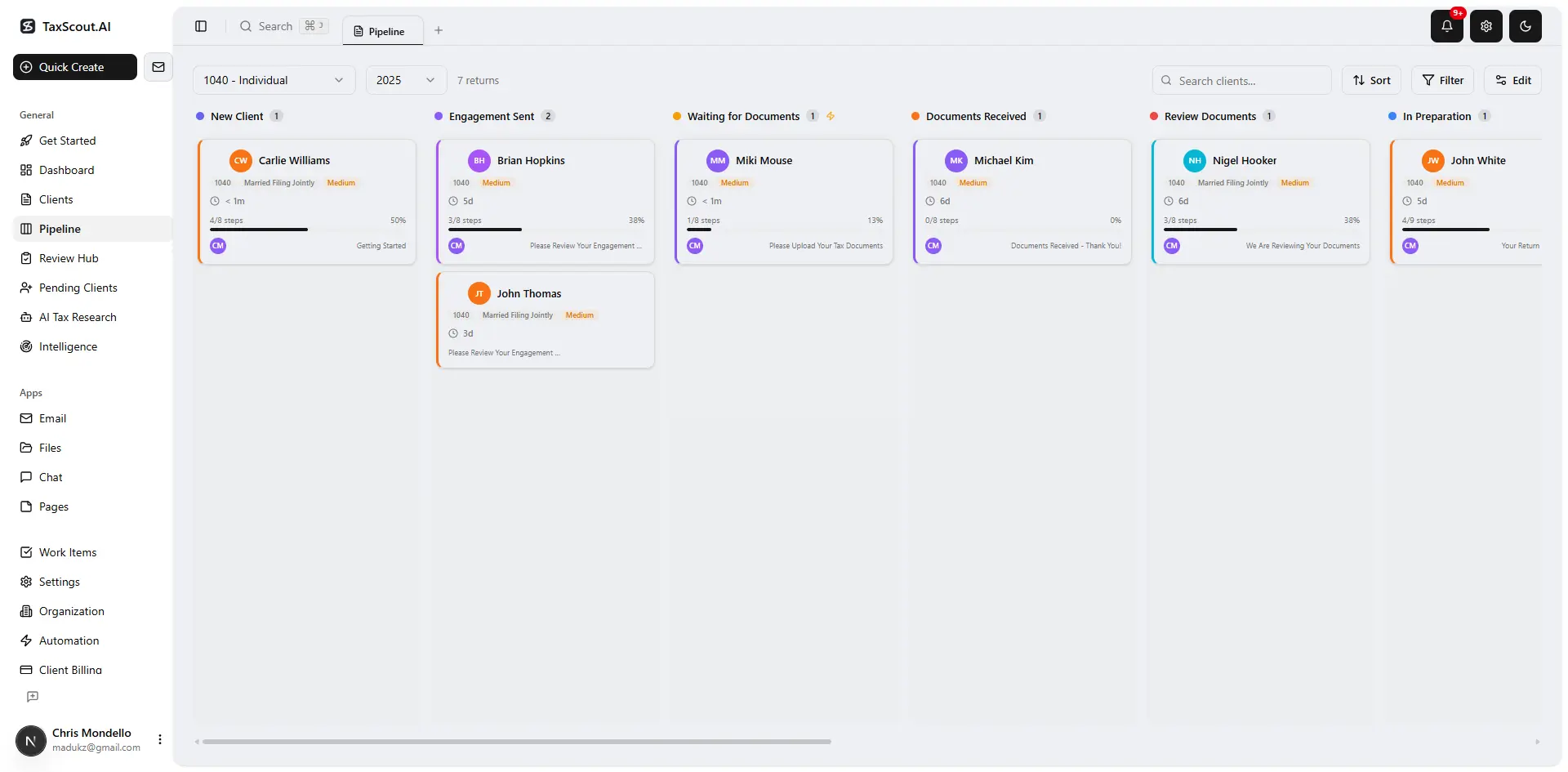
Track every return from intake to filed with drag-and-drop pipeline management
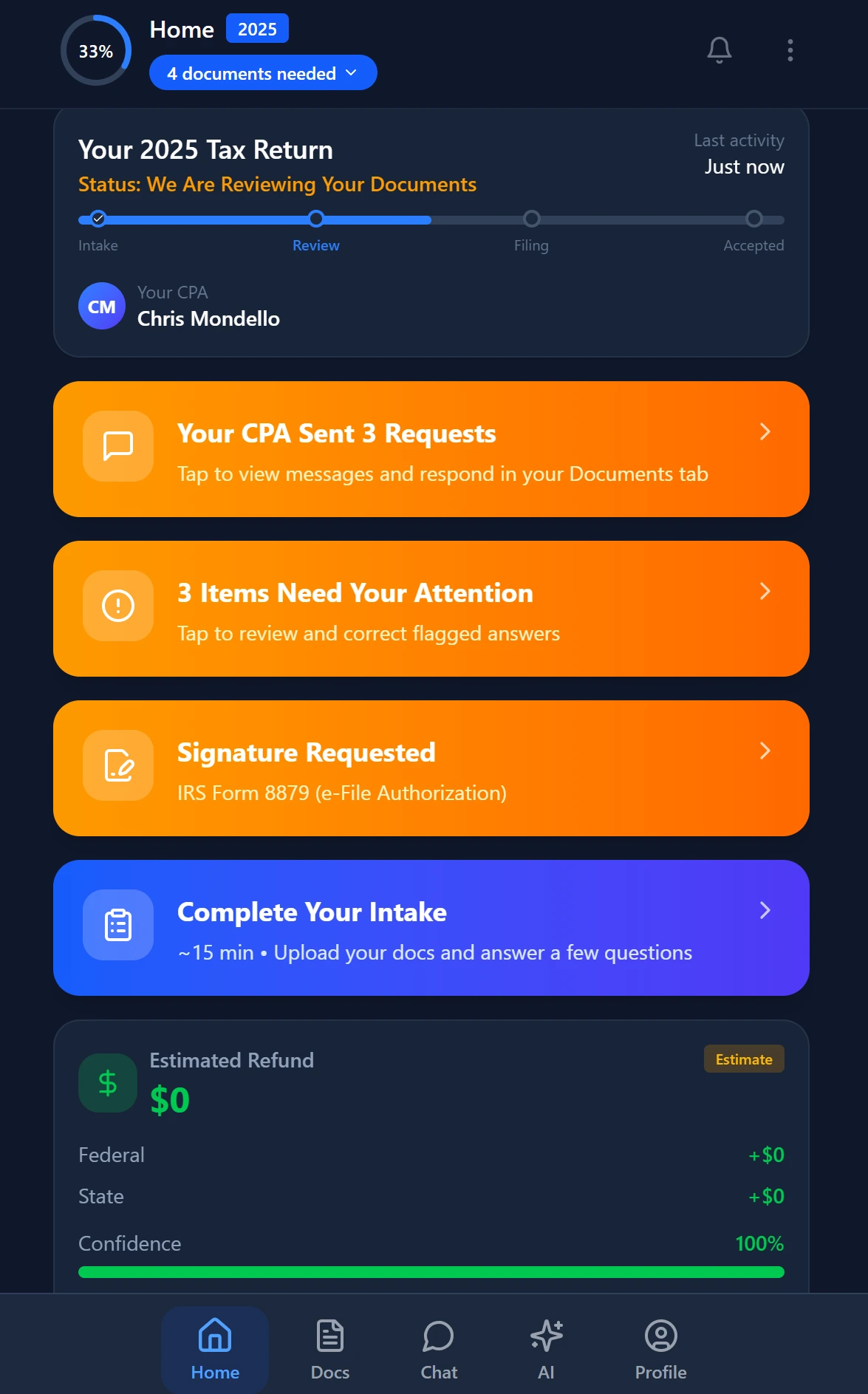
Smart intake auto-fills from uploaded documents and prior-year data
Sales Tax Nexus CPA Workflow: Registration and Remittance
Once you've identified a sales tax nexus obligation, the registration process itself can be managed efficiently if you have a standard checklist. Most states use their own online registration portals, though 24 states participate in the Streamlined Sales Tax Registration System, which allows a single application to register in all member states simultaneously — a significant time-saver for clients with broad geographic footprints.
The key decisions at registration time: (1) Will the client collect and remit directly, or use a marketplace facilitator or sales tax software like Avalara or TaxJar? For most small business clients with fewer than five states, direct remittance is manageable. For clients selling on Amazon FBA or with 10+ state obligations, a sales tax automation tool is usually worth the cost. (2) What filing frequency has the state assigned? Most states assign monthly, quarterly, or annual filing based on the client's expected tax liability. Confirm and calendar this immediately.
One often-overlooked compliance item: voluntary disclosure agreements (VDAs). If your client has a retroactive nexus exposure — meaning they should have been registered in a state for one or more prior years but weren't — many states offer VDA programs that cap the lookback period (often at 3 years) and waive penalties. The Multistate Tax Commission administers a national VDA program. Getting a client into a VDA proactively is almost always better than waiting for a state audit notice. Firms that have built a consistent process for state tax nexus for growing clients know that surfacing retroactive exposure early — before an auditor does — is one of the highest-value advisory conversations you can have.
For clients with California exposure specifically, the rules are particularly complex — the California Department of Tax and Fee Administration (CDTFA) has its own threshold rules and local-district-tax layers. See our California Tax Changes 2026 CPAs Must Know post for the latest updates. Similarly, New York's sales tax regime has unique vendor registration and resale certificate rules — our New York State Tax Updates 2026 post covers the key practitioner watch items.
State Income Tax Compliance for a Growing Client: The Apportionment Problem
Sales tax nexus gets more attention, but state income tax compliance for a growing client often carries larger dollar exposure. A C-corporation or S-corporation with nexus in multiple states must apportion its income across those states using each state's apportionment formula before calculating the tax.
Most states have moved toward a single-sales-factor apportionment formula, meaning only the ratio of in-state sales to total sales matters. But a significant minority still use a three-factor formula weighting sales, payroll, and property. A client with a single remote employee in a three-factor state may have a payroll factor that pushes meaningful income into that state even if sales there are modest. This is worth modeling before registration — sometimes the income tax cost of nexus in a given state is trivial; occasionally it's material. Mapping these apportionment implications is a core part of managing state tax nexus for growing clients responsibly, since an unexpected income tax bill in a new state can strain a small business's cash flow far more than the cost of the underlying registration.
Pass-through entities present additional complexity. For an S-corporation or partnership, nexus in a new state can create filing obligations at both the entity level (composite returns, withholding on nonresident owners) and the owner level (nonresident individual returns). The pass-through entity tax elections now available in most states — designed to work around the SALT deduction cap — add another layer: you need to assess whether the state's PTE election is available, beneficial, and properly elected before the filing deadline. Law.cornell.edu's overview of state tax law is a useful starting reference for understanding how each state's constitutional authority to tax flows.
Your firm should maintain a state-by-state reference document covering apportionment formulas, PTE election deadlines, and composite return rules. TaxScout's AI research agents can query IRS, Treasury, and state authority sources in real time to surface rule changes — particularly useful when a client crosses into a state you haven't filed in before and you need a quick authoritative answer without billing two hours of research time. You can also explore other blog resources for deeper dives on related compliance topics.

Click any extracted field to see its source highlighted on the original PDF
Remote Employee Nexus Trigger: What Every CPA Needs to Tell Clients Now
The remote employee nexus trigger has become the most common source of surprise multi-state obligations for small business clients. A client hires a marketing manager who works from Austin; six months later they add a developer in Chicago. Neither hire was preceded by a call to their CPA about state tax implications — because the client didn't know to ask.
Your onboarding questionnaire for business clients should include an explicit question: 'Do you have any employees, contractors, or officers who primarily work from a state other than your principal office state?' If the answer is yes, the nexus analysis clock starts immediately. This question belongs in your annual engagement renewal conversation as well, not just initial onboarding. The smart intake engine in TaxScout supports custom intake questions modeled on this pattern, making it easy to flag remote-employee situations before the return is assigned to a preparer.
When a remote employee nexus trigger is confirmed, the immediate action items are: (1) Register for state income tax withholding in the employee's state before the next payroll cycle. Most states impose penalties for late registration, not just late remittance. (2) Determine whether the state requires separate UI registration with a state workforce agency — the Department of Labor's SUTA overview is a helpful starting point. (3) Assess whether payroll in that state, combined with any in-state sales, crosses a factor-presence nexus threshold for corporate income tax. (4) Update your client's organizer for the following year to include a question about new states of employment. Each of these steps is a building block of a sound state tax nexus for growing clients protocol — skip one and you risk leaving the client exposed in exactly the states where payroll-based audits are most aggressive.
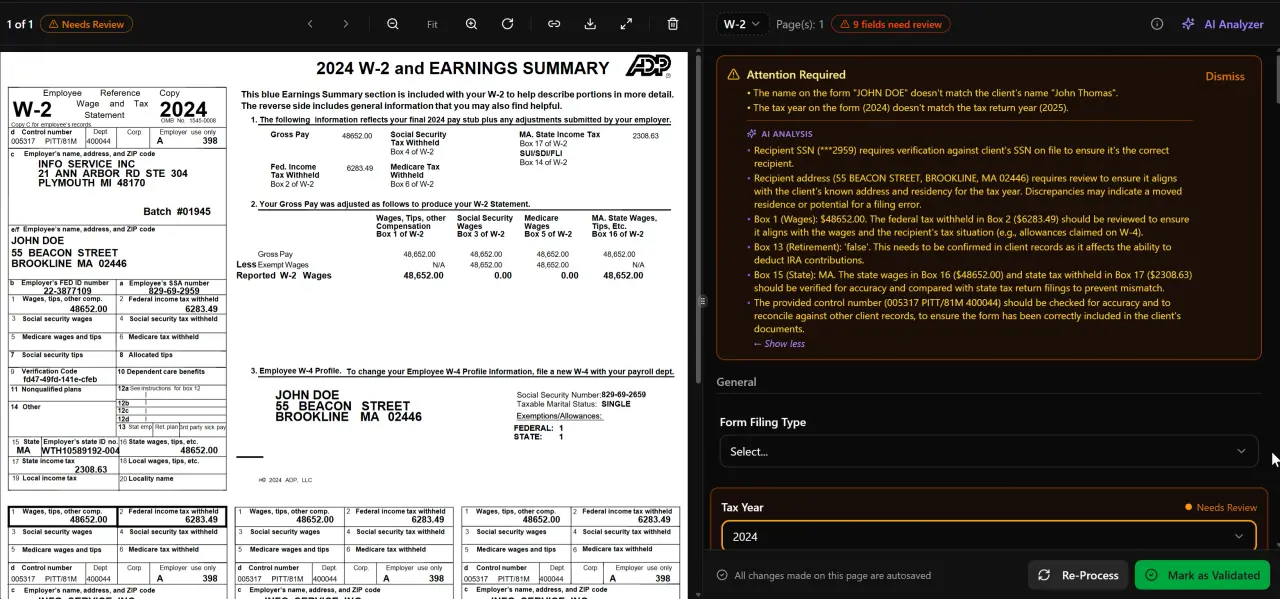
AI classifies, extracts, and validates every document automatically
Common Multi-State Nexus Triggers and Immediate CPA Action Items
| Nexus Trigger | Typical States Affected | Immediate CPA Action | Key Risk if Ignored |
|---|---|---|---|
| Remote W-2 employee | All 41 income-tax states | Register for withholding before first paycheck; assess income tax nexus | Late withholding penalties; unreported state income tax liability |
| Sales over $100K or 200 transactions | Virtually all states post-Wayfair | Register for sales tax; consider VDA if retroactive exposure exists | Back taxes, penalties, and interest; potential audit |
| Inventory in 3PL warehouse | Particularly CA, TX, NY, IL, OH | Confirm whether FBA/3PL creates physical nexus; review sales by state | Sales tax on all warehouse-state transactions; income tax apportionment |
| Independent contractor in new state | CA, NY, NJ, MA especially aggressive | Determine if service creates nexus under state rules; file 1099s on time | State income tax assessments; penalties for unreported activity |
| PTE election in multi-state context | States with PTE tax regimes | Compare state PTE benefit vs. cost; verify election deadline | Loss of SALT-cap benefit; owner-level nonresident filing exposure |
Deciding When to Refer Multi-State Work Out
Honest referral decisions are one of the marks of a high-quality small firm. Multi-state compliance work exists on a spectrum: an S-corporation with nexus in three familiar states is within most generalist practices' capability; a C-corporation with nexus in 25 states, FBA inventory, and a California franchise tax issue is a different matter entirely.
A practical referral threshold: if your client's nexus exposure includes more than 8 states, involves a state you've never filed in, or includes industries with specialized tax regimes (construction with mobile equipment, staffing agencies, SaaS with digital goods taxes), consider a co-counsel or referral arrangement with a state and local tax (SALT) specialist. Many SALT boutiques are open to referral fee arrangements or collaborative engagements where you retain the client relationship and they handle the technical filings. Documenting this decision as part of your state tax nexus for growing clients process protects your firm and demonstrates the kind of proactive advisory judgment that clients remember at renewal time.
Referral is also the right answer when a client is under audit in a state you haven't filed in. State tax auditors — particularly in California, New York, and New Jersey — are sophisticated, and responding without subject-matter expertise exposes both you and your client to expanded liability. Document your referral recommendation in writing, have the client acknowledge it, and keep that documentation in your engagement file. Your engagement letter for business clients should explicitly scope which states are covered and note that additional states require separate engagement.
Before referring, use TaxScout's AI research agents to at least understand the surface-level issue. Being able to articulate the problem to a SALT specialist — and to the client — is part of your value even when you're handing off technical work. You can also point clients to our state tax deadlines resource to help them understand the urgency of timely registration.
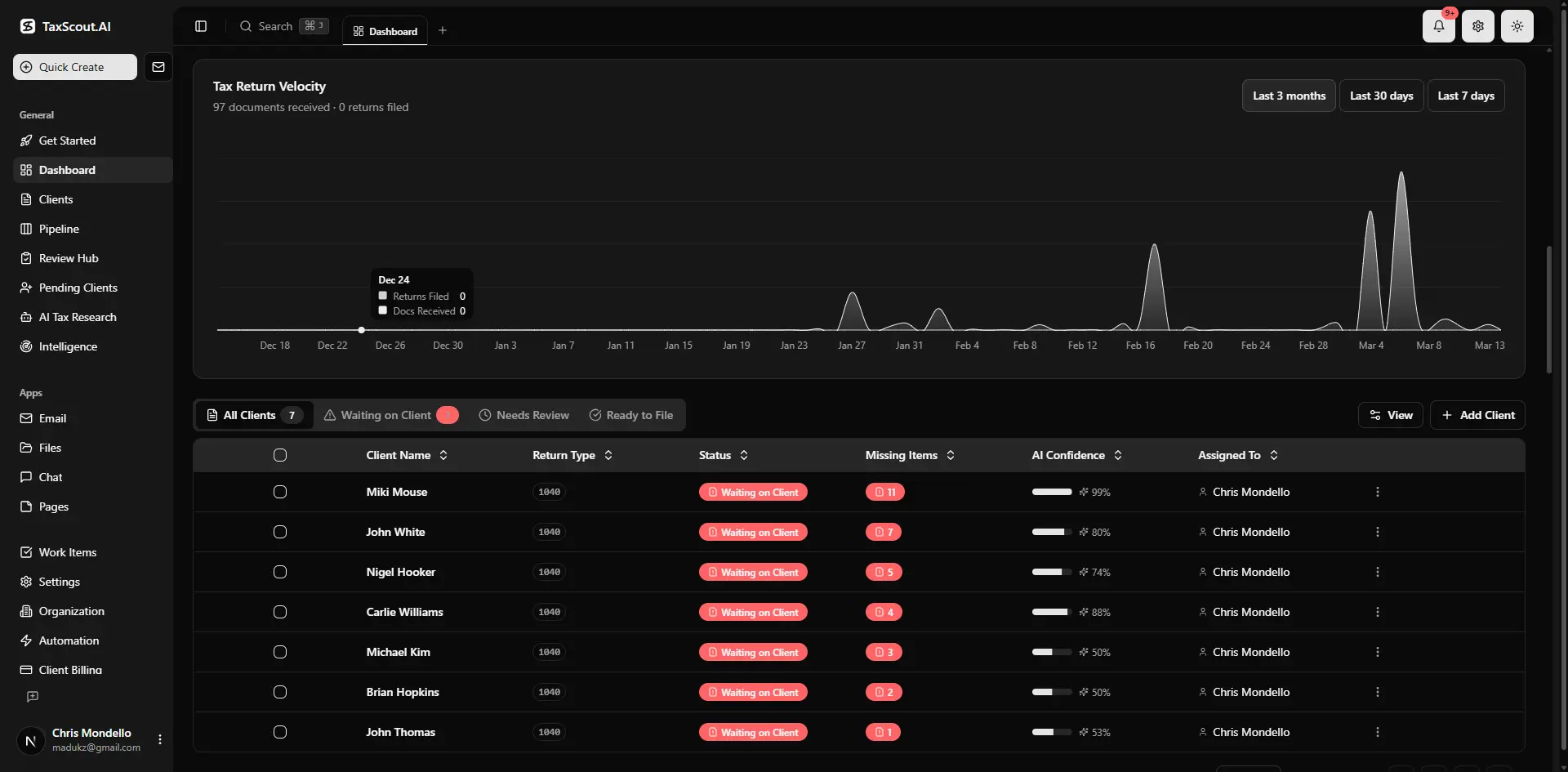
Real-time dashboard showing returns in progress, revenue, and upcoming deadlines

Track firm performance with real-time analytics and client activity monitoring
Building a Repeatable Multi-State Compliance System for Your Firm
The difference between firms that handle multi-state work profitably and firms that lose money on it is almost always a matter of systems. Ad hoc compliance — where each client's nexus situation is figured out from scratch each year — is expensive and error-prone. A documented system that any staff member can execute is the goal.
Start with three firm-level assets: (1) A nexus trigger checklist included in your annual business-client organizer — eight to ten yes/no questions covering physical presence, remote employees, sales thresholds, and marketplace activity. The client onboarding process is the right place to establish baseline multi-state data. (2) A state registration tracker maintained in your practice management system — one record per client per state, with registration date, filing frequency, and next due date. (3) A refer-or-handle decision matrix — a written internal policy specifying which combinations of state count, industry, and issue type require escalation. This protects junior staff from taking on work above their skill level and protects the firm from malpractice exposure. Embedding state tax nexus for growing clients reviews directly into your annual workflow — rather than treating them as one-off projects — is what transforms nexus compliance from a cost center into a reliable advisory revenue stream.
On the technology side, your practice management platform should support custom pipeline stages and recurring tasks so that multi-state review is a scheduled workflow item, not an afterthought. TaxScout's pipeline management lets you create a dedicated 'Multi-State Nexus Review' stage and assign it automatically to business clients above a revenue threshold. Combined with AI research agents that query current state tax authority directly, you can complete a preliminary nexus assessment in a fraction of the time it took three years ago.
For firms looking to benchmark their current processes or add advisory capacity, see our guide on how AI agents handle multi-state tax returns and our accounting firm capacity planning guide to ensure your team has the bandwidth to take on the additional work that multi-state advisory can generate.
Ready to stop managing state tax nexus obligations on sticky notes and spreadsheets?
TaxScout gives small CPA firms AI research agents, customizable pipeline stages, and smart client intake — all for a flat $149/month with no per-user fees.
Frequently Asked Questions
After the Wayfair decision, economic nexus based on sales volume is the most common trigger — most states use a $100,000 in-state revenue threshold or 200 transactions. However, hiring a single remote W-2 employee in a new state is a close second, and it creates withholding, unemployment insurance, and potentially corporate income tax obligations that many business owners don't anticipate.
Keep reading
Backdoor Roth IRA: How CPAs Execute the Strategy Without Triggering Pro-Rata Tax
Oct 12, 2026 · 1 min read
Transparency in Coverage Final Rules: What CPA Firms Must Do Now
Oct 12, 2026 · 1 min read
Late Filing Penalty Relief: How CPAs Reduce or Eliminate IRS Failure-to-File Charges
Oct 12, 2026 · 1 min read
Stay up to date
Get the latest tax tech insights delivered to your inbox.