Flat Fee Billing for CPAs: Ditch Hourly and Earn More
Most CPA billing content debates whether to switch from hourly rates. This guide assumes you've already decided — and walks you through how to build flat fee tiers, guard against scope creep, re-price existing clients without losing them, and use AI to track profitability per engagement.
Flat fee billing for CPAs has crossed from trend to table stakes. Clients increasingly expect to know their total cost before engaging a firm, and partners who still bill hourly find themselves defending invoices instead of selling outcomes. If you've spent any time reading about billing models, you already know the philosophical argument for fixed fees. What you likely haven't found is a step-by-step operational roadmap for actually making the switch.
This guide skips the debate. You'll learn how to design tiered flat fee packages that cover your cost floor, build contract language that controls scope creep, migrate your existing hourly clients mid-year without triggering churn, and use AI-powered tools to monitor whether each engagement is actually profitable — before a project turns into a loss leader. Every tactic here is grounded in what actually works when implementing flat fee billing for CPAs across firms of all sizes.
Whether you run a solo practice or a 15-person firm, the mechanics below apply. The numbers will differ, but the structure doesn't. By the time you finish reading, you'll have a concrete implementation checklist you can execute this quarter. Flat fee billing for CPAs scales just as well in a solo practice as it does in a larger firm — the underlying framework remains the same.
Why Hourly Billing Quietly Caps Your Firm's Revenue
The Bureau of Labor Statistics reports that the median hourly wage for accountants and auditors is around $40/hour — but CPA firm billing rates typically run $150–$400/hour. The gap looks healthy until you factor in write-downs, client pushback, and the invisible ceiling hourly imposes: your revenue is arithmetically bounded by the number of hours your team can bill. Flat fee billing for CPAs eliminates the write-down problem entirely by anchoring revenue to the value delivered rather than hours logged.
Fixed fee accounting breaks that ceiling. When you scope and price a service correctly, the efficiency gains from better processes and AI tooling translate directly into margin improvement — not into a lower invoice. A return that used to take four hours and billed at $600 might now take 90 minutes with AI document extraction. Under hourly, that efficiency gain evaporates. Under a flat fee structure, it becomes profit. For firms evaluating their flat fee billing for CPAs approach, this trade-off compounds over time.
There's a retention dimension too. Research from the Journal of Accountancy consistently shows that billing surprises are a leading driver of client attrition. Predictable invoices — the same amount on the same date every month — dramatically reduce friction and late payments. Pair that with automated recurring invoicing and you've replaced collections anxiety with reliable cash flow. Each of these factors directly shapes how flat fee billing for CPAs plays out in practice.
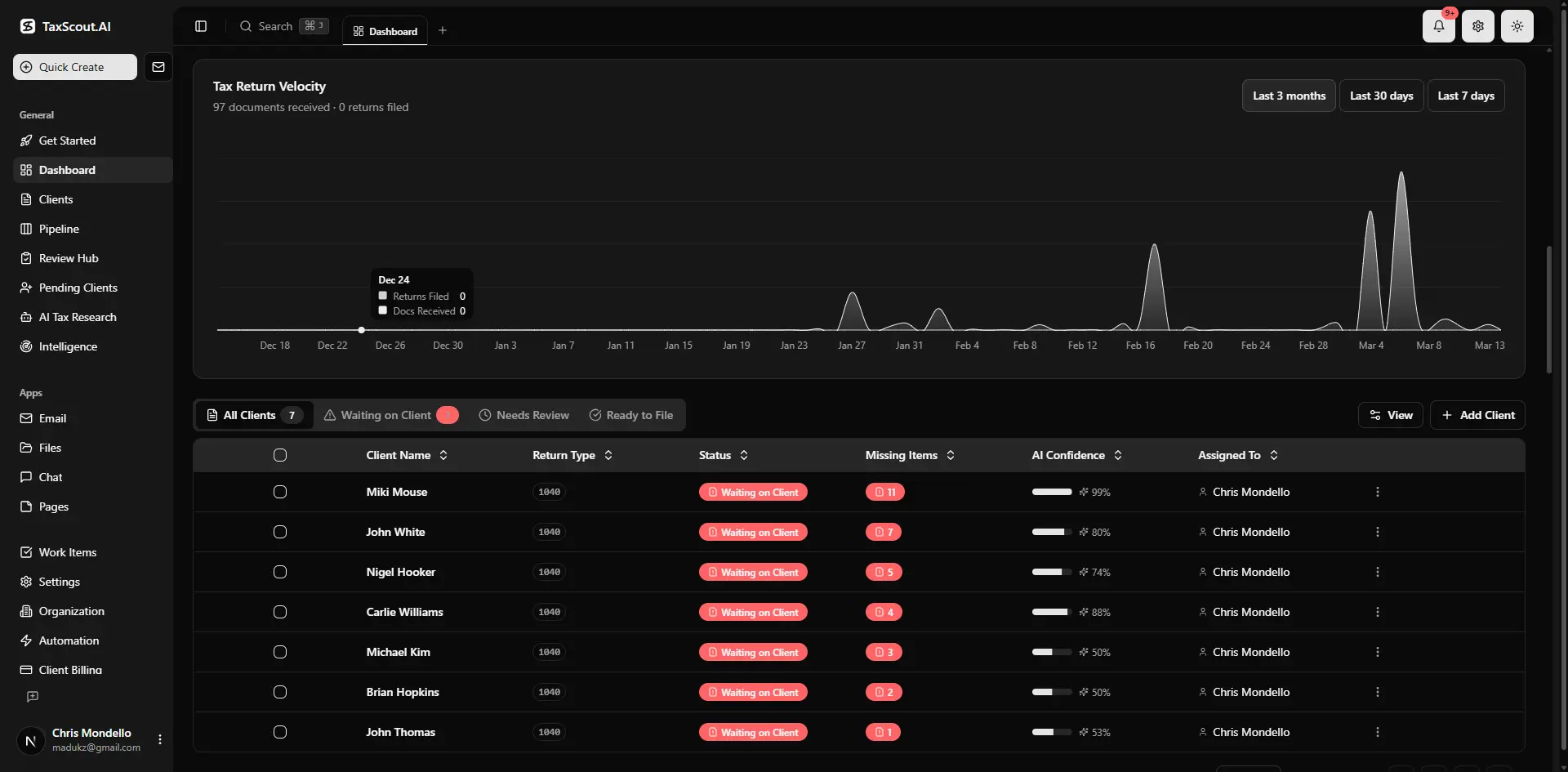
Real-time dashboard showing returns in progress, revenue, and upcoming deadlines
Building Your Flat Fee Tier Structure from the Ground Up
The most common mistake CPAs make when setting flat fee tiers is starting with what competitors charge. Start instead with your cost floor: what does it actually cost your firm, in staff time and overhead, to deliver each service at your current efficiency level? Then apply a target margin — most advisory-forward firms target 55–65% gross margin per engagement. Understanding flat fee billing for CPAs in this context is what separates firms that scale from those that stall.
A workable starting framework for a tax-focused CPA firm uses three tiers:
Tier 1 — Essential Prep covers a single-entity personal return (1040, standard complexity), one state, digital document delivery, and a 15-minute review call. Price: $400–$600 depending on your market. Tier 2 — Business Owner Bundle covers a 1040 plus Schedule C or S-Corp pass-through, one state, a mid-year check-in, and basic advisory services. Price: $1,200–$2,400/year. Tier 3 — Full Advisory Retainer covers all entities, multi-state, quarterly strategy calls, and proactive planning. Price: $4,800–$12,000/year. This is precisely where a deliberate flat fee billing for CPAs strategy pays off.
Each tier needs a clearly documented scope of work — not a vague description, but a line-item list of deliverables. This is the backbone of your scope creep guardrails (covered in the next section) and will also become the basis for your engagement letters. The IRS's Circular 230 and your state CPA society's practice standards both inform what must be disclosed in engagement agreements, so review those before finalizing. Flat fee billing for CPAs sits at the center of this decision — get it wrong and the rest unravels.
Once you have three tiers, resist the urge to add more. Complexity in your menu creates decision paralysis for prospects and operational inconsistency for your team. You can always customize within a tier for a specific client — that's different from proliferating tiers. For a broader look at firm management strategies, explore our other blog resources covering everything from capacity planning to AI automation. When firms revisit their flat fee billing for CPAs priorities, the gaps usually surface here.
Tired of building fee schedules in a spreadsheet that's already out of date?
TaxScout's invoicing and pipeline tools let you attach flat fee billing directly to client stages — so pricing, engagement tracking, and collections run on one platform.
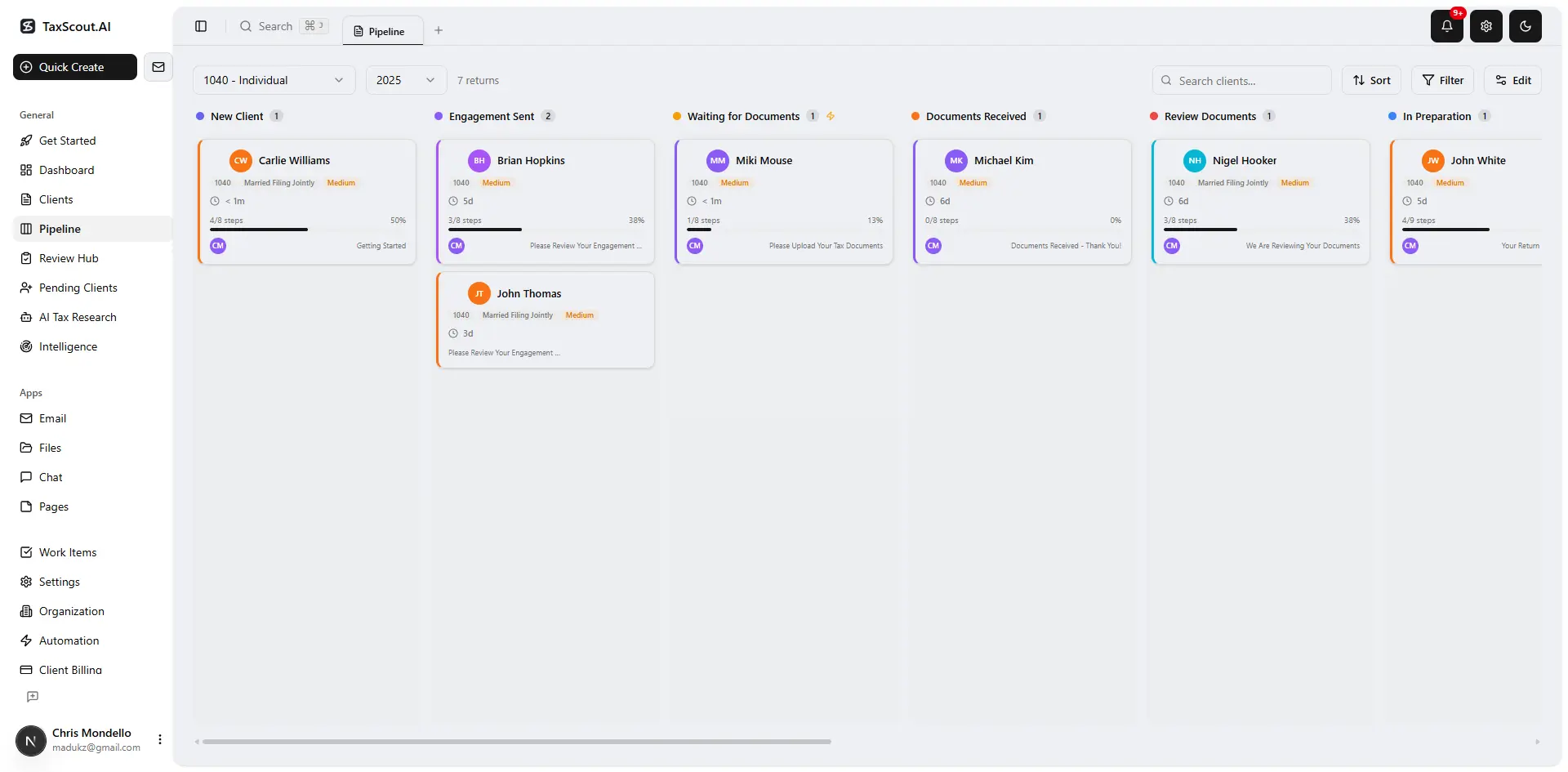
Track every return from intake to filed with drag-and-drop pipeline management
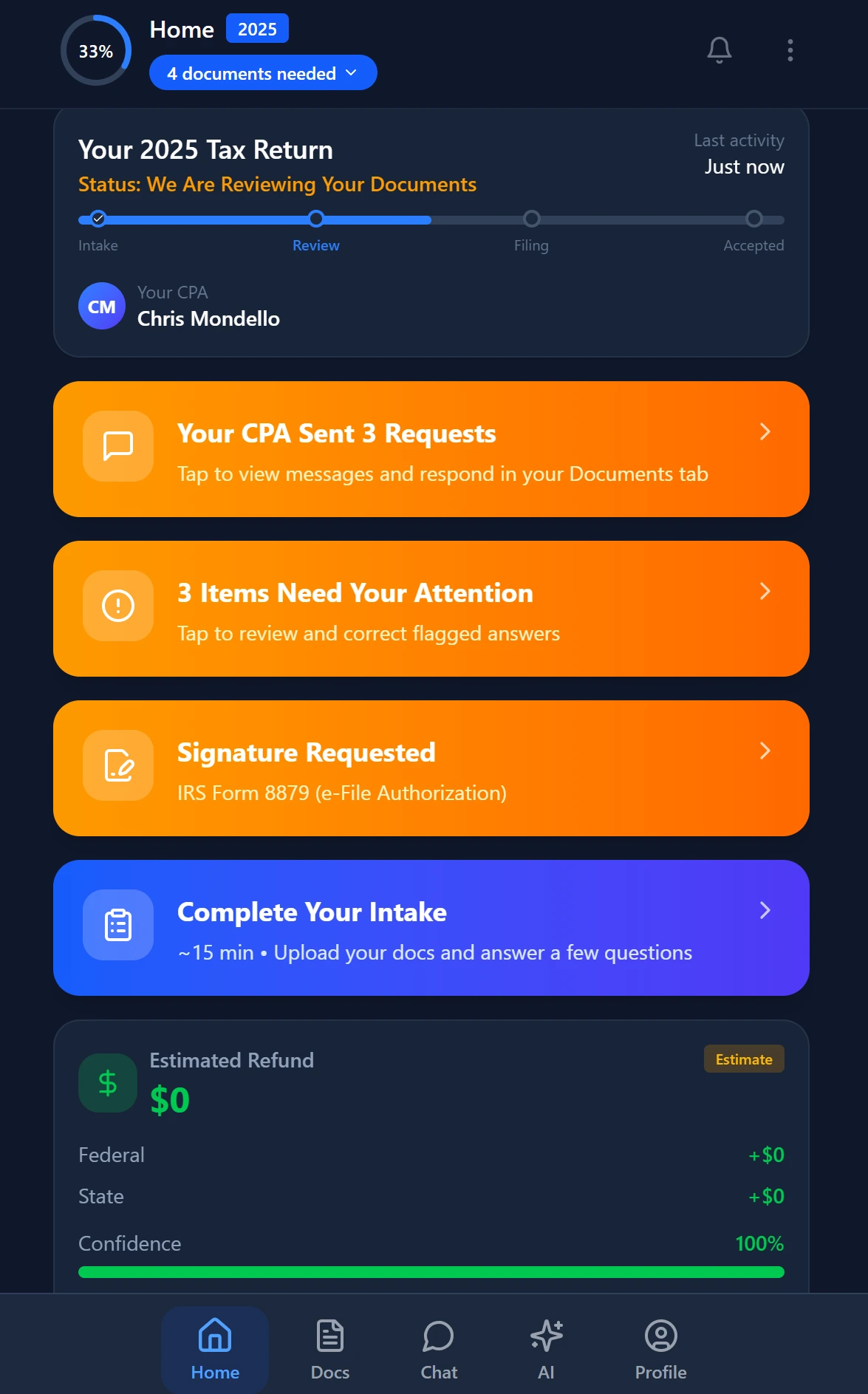
Smart intake auto-fills from uploaded documents and prior-year data
Scope Creep in CPA Billing: Guardrails That Actually Work
Scope creep CPA billing is the silent margin killer in every fixed fee practice. A client in Tier 1 calls with a rental property question. You answer it. Two months later they're emailing weekly and expecting advisory-level access they haven't paid for. Without hard guardrails, flat fee models bleed out through the small stuff. Firms that have fully committed to flat fee billing for CPAs find that the engagement letter — not the conversation — is what ultimately holds the line on scope.
The solution is a three-layer defense: (1) a precise written scope in the engagement letter, (2) a documented change-order process your team actually uses, and (3) a monitoring system that flags when a client's interaction volume exceeds their tier threshold. The first two are contractual; the third is operational.
For your engagement letter, use explicit exclusion language: 'This engagement does not include representation before the IRS, amended returns, bookkeeping corrections, or tax planning beyond a single annual strategy session.' Services outside the list trigger a change order at a stated flat rate — not an hourly add-on. That consistency is what protects you. You can see how platforms like TaxScout support standardized e-signatures on engagement letters and change orders, making the process frictionless for both parties.
The monitoring layer is where AI earns its keep. By tagging every client touchpoint — emails, portal messages, document requests, phone calls — and aggregating interaction time per engagement, your practice management platform surfaces clients whose actual service consumption has migrated into the next tier. Without this visibility, you're flying blind on per-engagement profitability. The accounting firm capacity planning guide covers related metrics in depth.
How to Re-Price Legacy Hourly Clients Without Losing Them
The most anxiety-inducing part of switching to a fixed fee accounting model is the conversation with clients who've been on hourly for years. The good news: the transition has a measurable success playbook, and most firms that execute it well retain 85–90% of their client base.
Start the migration 60–90 days before the engagement renews. Don't spring flat fees at tax season when clients are already stressed. Send a short communication — email or letter — that frames the change as a benefit to them: 'Starting [date], we're moving to flat fee pricing so you always know your cost upfront. Based on what we've done together, your new annual fee is $[X].' Anchor the new price to what they actually paid in the last 12 months, not to your tier list.
Segment your client base before you start. Use your last 24 months of billing data to identify three groups: (a) clients who underpaid hourly relative to work delivered — these get a modest increase, framed as the new rate; (b) clients who overpaid — these get a slight reduction or locked-in rate as a loyalty gesture; (c) clients whose consumption is unpredictable — these require a tiered flat fee with a clear change-order clause. For group (a), expect some pushback. Have two talking points ready: price certainty and response time guarantees. Framing the shift as flat fee billing for CPAs — rather than a price increase — gives clients a concrete reason to see the change as a service upgrade.
One practical tool for the transition: use your client portal to send the new engagement letter alongside a one-page comparison showing their prior-year invoices versus the new flat fee. Transparency reduces friction more than any sales script. The Treasury's guidance on written fee disclosures is worth reviewing to ensure your communications meet any applicable standards in your practice area.
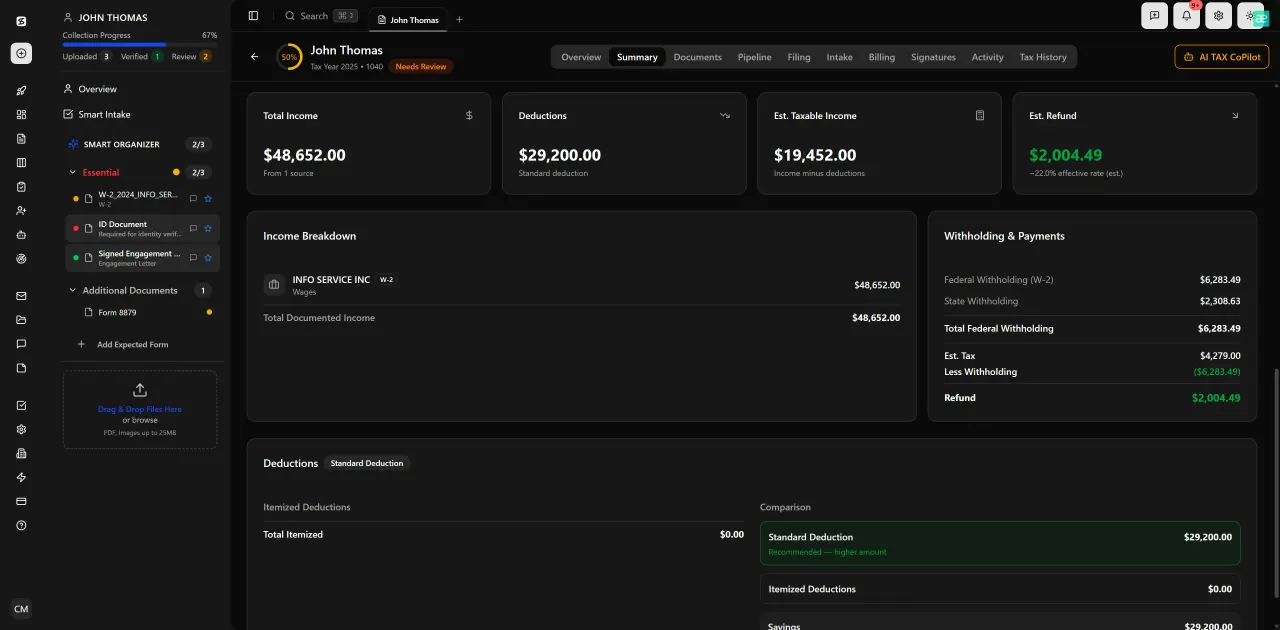
Review with AI assist — 9 agents answer questions with full client context

Click any extracted field to see its source highlighted on the original PDF
Using AI to Monitor Profitability Per Engagement
The biggest operational gap in most fixed fee accounting practices is the absence of real-time per-engagement profitability data. Partners set prices once at the start of the year, then find out in December — when reviewing P&L — that three clients consumed twice the expected hours. By then, the margin damage is done. This is one of the most underappreciated risks in flat fee billing for CPAs: the model is only as strong as your ability to track what each engagement actually costs.
AI-powered practice management changes this dynamic. When your platform integrates document processing, communication logs, pipeline stage timing, and invoicing into a single data layer, it becomes possible to surface a profitability score per client in real time. TaxScout's pipeline management tracks how long each return spends in each stage, giving you a proxy for staff effort even without manual time logging. Combine that with the AI document extraction workflow — which processes 180+ tax form types through a 5-layer validation pipeline — and the per-document processing cost drops enough that Tier 1 returns consistently hit your margin floor.
For advisory retainer clients, the signal to watch is communication volume. Research from law.cornell.edu's Legal Information Institute on fee structures in professional services firms consistently shows that service consumption correlates more with client access patterns than with formal deliverable count. Set a monthly interaction threshold per tier — say, four emails or portal messages for Tier 2 — and flag anything above it for a tier-upgrade conversation.
The KPI dashboard guide for accounting firms outlines how to build a simple profitability monitor using the metrics already flowing through your practice management platform. You don't need a separate analytics tool — you need your existing data organized around the right question: is this client relationship profitable at the fee they're paying?
Flat Fee vs. Hourly Billing: Impact on a 10-Person CPA Firm
| Metric | Hourly Billing | Flat Fee Billing |
|---|---|---|
| Revenue ceiling | Bounded by billable hours | Scales with efficiency gains |
| Client billing disputes | Frequent (invoice surprises) | Rare (price set in advance) |
| Scope creep protection | None — all hours billed | Defined in engagement letter |
| Cash flow predictability | Variable, collection lag | Recurring, predictable |
| AI efficiency benefit | Reduces your invoice | Increases your margin |
| Profitability visibility | Only at project close | Real-time per engagement |
| Client retention driver | Relationship-dependent | Predictability + transparency |

Every client gets organized documents, status tracking, and a complete history
Flat Fee Billing and Recurring Revenue: The Path to a More Scalable Firm
The financial benefit of recurring revenue CPA models extends well beyond margin. When 70–80% of your annual revenue is locked in as flat fee retainers, you can forecast headcount needs, hire ahead of demand, and stop selling from a position of scarcity every January. The Small Business Administration's resource on small firm financial planning notes that predictable revenue is one of the strongest indicators of small professional services firm survival and growth.
From a practice valuation standpoint, recurring flat fee revenue is worth significantly more than project-based or hourly revenue when you're looking at a future sale or merger. Buyers and private equity roll-up firms apply a higher multiple to firms with locked-in annual retainers. Building a flat fee model now is not just a billing decision — it's a firm equity decision. Firms that structure flat fee billing for CPAs around annual retainers rather than one-time engagements consistently command higher valuations at exit.
TaxScout's invoicing via Stripe Connect Express makes it operationally easy to set up monthly or annual recurring charges tied to specific flat fee tiers. Each client's invoice schedule is attached to their engagement, not managed manually. When a client upgrades to a higher tier, a single update adjusts the recurring charge going forward. Paired with the AI client onboarding workflow, you can onboard new flat fee clients from intake to first invoice without manual intervention at any step. That's what makes the model scalable rather than just conceptually appealing.
For firms comparing platforms, it's worth noting that per-user pricing models like TaxDome's ~$100/user/month or Canopy's module-based fees can erode the margin gains from flat fee billing before you ever collect them. TaxScout's flat-rate platform pricing — $149/month for 10 seats and 500 returns — keeps your practice management cost fixed regardless of team growth, which compounds the profitability benefit of the billing model itself.

Track firm performance with real-time analytics and client activity monitoring
Implementation Checklist: Switch to Flat Fee Billing This Quarter
Here is a concrete sequence for firms ready to execute the transition in the next 90 days. Work through each step in order — skipping the cost analysis step and jumping straight to pricing is the most common reason flat fee models underperform in year one.
Week 1–2: Pull 24 months of billing data. For each client, calculate total billed, estimated hours, and average hourly realized rate. Segment into the three migration groups described above. Identify your top 20% revenue clients and plan their migration conversations individually. Week 3–4: Draft your three service tiers with explicit scope-of-work lists and exclusion language. Have your engagement letter template reviewed against Circular 230 and your state CPA society's current practice standards — the AICPA's ethics resources are a useful cross-check for disclosure requirements. Week 5–6: Build your change-order rate card. Every service outside the tier scope gets a flat price: amended return ($250–$450), IRS notice response ($350–$600), bookkeeping cleanup ($95–$150/hour). Yes, this one line item is still hourly — that's fine. The goal is predictability for standard work, not eliminating time billing for genuinely variable remediation work. Structuring your change-order card this way keeps flat fee billing for CPAs clean at the core while giving you flexibility at the edges.
Week 7–8: Configure your practice management platform to reflect the new tier structure. Attach flat fee amounts to pipeline stages so invoicing triggers automatically at engagement milestones. Set up recurring billing schedules in Stripe for retainer clients. Week 9–10: Begin client communications, starting with renewal-due clients and your easiest relationships. Use the portal-based engagement letter workflow so clients can review, sign, and pay in a single session. Week 11–12: Monitor your first cohort of flat fee returns through your pipeline. Track stage durations to identify efficiency bottlenecks. Adjust tier pricing if your cost floor analysis was off — it's better to reprice one tier after 60 days than to absorb losses for a full year. Reviewing the paperless accounting firm guide alongside this checklist will help you close the remaining document workflow gaps that tend to inflate per-return effort.
Want a platform built for flat fee CPA firms — not adapted from generic project management software?
TaxScout gives you flat platform pricing, AI-powered per-engagement profitability tracking, automated recurring invoicing, and a client portal your clients will actually use — starting at $49/month.
Frequently Asked Questions
Start with a cost floor analysis: calculate actual staff time and overhead for each service type at your current efficiency level, then apply your target gross margin (typically 55–65%). Price each tier to cover your median-complexity client in that tier, and use explicit change-order language for clients whose work reliably exceeds that complexity. Review your first cohort's stage-timing data after 60 days and adjust pricing if the margin isn't landing where you modeled.
Keep reading
Estate Tax Closing Letter User Fee Update: What CPA Firms Must Do Now
Sep 28, 2026 · 1 min read
Qualified Plan Audit Requirements: How CPAs Prepare Employee Benefit Plans for DOL Review
Sep 24, 2026 · 1 min read
Client Billing Disputes: How CPAs Resolve Fee Conflicts Without Losing the Relationship
Sep 18, 2026 · 1 min read
Stay up to date
Get the latest tax tech insights delivered to your inbox.