Foreign Earned Income Exclusion: How CPAs File for Expat Clients
Most FEIE content is written for taxpayers, not for the CPA managing a queue of expat returns. This guide covers Form 2555 mechanics, a repeatable decision tree for choosing between the foreign earned income exclusion and the foreign tax credit, state tax traps, and how to package expat work as a…
The foreign earned income exclusion is one of the most powerful tools in a U.S. expatriate's tax arsenal — and one of the most error-prone engagements a CPA firm can take on. The exclusion allows qualifying Americans living abroad to exclude up to $126,500 of foreign earned income from U.S. federal taxable income in 2024, but the qualification rules, documentation requirements, and planning traps create a minefield that generic tax software walkthroughs rarely address at the practitioner level.
Most published content on FEIE is written for the taxpayer trying to self-file. That leaves a significant gap for the CPA who needs a repeatable workflow: how to collect the right documents from clients scattered across a dozen time zones, how to run the bona fide residence vs. physical presence analysis systematically, and how to decide — on a client-by-client basis — whether the exclusion is even the right choice over the foreign tax credit. Most published content on FEIE is written for the taxpayer trying to self-file, yet the foreign earned income exclusion presents unique workflow challenges for the CPA managing multiple expat clients across jurisdictions.
This guide is written for firm practitioners. It covers Form 2555 mechanics, a structured decision tree for the qualifying test election, the state tax traps that catch even experienced preparers off guard, audit-trigger patterns that IRS examiners look for, and — critically — how to structure expat tax engagements as a recurring high-margin service line rather than a one-off compliance headache. This guide is written for firm practitioners who need a comprehensive, repeatable approach to claiming the foreign earned income exclusion accurately and defensibly on behalf of their clients.
Understanding Form 2555 Mechanics Before You Build a Workflow
Form 2555 is the IRS vehicle for claiming the foreign earned income exclusion and the foreign housing exclusion or deduction. Before building any firm workflow, every preparer on your team should understand the three distinct fields the form is doing simultaneously: (1) qualifying the taxpayer under one of two tests, (2) computing the exclusion amount, and (3) capturing housing costs if the client qualifies for the additional housing benefit.
Part I of Form 2555 captures the taxpayer's tax home and employer information. A tax home is not the same as a domicile or a mailing address — it is the general area of the taxpayer's regular place of business or post of duty. If a client maintains a U.S. apartment while working abroad, that address can destroy tax home status. Flag this in your intake questionnaire explicitly. Part I of Form 2555 captures the taxpayer's tax home and employer information, both of which are foundational to determining eligibility for the foreign earned income exclusion — a distinction that matters significantly when a client maintains ties to a U.S. address.
Part II covers the bona fide residence test, which requires uninterrupted residence in a foreign country for a full calendar year. Part III covers the physical presence test, which requires 330 full days in any 12-month period regardless of calendar year alignment. Parts IV through VII compute the exclusion and housing amounts. The IRS Form 2555 instructions walk through the computation line by line, but the qualifying test decision happens before the form opens — and that decision has major downstream consequences. For firms evaluating their foreign earned income exclusion approach, this trade-off compounds over time.

Click any extracted field to see its source highlighted on the original PDF
Bona Fide Residence vs. Physical Presence Test Decision Tree
The choice between the two qualifying tests is not arbitrary. Build this as a repeatable intake step rather than a preparer judgment call made mid-engagement. The decision tree looks like this: Each of these factors directly shapes how foreign earned income exclusion plays out in practice.
Start with the physical presence test because the math is objective: did the client spend 330 full days outside the United States in any consecutive 12-month period that includes part of the tax year? If yes, the physical presence test is available and you can compute the partial-year pro-rata exclusion if the 12-month window does not align with the calendar year. The IRS physical presence test overview clarifies how to count days — fractional travel days do not count as full days outside the U.S. Understanding foreign earned income exclusion in this context is what separates firms that scale from those that stall.
If the physical presence test is not met, evaluate the bona fide residence test. The client must have been a bona fide resident of a foreign country for an uninterrupted period that includes a full calendar year. Key disqualifiers include: a temporary visa that prevents permanent residency, a U.S. employment contract that explicitly limits the foreign assignment to a fixed term, or a statement to a foreign tax authority claiming non-resident status. Document your analysis in the workpaper — IRS examiners routinely request it. This is precisely where a deliberate foreign earned income exclusion strategy pays off.
The practical tip for your firm: clients arriving abroad mid-year often cannot satisfy either test for the initial tax year. In those cases, the late-filing election under IRC §911(d)(2)(B) allows the client to delay filing until the test is met, then amend. This is a planning conversation that adds value and earns advisory fees — see the pricing section below. Foreign earned income exclusion sits at the center of this decision — get it wrong and the rest unravels.
For clients who qualify under both tests, the bona fide residence test is often preferable when the client has been abroad for multiple years, because it removes the day-counting obligation and the partial-year proration complexity. Document the election and the rationale in your engagement file. When firms revisit their foreign earned income exclusion priorities, the gaps usually surface here.
Tired of collecting foreign payslips and housing cost spreadsheets over email?
TaxScout's AI-native intake and document extraction handles foreign document classes including international payslips and housing records — so your expat workflow runs on the same pipeline as your domestic clients.
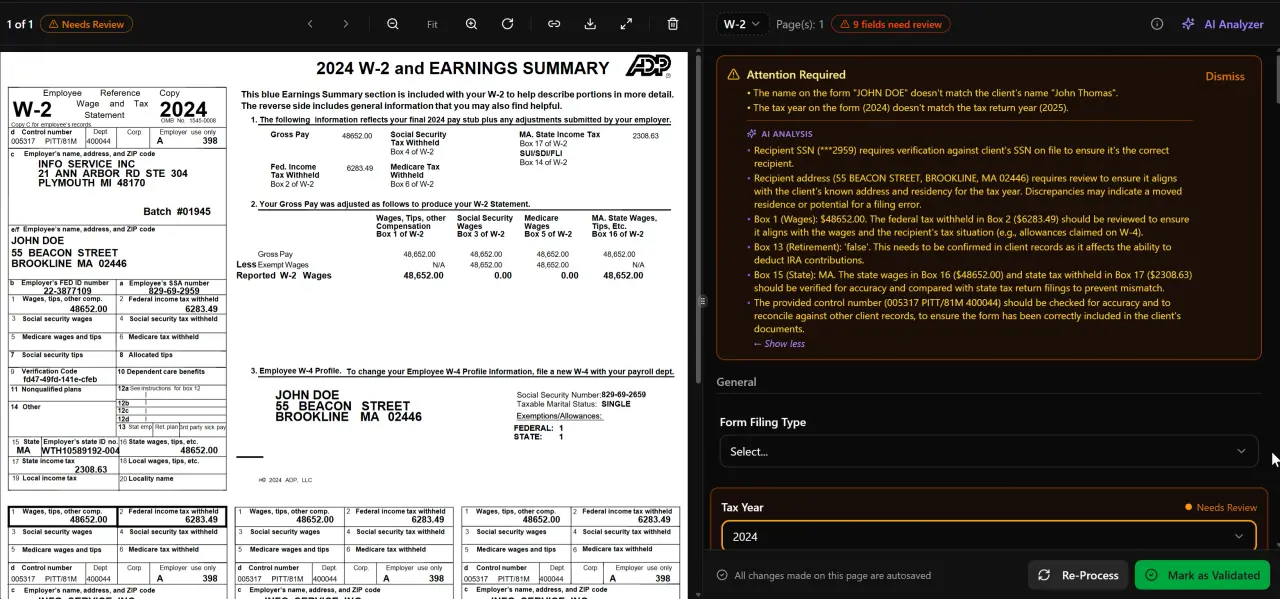
AI classifies, extracts, and validates every document automatically

Your clients see your brand — OTP login, document upload, and real-time status
Foreign Tax Credit vs. FEIE: A Repeatable Firm Decision Framework
The foreign tax credit and the foreign earned income exclusion are not always mutually exclusive, but they interact in ways that make the choice consequential. A client cannot claim both the foreign tax credit and the FEIE for the same foreign income — and the tax credit is often the better choice for clients in high-tax jurisdictions. Embedding a decision framework into your engagement process is one of the highest-value steps you can take for expat clients.
The core comparison: the FEIE excludes income from the U.S. tax base, reducing adjusted gross income. The foreign tax credit offsets U.S. tax liability dollar-for-dollar, subject to the basket rules under IRC §904. For a client in a country with an effective rate above the U.S. marginal rate — Germany, France, Canada, for example — the foreign tax credit will typically eliminate the U.S. liability entirely while preserving the ability to carry forward excess credits. The FEIE provides no carryforward; it is use-or-lose.
Run this calculation for every new expat client during onboarding: (a) compute U.S. tax under FEIE, (b) compute U.S. tax under the foreign tax credit on the same income, (c) compare outcomes with a 5-year projection that accounts for likely income growth and housing cost changes. The Treasury's explanation of the foreign tax credit provides the regulatory context if you need to document your analysis for a client file.
One critical trap: if a client has been claiming the FEIE and wants to switch to the foreign tax credit, the revocation triggers a 5-year lockout on re-electing the exclusion under IRC §911(e)(2). This makes the initial election decision — and your documentation of it — enormously consequential. For clients who are unsure about long-term plans, the foreign tax credit election is more reversible and therefore less risky as a default when the numbers are close.
For a deeper look at how AI-powered research tools can surface jurisdiction-specific treaty considerations that affect this analysis, see our guide on AI document extraction for CPAs.
State Tax Obligations That FEIE Does Not Cover
This is the gap that creates the most client surprises and the most preparer liability. The federal foreign earned income exclusion is a creature of the Internal Revenue Code. States are not required to conform to it, and several do not.
California is the most significant example. The California Franchise Tax Board does not recognize the federal FEIE for California-source income or for taxpayers who maintain California domicile. A client who lived in San Francisco, took a job in London, and kept a California domicile — because of family, property, or intention to return — may owe California income tax on the same income excluded from federal returns. This is especially consequential for high earners, and it is addressed in detail in our California tax changes 2026 CPAs must know article.
Virginia, Pennsylvania, New Jersey, and a handful of other states similarly do not automatically adopt the federal exclusion. Your engagement checklist should include a domicile analysis for every expat client, not just a federal qualification analysis. The domicile question — particularly the California question — should be raised at intake and documented explicitly in the engagement letter.
The practical workflow: in your intake questionnaire, ask about the state of last permanent domicile, any property owned or leased in U.S. states, registered vehicles, professional licenses maintained, and stated intention to return. These facts determine state filing obligations independent of the federal FEIE election. For multi-state nexus complexity beyond expat work, see our state tax nexus guide for CPA firms.
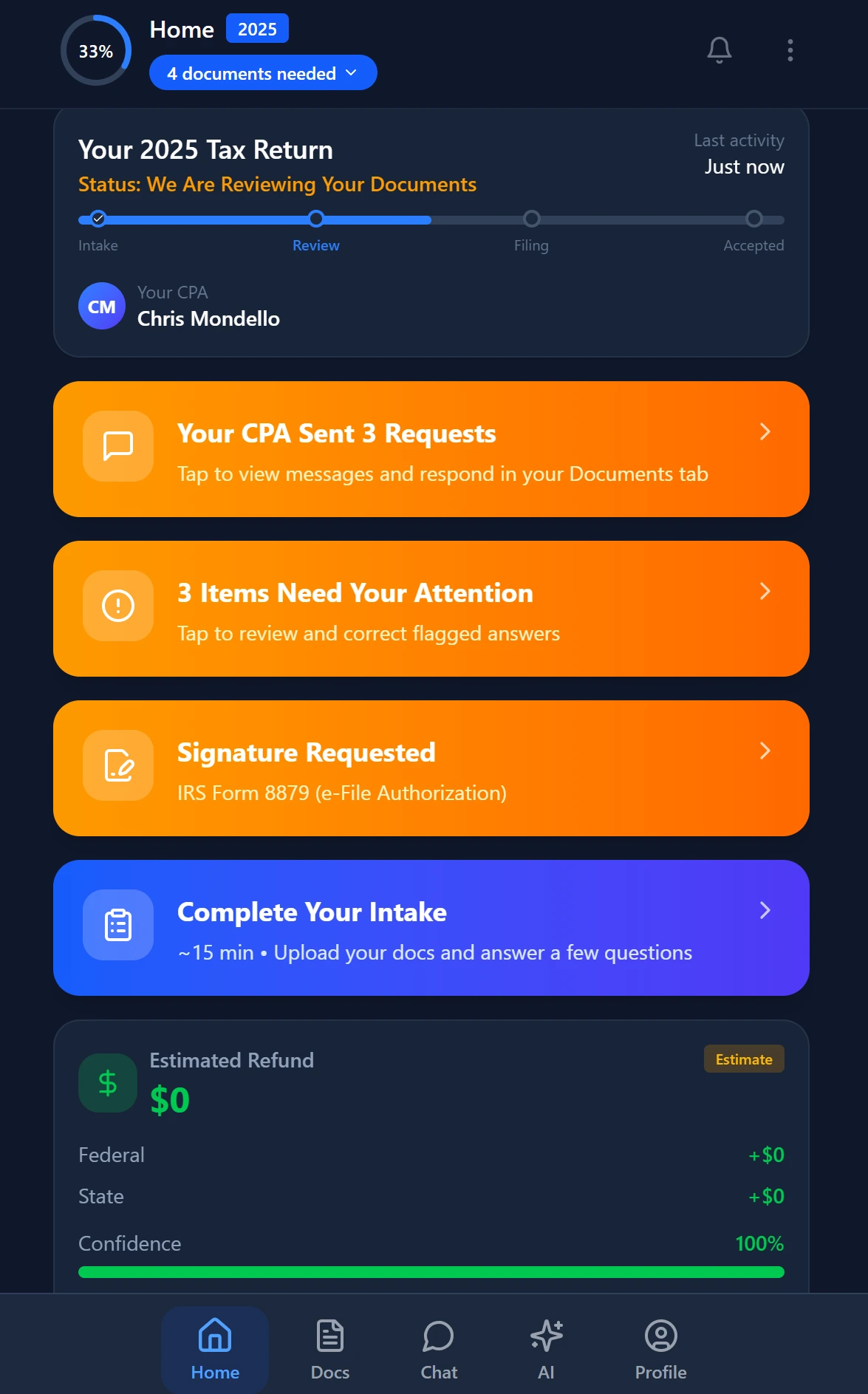
Smart intake auto-fills from uploaded documents and prior-year data
Document Collection Workflow for Expat Engagements
Expat tax returns require a document set that differs meaningfully from domestic returns. Building a specialized intake checklist saves preparer time and reduces the back-and-forth that stretches expat engagements across weeks. Your standard document request should include: foreign employer payslips or equivalent earnings statements (often in non-English formats), foreign tax returns or tax account transcripts, housing cost substantiation (lease agreements, utility bills, insurance payments), bank account records for FBAR eligibility analysis, and foreign employer name, address, and employer identification in native-language format.
Foreign payslips present an OCR and extraction challenge that generic document management tools handle poorly. TaxScout's AI document extraction is designed for recognized document classes and processes the full 5-layer validation pipeline — document quality routing, AI extraction with confidence scoring, OCR cross-verification, 15 deterministic math rules, and cross-document validation — which helps catch transposition errors on foreign-denominated income amounts before they reach the return.
For housing costs specifically, the IRS housing exclusion tables set location-specific limits. Your document request should map directly to the line items on Form 2555, Part VIII: rent, utilities (excluding telephone), insurance on household contents, and similar costs. Build a housing cost spreadsheet template for clients to complete before upload, then verify it against the substantiation documents in the client portal.
TaxScout's smart intake engine is modeled on IRS Form 13614-C and supports 4-layer prefill — including prior-year data — which means returning expat clients populate most of their profile automatically, and your team only reviews the delta. For a broader look at going paperless with your document workflow, see how to run a paperless accounting firm in 2026.
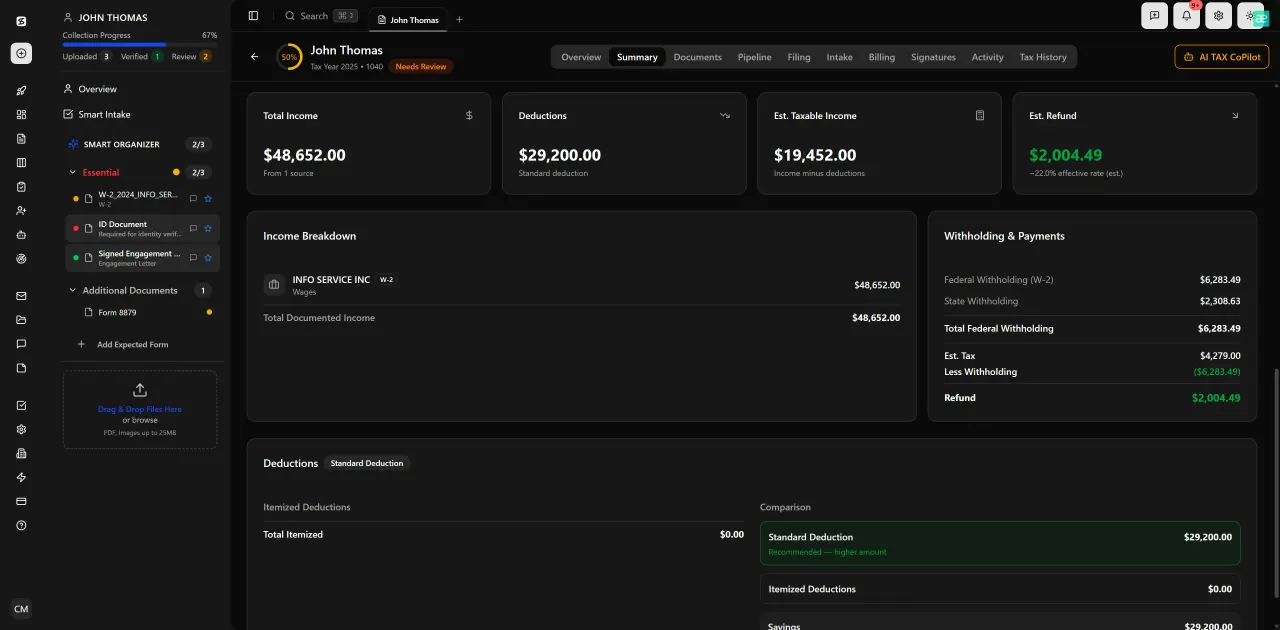
Review with AI assist — 9 agents answer questions with full client context
Common IRS Audit Triggers on Form 2555 Returns
Expat returns attract IRS scrutiny for predictable reasons. Understanding the audit trigger patterns lets you harden your workpapers before filing and counsel clients on record retention.
The most common triggers are: (1) mismatched tax home — the taxpayer claims a foreign tax home while maintaining a U.S. residence that suggests a continued U.S. domicile; (2) day-count errors on the physical presence test, especially in years with significant travel back to the U.S.; (3) housing cost claims that exceed the IRS location-specific limits without adequate substantiation; (4) FEIE claimed in the year of departure or return without a valid partial-year proration or the late-filing election; and (5) failure to file FBAR (FinCEN 114) or Form 8938 alongside the 1040, which signals incomplete international disclosure.
A particularly high-risk pattern: clients who travel frequently between the U.S. and a foreign country for work. Consulting-type arrangements where the client splits time between countries require a careful day-by-day analysis. The IRS Chief Counsel guidance on tax home at Cornell Law School provides the statutory definition that should anchor your analysis.
Workpaper best practice: maintain a day-count log with flight records or passport entry/exit stamps for all physical presence test clients. For bona fide residence clients, document the residency indicators — lease or title, local bank accounts, foreign social security registration, foreign driver's license — in a checklist format. If the return is examined, this documentation is the difference between a no-change letter and a significant deficiency. You can also surface relevant IRS guidance quickly using TaxScout's AI research agents, which query IRS, Treasury, and Cornell Law School sources in real time.

Every client gets organized documents, status tracking, and a complete history
Pricing and Packaging Expat Tax as a Premium Service Line
Expat tax is one of the clearest niche opportunities in CPA practice management because the complexity is predictable, the client base is underserved, and the retention rate is high. A client who moves abroad for a multi-year assignment needs annual compliance for the duration — plus advisory touchpoints at departure, at major income events, and at repatriation. That lifecycle maps perfectly to a retainer model.
A flat-fee structure works well for expat engagements. The base engagement should price the federal 1040 with Form 2555, the FBAR analysis, and one state return at a premium over a domestic 1040 — typically 2x to 3x depending on your market. Add-on modules can cover additional states, housing exclusion analysis, the foreign tax credit vs. FEIE comparison (which has value as a standalone planning deliverable), and treaty position documentation. The flat-fee billing guide for CPAs covers the broader pricing methodology, and our niche pricing strategy guide goes deep on commanding premium rates in specialized markets like expat tax.
The advisory layer is where the margin compounds. Clients at departure need a pre-move consultation covering domicile planning, FBAR thresholds, employer withholding adjustments, and the FEIE vs. foreign tax credit election. Clients in year two and beyond benefit from an annual review that checks whether a change in country or tax regime warrants revisiting the election. Clients approaching repatriation need a tax year analysis for the departure year and guidance on re-establishing U.S. tax residency. Price each of these as standalone advisory engagements or bundle them into a three-tier expat retainer package.
From a systems perspective, the recurring nature of expat work makes pipeline management and automated billing essential. TaxScout's pipeline management supports 12 customizable stages, and the Stripe-integrated invoicing handles recurring billing without manual intervention. Expat clients are also natural candidates for the client portal with OTP login — clients abroad often cannot receive SMS codes from U.S. numbers, and password-free authentication reduces friction at document submission time.
For additional context on building out specialized service lines and the metrics that show whether they are performing, see the accounting firm KPI dashboard guide and our complete blog resource library covering practice growth topics.
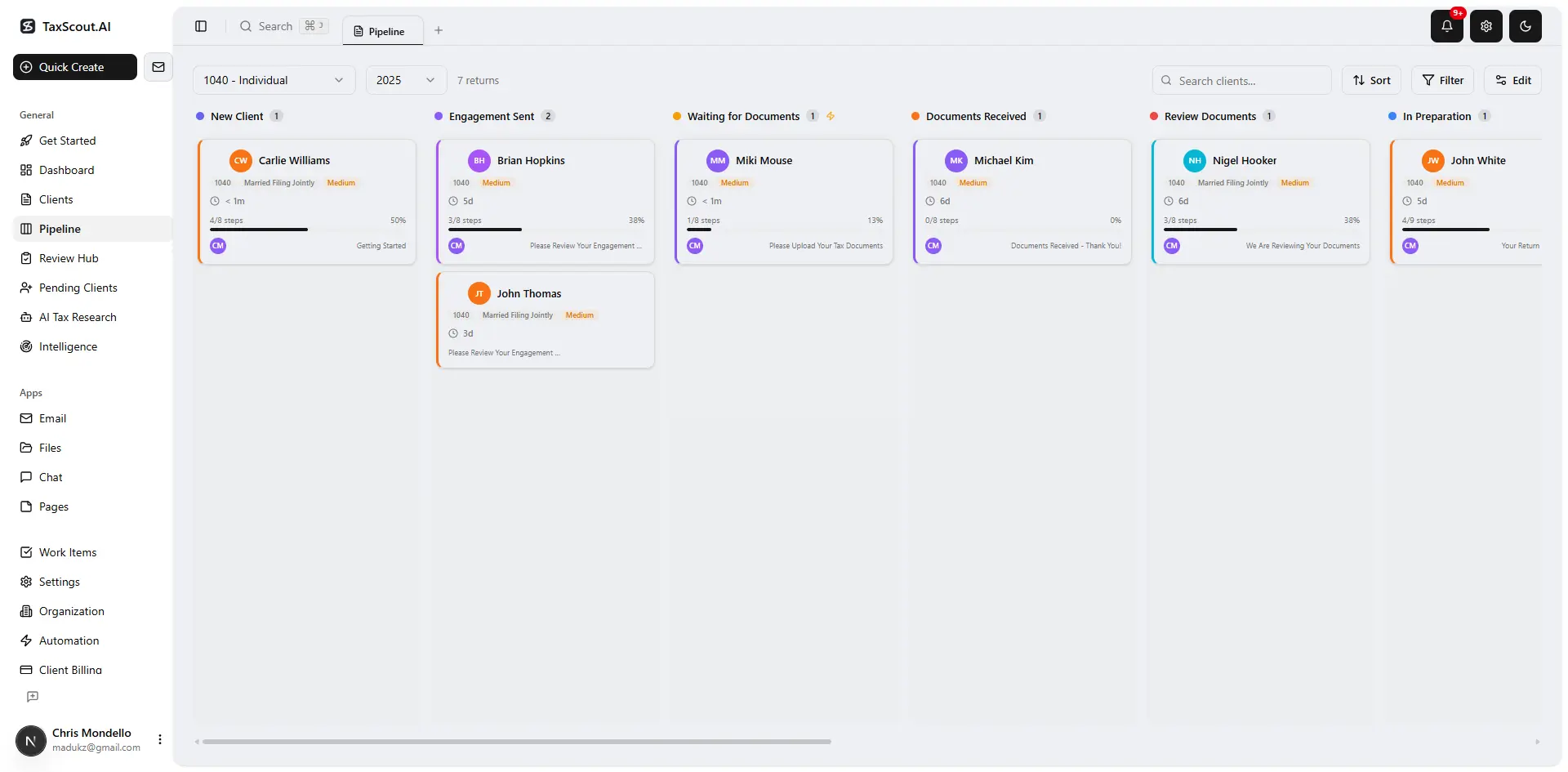
Track every return from intake to filed with drag-and-drop pipeline management
Expat Tax Engagement Tier Structure: What to Include at Each Price Point
| Tier | Inclusions | Typical Fee Range |
|---|---|---|
| Base Compliance | Federal 1040 + Form 2555, FBAR analysis (FinCEN 114), one state return | $600 – $1,200 |
| Standard Advisory | Base + housing exclusion analysis, FEIE vs. foreign tax credit comparison, second state return | $1,200 – $2,200 |
| Full Retainer | Standard + annual pre-filing review, treaty position memo, repatriation planning, priority turnaround | $2,500 – $5,000+ |
Building the Expat Niche: Staffing, Training, and Quality Control
A successful expat tax service line requires more than a preparer who has read the Form 2555 instructions once. It requires a team that understands the interaction between the FEIE, FBAR, Form 8938, foreign tax credits, and state obligations as a unified framework. Budget for annual training on IRS international tax updates and consider designating one senior preparer as the expat subject-matter lead who reviews all expat returns before delivery.
Quality control checkpoints specific to expat returns should include: tax home verification, day-count log review (physical presence clients), domicile and state filing obligation analysis, FBAR threshold check (aggregate foreign account value above $10,000 at any point in the year), Form 8938 threshold check ($200,000 single / $400,000 married for taxpayers living abroad), and a final review of whether the FEIE vs. foreign tax credit election is consistent with prior-year elections or whether a revocation risk exists.
The Bureau of Labor Statistics occupational data shows that accountant and auditor compensation continues to rise, which means the opportunity cost of manual, error-prone workflows is increasing. Investing in an AI-native platform that automates document classification, extraction, and cross-document validation for expat document classes is not a luxury for a firm building an expat niche — it is a margin protection strategy. Explore the full TaxScout feature set on the pricing page to see how the platform scales with your expat client volume.
Ready to build a high-margin expat tax practice without adding headcount?
TaxScout gives CPA firms AI document extraction, smart intake, 9 research agents, and unlimited-client pipeline management — all on a flat monthly fee with no per-user charges.
Frequently Asked Questions
For tax year 2024, the foreign earned income exclusion limit is $126,500. This amount is indexed for inflation annually. Taxpayers who qualify for only part of the year receive a pro-rated exclusion based on the number of qualifying days in the tax year relative to the total days in the year.
Keep reading
Backdoor Roth IRA: How CPAs Execute the Strategy Without Triggering Pro-Rata Tax
Oct 12, 2026 · 1 min read
Amended FBAR Procedures: How CPAs Correct Foreign Account Errors Without Triggering Penalties
Oct 12, 2026 · 1 min read
Transparency in Coverage Final Rules: What CPA Firms Must Do Now
Oct 12, 2026 · 1 min read
Stay up to date
Get the latest tax tech insights delivered to your inbox.