Backdoor Roth IRA: How CPAs Execute the Strategy Without Triggering Pro-Rata Tax
High-income clients are phased out of direct Roth contributions in 2026, but the backdoor Roth IRA remains a viable — and powerful — strategy when executed correctly. This guide walks CPAs through the two-step contribution-and-conversion process, the pro-rata rule traps most practitioners miss…
The backdoor Roth IRA is one of the most durable high-income planning tools in a CPA's arsenal, yet it remains one of the most frequently misexecuted. For 2026, the Roth IRA income phase-out starts at $150,000 for single filers and $236,000 for married filing jointly — figures that disqualify a wide swath of your physician, executive, and business-owner clients from contributing directly. The backdoor Roth IRA sidesteps those Roth IRA income limits by pairing a nondeductible traditional IRA contribution with a subsequent Roth conversion, a perfectly legal two-step process that has survived repeated Congressional scrutiny.
The mechanics sound simple enough, but the execution is where CPAs consistently stumble. The pro-rata rule — IRC § 408(d)(2) — can turn a clean conversion into a partially taxable event the moment a client carries any pre-tax IRA balance, including SEP-IRA and SIMPLE IRA assets that many practitioners forget to account for. Layered on top are Form 8606 filing obligations, IRA basis tracking across multiple years, and the companion mega backdoor Roth strategy that an increasing number of high-income clients can access through after-tax 401(k) contributions. Understanding these pitfalls is essential for any CPA guiding clients through a backdoor Roth IRA conversion.
This guide is written for the CPA as practitioner, not the client as consumer. It covers every step from confirming eligibility and advising on existing IRA balances, through Form 8606 line-by-line reporting, through the engagement-letter language that limits your liability exposure. Generic personal-finance content will not help you here — you need the technical execution details that let you file correctly, defend the position, and document the recommendation. Whether you are executing your first backdoor Roth IRA or refining a workflow you have used for years, the details here are designed to hold up under audit scrutiny.
Confirming Eligibility and Reviewing the Client's Full IRA Picture
Before you contribute a single dollar, you need to map every IRA the client holds — not just the account they mention first. Pull the prior-year Form 5498 data from the client file and ask directly about SEP-IRAs, SIMPLE IRAs, and any rollover IRAs sitting at former-employer plans. The reason matters profoundly: for pro-rata purposes, the IRS aggregates the December 31 fair market value of all traditional, SEP, and SIMPLE IRAs the client owns. A client who rolled over a $200,000 401(k) into a traditional IRA three years ago and forgot to mention it is not a clean backdoor Roth candidate until that balance is resolved. Overlooking even one pre-tax IRA account at this stage is the most common reason a backdoor Roth IRA triggers an unexpected tax bill for the client.
Confirm that the client has earned income at least equal to the contribution amount — the $7,000 limit for 2026 ($8,000 if age 50 or older). There is no income ceiling on making a nondeductible traditional IRA contribution (only the deductibility is phased out), so a client earning $800,000 can still contribute to a traditional IRA; they simply cannot deduct it. That nondeductibility is precisely the feature the backdoor Roth IRA strategy depends on. Document the earned income confirmation in your workpaper and note the applicable contribution limit. For firms evaluating their backdoor Roth IRA approach, this trade-off compounds over time.
Also confirm the client's filing status and whether their spouse holds IRA balances. The pro-rata calculation is applied separately to each spouse, not jointly — but a married couple where one spouse has a clean IRA slate and the other carries a large rollover IRA may have very different clean-execution prospects. This asymmetry often opens planning opportunities: the clean-slate spouse executes the backdoor Roth IRA while the pre-tax-heavy spouse pursues an IRA-to-plan rollback strategy instead. For more on how traditional IRA mechanics feed into the broader Roth conversion calculus, see our Roth Conversion Strategy guide. Each of these factors directly shapes how backdoor Roth IRA plays out in practice.

Click any extracted field to see its source highlighted on the original PDF
Step 1: Making the Nondeductible Traditional IRA Contribution
The first step is contributing to a traditional IRA on a nondeductible basis. Instruct the client to open a traditional IRA at a custodian that allows in-kind or cash conversion to Roth (not all custodians support same-institution conversions cleanly — Vanguard, Fidelity, and Schwab all do). The contribution should be parked in a money-market or stable-value fund to minimize the risk of any earnings accumulating before conversion; earnings are taxable on conversion and complicate the reporting if they are non-trivial. Understanding backdoor Roth IRA mechanics in this context is what separates firms that scale from those that stall.
Timing matters. The contribution can be made for the prior tax year up to April 15 of the following year. However, conversions are always calendar-year transactions — a contribution made in January 2026 for tax year 2025 that is converted in January 2026 is reported as a 2026 conversion on the 2026 return, while the nondeductible contribution is reported on the 2025 Form 8606. This mismatch trips up many CPAs the first time they encounter it. Keep the contribution and conversion years clearly separated in your workpaper notes. This is precisely where a deliberate backdoor Roth IRA strategy pays off.
One practical instruction to give clients: do not invest the funds. Leaving the traditional IRA in cash means the conversion amount will nearly equal the contribution amount, producing minimal or zero taxable income on conversion (assuming no pre-tax IRA balance). Any growth between contribution and conversion creates taxable income at ordinary rates — for a client in the 37% bracket, even $50 of earnings costs $18.50 in federal tax, plus net investment income tax if applicable. Speed matters. See our guide on the net investment income tax for a fuller picture of how these layers interact for high-income clients. The backdoor Roth IRA sits at the center of this decision — get it wrong and the rest unravels.
Tracking IRA basis and Form 8606 history across dozens of clients during tax season? When firms revisit their backdoor Roth IRA priorities, the gaps usually surface here.
TaxScout's AI document extraction and client-context memory keep every client's filing history organized and accessible — so you never miss a carryforward basis again.
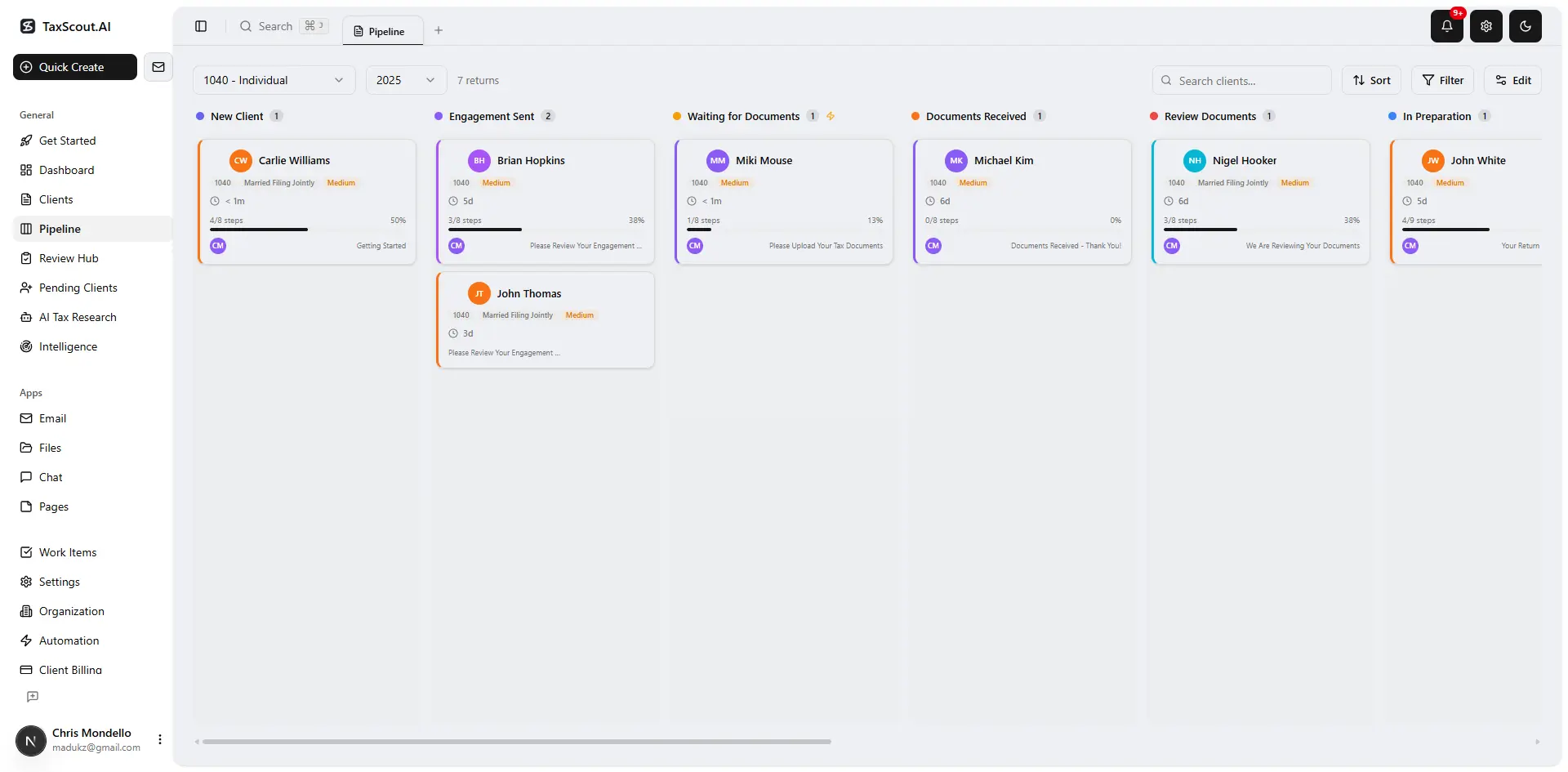
Track every return from intake to filed with drag-and-drop pipeline management
Step 2: Executing the Roth Conversion
Once the nondeductible contribution settles — typically one to three business days — instruct the client to request a Roth conversion for the full balance of the traditional IRA. If the client opened a brand-new IRA solely for this purpose and parked the funds in cash, the conversion amount will be exactly (or nearly exactly) equal to the nondeductible contribution, resulting in zero (or minimal) taxable income on conversion. The custodian will generate a Form 1099-R coded with distribution code 2 (early distribution, exception applies) or code 7 (normal distribution) depending on the client's age, with box 2a showing the taxable amount as determined by the pro-rata calculation.
Do not instruct the client to convert only part of the traditional IRA balance unless you have a deliberate reason. Partial conversions that leave behind a small traditional IRA balance preserve pre-tax exposure and complicate future-year basis tracking. A clean, complete conversion eliminates the account and resets the IRA landscape. Confirm with the custodian that the account will be fully closed post-conversion, and retain the account closure or zero-balance confirmation in the client file as supporting documentation.
After conversion, the client should not re-contribute to a traditional IRA at that custodian for the same tax year unless you immediately re-execute the conversion. 'Contribution creep' — where a client accidentally leaves a small traditional IRA balance open and adds to it the following January — is one of the most common ways clean backdoor Roth IRA arrangements drift out of compliance. Set a calendar reminder or automated workflow to verify the account status before the following year's contribution window opens.
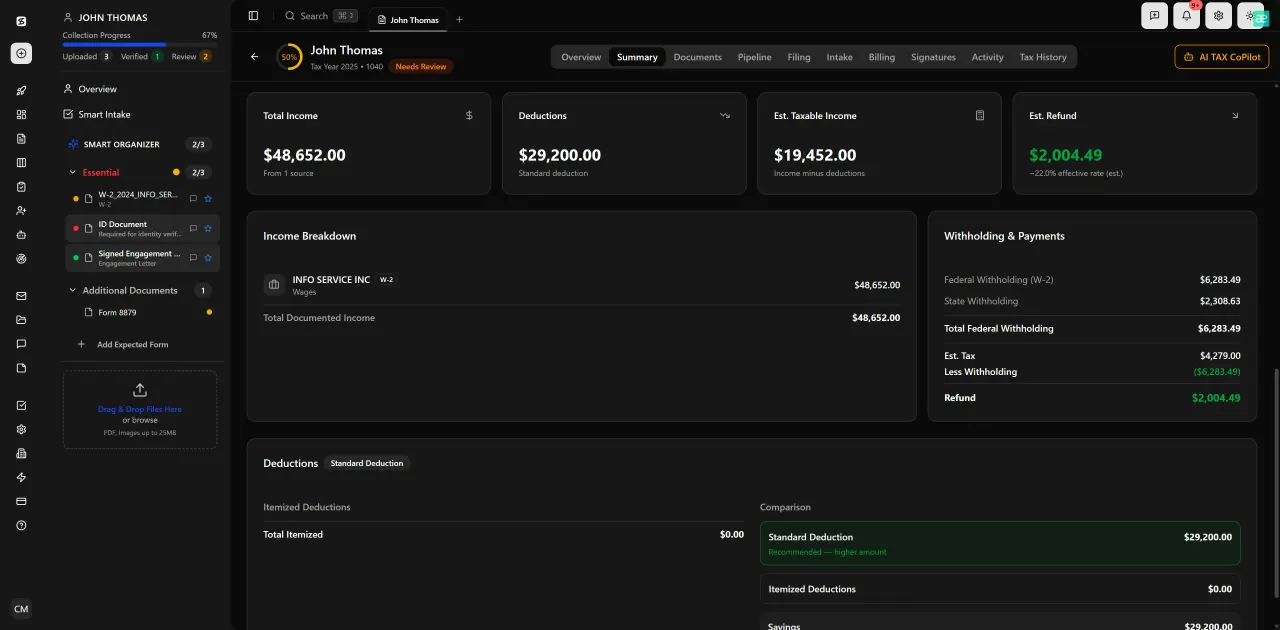
Review with AI assist — 9 agents answer questions with full client context
The Pro-Rata Rule: The Most Expensive Mistake CPAs Make
The pro-rata rule under IRC § 408(d)(2) requires that any distribution or conversion from a traditional IRA be treated as coming proportionally from pre-tax and after-tax (basis) amounts across all traditional, SEP, and SIMPLE IRAs the taxpayer owns. You cannot cherry-pick which dollars you convert. The formula is: tax-free percentage = (total IRA basis) ÷ (total IRA FMV on December 31 of the conversion year + amount converted).
Consider a concrete example: a client makes a $7,000 nondeductible contribution and then converts $7,000, but also holds a $93,000 rollover IRA from a former employer. Total basis is $7,000. Total IRA value including the conversion is $100,000. Tax-free percentage is 7%. Only $490 of the $7,000 conversion is tax-free; the remaining $6,510 is taxable at ordinary income rates. For a client in the 37% federal bracket, that is a $2,409 unexpected federal tax bill — plus state income tax — on a backdoor Roth IRA transaction the client believed was entirely clean.
The SEP-IRA and SIMPLE IRA trap catches practitioners who advise self-employed clients. A solo practitioner who contributes $69,000 to a SEP-IRA each year holds a massive pre-tax IRA balance that contaminates every backdoor Roth attempt unless it is removed. The solution is to roll the SEP-IRA or SIMPLE IRA balance into the client's current-employer 401(k) plan — if the plan accepts incoming rollovers — or into a solo 401(k) that accepts rollovers, thereby removing those dollars from the pro-rata calculation entirely before year-end. Note: a solo 401(k) is not an IRA for pro-rata purposes and is not aggregated. Executing this rollout prior to December 31 of the conversion year is essential; the pro-rata denominator is measured at December 31.
The SIMPLE IRA adds one additional wrinkle: SIMPLE IRA assets cannot be rolled over to a non-SIMPLE plan until two years have elapsed from the date of first SIMPLE IRA participation. If a client is within the two-year window, neither the SEP-IRA elimination strategy nor a direct rollover to a 401(k) is available for the SIMPLE IRA assets. Document this limitation explicitly in your workpaper and advise the client to defer the backdoor Roth IRA strategy until the two-year restriction lapses. Attempting to work around it by converting anyway simply generates a larger-than-expected tax bill — and a confused client.
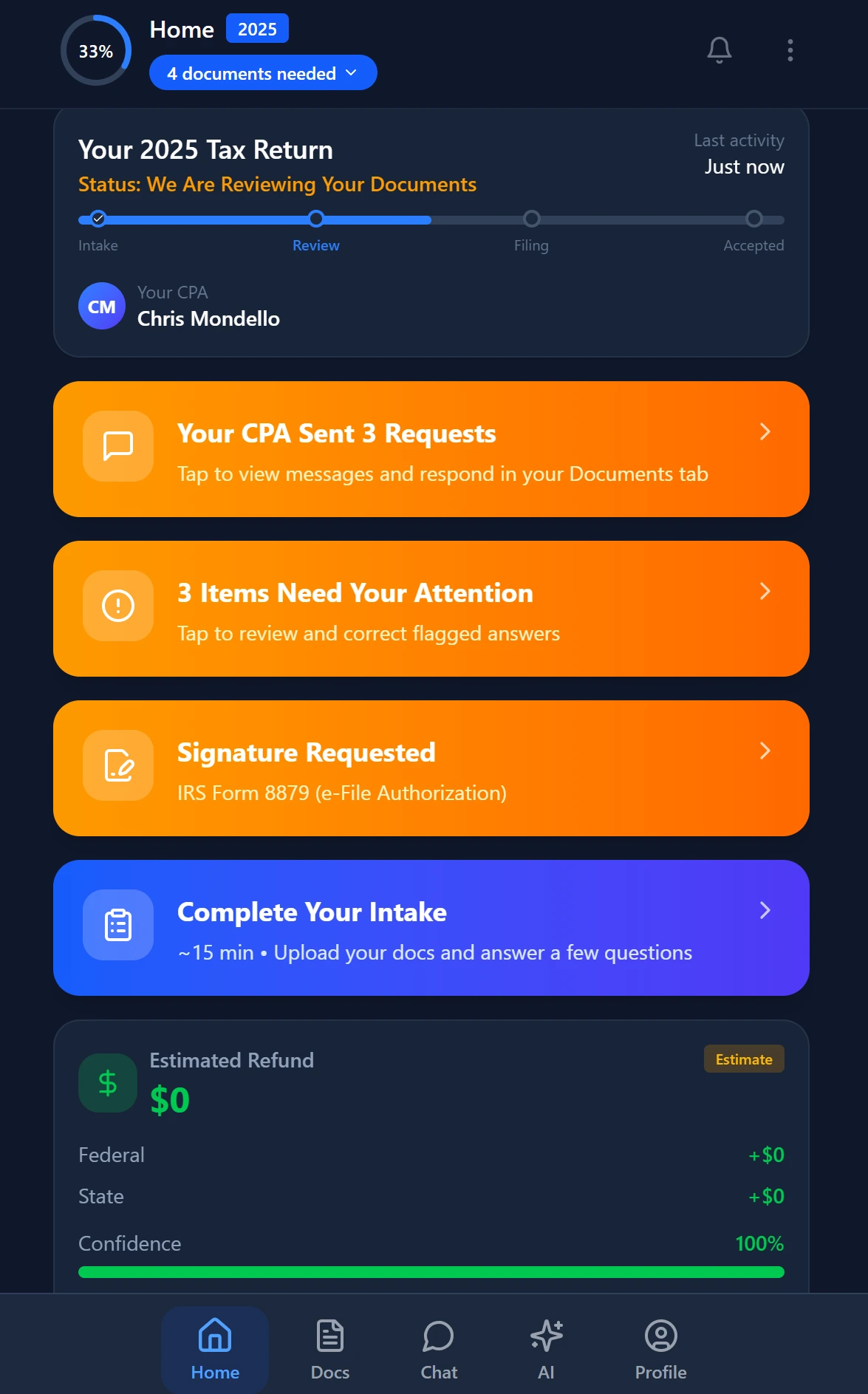
Smart intake auto-fills from uploaded documents and prior-year data
Form 8606 Filing Mechanics: Line-by-Line Execution
Form 8606 is the document of record for IRA basis. Every year a client makes a nondeductible traditional IRA contribution, Part I of Form 8606 must be filed — even if no conversion occurs that year. Every year a Roth conversion occurs, Part II must be completed. Failure to file Form 8606 when required subjects the taxpayer to a $50 penalty per IRS Form 8606 instructions, and more critically, the undocumented basis is effectively lost unless the taxpayer can reconstruct it via amended returns.
Part I walkthrough for the contribution year: Line 1 — enter the nondeductible contribution amount for the current year ($7,000 or $8,000 depending on age). Line 2 — carry forward the total basis from the prior-year Form 8606, line 14. Line 3 — sum of lines 1 and 2. Lines 4-5 cover distributions taken during the year; if none, leave blank. Line 6 — enter the December 31 FMV of all traditional, SEP, and SIMPLE IRAs. Lines 7-13 compute the nontaxable distribution amount (applies only if a distribution was taken). Line 14 — the carryforward basis to the next year. In a clean backdoor Roth IRA with no pre-tax IRA balance and same-year conversion, line 14 will be zero after the conversion is reported in Part II.
Part II walkthrough for the conversion year: Line 16 — total amount converted from traditional to Roth during the year. Line 17 — basis allocable to conversions (from the pro-rata calculation; if IRA is clean, this equals line 16). Line 18 — taxable amount of conversion (line 16 minus line 17). In the ideal clean-backdoor scenario with no pre-tax IRA balance, line 18 will be zero or nearly zero. In the contaminated scenario — where pre-tax balances exist — line 18 will reflect the proportional taxable amount as computed by the pro-rata formula. Feed line 18 directly to Form 1040 line 5b (taxable IRA distributions).
Basis carryforward is the long-term record-keeping obligation that most clients underestimate. Every prior-year Form 8606 is required to compute the current-year basis correctly. If a client comes to you mid-career with missing Form 8606 history, you will need to reconstruct it from custodian records and prior-year returns under Rev. Proc. 98-59, filing corrected or original Forms 8606 for all open years. Use TaxScout's AI document extraction to process prior-year 1099-R series and custodian statements systematically when reconstructing basis history for newly onboarded clients. For related document and tax-workpaper-package considerations, see other blog resources covering practice-wide documentation standards.
The Mega Backdoor Roth: The Companion Strategy CPAs Must Evaluate
For clients whose employer 401(k) plan permits after-tax contributions beyond the standard pre-tax limit, the mega backdoor Roth offers a far larger annual Roth conversion opportunity that the standard backdoor Roth IRA cannot match. For 2026, the total 401(k) annual additions limit under IRC § 415(c) is $70,000. A client who maxes pre-tax contributions at $23,500 (plus $7,500 catch-up if age 50+) can potentially contribute the remaining headroom as after-tax dollars — up to approximately $46,500 — and then convert those after-tax dollars to Roth either via in-plan Roth conversion or by rolling them out to a Roth IRA upon distribution.
The critical plan-document requirement is that the 401(k) plan must explicitly allow after-tax contributions and must permit either in-plan Roth conversions or in-service distributions of after-tax amounts. Not all plans do. Your client's HR department or plan administrator can confirm this via the Summary Plan Description. If the plan permits it, the mega backdoor Roth is executed within the 401(k) wrapper — no IRA pro-rata contamination applies because 401(k) assets are not aggregated for IRA pro-rata purposes. Earnings on after-tax contributions that accumulate before conversion are taxable, so the same prompt-conversion discipline applies.
From a CPA's advisory standpoint, the mega backdoor and the standard backdoor Roth IRA should be evaluated simultaneously for any high-income W-2 client. If the employer plan supports it, the mega backdoor dwarfs the standard $7,000 contribution in annual Roth accumulation potential. For self-employed clients with a solo 401(k), the same strategy is available if the plan document — adopted from a prototype provider — includes after-tax contribution and in-plan conversion provisions. Many off-the-shelf solo 401(k) documents do not include these provisions by default; the client may need to adopt an amended plan document. Pair this evaluation with the qualified plan audit requirements analysis for clients approaching the 100-participant threshold.

Every client gets organized documents, status tracking, and a complete history
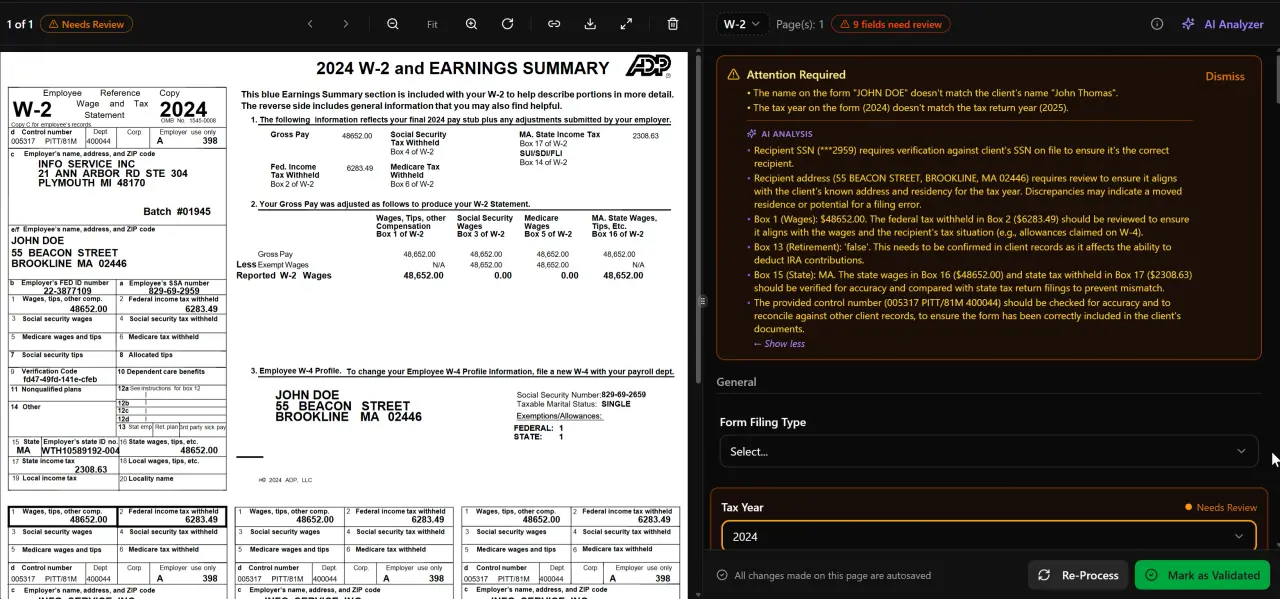
AI classifies, extracts, and validates every document automatically
Documentation and Engagement Letter Language for Liability Protection
The backdoor Roth IRA is a tax position with a non-trivial controversy history — it has been targeted in proposed legislation (the Build Back Better Act, 2021) and remains subject to regulatory risk. Your documentation posture should reflect that. At minimum, your engagement letter for any year in which you recommend or execute a backdoor Roth IRA strategy should explicitly identify the strategy, describe the potential tax consequences if the client's IRA profile changes (including acquiring a rollover IRA mid-year), and confirm that the recommendation is conditioned on the client's IRA landscape as represented to you.
Your workpaper file for the engagement year should contain: (1) a signed client representation confirming the December 31 IRA balances at all custodians; (2) Form 5498 copies or custodian statements supporting those balances; (3) a completed pro-rata calculation worksheet showing your basis-allocation math; (4) a copy of the Form 8606 as filed; and (5) the 1099-R from the custodian confirming the conversion amount. If the client already had existing pre-tax IRA balances and you advised a rollover-to-401(k) strategy to clean the slate, document that separately — including confirmation that the receiving plan accepted the rollover before December 31. Retaining these records in an organized, accessible structure is something TaxScout's file management and client portal tools are built to support, keeping every document tied to the client record and retrievable in seconds.
On the engagement letter itself, the AICPA's tax advisory standards under SSTS No. 1 require that you have a reasonable basis for any tax position you recommend. For the backdoor Roth IRA, that reasonable basis is well-established — Congress has repeatedly declined to eliminate the strategy despite having the opportunity — but the position is stronger if you can demonstrate you evaluated the pro-rata implications specifically for this client. A boilerplate engagement letter that does not mention the strategy provides no protection; a tailored addendum that does is your best defense. Use TaxScout's e-signatures to obtain client sign-off on the engagement-letter addendum before you execute the contribution.
Finally, consider the multi-year obligation you are taking on. IRA basis tracking must continue as long as the client holds any traditional IRA with after-tax basis — potentially for decades. That is a recurring service deliverable with recurring liability exposure. Build it into your annual engagement scope and price accordingly. For pricing guidance on recurring advisory engagements, see our pricing page.
IRS Scrutiny Patterns and Audit Defense Considerations
The IRS does not currently have a formal audit program targeting backdoor Roth transactions specifically, but the 1099-R and Form 8606 paper trail is visible on the return and examiners in correspondence audits will sometimes question the zero-taxable-amount conversion. The most common trigger is a 1099-R showing a large distribution from a traditional IRA with box 2a (taxable amount) left blank or shown as zero, paired with a Form 8606 that reports a matching Roth conversion. If your pro-rata worksheet is clean, this is a 10-minute audit response — produce the Form 8606 and the IRA balance confirmation. If the workpaper does not exist, the audit becomes a reconstruction exercise.
A second scrutiny pattern arises when a client has executed backdoor Roth IRA contributions for multiple years but failed to file Form 8606 in one or more prior years. The basis for those years is technically unsubstantiated on the return, even if the underlying facts support it. If you inherit a client with this situation, file corrected or delinquent Forms 8606 for all open years under the basis-reconstruction guidance before executing any new backdoor Roth IRA contributions. Filing a delinquent Form 8606 does not by itself generate a penalty if no tax is owed — the IRS instructions confirm the $50 penalty applies only when the form is required to report a taxable event that was not properly reported.
The IRS AI research agents available in TaxScout can assist with real-time lookup of current IRS position papers, PLRs, and Treasury guidance on Roth conversion issues — useful when a client's situation has unusual facts (such as an inherited IRA aggregation question or a state that does not conform to federal Roth conversion treatment). State nonconformity is an underappreciated risk: California, for example, does not recognize the backdoor Roth as a distinct category and taxes conversions under its own rules. Confirm state-level treatment before advising any out-of-state client, and consider linking to the state tax deadlines resource to stay current on conformity changes. The charitable giving strategies guide is a useful companion read for high-income clients who are simultaneously managing Roth accumulation and charitable vehicles.
Managing backdoor Roth documentation, Form 8606 history, and IRA basis records across your entire client base?
TaxScout gives CPA firms AI-powered document extraction, client-context memory, and built-in e-signatures — everything you need to execute and document high-income strategies without missing a step.
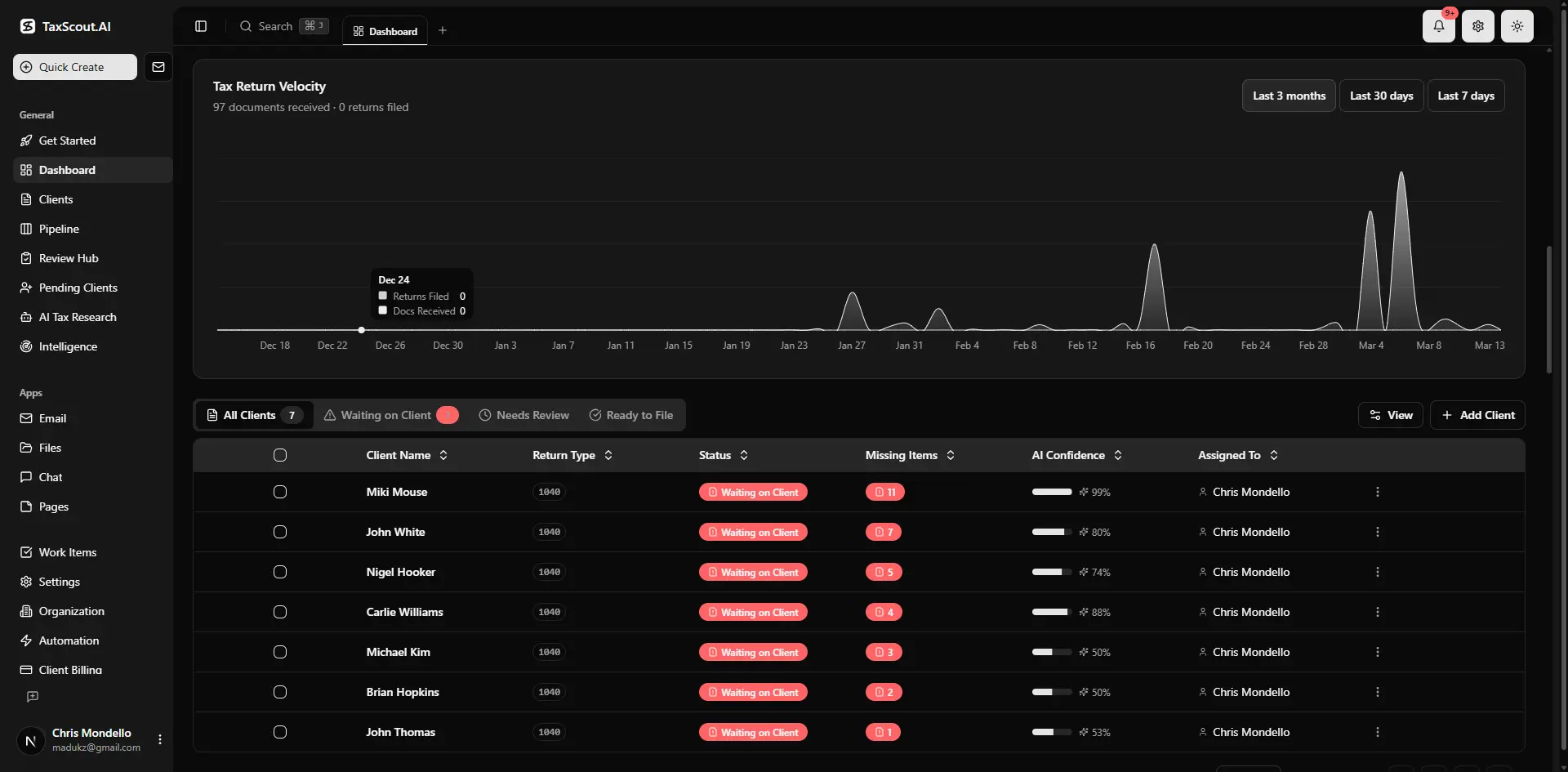
Real-time dashboard showing returns in progress, revenue, and upcoming deadlines
Frequently Asked Questions
Yes. Congress considered eliminating the strategy in the 2021 Build Back Better Act but did not pass those provisions. As of 2026, making a nondeductible traditional IRA contribution and then converting it to a Roth IRA remains a fully legal strategy explicitly contemplated by IRC § 408A and IRS guidance. CPAs should monitor future legislative sessions, but the strategy has a solid legal foundation supported by multiple cycles of Congressional inaction.
Keep reading
Amended FBAR Procedures: How CPAs Correct Foreign Account Errors Without Triggering Penalties
Oct 12, 2026 · 1 min read
Transparency in Coverage Final Rules: What CPA Firms Must Do Now
Oct 12, 2026 · 1 min read
Backdoor Roth IRA: How CPAs Execute the Strategy for High-Income Clients
Oct 12, 2026 · 1 min read
Stay up to date
Get the latest tax tech insights delivered to your inbox.