Amended FBAR Procedures: How CPAs Correct Foreign Account Errors Without Triggering Penalties
Most FBAR content covers initial filing. This guide goes deeper — walking CPAs through the exact steps to correct a filed or missed FinCEN 114, choose between delinquent and streamlined procedures, document reasonable cause, and communicate risk exposure to clients without alarming them.
Amended FBAR procedures sit in a narrow, high-stakes corner of international compliance that most practitioners encounter only after something has already gone wrong. A client discloses a forgotten Swiss account. A prior-year preparer missed the aggregate threshold. A K-1 footnote buried a foreign financial account that nobody flagged for FinCEN 114 purposes. Whatever the trigger, the moment a CPA realizes a previously filed — or entirely unfiled — FBAR contains an error, the clock starts on a set of decisions that can mean the difference between a quiet correction and a six-figure civil penalty.
The challenge is that the IRS and FinCEN have created at least three distinct correction pathways — an amended FinCEN 114 through the BSA E-Filing System, the Delinquent FBAR Submission Procedures, and the Streamlined Filing Compliance Procedures — and the wrong choice can inadvertently signal willfulness, forfeit penalty protection, or conflict with a parallel offshore voluntary disclosure. Almost no CPA-focused content explains the distinction between these routes in operational terms, which leaves practitioners piecing together procedures from IRS notices, FinCEN FAQs, and Treasury guidance that were written for administrators, not preparers. Understanding which of these amended FBAR procedures applies to a given client is the foundational decision that shapes every step that follows.
This guide is built for error remediation, not initial filing. It covers the BSA E-Filing workflow step by step, the threshold questions that route a client into delinquent versus streamlined procedures, how to construct a defensible FBAR reasonable cause statement, and how to frame the conversation with a client who is about to learn they have a compliance problem — and a potential penalty exposure — they did not know existed. Practitioners who work through these amended FBAR procedures regularly will recognize that the diagnostic phase — not the filing itself — is where most errors in the correction process originate.
Understanding the Three Correction Pathways Before You File Anything
Before touching the BSA E-Filing System, a CPA must correctly diagnose which pathway applies. Filing under the wrong procedure is not a technicality — it can constitute a separate disclosure that undermines privilege, signals the IRS to open an examination, or disqualify a client from penalty protection they would otherwise have received. Each of the amended FBAR procedures carries its own eligibility requirements, and conflating them can produce consequences far worse than the original reporting error.
The three main routes are: (1) a standard FinCEN 114 amendment for clients who filed on time but reported incorrect or incomplete information; (2) the Delinquent FBAR Submission Procedures for clients who never filed but have no unreported income and are not under IRS examination; and (3) the Streamlined Filing Compliance Procedures — either the Streamlined Domestic Offshore Procedures (SDOP) or Streamlined Foreign Offshore Procedures (SFOP) — for clients who have both unfiled FBARs and unreported foreign income attributable to non-willful conduct. For firms evaluating their amended FBAR procedures approach, this trade-off compounds over time.
A fourth path, the Voluntary Disclosure Program (VDP), exists for willful violations and is outside the scope of this guide. However, the willfulness question must be addressed before choosing any of the first three routes. If the facts suggest the client knew about the account and knowingly failed to report it, an amended FBAR or delinquent submission could be construed as an attempt to quietly correct a willful violation, which dramatically increases risk. For other IRS compliance frameworks that involve similar voluntary disclosure decisions, the threshold analysis is equally critical. Each of these factors directly shapes how amended FBAR procedures plays out in practice.
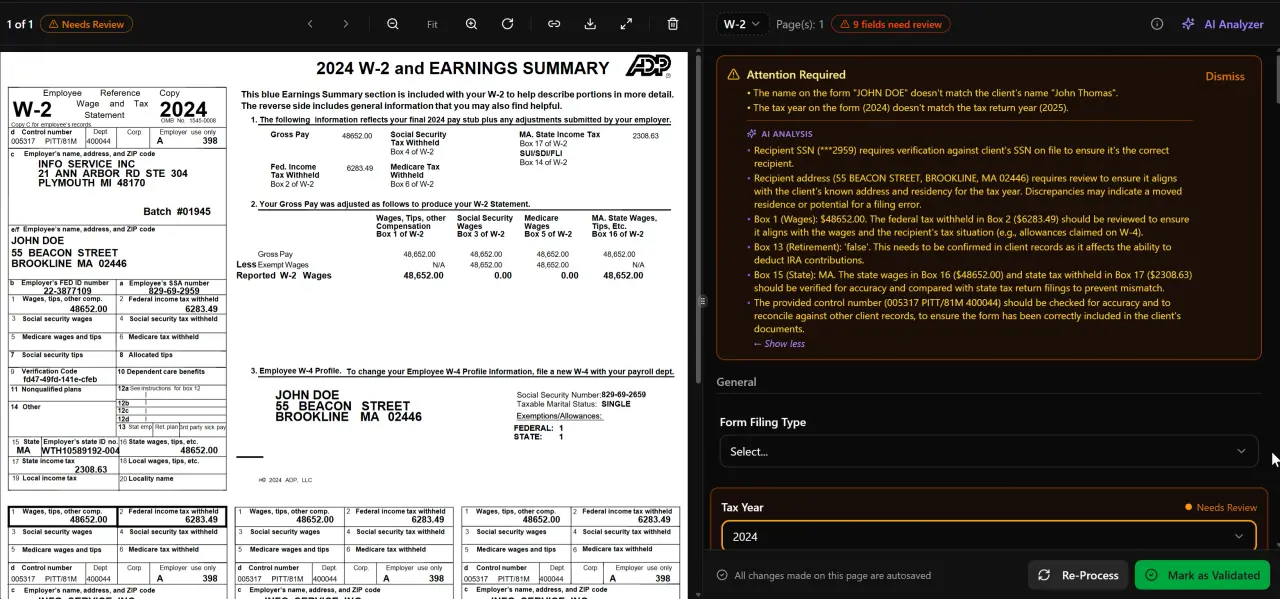
AI classifies, extracts, and validates every document automatically
Step 1: Gather the Documentation Before Opening the BSA E-Filing Portal
The BSA E-Filing System does not save incomplete sessions reliably, and an interrupted submission can create a partial record that complicates the correction. Before logging in, assemble the complete documentation package: prior-year FinCEN 114 confirmation number (if one exists), foreign financial account statements for all years in question, account opening and closing dates, the foreign financial institution's full legal name and country, maximum account values by year converted to U.S. dollars using the Treasury's published year-end exchange rates, and any correspondence from the IRS or FinCEN related to the account. Understanding amended FBAR procedures in this context is what separates firms that scale from those that stall.
For clients with multiple accounts or multiple years, build a reconciliation worksheet before touching the portal. The BSA system requires a separate FinCEN 114 per filing year — there is no multi-year consolidated form — so each year must be prepared and submitted individually. TaxScout's PDF tools can help organize multi-year account statements, apply Bates numbering to your workpaper set, and mask PII before sharing documents internally, which is especially important when foreign account details are involved. Firms that have formalized their amended FBAR procedures into a repeatable checklist find this document-gathering phase far less error-prone.
Also confirm whether the client has filed Forms 8938 (Statement of Specified Foreign Financial Assets) for the relevant years, since inconsistency between an 8938 and a corrected FBAR creates an independent audit flag. The IRS comparison of FBAR and Form 8938 requirements is the clearest reference for reconciling the two obligations. Amended FBAR procedures sits at the center of this decision — get it wrong and the rest unravels.
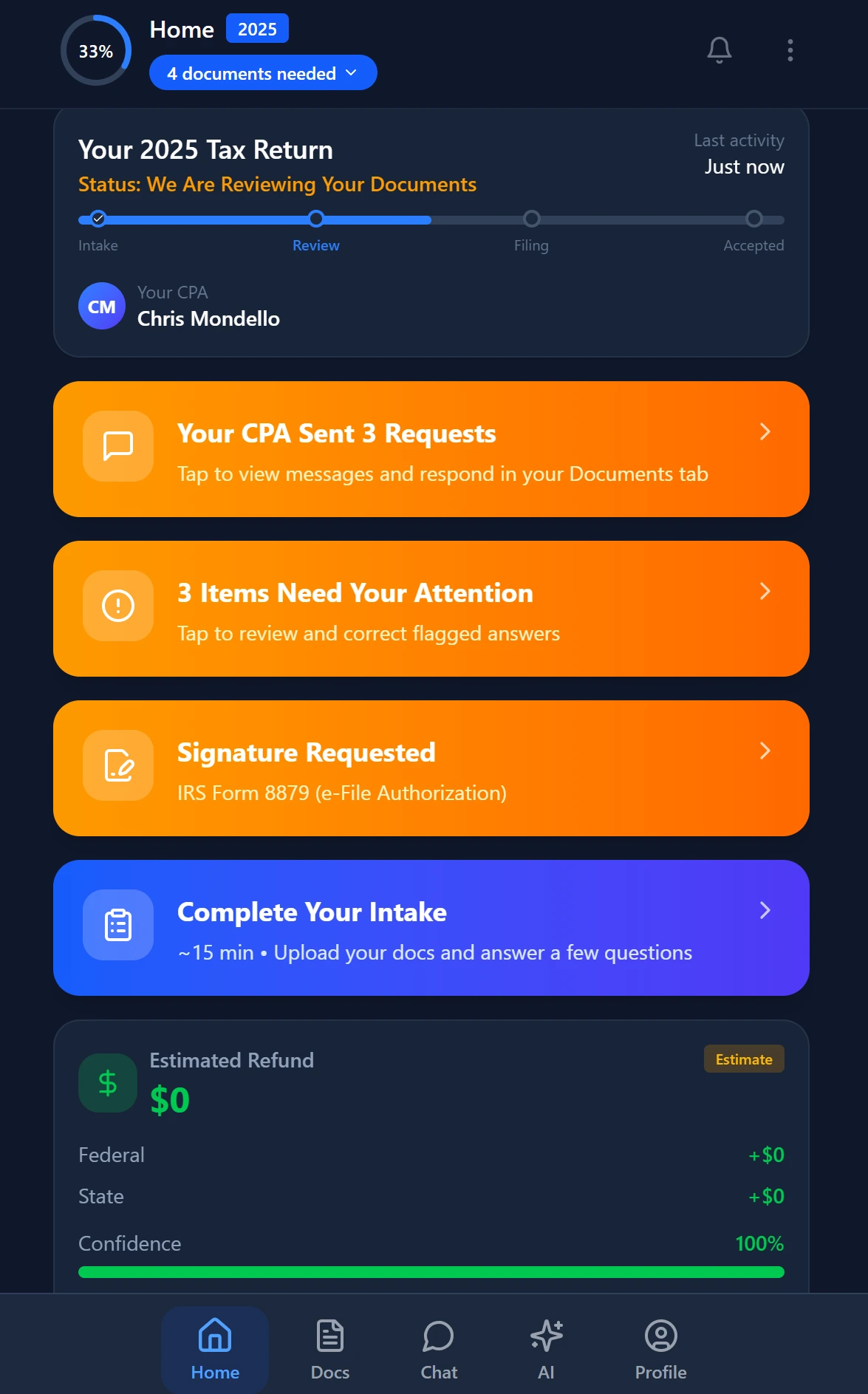
Smart intake auto-fills from uploaded documents and prior-year data
Step 2: File an Amended FinCEN 114 Through the BSA E-Filing System
For clients who filed a timely FBAR but reported incorrect information — wrong account number, understated maximum value, missing account, incorrect institution name — the correction path is an amended FinCEN 114. This is distinct from a late or delinquent filing and does not require the additional reasonable cause narrative that delinquent submissions demand. When firms revisit their amended FBAR procedures priorities, the gaps usually surface here.
Log into the BSA E-Filing System using the firm's existing credentials, or register as a third-party preparer if this is the firm's first BSA submission. Select 'FinCEN Report 114' and, on the filing type screen, choose 'Amended.' The system will prompt for the Prior Report BSA Identifier — the confirmation number from the original submission — which is why that number belongs in the workpaper before you begin.
On the amended form, complete all fields in full, not just the corrected fields. The BSA system does not display a diff against the original; the amended return supersedes the original entirely. Mark the 'Amended' checkbox on Part I, enter the BSA ID of the return being amended, and complete all account and filer information as it should appear in final form. After submission, download and retain the confirmation page — it includes the new BSA Identifier and timestamp, both of which belong in the client file. The IRS FBAR reference guide remains the authoritative source for field-level instructions.
For practitioners managing multiple clients with international holdings, TaxScout's pipeline management can track FBAR amendment status across your portfolio with custom stages, so no correction slips through during a busy compliance season.
Managing FBAR amendments, foreign document extraction, and penalty exposure analysis across multiple clients at once?
TaxScout gives CPA firms AI-powered document processing, research agents with real-time IRS and Treasury access, and a secure client portal — all at a flat price with no per-user fees.
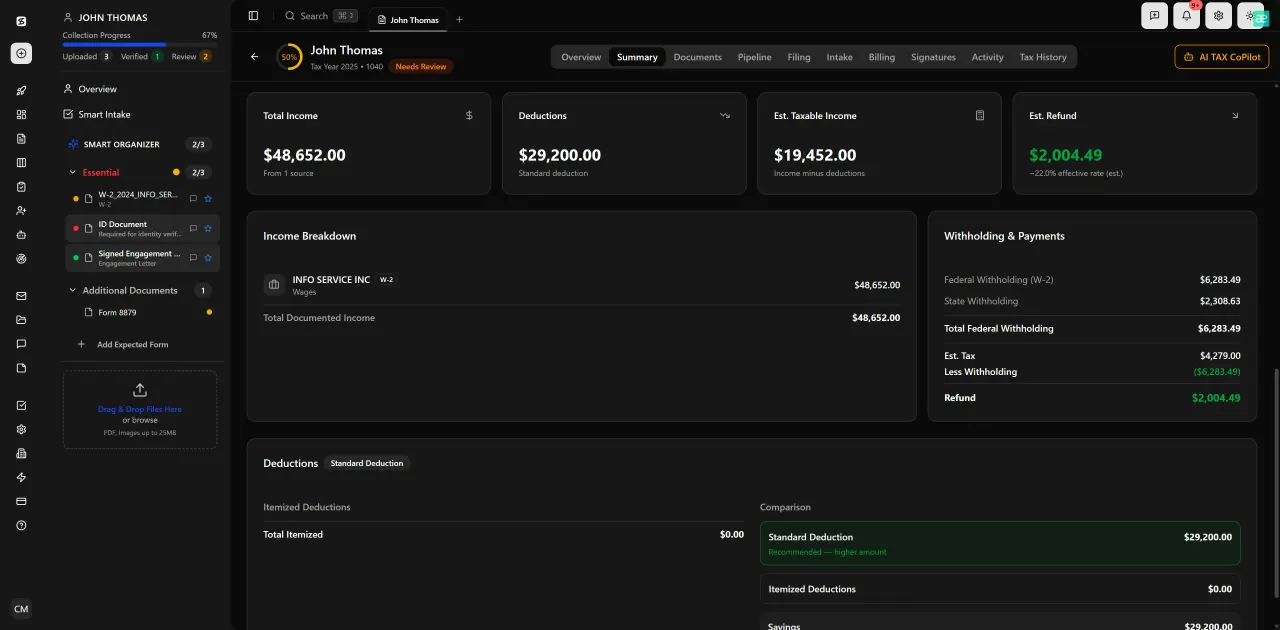
Review with AI assist — 9 agents answer questions with full client context
Step 3: Apply the Delinquent FBAR Submission Procedures for Unfiled Returns
When a client has never filed an FBAR and has no unreported foreign income connected to the account, the Delinquent FBAR Submission Procedures allow a quiet correction without the Title 26 certification and 5% miscellaneous offshore penalty that the Streamlined Domestic Offshore Procedures require. This is the lower-friction path — but it has a gatekeeper condition that must be verified before use. Practitioners who have internalized amended FBAR procedures as a diagnostic framework, rather than a filing mechanic, are far less likely to misroute a client into this pathway when the facts don't support it.
The IRS instructions state that a taxpayer may use delinquent FBAR submission procedures if they: (a) have not filed a required FBAR, (b) are not currently under civil or criminal investigation by the IRS, (c) have not already been contacted by the IRS about the delinquent FBAR, and (d) have properly reported on their U.S. tax return and paid tax on all income from the foreign financial account. If all four conditions are satisfied, the client files the late FinCEN 114(s) through the BSA E-Filing System and attaches an explanation statement.
The explanation statement — often called the reasonable cause narrative even though no formal penalty waiver is requested here — should describe why the FBAR was not filed on time, confirm that all income was reported, and establish that the omission was not willful. IRS guidance indicates that delinquent FBARs filed under this procedure will not be automatically subject to penalty, though the IRS reserves discretion to examine. For clients with complicated multi-year foreign account histories, also review the statute of limitations implications covered in our glossary to understand which years remain open.
File each delinquent year separately through BSA E-Filing, following the same documentation workflow described in Step 2 but selecting 'Late Filing' rather than 'Amended' on the filing type screen. Attach the explanation in the submission notes field and retain a copy in the client workpaper.

Click any extracted field to see its source highlighted on the original PDF
Step 4: Choose the Correct Streamlined Procedure When Unreported Income Exists
When a client has both unfiled FBARs and unreported foreign income, the Streamlined Filing Compliance Procedures are generally the appropriate vehicle — assuming non-willful conduct. The two variants differ primarily by residency and penalty structure:
The Streamlined Foreign Offshore Procedures (SFOP) apply to taxpayers who were not U.S. residents for at least one of the three years covered. They require filing amended or delinquent returns for three years, filing delinquent FBARs for six years, paying all outstanding tax and interest, and certifying non-willfulness on Form 14653. Critically, there is no miscellaneous offshore penalty under SFOP — making it the most favorable resolution path when a client qualifies.
The Streamlined Domestic Offshore Procedures (SDOP) apply to U.S. residents. The requirements mirror SFOP for the return and FBAR filings, but SDOP imposes a 5% miscellaneous offshore penalty on the highest aggregate balance of the foreign accounts across the covered period. The certification is submitted on Form 14654. Both procedures require the signed non-willfulness certification — and that document is where the CPA's work either holds up or collapses under scrutiny. Applying amended FBAR procedures correctly at this stage means ensuring the client's facts are fully documented before that certification is signed.
Neither streamlined procedure is available to taxpayers already under IRS examination. Before advising a client to use these procedures, verify the client's examination status through a CAF lookup or by filing Form 2848 and requesting transcripts. For a broader look at how compliance pathways interact with penalty exposure on international reporting, the IRS's offshore tax compliance resources provide the underlying policy context.
Step 5: Draft a Defensible FBAR Reasonable Cause Statement
Whether filing under the delinquent FBAR submission procedures, SDOP, or SFOP, the non-willfulness certification or reasonable cause narrative is the highest-stakes document in the correction package. The Bank Secrecy Act authorizes civil penalties of up to $10,000 per violation for non-willful violations and the greater of $100,000 or 50% of account balance per violation for willful violations. A weak or internally inconsistent certification can convert a non-willful case into a willful one.
A strong FBAR reasonable cause statement addresses five elements: (1) when the client first became aware of the FBAR obligation, (2) the specific facts that explain the oversight — inherited account, misunderstanding of threshold rules, reliance on a prior preparer, complexity of entity structure; (3) evidence that income was properly reported on U.S. returns despite the missed FBAR; (4) a clear factual basis for the non-willfulness conclusion; and (5) corrective action taken, including this filing. The way amended FBAR procedures are documented in the workpaper directly supports — or undermines — the credibility of each of these elements.
Avoid conclusory language. 'My client did not know about the FBAR requirement' is insufficient without supporting facts. 'My client is a naturalized citizen who moved to the U.S. in 2018, retained a savings account at [institution] opened prior to immigration, understood it held under $1,000, and first learned of the aggregate threshold rule when reviewing their 2023 tax organizer' is the kind of specific factual narrative that withstands scrutiny.
Use TaxScout's AI research agents to retrieve current IRS Chief Counsel advice, Tax Court decisions, and FinCEN FAQ updates that bear on the reasonable cause analysis — particularly for unusual account types like foreign pension plans or foreign insurance contracts, which have their own interpretive history under Treasury regulations.
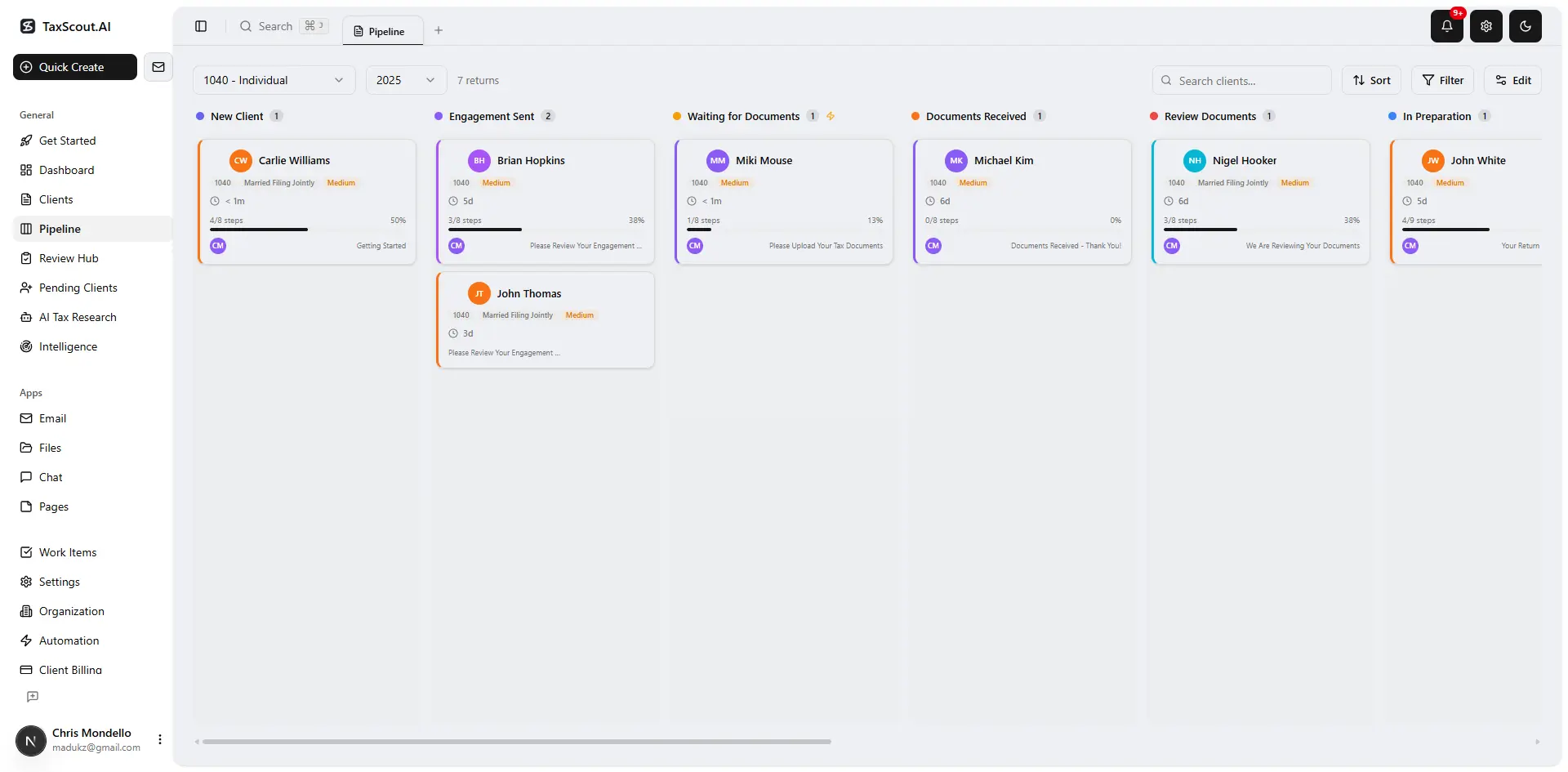
Track every return from intake to filed with drag-and-drop pipeline management
FBAR Correction Pathway Selector: Key Criteria at a Glance
| Scenario | Correct Pathway | Penalty Exposure | Key Certification |
|---|---|---|---|
| Filed on time, wrong account details or value | Amended FinCEN 114 (BSA E-Filing) | Generally none if voluntary and timely | None required |
| Never filed, all income reported, no IRS contact | Delinquent FBAR Submission Procedures | IRS discretion — typically none if explanation is solid | Explanation statement |
| Never filed, unreported income, U.S. resident, non-willful | Streamlined Domestic Offshore (SDOP) | 5% miscellaneous offshore penalty | Form 14654 non-willfulness certification |
| Never filed, unreported income, non-resident ≥1 year, non-willful | Streamlined Foreign Offshore (SFOP) | No miscellaneous penalty; tax + interest only | Form 14653 non-willfulness certification |
| Willful failure to report | IRS Voluntary Disclosure Program (VDP) | Significant — negotiated; civil and possibly criminal risk | VDP submission package |

Your clients see your brand — OTP login, document upload, and real-time status
Step 6: Communicate Risk Exposure to Clients Without Triggering Panic
Clients who learn they have missed FBAR obligations typically hear two things simultaneously: a large statutory penalty number and the word 'willful.' Both land hard, and an unstructured disclosure conversation can push a cooperative client toward defensive behavior — hiring separate legal counsel preemptively, withholding facts, or freezing on the correction steps that would actually reduce their exposure.
A more effective framework separates the conversation into three parts. First, describe what was missed and why it happened, in factual, non-accusatory terms. Second, explain the specific procedure you are recommending and why it applies — including what penalty protections it provides and what it requires the client to certify. Third, give an honest but bounded estimate of the remaining risk after the correction is made. 'If we file under SDOP and your certification holds up, the maximum economic cost is the 5% penalty plus interest and any tax due on unreported income. The large statutory numbers you may have read about apply to willful cases, which is not what the facts here support.'
Written communication after the meeting matters as much as the conversation itself. Send a follow-up memo that documents the options discussed, the pathway selected and why, and the client's explicit consent to proceed. This protects the CPA as well as the client — and it integrates naturally into a practice that uses TaxScout's communication hub to thread email exchanges and internal notes into the client file. For practitioners who want additional guidance on structuring difficult client conversations, our accounting firm communication guide covers the broader framework.
For clients referred to you specifically because of an FBAR problem — a pattern that often emerges after high-net-worth client acquisition — proper intake documentation is essential. TaxScout's AI intake engine can surface prior-year foreign account disclosures from uploaded documents, reducing the risk that a second account is missed during the correction review. You can also explore other blog resources on international compliance and client advisory workflows to build a complete practice framework.

Every client gets organized documents, status tracking, and a complete history
Building an FBAR Amendment Practice Workflow That Scales
A single FBAR correction case is manageable. A practice that handles them repeatedly — whether from referrals, estate settlements uncovering undisclosed foreign accounts, or your own ongoing annual review catching multi-year gaps — needs a repeatable workflow that does not depend on any one preparer's memory. Embedding amended FBAR procedures into a standardized checklist ensures the diagnostic questions get asked consistently, regardless of who is staffing the engagement.
The critical workflow checkpoints are: (1) a mandatory foreign account screen during annual tax intake for every client; (2) a standing checklist that maps the five diagnostic questions (filed before? unreported income? IRS contact? examination status? willfulness indicators?) to the correct procedure; (3) a workpaper template for the BSA E-Filing confirmation numbers, exchange rate documentation, and reasonable cause narrative; and (4) a pipeline stage specifically for FBAR correction matters so they are tracked separately from standard return preparation.
TaxScout's pipeline management supports 12 customizable stages with drag-and-drop kanban, which means you can build an 'FBAR Remediation' pipeline with stages like Diagnostic Review, Pathway Selected, Client Consent, BSA Submission, and Confirmation Archived — entirely separate from your standard 1040 workflow. Pair that with TaxScout's file management for organized document retention and the e-signatures feature for client consent on the certification forms, and the operational complexity of managing multiple concurrent FBAR corrections becomes significantly more tractable.
For firms that want to compare their current practice management stack against what a purpose-built platform provides, the TaxScout vs. TaxDome comparison covers the differences in document processing, AI capability, and flat-fee pricing that affect how much of this workflow you can automate versus handle manually.
Handling FBAR corrections manually across disconnected tools, with no audit trail and no AI research support?
TaxScout gives your firm a secure client portal, AI research agents with live IRS and FinCEN access, PDF tools for document organization, and pipeline management for every correction case — flat price, unlimited team members.
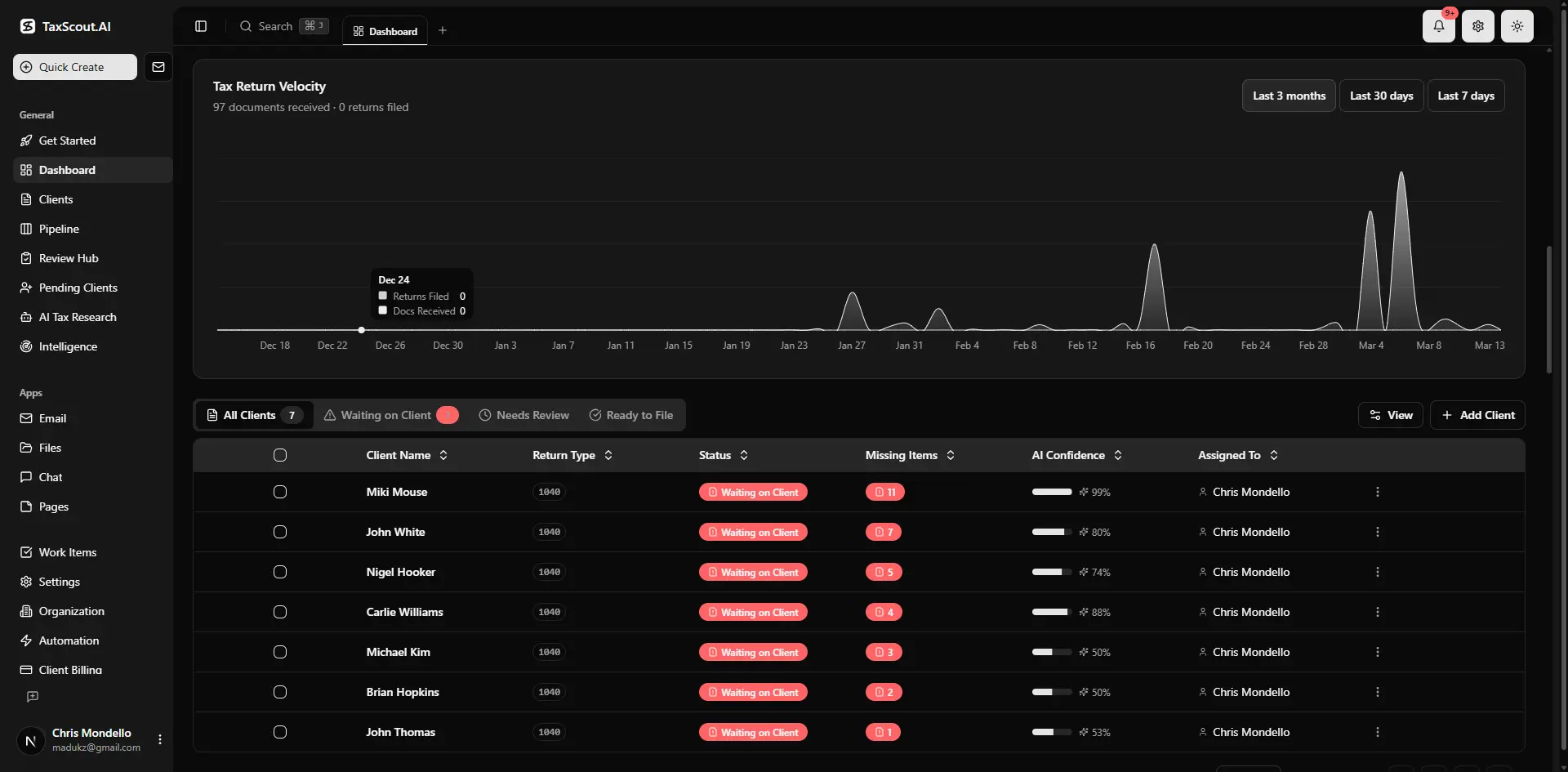
Real-time dashboard showing returns in progress, revenue, and upcoming deadlines
Frequently Asked Questions
An amended FBAR (FinCEN 114 amendment) corrects information on a return that was filed on time — for example, an incorrect account balance or a missing account that should have been included. A delinquent FBAR submission covers returns that were never filed in the first place. The BSA E-Filing System handles both, but the filing type selection and the required explanatory documentation differ. Delinquent submissions require an explanation statement; amendments require the prior BSA Identifier from the original filing.
Keep reading
Stay up to date
Get the latest tax tech insights delivered to your inbox.