Virtual CFO Services: How CPAs Launch and Price This High-Margin Offering
Virtual CFO services are one of the highest-margin offerings a CPA firm can add — but most articles stop at pricing frameworks and skip the delivery mechanics. This guide gives you a concrete playbook: how to identify ideal clients, package fixed-fee retainers, automate recurring deliverables, and…
Virtual CFO services represent one of the clearest revenue expansion opportunities available to CPA firms right now. Small and mid-sized businesses are increasingly willing to pay $2,000–$8,000 per month for strategic financial guidance, yet most of them cannot afford a full-time CFO. That gap is exactly where a well-positioned accounting firm can step in — not as a compliance vendor, but as a trusted financial operator.
Most content on this topic covers positioning and pricing at a surface level, then leaves you to figure out the hard part: how do you actually deliver vCFO services profitably without burning out your team? The answer lies in operationalization — building a repeatable delivery engine that uses automation and AI-assisted reporting so that each client engagement does not require proportional increases in staff hours. Most practitioners offering virtual CFO services discover too late that the real challenge is not winning clients but building a delivery model that scales without constant firefighting.
This guide walks through client selection, engagement structure, pricing models, tech-stack requirements, liability guardrails, and the specific workflows that make fractional CFO services scalable. Whether you are a solo practitioner exploring your first advisory client or a multi-partner firm ready to build a dedicated vCFO practice, the playbook below gives you a concrete starting point. This guide walks through client selection, engagement structure, pricing models, tech-stack requirements, liability guardrails, and the specific workflows that make virtual CFO services scalable across a growing client roster.
Which Clients Are the Right Virtual CFO Upsell Targets
The most overlooked question in every virtual CFO services discussion is client selection. Not every bookkeeping or tax client is ready for — or will benefit from — CFO-level advisory. Targeting the wrong clients leads to scope creep, pricing resistance, and disengaged relationships. The right targets share a specific set of financial and operational characteristics.
Start with your existing tax and bookkeeping clients who already exhibit complexity signals: multiple entity structures, revenue between $1M and $20M, active bank debt or upcoming capital needs, more than five employees, and recurring frustration with cash flow unpredictability. These clients already trust you, already share their financial data, and already feel the pain that a vCFO solves. Converting them requires positioning a new scope — not rebuilding a relationship from scratch. These clients already feel the pain that virtual CFO services are designed to solve, making them your highest-probability early adopters.
Secondary targets are business owners approaching inflection points: a pending acquisition, a first outside investment round, a transition to an S-corp structure (see the S-corporation election glossary entry for what that involves), or rapid headcount growth that is straining working capital. According to SBA data on small business financing, the majority of small business failures cite financial mismanagement as a contributing cause — a stat that resonates when you are having a discovery conversation about what CFO advisory actually prevents. For firms evaluating their virtual CFO services approach, this trade-off compounds over time.
Avoid starting with clients whose books are disorganized, whose revenue is below $500K, or who resist fixed-fee arrangements. Those engagements will consume disproportionate hours and make the practice feel unscalable before it has a chance to mature. Use your pipeline management workflow to tag existing clients by revenue tier and entity complexity, then generate a shortlist of 10–15 ideal upsell candidates to approach in Q1 of your expansion year. Each of these factors directly shapes how virtual CFO services plays out in practice.
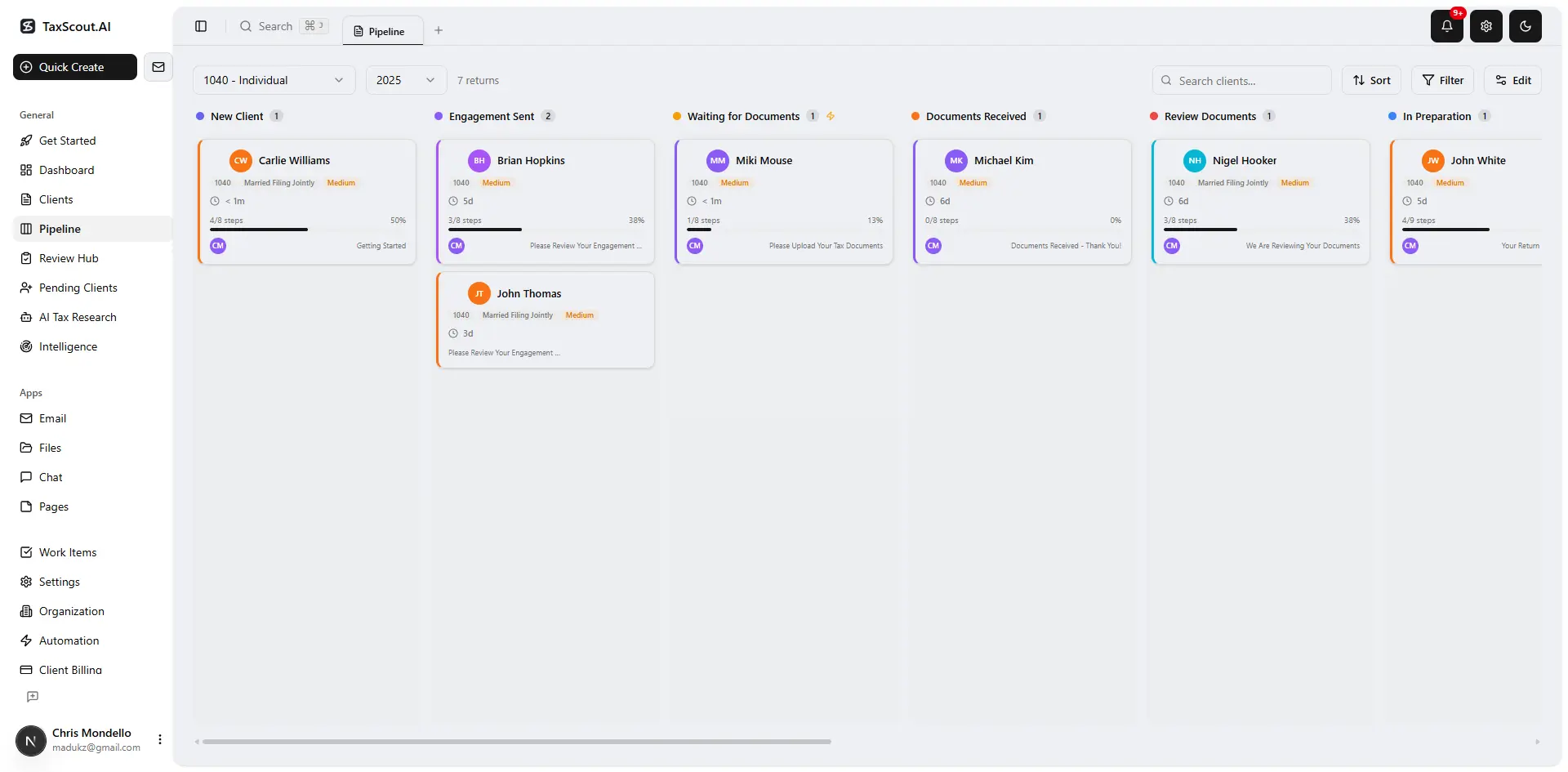
Track every return from intake to filed with drag-and-drop pipeline management
How to Structure a Virtual CFO Engagement
A scalable vCFO engagement is built around three layers: a defined scope of recurring deliverables, a cadence of client-facing touchpoints, and a set of exception-based escalation triggers. Without this structure, the engagement drifts into ad-hoc consulting, which is both hard to price and hard to staff. Understanding virtual CFO services in this context is what separates firms that scale from those that stall.
The core monthly deliverable package typically includes: a cash flow forecast (13-week rolling is standard for operating businesses), a variance report comparing actuals to budget, a KPI dashboard refreshed from the accounting system, and a 30–60-minute strategy call. Some firms add a quarterly board-ready summary and annual budget build as add-on modules at a higher tier. This is precisely where a deliberate virtual CFO services strategy pays off.
Touchpoint cadence matters as much as deliverables. Monthly calls keep the engagement visible and reinforce the value; quarterly business reviews create natural upsell moments (tax planning, entity restructuring, financing readiness). Structure the cadence explicitly in the engagement letter so the client knows what to expect and you know what to deliver. This predictability is what separates a well-run fractional CFO accounting firm from a firm that bills inconsistently and eventually loses the client. Virtual CFO services sits at the center of this decision — get it wrong and the rest unravels.
Define escalation triggers upfront: if cash on hand drops below X weeks of runway, if a receivable exceeds 90 days and crosses a materiality threshold, or if debt covenants are at risk, the engagement letter should specify that you will flag these proactively rather than wait for the monthly call. This transforms the client's perception of your role from reporter to advisor. When firms revisit their virtual CFO services priorities, the gaps usually surface here.
Core Monthly Deliverables
Every vCFO engagement should standardize at least four recurring outputs: a 13-week cash flow forecast, a budget-versus-actual variance report, a KPI scorecard (see CPA Firm KPIs to Track With AI for a framework), and a written narrative of financial highlights and risks. These four outputs cover the minimum viable CFO function for a small business and form the basis of your fixed-fee pricing.
Optional Add-On Modules
Above the base tier, you can offer modular add-ons: annual budget construction, lender package preparation (CIM, projections, covenant tracking), M&A financial due diligence support, cap table modeling for businesses with equity compensation, or state and local tax nexus reviews tied to geographic expansion. Pricing these as distinct modules avoids scope creep and lets you upsell as the client's needs evolve.
Tired of delivering advisory work that is not reflected in your revenue?
TaxScout.ai gives CPA firms the automation infrastructure — from recurring invoicing to AI-assisted reporting workflows — that makes virtual CFO services profitable at any firm size.
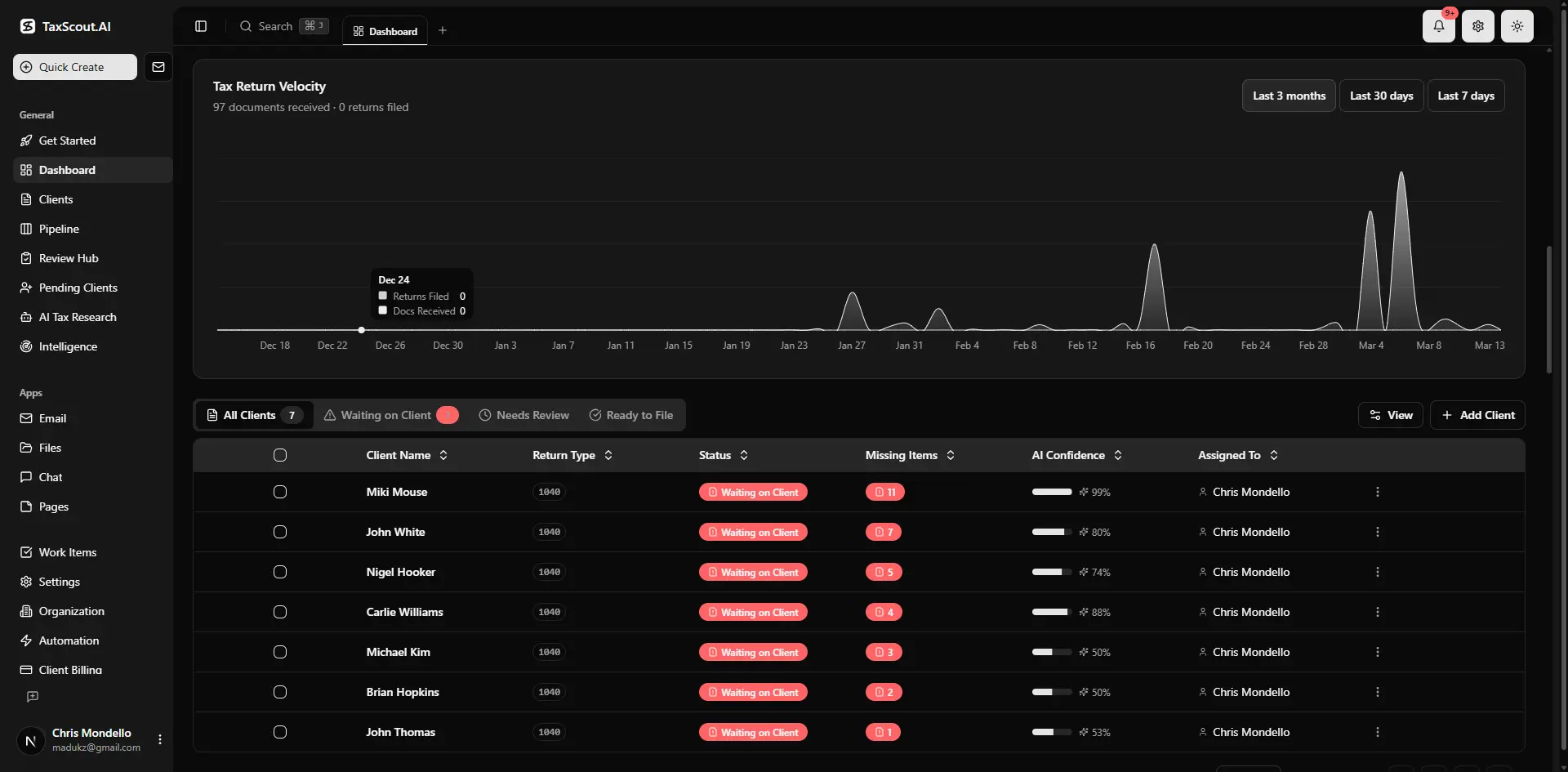
Real-time dashboard showing returns in progress, revenue, and upcoming deadlines

Your clients see your brand — OTP login, document upload, and real-time status
Virtual CFO Pricing: Fixed Fee Versus Time and Materials
Virtual CFO pricing is one of the most debated topics in advisory service design, and most published frameworks fail because they treat it as a rate card exercise rather than a value alignment problem. The core choice is between a fixed-fee monthly retainer and a time-and-materials arrangement — and for scalable delivery, fixed fee wins almost every time.
Time-and-materials billing for CFO advisory creates three structural problems: it incentivizes the client to limit contact (since every call costs money), it forces you to track hours you would rather spend on actual analysis, and it makes revenue unpredictable on your side. Fixed-fee retainers solve all three: the client knows their monthly cost, you know your revenue, and both parties are aligned on the defined scope of deliverables.
A workable pricing ladder for a fractional CFO accounting firm looks like this: a Foundation tier at $1,500–$2,500/month covering the core four deliverables plus a monthly call for businesses under $3M revenue; a Growth tier at $3,000–$5,000/month adding quarterly board summaries and proactive tax strategy integration for businesses $3M–$10M; and an Executive tier at $6,000–$10,000/month for businesses above $10M or those with active financing activity, M&A exposure, or equity structure complexity. These ranges reflect market rates reported in Journal of Accountancy advisory pricing surveys and should be calibrated to your geography and client industry.
Value-based pricing — anchoring your fee to the financial impact you create rather than hours spent — is the right philosophical frame (see the value-based pricing glossary entry), but it requires you to quantify outcomes. Document the cash flow improvements, the financing terms improved, or the tax savings generated by your advisory work and reference those outcomes in renewal conversations. This justifies rate increases and reduces churn. You can also automate recurring invoice delivery so retainers bill on the first of each month without manual intervention — TaxScout's invoicing module handles Stripe Connect billing and can be configured to run on autopilot.
Building the Tech Stack That Makes Virtual CFO Services Scalable
The reason most CPA firms find virtual CFO services unscalable is not a lack of expertise — it is a lack of automation. When every monthly deliverable requires manual data pulls, spreadsheet manipulation, and report assembly, a single practitioner can serve four or five vCFO clients before hitting a capacity wall. The right tech stack moves that ceiling to 15–25 clients per practitioner.
Your foundational layer is a connected accounting data pipeline. Whether your client uses QuickBooks Online, Xero, or NetSuite, you need automated data retrieval that feeds directly into your reporting templates. The IRS encourages electronic recordkeeping and digital workflows for business financial management, and the same logic applies to your delivery infrastructure — manual processes introduce errors and latency that erode client confidence.
On top of the data layer, you need AI-assisted document extraction for the tax and compliance inputs that feed CFO-level analysis. When a client receives a loan term sheet, a new lease agreement, or a complex K-1 from a partnership investment (see the K-1 glossary entry for what that involves), you need to extract and interpret those figures quickly. TaxScout's AI document extraction handles 180+ tax form types with a 5-layer validation pipeline, meaning financial inputs from tax documents flow into your analysis without manual re-keying.
For research-intensive advisory work — tax treatment of a new financing structure, state nexus implications of a new office, deductibility questions on a capital expenditure — the AI Research Agents built into TaxScout search IRS, Treasury, Cornell Law, and SSA sources in real time and return cited answers. That eliminates the 45–90 minutes a senior associate might otherwise spend on a single research question, which compounds significantly across a 20-client vCFO book.
Finally, systematize client communication and document delivery through a branded client portal so that each client has a secure, organized hub for receiving monthly deliverables, signing documents, and submitting supporting materials. Clients who receive reports through a professional portal perceive the engagement as more structured and are more likely to renew. See our guide on building a client portal your clients will actually use for implementation details.
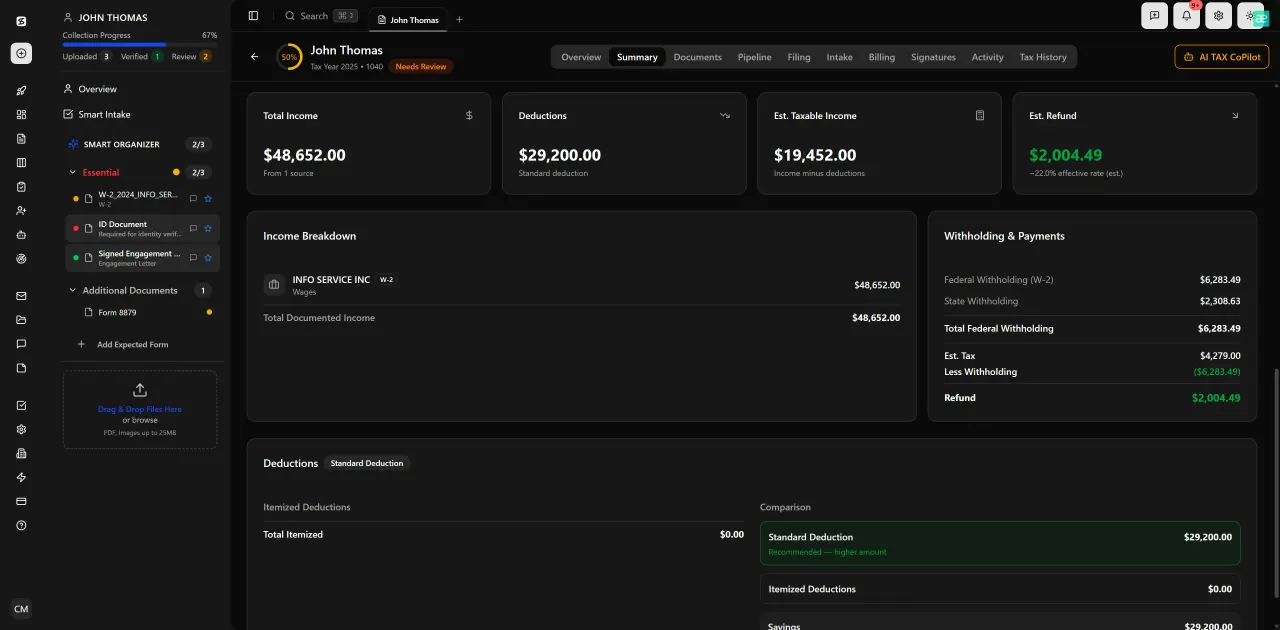
Review with AI assist — 9 agents answer questions with full client context
Typical vCFO Engagement Tiers: Scope and Pricing Reference
| Tier | Monthly Fee | Core Deliverables | Ideal Client Profile |
|---|---|---|---|
| Foundation | $1,500 – $2,500 | Cash flow forecast, variance report, KPI dashboard, monthly call | Revenue under $3M, stable operations, no active financing |
| Growth | $3,000 – $5,000 | All Foundation plus quarterly board summary, tax strategy integration | Revenue $3M – $10M, growing headcount, occasional capital needs |
| Executive | $6,000 – $10,000 | All Growth plus lender packages, M&A support, equity modeling | Revenue above $10M, active financing, ownership transition or acquisition |
| Add-On Modules | $500 – $2,000 each | Annual budget build, nexus review, cap table modeling, covenant tracking | Any tier with specific project need outside base scope |

Track firm performance with real-time analytics and client activity monitoring
Engagement Letter Language and Liability Guardrails for CFO Advisory
Virtual CFO engagements carry a different liability profile than tax preparation or bookkeeping. When a client acts on your cash flow forecast and the outcome differs materially from the projection, or when a financing decision influenced by your analysis goes sideways, the risk exposure is real. Proper engagement letter language is the primary risk management tool — and most CPA-focused content on vCFO services ignores it entirely.
Your engagement letter for a vCFO arrangement should explicitly define: the scope of services (tied directly to the deliverable list in your tier), the boundaries of the engagement (you are providing financial analysis and strategic recommendations, not guaranteeing outcomes or providing legal advice), the client's obligations (timely provision of accurate underlying data, notification of material business changes), and the limitation of liability clause that caps your exposure at the fees paid in the prior 12 months.
Beyond the base engagement letter, add a forward-looking statement disclaimer to every cash flow forecast and projection deliverable. This mirrors the language used in SEC-regulated financial disclosures and signals to the client that projections are models based on assumptions, not guarantees. The Cornell Law definition of professional liability is a useful reference when reviewing your state's specific standards for CPA advisory engagements.
Use TaxScout's e-signatures module to collect signed engagement letters before any advisory work begins. The platform supports engagement letters natively via Documenso, and you can store signed copies in the client file with automatic versioning. See the engagement letter glossary entry for a breakdown of required clauses. For ongoing risk management, consider adding a semi-annual scope review to your retainer calendar — it surfaces scope creep before it becomes a dispute and gives you a structured moment to reprice if the work has grown.
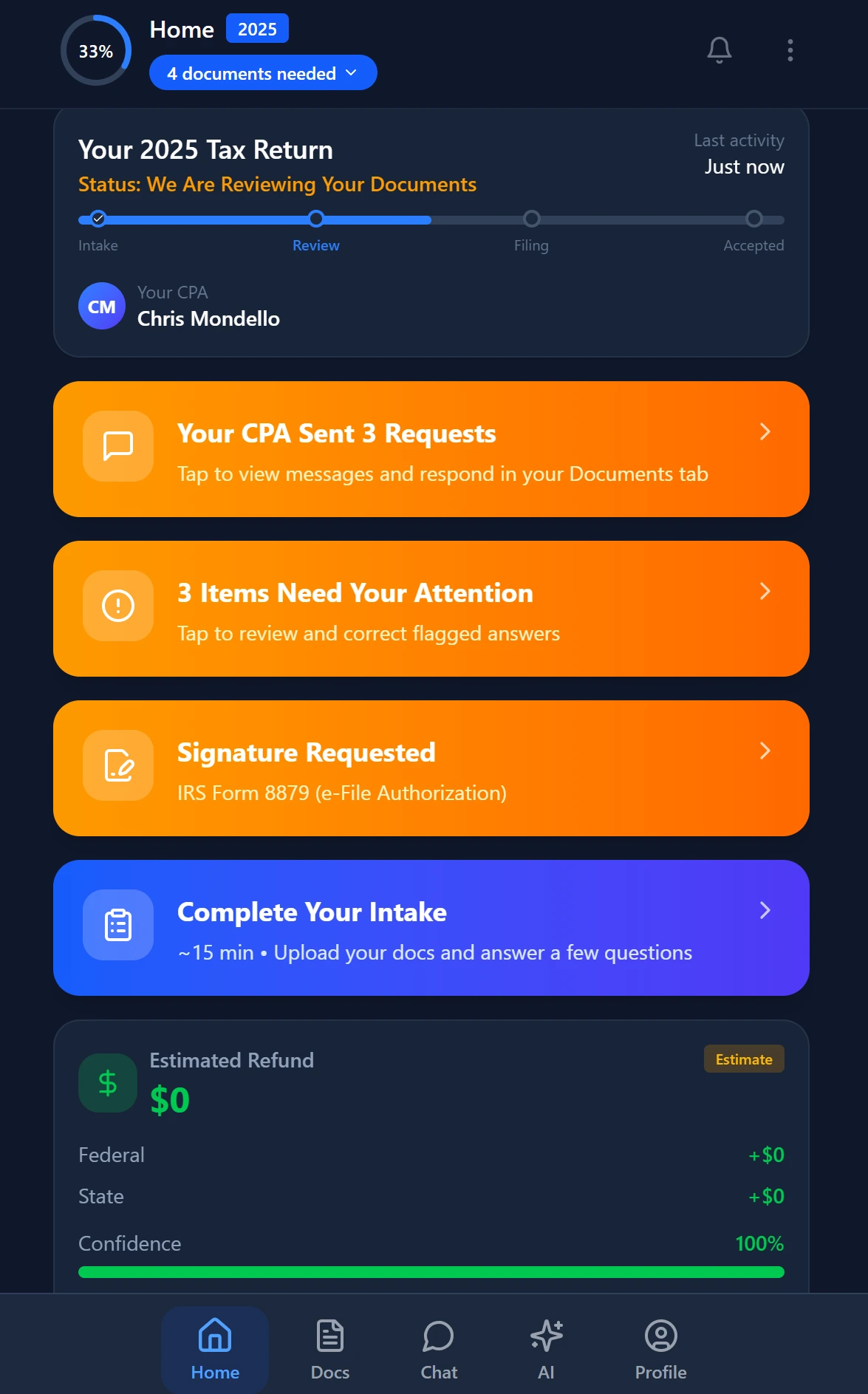
Smart intake auto-fills from uploaded documents and prior-year data
Automating Recurring vCFO Workflows to Protect Margins
Margin protection in a virtual CFO practice comes from reducing the number of hours required to produce each deliverable, not from charging more. The two highest-leverage automation targets are monthly report assembly and client intake for new engagements.
For report assembly, build master templates for your cash flow forecast, variance report, and KPI dashboard that pull data via API or standardized export from the client's accounting system. When the data source is clean and the template is locked, generating a monthly deliverable drops from three hours to under one. Bureau of Labor Statistics data on accounting and auditing occupations shows median wages above $78K annually — every hour saved in report production is a meaningful margin recapture.
For client intake on new vCFO engagements, use a structured onboarding workflow that collects entity documents, prior-year financials, existing loan agreements, and ownership information in a single pass. TaxScout's AI intake engine is modeled on IRS Form 13614-C with four-layer prefill — document-first, prior-year, profile, and AI gap analysis — which means new clients move from signed engagement letter to first deliverable faster and with fewer back-and-forth requests. Pair that with workflow automation to trigger the onboarding sequence automatically when a new vCFO client is added to your pipeline.
Track capacity utilization across your vCFO book using pipeline-level analytics. If a single staff member is consistently over-allocated on one client, that is a signal the scope has grown beyond the original tier — and a trigger to reprice at the next renewal. Our accounting firm capacity planning guide covers how to model this before you hit a bottleneck. Recurring billing should also run on autopilot: see our guide to automated recurring invoicing for the setup steps inside TaxScout.
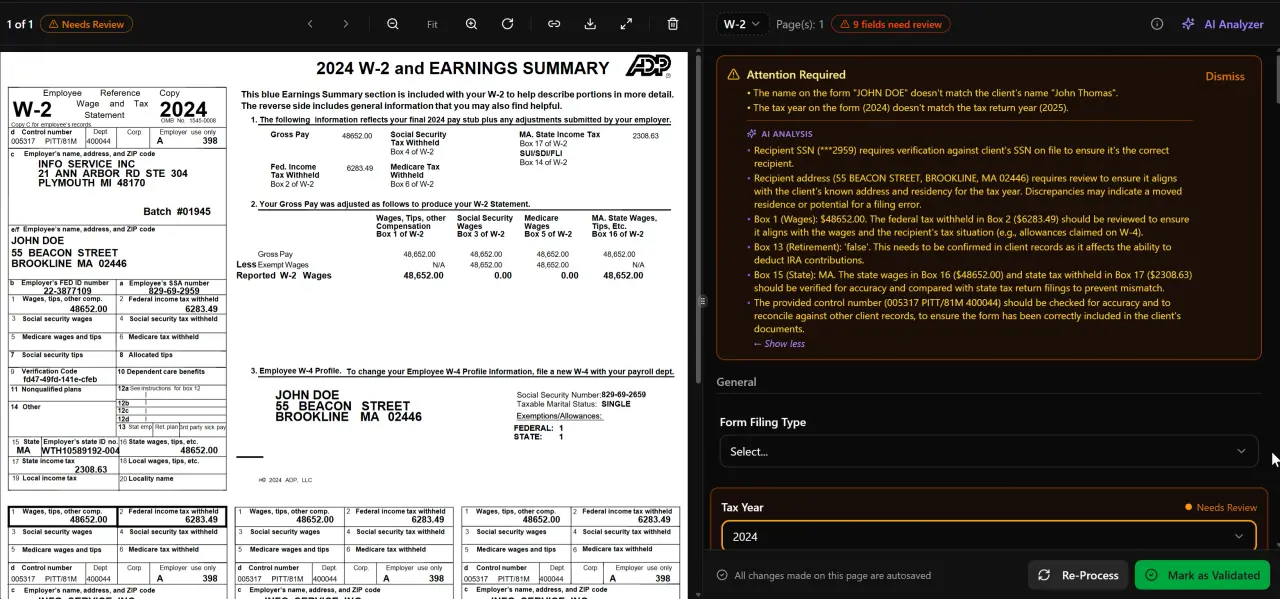
AI classifies, extracts, and validates every document automatically
Launching Your First Virtual CFO Client: A Practical First 90 Days
The most effective launch sequence for a first vCFO client compresses onboarding, baseline analysis, and first deliverable into a 30-day sprint, then settles into a steady monthly rhythm for the remaining 60 days of the trial period.
Days 1–10: Execute the engagement letter, collect signed authorization, and run the onboarding data collection workflow. Extract prior-year tax returns, current-year interim financials, and any existing loan or lease agreements. Build your baseline financial model — trailing 12 months of P&L, balance sheet snapshot, and a first-pass 13-week cash flow forecast using actuals as calibration data.
Days 11–20: Deliver the baseline package to the client via the portal with a narrative memo identifying the top three financial risks and opportunities you observed. Schedule the first strategy call. The goal of this call is not to impress — it is to listen. Ask what decisions the owner has been deferring due to financial uncertainty. Those deferred decisions become the agenda for months two and three.
Days 21–30: Refine the cash flow model based on information gathered in the strategy call, set up automated KPI tracking, and configure the monthly reporting template with the client's specific metrics. By the end of month one, the client should have experienced a professional deliverable, a structured conversation, and a clear sense of what the ongoing engagement provides. Days 31–90 are about executing the cadence: monthly reports delivered on the same date, calls scheduled and held, and exception alerts sent when a trigger threshold is crossed. Consistency in the first 90 days is the single strongest predictor of retainer renewal.
Ready to stop leaving advisory revenue on the table?
TaxScout.ai gives your firm the AI extraction, research agents, portal, and invoicing infrastructure to launch virtual CFO services without adding headcount.
Frequently Asked Questions
The terms are used interchangeably in most markets. Virtual CFO typically emphasizes the remote delivery model, while fractional CFO emphasizes the part-time or shared engagement structure. In practice, both refer to outsourced CFO-level financial strategy provided by a CPA or advisory firm on a recurring retainer rather than a full-time employment basis.
Keep reading
Backdoor Roth IRA: How CPAs Execute the Strategy Without Triggering Pro-Rata Tax
Oct 12, 2026 · 1 min read
Amended FBAR Procedures: How CPAs Correct Foreign Account Errors Without Triggering Penalties
Oct 12, 2026 · 1 min read
Transparency in Coverage Final Rules: What CPA Firms Must Do Now
Oct 12, 2026 · 1 min read
Stay up to date
Get the latest tax tech insights delivered to your inbox.