CPA Firm KPIs to Track: Top 10 With AI Automation
Most CPA firms know their revenue but can't tell you their realization rate or average client turnaround time. That blind spot quietly costs thousands each year. This guide breaks down the 10 KPIs that drive accounting firm profitability — and shows how AI makes tracking them effortless.
For CPA firms evaluating cpa firm kpis to track, this guide covers the complete workflow. Most CPA firms can tell you their gross revenue. Fewer can tell you their realization rate. Almost none can tell you their average client turnaround time — and if they can, they got the number from a spreadsheet someone updated last quarter.
That gap between knowing your revenue and understanding your firm's actual performance is where most accounting practices quietly lose thousands of dollars a year. CPA firm KPIs to track aren't just management theory — they are the difference between a firm that grows intentionally and one that scales chaos. The problem isn't that partners don't care about accounting firm performance metrics. It's that collecting the data manually costs more time than most firms are willing to spend.
This article covers the 10 KPIs that drive CPA firm profitability, why most firms track zero of them consistently, and how AI-native practice management changes the entire equation.
Why Most CPA Firms Track Zero KPIs Consistently
Ask a managing partner which metrics they monitor, and most will name three: revenue, new clients, and some version of "we're busy." That's not negligence — it's a structural problem. This directly impacts how firms approach cpa firm kpis to track in practice.
Traditional practice management platforms store your data. They don't analyze it. To produce meaningful accounting firm profitability metrics, someone has to export time entries, cross-reference invoices, calculate write-downs, and build a spreadsheet — then do it again next month, slightly differently, because the person who built the last one left the firm.
According to PCPS research from the AICPA, owner capacity and staff retention rank as the top two issues for CPA firms under 25 staff. Both problems are directly measurable through KPIs — and both get worse when you can't see the data. Understanding which cpa firm kpis to track is the first step toward making that data actionable.
The firms that track these metrics are not doing more work. They've built systems where the data surfaces automatically. In 2026, that means AI-native practice management platforms, not spreadsheets — and not conventional software that requires manual dashboards.
Spending hours building KPI reports that are outdated the moment you finish? See how TaxScout surfaces accounting firm performance metrics automatically — no spreadsheets required. → Book a 15-Min Demo — See It Live
The 10 CPA Firm KPIs to Track (and What They Actually Mean)
1. Realization Rate
Formula: (Fees Billed ÷ Total Hours at Standard Rate) × 100
Your realization rate tells you how much of your billable capacity actually converts to collected revenue. An industry benchmark for healthy CPA firms is 85–95%. If yours is lower, you have a write-down problem, a pricing problem, or both.
Most firms don't calculate this monthly because it requires cross-referencing time entries against invoices against collected payments — three data sources that live in three different tools. It's one of the most important cpa firm kpis to track, yet it remains invisible at most practices.
2. Utilization Rate
Formula: (Billable Hours ÷ Total Available Hours) × 100
Billable hours tracking for CPAs is the foundation of every workforce planning decision. A 65–70% utilization rate is considered healthy for accounting firms — too low means underdeployed staff, too high means burnout risk (a topic we explored directly in our guide to reducing CPA burnout during tax season).
3. Average Client Turnaround Time
Formula: Average days from document receipt to return filed
This is both a profitability metric and a client satisfaction metric. Long turnaround times reduce capacity, increase WIP buildup, and erode client trust. Tracking it manually requires comparing intake timestamps against filing timestamps — across every client, every week.
4. Revenue Per Staff Member
Formula: Total Revenue ÷ Total Full-Time Equivalent Staff
A strong benchmark for tax-focused CPA firms is $150,000–$200,000+ per staff member. Below that range, you either have capacity underutilization or a pricing problem. Above it, you may be running lean enough to create retention risk.
5. Client Acquisition Cost (CAC)
Formula: Total Marketing + Sales Spend ÷ New Clients Acquired
CAC rarely gets tracked in CPA firms because "marketing" often means referrals and word of mouth. But even referral-based growth has indirect costs — partner time, proposal preparation, and client onboarding. Knowing your CAC tells you whether your growth is actually profitable, and it's among the cpa firm kpis to track that most directly connect marketing spend to bottom-line results.
6. Client Lifetime Value (CLV)
Formula: Average Annual Revenue per Client × Average Client Retention in Years
Paired with CAC, CLV tells you whether your acquisition economics are healthy. A CLV:CAC ratio of 3:1 or higher is the standard benchmark for sustainable firm growth. Most CPA firms don't know their CLV because calculating average retention requires querying historical client data across multiple years.
7. Write-Down Rate
Formula: (Total Write-Downs ÷ Total Fees at Standard Rate) × 100
Write-downs are the silent margin killer. Industry averages hover around 10–15%, but firms with poor scope definition or weak engagement letters frequently run 20–25%. Tracking write-downs by service line, client, and staff member reveals exactly where the margin is leaking — and it almost never gets tracked at the granularity needed to act on it.
8. Accounts Receivable Aging
Formula: Percentage of outstanding invoices by bucket: 0-30, 31-60, 61-90, 90+ days
According to IRS tax gap research, billing and collection failures are pervasive across professional services. More than 60% of invoices overdue past 90 days in service businesses are never collected in full. For CPA firms, this metric directly maps to cash flow health.
9. Net Promoter Score (NPS) / Client Satisfaction
A single survey question — "How likely are you to recommend our firm?" — on a 0–10 scale gives you a lagging indicator of client retention risk. Firms with NPS above 50 show measurably lower churn rates. Below 30 is a warning sign.
10. Pipeline Conversion Rate
Formula: (Prospects Who Became Clients ÷ Total Proposals Sent) × 100
For firms running structured business development, pipeline conversion rate is the KPI that ties prospecting activity to actual revenue growth. Without a documented pipeline, this metric is invisible — and for most firms, it is. When deciding which cpa firm kpis to track first, pipeline conversion rate is often the one with the fastest impact on growth.

Click any extracted field to see its source highlighted on the original PDF
Why These Metrics Stay Invisible (The Real Reason)
The problem isn't awareness. Most managing partners know these metrics exist. The problem is data fragmentation. This directly impacts how firms approach cpa firm kpis to track in practice.
Time entries live in one tool. Invoices and payments live in another. Client documents and intake data live in a third. Filing dates are tracked in Drake, UltraTax, or CCH Axcess. And none of these systems talk to each other automatically.
To calculate your realization rate, you need time data, billing data, and collection data in one place simultaneously. To calculate turnaround time, you need intake timestamps and filing confirmation dates cross-referenced by client. To calculate utilization by staff member, you need actual hours tracked against capacity — with seasonal adjustments.
The burden of assembling all of this manually falls on whoever is least busy — which, in a CPA firm, is no one.
This is why the firms that do track KPIs consistently are either large enough to have a dedicated operations manager or have moved to platforms that collect and surface the data as a byproduct of normal workflows.
How AI-Native Practice Management Makes KPI Visibility Automatic
Here's the structural difference between conventional practice management software and an AI-native platform: conventional platforms store your workflow data. AI-native platforms analyze it in real time and surface insights without you asking. This directly impacts how firms approach cpa firm kpis to track in practice.
TaxScout's pipeline management uses 12 customizable stages — from New Client through Preparation, Review, E-Signature, and Filed — with auto-advance triggers and drag-and-drop kanban. Every stage transition is timestamped automatically. That means average turnaround time is calculated passively, across every client, every week, without a single spreadsheet.
TaxScout's invoicing via Stripe Connect Express logs every invoice issue date, due date, payment date, and overdue status. Automated overdue reminders run on a daily cron at 9 AM EST. AR aging buckets are populated in real time. Your 90-day overdue exposure is visible the moment you log in — not after someone builds a report.
The AI research agents — specifically the Gap Detection and Risk Assessment agents — run in the background during document processing and flag clients who are missing documents, overdue for responses, or presenting anomalous filing patterns. This is passive KPI alerting: the system tells you which clients are threatening your turnaround time before the problem compounds.
For AI document extraction, TaxScout processes 180+ tax form types with a 5-layer validation pipeline that includes per-field confidence scoring, cross-document duplicate detection, and 18 post-extraction rules. The data flowing through this pipeline isn't just documents — it's structured client data that feeds directly into performance reporting. Time from document receipt to extraction complete is logged automatically. That's the foundation of turnaround time calculation.
CPA Practice Management Analytics: The Dashboard View
TaxScout's Pro plan includes three analytics dashboards that aggregate this pipeline data into firm-level performance metrics. The key distinction from competitors: these dashboards don't require any configuration, manual tagging, or export routines. They're populated by the same workflows your team is already running.
| Metric | TaxScout | TaxDome | Canopy |
|---|---|---|---|
| Pipeline stage tracking | Auto-timestamped, 12 stages | Manual, requires setup | Available, manual |
| AR aging visibility | Real-time via Stripe | Separate billing module | Available, modular pricing |
| Turnaround time reporting | Automatic via stage data | Not built-in | Not built-in |
| AI-surfaced KPI alerts | Yes — Gap Detection + Risk agents | No AI agents | No AI agents |
| Analytics dashboards (Pro) | 3 included | Limited | Modular add-on cost |
| Staff utilization tracking | Via pipeline + assignment data | Manual | Manual |
| Monthly pricing (10-person firm) | $199/mo flat | ~$1,000/mo | ~$660/mo |
For a direct breakdown of how the platforms compare feature-by-feature, see our TaxScout vs Canopy 2026 comparison — Canopy's analytics in particular require purchasing modules separately.
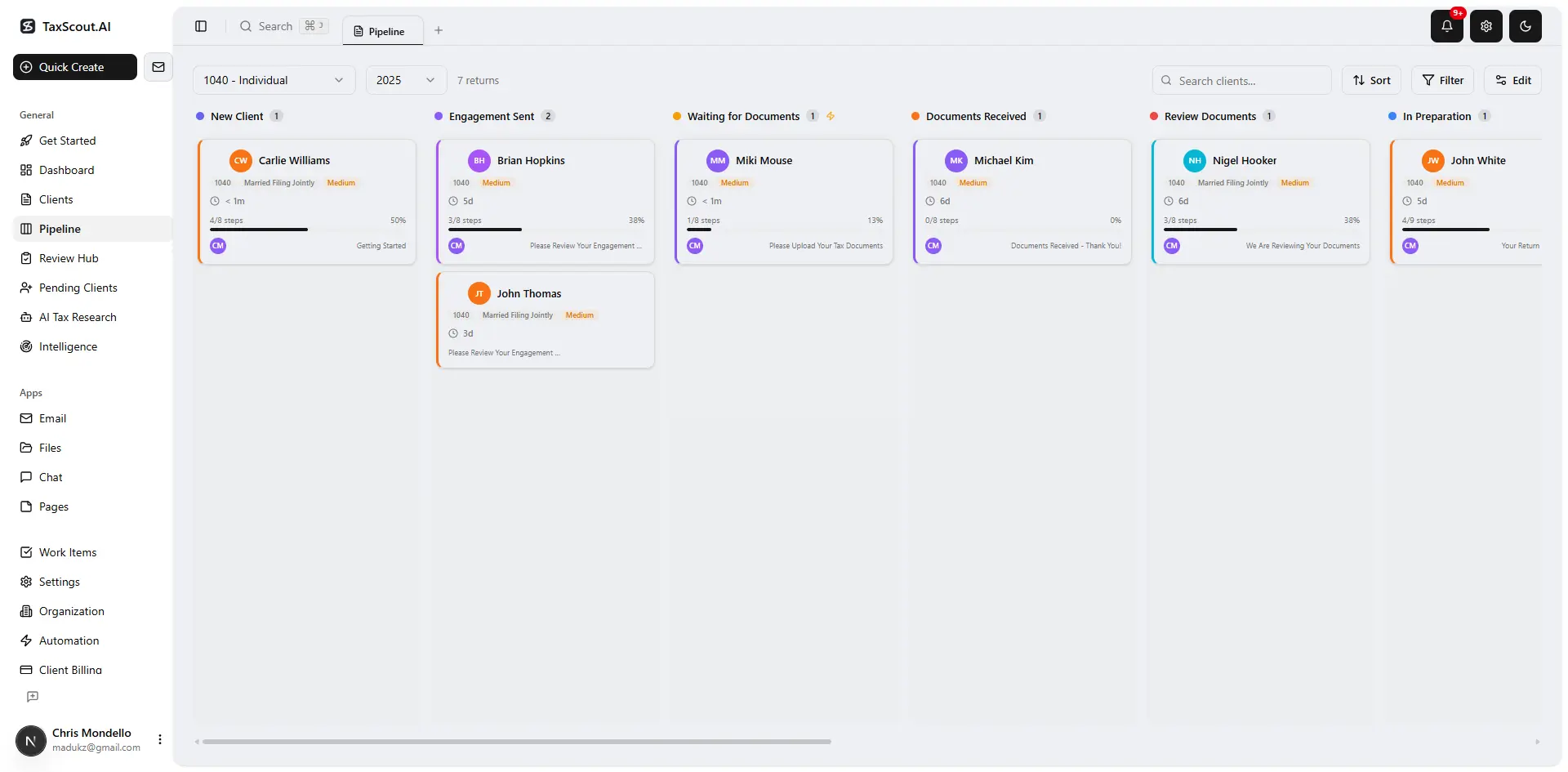
Track every return from intake to filed with drag-and-drop pipeline management
Real-World Workflow: KPIs as a Byproduct of Normal Work
Here's what KPI visibility looks like in practice at a firm running TaxScout Pro.
A client uploads their W-2 and 1099 documents through the branded client portal. TaxScout's AI extraction logs the document receipt timestamp and begins processing immediately — extracting all fields, running the 5-layer validation pipeline, and flagging any cross-document inconsistencies. The Gap Detection agent identifies that the client's K-1 is missing and generates a prioritized follow-up question automatically.
The preparer assigned to the return moves through the pipeline stages: Documents Received → In Preparation → Under Review → E-Signature Pending → Filed. Each transition is timestamped. The time between Documents Received and Filed is the turnaround time for that return — calculated automatically, no data entry required.
When the return is complete, the invoice is generated via Stripe, emailed to the client through the portal, and tracked for payment. If it goes overdue, the daily reminder cron fires automatically. If it hits 60+ days, it surfaces in the AR aging dashboard.
At month-end, the managing partner opens the analytics dashboard and sees: average turnaround time this month, pipeline stage distribution across all active clients, invoices by aging bucket, and staff assignment distribution. None of it required a single manual report. These are exactly the cpa firm kpis to track that reveal whether the firm is operating efficiently or quietly bleeding margin.
That's what AI practice management reporting looks like when it's built into the workflow instead of layered on top of it. As we've covered in our complete guide to CPA practice management software in 2026, the firms pulling ahead are the ones treating analytics as a platform feature, not an afterthought.
Ready to Stop Estimating Your Firm's Performance?
TaxScout gives your firm automatic KPI visibility — pipeline analytics, AR aging, turnaround tracking, and AI-surfaced alerts — for $199/mo flat for your entire team.
Pricing referenced: TaxDome ~$100/user/month, Canopy ~$45/user/month per module. TaxScout Pro plan is $199/mo flat regardless of team size up to 25 members. All competitor data verified March 2026.
Frequently Asked Questions
The 10 KPIs most directly tied to CPA firm profitability include realization rate, utilization rate, average client turnaround time, revenue per client, client retention rate, work-in-progress (WIP) aging, staff billing efficiency, cost per engagement, net promoter score, and collection rate. Most firms manually track only revenue and new client count, missing the operational metrics that reveal hidden profit leaks. TaxScout.ai automatically calculates all 10 in a single dashboard, updating in real time rather than relying on quarterly spreadsheet exports.
Keep reading
Tangible Property Regulations: How CPAs Apply Capitalization vs Expensing Rules
Oct 15, 2026 · 1 min read
QSBS Exclusion: How CPAs Maximize Section 1202 Gains for Startup Investors
Oct 15, 2026 · 1 min read
Section 1202 QSBS Exclusion: How CPAs Shelter Startup Gains for Founder Clients
Oct 15, 2026 · 1 min read
Stay up to date
Get the latest tax tech insights delivered to your inbox.