Nonprofit Audit Preparation: How CPAs Streamline Form 990 and Compliance Reviews
Nonprofit audit preparation is one of the most document-intensive engagements a CPA firm handles — combining Form 990 accuracy, Uniform Guidance compliance, and board governance reviews into a single high-stakes workflow. This guide walks through the full nonprofit audit lifecycle and shows how…
Nonprofit audit preparation sits at the intersection of tax compliance, governance documentation, and federal grant accounting — a combination that catches many CPA firms off guard the first time they take on a nonprofit client. Unlike a standard corporate return, a Form 990 engagement requires your team to validate public support tests, disclose related-party transactions, document board minutes, and, for federally funded organizations, satisfy the single audit requirements under Uniform Guidance (2 CFR Part 200). Miss one element and the auditor flags it; miss several and your client risks losing tax-exempt status.
CPAs serving nonprofits also face a documentation coordination problem. Board resolutions, conflict-of-interest policies, grant award letters, and financial statements originate from multiple people across the organization — often in paper form or scattered across personal email accounts. Assembling that evidence package before the auditor's fieldwork begins is a manual, error-prone process at most firms today. Effective nonprofit audit preparation depends on solving this documentation coordination problem before fieldwork begins, not during it.
This guide covers every stage of the nonprofit audit preparation lifecycle: Form 990 accuracy checks, Schedule A and B public support calculations, board governance documentation requirements, single audit thresholds, internal control reviews, and the AI-assisted workflows that help CPA firms flag compliance anomalies before the auditor arrives. You will also find a practical 990 preparation checklist and a look at how modern practice management tools remove the friction from this complex engagement type.
Why Nonprofit Audit Preparation Is Uniquely Complex for CPA Firms
The IRS Form 990 is not just a tax return — it is a public disclosure document. Every 990 filed by a 501(c)(3) is available for inspection on platforms like ProPublica Nonprofit Explorer, which means errors in executive compensation reporting, related-party disclosures, or program service accomplishments carry reputational risk beyond a simple IRS correspondence audit. For CPAs, this creates a dual accountability: accuracy for the IRS and credibility for the public and donors. Thorough nonprofit audit preparation includes a pre-filing review of the 990 specifically to catch public-facing errors in compensation and related-party disclosures before they become reputational liabilities.
Nonprofit clients also operate under a patchwork of compliance frameworks that rarely appear in for-profit engagements. A community health center might file a 990, comply with state charitable solicitation registration in 12 states, and simultaneously satisfy a federal Single Audit because it received more than $750,000 in federal awards during the fiscal year. Each layer adds documentation requirements your engagement team must collect, organize, and cross-reference before the auditor begins fieldwork. This layered regulatory environment means that nonprofit audit preparation must account for far more than a single filing deadline or a single compliance framework.
Finally, the governance angle is distinctive. Auditors reviewing a nonprofit expect to see board-approved compensation policies, documented conflict-of-interest disclosures from every board member, meeting minutes showing key financial decisions, and an audit committee charter for larger organizations. CPAs who serve nonprofits effectively act as the first line of review — catching governance gaps months before the external auditor does. For firms evaluating their nonprofit audit preparation approach, this trade-off compounds over time.
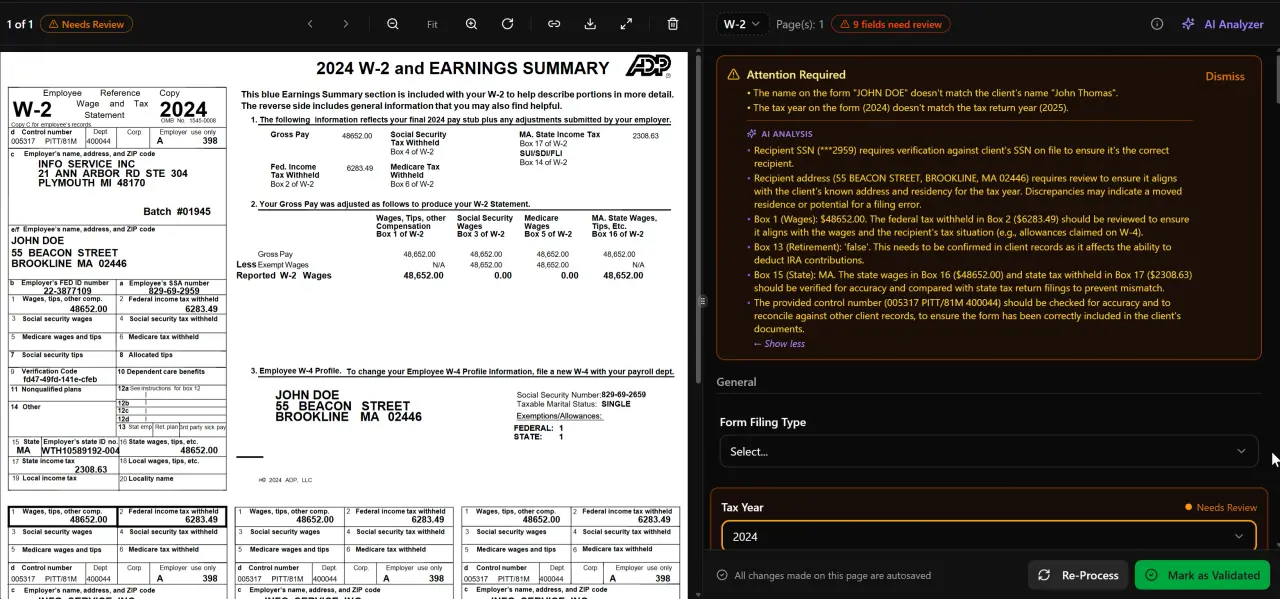
AI classifies, extracts, and validates every document automatically
Form 990 Filing for CPAs: Accuracy Checkpoints That Matter
The core Form 990 return spans Parts I through XII, but the highest-risk compliance areas cluster around a handful of specific schedules. Schedule A determines whether a public charity passes the public support test — either the 33.33% test under Section 509(a)(1) or the 10% facts-and-circumstances test. A calculation error here can reclassify a public charity as a private foundation with significantly stricter excise tax rules. Each of these factors directly shapes how nonprofit audit preparation plays out in practice.
Schedule B (Schedule of Contributors) requires disclosure of contributors who gave $5,000 or more during the year, subject to IRS Notice 2018-67 reporting guidance. Many nonprofits under-report here because gift tracking lives in their donor database rather than their accounting software, and the two systems often disagree on contribution dates and amounts. Your engagement should reconcile both systems before touching the form. Understanding nonprofit audit preparation in this context is what separates firms that scale from those that stall.
Part VII and Schedule J address executive compensation. The IRS uses compensation data to identify potential excess benefit transactions under Section 4958 — situations where a disqualified person receives economic benefits that exceed fair market value. CPAs should verify that the nonprofit followed the rebuttable presumption procedure (board approval, comparability data, concurrent documentation) for any compensation arrangement above $100,000. If that documentation does not exist, it must be assembled — or disclosed — before filing. This is precisely where a deliberate nonprofit audit preparation strategy pays off.
For firms managing high document volumes across multiple nonprofit clients, AI document extraction can accelerate the process of ingesting W-2s, 1099s, grant award letters, and prior-year returns with field-level confidence scoring, dramatically reducing the manual data entry that makes 990 season so taxing. Nonprofit audit preparation sits at the center of this decision — get it wrong and the rest unravels.
Tired of chasing board minutes and grant letters two weeks before the auditor arrives? When firms revisit their nonprofit audit preparation priorities, the gaps usually surface here.
TaxScout.ai centralizes nonprofit client documents, auto-flags 990 compliance anomalies, and keeps your entire engagement team on the same pipeline — all for a flat monthly fee with no per-user pricing.
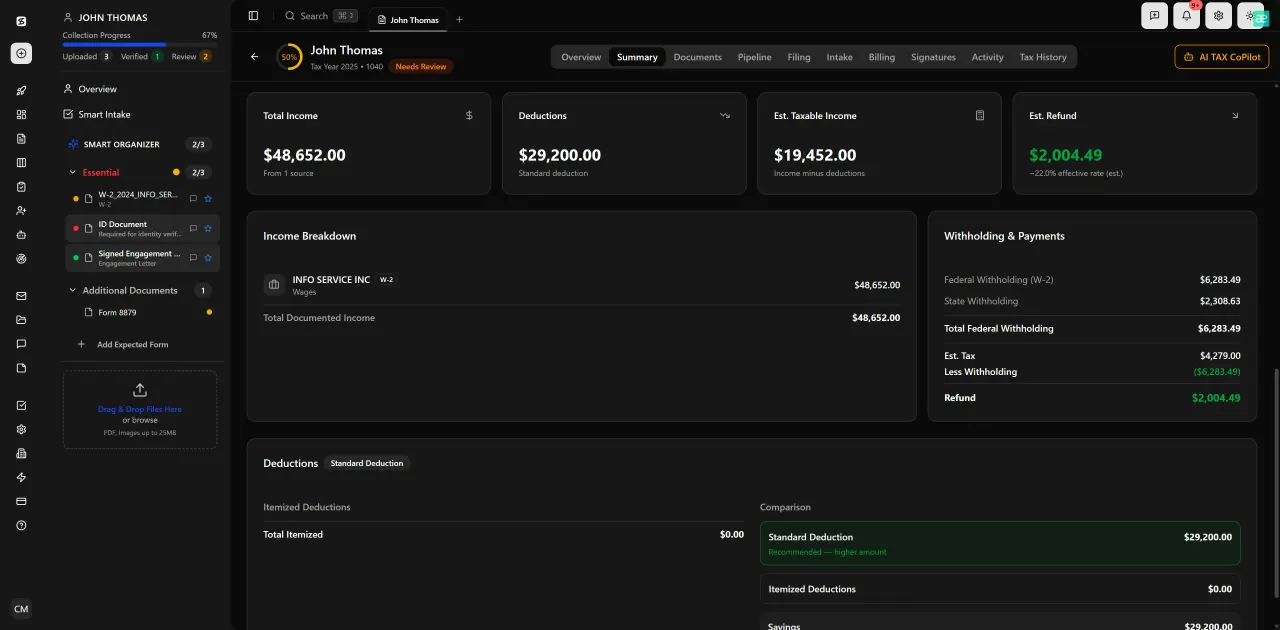
Review with AI assist — 9 agents answer questions with full client context

Click any extracted field to see its source highlighted on the original PDF
Single Audit Requirements and Uniform Guidance Accounting
Any nonprofit that expends $750,000 or more in federal awards during a fiscal year is subject to a Single Audit under 2 CFR Part 200 (Uniform Guidance), administered through the Federal Audit Clearinghouse. This threshold, raised from $500,000 in 2014, means a significant share of mid-sized nonprofits — arts organizations with NEA grants, housing agencies with HUD funding, health centers with HRSA awards — fall into single audit territory without their leadership fully understanding what that entails.
A Single Audit goes beyond financial statement accuracy. The auditor must test compliance with the specific requirements of each major federal program (as defined by the risk-based Type A/B program classification) and evaluate internal controls over compliance. CPAs assisting with single audit preparation must obtain the Schedule of Expenditures of Federal Awards (SEFA), confirm that all direct and indirect federal expenditures are captured, and verify that the nonprofit has a current Negotiated Indirect Cost Rate Agreement (NICRA) if applicable.
Common Single Audit findings involve procurement violations, inadequate subrecipient monitoring, and missing or untimely submission of the data collection form (Form SF-FAC) to the Federal Audit Clearinghouse. CPAs can reduce finding risk by building a Uniform Guidance compliance checklist into the engagement workflow — mapping each major program against its applicable compliance supplement requirements — rather than waiting for the auditor to surface gaps. For a deeper look at how AI-powered research tools help CPAs stay current on federal program requirements, see our post on AI agents handling multi-state and complex tax research.
Firms that use AI research agents with real-time access to Treasury guidance and federal compliance supplements can query specific program requirements on demand, cutting the research time that typically falls to a senior manager or partner.
Board Governance Documentation CPAs Must Collect Before the Audit
External auditors for nonprofits routinely request a standard governance package during the planning phase of fieldwork. CPAs who prepare that package in advance — rather than scrambling during PBC (Prepared by Client) list delivery — create a measurably smoother engagement and reduce the risk of auditor-identified findings that could have been resolved beforehand.
The governance documentation package should include: (1) board meeting minutes for the full fiscal year under audit, with specific attention to approval of the annual budget, executive compensation, and any related-party transactions; (2) signed conflict-of-interest disclosure forms from every board member and key employee; (3) the organization's written policies on document retention, whistleblower protections, and gift acceptance; (4) the audit committee charter or evidence that the full board serves this function; and (5) the most recent Form 990 and any IRS determination letter amendments.
Conflict-of-interest disclosure is the area most likely to have gaps. Many nonprofits collect signed forms at the beginning of the year but fail to update them when a board member gains a new business relationship mid-year. CPAs should request the disclosure forms directly and compare them to Part VI, Line 12 of the 990, which asks whether the organization has a written conflict-of-interest policy and whether officers complete and disclose annual statements. Mismatches between the answer on the form and the actual documentation in hand represent a finding risk.
A branded client portal with structured document requests makes collecting this governance package significantly easier — clients receive a clear checklist, upload documents directly, and your team sees real-time completion status without a single email follow-up.
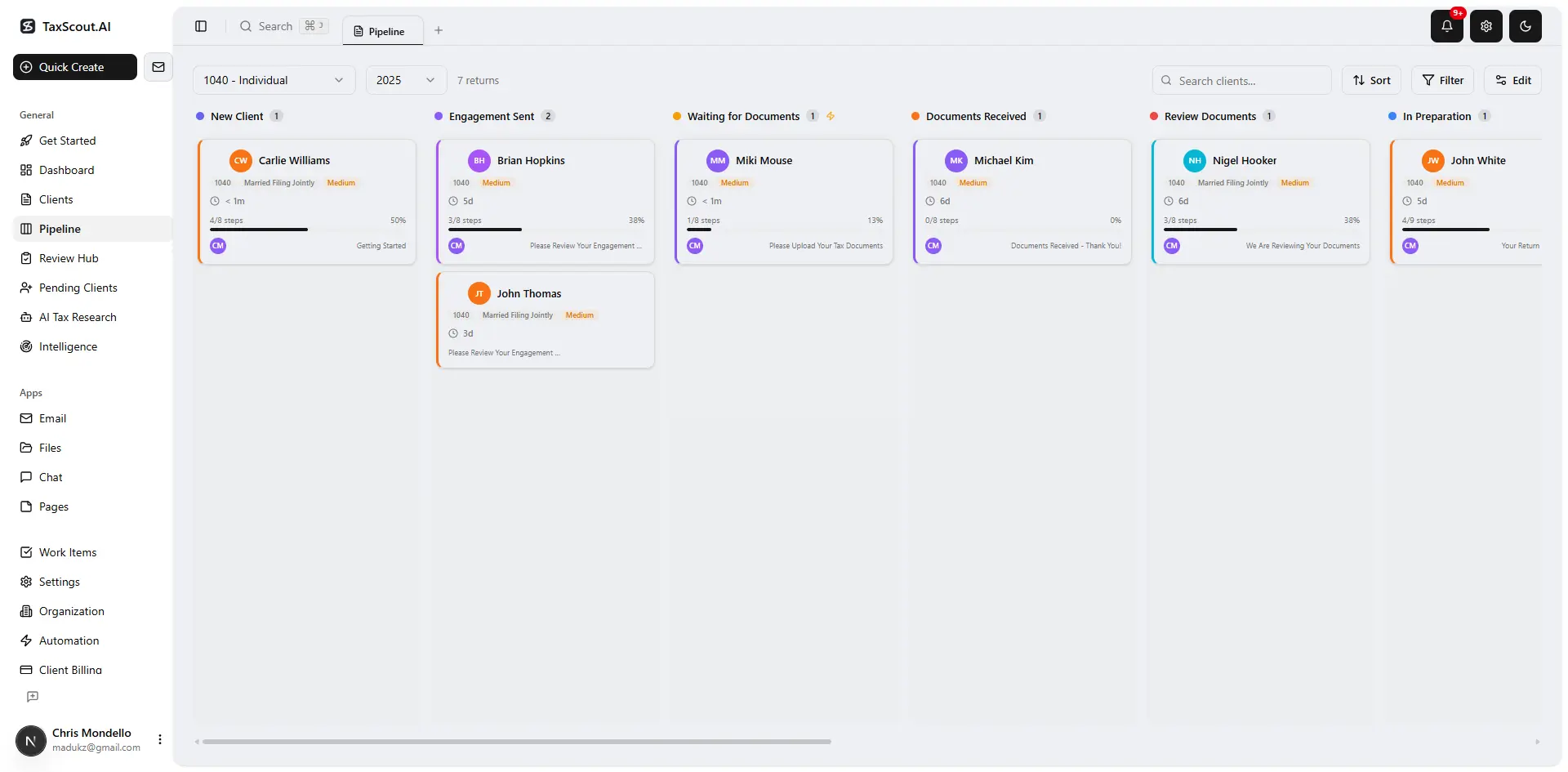
Track every return from intake to filed with drag-and-drop pipeline management

Your clients see your brand — OTP login, document upload, and real-time status
Nonprofit Internal Controls Review Before Auditor Fieldwork
A pre-audit internal controls review positions CPAs as advisory partners rather than passive preparers. The goal is to identify control deficiencies or material weaknesses before the auditor documents them in the audit report — which becomes public record for nonprofits that file a publicly available 990.
Key internal control areas to assess for nonprofits include: segregation of duties over cash receipts and disbursements (particularly challenging for small nonprofits with few staff), authorization controls over grant expenditures, the reconciliation process for contribution revenue between the donor database and general ledger, and the monthly close process for restricted versus unrestricted net assets. Many nonprofits also lack formal review procedures for journal entries — an area auditors increasingly test after high-profile nonprofit fraud cases.
CPAs performing a pre-audit internal controls walkthrough should document findings in a management letter draft and discuss remediation options with leadership before the auditor's planning meeting. Any control deficiency that gets remediated before fieldwork begins is one that will not appear in the final audit report, protecting the organization's reputation with grantors, donors, and state regulators.
For firms that manage dozens of nonprofit clients, a pipeline management system with 12 customizable stages lets you track exactly where each client stands in the governance review, document collection, and internal controls assessment process — with drag-and-drop kanban visibility across your entire nonprofit book of business. You can find complementary workflow strategies in our guide on running a paperless accounting firm in 2026.
990 Preparation Checklist: Key Compliance Areas and Documentation Required
| Compliance Area | Documentation Required | Common Gap |
|---|---|---|
| Public Support Test (Schedule A) | 3-year contribution and revenue data, donor classification | Misclassified government grants vs. public support |
| Schedule B Contributors | Donor database reconciled to GL, contribution amounts and dates | Database and GL disagree on year-end gifts |
| Executive Compensation (Part VII / Schedule J) | Board minutes approving comp, comparability study, Form W-2 | Missing rebuttable presumption documentation |
| Related-Party Transactions (Schedule L) | Contracts, loan agreements, board minutes authorizing transactions | Transactions omitted because not recognized as reportable |
| Single Audit SEFA | Award letters, drawdown reports, indirect cost rate agreement | Indirect expenditures not allocated to federal programs |
| Board Governance (Part VI) | Signed conflict-of-interest forms, meeting minutes, written policies | Mid-year board member relationships not updated |
| Internal Controls | Segregation of duties matrix, reconciliation procedures, JE approval logs | No documented review process for journal entries |
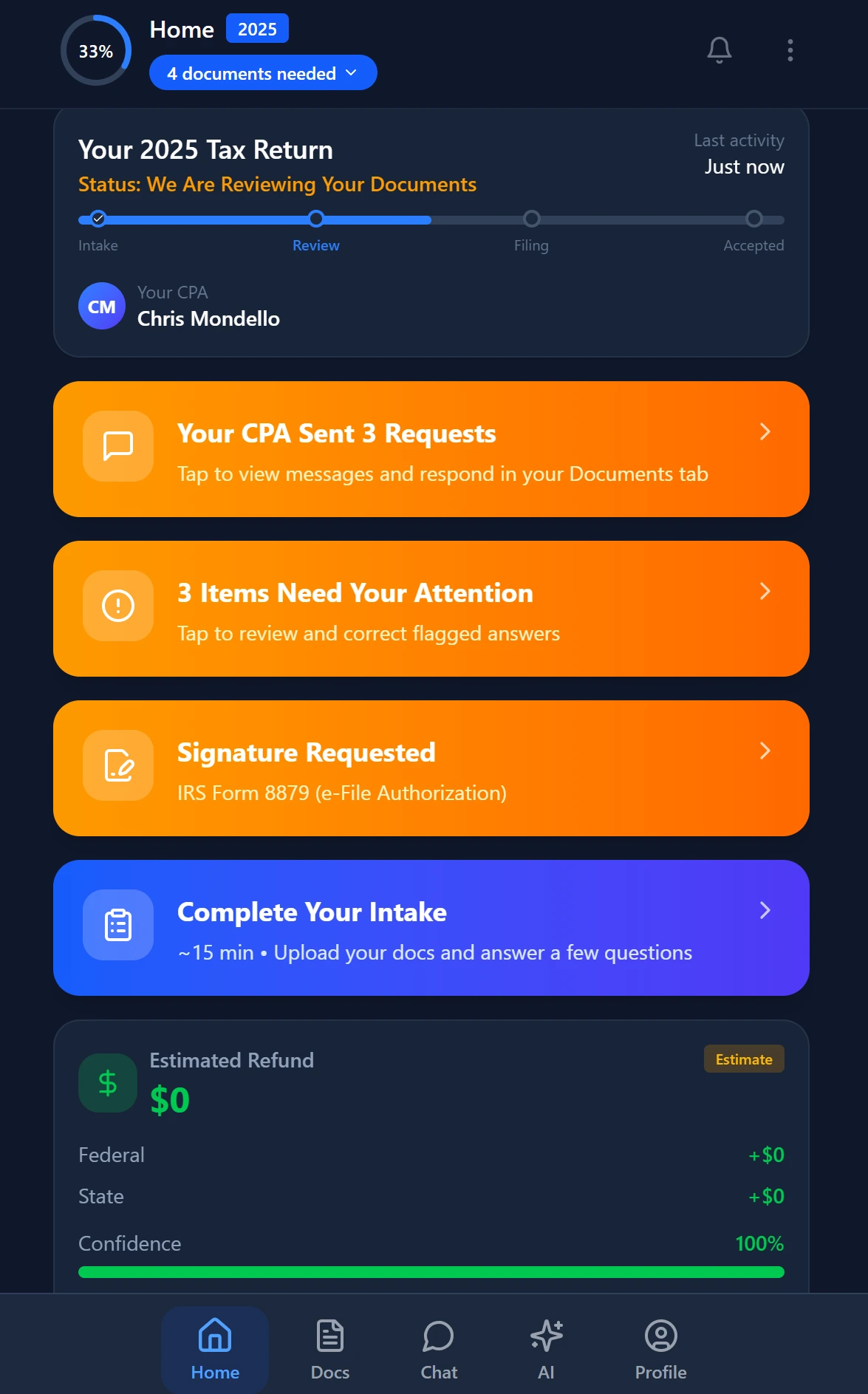
Smart intake auto-fills from uploaded documents and prior-year data
How AI-Native Platforms Auto-Flag Nonprofit Compliance Gaps
The competitive gap in nonprofit audit preparation tooling is significant. General-purpose practice management platforms track tasks and deadlines but have no awareness of nonprofit-specific compliance rules — they cannot flag a missing Schedule L disclosure or identify that a compensation amount on Part VII exceeds the threshold requiring Schedule J completion. AI-native platforms built for CPA workflows can close this gap meaningfully.
TaxScout.ai's AI research agents include real-time search across IRS guidance, Treasury regulations, and the Cornell Legal Information Institute — enabling instant lookups on topics like excess benefit transaction thresholds, state charitable registration requirements, or the latest Uniform Guidance compliance supplement for a specific federal program. Rather than spending 45 minutes researching whether a particular nonprofit's program meets the criteria for a Type A major program under OMB's risk-based approach, a CPA can get a sourced answer in seconds.
On the document side, AI document extraction handles 180+ tax form types including W-2s, 1099s, K-1s, and supporting schedules — and a 5-layer validation pipeline that includes cross-document validation catches discrepancies like a W-2 total that does not reconcile to the compensation figure reported on Part VII. For nonprofits with multiple revenue streams, the split-screen PDF viewer with click-to-source field highlighting lets preparers trace every extracted value back to the source document in seconds.
The AI intake engine — modeled on IRS Form 13614-C with four-layer prefill including prior-year data and AI gap analysis — can be configured to surface nonprofit-specific questions during client onboarding: Does the organization receive federal awards? Does it have an audit committee separate from the full board? These answers pre-populate the engagement checklist and alert preparers to applicable compliance frameworks before the first document is uploaded.
For a broader look at how AI document workflows are changing CPA practice, explore other blog resources covering document automation, advisory services, and firm technology.
Pricing and Platform Fit for Firms with Nonprofit Clients
CPA firms that serve nonprofit clients alongside their regular tax practice need a platform that handles both without charging per-user fees that scale painfully during busy season. TaxScout.ai's flat-fee structure — see full pricing — means a 10-person firm pays $149/month for Prep Pro with unlimited clients, compared to approximately $500/month for TaxDome or $660/month for Canopy at comparable team sizes.
The Prep Pro plan includes all 9 AI research agents, the complete PDF toolbox (OCR, merge, Bates numbering, PII masking — useful for redacting donor PII before sharing documents with auditors), e-signatures via Documenso for engagement letters and Form 8879, and invoicing via Stripe Connect Express. Nonprofits often require multiple rounds of document review and board approvals before filing — the e-signatures workflow handles multi-party signing sequences without requiring clients to create passwords or manage separate accounts.
Firms considering a switch from TaxDome should review our TaxDome alternative comparison, which covers the AI extraction and research capabilities that general practice management platforms do not include. Similarly, firms currently on Canopy can compare module-by-module functionality at our Canopy alternative page — particularly relevant given that Canopy charges $11 per client for Smart Intake features that TaxScout includes at no additional cost.
Ready to handle nonprofit audit prep with the same efficiency you bring to individual and business returns?
TaxScout.ai gives your firm AI extraction, real-time IRS research, structured client portals, and flat-fee pricing — everything you need to own the nonprofit CPA services market in your region.
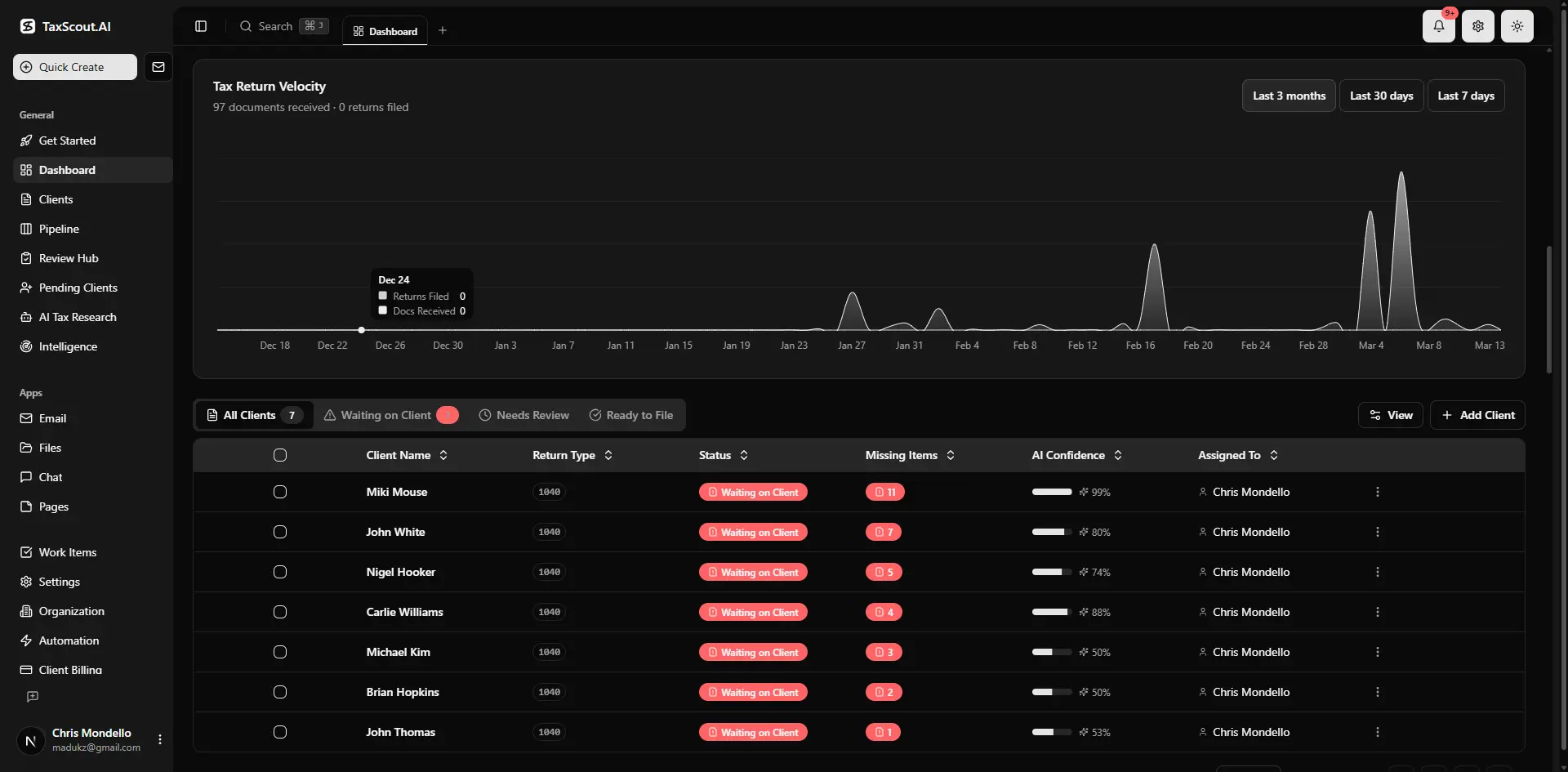
Real-time dashboard showing returns in progress, revenue, and upcoming deadlines
Frequently Asked Questions
Nonprofits that expend $750,000 or more in federal awards during a fiscal year are required to undergo a Single Audit under 2 CFR Part 200 (Uniform Guidance). This threshold applies to direct federal awards and pass-through federal funds combined. CPAs assisting nonprofit clients should confirm total federal expenditures early in the engagement to determine whether Single Audit requirements apply and begin preparing the Schedule of Expenditures of Federal Awards (SEFA) accordingly.
Keep reading
Amended FBAR Procedures: How CPAs Correct Foreign Account Errors Without Triggering Penalties
Oct 12, 2026 · 1 min read
Transparency in Coverage Final Rules: What CPA Firms Must Do Now
Oct 12, 2026 · 1 min read
Backdoor Roth IRA: How CPAs Execute the Strategy for High-Income Clients
Oct 12, 2026 · 1 min read
Stay up to date
Get the latest tax tech insights delivered to your inbox.