Client Retention Strategies for CPA Firms: Keep Clients for Life
Most CPA firms spend far more on acquiring clients than keeping them — despite retention offering 5–7x the ROI of acquisition. This guide breaks down the operational tactics, annual review frameworks, and AI-powered signals top firms use to prevent churn before it starts.
Client retention strategies for CPA firms rarely get the attention they deserve. The average accounting firm invests heavily in referral programs, Google Ads, and networking events to fill the pipeline — yet a quiet but costly leak drains that same pipeline every year. Industry estimates suggest CPA firms lose 10–25% of clients annually, often without a clear reason documented anywhere in their practice management system.
The math is unforgiving. Acquiring a new tax client typically costs 5–7x more than retaining an existing one, yet most firm owners cannot tell you their current churn rate, which client segments are most at risk, or what signals preceded the last five departures. That blind spot is where revenue quietly disappears. Understanding client retention strategies for CPA firms starts with knowing your numbers — and most owners simply don't.
This guide covers the operational and relationship tactics that separate firms with 90%+ retention rates from everyone else — including annual review cadences, proactive advisory touchpoints, satisfaction scoring, flat-fee pricing as a retention lever, and how AI can flag at-risk clients before they silently move to a competitor. The client retention strategies for CPA firms outlined here are drawn from what consistently separates high-retention practices from those quietly hemorrhaging revenue.
Why CPA Firm Churn Rates Are Higher Than Most Owners Realize
The Bureau of Labor Statistics tracks the accounting profession broadly, but firm-level churn data is rarely published. Informal surveys in CPA communities consistently surface 10–20% annual attrition as typical, with boutique firms often higher because a single key-person departure or competitor poach can move the needle fast. For firms evaluating their client retention strategies for CPA approach, this trade-off compounds over time.
What makes accounting firm churn particularly painful is that it is largely silent. Unlike SaaS businesses with cancellation flows, most CPA clients simply do not return after tax season. They do not complain — they just find someone else. By the time you notice, the decision was made months ago. Each of these factors directly shapes how client retention strategies for CPA plays out in practice.
The Journal of Accountancy has noted repeatedly that advisory-oriented firms retain clients at meaningfully higher rates than compliance-only firms. When a client perceives their CPA as a strategic partner — not just a form filer — the switching cost rises dramatically. That perception gap is entirely within your control to close. Understanding client retention strategies for CPA in this context is what separates firms that scale from those that stall.
Understanding your own CPA firm KPIs is the starting point. Without a dashboard that tracks client tenure, average revenue per client, and reactivation rate, you are managing retention by instinct alone. This is precisely where a deliberate client retention strategies for CPA strategy pays off.
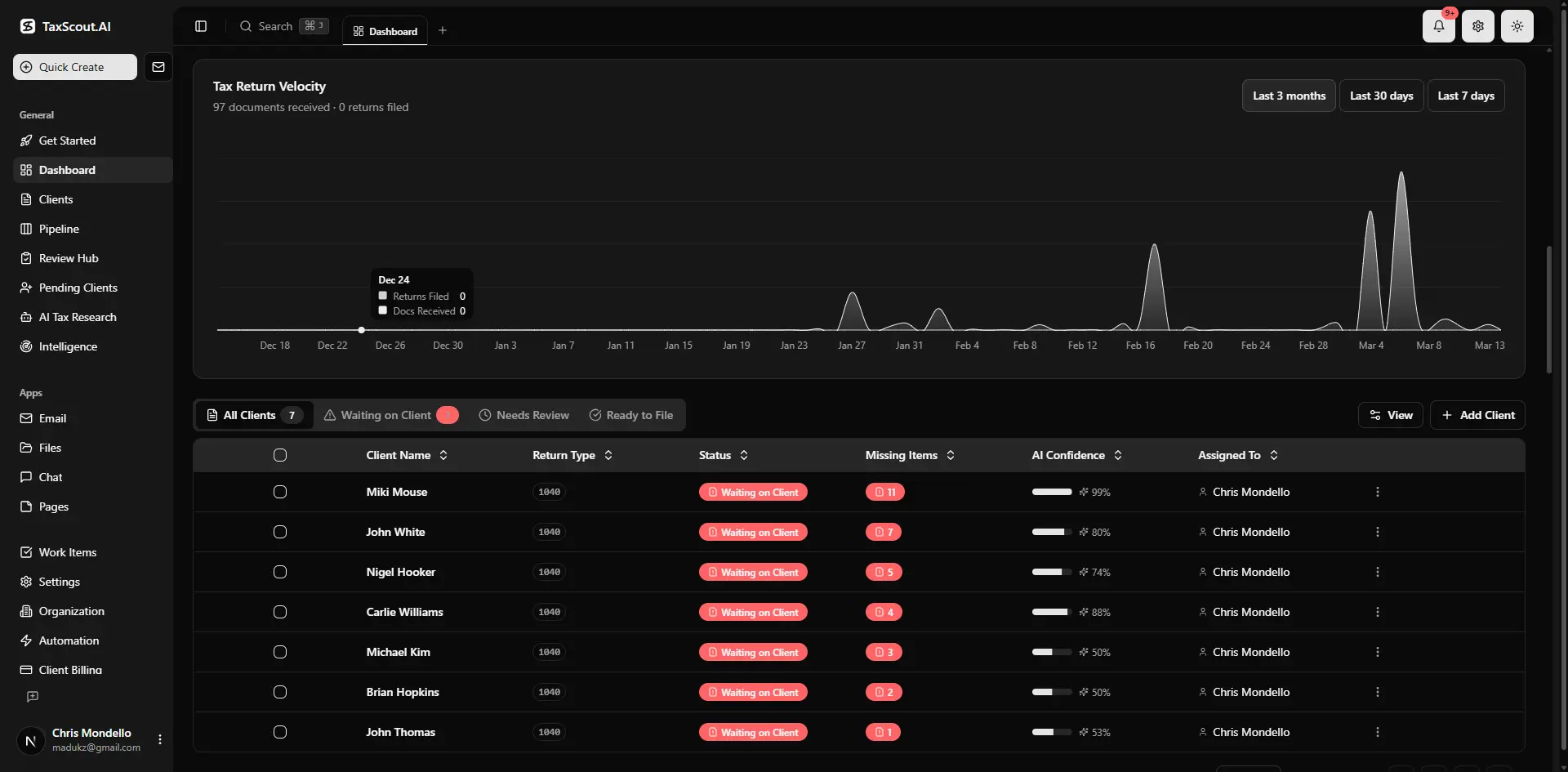
Real-time dashboard showing returns in progress, revenue, and upcoming deadlines
The Annual Client Review Framework as a Retention Tool
The single highest-ROI retention activity most CPA firms are not doing consistently is a structured annual client review — not a tax meeting, but a dedicated business or financial health conversation timed outside peak season. This one practice, run systematically, directly improves CPA client satisfaction and signals to clients that they are more than a transaction. Client retention strategies for CPA sits at the center of this decision — get it wrong and the rest unravels.
A practical annual review framework has three phases: a pre-meeting data pull (prior-year return summary, estimated tax positions, life or business changes flagged in intake), a 45-minute advisory conversation (covering tax planning opportunities, entity structure questions, and goals), and a post-meeting action summary sent within 24 hours. When firms revisit their client retention strategies for CPA priorities, the gaps usually surface here.
The pre-meeting data pull is where technology pays off immediately. TaxScout's client management hub stores entity structures, filing history, and prior-return context in an AI-accessible memory layer, so staff can generate a meeting brief in minutes rather than hours. That context is also available to the AI Research Agents, which can surface relevant planning opportunities — like a Section 199A QBI deduction threshold shift or an S-corporation election analysis — before the meeting begins.
Firms that run annual reviews on a rolling calendar (not just during tax season) consistently report higher satisfaction scores and longer average client tenure. Schedule reviews for 60–90 days after the return is filed, when the client's attention has returned and there is still time to act on planning ideas.
How to Structure the Advisory Conversation
The most effective annual review conversations follow a simple arc: look back (what happened last year and what did we learn), look forward (what changes are coming in their business or personal life), and look at gaps (what planning opportunities exist that we have not addressed). Resist the urge to fill the meeting with tax law updates — that is content for a newsletter, not a client conversation.
Prepare two or three specific, personalized talking points for every meeting. A client who owns a rental property should hear about depreciation recapture planning. A self-employed client approaching retirement should discuss SEP-IRA vs Solo 401(k) options. Personalization is the proof of value that keeps clients loyal — and it is one of the most effective client retention strategies for CPA firms available at any firm size.
Tired of losing clients who never told you they were unhappy?
TaxScout's AI client health scoring and pipeline management give you the visibility to act before clients walk out the door — at a flat monthly rate with no per-user fees.
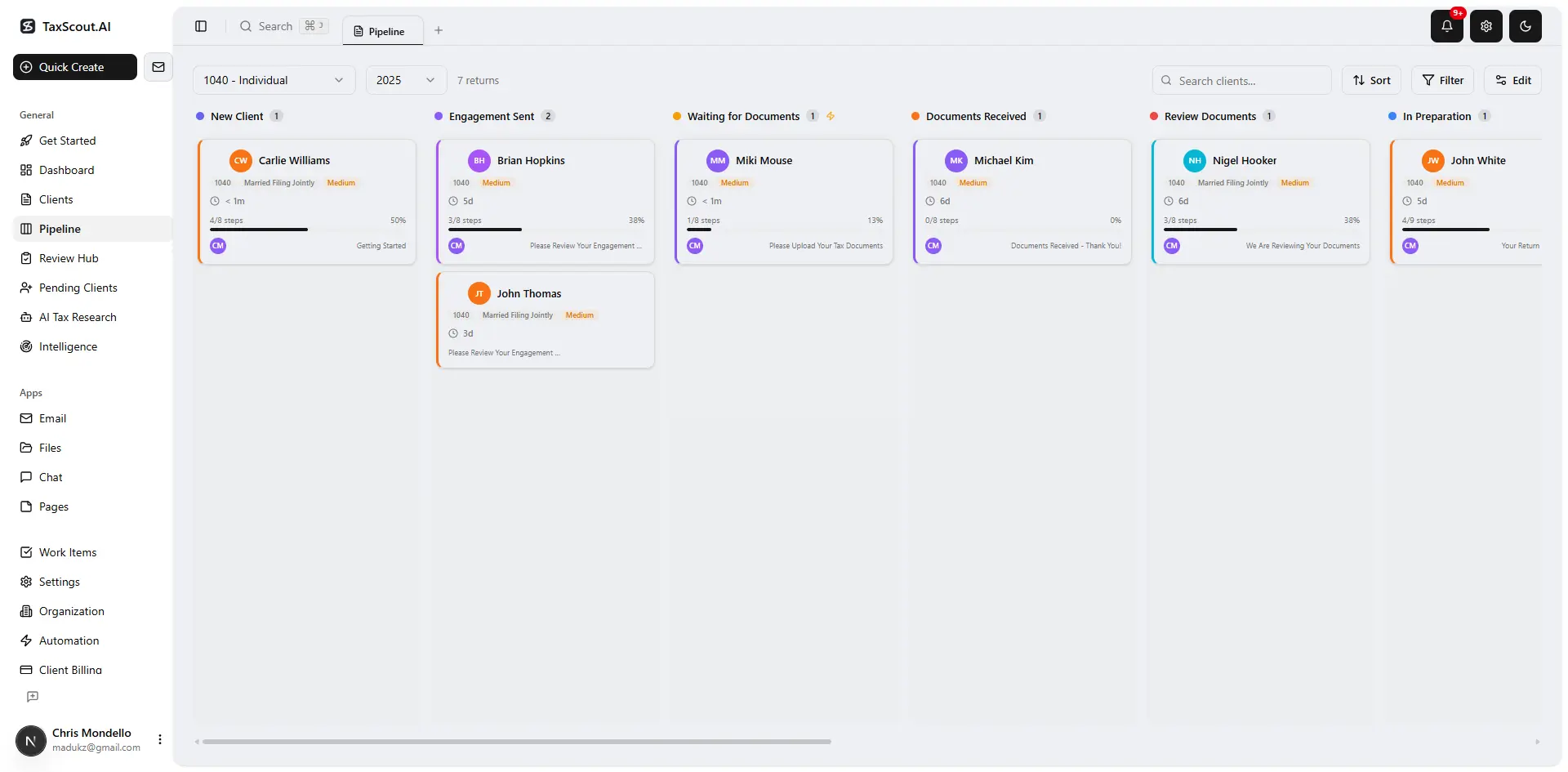
Track every return from intake to filed with drag-and-drop pipeline management
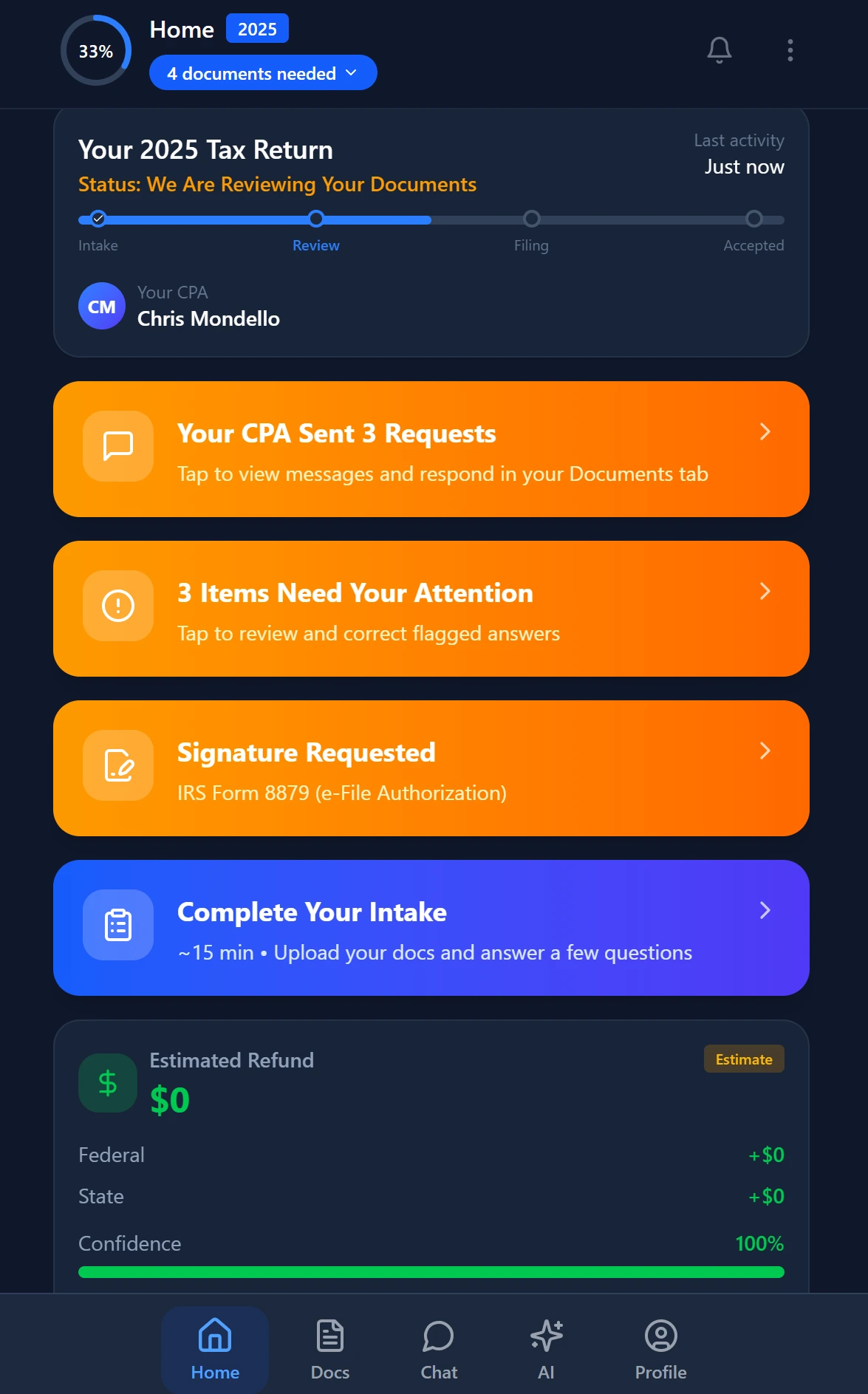
Smart intake auto-fills from uploaded documents and prior-year data
AI-Driven Client Health Scoring to Catch At-Risk Clients Early
No competitor platform today connects AI-driven client health scoring to a retention workflow — and that gap represents one of the highest-leverage opportunities in modern CPA practice management. The concept is straightforward: certain behavioral signals reliably precede churn, and if your software surfaces those signals in time, you can intervene. Building effective client retention strategies for CPA firms increasingly depends on having this kind of early-warning infrastructure in place.
At-risk signals in a CPA context include: late or missing document submissions two or more years running, declining response rates to portal messages, a dropped service (e.g., payroll removed from scope), a recent complaint or refund request, and zero engagement with advisory recommendations for 12+ months. Individually, each signal is ambiguous. In combination, they form a pattern that experienced practitioners recognize — usually after the client has already left.
TaxScout's pipeline management uses 12 customizable stages and a drag-and-drop kanban view that makes these patterns visible at a glance. When a client stalls in a stage far longer than their historical average, or when intake completion rates drop, that is a concrete, actionable signal. Pair that visibility with TaxScout's communication hub — which classifies incoming emails using AI and flags unanswered messages — and you have an early-warning system that most firms currently lack entirely.
Firms that want to build a formal health score can weight signals manually: assign points for on-time document delivery, portal login frequency, advisory engagement, and satisfaction survey responses. Review the aggregate score quarterly. The clients in the bottom quartile deserve a personal call, not an automated email.
Proactive Client Communication That Actually Builds Loyalty
Proactive client communication for CPA firms is widely recommended and rarely executed well. The usual advice — send a newsletter, post on LinkedIn — misses the point. Clients stay loyal when they feel that their specific situation is being watched over by someone who understands it. Generic content does not create that feeling, and it does nothing to advance the client retention strategies for CPA goals that actually move retention numbers.
The highest-retention firms operate on a communication calendar that is client-segment-specific. Business owners get quarterly check-ins tied to estimated tax payment deadlines. W-2 employees get a mid-year withholding review offer. Real estate investors get notices when relevant IRS guidance drops. The IRS regularly publishes guidance that creates timely, personalized outreach hooks — and your clients will notice if you surface it for them before they read it in a trade publication.
TaxScout's AI Research Agents monitor IRS, Treasury, and congressional sources in real time. When a revenue ruling affects a specific client profile — say, a pass-through entity owner — you can craft a targeted advisory note and deliver it through the client portal or email integration within hours, not weeks. That speed of insight delivery is a genuine differentiator that clients remember at renewal time.
For broader context on building communication systems that work at scale, see our other blog resources on practice operations and firm growth.

Every client gets organized documents, status tracking, and a complete history
Flat-Fee Pricing as a Structural Driver of Client Stickiness
Pricing model changes are one of the least-discussed but most powerful client retention strategies for CPA firms. Hourly billing creates a perverse dynamic: every phone call feels like a cost to the client, which means clients self-censor questions, disengage from advisory conversations, and ultimately devalue the relationship. Flat-fee and value-based pricing remove that friction entirely.
When clients pay a predictable monthly or annual fee, they are more likely to call with questions, engage with planning ideas, and refer others — because the meter is not running. They also develop a subscription mindset, where the relationship feels ongoing rather than transactional. Research on value-based pricing consistently shows that firms making this switch see both revenue per client and retention rates increase.
The operational challenge of flat-fee billing is scope management and invoicing automation. TaxScout's invoicing via Stripe Connect Express allows recurring billing with automatic retries, and the engagement letter workflow via e-signatures through Documenso ensures scope is documented before work begins — protecting both parties. Our dedicated guide on flat-fee billing for CPAs covers the transition in detail, including how to price legacy hourly clients into new packages without triggering churn.
Firms on per-user-priced platforms like TaxDome (approximately $100/user/month) or Canopy (approximately $45/user/month per module) often find that software costs force them to keep billing hourly to recoup overhead. TaxScout's flat-rate model — $149/month total for up to 10 seats — eliminates that pressure and lets you pass the pricing simplicity downstream to clients.

Your clients see your brand — OTP login, document upload, and real-time status
Practice Management Platform Cost Comparison for a 10-Person CPA Firm
| Platform | Monthly Cost (10 Users) | AI Client Signals | Flat-Fee Friendly |
|---|---|---|---|
| TaxScout Prep Pro | $149 flat | Yes — pipeline health, AI agents, email classification | Yes — Stripe recurring billing built in |
| TaxDome | ~$500 | No | Limited — no built-in recurring invoicing |
| Canopy | ~$660 | No | Limited — Smart Intake costs $11/client extra |
| Karbon | ~$590 | No — email-centric only | No — lacks document and invoicing layer |
Client Satisfaction Scoring: How to Measure What You Cannot Afford to Ignore
Accounting firm client loyalty is hard to quantify without a deliberate measurement system. Net Promoter Score (NPS) is the most widely adopted framework — one question, a 0–10 scale, and a follow-up asking why. The Small Business Administration emphasizes that small business owners choose advisors based on perceived responsiveness and trust, both of which NPS indirectly captures. Treating satisfaction scoring as a core component of your client retention strategies for CPA program ensures you catch at-risk clients before they quietly disengage.
For CPA firms, the best NPS deployment timing is 2–3 weeks after the return is filed, while the experience is still fresh but the stress of filing season has passed. Keep the survey to three questions maximum: the NPS question, a satisfaction rating on responsiveness, and one open-ended question about what would make the relationship more valuable. Any firm averaging below 40 NPS should treat that as a retention emergency.
Segment your scores by client type (individual vs. business, new vs. multi-year). Multi-year clients who suddenly score lower are your highest-priority intervention targets. A personal call from a partner — not a form email — is the only appropriate response to a detractor score from a long-tenure client.
Connect satisfaction data to your pipeline stages in TaxScout so that low-scoring clients are automatically flagged for follow-up. The pipeline management kanban board supports custom stage labels, so you can create a "Satisfaction Follow-Up" stage that makes at-risk clients visible to the whole team without anyone falling through the cracks.
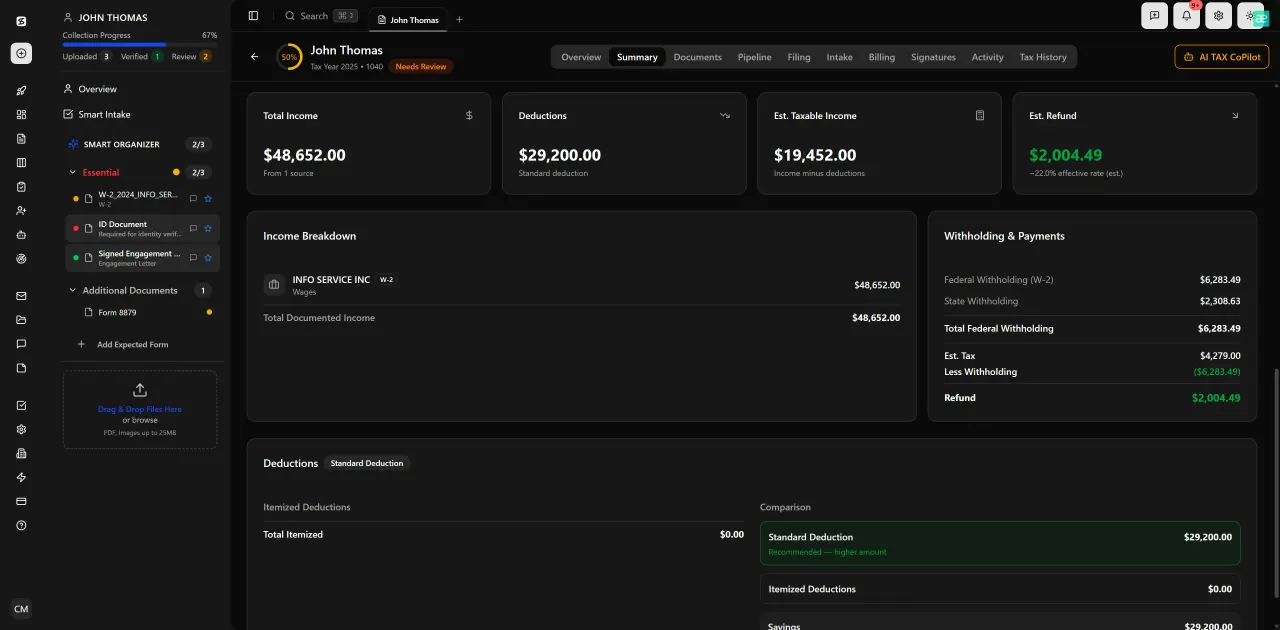
Review with AI assist — 9 agents answer questions with full client context

Track firm performance with real-time analytics and client activity monitoring
Maximizing Client Lifetime Value Through Service Expansion
Client lifetime value for CPA firms grows in two ways: by keeping clients longer and by expanding the services they use. Most firms do the second reactively — clients ask about bookkeeping or payroll, and the firm says yes. The highest-performing firms do it proactively, with a deliberate service expansion roadmap for each client segment. This approach is one of the more underutilized client retention strategies for CPA firms, because expanding a client's engagement depth directly raises their switching cost.
A practical expansion framework maps client life events to service triggers. A business client whose revenue crosses $500K is a natural candidate for an entity structure review — the S-corporation election conversation, specifically. A client who just inherited property needs estate planning guidance and potentially a cost segregation analysis. A client getting married needs a filing status and withholding update. These are not upsells — they are the natural expression of the CPA-as-advisor role.
The intake data captured in TaxScout's AI intake engine — modeled on IRS Form 13614-C with four-layer prefill — surfaces life changes automatically as clients update their profiles. That data feeds the AI memory layer, which means your team gets prompted with expansion opportunities rather than having to remember to look for them.
Firms that cross-sell even one additional service to 20% of their client base annually can offset the revenue loss from normal attrition entirely. Combined with a structured retention program, that math compounds into significantly higher firm valuation over time. Treasury research on small business advisory relationships consistently shows that multi-service clients churn at roughly half the rate of single-service clients.
The Role of the Client Portal in Reducing Passive Churn
Passive churn — clients who leave not because they are unhappy but because the friction of working with you quietly accumulated — is underrated as a retention threat. A poorly designed document exchange process, confusing invoicing, or slow response times do not generate complaints. They generate departures. Addressing this friction layer is one of the most practical client retention strategies for CPA firms that is fully within your control to implement today.
A branded, frictionless client portal directly addresses passive churn by making every interaction easier than the alternative. TaxScout's client portal uses OTP (one-time password) login — no password management headaches for clients — and delivers a branded experience that reinforces the firm's identity on every visit. When clients can upload documents, sign forms, pay invoices, and message their accountant in one place, the switching cost to a competitor rises substantially.
The connection between portal adoption and retention is intuitive: clients who log in regularly are engaged clients. Clients who never log in are disengaged clients who are one bad experience away from leaving. Monitor portal login frequency as a leading retention indicator, and flag clients with zero logins in the past 60 days for a personal outreach.
For a deeper look at building a portal experience that clients actually use, see our guide on client portals that clients will actually use. The design and communication principles there apply directly to retention, not just onboarding.
What would 5% lower churn mean for your firm's revenue over five years?
TaxScout gives CPA firms the AI tools, pipeline visibility, and client communication infrastructure to retain more clients — all at a flat monthly rate that scales with your firm, not against it.
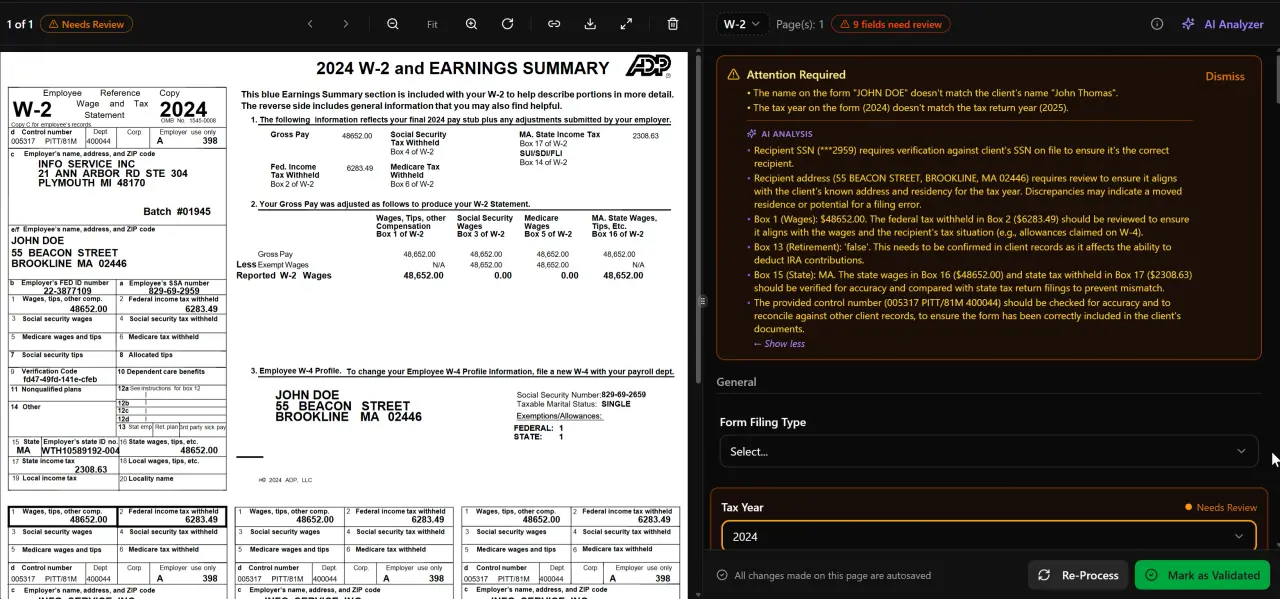
AI classifies, extracts, and validates every document automatically
Frequently Asked Questions
Industry estimates place average CPA firm churn at 10–25% annually. Compliance-only firms tend to lose clients at the higher end of that range, while advisory-oriented firms with proactive communication cadences typically see 8–12% attrition. Firms that implement annual review frameworks and AI-driven client health monitoring consistently report retention rates above 90%.
Keep reading
Amended FBAR Procedures: How CPAs Correct Foreign Account Errors Without Triggering Penalties
Oct 12, 2026 · 1 min read
Transparency in Coverage Final Rules: What CPA Firms Must Do Now
Oct 12, 2026 · 1 min read
Backdoor Roth IRA: How CPAs Execute the Strategy for High-Income Clients
Oct 12, 2026 · 1 min read
Stay up to date
Get the latest tax tech insights delivered to your inbox.