Specializing in Real Estate Tax: A Practice-Growth Playbook for CPAs
Most CPA firms treat cost segregation, 1031 exchanges, and passive activity rules as separate engagements — and leave premium fees on the table. This playbook shows how bundling those services into a coherent real estate tax specialization drives higher prices, referral momentum from investors and…
Specializing in real estate tax is one of the clearest paths a CPA firm can take toward higher-margin work, predictable referral flow, and the kind of client relationships that don't evaporate when someone finds a cheaper preparer. Yet most firms dabble: they handle a landlord's Schedule E here, run a cost segregation study there, and occasionally field a 1031 exchange question — all without ever positioning themselves as the go-to real estate tax advisor in their market.
The result is a fragmented client roster full of people who see the firm as a commodity. They shop on price, they delay sending documents, and they never refer other investors because they don't think of their CPA as a specialist. Meanwhile, real estate syndicators, active investors, and residential rental portfolios are actively seeking — and paying premium retainers to — advisors who can speak their language fluently. CPAs specializing in real estate tax, by contrast, attract clients who value expertise and actively send referrals to other investors in their network.
This guide is a practice-growth playbook for CPAs ready to shed low-margin generalist work and build a recognizable real estate tax boutique. We'll cover the core service bundle that defines the niche, how to market it to the right referral partners, and how AI-assisted workflow lets a small team handle the volume without burning out. Whether you are just beginning to focus your practice or are already specializing in real estate tax and want to scale, the strategies here will help you build a more profitable and referable firm.
Why Real Estate Investors Are the Ideal CPA Niche
Real estate investors have tax complexity that compounds every year. Each acquisition introduces a new depreciation schedule. Each refinance triggers potential interest-tracing questions. Each disposition surfaces depreciation recapture and capital gains calculations. Active investors can easily generate $5,000–$20,000+ in annual advisory fees — multiples of what a comparable W-2 household ever will. A CPA specializing in real estate tax is positioned to manage this compounding complexity proactively, rather than scrambling to untangle problems at filing time.
Beyond fee potential, real estate investors are natural networkers. They work alongside mortgage brokers, real estate agents, title companies, and property managers — all of whom regularly need to refer clients to a trusted CPA. When your firm is known as the real estate tax advisor in your region, those referral channels activate without paid advertising. For firms evaluating their specializing in real estate tax approach, this trade-off compounds over time.
According to the National Association of Realtors, there are roughly 1.5 million active real estate licensees in the United States, many of whom are investors themselves or work daily with investor clients. Every one of them is a potential referral node for a firm that has visibly planted a flag in this niche. Each of these factors directly shapes how specializing in real estate tax plays out in practice.
Compare that to a generalist book of business: mixed clients, inconsistent document complexity, and no natural referral community. The real estate vertical offers exactly the opposite — a tight ecosystem where one excellent client introduction can cascade into a dozen qualified prospects. A firm specializing in real estate tax is uniquely positioned to benefit from this kind of compounding referral momentum. Understanding specializing in real estate tax in this context is what separates firms that scale from those that stall.

Click any extracted field to see its source highlighted on the original PDF
The Four-Pillar Real Estate Tax Service Bundle
The key insight that competitor content misses is this: cost segregation, 1031 exchanges, passive activity rules, and depreciation recapture are not separate products — they are four interconnected levers that real estate investors need pulled in coordination. A CPA who masters all four and packages them together commands advisory pricing rather than preparation pricing. This is precisely where a deliberate specializing in real estate tax strategy pays off.
Offering them as a coherent bundle also signals expertise. When a prospective client asks, "Do you understand real estate?" and you can explain how a cost segregation study accelerates first-year deductions, how those deductions affect passive activity loss absorption, how depreciation recapture will be calculated on eventual sale, and how a 1031 exchange defers that recapture — that single conversation closes most deals. Specializing in real estate tax sits at the center of this decision — get it wrong and the rest unravels.
Cost Segregation and Accelerated Depreciation
Cost segregation engineering studies reclassify components of a commercial or residential rental property from 27.5-year or 39-year schedules into 5-, 7-, and 15-year property, dramatically increasing first-year deductions under bonus depreciation provisions. The IRS Audit Techniques Guide for Cost Segregation provides the authoritative framework CPAs must understand to defend these positions. Our own deep-dive on cost segregation studies covers the mechanics in detail — but the practice-growth angle is that CPAs specializing in real estate tax who can model the study, coordinate with an engineering firm, and integrate the results into the return workflow own this client relationship permanently. When firms revisit their specializing in real estate tax priorities, the gaps usually surface here.
1031 Exchanges and Deferral Strategy
Section 1031 of the Internal Revenue Code allows investors to defer capital gain and depreciation recapture on property dispositions, provided they identify replacement property within 45 days and close within 180 days. The rules governing boot, like-kind requirements, and qualified intermediary obligations are detailed in Treasury Regulation 1.1031-1). A CPA specializing in real estate tax who proactively models the exchange economics — including the recapture exposure avoided — turns a transactional engagement into an ongoing planning relationship.
Passive Activity Rules and Loss Utilization
For most rental investors, passive activity loss rules under IRC Section 469 are the primary planning battleground. Whether a client qualifies as a real estate professional under the 750-hour and majority-of-services tests determines whether their rental losses offset W-2 income or suspend until disposition. The IRS Publication 925 lays out the rules, but the advisory value is in year-round monitoring: tracking hours, grouping elections, and coordinating short-term rental strategies with the material participation standards.
Depreciation Recapture Planning
Depreciation recapture under Section 1250 (taxed at up to 25%) is one of the most underestimated tax costs in real estate. A client who took aggressive bonus depreciation and then sells without a 1031 exchange faces a recapture bill they may not have modeled. CPAs specializing in real estate tax who educate clients on recapture exposure at acquisition — not at sale — become indispensable advisors. This is also where installment sales, charitable remainder trusts, and opportunity zone investments enter the conversation as complementary tools.
Tired of building each client's depreciation schedule from scratch in a spreadsheet?
TaxScout.ai extracts Schedule E data, closing statements, and depreciation schedules automatically — so your real estate tax practice runs at advisory speed, not data-entry speed.
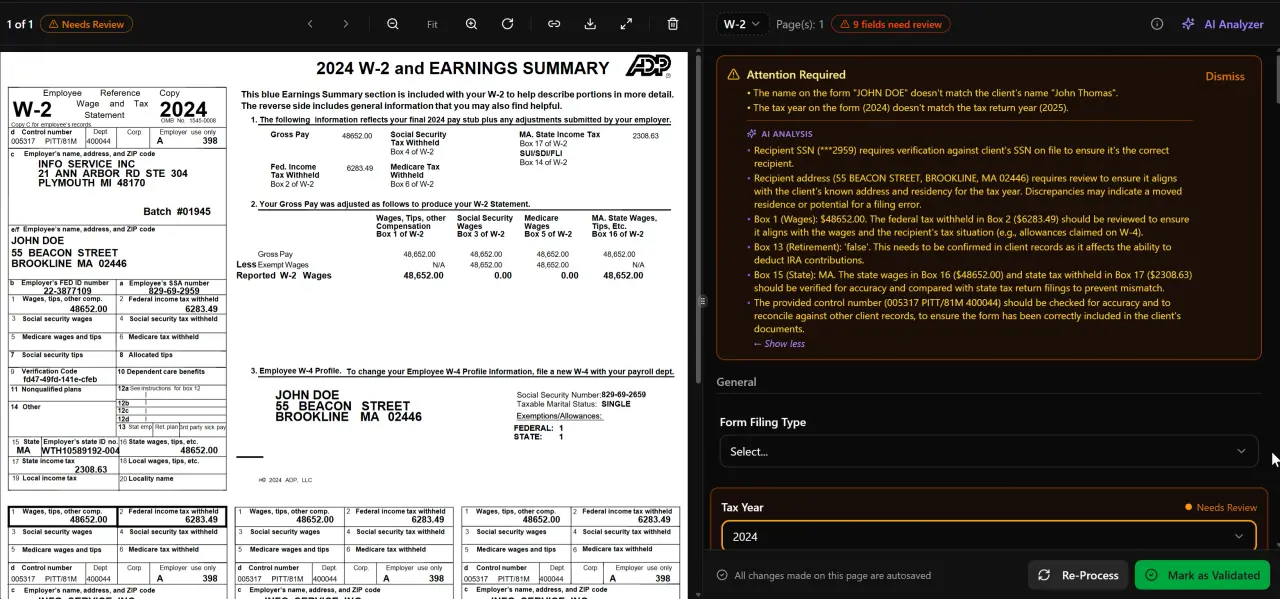
AI classifies, extracts, and validates every document automatically

Your clients see your brand — OTP login, document upload, and real-time status
Pricing a Real Estate Tax Specialization at Premium Rates
Generalist CPA pricing is anchored to form complexity. Real estate tax advisory pricing is anchored to value delivered — and the gap between those two benchmarks is substantial. A firm that bills $600 for a Schedule E return leaves thousands in advisory fees unrealized on the same client relationship.
The bundled service model supports value-based pricing because you can quantify outcomes. A $3,000 cost segregation coordination engagement might generate $40,000 in deductions for a client in the 37% bracket. A 1031 exchange advisory retainer might defer $150,000 in tax. These are defensible value anchors. Our guide on flat-fee billing for CPAs covers the mechanics of moving off hourly rates — the real estate niche is one of the strongest contexts in which to execute that transition.
A practical real estate service tier might look like: a base annual advisory retainer covering quarterly check-ins, passive activity tracking, and return preparation; a cost segregation add-on for acquisition years; and a disposition planning fee when a sale or exchange is in view. For a firm specializing in real estate tax, this structure ensures recurring revenue, not just seasonal spikes, and it makes capacity planning far more predictable. See our complete guide to firm-building topics for more strategies on sustainable growth.
Building Referral Partnerships With Real Estate Agents and Investors
Real estate agents are uniquely motivated referral partners because their clients — buyers and sellers — almost always have an immediate tax event that requires professional guidance. A listing agent whose client just sold a rental property and faces depreciation recapture needs to refer that client somewhere. If your firm is known for specializing in real estate tax, you become the obvious choice.
The same logic applies to mortgage brokers (whose clients often need cash-flow modeling that incorporates tax), property managers (whose landlord clients need rental property tax planning every year), and real estate attorneys (whose clients face 1031 deadlines and entity structuring questions).
To activate these channels, CPAs should attend local real estate investor meetups, contribute educational content to investor Facebook groups and BiggerPockets forums, and offer free 30-minute consultations specifically framed around real estate tax questions. The goal is not to give away advisory work — it's to demonstrate fluency so that agents and investors become confident referring their network to you.
A structured referral program with formal tracking also helps. The TaxScout referral program tools give your firm a trackable way to acknowledge and reward the professionals who send clients your way, which reinforces the relationship without uncomfortable cash-for-referral arrangements that violate professional standards. For more on building systematic referral pipelines, see the accounting firm referral program guide.

Smart intake auto-fills from uploaded documents and prior-year data
How AI Workflow Lets a Small Firm Compete as a Real Estate Tax Boutique
The single biggest objection CPAs raise about niching down is capacity: real estate clients generate high document volume — closing disclosure statements, depreciation schedules, K-1s from syndications, multiple Schedule E worksheets, 1098 mortgage interest statements — and a two-person firm worries about drowning in paper before they can deliver the advisory work that commands premium fees.
AI-powered document extraction changes this calculus entirely. TaxScout.ai's AI document extraction handles 180+ tax form types, including all 1099 variants, K-1 packages from real estate partnerships, and the full 1040 with all schedules. The 5-layer validation pipeline — document quality routing, AI extraction with confidence scoring, OCR cross-verification, 15 deterministic math rules, and cross-document validation — means that closing statements and depreciation schedules arrive in the return workflow pre-verified, not raw.
For a firm specializing in real estate tax, this means the senior CPA spends time on passive activity analysis and exchange modeling rather than manually keying depreciation asset tables. The AI intake engine — modeled on IRS Form 13614-C with 4-layer prefill using document-first, prior-year, and profile data — ensures new real estate clients answer the right questions the first time, flagging whether they meet the real estate professional hours test before the return is ever opened.
The split-screen PDF viewer with click-to-source field highlighting also means that when a client sends a complex closing disclosure with multiple allocation lines, any team member can trace exactly which extracted figure maps to which PDF line — critical for cost segregation basis calculations that must withstand IRS scrutiny.
For a deeper look at how AI document extraction works technically, see the guide on AI document extraction for CPAs.
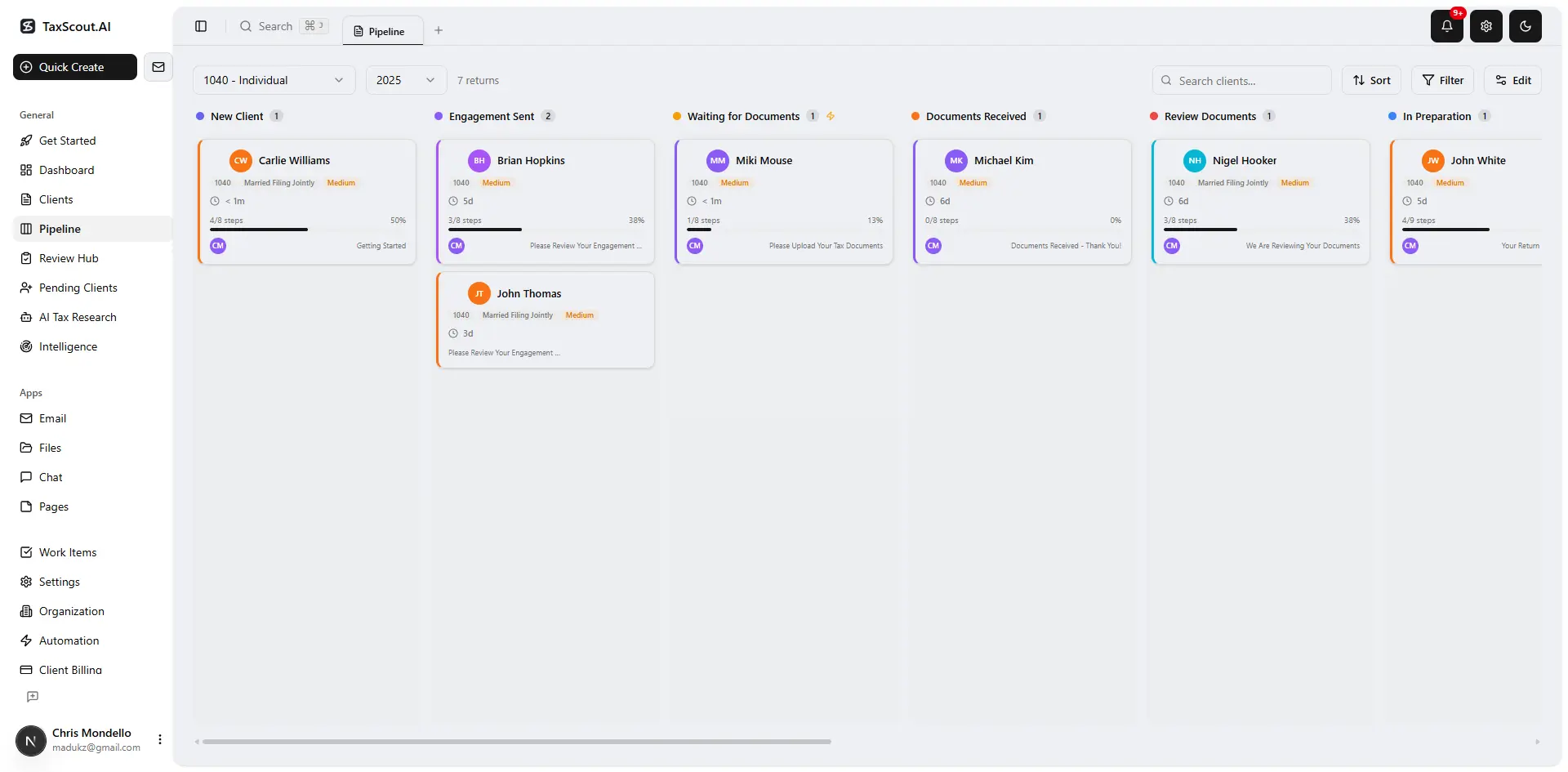
Track every return from intake to filed with drag-and-drop pipeline management
Pipeline and Client Management for Real Estate Tax Workflow
Real estate engagements do not follow the same workflow as W-2 returns. A cost segregation coordination has different milestones than a 1031 exchange advisory. A syndication K-1 review has different dependencies than a rental property Schedule E. A practice management system that forces all work into a single generic workflow creates friction — and missed deadlines — in a niche where timing can cost clients hundreds of thousands of dollars.
TaxScout's pipeline management supports 12 customizable stages with drag-and-drop kanban, allowing firms specializing in real estate tax to create distinct workflows for acquisition-year tax planning, ongoing rental property tax preparation, and disposition/exchange engagements. Each workflow can have its own document checklist, deadline triggers, and team assignments.
Combined with the branded client portal — which uses OTP login so investors aren't fumbling with passwords when they need to upload a closing disclosure at 11 p.m. — and e-signatures via Documenso for engagement letters and Form 8879, the entire real estate client experience is smoother than what most boutique tax firms currently offer.
For firms coming from tools like TaxDome or Canopy, the comparison is stark: TaxScout at $149/month for the full Prep Pro tier (10 seats, unlimited clients, all 9 AI Research Agents) versus TaxDome at approximately $500/month for the same headcount or Canopy at approximately $660/month with smart intake billed at $11 per client. See the TaxDome alternative comparison and Canopy alternative comparison for a full breakdown.
Real Estate Tax Specialization: TaxScout vs Competitors for a 10-Person Firm
| Capability | TaxScout Prep Pro | TaxDome | Canopy |
|---|---|---|---|
| Monthly cost (10 seats, unlimited clients) | $149/mo flat | ~$500/mo | ~$660/mo |
| AI document extraction (K-1s, Schedule E, closing statements) | Yes — 180+ form types, 5-layer validation | No | No |
| AI research agents (passive activity, 1031, recapture) | 9 specialized agents with IRS/Treasury search | No | No |
| Smart intake with prior-year prefill | Yes — 4-layer prefill, document-first | Limited | Costs $11/client extra |
| Branded client portal with OTP login | Yes | Yes | Yes |
| E-signatures (Form 8879, engagement letters) | Yes via Documenso | Yes | Yes |
| 14+ PDF tools including PII masking | Yes | Limited | Limited |
| Works with Drake, Lacerte, ProConnect, CCH | Yes | Partial | No |
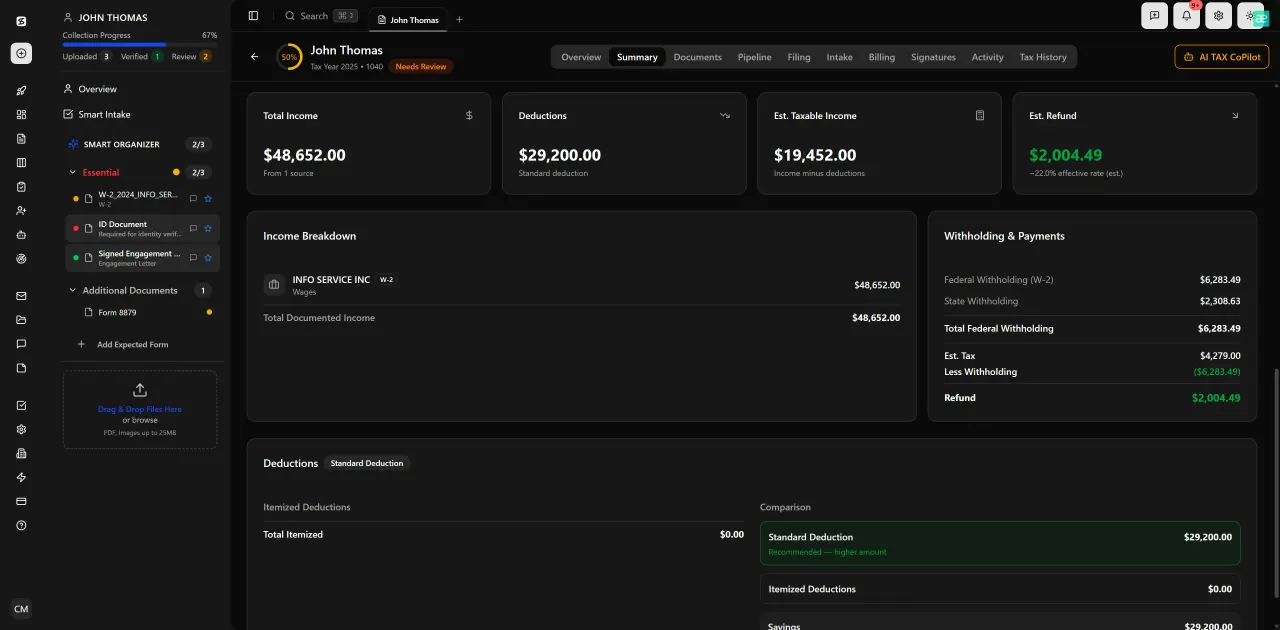
Review with AI assist — 9 agents answer questions with full client context

Every client gets organized documents, status tracking, and a complete history
Marketing Your Real Estate CPA Services Without a Large Budget
Positioning a CPA firm as a real estate tax specialist does not require expensive advertising. The most effective channels for this niche are content authority, community presence, and strategic partnerships — all of which compound over time.
On the content side, publishing detailed guides on topics like the real estate professional election, depreciation recapture strategy at exit, or how bonus depreciation interacts with passive activity rules signals expertise to both prospects and referral partners. These are exactly the searches real estate investors and syndicators run on Google when they're evaluating advisors who are specializing in real estate tax. The Bureau of Labor Statistics data on real estate industry employment underscores how large and economically active this sector is — there are millions of potential clients searching for specialized guidance.
On the community side, joining local real estate investment clubs and national networks like the Real Estate Investors Association gives CPAs direct access to active investors before they've made a CPA decision. Speaking at these events — even a 20-minute presentation on "How Depreciation Recapture Works When You Sell" — positions the firm as a credible real estate investor tax advisor in a way no LinkedIn post can replicate.
The TaxScout CPA landing page tools help firms specializing in real estate tax create a polished web presence specifically for the real estate niche without building a new website from scratch — an underrated advantage for small firms that want to convert referral traffic into consultation bookings.
Ready to stop doing commodity tax prep and start running a real estate tax practice that commands premium fees?
TaxScout Prep Pro gives a two-person real estate tax boutique the AI extraction, research agents, and workflow automation to compete above its weight — at $149/month flat, no per-user fees.
Frequently Asked Questions
Real estate clients generate recurring, compounding tax complexity — depreciation schedules, passive activity tracking, entity structuring, and eventual disposition planning — that supports advisory retainers rather than one-time preparation fees. A single active real estate investor can generate $5,000–$20,000+ in annual fees while also referring other investors through their existing network of agents, brokers, and property managers.
Keep reading
Business Valuation for CPAs: How to Price a Client Company Without Hiring an Appraiser
Sep 18, 2026 · 1 min read
Equity Partner Compensation: How CPA Firms Structure Pay for Owners
Sep 18, 2026 · 1 min read
Accountant Shortage Solutions: How CPA Firms Survive the Talent Crisis Without Overpaying
Sep 18, 2026 · 1 min read
Stay up to date
Get the latest tax tech insights delivered to your inbox.