Accounting Firm Capacity Planning: End Team Overload
Running your firm on spreadsheets and gut instinct is a recipe for missed deadlines and burned-out preparers. Accounting firm capacity planning gives you a real-time view of who can take on more work — and who's already at the breaking point. Learn how to turn capacity management into a…
Most CPA firm owners discover their need for accounting firm capacity planning the same way: a preparer misses a March 15 S-corp deadline because nobody noticed their queue had 23 active returns. The client calls. The partner apologizes. Internally, everyone wonders how it happened — and nobody has a real answer, because the firm is running on spreadsheets, mental models, and a weekly team meeting that covers maybe 40% of what's actually in progress.
Accounting firm capacity planning is the practice of measuring exactly how much work your team can absorb, distributing it intelligently, and detecting overload before it becomes a missed deadline. Done right, it's not a scheduling exercise. It's a profitability lever — one that determines whether your firm can take on 50 more clients this season without adding a single hire.
This article explains the methodology behind capacity planning for CPA firms, where most firms fail, and how AI-powered workload visibility changes the entire equation. Understanding accounting firm capacity planning is the foundation for breaking that cycle of annual burnout and missed deadlines.
Why Accounting Firm Capacity Planning Breaks Down Every Tax Season
The IRS tax deadline calendar creates a demand pattern unlike almost any other professional service. A solo practitioner or small CPA firm absorbs relatively stable work from October through January, then faces a near-vertical demand spike from February 1 through April 15 — followed by a secondary surge around the October extension deadline. This demand curve is precisely why accounting firm capacity planning must account for seasonal volatility rather than average workload.
That spike is predictable. The breakdown that follows it is also predictable, yet most firms walk into it unprepared every year. Here's why. Poor accounting firm capacity planning is the hidden variable that turns a predictable crunch into a preventable crisis.
Capacity planning in most firms works like this: A partner knows roughly how many returns are in the pipeline. Preparers know their own queue. Nobody has a real-time view of aggregate load across the team. Work gets assigned by gut feel — "Sarah seems less busy this week" — and bottlenecks only surface when someone raises a hand or misses a date.
According to the AICPA's 2024 National Management of an Accounting Practice survey, staff capacity and talent retention consistently rank among the top five challenges facing CPA firm managing partners. The problem isn't a lack of effort — it's a lack of visibility.
The specific failure modes:
- Uneven load distribution. One senior preparer carries 30 returns. Another carries 12. Both are paid the same. One is burning out; the other is underutilized.
- No early warning system. By the time a manager notices a bottleneck, the deadline is already close.
- No distinction between return complexity. A Schedule C sole proprietor and an S-corp with multi-state apportionment both count as "one return" — but the S-corp might take 4x as long.
- Seasonal blindness. Firms don't model the March/April surge vs. the May–August trough. They staff for average load and get crushed at peak. Proactive accounting firm capacity planning would catch this imbalance weeks in advance.
The financial cost of this dysfunction is direct: overtime pay, extension penalties absorbed by the firm, client churn from missed deadlines, and the hard-to-quantify cost of experienced staff quitting after their third brutal tax season in a row.
As we covered in depth in CPA Burnout Tax Season: AI Solutions That Help, the burnout problem isn't primarily about hours — it's about the perception that the chaos is unmanageable. Capacity planning is the structural fix that makes the chaos manageable.
Watching your team get buried every March while you scramble to figure out who has bandwidth? See how TaxScout surfaces workload imbalances and keeps returns moving before deadlines slip. → Book a 15-Min Demo — See It Live
The Three Layers of Effective CPA Team Workload Management
Real accounting firm capacity planning operates across three distinct layers. Most firms only address one of them.
Layer 1: Volume Capacity — How Many Returns Can Your Team Handle?
This is the calculation most firms attempt. Multiply available hours by number of staff, subtract admin time, divide by average return time. The result is a theoretical ceiling.
The problem: average return time is fiction. A 1040 with W-2 income and standard deduction takes 45 minutes. A 1040 with rental properties, a K-1 from a partnership, foreign tax credit, and an HSA correction takes six hours. Both count as one return in your pipeline.
Effective volume capacity planning requires:
- A complexity-weighted time estimate per return type
- Differentiated capacity by role (senior vs. staff preparer)
- Buffer allocation for client response delays and revision cycles
- Explicit modeling of deadline clusters (all March 15 S-corp returns vs. April 15 1040s)
Layer 2: Pipeline Visibility — Where Is Every Return Right Now?
Real-time pipeline management answers the question: of the 340 returns in your pipeline, how many are in each stage — and which ones are at risk?
Without a 12-stage pipeline with status tracking, this question gets answered in the weekly meeting, which means it's already stale by Tuesday. With a live kanban view that shows every return's stage, assigned preparer, and days-in-stage, a managing partner can see at 7 AM on March 3 that 14 returns assigned to one preparer are in "Waiting on Client Documents" and have been there for more than a week — and act on it. This level of granular visibility is what makes accounting firm capacity planning actionable rather than theoretical.
Layer 3: Dynamic Rebalancing — Can You Redistribute Work Automatically?
This is where most platforms stop short and where AI creates genuine competitive advantage. Static capacity planning tells you what the load looks like. Dynamic rebalancing changes it.
When a preparer's queue exceeds their capacity threshold, or when a deadline cluster is three weeks away and 40% of those returns haven't started extraction, the system should surface that problem and facilitate reassignment — without a manager having to manually audit every staff member's workload every morning. Firms that embed accounting firm capacity planning into their daily operations through tools like these stop reacting to crises and start preventing them.

Click any extracted field to see its source highlighted on the original PDF
How TaxScout Approaches Accounting Workflow Capacity
TaxScout's pipeline management gives CPA firms the real-time workload visibility that makes capacity planning operational rather than theoretical.
12 customizable stages, from New Client through Filed, track every return's exact position. Each stage can have auto-advance conditions (e.g., when all documents are extracted and validated, auto-advance to Review) and loopback transitions with required notes (e.g., return sent back for client clarification automatically flags the assigned preparer).
Drag-and-drop kanban makes manual rebalancing fast. When a manager sees that one preparer has 18 returns in the "Preparation" stage and another has 4, the fix takes 30 seconds — drag and reassign, with the system maintaining the full audit trail.
Auto-advance pipeline triggers remove the administrative overhead of manually moving returns through stages. When TaxScout's AI document extraction completes processing on a client's uploaded files — across 180+ tax form types including all 1099 variants, K-1s, W-2s, and multi-schedule 1040s — the return can automatically advance from "Awaiting Documents" to "Ready for Prep," instantly visible to the assigned preparer without a manager having to check in.
AI-powered smart intake with 4-layer prefill (document-first prefill, prior-year data, profile data, and AI gap analysis) reduces per-return prep time significantly. When the time-per-return shrinks because AI handles extraction and gap detection, your actual team capacity — measured in completable returns per week — goes up without adding headcount. That efficiency gain is one of the most direct ways technology improves accounting firm capacity planning outcomes.
Tax Season Workload Planning: Modeling the Surge
The March/April deadline spike requires explicit capacity modeling that most firms skip. Here's a practical framework:
Step 1: Classify your return mix by complexity tier
- Tier 1 (simple 1040): 0.75–1.5 hours
- Tier 2 (1040 with Schedule C, rental, or investment activity): 2–4 hours
- Tier 3 (S-corp, partnership, multi-state, or trust): 4–10+ hours
Step 2: Map deadline clusters Using your pipeline, identify how many returns fall into each deadline window: March 15 (S-corps, partnerships), April 15 (individual 1040s), and October 15 (extensions). Weight them by complexity tier.
Step 3: Calculate actual available hours by week Account for client communication time (higher in February–March as clients send documents piecemeal), partner review cycles, and administrative load. A realistic utilization rate for a tax preparer during peak season is 80–85% billable — not 100%.
Step 4: Identify your capacity gap If Week 10 (mid-March) requires 340 hours of preparer time and you have 280 available, you have a 60-hour gap. That tells you whether to extend hours, accelerate intake on simpler returns earlier, or bring in a seasonal contractor — six weeks before the problem becomes a crisis. Running this analysis is the core discipline of accounting firm capacity planning done right.
This kind of forward modeling is exactly what separates firms that consistently hit deadlines from firms that spend April in triage mode. The accounting firm KPI dashboard article covers the specific metrics — realization rate, average days-to-invoice, returns per preparer — that complement this capacity analysis.
CPA Firm Resource Planning: The Profitability Connection
Here's the reframe that most capacity planning conversations miss: capacity isn't just a staffing problem — it's a revenue problem.
If your firm is turning away clients in February because you don't think you have bandwidth, but your actual pipeline data shows two preparers operating at 60% capacity while one is at 110%, you're not capacity-constrained. You're distribution-constrained. The difference is worth tens of thousands of dollars in annual revenue. This is exactly the kind of insight that proper accounting firm capacity planning makes visible before it costs you clients.
The math is direct. If a mid-size CPA firm charges an average of $650 per individual return and has the pipeline capacity to absorb 20 additional returns per season — but doesn't because of perceived capacity limits — that's $13,000 in revenue left on the table. With better workload visibility, that capacity gap closes without a hire.
TaxScout's AI document extraction with 5-layer validation — including per-field confidence scoring, OCR cross-verification, and 15 deterministic math rules — reduces the time a preparer spends on document review and data verification. When a preparer isn't manually keying in W-2 data or hunting for a missing 1099-INT on a PDF, they complete more returns in the same hours. That's the capacity multiplier.
For context on how this fits into a firm's broader revenue strategy, see Boost CPA Firm Revenue Growth Without Adding Headcount — the capacity planning framework connects directly to the revenue-per-staff-member calculation.
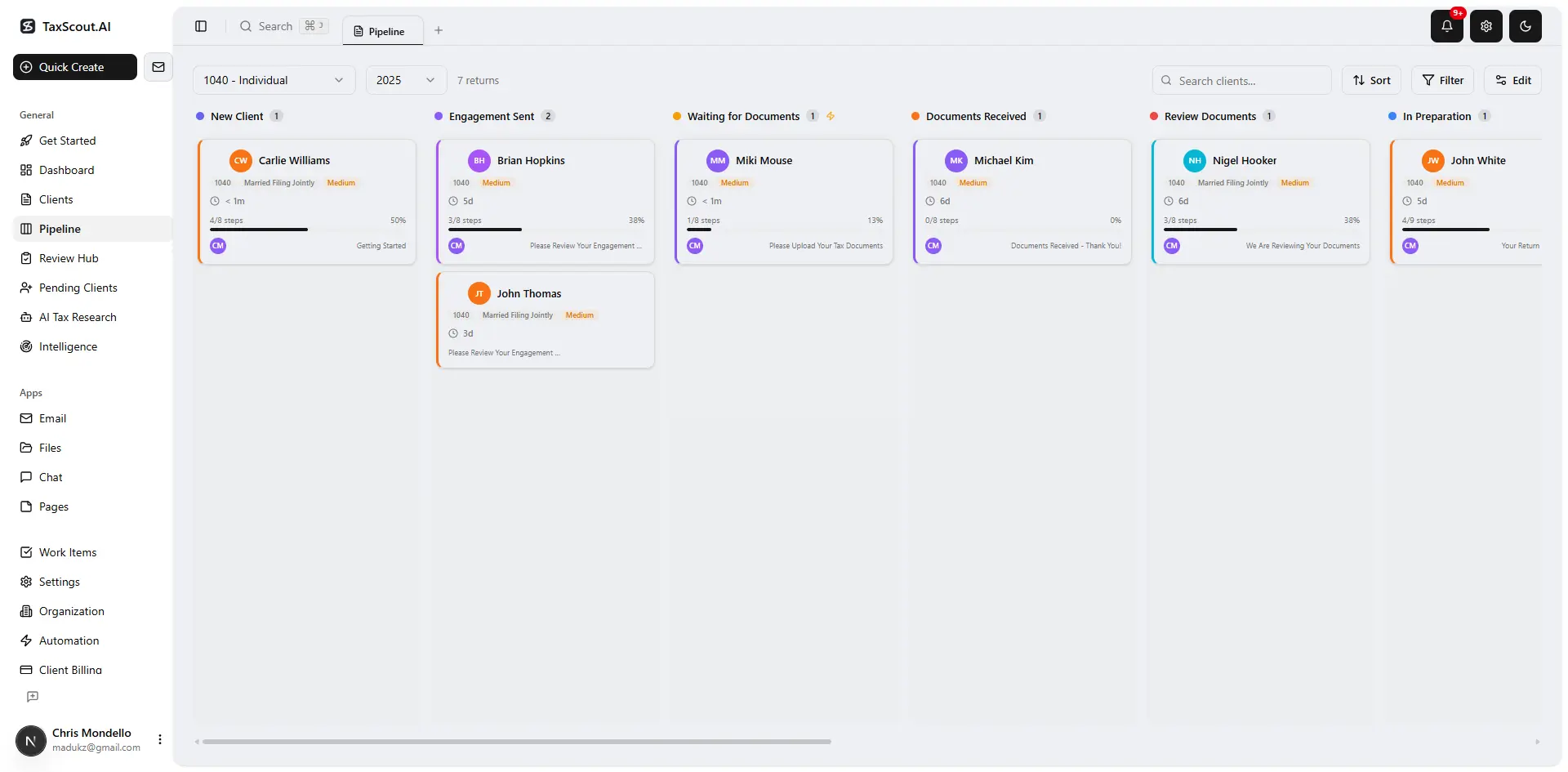
Track every return from intake to filed with drag-and-drop pipeline management
CPA Firm Capacity Planning vs. Competitor Approaches
| Feature | TaxScout | TaxDome | Canopy |
|---|---|---|---|
| Pipeline stages | 12 customizable | Custom workflows | Yes |
| Auto-advance triggers | Yes (condition-based) | Limited | Limited |
| AI document extraction | 180+ form types, 5-layer validation | No | Basic rename only |
| Real-time workload view | Kanban + stage tracking | Basic task lists | Capacity planning module |
| AI gap detection for intake | Yes (background workflow) | No | Smart Intake ($11/client extra) |
| Per-user pricing | Flat pricing ($49–$149/mo total) | ~$100/user/month | ~$45/user/month/module |
| 10-person firm monthly cost | $149 | ~$1,000 | ~$660+ |
Canopy lists capacity planning as a product feature but positions it as a standalone module without connecting it to AI-driven workload distribution or automated task advancement. TaxDome has strong pipeline automation for workflow management but has no AI document extraction, meaning preparers still manually enter data — which is where the actual time goes.
TaxScout connects the full chain: AI extracts and validates documents faster, smart intake captures client data with less back-and-forth, the pipeline automatically advances returns as conditions are met, and the kanban view gives managing partners real-time visibility into every team member's load. The result is accounting firm capacity planning that works continuously in the background rather than as a once-a-season spreadsheet exercise.
Real-World Workflow: What Rebalanced Capacity Looks Like
A 6-person CPA firm — two partners, three preparers, one admin — enters peak season with 280 returns in the pipeline. Here's what accounting workflow capacity management looks like with TaxScout:
Week 6 (February): The kanban board shows that Preparer A has 42 returns in "Awaiting Documents," Preparer B has 31, and Preparer C has 18. The managing partner immediately identifies Preparer C as having headroom. Ten returns are dragged from A's queue to C's. The auto-advance rules mean that as soon as clients upload documents through the branded client portal, those returns advance to "Ready for Prep" automatically — no manual check required.
Week 9 (early March): AI gap analysis surfaces that 14 returns assigned to the March 15 S-corp deadline are still in "Awaiting K-1s." The pipeline's loopback transition automatically flags these with a required note. The admin sends a targeted follow-up to those 14 clients directly from the platform. Eleven respond within 48 hours.
Week 12 (April): Post-season analysis shows average days-in-stage per return type. The firm identifies that S-corp returns spend an average of 4.2 days in "Partner Review" — longer than expected. That single data point drives a process change for next season: partner review gets scheduled as a dedicated block on Thursdays rather than happening reactively. This is how ongoing accounting firm capacity planning compounds into measurable gains year over year.
This is the compounding benefit of real-time workload visibility: not just surviving tax season, but getting measurably better at it each year.
Ready to Stop Running Tax Season on Gut Feel?
TaxScout gives your firm real-time workload visibility, AI-powered intake, and a 12-stage pipeline that moves returns forward automatically — all for $49/mo flat, regardless of team size.
Frequently Asked Questions
TaxScout uses AI to automatically track each preparer's active return count, estimated completion hours, and deadline proximity in real time. Instead of manually updating spreadsheets, firm managers see a live capacity dashboard that flags when any team member's queue exceeds their available bandwidth — typically set as a configurable threshold (e.g., 18 active returns per preparer). This eliminates the guesswork that causes missed March 15 S-corp and April 15 individual deadlines.
Keep reading
Backdoor Roth IRA: How CPAs Execute the Strategy Without Triggering Pro-Rata Tax
Oct 12, 2026 · 1 min read
Amended FBAR Procedures: How CPAs Correct Foreign Account Errors Without Triggering Penalties
Oct 12, 2026 · 1 min read
Backdoor Roth IRA: How CPAs Execute the Strategy for High-Income Clients
Oct 12, 2026 · 1 min read
Stay up to date
Get the latest tax tech insights delivered to your inbox.