Lateral CPA Hire: How to Onboard Experienced Staff Without Disrupting Your Firm
Bringing on an experienced lateral hire is one of the highest-stakes moves a CPA firm can make. Unlike onboarding a junior staff member, a lateral CPA hire arrives with entrenched habits, legacy tool preferences, and sometimes an entire book of business in tow. This 30-day playbook covers every…
A lateral CPA hire is fundamentally different from any other staffing move your firm makes. When you bring on a recent graduate, you're molding someone from scratch. When you hire a senior accountant, manager, or partner from another firm, you're merging two distinct operational cultures — and the friction is real, expensive, and often invisible until it's too late.
Most hiring content in the accounting profession focuses on recruiting pipelines, compensation benchmarks, or campus outreach. Almost none of it addresses what happens after the offer letter is signed: the messy, high-stakes work of integrating an experienced professional who already knows how to do tax work but doesn't yet know how to do it your way. According to the Bureau of Labor Statistics, accountant and auditor employment is projected to grow steadily — meaning competition for experienced talent will keep intensifying, and firms that can't retain lateral hires after onboarding will keep paying the price. Yet the lateral CPA hire represents one of the highest-leverage — and highest-risk — moves a firm can make.
The good news is that a structured 30-day integration playbook — covering system access, client reassignment, workflow alignment, and technology adoption — can compress your typical 90-day ramp-up to a single month. This guide walks you through every step, with specific attention to the technology gaps that most practice management platforms fail to address when an experienced hire arrives with different tool expectations. Whether you're bringing in a senior manager or a partner-track professional, the principles apply to any lateral CPA hire regardless of specialty or firm size.
Why Lateral CPA Hires Fail in the First 90 Days
The failure modes for lateral hires are different from those for junior staff. A new graduate fails because they lack knowledge. A lateral hire fails because the firm fails to integrate them. Research consistently shows that poor onboarding — not poor performance — is the primary driver of early departure in professional services. The Journal of Accountancy has highlighted talent retention as a top concern for CPA firms, and onboarding quality is directly tied to whether a hire stays past the first year. Understanding this distinction is the first step toward building an onboarding process that actually works for the lateral CPA hire your firm just invested in.
Three specific failure patterns appear repeatedly in lateral CPA hire scenarios. First, the client portfolio handoff is handled informally — verbal introductions and forwarded email chains rather than a structured transition process. Clients who don't feel properly handed off become flight risks. Second, system access is provisioned piecemeal, leaving the lateral hire unable to work independently for weeks while waiting on credentials, training, and permissions. Third, and most insidiously, technology friction causes the new hire to revert to their old firm's workflows in the absence of clear guidance, creating shadow processes that diverge from firm standards.
Understanding these failure modes is the first step toward preventing them. The playbook below addresses all three directly, with day-by-day milestones designed to keep the integration on track. For broader workforce planning context, see our accounting firm capacity planning guide. For firms evaluating their lateral CPA hire approach, this trade-off compounds over time.
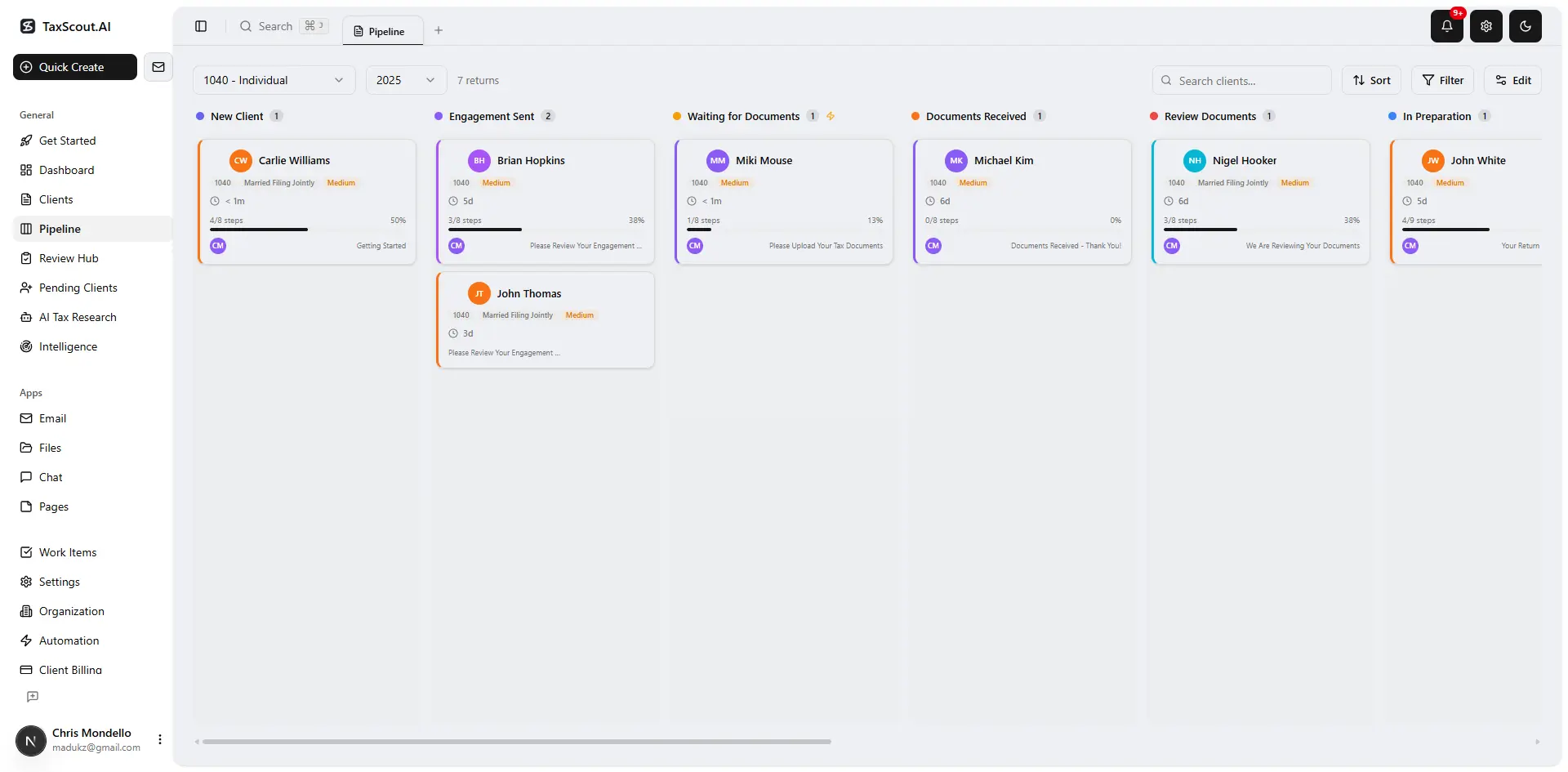
Track every return from intake to filed with drag-and-drop pipeline management
Step 1: Pre-Arrival Setup — Week Negative One
The most impactful onboarding work happens before the lateral hire's first day. If you wait until day one to provision accounts, prepare workstations, or think about client assignments, you've already lost a week of productive ramp-up time. Each of these factors directly shapes how lateral CPA hire plays out in practice.
Start by mapping the hire's intended client portfolio. If they are bringing a book of business from their prior firm, work with them before their start date to create a preliminary client roster with entity types, filing complexity, and any known deadlines in the next 60 days. Use this to pre-stage client records in your practice management platform so the hire can start working immediately rather than spending their first week doing data entry. Understanding lateral CPA hire in this context is what separates firms that scale from those that stall.
Simultaneously, complete all technology provisioning. This means email accounts, VPN or remote access credentials, tax software licenses (whether you use Drake, CCH Axcess, Lacerte, or another platform), and access to your client portal and pipeline management tools. The IRS Publication 4557 guidelines on safeguarding taxpayer data also require that access controls be role-appropriate from day one — so configure your 7-role RBAC permissions before the hire arrives, not after. This is precisely where a deliberate lateral CPA hire strategy pays off.
Finally, draft the internal announcement, assign a peer buddy from your existing team, and schedule the week-one orientation blocks on the calendar. Blocking time now prevents the all-too-common situation where the new hire sits idle because senior partners are too busy during tax season to train. Lateral CPA hire sits at the center of this decision — get it wrong and the rest unravels.
Pre-Arrival Checklist
Complete these items at least five business days before the start date: (1) Provision all software licenses and system credentials. (2) Configure role-based access control for the hire's permission level. (3) Create a draft client portfolio with entity types and upcoming deadlines. (4) Assign an internal buddy or integration lead. (5) Schedule orientation blocks for the first five business days. (6) Prepare the engagement letter templates the hire will use for new client intake. (7) Brief any existing staff who will collaborate with the lateral hire on their background and the transition plan. When firms revisit their lateral CPA hire priorities, the gaps usually surface here.
Tired of watching lateral hires spend their first month figuring out your software instead of serving clients?
TaxScout.ai gives experienced hires an AI-native platform they can operate confidently from day one — no week-long training cycles, no shadow workflows.
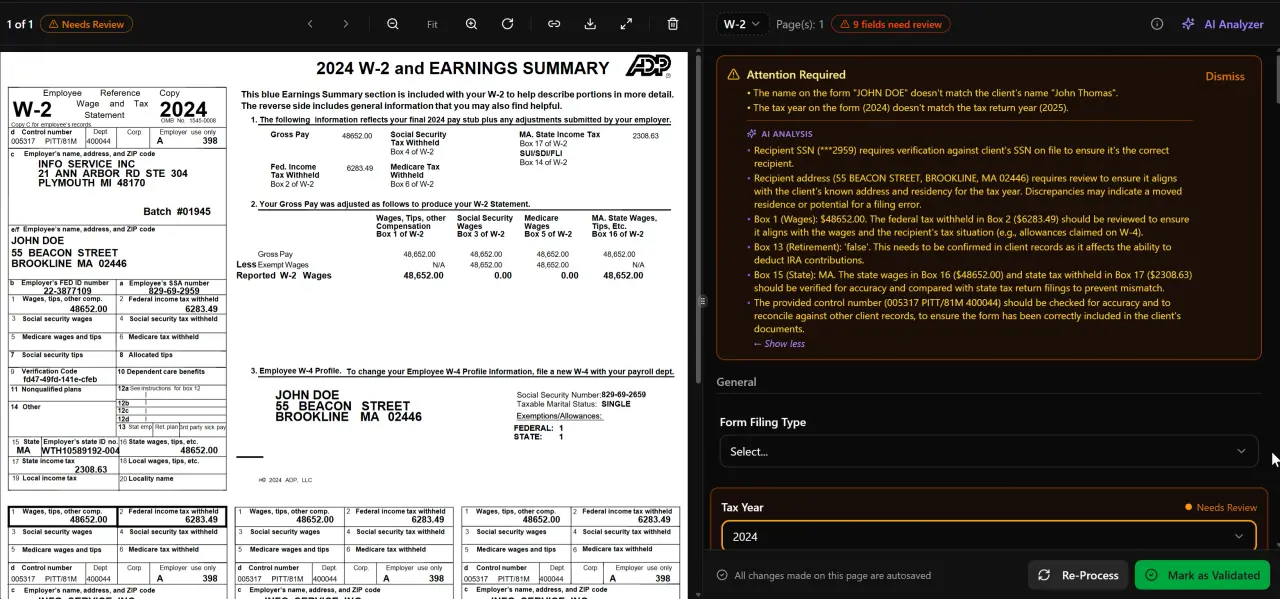
AI classifies, extracts, and validates every document automatically

Your clients see your brand — OTP login, document upload, and real-time status
Step 2: Client Portfolio Handoff — Days 1 Through 10
Client portfolio handoff is the operational step most firms underinvest in, and it is the single largest source of early departure risk for a lateral CPA hire. Clients who feel their relationship is being managed impersonally — shuffled between staff without explanation — will quietly begin interviewing other firms. The AICPA's practice management resources emphasize continuity of service as a core professional obligation, and your onboarding process should reflect that.
Structure the handoff in three tiers based on client risk. Tier 1 clients are high-revenue, complex, or relationship-sensitive accounts that require a warm introduction meeting with both the departing staff member (or a firm principal) and the lateral hire present. Tier 2 clients receive a personalized written introduction — not a form letter — that explains who their new point of contact is and what their background brings to the relationship. Tier 3 clients receive a brief standard notification email with the new hire's contact information.
If the lateral hire is bringing their own book of business from a prior firm, the handoff dynamic is reversed: you are receiving clients rather than transferring them. In this case, focus on getting those clients set up in your client management system quickly, completing intake documentation, and issuing your firm's standard engagement letters before any billable work begins. State bar and CPA licensing boards in many states require written engagement agreements — for example, the California Board of Accountancy publishes guidance on professional responsibilities that includes engagement documentation requirements.
Use your practice management platform's pipeline to create a dedicated onboarding stage for lateral-hire client transfers. Tag these clients so you can monitor their status and ensure none fall through the cracks during the transition period. TaxScout.ai's pipeline management supports 12 customizable stages with drag-and-drop kanban, so you can build a dedicated lateral client transition lane without disrupting your existing workflow.
Step 3: Workflow Alignment — Days 5 Through 15
An experienced lateral hire knows how to prepare a return. What they don't know is how your firm prepares a return — which review steps are required, who signs off at each stage, how document requests are tracked, and what your quality control checkpoints look like. Workflow alignment is the process of translating their existing competence into your firm's specific operating procedures.
Start with a documented workflow walkthrough. Walk the hire through a real client engagement from intake to filing, explaining every step and the tools used at each stage. Pay particular attention to any steps that differ significantly from standard industry practice, because these are the steps the lateral hire is most likely to skip or shortcut based on their prior experience.
For document management specifically, spend dedicated time on your firm's intake process. TaxScout.ai's smart intake engine is modeled on IRS Form 13614-C with four-layer prefill — document-first, prior-year data, client profile, and AI gap analysis — and experienced hires who come from firms using manual intake checklists will need to understand how to work with AI-assisted prefill rather than fighting it. See also our detailed walkthrough on AI document extraction for CPAs for a technical explanation of how the extraction pipeline works.
Document your firm's workflow standards in a written procedure guide and give the lateral hire a copy on day one. This serves two purposes: it gives them a reference they can use independently, and it forces your firm to articulate standards that may have previously existed only in institutional memory. Many of the other resources in our complete guide to practice management content touch on this documentation discipline, and it pays dividends far beyond any single hire.
Technology Stack Alignment for Experienced Hires
The technology onboarding challenge for lateral hires is distinct from what junior staff face. A recent graduate will learn whatever tools you give them. An experienced senior accountant or manager has often spent years building muscle memory around specific software — whether that is TaxDome, Canopy, Karbon, or a legacy system — and switching costs are real. The biggest mistake firms make is assuming that prior software experience translates directly to productivity on new tools.
Allocate dedicated technology training time in the first two weeks, even if the hire pushes back on the need for it. Focus especially on the features that differ most from what they used previously: AI-assisted document extraction, AI research agents, and the client portal workflow. TaxScout.ai's AI document extraction supports 180-plus tax form types with a 5-layer validation pipeline — a significant departure from manual document review workflows common in legacy platforms. Give the lateral hire a low-stakes test client to work through the full workflow before they handle live engagements.
If your firm uses TaxScout.ai alongside existing tax prep software (it works with Drake, CCH Axcess, UltraTax CS, Lacerte, ProConnect, and ProSeries), make sure the integration points are clearly explained. Lateral hires who don't understand that TaxScout handles intake, document management, pipeline, and AI research — while their existing tax software handles the actual return preparation — will create redundant processes or use neither tool correctly.

Click any extracted field to see its source highlighted on the original PDF
Lateral Hire Onboarding Outcomes: AI-Native Platform vs. Legacy Practice Management Software
| Onboarding Task | Legacy Platform (e.g., TaxDome, Canopy) | TaxScout.ai AI-Native Platform |
|---|---|---|
| Client intake setup | Manual form data entry, 2-3 hours per client | AI-assisted prefill from documents and prior-year data, minutes per client |
| Document extraction training | Manual PDF review, no AI validation layer | 5-layer AI validation pipeline, click-to-source field highlighting in split-screen viewer |
| Tax research for unfamiliar issues | External research tools, separate login, no firm context | 9 AI research agents with IRS/Treasury/Cornell search, client-context memory built in |
| Pipeline visibility for new clients | Manual stage updates, limited customization | 12 customizable kanban stages, drag-and-drop, real-time status |
| Client portal setup for incoming book | Per-user or per-client fees add up fast | Flat platform fee, unlimited clients, branded OTP portal ready immediately |
| Cost for 10-person firm | TaxDome ~$500/mo, Canopy ~$660/mo | TaxScout.ai $149/mo total, no per-user fees |
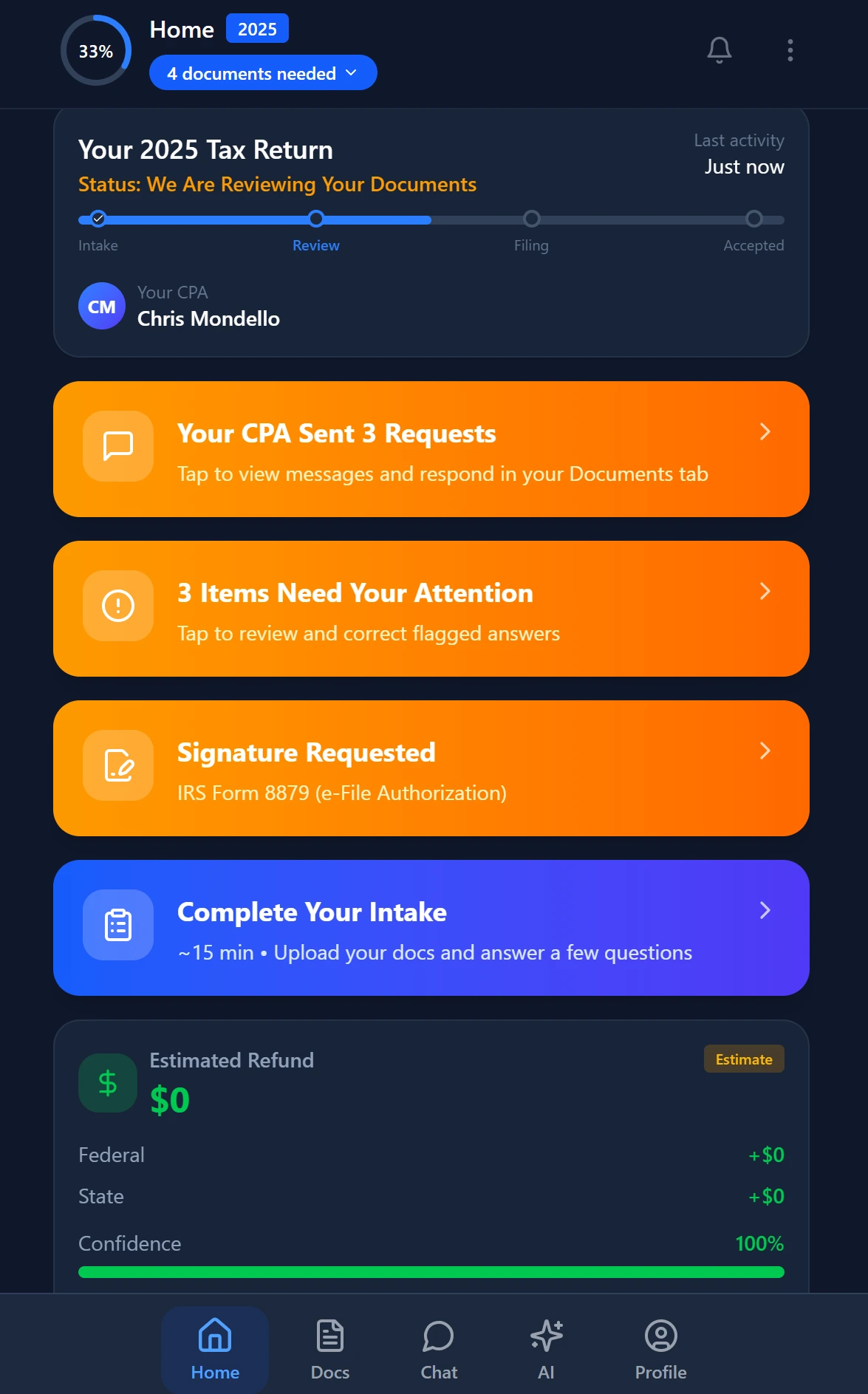
Smart intake auto-fills from uploaded documents and prior-year data
Step 4: AI Tool Adoption — Days 10 Through 20
AI tool adoption deserves its own phase in the lateral CPA hire onboarding process because it is the area where experienced hires most often stall. Senior accountants and managers who have spent a decade doing tax research manually are often skeptical of AI-assisted workflows — not because they are resistant to technology, but because they have been burned before by tools that added steps rather than removing them.
The most effective adoption strategy is to start with the AI features that deliver the most immediate, visible time savings. For most lateral hires, that means starting with AI document extraction and the AI research agents. AI extraction eliminates the manual data entry that experienced hires know is error-prone and tedious. The 9 specialized research agents — with real-time search across IRS.gov, Treasury, Cornell Law, SSA, and Congress — replace the multi-tab research process that even senior preparers find time-consuming.
Schedule a structured demo session in week two where the lateral hire works through a real research question using the AI agents. Let them choose the question — something they would normally spend 20-30 minutes researching — and walk through the answer together. The goal is not to show off the technology but to demonstrate that it produces reliable, citable results that the hire can verify and trust. Once they trust the tool on a research question they already know the answer to, adoption accelerates significantly.
For broader AI productivity strategies beyond individual tools, see our guide to boosting AI accounting productivity. The principles for lateral hires are the same as for any experienced professional adopting new technology: validate first, then expand use cases.
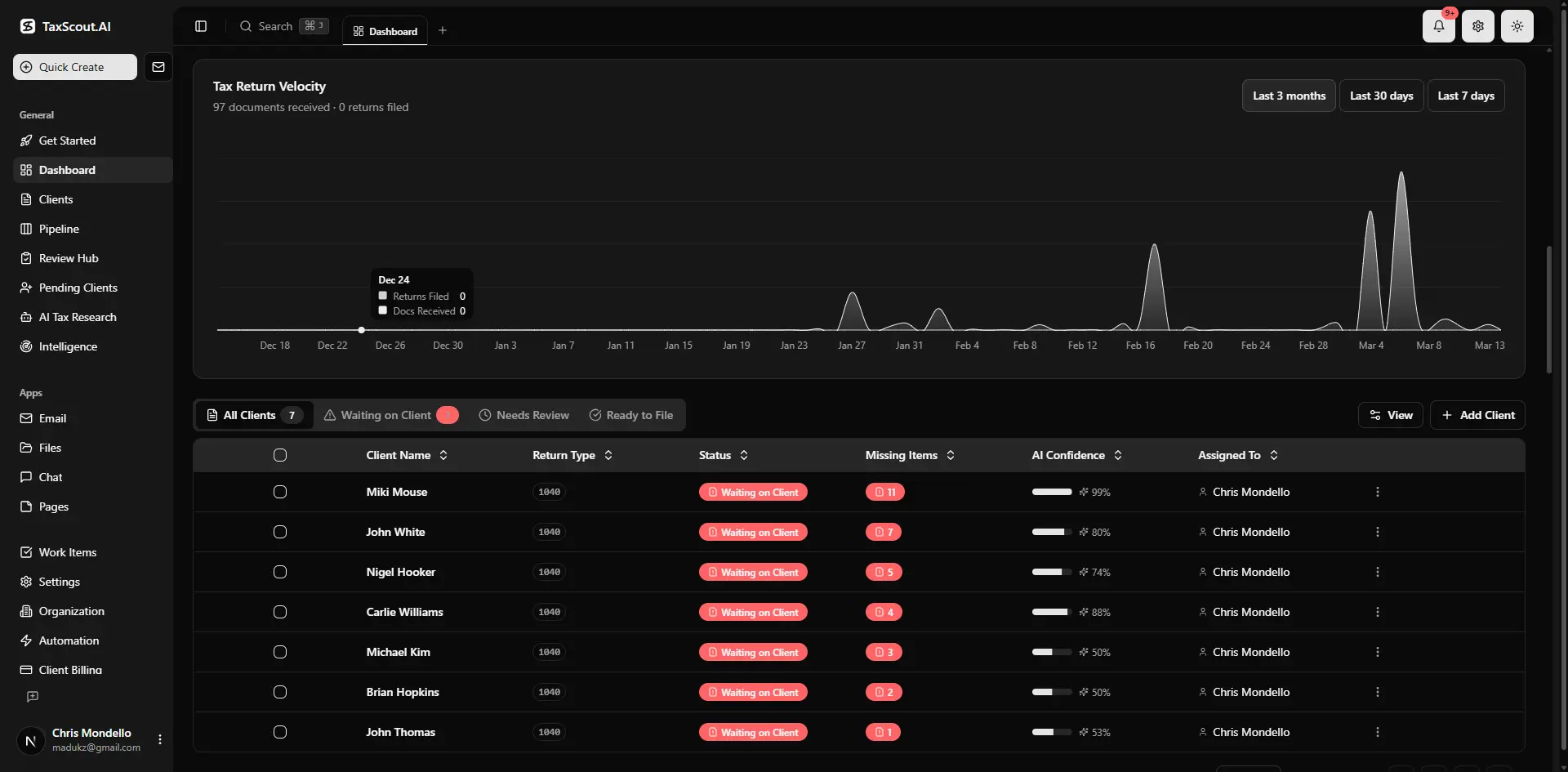
Real-time dashboard showing returns in progress, revenue, and upcoming deadlines
Step 5: Cultural Integration and Billing Alignment — Days 15 Through 30
By the third week of onboarding, the operational mechanics should be largely in place. The remaining work — and often the most overlooked — is cultural integration: aligning the lateral hire with your firm's client communication standards, billing practices, and professional norms.
Billing alignment is especially important for lateral hires who are bringing a book of business. Their prior firm may have used hourly billing, while yours uses flat fees. Or their rate card may differ significantly from your standard engagements. Have an explicit conversation about billing philosophy early — ideally in week one — so the hire is not inadvertently quoting clients differently than your firm's standard. Our flat fee billing guide for CPAs covers how to structure and communicate value-based pricing to clients who are accustomed to hourly billing.
Client communication standards also need explicit attention. Your firm may use a specific tone in client emails, a defined response time standard, or particular templates for common communications. A lateral hire who defaults to their prior firm's communication style — even if it is perfectly professional — creates inconsistency that clients notice. TaxScout.ai's communication hub with Gmail OAuth, Outlook Graph, and AI email classification helps enforce these standards by routing client communications through a unified platform rather than individual inboxes. Review the shared inbox guide for implementation details.
Finally, schedule a formal 30-day check-in with the lateral hire to review what is working, what is not, and whether any of the onboarding steps need to be revisited. Use your KPI dashboard to review the hire's pipeline activity, client intake completions, and return throughput against the targets you set in week one. This data-driven review gives both sides objective ground to stand on and signals that the firm takes integration seriously.
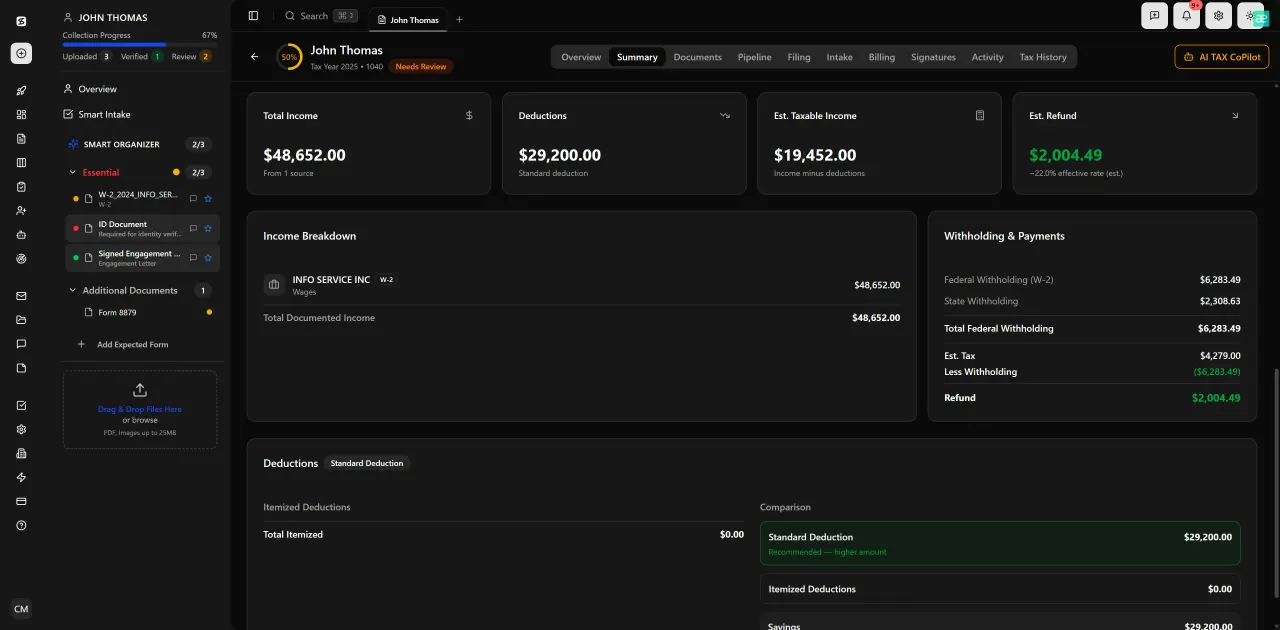
Review with AI assist — 9 agents answer questions with full client context
Security and Compliance Considerations for Lateral Hires
Lateral hires introduce specific security risks that junior staff do not. They may have client data from their prior firm stored on personal devices. They may be accustomed to workflows that do not meet your firm's data handling standards. And they are provisioned with access to sensitive client information — SSNs, financial records, entity structures — from their first day. Getting security onboarding right is not optional.
On day one, brief the lateral hire on your firm's data security policies. This should cover device usage, acceptable storage locations for client documents, email handling, and the prohibition on transferring any client data from their prior firm to your systems without proper authorization. The IRS Publication 4557 guidelines on safeguarding taxpayer data provide the baseline requirements, and your state CPA society may impose additional obligations. California CPAs, for example, are subject to the California Consumer Privacy Act, which affects how taxpayer data can be stored and accessed — see our California tax changes guide for broader compliance context.
TaxScout.ai's security architecture is designed for exactly this risk profile: AES-256-GCM encrypted SSN vault, 13-step DSAR anonymization, and 7-role RBAC mean that access can be scoped to exactly what the lateral hire needs, expanded as they demonstrate compliance, and audited at any time. For a comprehensive review of what a secure CPA firm technology stack looks like, see our cybersecurity essentials guide.
Ready to cut your lateral hire ramp-up from 90 days to 30?
TaxScout.ai's AI-native platform — flat $149/month for up to 10 seats, unlimited clients — gives your new senior hire every tool they need from day one: AI extraction, 9 research agents, client portal, pipeline management, and e-signatures.
Frequently Asked Questions
Without a structured playbook, most lateral hires take 60 to 90 days to reach full productivity. With a deliberate 30-day integration plan covering system access, client portfolio handoff, workflow alignment, and technology adoption, experienced hires can be fully operational in a single month. The key is completing system provisioning and client prep work before the hire's first day rather than scrambling during week one.
Keep reading
Uniform Capitalization Rules: How CPAs Apply UNICAP to Inventory and Self-Constructed Assets
Oct 17, 2026 · 1 min read
Non-Applicability of Section 357(c) to Consolidated Groups: What CPA Firms Must Do Now
Oct 17, 2026 · 1 min read
Reasonable Basis Defense: How CPAs Shield Clients From Accuracy-Related Penalties
Oct 17, 2026 · 1 min read
Stay up to date
Get the latest tax tech insights delivered to your inbox.