CAS Scope Creep: How to Stop Giving Away Free Work on Monthly Engagements
Most CPA firms treat CAS scope creep as a pricing design problem — they restructure their tiers and hope clients stay in bounds. The real culprit is a workflow enforcement gap: no system exists to catch out-of-scope requests before they turn into free work. This guide shows you how to build…
CAS scope creep doesn't announce itself. It arrives as a quick Slack message — 'Can you just run a quick cash flow projection?' — or a three-paragraph email that ends with 'Shouldn't take long.' By the time your staff accountant has spent ninety minutes on a task that was never in the engagement letter, the work is done, the client is happy, and your firm has quietly absorbed another uncompensated hour into the monthly retainer.
The standard advice for CAS scope creep is to build better pricing tiers, define deliverables more clearly in your CAS engagement letter, or shift to value-based billing. That advice isn't wrong, but it misdiagnoses the root cause. Scope creep in client accounting services isn't primarily a pricing design failure — it's a workflow enforcement failure. Firms that lose money on CAS engagements almost always have the right language in their agreements; they just lack any operational system that converts that language into a real-time guardrail.
This guide takes a different approach. Instead of restructuring your CAS pricing model from scratch, it shows you how to build AI-assisted checkpoints inside your existing workflow — engagement triggers, automated out-of-scope alerts, and pre-built response templates — that stop free work before it starts. The result is a CAS practice where your monthly recurring revenue is actually protected, not just theoretically defined. These tools are specifically designed to address CAS scope creep at the operational level, where the problem actually lives.
Why CAS Scope Creep Is a Workflow Problem, Not a Pricing Problem
The most common reaction when a firm realizes it's losing money on monthly CAS clients is to redesign the pricing structure. Partners add more tiers, unbundle deliverables, or switch from flat retainers to hourly overages. These changes can help at the margins, but they don't address what actually causes free work to flow: the absence of any system that intercepts an out-of-scope request between the moment a client sends it and the moment a staff member starts working on it. The root cause of CAS scope creep isn't pricing structure — it's the absence of real-time guardrails inside the delivery workflow.
Consider how most CAS firms operate. A client sends an email. A staff accountant reads it, realizes it's technically out of scope, but also knows that asking the partner for approval will take two days and create friction with the client. So they do the work. This decision happens dozens of times per month across a growing CAS book, and no pricing structure in the world prevents it because the decision is made entirely at the individual task level, below any pricing logic. Multiplied across a full client roster, these small capitulations are exactly how CAS scope creep quietly erodes firm profitability month after month.
The AICPA's guidance on client accounting services consistently emphasizes written scope boundaries, but written boundaries only protect you if there's a mechanism to enforce them operationally. A well-drafted engagement letter is necessary — it's your legal foundation — but it needs to be connected to your workflow so that out-of-scope requests surface as alerts rather than disappearing into a staff member's task queue. That connection is where most CAS practices break down, and it's exactly where automation pays the most immediate dividend. For firms evaluating their CAS scope creep approach, this trade-off compounds over time.
Firms that have solved this problem aren't necessarily charging more or using more sophisticated pricing models. They're using better workflow tools — systems that compare every incoming client request against defined scope parameters and route exceptions to a decision point before work begins. If you want to see how this compounds with AI-driven practice management, explore other blog resources covering operational efficiency for CPA firms. Each of these factors directly shapes how CAS scope creep plays out in practice.
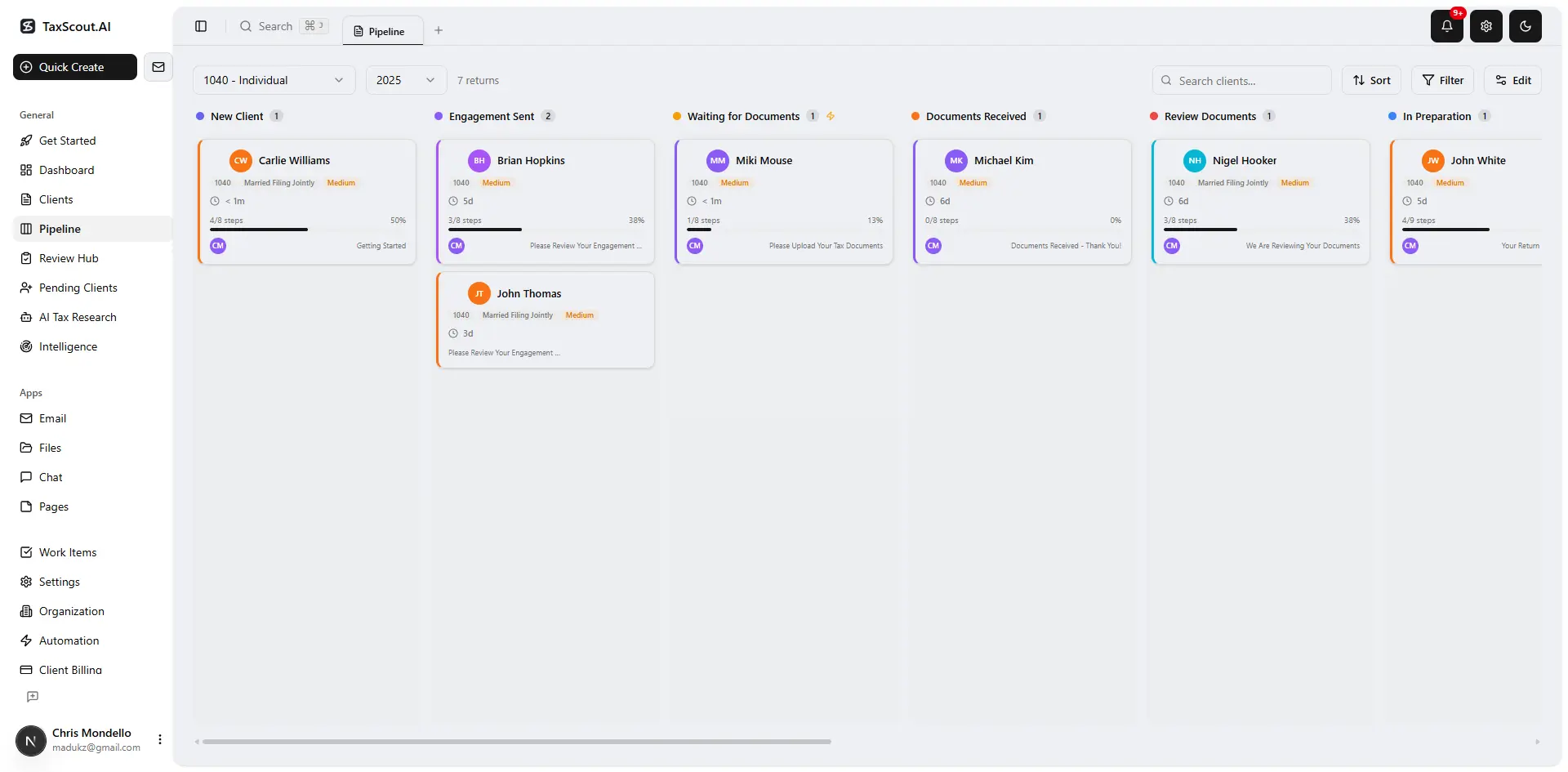
Track every return from intake to filed with drag-and-drop pipeline management
The Anatomy of a CAS Engagement Trigger
An engagement trigger is a defined condition in your workflow that fires when a client request exceeds the parameters of their current service tier. Think of it as a conditional rule embedded in your practice management system: if a client on your Bookkeeping Plus tier submits a request tagged as financial modeling, projections, or strategic advisory, the system flags it rather than routing it to a staff queue as a normal task. Understanding CAS scope creep in this context is what separates firms that scale from those that stall.
Building effective engagement triggers requires two components. First, you need a clear, granular scope map for each CAS tier — not just broad categories like 'bookkeeping' or 'CFO services,' but specific deliverable types. The IRS's own guidance on accounting method changes draws sharp lines between routine recordkeeping and advisory analysis; your scope map should do the same. Second, you need a workflow system capable of acting on those rules automatically when client communications arrive. This is precisely where a deliberate CAS scope creep strategy pays off.
The trigger logic doesn't have to be complex to be effective. A basic version looks like this: every inbound client request is classified by type (reconciliation, reporting, modeling, compliance, advisory, other). Classification is compared against the client's tier scope map. Requests that match approved deliverables route normally. Requests that fall outside trigger a scope exception workflow — which means they go to a partner review queue, not to a staff task list. This one change eliminates the staff-level decision point where most free work is silently approved. CAS scope creep sits at the center of this decision — get it wrong and the rest unravels.
For firms managing client accounting services pricing across multiple tiers, the trigger framework also generates data you didn't have before: how often each client generates out-of-scope requests, which request types appear most frequently, and which clients are candidates for a tier upgrade conversation. When firms revisit their CAS scope creep priorities, the gaps usually surface here.
Tired of discovering unbilled hours after the work is already done?
TaxScout's AI-assisted workflow automation flags out-of-scope requests in real time — so your team never starts free work by accident.
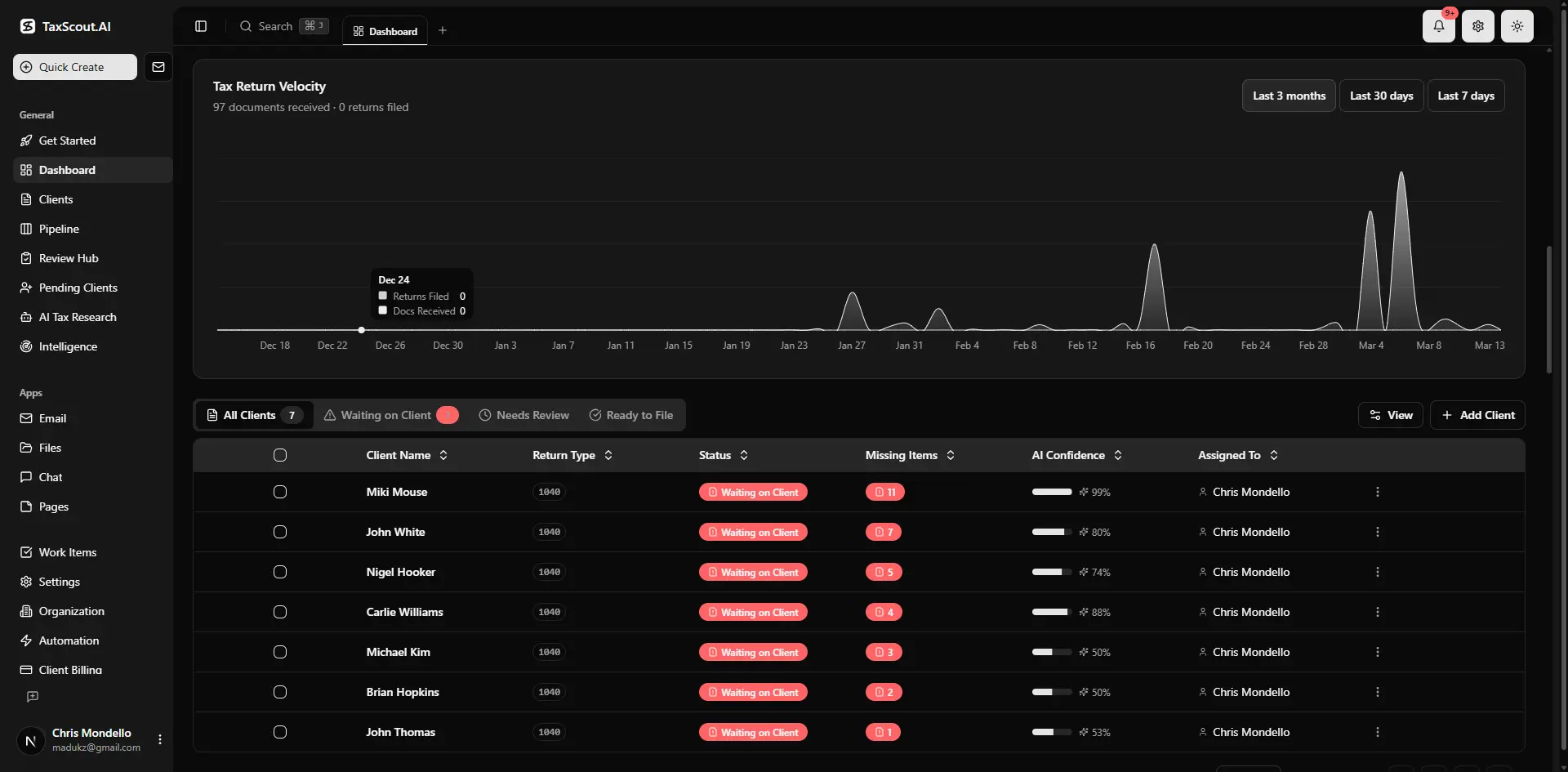
Real-time dashboard showing returns in progress, revenue, and upcoming deadlines

Your clients see your brand — OTP login, document upload, and real-time status
Building AI-Assisted Out-of-Scope Alerts in Your Practice
Manual scope reviews don't scale. As your CAS book grows from 10 clients to 40, no partner has the bandwidth to personally review every inbound request for scope compliance. AI-assisted classification changes this by making the review automatic — client communications are analyzed at the moment of receipt, categorized by request type, and compared against the client's engagement profile before any human involvement.
TaxScout's communication hub integrates Gmail OAuth, Outlook Graph, and IMAP/POP3, with AI classification built into the email layer. When a CAS client sends a message, the system categorizes the request type and surfaces it in the correct workflow context — including flagging requests that don't match the client's active engagement scope. This happens before a staff member even sees the message in their queue, which is the critical intervention point most firms are missing.
The AI's effectiveness here depends on client-context memory — the system's ability to know what each client's engagement covers, not just what the request says on its surface. TaxScout maintains client-context AI memory that tracks entity structures, filing history, and engagement details, so when a bookkeeping client asks about S-corp election timing, the system understands this as a request that crosses into advisory services territory — even if the client phrased it casually. For a deeper look at how AI handles document and communication workflows, see our guide on AI document extraction for CPAs.
Beyond email, the same logic applies to client portal requests. When clients submit documents or questions through TaxScout's branded client portal, the intake engine applies scope-awareness rules that can surface exceptions before they hit your internal pipeline. You can configure the portal to present out-of-scope requests as a separate category — signaling to the client that the request requires a scope review — rather than letting it blend invisibly into normal deliverable requests.
Pre-Built Response Templates That Protect Boundaries Without Damaging Relationships
One reason CPAs avoid enforcing scope is the fear of damaging the client relationship. Telling a client their request is out of scope feels transactional, even confrontational — especially when the relationship has been built on flexibility and responsiveness. Pre-built response templates solve this by giving your team a professional, empathetic, consistent way to respond to scope exceptions that doesn't feel like a rejection.
A well-crafted scope exception template does three things: it acknowledges the request, explains that it falls outside the current engagement, and presents a clear path forward — either a one-time add-on fee or an invitation to discuss a tier upgrade. The Small Business Administration's guidance on professional services agreements emphasizes that clear communication about scope changes protects both parties; your template library is how that principle gets operationalized at scale.
Your template library should cover the most common exception scenarios: advisory requests from bookkeeping clients, projection or modeling requests outside CFO tier, tax planning requests from compliance-only clients, and ad hoc reporting requests that exceed agreed-upon deliverable frequency. Each template should include a placeholder for the specific service requested, a reference to the relevant engagement tier, and a pricing anchor for the add-on. Templates stored in your practice management system and linked to client profiles mean any staff member can send a professionally worded response in under two minutes, which is faster than doing the work for free.
TaxScout's pipeline management system supports 12 customizable stages, which means you can build a dedicated 'Scope Exception Review' stage that captures flagged requests, stores the associated template response, and tracks whether the client converted to a paid add-on or declined. Over time this stage becomes a revenue intelligence layer — showing you exactly how much potential revenue is being left on the table by clients who consistently push against their tier boundaries, and making the case for proactive upsell conversations grounded in data rather than gut feel. Pair this with flat-fee billing strategies for CPAs to create a pricing structure that works with your enforcement system.
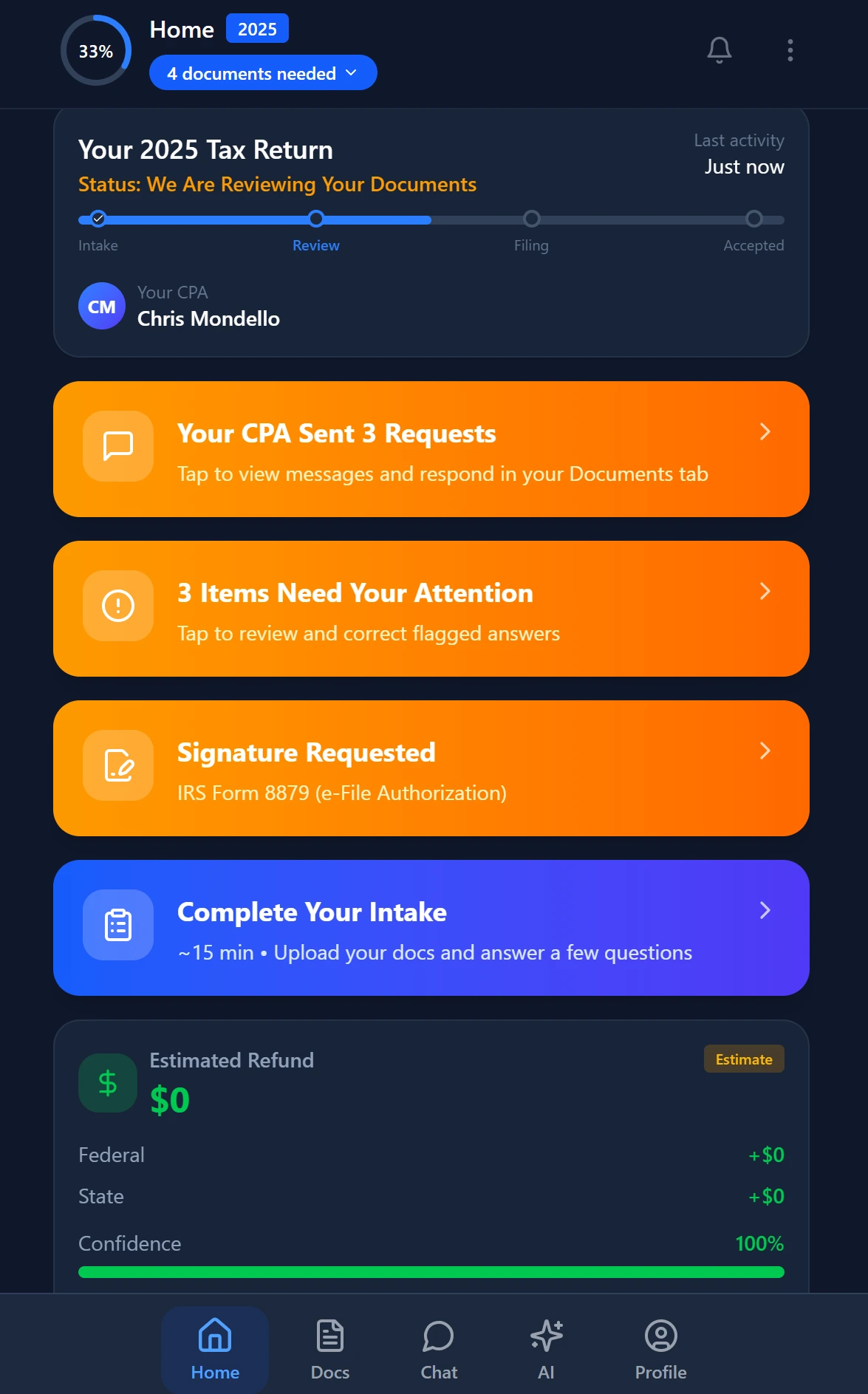
Smart intake auto-fills from uploaded documents and prior-year data
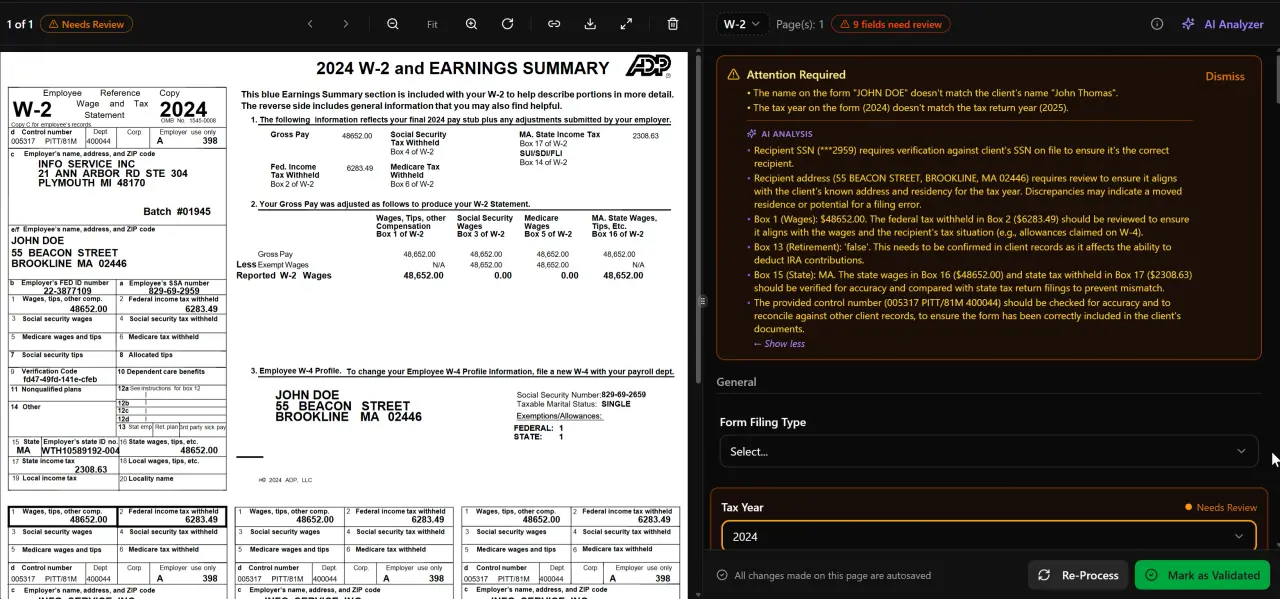
AI classifies, extracts, and validates every document automatically
Designing a CAS Engagement Letter That Powers Workflow Automation
The CAS engagement letter is only as protective as the workflow system connected to it. Most engagement letters describe scope in narrative paragraphs that are clear to a lawyer but invisible to a workflow tool. To make your engagement letter operational, it needs to be structured so that its scope definitions can be mapped directly to the trigger logic in your practice management system.
This means moving from paragraph descriptions to enumerated deliverable lists with defined frequencies and formats. Instead of 'monthly bookkeeping services,' the letter specifies: bank reconciliation for up to three accounts, monthly P&L and balance sheet in standard format, one internal-use report per month. Each of those elements becomes a distinct scope parameter that your workflow system can compare incoming requests against. The Treasury Department's guidance on written agreements in professional services reinforces the principle that scope specificity is the foundation of enforceable agreements — and the same principle applies at the practice level.
TaxScout's e-signature integration via Documenso supports engagement letters alongside Form 8879, FBAR, and other standard documents. When clients sign a CAS engagement letter through the platform, the signed version is stored in the client's profile alongside their entity structure and filing history. This means the scope definition lives in the same system as the client communication and workflow tools — which is what makes trigger-based enforcement possible. There's no manual step of 'look up what the client is supposed to get' because the system already knows.
For firms that haven't recently updated their CAS engagement letter templates, Cornell Law School's Legal Information Institute provides useful framework language on contract specificity and modification clauses — both of which are relevant when you're building a letter designed to support automated scope enforcement. Combine specific deliverable lists with a clear change-order clause that describes how out-of-scope requests are priced, and you have a document that both protects you legally and drives your workflow automation.
CAS Scope Enforcement: Manual Process vs AI-Assisted Workflow
| Enforcement Point | Manual Process | AI-Assisted Workflow (TaxScout) |
|---|---|---|
| Inbound request classification | Staff reads and decides informally | AI classifies at receipt, before staff sees it |
| Scope comparison | Staff recalls engagement terms from memory | System compares request type against client scope profile automatically |
| Out-of-scope routing | Request goes to staff task queue unchecked | Triggers Scope Exception Review stage with partner alert |
| Client response | Ad hoc, inconsistent, often delayed | Pre-built template sent in under 2 minutes, tone consistent |
| Engagement letter access | PDF in a folder somewhere | Stored in client profile, linked to workflow triggers |
| Revenue data from exceptions | None — exceptions are invisible | Pipeline stage captures conversion rate and potential MRR uplift |

Every client gets organized documents, status tracking, and a complete history
Connecting CAS Scope Controls to Monthly Recurring Revenue Protection
The financial case for AI-assisted scope enforcement is straightforward once you measure the current loss. Take a 10-person CAS firm averaging 30 monthly clients. If each client generates one out-of-scope request per month that gets absorbed as free work — a conservative estimate — and each request represents 45 minutes of staff time at a $75 fully loaded cost, that's $27,000 per year in uncompensated labor. That number doesn't include the opportunity cost of staff time that could have been spent on billable advisory work.
When scope exceptions are caught before work begins, the revenue outcome is binary: the client pays for an add-on, or they decline. Both outcomes are better than the silent absorption. A client who pays for the add-on generates revenue that should have existed from the start. A client who declines has still not consumed staff time — and the data from that declination informs whether the client is the right fit for the firm's CAS model. For firms thinking about monthly recurring revenue CPA targets, this enforcement layer is where MRR protection actually lives.
TaxScout's invoicing integration via Stripe Connect Express makes add-on billing frictionless. When a scope exception converts to a paid request, the add-on can be invoiced directly from the pipeline stage without leaving the platform. Combined with the recurring invoicing automation available in TaxScout, the entire cycle from exception flag to invoice delivery can be handled without manual billing overhead. Firms on the Prep Pro plan get this workflow — 10 seats, 500 returns per year, all automation features — for $149 per month flat, with no per-user fees that would make the economics punishing as your CAS team scales. Compare that to TaxDome's per-user pricing of approximately $100 per user per month, which means a 10-person firm pays roughly $500 per month before any CAS-specific automation is in place.
Protecting monthly recurring revenue in a CAS practice ultimately comes down to whether your systems enforce the commitments your engagement letters describe. Pricing design sets the ceiling; workflow automation determines how close to that ceiling you actually operate.

Click any extracted field to see its source highlighted on the original PDF
Implementing the System: A Practical Rollout Sequence
The barrier to building scope enforcement systems is usually perceived complexity — partners assume it requires a major workflow overhaul before the first guardrail is in place. In practice, a functional scope enforcement system can be live within a week using existing tools, and it gets more effective as you add data over time.
Start with your top five clients by monthly retainer value. For each one, extract the deliverable list from their current engagement letter and convert it into an enumerated scope map — a simple list of approved request types, frequencies, and formats. This exercise alone usually surfaces ambiguities in your current engagement language that have been generating free work without anyone noticing.
Next, configure your Scope Exception Review pipeline stage in TaxScout's pipeline management system. Any inbound request classified as a non-routine task for a CAS client routes here before it hits a staff queue. Build two response templates to start: one for advisory requests from bookkeeping clients, one for additional reporting requests above the agreed-upon frequency. These two categories cover the majority of scope exceptions in most CAS practices.
Roll the system to all CAS clients in the second week. Use the accounting firm capacity planning framework to identify which staff members are absorbing the most out-of-scope work currently — they'll be the most immediate beneficiaries of the new routing. Monitor the Scope Exception Review stage daily for the first month, adjust template language based on client responses, and track the conversion rate from exception flag to paid add-on. By month three, you'll have enough data to identify which clients are consistently pushing against their tier boundaries and warrant a proactive upgrade conversation, grounded in actual usage data from your own pipeline.
Ready to turn your engagement letter into an actual enforcement mechanism?
TaxScout gives CAS firms AI-assisted scope alerts, pipeline automation, and flat-rate pricing — so your MRR is protected, not just promised.
Frequently Asked Questions
CAS scope creep occurs when clients request work outside their defined monthly engagement — often informally, via email or messaging — and staff complete those tasks without billing for them. Because these requests arrive at the individual task level, below any pricing logic, they're absorbed silently into retainer time. Over a year, even one uncaptured out-of-scope request per client per month can represent tens of thousands of dollars in uncompensated labor for a mid-size CAS practice.
Keep reading
Tangible Property Regulations: How CPAs Apply Capitalization vs Expensing Rules
Oct 15, 2026 · 1 min read
Amended FBAR Procedures: How CPAs Correct Foreign Account Errors Without Triggering Penalties
Oct 12, 2026 · 1 min read
Transparency in Coverage Final Rules: What CPA Firms Must Do Now
Oct 12, 2026 · 1 min read
Stay up to date
Get the latest tax tech insights delivered to your inbox.