Boost AI Accounting Productivity Without the Overwhelm
Research shows AI is saving accounting professionals roughly one hour per day — yet satisfaction scores remain stubbornly low. This article unpacks the three structural reasons CPA firms fall into the productivity trap and explains why agentic AI, not passive automation, is the only way out.
AI accounting productivity is delivering on its headline promise. According to Karbon's 2026 State of AI in Accounting report, professionals are reclaiming roughly 60 minutes every day — more than 21 hours per month, per person. That is not a rounding error. For a 10-person firm, it is the equivalent of adding half a full-time employee's output every single month without a new hire.
And yet only 18% of accounting professionals say AI has meaningfully improved their job satisfaction. If the time savings are real, why does nearly everyone still feel stretched thin, stressed, and buried? The gap between efficiency gains and wellbeing improvements is not a data anomaly. It is a structural problem — one rooted in how CPA firms adopt AI, how vendors design their tools, and what happens to reclaimed time once it lands back in a practitioner's lap. This disconnect reveals a fundamental truth about AI accounting productivity: raw time savings and human wellbeing require separate, intentional strategies to align.
This article names the three mechanisms driving the paradox and explains why the solution is not more automation bolted onto existing workflows. It is a fundamentally different design philosophy — agentic AI that removes oversight burden entirely, rather than passive AI that hands you a faster hamster wheel. Most conversations about AI accounting productivity focus on hours saved rather than the cognitive load created by managing the tools generating those savings.
The Research Karbon Cited but Did Not Explain
Karbon deserves credit for surfacing the uncomfortable truth: time savings and satisfaction are not the same thing, and right now they are moving in opposite directions. Their research anchors the paradox in concrete numbers — 60 minutes returned daily, 18% satisfaction improvement — but stops short of diagnosing why the gap exists. That analysis gap is precisely where CPA firms are left without a framework to act. Their data forces a harder question that the AI accounting productivity conversation has largely avoided: what does it actually mean to benefit from efficiency gains if your daily experience of work keeps getting worse?
The Journal of Accountancy has documented a parallel trend: accounting professionals consistently cite workload volume, not task difficulty, as the primary driver of burnout. This distinction matters enormously when evaluating AI tools. If an AI system reduces the time required to complete a task but the volume of tasks expands proportionally, net stress is unchanged — or worse, increases due to the coordination overhead of managing the AI layer itself. For firms evaluating their AI accounting productivity approach, this trade-off compounds over time.
The Bureau of Labor Statistics Occupational Outlook Handbook projects continued demand growth for accounting services through 2032. Firms operating under that demand pressure have a powerful incentive to convert any efficiency gain directly into new revenue — which is exactly what the data shows is happening. Understanding this context is essential before evaluating any AI tool's claim to improve work-life balance. For more on the structural factors shaping accounting firm operations, see other blog resources. Each of these factors directly shapes how AI accounting productivity plays out in practice.
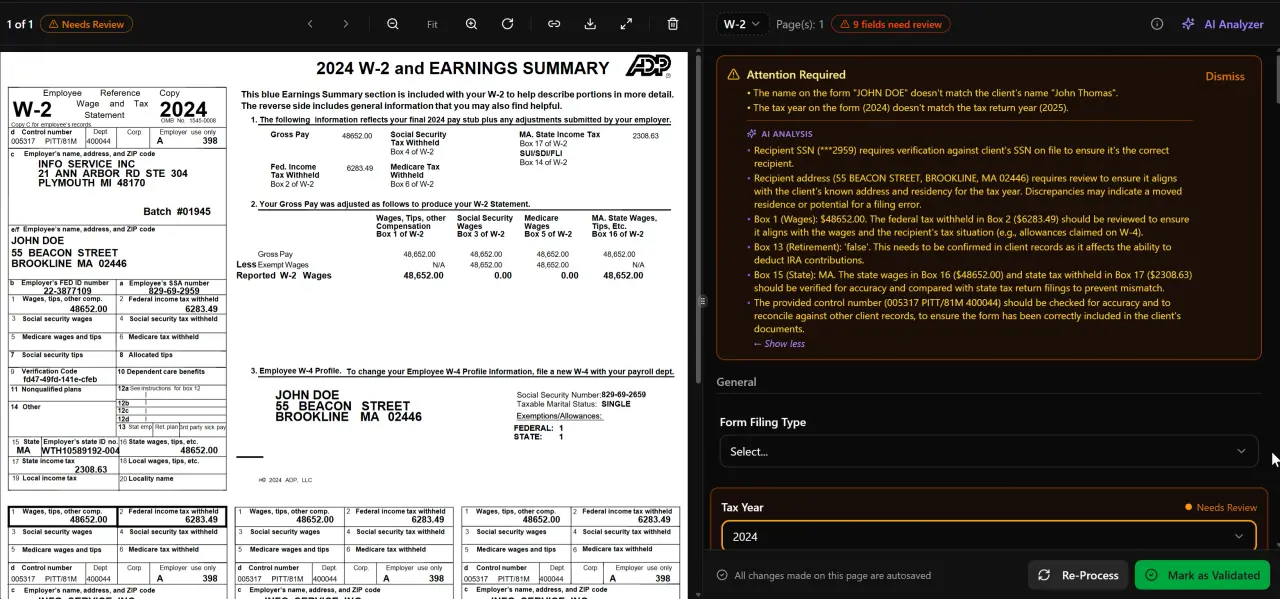
AI classifies, extracts, and validates every document automatically
Trap One: Time Savings Get Reinvested Into Volume Growth
The most predictable consequence of efficiency gains in a professional services firm is not rest — it is growth. When an AI tool saves a preparer 20 minutes per return, practice management instinct immediately converts that margin into capacity for more returns. The firm takes on 15% more clients, the preparer's schedule fills back up to its prior level, and the net experience is identical workload at higher throughput. The treadmill got faster; no one stepped off it. Understanding AI accounting productivity in this context is what separates firms that scale from those that stall.
This is not irrational behavior. Firm owners operate under genuine financial pressure: IRS filing season statistics show total individual return volume grows year over year, and firms that do not grow risk losing clients to larger competitors. The incentive structure practically guarantees that time savings get monetized as volume rather than preserved as slack. This is precisely where a deliberate AI accounting productivity strategy pays off.
The solution is not to resist growth — it is to build systems where growth does not automatically create proportional stress. That requires AI that eliminates entire categories of cognitive overhead, not just accelerates individual tasks. When reviewing your own accounting firm capacity planning, the honest question is not 'how fast can we process returns' but 'how much mental load does each return generate, and can AI reduce that load rather than just the time?' AI accounting productivity sits at the center of this decision — get it wrong and the rest unravels.
Tired of efficiency gains that evaporate into a longer client list?
TaxScout's agentic AI eliminates oversight burden — 5-layer validation, 9 research agents, and smart intake that works before you open the file. See it live. When firms revisit their AI accounting productivity priorities, the gaps usually surface here.
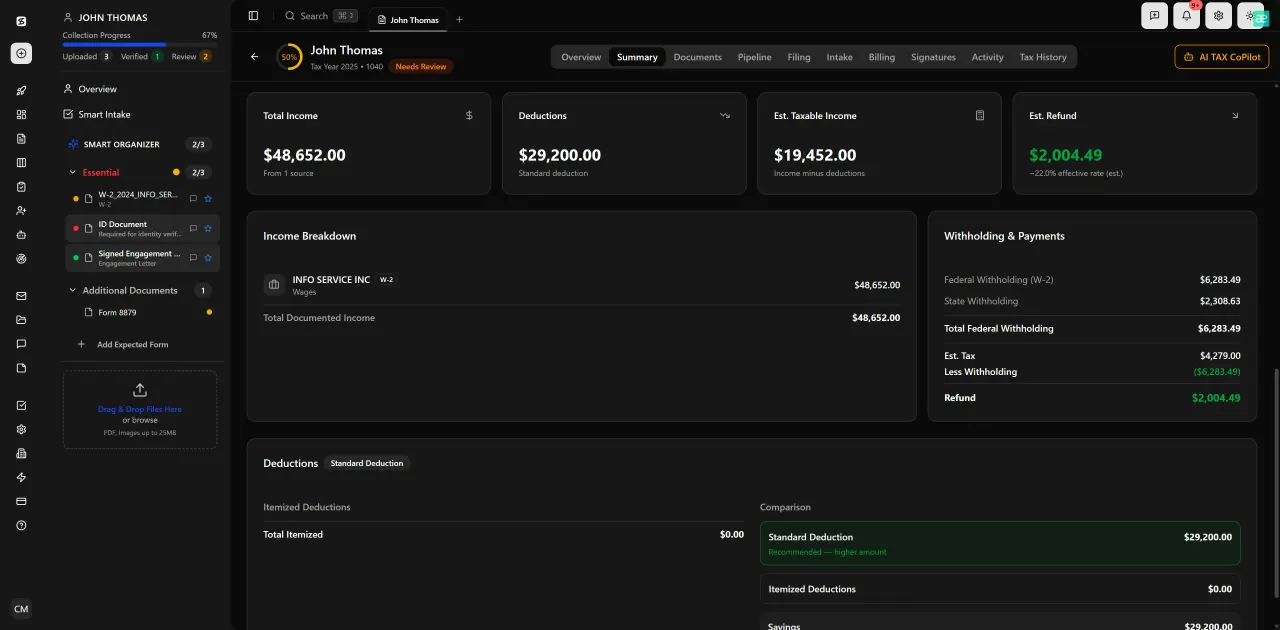
Review with AI assist — 9 agents answer questions with full client context

Click any extracted field to see its source highlighted on the original PDF
Trap Two: Passive AI Creates New Oversight Burdens
Most AI tools marketed to CPA firms today are passive extractors and classifiers. They scan a document, populate fields, and hand the result back to a human for review. This is genuinely useful. It is also genuinely incomplete — because it adds a new cognitive step to every workflow: validating what the AI did.
A preparer using a basic AI extraction tool now has two jobs on every document: the original job (interpreting the data) and the new job (verifying the AI did not hallucinate a value, misclassify a form, or miss a field). Cornell Law School's Legal Information Institute notes that tax preparer due diligence obligations are defined by accuracy of the return, not the method of preparation — meaning the human remains fully liable for whatever the AI outputs. That liability does not compress; it creates vigilance pressure.
TaxScout approaches this differently with a 5-layer validation pipeline that runs before any human reviews the output: document quality routing, AI extraction with confidence scoring, OCR cross-verification, 15 deterministic math rules, 18 post-extraction rules, and cross-document reconciliation. The result is that by the time a preparer sees extracted data, it has already been stress-tested across 180+ form types — including every W-2, 1099 variant, K-1, and Schedule. The human step shifts from 'is this right?' to 'anything surprising here?' — a fundamentally lower cognitive load.
This distinction — between AI that creates a review step and AI that compresses the review requirement — is the single most underexplored dimension in the CPA firm AI adoption conversation. Vendors rarely lead with it because passive extraction is cheaper to build. But for accounting wellbeing AI to deliver on its promise, it has to reduce mental load, not just reduce manual keystrokes.
Trap Three: Nobody Redesigns the Workflow When AI Is Bolted On
The third structural failure is organizational. When a firm adopts an AI point solution — an extraction tool here, a research assistant there, a portal add-on somewhere else — it typically layers these tools on top of existing workflows rather than redesigning them. The result is a Frankenstein stack: three more tabs open, two more notification sources, a new vendor login, and the same underlying process with AI accessories attached.
Treasury's IRS modernization roadmap has repeatedly emphasized integrated digital workflows as the target state for tax administration. Yet many CPA firms are moving in the opposite direction — adding AI tools piecemeal while preserving the siloed, handoff-heavy workflows beneath them. Every additional tool with its own interface, its own alert logic, and its own integration quirks contributes to cognitive overhead even when each individual tool is technically useful.
TaxScout's pipeline management with 12 customizable kanban stages, combined with AI-powered intake and a unified client portal, is designed to replace the stack rather than extend it. The philosophy is that accounting firm efficiency gains compound only when the entire client journey — from document upload through e-signature to invoice — runs through a single coherent system with consistent AI behavior throughout. Fragmented toolchains fragment attention. Our deep-dive on AI document extraction for CPAs covers why integration architecture matters more than any individual feature.
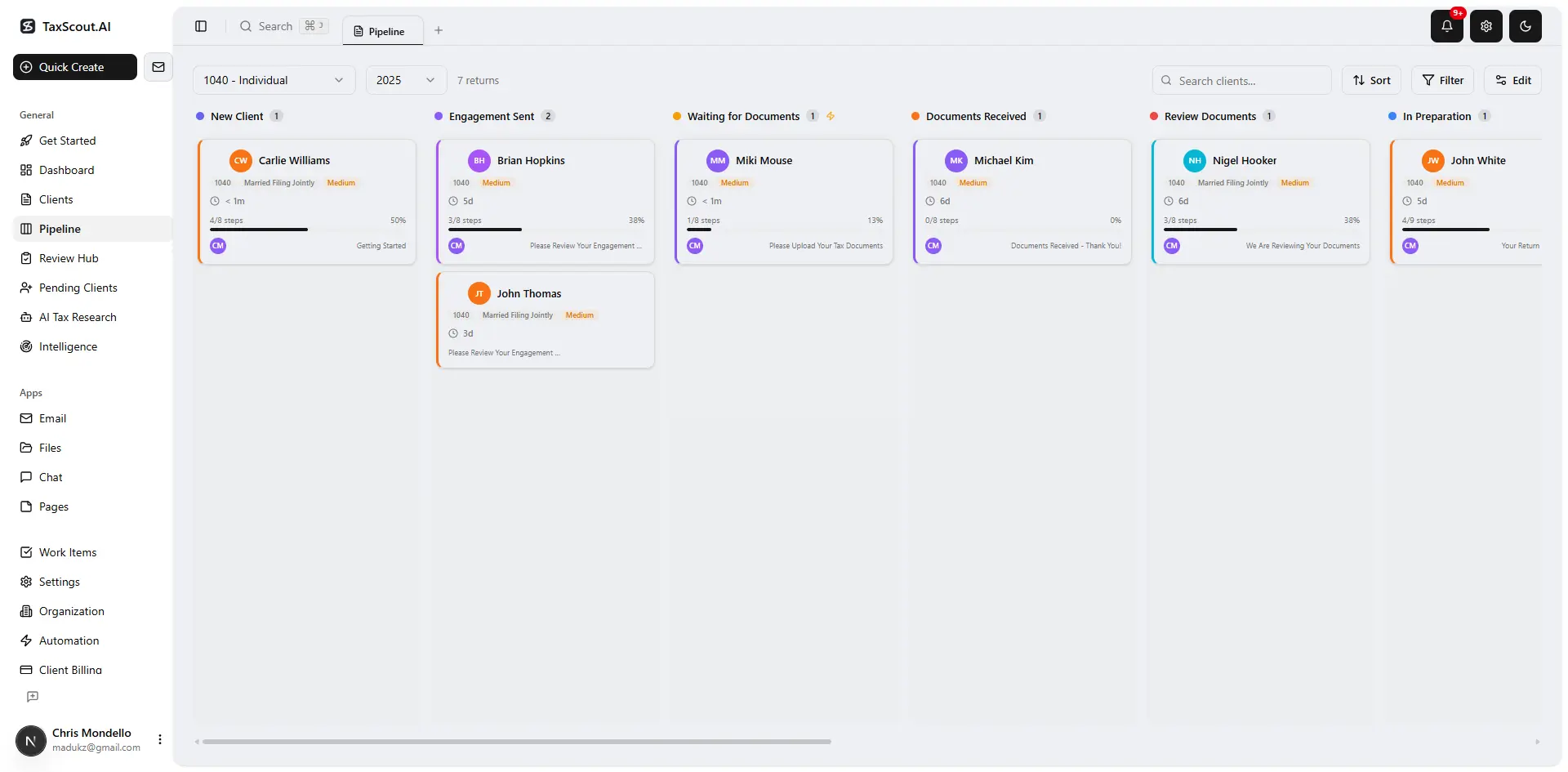
Track every return from intake to filed with drag-and-drop pipeline management
Passive AI vs. Agentic AI: How Design Philosophy Shapes Practitioner Experience
| Dimension | Passive AI (bolt-on tools) | Agentic AI (TaxScout) |
|---|---|---|
| Extraction validation | Human reviews every AI output field | 5-layer pipeline validates before human sees result |
| Research burden | Preparer searches IRS/Treasury manually | 9 AI agents search IRS, Treasury, Cornell, SSA in real time |
| Intake data quality | Client uploads raw documents; preparer chases gaps | Smart intake with 4-layer prefill + AI gap analysis before review |
| Workflow integration | Point tool; requires separate practice management system | End-to-end: intake, pipeline, portal, e-sign, invoicing in one platform |
| Oversight stress | New vigilance layer added to every task | Confidence scoring and cross-doc validation compress review requirement |
| Pricing model | Per-user fees; costs scale with team size | Flat fee; unlimited clients, up to 10 seats at $149/mo |

Your clients see your brand — OTP login, document upload, and real-time status
What Agentic AI Actually Means for Accounting Firm Efficiency
The word 'agentic' is increasingly overloaded in AI marketing, so a concrete definition matters. In TaxScout's context, agentic AI means that the system takes multi-step autonomous action on behalf of the preparer — not just completing one narrow task but coordinating across information sources, validating its own outputs, and surfacing only the residual judgment calls that genuinely require human expertise.
The 9 specialized AI research agents embedded in TaxScout illustrate this in practice. When a preparer encounters an ambiguous deductibility question, they do not open a separate browser tab and spend 20 minutes searching IRS publications. The agent queries IRS.gov, Treasury regulations, Cornell LII, and SSA guidance in real time, synthesizes the relevant authority, and presents a cited answer within the existing workflow. The preparer's cognitive path shortens from 'I need to research this' to 'does this answer match my professional judgment?' — a much smaller mental step.
Client-context AI memory extends this further: entity structures, prior filing history, and engagement patterns persist across sessions, so the system grows more useful with each return rather than resetting to zero. For firms evaluating how to choose CPA practice management software, the presence or absence of this memory layer is one of the sharpest differentiators between tools that reduce load over time and tools that stay static.
The SSA's guidance on wage reporting and employer obligations represents exactly the kind of multi-agency research burden that agentic AI should absorb, not delegate back to practitioners. When the system handles cross-agency lookups autonomously, the practitioner's cognitive budget expands — which is the actual mechanism behind sustainable wellbeing improvements.
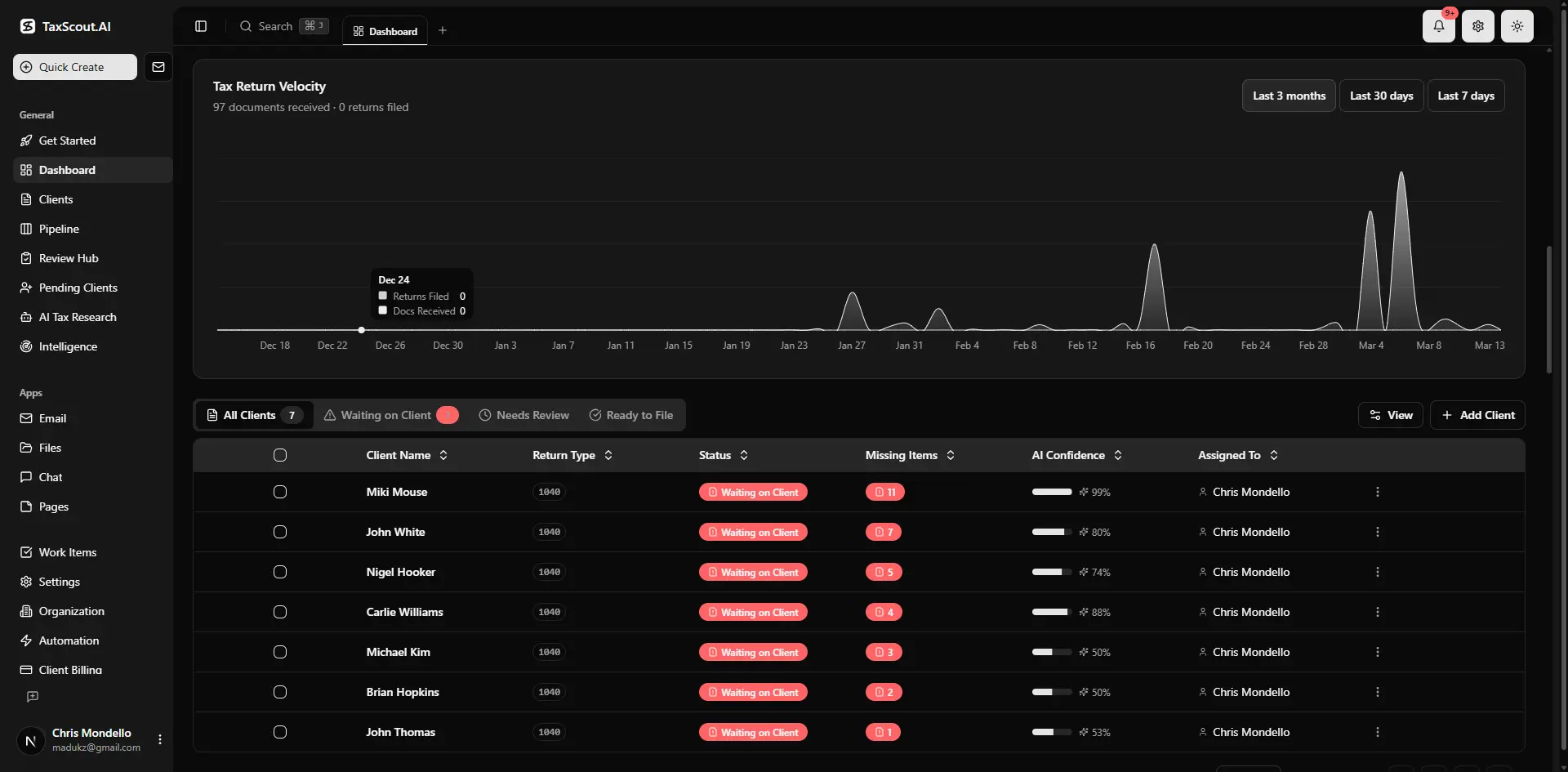
Real-time dashboard showing returns in progress, revenue, and upcoming deadlines
Breaking the Growth Treadmill: A Framework for CPA Firm AI Adoption
CPA firm AI adoption only improves wellbeing when firms consciously protect a portion of reclaimed time rather than immediately monetizing all of it as volume. This requires an explicit operational policy — not just a tool upgrade. Consider a simple rule: for every hour per week reclaimed by AI, allocate 30 minutes to capacity, 20 minutes to quality improvement (deeper reviews, advisory conversations), and 10 minutes to actual recovery. Without a policy, market pressure will allocate 60 minutes to volume, every time.
The second framework element is evaluating AI tools specifically on oversight reduction, not task speed. Ask vendors: 'What steps does your AI eliminate from my review workflow?' rather than 'How fast does your AI process documents?' Speed is visible and marketable. Oversight reduction is structural and durable. The post-tax-season review checklist at /blog/post-tax-season-accounting-firm-review offers a practical diagnostic for identifying which review steps in your current workflow are genuinely necessary versus artifacts of low-confidence automation.
Third, consolidate your stack before adding AI to it. If your firm uses separate tools for document management, pipeline tracking, client communication, e-signatures, and invoicing, each AI layer you add multiplies complexity rather than reducing it. The SBA's resource guidance for professional service firms consistently emphasizes operational simplicity as a prerequisite for sustainable scaling — that logic applies directly to your software architecture.
TaxScout's flat pricing model reinforces this consolidation incentive: at $149/month for up to 10 seats and 500 returns annually, there is no per-user cost penalty for adding team members to a unified platform. Compare that to per-seat pricing from competitors — for a 10-person firm, TaxScout at $149/month total versus approximately $590/month for Karbon or $500/month for TaxDome. See the full pricing comparison to model the numbers for your firm size.
Ready to stop managing AI and start letting it manage the work?
TaxScout combines agentic AI extraction, 9 research agents, smart intake, and full pipeline management in one flat-fee platform — designed to reduce cognitive load, not just processing time.
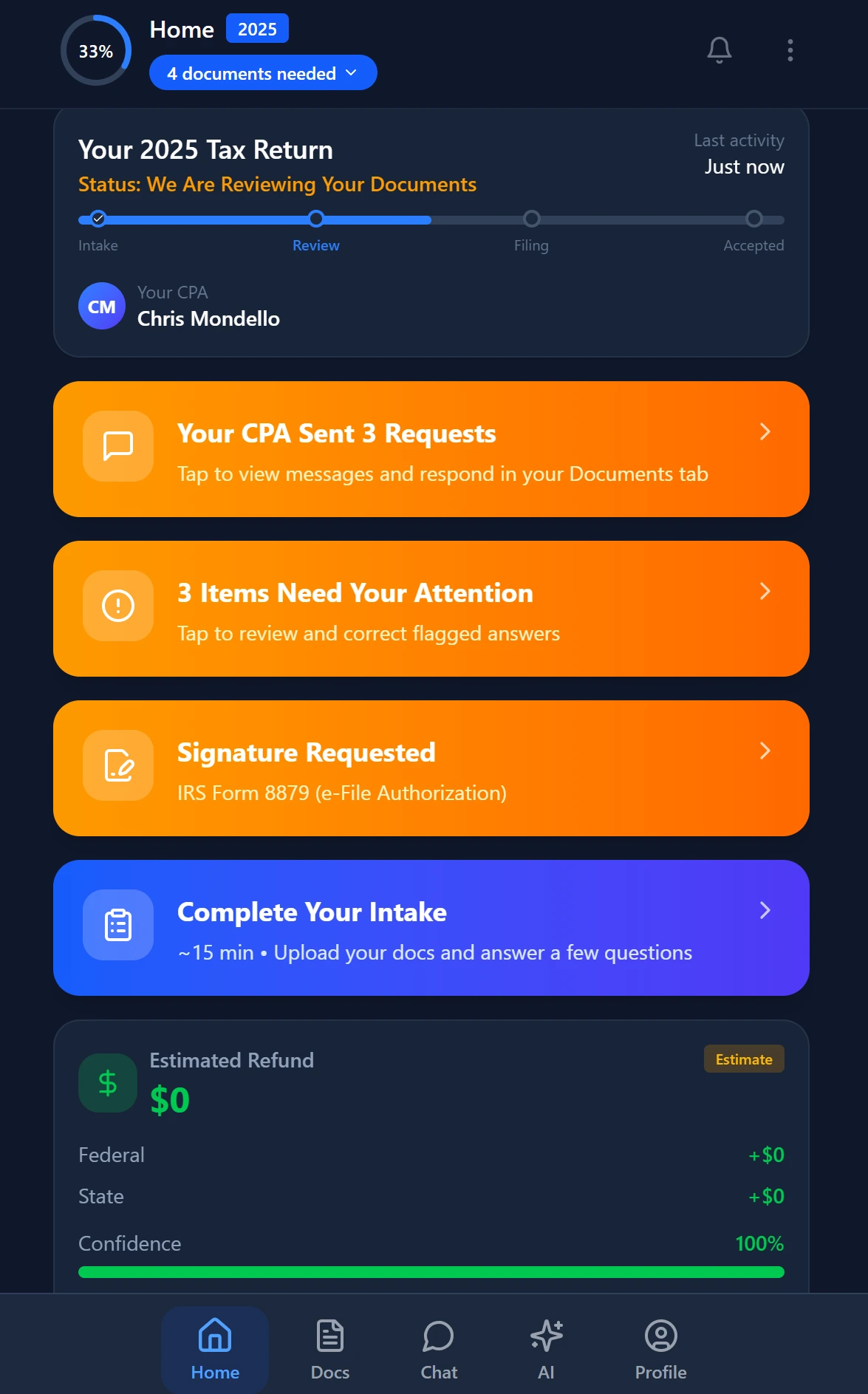
Smart intake auto-fills from uploaded documents and prior-year data
Frequently Asked Questions
Because reclaimed time is almost always reinvested into higher client volume rather than preserved as slack. The efficiency gain is real, but the workload adjusts upward to absorb it. Sustainable satisfaction improvements require both better AI tools that reduce oversight burden and an explicit firm policy to protect a portion of reclaimed time from immediate monetization.
Keep reading
IRS Power of Attorney: How CPAs File Form 2848 Without Delays
Sep 22, 2026 · 1 min read
Accountant Shortage Solutions: How CPA Firms Survive the Talent Crisis Without Overpaying
Sep 18, 2026 · 1 min read
Accounting Firm Communication: How AI Eliminates the Gaps That Cost You Clients
Sep 18, 2026 · 1 min read
Stay up to date
Get the latest tax tech insights delivered to your inbox.