IRS Penalty Abatement: How CPAs Request Relief for Clients
IRS penalty abatement is one of the highest-ROI services a CPA firm can offer — yet most practices treat it as one-off firefighting rather than a systematized revenue line. This guide walks through first-time abatement, reasonable cause relief, and CP2000 responses, then shows how to build…
IRS penalty abatement is a legitimate, frequently granted form of tax relief that most CPA firms underutilize. The IRS assessed more than $73 billion in penalties in a recent fiscal year, yet the agency's own First Time Abatement (FTA) waiver grants relief to any taxpayer with a clean three-year compliance history — no documentation required beyond the request itself. For a firm with even 50 active clients, dozens of abatement opportunities are sitting unidentified inside your client list right now.
The challenge is operational, not technical. Identifying eligible clients, drafting the right type of relief request, tracking each notice through resolution, and capturing the billing — all of that requires a workflow, not just knowledge of the tax code. Most practice management platforms treat penalty abatement as a footnote to audit representation, if they address it at all. The result is that CPAs leave real money on the table while clients pay penalties they legally do not owe. Building a structured approach to IRS penalty abatement is what separates firms that consistently win relief for clients from those that leave money on the table.
This guide covers the three primary abatement strategies — first-time abatement, reasonable cause penalty relief, and statutory exceptions — along with step-by-step instructions for drafting winning requests and building a repeatable service workflow. We also explain how IRS transcript monitoring and modern practice management tools can turn penalty abatement from a reactive chore into a proactive, billable advisory service. Understanding when and how to pursue IRS penalty abatement is one of the highest-value skills a CPA can bring to a client relationship.
Understanding the Three Abatement Strategies
Before drafting any relief request, you need to match the client's situation to the correct abatement theory. Using the wrong theory — for example, arguing reasonable cause when first-time abatement applies — wastes time and risks a denial that complicates a subsequent attempt. The IRS penalty relief overview identifies four grounds for relief: statutory exceptions, administrative waivers (FTA), reasonable cause, and correction of IRS error. In practice, CPAs work primarily with the first three. Every successful IRS penalty abatement case starts with selecting the theory that best fits the facts, since mismatched arguments invite unnecessary denials.
First-Time Abatement (FTA) is the fastest and most predictable path. It applies to failure-to-file, failure-to-pay, and failure-to-deposit penalties when the taxpayer: (1) has no prior penalties in the three preceding tax years, (2) has filed all required returns or extensions, and (3) has paid or arranged to pay any outstanding tax. No narrative is required. A single phone call to the IRS Practitioner Priority Service or a written request citing IRC § 6651 and the FTA criteria routinely secures relief within weeks. IRS data consistently shows FTA approval rates above 80% for qualifying requests. For firms evaluating their IRS penalty abatement approach, this trade-off compounds over time.
Reasonable cause relief applies when the taxpayer exercised ordinary business care and prudence but still could not comply. The IRS evaluates factors including serious illness, natural disaster, erroneous advice from a tax professional, and inability to obtain records. Unlike FTA, reasonable cause requires a documented narrative and supporting evidence — medical records, disaster declarations, correspondence with a prior advisor. The IRS's internal revenue manual guidance on reasonable cause at IRM 20.1.1 is the definitive reference for what examiners look for. Each of these factors directly shapes how IRS penalty abatement plays out in practice.
Statutory exceptions cover situations where a specific code section removes the penalty entirely — for example, estimated tax payment penalties waived under IRC § 6654(e) when the taxpayer had no liability in the prior year, or disaster-area relief granted by IRS notice. These require matching the client's fact pattern against current IRS notices, which is where an AI research agent that monitors IRS guidance in real time becomes especially useful. Understanding IRS penalty abatement in this context is what separates firms that scale from those that stall.
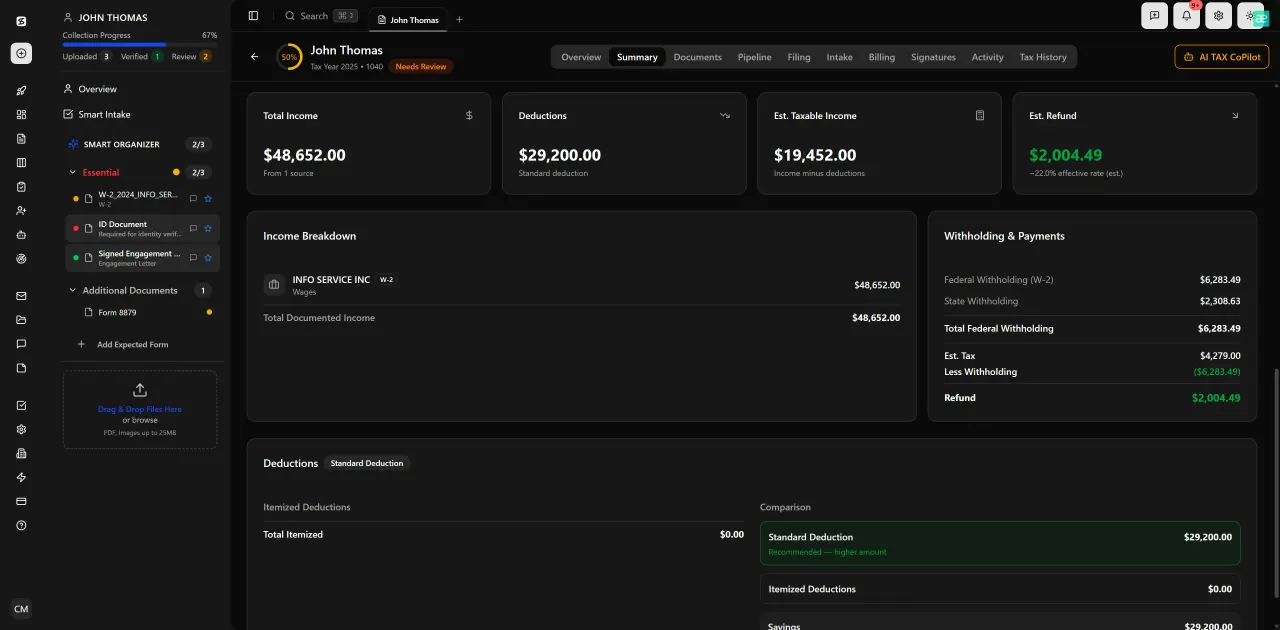
Review with AI assist — 9 agents answer questions with full client context
Abatement Eligibility Criteria: How to Screen Your Client List
Systematic screening is what separates firms that bill penalty abatement as an advisory service from firms that handle it reactively. The first step is pulling IRS account transcripts for every client who received a penalty notice in the past 24 months. The Transcript Delivery System (TDS) through IRS e-Services provides the TXMODA and IMFOL transcript types that show penalty assessments, abatement history, and compliance records across prior years. For firms not yet enrolled in TDS, the IRS e-Services portal is the starting point. This is precisely where a deliberate IRS penalty abatement strategy pays off.
Once you have transcripts, apply the FTA checklist first — it is the highest-yield filter. Flag any client who: received a first-time IRS failure to file penalty or failure-to-pay penalty, has no assessed penalties in the three prior tax years on the transcript, and is current on all return filings. These clients are FTA-eligible and represent the lowest-effort, highest-approval abatements in your pipeline. IRS penalty abatement sits at the center of this decision — get it wrong and the rest unravels.
For clients who do not pass the FTA filter, review the circumstances that triggered the penalty. Document any illness, casualty event, reliance on prior professional advice, or inability to obtain third-party records (K-1 delays from partnerships are a frequent and well-accepted reasonable cause argument). Cross-reference open IRS disaster area relief notices using Treasury's published guidance — taxpayers in federally declared disaster areas often qualify for automatic penalty suspension under IRC § 7508A. When firms revisit their IRS penalty abatement priorities, the gaps usually surface here.
A robust client management system that stores notice history alongside filing history dramatically accelerates this screening. When a new penalty notice arrives, you should be able to open the client record, see the prior three years of compliance data, and determine abatement eligibility in under five minutes — not after digging through email threads and paper files.
Tired of discovering penalty abatement opportunities too late — or missing them entirely?
TaxScout.ai tracks client notices, stores transcript data, and flags abatement-eligible clients automatically so your team can act before the response deadline.
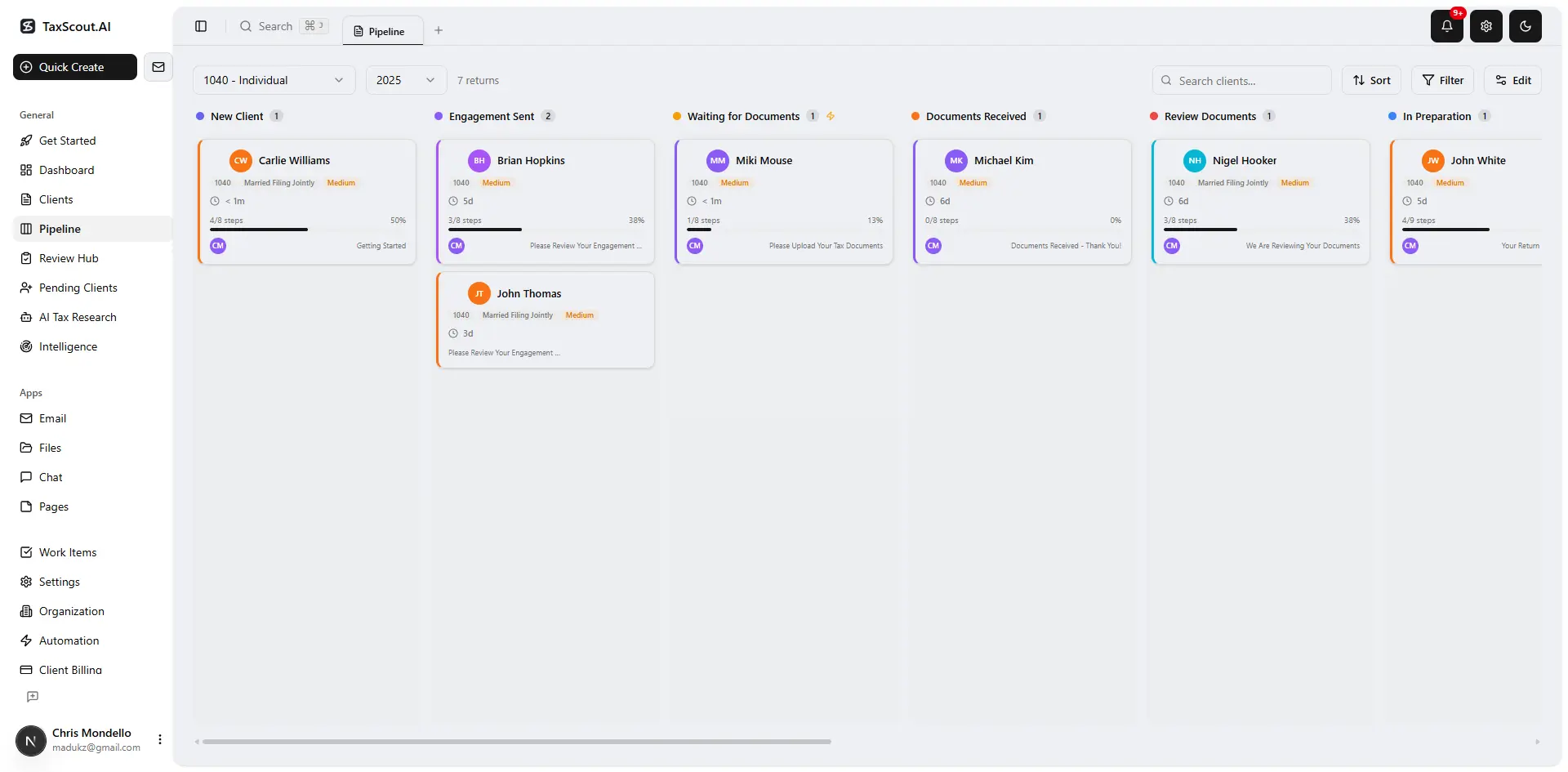
Track every return from intake to filed with drag-and-drop pipeline management

Click any extracted field to see its source highlighted on the original PDF
How to Draft a Winning Penalty Abatement Request Letter
A penalty abatement request letter is a formal written communication to the IRS that must accomplish three things: identify the penalty by notice number and tax period, cite the correct legal authority for relief, and provide a clear factual narrative (for reasonable cause) or a concise compliance-history statement (for FTA). The format matters because IRS correspondence examiners process hundreds of letters per day — a well-organized letter reduces misrouting and speeds decisions.
For an FTA request, the structure is simple. Open by identifying the taxpayer (name, EIN or SSN, tax year, penalty type), then state that the taxpayer qualifies for first-time abatement under IRS Administrative Waiver guidance because: (a) no penalties were assessed for the three preceding years, (b) all required returns have been filed or extended, and (c) any outstanding balance has been paid or is subject to an installment agreement. Close with a specific request to abate the assessed penalty and issue a corrected balance notice. No supporting documents are needed for FTA — attaching irrelevant documentation can actually slow processing.
For a reasonable cause letter, the structure is more detailed. State the penalty and amount in the opening paragraph. In the body, describe the specific circumstance that prevented timely compliance, explain why the circumstance was beyond the taxpayer's control, and document steps taken to file or pay as soon as the obstacle was removed. Attach corroborating evidence (dated medical records, disaster agency correspondence, signed written advice from a prior advisor). Close by citing IRM 20.1.1.3.2 on ordinary business care and prudence and request abatement with a specific dollar amount stated.
Regardless of penalty type, always address the letter to the correct IRS campus. The notice header identifies the campus; misrouting to the wrong address adds weeks to processing. Store a copy of every letter in the client's file immediately — the file management system should timestamp the outgoing correspondence so you have a clear record if the IRS claims it was never received. For firms managing dozens of abatement cases simultaneously, using PDF tools that apply Bates numbering and PII masking before archiving protects client data and keeps exhibit sets organized.
Responding to IRS Notice CP2000 and Other Automated Correspondence
The CP2000 notice is not technically a penalty notice — it is a proposed tax change based on an information reporting mismatch — but it frequently triggers penalties if left unresolved. An IRS notice CP2000 response requires the CPA to agree, disagree, or partially agree with the proposed changes within 60 days of the notice date. If a penalty is subsequently assessed because of underreported income confirmed by the CP2000, that penalty is often eligible for reasonable cause abatement, especially when the discrepancy arose from a 1099 or K-1 issued after the original return was filed.
The critical operational point is notice date tracking. The CP2000 response clock starts from the date printed on the notice, not the date the client opens the mail or forwards it to you. Firms that rely on clients to self-report incoming IRS correspondence routinely lose days or weeks of response time. A notice management workflow — where clients upload documents directly through a branded client portal and the system timestamps receipt automatically — eliminates this vulnerability.
Once the CP2000 is received and logged, use the split-screen document review environment to compare the proposed changes against the original return side by side. Identify which information items the IRS claims were unreported, then pull the corresponding source documents to confirm or refute each item. If the IRS's proposed change is correct, calculate the resulting tax and prepare a penalty abatement request simultaneously with the agreement response — bundling them saves a round trip and signals organized, professional representation. See our guide to other blog resources for additional IRS correspondence workflows.
For other common automated notices — CP501 (balance due reminder), CP503, CP504 (intent to levy), and LT11 — the same notice-date-tracking discipline applies. The IRS Notices and Letters index describes each notice type and the appropriate response path. A pipeline stage dedicated to "IRS Notice Received" that triggers an automatic task assignment and response deadline ensures no notice ages past its window without action.
First-Time Abatement vs Reasonable Cause: Key Differences for CPAs
| Factor | First-Time Abatement (FTA) | Reasonable Cause |
|---|---|---|
| Legal basis | IRS Administrative Waiver | IRC § 6651(a), IRM 20.1.1 |
| Documentation required | None beyond compliance history | Narrative letter plus supporting evidence |
| Applicable penalties | Failure-to-file, failure-to-pay, failure-to-deposit | Most civil penalties including accuracy-related |
| Prior penalty requirement | Clean 3-year history required | No prior-history requirement |
| Typical approval rate | Above 80% for qualifying requests | Varies widely based on facts and documentation |
| Phone vs written request | Either works; phone is fastest | Written letter strongly preferred |
| Can be used repeatedly | No — one-time waiver per penalty type | Yes — with new qualifying circumstances |
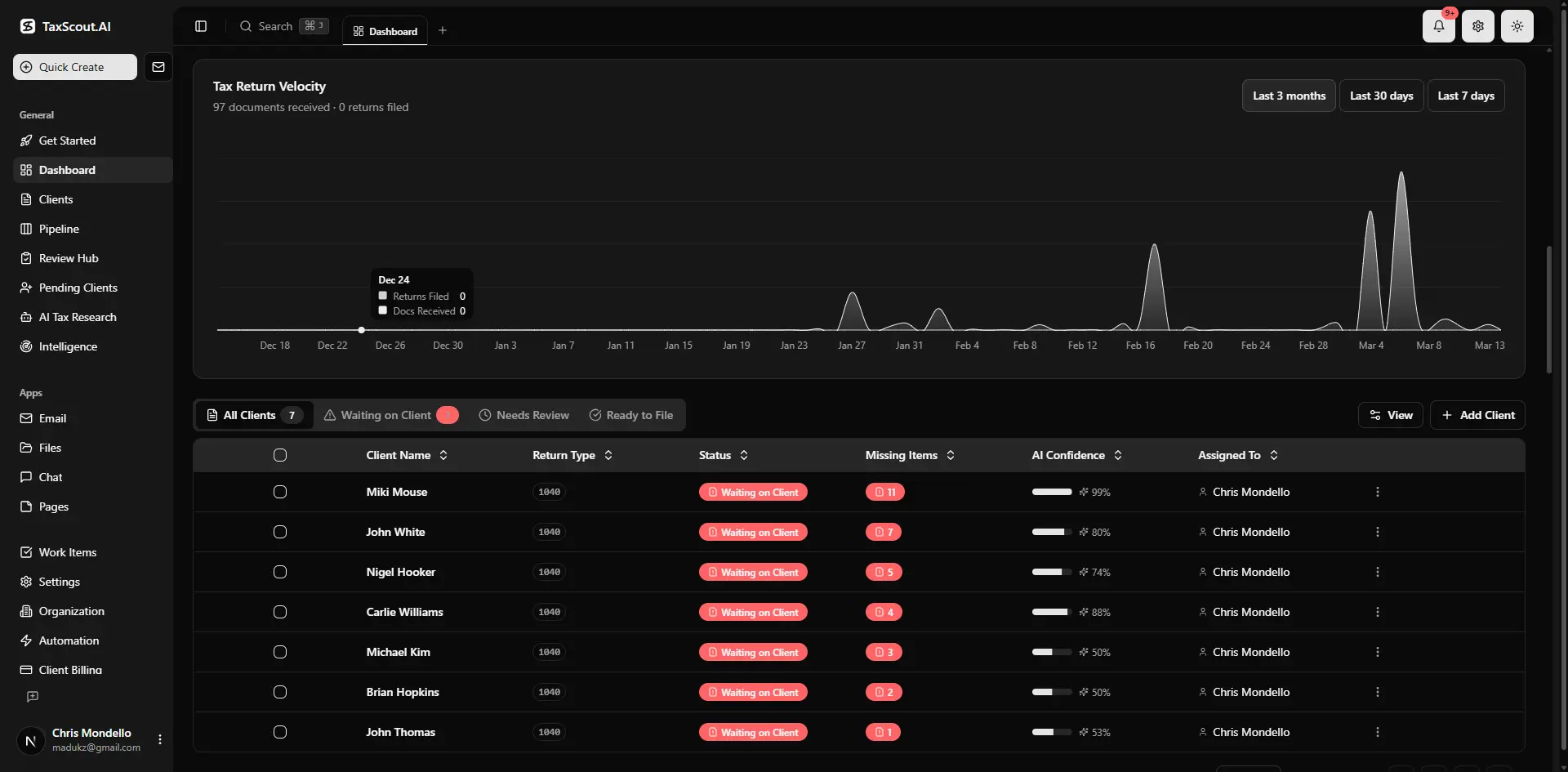
Real-time dashboard showing returns in progress, revenue, and upcoming deadlines
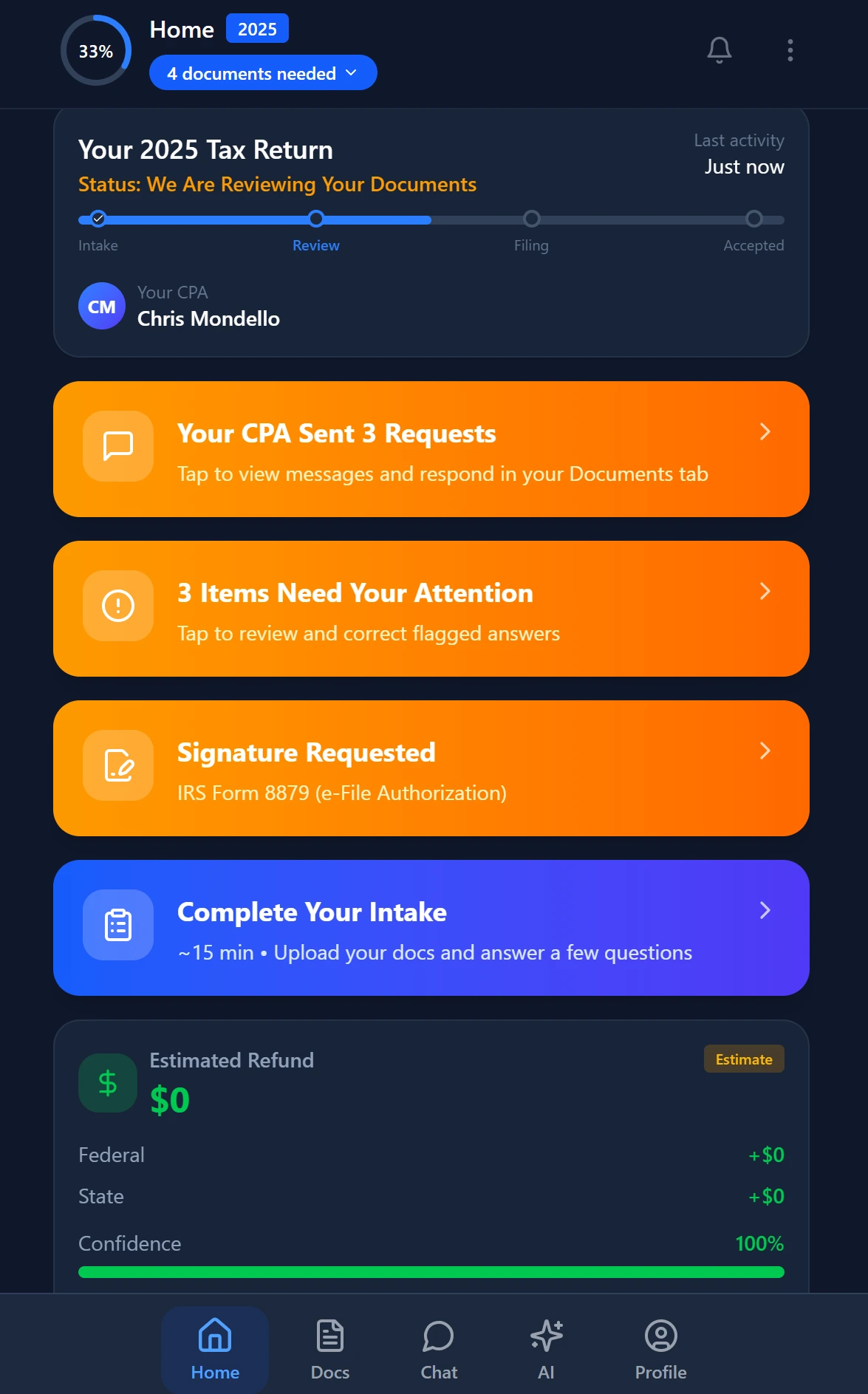
Smart intake auto-fills from uploaded documents and prior-year data
Building a Penalty Abatement Workflow in Your Practice
The difference between a firm that generates consistent penalty abatement revenue and one that handles it sporadically comes down to workflow design. The goal is a system that identifies eligible clients proactively, routes each case through a defined set of stages, captures billable time, and closes with a documented outcome — all without requiring a partner to remember who received what notice six weeks ago.
A practical workflow uses five pipeline stages: (1) Notice Received and Logged, (2) Transcript Pulled and Eligibility Assessed, (3) Request Drafted and Client Approved, (4) Request Submitted and Acknowledgment Received, (5) Resolution Documented and Invoice Sent. The pipeline management feature in TaxScout.ai supports 12 customizable stages with drag-and-drop kanban, so you can build this exact sequence and assign task owners at each stage. When a new notice arrives through the client portal, a team member moves the client card to Stage 1 and the pipeline enforces the rest of the process.
Billing is easiest when it is structured upfront. Most firms charge a flat fee per abatement case — typically $150–$500 for an FTA request and $300–$800 for a reasonable cause letter depending on complexity — with a separate fee if IRS appeals are required. Presenting the engagement scope in writing before the work begins protects the firm and sets clear client expectations. E-signatures on a short engagement letter via Documenso means the client can authorize the work from their phone in under two minutes. Pair that with automated invoicing through Stripe Connect Express and the billing cycle closes without manual follow-up.
For firms ready to scale penalty abatement into a proactive advisory offering, the highest-leverage step is connecting transcript monitoring to the intake workflow. When TaxScout.ai processes incoming IRS transcripts and account notices, the AI research agents can cross-reference current IRS relief notices and flag clients who appear to qualify for statutory exceptions — such as automatic disaster-area waivers — before those clients even know a penalty was assessed. This is the kind of proactive service that justifies advisory retainer pricing rather than one-off compliance fees. Our post on avoiding penalties with estimated quarterly tax payments covers the companion strategy of penalty prevention for clients who want to stay out of abatement situations in the first place.

Your clients see your brand — OTP login, document upload, and real-time status
Packaging Penalty Abatement as a Recurring Advisory Service
The firms capturing the most value from penalty abatement have reframed it as a standing component of their advisory relationship rather than an emergency service. The pitch to clients is straightforward: as part of your engagement, we monitor your IRS account for any penalty assessments and respond within the response window — you never pay a penalty you do not legally owe. This framing positions the CPA as a proactive financial guardian rather than a reactive filer.
Structurally, this can be delivered as an add-on to an existing tax preparation engagement or as part of a broader tax advisory retainer. The value-based pricing model works well here because the client's perceived value (avoiding a $1,200 penalty) typically exceeds the fee ($250–$400) by a comfortable margin, making the service easy to sell and easy to retain. For firms building out their advisory services menu, penalty abatement monitoring pairs naturally with estimated tax planning, IRS transcript reviews, and annual compliance audits.
Operationally, systematizing this service requires a client communication layer that keeps clients informed without generating manual update emails. The communication hub in TaxScout.ai handles email integration via Gmail OAuth and Outlook Graph with AI classification, so incoming IRS correspondence is automatically sorted, logged, and routed to the correct client record. Combined with workflow automation that creates tasks and deadlines when specific notice types are detected, the firm's response process runs on defined rules rather than individual memory.
Firms that have built this infrastructure report that penalty abatement cases — which previously consumed two to three hours of unplanned partner time — now move through the pipeline in under an hour of billable staff time. The margin on a $300 flat-fee abatement request handled in 45 minutes is excellent, and the client experience of receiving a resolution letter (and a penalty refund) cements the relationship in a way that routine compliance work rarely does. For additional context on building a technology stack that supports these kinds of high-margin advisory services, see how TaxScout compares on practice management features versus TaxDome.
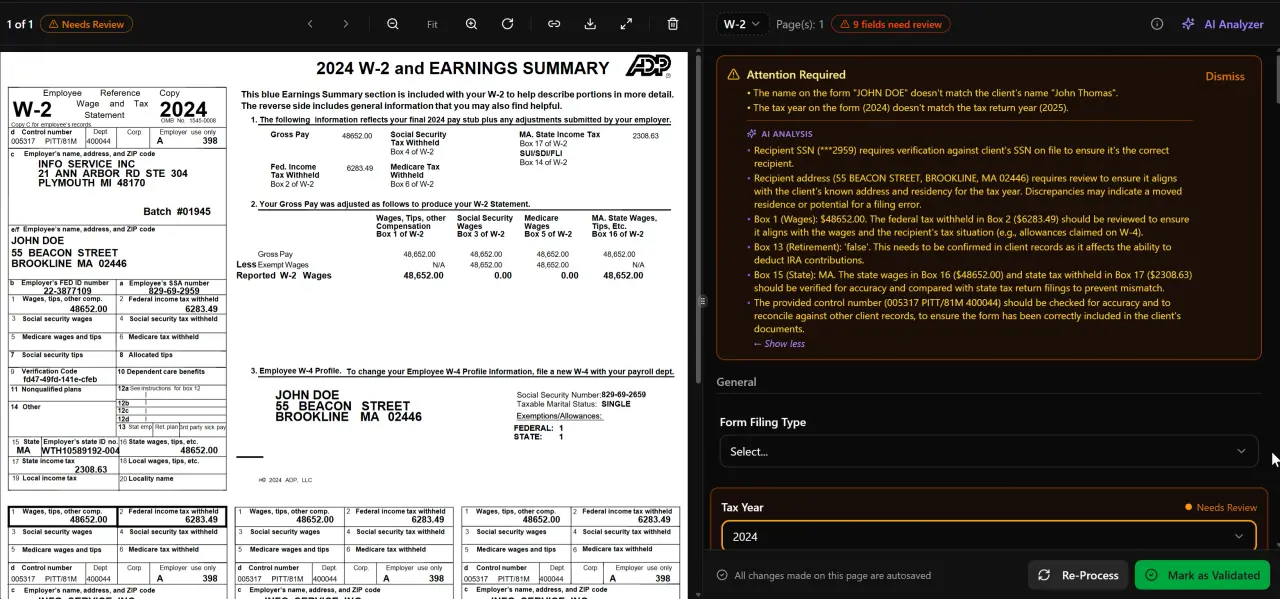
AI classifies, extracts, and validates every document automatically
How TaxScout.ai Supports End-to-End IRS Penalty Abatement Management
TaxScout.ai was designed for CPA firms that want to run structured, defensible workflows across every service type — including IRS penalty abatement. The platform's AI document extraction processes IRS notices, transcript pages, and correspondence through a 5-layer validation pipeline that captures penalty amounts, notice dates, tax periods, and assessment codes with confidence scoring, so the data entering your pipeline is reliable from the start. All 180+ supported form types include IRS account transcripts and correspondence documents.
The client portal gives clients a secure, branded upload path with OTP login — no passwords — so they can forward IRS mail to your firm in seconds rather than scanning and emailing. The portal timestamps every upload, creating an auditable record of when the firm received notice that is separate from the client's claim about when they received it from the IRS. This timestamp record has practical value if a client later disputes a missed deadline.
For research, the nine specialized AI research agents query IRS.gov, Treasury, Cornell Law, SSA, and Congress in real time, which means your team can verify current disaster-area relief notices, confirm the latest FTA waiver criteria, or pull the current version of IRM 20.1.1 without leaving the platform. Client-context AI memory retains entity structures, filing history, and prior abatement outcomes so every subsequent case starts with the full picture already loaded.
Pricing is flat with no per-user fees: the Prep Pro plan at $149/month covers 10 seats and 500 returns per year, which is the right tier for firms running an active penalty abatement service line alongside standard preparation work. Compare that against platforms like TaxDome at roughly $100 per user per month for a 10-person firm, and the math on TaxScout versus TaxDome is straightforward. Review the full pricing options to find the tier that fits your firm's volume.
Ready to stop leaving penalty abatement revenue on the table?
TaxScout.ai gives your firm the notice tracking, AI research, and pipeline tools to systematize IRS penalty abatement as a high-margin advisory service — starting with your existing client list.
Frequently Asked Questions
IRS penalty abatement is a formal reduction or elimination of an assessed tax penalty. Taxpayers qualify under three main theories: first-time abatement (clean three-year compliance history with no prior penalties), reasonable cause (circumstances beyond the taxpayer's control prevented timely filing or payment), and statutory exceptions (specific code sections or IRS disaster-area notices that suspend penalties automatically). CPAs should screen clients against all three criteria before deciding which relief request to file.
Keep reading
Backdoor Roth IRA: How CPAs Execute the Strategy Without Triggering Pro-Rata Tax
Oct 12, 2026 · 1 min read
Amended FBAR Procedures: How CPAs Correct Foreign Account Errors Without Triggering Penalties
Oct 12, 2026 · 1 min read
Transparency in Coverage Final Rules: What CPA Firms Must Do Now
Oct 12, 2026 · 1 min read
Stay up to date
Get the latest tax tech insights delivered to your inbox.