IRS Transcript Monitoring for CPA Firms: Stay Ahead of Client Notices Automatically
Most CPA firms still rely on manual IRS transcript pulls, leaving clients to discover CP2000 notices and account issues before their accountant does. This guide covers how IRS transcript monitoring works today and what a fully automated system looks like in practice. Learn how to protect your…
It's 4:47 PM on a Tuesday — before your IRS transcript monitoring system has a chance to flag anything — and a client calls in a panic: "I just got a CP2000 notice — the IRS says I owe $12,000 in back taxes. What's going on?" You pull up the account. The discrepancy has been sitting in their transcript for six weeks. You just didn't know about it.
That scenario plays out thousands of times every tax season. Not because CPAs are careless — but because IRS transcript monitoring, for most firms, still depends on someone remembering to log into e-Services and manually pull transcripts for each client. When you're managing 300 returns across three preparers, that check doesn't happen consistently. And when it doesn't, clients hear from the IRS before they hear from you.
This guide is for the CPA who wants to fix that. We'll walk through exactly how IRS transcript monitoring works today — from CAF number authorization through manual pull workflows — and show what a properly automated system looks like in practice.
What IRS Transcript Monitoring Actually Means for Tax Professionals
IRS transcripts for tax professionals aren't a single document — they're a family of records accessible through IRS e-Services Transcript Delivery System (TDS) using a CAF (Centralized Authorization File) number. Each transcript type tells a different story about what's happening on the IRS side of a client's account. IRS transcript monitoring starts with understanding exactly which records are available and how to access them systematically for every client in your portfolio.
The five transcript types CPAs pull most frequently:
Account Transcript — Shows all IRS account activity: payments, penalties, interest accruals, adjustments, and notice issuances. This is where you'll see a CP2000 flagged before the client's mail arrives. This is precisely why IRS transcript monitoring focused on Account Transcripts can give your firm days or even weeks of advance warning before a client ever sees a notice in their mailbox.
Return Transcript — A summarized view of the filed return as the IRS received it. Useful for verifying that what you filed matches what the IRS has on record. Incorporating Return Transcripts into your IRS transcript monitoring workflow adds a critical verification layer, ensuring filing discrepancies are caught before they escalate into penalties or audits.
Wage and Income Transcript — Shows third-party information returns (W-2s, 1099s, K-1s) that the IRS has received for the tax year. Critical for catching unreported income before the IRS sends a notice. For firms evaluating their IRS transcript monitoring approach, this trade-off compounds over time.
Record of Account Transcript — Combines account and return data in one document. The most complete single-pull option for a year under examination. Each of these factors directly shapes how IRS transcript monitoring plays out in practice.
Tax Compliance Transcript — Shows whether a client is compliant for a given tax year. Used heavily in installment agreement and OIC work. Understanding IRS transcript monitoring in this context is what separates firms that scale from those that stall.
Each of these requires a separate pull via e-Services, with one transcript available per client per pull. For a 200-client practice, a systematic transcript review isn't a 20-minute task — it's a multi-hour workflow, and that's before accounting for the CAF authorization requirements. This is precisely where a deliberate IRS transcript monitoring strategy pays off.
The CAF Number Authorization Workflow
Before any transcript can be pulled, your firm needs IRS authorization. The CAF number system — managed via Form 2848 (Power of Attorney) or Form 8821 (Tax Information Authorization) — is the gateway.
Form 2848 gives your firm full representation authority, including the ability to receive and respond to IRS notices on behalf of the client. Form 8821 is narrower — it authorizes information access only, without representation rights. Both routes result in a CAF number linkage that unlocks transcript access through e-Services.
The friction here is real:
- Processing time: Fax submissions take 5–10 business days for CAF processing. E-fax through the secure mailbox is faster but still not instant.
- Year-specific authorization: An 8821 filed for 2023 doesn't automatically cover 2024. Each tax year under monitoring needs its own authorization window.
- Name/EIN matching: Even minor discrepancies between the authorization form and IRS records can cause access failures.
Once authorized, the transcript pull itself is manual: log into e-Services, navigate to TDS, search by SSN/EIN and form type, select the transcript type and year, download the PDF or raw data file, and file it somewhere meaningful in your document management system.
Multiply that by a full client list. Multiply it again by the frequency you'd need to pull transcripts to actually catch issues proactively. The manual approach doesn't scale — and that's why most firms only pull transcripts reactively, after something has already gone wrong. Firms that implement structured IRS transcript monitoring, even in a partially manual form, consistently catch issues earlier and respond faster than those relying on client-forwarded notices alone.
Tired of hearing about IRS notices from your clients before you do? See how TaxScout surfaces client-side IRS activity and real-time regulatory flags before they become phone calls. → Book a 15-Min Demo — See It Live

Click any extracted field to see its source highlighted on the original PDF
What You Miss When Transcript Pulls Are Reactive
The problem with a reactive pull workflow isn't just inefficiency — it's that certain IRS actions have tight response windows that evaporate while you're waiting for a client to forward mail.
CP2000 notices: Generated when income on a return doesn't match third-party information returns. The IRS sends a proposed change with a 60-day response window. If the client sits on the notice for two weeks before forwarding it to you, and your team takes another week to triage it, you're already 25% through the response clock before work has started. Consistent IRS transcript monitoring would have surfaced the income mismatch weeks before the notice was ever generated.
CP501/CP503/CP504 balance-due notices: These escalate rapidly. CP504 authorizes IRS levies on state tax refunds and is a direct precursor to enforced collection. The gap between CP501 and CP504 can be as short as 10–12 weeks.
TC 971 action codes on the account transcript: These are the IRS's own internal event codes — notice issued, levy filed, installment agreement established, examination opened. A TC 971 with action code 010 means a notice was generated. Catching that event on the transcript before your client's mail arrives is the difference between proactive advice and reactive damage control.
Return processing holds: A TC 570 on an account transcript means the return has been frozen pending additional review. Clients expecting refunds will start calling. If you already know about the hold, you have an answer. If you don't, the call catches you flat-footed.
For multi-state filers, the complexity compounds. You're not just monitoring federal transcripts — you're tracking state notices from California FTB, New York DTF, or Texas Comptroller, each with their own access methods and response timelines. We covered the state-side complexity in detail in our California Tax Changes 2026 CPAs Must Know and New York State Tax Updates 2026 CPAs Need to Know guides.
The Manual Pull Workflow vs. Automated IRS Transcript Monitoring
Here's what the workflow comparison actually looks like at the task level:
| Step | Manual Workflow | Automated Monitoring |
|---|---|---|
| Authorization tracking | Preparer manually checks CAF coverage | System tracks 8821/2848 expiration by client |
| Pull scheduling | Ad hoc, based on preparer memory | Scheduled pulls on configurable cadence |
| Account transcript review | Preparer reads PDF for action codes | Flagging engine parses TC codes automatically |
| Notice detection | Reactive — client forwards mail | Alert generated when TC 971 appears |
| CP2000 awareness | Client calls after notice arrives | Flagged on account transcript before mail date |
| Return processing status | No visibility until client asks | TC 150 (return filed), TC 846 (refund issued) tracked |
| Staff time per client | 15–25 minutes per pull | Near-zero — alerts only when action needed |
| Documentation | Manual PDF saves, inconsistent naming | Auto-filed to client record by year and type |
| Cross-client pattern detection | None | Aggregate flags (e.g., widespread processing delays) |
For a 200-client firm running quarterly transcript pulls manually, that's roughly 50–80 hours of staff time per cycle just for the pull and review process — before any actual client work is done in response to what you find. That time burden is precisely why automated IRS transcript monitoring delivers such a measurable return on investment for growing practices.
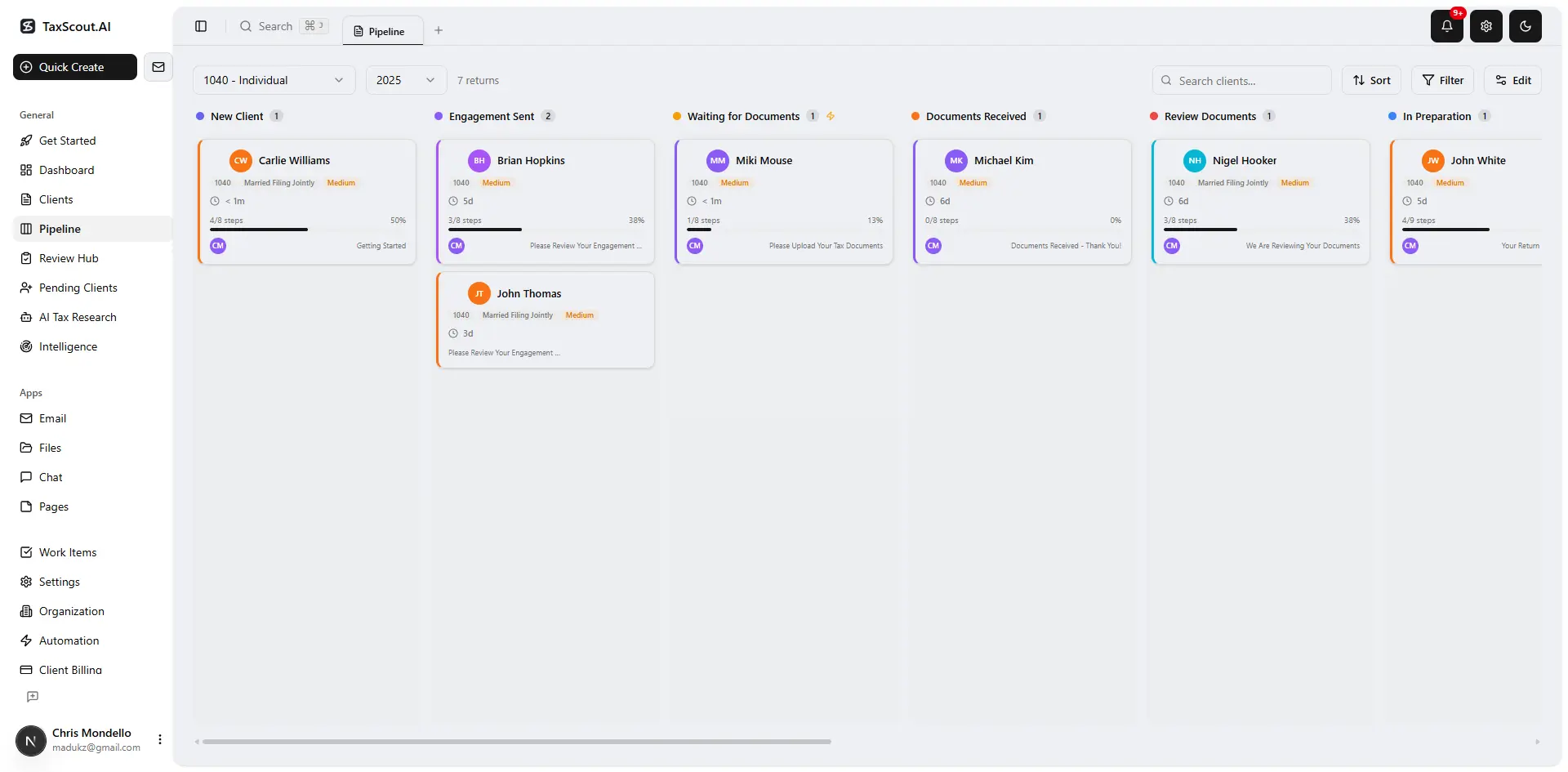
Track every return from intake to filed with drag-and-drop pipeline management
How AI-Native Practice Management Handles This
No standalone software gives your firm direct IRS API access — that infrastructure simply doesn't exist yet for third-party practice management platforms. What differentiates AI-native platforms is how they integrate transcript monitoring into the broader practice workflow so that the human effort required is minimal and the alerts actually reach the right person at the right time.
TaxScout's AI research agents include a real-time IRS research capability that searches IRS.gov, treasury.gov, and authoritative regulatory sources live — not from a cached database. When a notice type like CP2000 or a new IRS processing bulletin requires interpretation, the research agent pulls current guidance directly from the source rather than relying on static content that may be months old.
The pipeline management engine connects transcript status to filing workflow. A client whose account transcript shows a TC 570 processing hold can be automatically advanced or flagged in the pipeline, triggering a preparer task before the client calls. The system's 12 customizable stages support loopback transitions with required notes — so when a client's return status changes, the workflow reflects it immediately with an audit trail.
For the document side, AI document extraction processes 180+ tax form types including all 1099 variants, K-1s, and the full 1040 schedule set — with a 5-layer validation pipeline that includes cross-document consistency checks and duplicate detection. This matters for transcript work because the most common transcript discrepancy trigger is a mismatch between what was reported on the return and what the IRS has from third-party information returns. When your extraction layer catches a W-2 or 1099 discrepancy before filing, you eliminate the downstream CP2000 risk — making pre-filing document validation a natural complement to ongoing IRS transcript monitoring.
The security and compliance architecture supports the access controls that transcript monitoring requires: AES-256-GCM encrypted SSN vault, 7-role RBAC, and full audit logging for every SSN access. When you're pulling transcript data that includes sensitive taxpayer identifiers, that access needs to be logged and rate-limited — especially under Circular 230 standards and state CPA licensing requirements.
Real-World Workflow: Catching a CP2000 Before It Arrives
Here's how a firm running automated IRS notice monitoring handles a CP2000 scenario from start to finish:
Week 1, post-filing: Automated transcript pull runs on schedule. The client's wage and income transcript shows a 1099-NEC from a payer that was not on the filed return. The mismatch is flagged automatically — not because the IRS has acted, but because the transcript data now differs from the return data in the system.
Week 1, same day: The assigned preparer receives an alert inside the platform. The client's pipeline stage advances from "Filed" to "Under Review — Income Discrepancy." A task is auto-generated: "Review 1099-NEC from [Payer] — not reflected on 2024 return."
Week 2: The preparer contacts the client, discovers the 1099-NEC was for a freelance project the client forgot to mention. The income was roughly $4,200. An amended return is prepared and filed proactively.
Week 6: The IRS issues a CP2000 based on the same discrepancy — but the amended return was already processed. The CP2000 results in a zero-balance adjustment rather than a $900+ tax bill. The client receives a letter from the IRS; instead of panic, they call their CPA and hear, "Yes, we already handled that — you're all set."
That's the operational difference. Not AI magic — systematic IRS transcript monitoring that catches what manual workflows miss because they're too time-consuming to run consistently.
Building a Transcript Monitoring Protocol for Your Firm
Whether you're running a fully automated system today or building toward one, the protocol structure matters. Here's the framework:
1. CAF authorization audit: Quarterly, confirm that every active client has a current Form 8821 or 2848 on file covering the open tax years you're monitoring. Build this check into your annual onboarding workflow — we covered the full client intake process in our Client Onboarding Accounting Firm Checklist Guide.
2. Transcript pull cadence: Monthly minimum for active clients with open years. Immediately post-filing for the first 90 days (highest probability of processing holds, CP2000 generation, and notice activity). Without a defined cadence, IRS transcript monitoring becomes inconsistent — and inconsistency is where notices slip through.
3. Response SLA by notice type: Establish internal SLAs before you need them:
- CP2000: 30-day internal response target (leaving 30 days of the 60-day window for drafting and client review)
- CP501/CP503: 15-day triage, 30-day resolution
- CP504: 7-day triage, immediate senior review
- Examination notices (CP75/CP75A): 48-hour escalation
4. Documentation standard: Every transcript pull, regardless of findings, gets filed to the client record with a date stamp and reviewer initials. If you can't prove you pulled and reviewed, you effectively didn't.
5. Client communication template: When you catch something before the client does, the communication matters. A brief, confident email that says "We saw activity on your IRS account and want to update you" is far better than waiting for the client to forward a notice in alarm.
The Cost of Not Monitoring Proactively
The CP2000 failure mode isn't just a client experience problem — it's a liability and business risk. Under Circular 230, practitioners have an obligation to advise clients of positions that could result in penalties. A proactive IRS transcript monitoring workflow that catches discrepancies before they become notices is a direct extension of that standard of care.
Beyond professional liability, there's the revenue equation. A client who receives a $12,000 IRS notice that their CPA could have prevented — or at least flagged before the fact — is a client who questions the value of the engagement. Client retention in accounting firms is heavily correlated with proactive communication. Reactive crisis management, even when well-executed, erodes trust.
For context on how AI-native platforms change the economics of proactive client service, the AI Tax Research Agents for CPAs: What You Need to Know article walks through how real-time regulatory monitoring compounds with client-context AI memory to keep CPAs ahead of the information curve rather than chasing it.
Ready to Stop Hearing About IRS Notices from Your Clients First?
TaxScout gives your firm the AI-native infrastructure to monitor IRS activity, flag discrepancies before they become notices, and keep every client's pipeline status current — for $49/mo flat with no per-user fees.
Frequently Asked Questions
Automated IRS transcript monitoring works by connecting to the IRS e-Services Transcript Delivery System (TDS) through your existing CAF number authorization and pulling transcripts on a scheduled basis — without requiring a preparer to manually log in for each client. TaxScout monitors transcripts across your entire client roster and flags changes automatically, so when a discrepancy like a CP2000-triggering mismatch appears, your firm sees it within 24 hours instead of six weeks later. Firms managing 300+ returns typically reduce manual transcript pulls by over 80% after implementation.
Keep reading
Backdoor Roth IRA: How CPAs Execute the Strategy Without Triggering Pro-Rata Tax
Oct 12, 2026 · 1 min read
Amended FBAR Procedures: How CPAs Correct Foreign Account Errors Without Triggering Penalties
Oct 12, 2026 · 1 min read
Backdoor Roth IRA: How CPAs Execute the Strategy for High-Income Clients
Oct 12, 2026 · 1 min read
Stay up to date
Get the latest tax tech insights delivered to your inbox.