Avoid Penalties With Estimated Quarterly Tax Payments
A missed estimated quarterly tax payment conversation can cost clients hundreds in penalties — and cost you their trust. This CPA-focused guide shows how to build a proactive system that prevents underpayment surprises and creates four high-value client touchpoints every year. Turn a reactive pain…
A client calls in March, furious. They owe $4,200 at filing — plus a $340 underpayment penalty they didn't see coming. They made significantly more money in 2025, you knew it, and nobody set up estimated quarterly tax payments. That call is a relationship risk, a reputational hit, and entirely preventable.
For CPAs managing growing client rosters, estimated quarterly tax payments are one of the highest-leverage advisory touchpoints in the calendar year. Handled proactively, they prevent penalties, demonstrate forward-thinking value, and create four natural client touchpoints per year outside of filing season. Handled reactively — or not at all — they become the reason clients quietly move to a competitor who "actually looks out for them."
This guide is written for CPAs, not clients. It covers the 2026 payment deadlines, the safe harbor calculations that actually hold up under IRS scrutiny, and how AI-native practice management can automate the reminder and document workflow so this advisory service runs without manual effort. Whether your clients are self-employed, have investment income, or run S-corps, the mechanics of estimated quarterly tax payments are the same — but the advisory opportunity varies widely.
Why Estimated Quarterly Tax Payments Are a CPA Advisory Revenue Opportunity
Most CPA firms treat estimated payments as a one-time April conversation: file the return, print the vouchers, hand them to the client, move on. That approach leaves money and relationships on the table. Clients who miss or underpay estimated quarterly tax payments don't just face penalties — they lose confidence in their advisor for not catching it sooner.
Consider what a structured estimated tax advisory service actually provides:
Four guaranteed client touchpoints per year. Each payment deadline — April, June, September, January — is a legitimate reason to reach out, review income changes, and reassess the payment amount. That is four conversations that reinforce your value between returns. Framing each outreach around estimated quarterly tax payments gives you a concrete, numbers-driven reason to connect rather than a generic check-in that's easy for clients to ignore.
Penalty prevention that clients attribute to you. The IRS underpayment penalty under IRC §6654 currently uses the federal short-term rate plus 3 percentage points — for 2026 that rate is around 8%. On a $20,000 underpayment, that is approximately $1,600 in annualized penalty exposure. Clients feel that. When your firm prevents it by keeping estimated quarterly tax payments on track, they remember.
A billable service with clear deliverables. Safe harbor modeling, mid-year income projections, and quarterly payment calculations are legitimate advisory deliverables. For high-income clients, business owners, and clients with variable income, this is worth a standalone engagement. As we covered in CPA Advisory Services: Scaling With AI, structuring advisory work around recurring calendar triggers is one of the most reliable ways to grow per-client revenue without adding headcount.
The segment that needs this most is growing. Self-employed individuals, S corp shareholders, rental property owners, freelancers, and clients who receive non-wage income of any kind are all required to make estimated quarterly tax payments. That segment is expanding every year.
The 2026 Estimated Tax Payment Deadlines
The IRS publishes estimated tax due dates on an uneven schedule — a detail that catches clients off guard. The "quarterly" label is misleading: the periods are not equal.
| Payment Period | Due Date (2026) | Income Period Covered |
|---|---|---|
| Q1 | April 15, 2026 | January 1 – March 31 |
| Q2 | June 16, 2026 | April 1 – May 31 |
| Q3 | September 15, 2026 | June 1 – August 31 |
| Q4 | January 15, 2027 | September 1 – December 31 |
Note that Q2 is due June 16 in 2026 because June 15 falls on a Monday — the standard rule applies that when a deadline falls on a weekend or federal holiday, it moves to the next business day. Q4 does not fall in Q4 of the calendar year at all — it is due in January of the following year.
For clients in states with their own estimated quarterly tax payments requirements, the picture gets more complex. California, for example, uses a 30/40 split for the first two installments rather than equal quarterly payments — a point we covered in depth in California Tax Changes 2026 CPAs Must Know. CPAs advising multi-state clients need to track both federal and state deadlines simultaneously.
Tired of manually tracking estimated payment deadlines across your entire client roster? See how TaxScout's AI-native pipeline management and client workflows automate this entire process. → Book a 15-Min Demo — See It Live

Click any extracted field to see its source highlighted on the original PDF
Safe Harbor Rules: The Math Your Clients Need
The safe harbor rules under IRC §6654 define the minimum payment thresholds that protect taxpayers from underpayment penalties. CPAs need to know both thresholds and advise clients on which one applies to their estimated quarterly tax payments.
The 90% Current-Year Rule
A client avoids penalty if their total estimated payments and withholding equal at least 90% of the current year's actual tax liability. This is the right approach when a client's income is declining or roughly stable — paying 90% of a smaller number is cheaper than paying 100% of last year's larger number.
The challenge: this requires an income projection. For clients with highly variable income — commission-based salespeople, real estate investors, freelancers — estimated quarterly tax payments can be a moving target all year.
The 110% Prior-Year Rule (High-Income Clients)
For clients with adjusted gross income above $150,000 on the prior-year return ($75,000 if married filing separately), the safe harbor threshold is 110% of the prior year's total tax liability. For clients below that income threshold, 100% of the prior-year liability suffices.
This is often the safer and simpler approach to structuring estimated quarterly tax payments: pull the prior-year return, calculate the threshold, divide by four, set the payments. No income projection required. The IRS cannot assess an underpayment penalty if the client has met this threshold — regardless of how much more they earn in the current year.
| Client AGI (Prior Year) | Safe Harbor Threshold | Calculation Method |
|---|---|---|
| ≤ $150,000 | 100% of prior-year tax | Prior year Form 1040, Line 24 ÷ 4 |
| > $150,000 | 110% of prior-year tax | Prior year Form 1040, Line 24 × 1.10 ÷ 4 |
| Either | 90% of current-year tax | Requires income projection |
Which Method to Use When
Use the prior-year safe harbor for:
- W-2 clients with side income or investment income that varies
- Business owners in a growth year where income is hard to predict
- Clients where simplicity and certainty matter more than optimization
Use the 90% current-year method for:
- Clients whose income dropped significantly from the prior year
- Clients who want to minimize cash outflow and can project income accurately
- Situations where the prior-year liability was an anomaly (large capital gain, one-time event)
For most clients with AGI above $150,000, the 110% prior-year method is the defensible default for estimated quarterly tax payments: it is computable on day one of the tax year, requires no mid-year income tracking, and is bulletproof against IRS scrutiny.
How to Structure This as an Ongoing Advisory Engagement
The firms that monetize estimated tax planning most effectively do not treat it as a one-time calculation — they build it into a repeatable workflow with defined deliverables at each payment cycle.
January/February: When preparing or receiving the prior-year return, run the safe harbor calculation for all clients with non-wage income. Generate a payment schedule with the Q1-Q4 amounts pre-calculated. This takes minutes when you have access to the prior-year data — but only if your practice management system surfaces it automatically.
April (Q1 deadline): Send a reminder two weeks before April 15. Include the Q1 voucher amount, a link to the client portal for any document uploads, and a brief check-in on whether income trajectory has changed.
June (Q2 deadline): Mid-year is the right time for a proactive income review. A 15-minute call or portal message reviewing first-half income against the projection catches problems before they compound. If income is running higher than projected and the client is using the 90% method, adjust Q3 and Q4 estimated quarterly tax payments upward.
September (Q3 deadline): Third-quarter checkpoint. High-income clients with variable income may need adjustments. This is also the moment to flag clients who have not made their Q1 or Q2 payments — the annualized income exception (IRS Form 2210) may provide relief, but it requires documentation.
January (Q4 deadline): Final payment and year-end review. Confirm total estimated quarterly tax payments made, compare against projected liability, and flag any remaining exposure before year-end W-2s and 1099s arrive.
For a detailed breakdown of how to price this type of advisory engagement, see CPA Advisory Services Pricing: A Practical Guide.
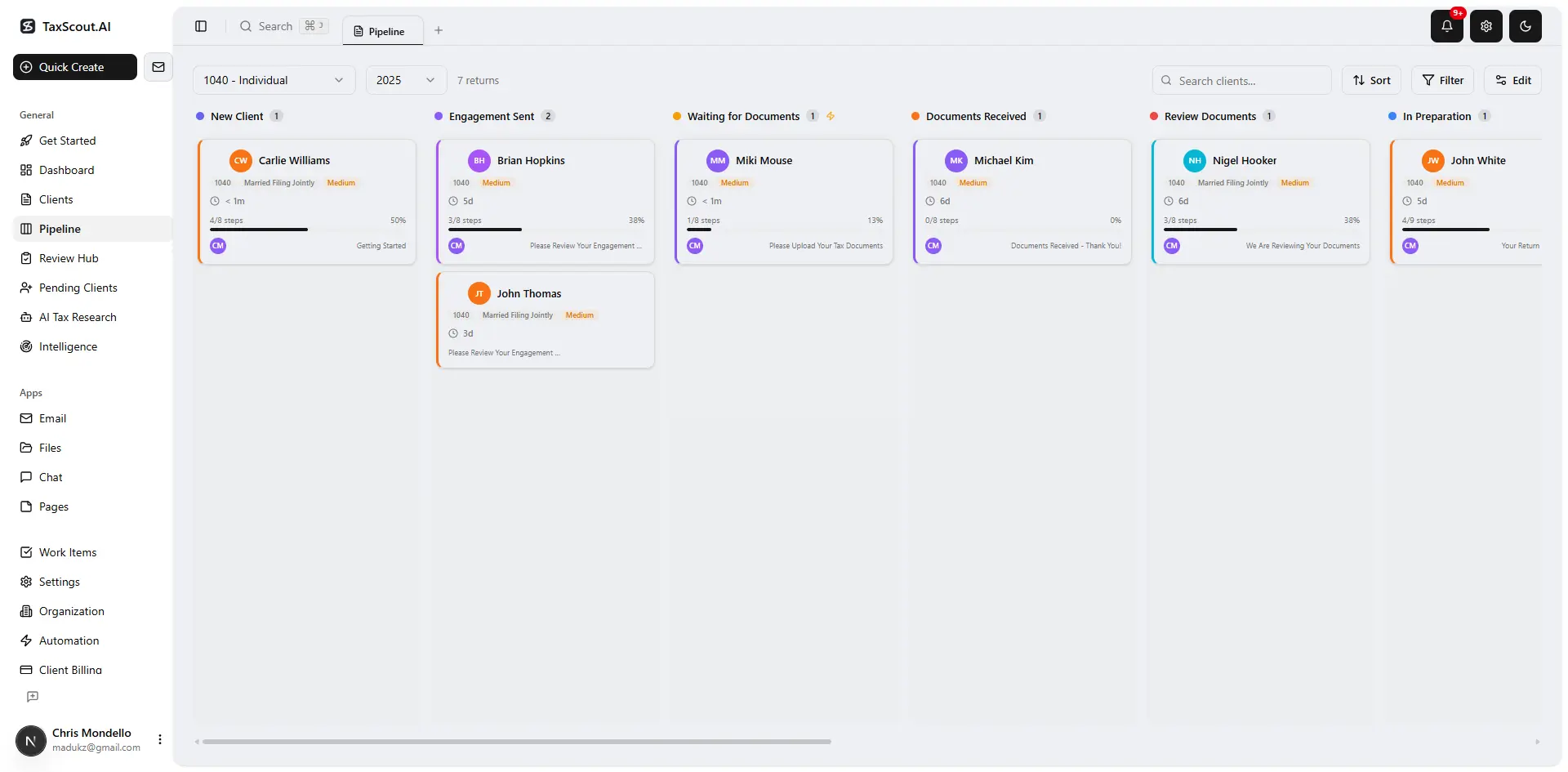
Track every return from intake to filed with drag-and-drop pipeline management
How AI-Native Practice Management Automates the Estimated Payment Workflow
This is where TaxScout's platform directly addresses a gap that no competitor — TaxDome, Canopy, Karbon, or anyone else — has built for. None of them connect estimated payment workflows to AI-assisted client advisory or automation. They are writing about LinkedIn profiles and recruitment strategies while their users are manually tracking Q2 deadline reminders in spreadsheets.
Here is what an automated estimated quarterly tax payments workflow looks like inside TaxScout:
Prior-year data extraction without rekeying. TaxScout's AI document extraction processes 180+ tax form types, including the prior-year 1040 with all schedules. Line 24 (total tax liability) is extracted with per-field confidence scoring through a 5-layer validation pipeline. You do not need to manually pull the number — it is already in the system and available across all sessions through client-context AI memory.
Safe harbor calculation via the Tax Calculation agent. One of TaxScout's 9 specialized AI research agents is dedicated to tax calculation. Ask it to run the safe harbor calculation for a specific client, and it retrieves the prior-year liability from extracted data, applies the 100%/110% threshold based on AGI, and returns the per-quarter payment amounts. It can also cross-reference current-year income data if the client has uploaded documents through the portal.
Pipeline management with deadline-triggered stages. TaxScout's pipeline management includes 12 customizable stages with auto-advance triggers. You can build an "Estimated Payments" pipeline that moves clients through Q1 Reminder → Q1 Confirmed → Q2 Reminder → Q2 Confirmed stages automatically, with condition-based advancement when the client acknowledges receipt through the portal.
Automated client communications. Through email integration (Gmail OAuth or Microsoft Graph API), TaxScout can send deadline reminders with the payment amount, relevant voucher, and a portal link — without manual drafting. The AI email classification system tags incoming responses by client and urgency, so if a client replies that their income has changed significantly, that surfaces immediately.
Document collection at each checkpoint. If a mid-year income review requires updated documents — a new 1099 for a consulting project, updated K-1 information — the branded client portal handles collection via OTP login with no password or account creation required. Clients upload, documents flow into the correct client folder automatically.
E-signature on payment authorization letters. If your engagement requires client sign-off on the recommended estimated quarterly tax payments, TaxScout's e-signatures via Documenso handle it — including engagement letters and custom authorization forms, with signing order dependencies if multiple parties need to review.
This is the workflow that transforms estimated payment advisory from a reactive call in April to a proactive, automated service that runs on its own between filing seasons.
Real-World Workflow: High-Income Self-Employed Client
Consider a client — a physician who incorporated as an S corp in 2025 — with prior-year AGI of $380,000 and a prior-year tax liability of $82,000. Income is projected to be similar in 2026, but there are quarterly K-1 distributions from a real estate partnership that vary.
January: TaxScout extracts Line 24 from the prior-year 1040 automatically. The safe harbor threshold is 110% × $82,000 = $90,200. Each quarterly payment: $22,550. The client's pipeline stage moves to "Safe Harbor Calculated."
March: Automated reminder sends through email integration, 14 days before April 15 Q1 deadline. The reminder includes the $22,550 payment amount and a portal link to confirm payment. The client confirms through the portal; the pipeline stage auto-advances.
June: Mid-year income checkpoint. The real estate K-1 is running higher than expected — Q1 distribution was $45,000 instead of projected $30,000. The client uploads the interim K-1 through the portal. The tax calculation agent flags that the current-year 90% method might now be preferable if income continues at this pace, but that the prior-year safe harbor is still covered for estimated quarterly tax payments. The CPA reviews and sends a 5-minute explainer note through the portal.
September and January: Q3 and Q4 reminders fire automatically. No manual intervention required unless income changes are flagged.
Result: zero underpayment penalty. Four client touchpoints. One advisory fee that more than covered the service cost. And the client's year-end call is about planning for next year — not explaining a penalty.
Ready to Turn Estimated Payment Deadlines Into an Advisory Revenue Stream?
TaxScout gives your firm the AI extraction, tax calculation agents, pipeline automation, and client portal to run a proactive estimated payment advisory service — for $49/mo flat, for your entire team.
Frequently Asked Questions
The 2026 estimated quarterly tax payment deadlines fall on April 15, June 16, September 15, and January 15, 2027. TaxScout.ai automatically flags each client's upcoming deadline 30, 14, and 7 days in advance, so no payment window falls through the cracks across a growing roster. The system tracks each client's payment status individually, giving CPAs a deadline dashboard without manual calendar management.
Stay up to date
Get the latest tax tech insights delivered to your inbox.