IRC 163(j) Interest Limitation: How CPAs Minimize the Impact on Heavily Leveraged Clients
The IRC 163(j) interest limitation catches many heavily leveraged clients off guard, and most available guidance stops at the IRS summary level. This walkthrough covers the complete CPA workflow: calculating the 30% ATI threshold, evaluating irrevocable elections, tracking EBIE carryforwards…
The IRC 163(j) interest limitation is one of the most consequential — and operationally underestimated — provisions affecting heavily leveraged businesses. Since the Tax Cuts and Jobs Act restructured the rule, every CPA with clients carrying significant debt load has had to navigate a calculation that begins simply enough (30% of adjusted taxable income) but branches quickly into elections, carryforwards, and entity-level coordination that compound across years.
Most publicly available coverage treats 163(j) as a summary exercise: define ATI, apply the cap, note the real property exception, move on. What that coverage omits is the CPA-specific workflow — how you actually document the ATI build-up, evaluate whether an irrevocable election makes economic sense over a 10-year horizon, track excess business interest expense at the partnership level as it flows through K-1s, and reconcile 163(j) with cost segregation studies and bonus depreciation when ATI is sitting right at the threshold. Most publicly available coverage treats the IRC 163(j) interest limitation as a summary exercise: define ATI, apply the cap, note the real property exception, move on.
This guide fills that gap. Whether you're preparing a C corporation with a leveraged buyout capital structure, a real estate partnership with a dozen limited partners, or a closely held S corp that may qualify for the small business exemption, the following walkthrough gives you the analytical sequence and documentation framework to minimize the limitation's impact and keep client workpapers defensible. This guide fills that gap by walking through the IRC 163(j) interest limitation in the context CPAs actually encounter it — from leveraged buyout structures to real estate partnerships to closely held S corps that may qualify for the small business exemption.
How the 30% ATI Threshold Actually Works
Under IRC §163(j), the deductible business interest expense for any taxable year is capped at the sum of business interest income, floor plan financing interest, and 30% of adjusted taxable income (ATI). Any business interest expense exceeding that sum becomes excess business interest expense (EBIE) and carries forward indefinitely. Under the IRC 163(j) interest limitation, the deductible business interest expense for any taxable year is capped at the sum of business interest income, floor plan financing interest, and 30% of adjusted taxable income (ATI), with any excess carrying forward to future years.
ATI is not the same as taxable income. For tax years beginning before January 1, 2022, ATI was computed by adding back depreciation, depletion, and amortization (a EBITDA-like measure). Beginning in 2022, those addbacks were removed, making ATI an EBIT-based figure — a change that significantly reduced the allowable deduction for capital-intensive businesses. CPAs who prepared 163(j) calculations under the pre-2022 regime and have not re-benchmarked affected clients against the tighter base are likely understating the IRC 163(j) interest limitation. For firms evaluating their IRC 163(j) interest limitation approach, this trade-off compounds over time.
The mechanical build-up starts with taxable income (before the 163(j) deduction itself), then adds back: business interest expense, net operating loss deductions, the Section 199A deduction, and — for tax years beginning before 2022 — depreciation, depletion, and amortization. From that figure, subtract business interest income and floor plan financing interest. The result is ATI. Multiply by 30% and you have the interest limitation ceiling. Document each addback line with a cross-reference to the return schedule; examiners will ask for it. Each of these factors directly shapes how IRC 163(j) interest limitation plays out in practice.
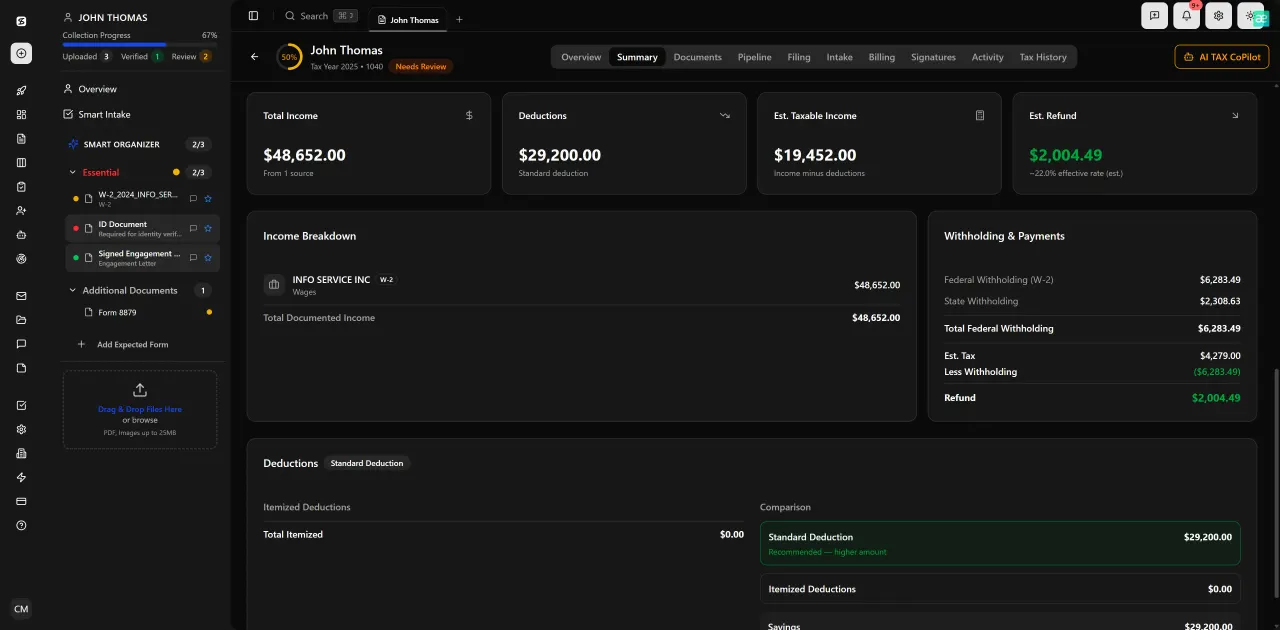
Review with AI assist — 9 agents answer questions with full client context
Small Business Exemption and the Gross Receipts Aggregation Election
Before running the 163(j) calculation at all, confirm whether the client qualifies for the small business exemption under IRC §163(j)(3). A taxpayer with average annual gross receipts of $30 million or less (indexed for inflation — confirm the current threshold at IRS.gov) for the three preceding tax years is entirely exempt from the IRC 163(j) interest limitation. For many closely held businesses, qualifying for this exemption is more valuable than any planning around the calculation itself. Understanding IRC 163(j) interest limitation in this context is what separates firms that scale from those that stall.
The complexity arises when related entities are involved. Under IRC §448(c), aggregation rules require that controlled groups and affiliated service groups be tested on a combined gross receipts basis. A client operating five LLCs under common control may individually clear the $30 million threshold in each entity, yet fail it when aggregated. Your workpaper should include a control group analysis, a schedule of gross receipts per entity for the three-year look-back, and a clear conclusion statement. This is precisely where a deliberate IRC 163(j) interest limitation strategy pays off.
The aggregation election itself (to treat related entities as one taxpayer for purposes of the gross receipts test) must be documented on the return. If the client is on the bubble, model both sides: qualifying for the exemption eliminates the limitation entirely, while a failure means the full 163(j) analysis applies. This is a planning decision with multi-year consequences — document your recommendation and the client's sign-off in the engagement file. The /features/ai-research-agents tool in TaxScout can pull current IRS guidance on aggregation elections in real time, reducing the research burden on this threshold question. IRC 163(j) interest limitation sits at the center of this decision — get it wrong and the rest unravels.
Tired of rebuilding your 163(j) workpapers from scratch every engagement?
TaxScout's AI research agents surface current IRS and Treasury guidance instantly, while structured document extraction keeps your ATI calculations traceable from source documents to return. When firms revisit their IRC 163(j) interest limitation priorities, the gaps usually surface here.

Every client gets organized documents, status tracking, and a complete history
The Real Property Trade or Business Election: Irrevocable Trade-Off Analysis
Under IRC §163(j)(7)(B), a real property trade or business can elect out of the IRC 163(j) interest limitation entirely. This is an irrevocable election — once made, it cannot be undone — and it comes with a permanent cost: electing real property trades or businesses must use the alternative depreciation system (ADS) for nonresidential real property, residential rental property, and qualified improvement property. For clients who have been claiming bonus depreciation or MACRS short lives on interior improvements, the ADS conversion eliminates those benefits prospectively.
The trade-off analysis CPAs must document involves projecting the present value of unrestricted interest deductions against the present value of the depreciation lives lost to ADS. ADS lives for nonresidential real property are 40 years; MACRS is 39. For residential rental property, ADS is 30 years versus MACRS's 27.5. The gap is narrowest for residential rental and widest for properties with significant qualified improvement property, where MACRS allows 15-year bonus-eligible treatment but ADS requires 20-year straight-line.
Before recommending the election for a real estate client, build a 10-year projection comparing: (a) the after-tax cost of disallowed interest expense under the IRC 163(j) interest limitation with carryforward assumptions, versus (b) the after-tax cost of slower depreciation deductions under ADS. For clients with high leverage and long asset hold periods, the election often wins. For clients planning to exit in three to five years, the depreciation drag may outweigh the interest benefit. This analysis belongs in the workpaper, not just in your notes — see our coverage of basis tracking for S corp shareholders for a parallel example of multi-year projection documentation in a pass-through context.
If the client has completed a cost segregation study, the interaction becomes more complex. Cost segregation reclassifies building components into 5, 7, and 15-year personal property and land improvement categories. Under the current bonus depreciation rules, property acquired after January 19, 2025 qualifies for 100% bonus depreciation under P.L. 119-21 §70301. The real property election eliminates this benefit for QIP but does not affect personal property components already segregated — confirm the reclassification schedule before making the election, and document which assets fall inside versus outside the ADS mandate.

Click any extracted field to see its source highlighted on the original PDF
Floor Plan Financing Interest and the Motor Vehicle Dealer Exception
Floor plan financing interest — interest paid on debt used to finance motor vehicle, boat, farm machinery, and similar dealer inventory — is treated as fully deductible under IRC §163(j)(1)(C) and is also added back to the 30% ceiling. This exception is significant for auto dealerships and equipment dealers, but it comes with an important restriction: any taxpayer with floor plan financing interest cannot use the small business exemption. The two benefits are mutually exclusive by statute.
When a client has both floor plan financing and other business interest, the workpaper must segregate the two categories of debt. The floor plan component is deductible dollar-for-dollar; only the non-floor-plan business interest is subject to the IRC 163(j) interest limitation's 30% cap. Misclassifying a revolving line of credit as floor plan financing — a common error when a dealer uses a single credit facility for both inventory and operations — overstates the deductible amount and creates exam exposure. Review the underlying credit agreement and confirm that the funds were specifically designated for dealer inventory before treating the interest as floor plan financing.
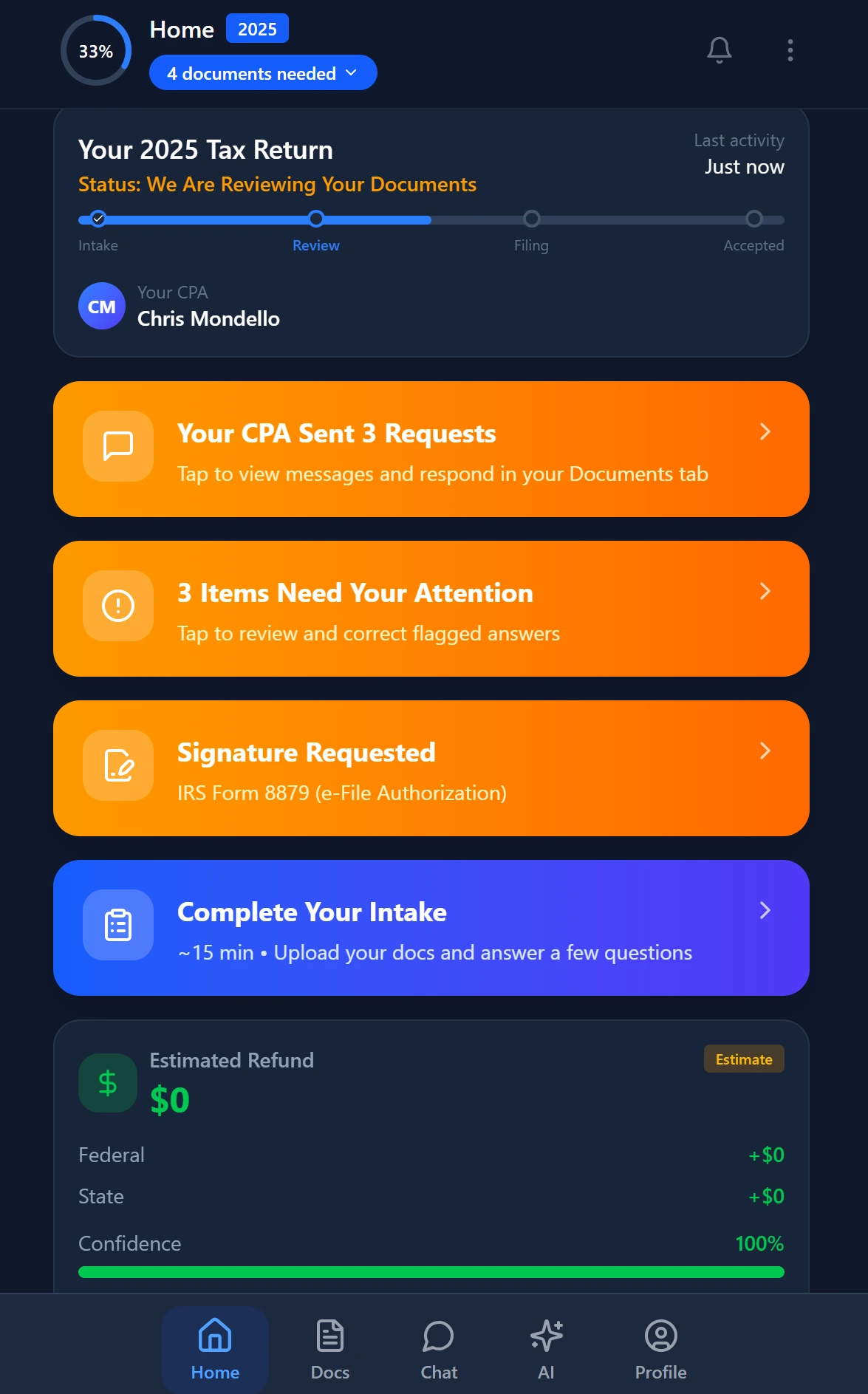
Smart intake auto-fills from uploaded documents and prior-year data
EBIE Carryforward Tracking at the Partnership Level
The most technically demanding aspect of 163(j) for most CPA practices is managing excess business interest expense at the partnership level. Under the Treasury regulations, partnerships apply the IRC 163(j) interest limitation at the entity level. The deductible business interest is allocated to partners as excess business interest income (EBII) or deductible BIE on Schedule K-1. Disallowed interest becomes EBIE allocated on each partner's K-1 — and this is where partner-level tracking becomes critical.
EBIE allocated to a partner is not deductible by that partner in the year allocated. Instead, it sits in a partner-level suspense account and becomes deductible only in a future year when the partnership allocates excess taxable income (ETI) or EBII to that same partner. The deductible amount in the future year equals the lesser of the EBIE carryforward or 50% of the partner's adjusted basis in the partnership, with a separate calculation for the basis test. Partners who sell or dispose of their partnership interest before the EBIE carryforward is released lose those deductions permanently — a planning landmine that CPAs rarely surface proactively.
For your practice, EBIE tracking requires a per-partner, per-partnership schedule that carries forward the cumulative suspended interest year over year and models when ETI allocations from the partnership will release it. This schedule must reconcile to the K-1 received each year. If a client holds interests in multiple leveraged partnerships — common in real estate fund structures — the schedules must be maintained separately; EBIE from Partnership A cannot be released by ETI from Partnership B. Review our 754 step-up basis guide for context on the related partner-level basis adjustments that interact with EBIE calculations when partners transfer interests.
When a partnership makes the 163(j) real property election, no EBIE is allocated to partners — the election resolves the IRC 163(j) interest limitation at the entity level. CPAs advising limited partners in a fund should understand whether the fund has made the election, since it materially changes whether partner-level EBIE schedules are even necessary. Request confirmation from the fund's tax advisor or general partner before preparing K-1 input, and document the source of that confirmation in your file. The /features/file-management system in TaxScout allows you to attach source K-1s and correspondence directly to the client record alongside your workpaper, keeping the audit trail intact.
163(j) Limitation vs. Small Business Exemption: Key Criteria at a Glance
| Factor | 163(j) Applies | Small Business Exemption |
|---|---|---|
| Gross Receipts (3-yr avg) | Over $30M threshold | At or below $30M threshold |
| Floor Plan Financing | Fully deductible; caps other BIE | Not eligible for exemption if present |
| Real Property Election | Irrevocable; ADS required | Not applicable — exempt from rule |
| Partnership EBIE | Tracked per partner per year | Not applicable — exempt from rule |
| Carryforward Period | Indefinite | N/A |
| Documentation Burden | ATI schedule, K-1 reconciliation, election analysis | Control group analysis, 3-yr gross receipts schedule |
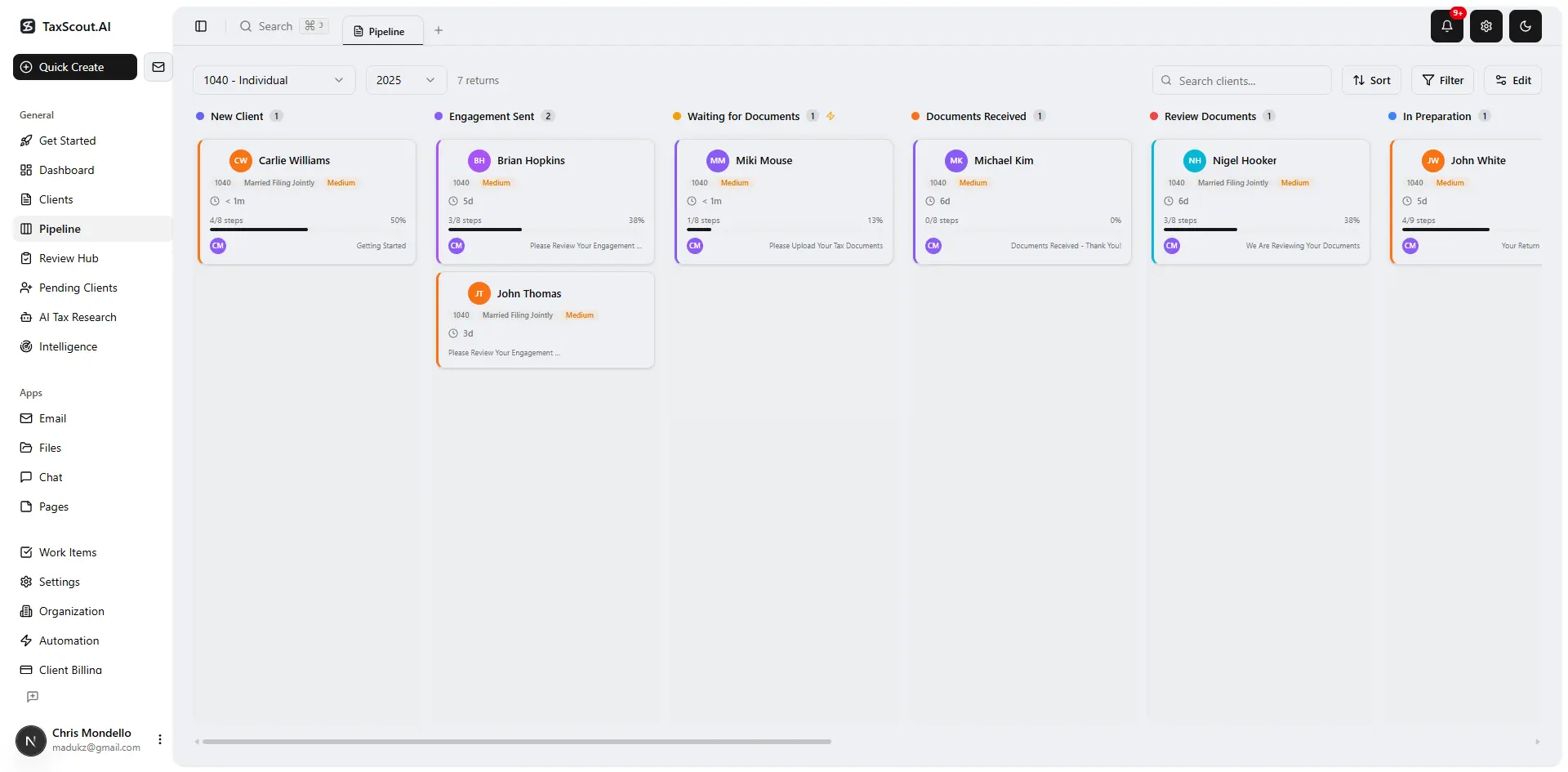
Track every return from intake to filed with drag-and-drop pipeline management
IRC 163(j) Interest Limitation Interaction With Bonus Depreciation and Cost Segregation
When ATI is near the 30% threshold, the interaction between the IRC 163(j) interest limitation and bonus depreciation creates a planning tension that many CPAs resolve suboptimally. Large bonus depreciation deductions reduce taxable income — and therefore reduce ATI — which in turn tightens the 163(j) ceiling and potentially disallows more interest expense. For a C corporation with $10 million of ATI before a $4 million bonus depreciation deduction, the ceiling drops from $3 million to $1.8 million (30% × $6M), potentially pushing significant interest expense into carryforward.
The energy tax credits and IRA incentive planning framework offers a useful analogy: sometimes a dollar of immediate depreciation costs more than a dollar when it triggers a cascade limitation elsewhere. The same logic applies here. For clients whose ATI is between 1.0x and 1.5x their annual business interest expense, model the after-tax result of: (1) claiming full bonus depreciation and carrying forward EBIE, versus (2) electing out of bonus depreciation under IRC §168(k)(7) to preserve ATI and deduct more interest currently. The election-out is made property class by property class, giving CPAs granular control.
Cost segregation studies compound this analysis. A study that reclassifies $2 million of 39-year property into 5-year personal property eligible for 100% bonus depreciation is straightforwardly beneficial in most contexts — but if the client is already at the IRC 163(j) interest limitation ceiling, the incremental depreciation may deliver less current value than the interest deduction it displaces. Run both scenarios, document the analysis, and let the client make an informed decision. For clients who have already completed cost segregation and are now facing a 163(j) problem, see our other tax planning resources for additional interaction issues across depreciation regimes.
One practical note for the workpaper: when the client is a C corporation subject to both 163(j) and the corporate AMT under IRC §55 as amended by the Inflation Reduction Act, the ATI calculation for the IRC 163(j) interest limitation uses regular taxable income — not AFSI (adjusted financial statement income) used for CAMT. The two measures can diverge substantially for asset-heavy businesses. Document which income base applies to which calculation to avoid confusion in exam. Our AMT planning guide covers the CAMT computation in detail for C corporations above the $1 billion AFSI threshold.
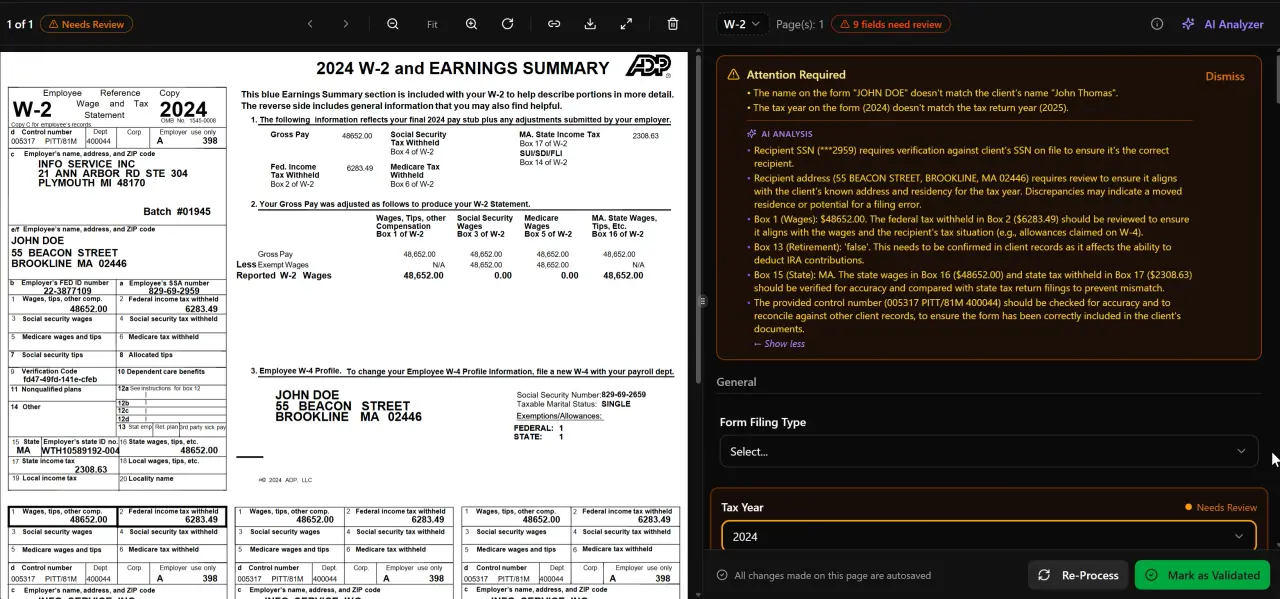
AI classifies, extracts, and validates every document automatically
Building Defensible Workpapers for the 163(j) Analysis
A well-constructed 163(j) workpaper has five components: (1) ATI computation with line-by-line cross-references to the return; (2) business interest expense classification schedule separating floor plan, investment, and trade or business interest; (3) election documentation including the trade-off analysis and client authorization; (4) EBIE carryforward schedule by entity and by partner where applicable; and (5) a planning memo summarizing the annual conclusion, any elections made, and forward-looking considerations for next year.
For clients in tiered structures — a holding company that owns operating entities that own real property — the workpaper must trace the IRC 163(j) interest limitation through each level. An operating partnership that makes the real property election does not pass EBIE to its partners, but a holding company that borrows to acquire partnership interests and deducts that interest as business interest expense faces a separate 163(j) analysis at the holding company level. These are distinct calculations; do not blend them into a single schedule.
The /features/ai-document-extraction capability in TaxScout processes K-1s and supporting schedules with confidence scoring and cross-document validation, reducing the manual effort of populating EBIE schedules from multi-entity K-1 packages. The split-screen PDF viewer with click-to-source field highlighting makes it straightforward to verify that the EBIE figure on your workpaper traces back to the exact box on the K-1 — precisely the documentation trail that holds up under IRS examination.
Finally, calendar a 163(j) review as a standing agenda item in your year-end planning meetings for any client with significant leverage. The ATI calculation, the status of carryforward schedules, and the continued appropriateness of any irrevocable elections should all be reviewed annually — not just at return time. Embedding this review into your pipeline management workflow ensures it does not fall through the cracks during a busy season.
Are EBIE carryforward schedules and multi-entity K-1 reconciliations eating your team's time every season?
TaxScout's AI extraction, research agents, and structured document management give your firm a complete platform for complex limitation analysis — at a flat monthly fee, no per-user charges.
Frequently Asked Questions
Adjusted taxable income (ATI) under IRC §163(j) starts with taxable income computed without regard to the business interest deduction itself, then adds back business interest expense, net operating loss deductions, the Section 199A deduction, and — for tax years beginning before January 1, 2022 — depreciation, depletion, and amortization. From 2022 onward, the D&A addbacks are gone, making ATI an EBIT-based measure that is generally lower than the pre-2022 EBITDA-based figure, and therefore tightening the 30% ceiling for capital-intensive businesses.
Keep reading
Passive Foreign Investment Company Rules: How CPAs Minimize PFIC Tax for Clients With Foreign Mutual Funds
Nov 7, 2026 · 1 min read
Meals and Entertainment Deductions: How CPAs Navigate the Post-TCJA Rules for Business Clients
Nov 5, 2026 · 1 min read
Basis Tracking for S Corp Shareholders: How CPAs Prevent Deduction Losses at Year-End
Nov 4, 2026 · 1 min read
Stay up to date
Get the latest tax tech insights delivered to your inbox.