AMT Planning for CPAs: How to Shield Business Clients From the Corporate Alternative Minimum Tax
The Inflation Reduction Act's 15% Corporate Alternative Minimum Tax creates a new compliance burden for C-corp clients with over $1 billion in adjusted financial statement income — and planning exposure that ripples into mid-market consolidated groups. This guide walks CPAs through the AFSI…
AMT planning for CPAs entered a new era on January 1, 2023, when the corporate alternative minimum tax established by the Inflation Reduction Act took effect. Unlike the individual AMT that practitioners have managed for decades, the new 15% Corporate AMT — formally the Book Minimum Tax — is calculated on adjusted financial statement income (AFSI), not on taxable income or traditional alternative minimum taxable income. That distinction changes the entire planning calculus for CPA firms serving C-corps, consolidated groups, and certain pass-through entities with corporate parents.
Most published guidance on AMT still targets high-income individuals: phaseouts, ISO exercises, and the AMTI exemption under prior law. Firms searching for practical CAMT workflow guidance find almost nothing at the mid-market level. The IRS has released initial guidance under Notice 2023-7 and Notice 2023-64, and proposed regulations followed in September 2024, but translating that technical framework into client-facing planning steps is still a gap most CPA firms have not closed. This disconnect is precisely why AMT planning for CPAs has shifted focus toward the new corporate alternative minimum tax and its unique compliance demands.
This guide fills that gap. We cover how to identify which clients are actually at risk, how to reconstruct the AFSI computation from financial statements, what credits and elections are available to reduce or defer the liability, and how to build a documentation trail that withstands IRS scrutiny — all within a practical workflow CPAs can apply today. Effective AMT planning for CPAs requires a structured approach that goes well beyond simply flagging exposure after the return is prepared.
Who Is Subject to the Corporate Alternative Minimum Tax
The CAMT applies to an applicable corporation — any C-corp (other than an S-corp, regulated investment company, or real estate investment trust) whose average annual AFSI exceeds $1 billion over the three prior tax years. That threshold sounds like it filters out mid-market clients entirely, but consolidated group rules create meaningful downstream exposure. Understanding exactly who qualifies as an applicable corporation is the first analytical step in any serious AMT planning for CPAs advising C-corp clients.
Under IRC § 59(k), the three-year average is tested at the controlled group level. A C-corp subsidiary of a foreign parent whose worldwide financial statements clear $1 billion is potentially an applicable corporation even if its standalone revenue is far lower. Similarly, a domestic consolidated group where the parent's GAAP consolidated financials surpass the threshold pulls every member into scope. CPAs advising mid-market C-corps that belong to larger consolidated groups — or that were recently acquired by private equity platforms with aggregated revenue above the threshold — should run the controlled group test before concluding the client is exempt. For firms evaluating their AMT planning for CPAs approach, this trade-off compounds over time.
Foreign-parented companies face a bifurcated calculation: only the U.S. portion of AFSI is used for the actual tax computation, but the entire worldwide group's AFSI is used for the threshold test. This asymmetry means a $250 million U.S. subsidiary of a $1.5 billion global manufacturer is subject to CAMT even though its own financials would never trip the threshold independently. See our related analysis of consolidated group planning issues for additional context on group-level complications CPAs should anticipate. Each of these factors directly shapes how AMT planning for CPAs plays out in practice.
Pass-through clients are generally outside CAMT's reach — S-corps, partnerships, and sole proprietors are explicitly excluded. However, CPAs should flag any S-corp or partnership with a C-corp investor that is itself part of a larger controlled group. The pass-through itself is not subject, but the C-corp partner's distributive share of partnership income flows into AFSI calculations for the corporate partner, which matters for credit and income allocation planning. Understanding AMT planning for CPAs in this context is what separates firms that scale from those that stall.
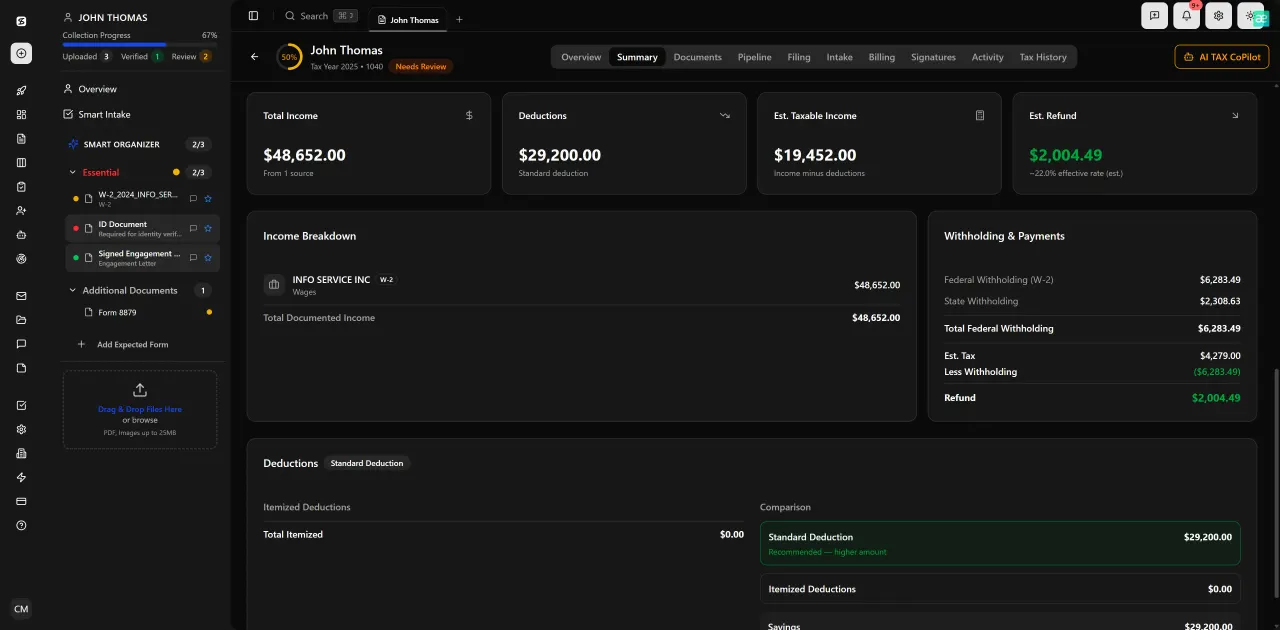
Review with AI assist — 9 agents answer questions with full client context
How to Calculate Adjusted Financial Statement Income
Tired of manual workflows slowing your firm down? See how TaxScout handles this with AI-powered automation. → Book a 15-Min Demo This is precisely where a deliberate AMT planning for CPAs strategy pays off.
AFSI begins with the net income or loss reported on the corporation's applicable financial statement — typically audited GAAP financials, or IFRS financials for foreign-parented entities. From that starting point, CPAs must make a series of adjustments specified in IRC § 56A and the 2024 proposed regulations. AMT planning for CPAs sits at the center of this decision — get it wrong and the rest unravels.
The most consequential adjustments for most clients are: (1) eliminating dividends received from domestic corporations that would be eliminated in consolidation; (2) adjusting for the tax basis of depreciable property — the proposed regulations require adding back the excess of book depreciation over tax depreciation, which will create AFSI increases for clients who took large bonus depreciation deductions; (3) excluding income of foreign subsidiaries to the extent it is already subject to GILTI or Subpart F inclusion; and (4) reversing any Section 168(k) bonus depreciation benefit that reduced taxable income but not book income. When firms revisit their AMT planning for CPAs priorities, the gaps usually surface here.
Depreciation timing differences are the most common driver of AFSI exceeding taxable income for capital-intensive clients. A manufacturer or logistics company that elected 100% bonus depreciation under TCJA — and whose tax return shows a near-zero regular tax — may discover significant CAMT exposure once book depreciation is substituted back in. The IRS addressed some depreciation computation mechanics in Notice 2023-64, but practitioners should also monitor the proposed regulations for the final depreciation adjustment rules, which were still not finalized as of the first quarter of 2026.
Financial statement restatements add another layer of complexity. If a client restates its financial statements after filing, AFSI for the restated years must also be recomputed, potentially triggering amended returns or carryforward adjustments. Document the financial statement version used for each year's CAMT calculation — this is not optional; the IRS will want to trace the AFSI figure to a specific financial statement dated and signed by management.
Step-by-Step AFSI Computation Checklist
Step 1: Obtain the applicable financial statement for each year in the three-year averaging period. Confirm the statement type (GAAP, IFRS, or SEC filing) and identify the entity whose financials are used for the threshold test versus the tax computation.
Step 2: Pull net income (loss) before income taxes from the financial statements. Do not use after-tax net income — the starting point excludes the current and deferred tax provision.
Step 3: Apply the IRC § 56A adjustments in sequence: remove intercompany dividends eliminated in consolidation; substitute tax depreciation for book depreciation on § 168 property; adjust for related-party transactions not at arm's length; and add back any GAAP income that is permanently excluded from taxable income and lacks a § 56A exclusion.
Step 4: For foreign-parented groups, calculate the U.S.-only AFSI by eliminating the foreign parent's net income and only including the U.S. group member income attributable to U.S. operations, per the proposed regulations' U.S. net income rules.
Step 5: Average AFSI over the three-year period. If the client has not existed for three years, use the available years. First-year applicability uses the single year's AFSI.
Step 6: Multiply AFSI by 15% to arrive at the tentative CAMT. Compare to regular tax plus any base erosion and anti-abuse tax. CAMT is owed only to the extent it exceeds this sum.
Tracking AFSI adjustments across multiple financial statement versions in a spreadsheet?
TaxScout's AI research agents search IRS, Treasury, and Cornell Law in real time so your team can build defensible CAMT memos in minutes, not hours.
→ See AI Research Agents in Action
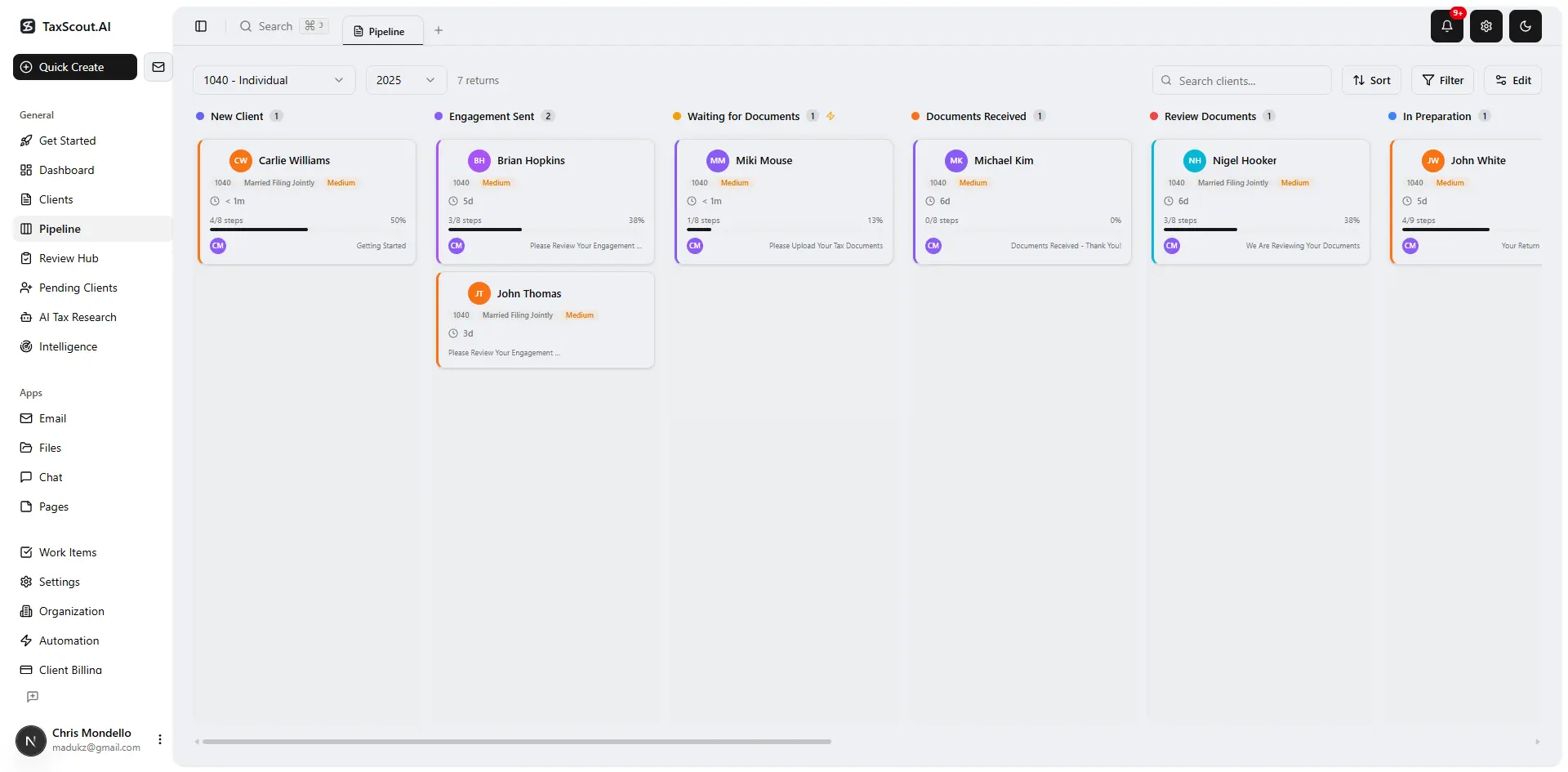
Track every return from intake to filed with drag-and-drop pipeline management
Available Credits and Offsets That Reduce CAMT Liability
The CAMT is not a hard-floor tax in the way the old individual AMT operated. Several credits and mechanisms can reduce or eliminate the actual cash outlay, and understanding them is central to CAMT planning strategies for CPAs.
The most significant relief mechanism is the CAMT credit carryforward under IRC § 53 as modified by the IRA. When a client pays CAMT in a given year, that amount becomes a credit carryforward — the CAMT credit — that can offset regular tax liability in future years when regular tax exceeds CAMT. For clients whose CAMT exposure is driven by timing differences (bonus depreciation, accelerated amortization), the CAMT credit carryforward effectively converts the liability into a prepayment of future tax rather than a permanent cost. Planning opportunity: model the expected reversal years and project when the CAMT credit will be usable, then include that schedule in the client's multi-year tax projection. This kind of forward-looking analysis is a hallmark of strong AMT planning for CPAs serving capital-intensive businesses.
The general business credit is not currently allowable against CAMT, but the IRA created specific exceptions. The Section 48D advanced manufacturing investment credit, the Section 45X advanced manufacturing production credit, and certain clean energy credits under Sections 45 and 48 are explicitly allowed as offsets to CAMT. If your client holds these credits, verify applicability and document the election or allocation. The IRS CAMT guidance page is the most current resource for credit interaction rules pending finalization of proposed regulations.
The foreign tax credit is available against CAMT, but only a proportionate share tied to the ratio of AFSI to worldwide financial statement income. This limitation can surprise foreign-parented clients that routinely use large FTC pools to eliminate regular tax — the CAMT FTC calculation is entirely separate from the regular tax FTC and must be computed on Form 8827 using AFSI-based apportionment. Practitioners who have built AMT planning for CPAs into their annual client review process tend to catch these FTC discrepancies well before the return is due.
Practitioners working on net investment income tax exposure for high-income shareholders of affected C-corps may also want to cross-reference our guide on net investment income tax planning, since dividend distributions from a CAMT-paying corporation interact with NIIT at the shareholder level.

Click any extracted field to see its source highlighted on the original PDF
CAMT Planning Strategies and Elections CPAs Should Document
Proactive CAMT planning for CPAs centers on two questions: can the AFSI base be reduced through legitimate planning, and can the timing of CAMT liability be deferred or converted to a recoverable credit? Both questions require written documentation that survives an IRS examination.
Depreciation method elections offer the clearest planning lever. Clients who have been claiming maximum bonus depreciation to minimize regular tax should model the tradeoff: bonus depreciation reduces taxable income and regular tax, but it simultaneously expands the gap between book and tax depreciation, which increases AFSI and CAMT exposure. For some capital-intensive clients, electing out of bonus depreciation under § 168(k)(7) — or electing ADS depreciation — narrows the book-tax depreciation gap, reduces AFSI, and may lower total tax cost on a present-value basis. Run both scenarios before year-end and document the modeling in the workpaper file.
Partnership income allocations flowing into a corporate partner's AFSI also present planning opportunities. Because the corporate partner's share of partnership book income is included in its AFSI, CPAs advising both the partnership and its C-corp partners should review the allocation methodology. Guaranteed payments, preferred return structures, and special allocations can shift income timing in ways that affect the three-year AFSI average. Any allocation change must be supported by a valid business purpose and should be documented in an updated partnership agreement or side letter before the end of the tax year.
For consolidated group filers, the proposed regulations allow certain intercompany eliminations that reduce consolidated AFSI. Document which intercompany transactions have been eliminated and confirm that the eliminations are consistent with the group's consolidation policy. Inconsistencies between the GAAP consolidation and the CAMT consolidation are an audit red flag.
Finally, maintain a CAMT-specific workpaper package for each applicable corporation. At minimum, this should include: the applicable financial statement used, the AFSI computation with supporting adjustments, the three-year average calculation, the tentative CAMT amount, any credits applied with authority citations, and the CAMT credit carryforward schedule. Attaching this package to the e-file record and storing it with other tax workpapers creates the documentation trail required to invoke the reasonable basis and good-faith reliance defenses if positions are later challenged — see our guide to the reasonable basis defense for the documentation standards CPAs should meet.
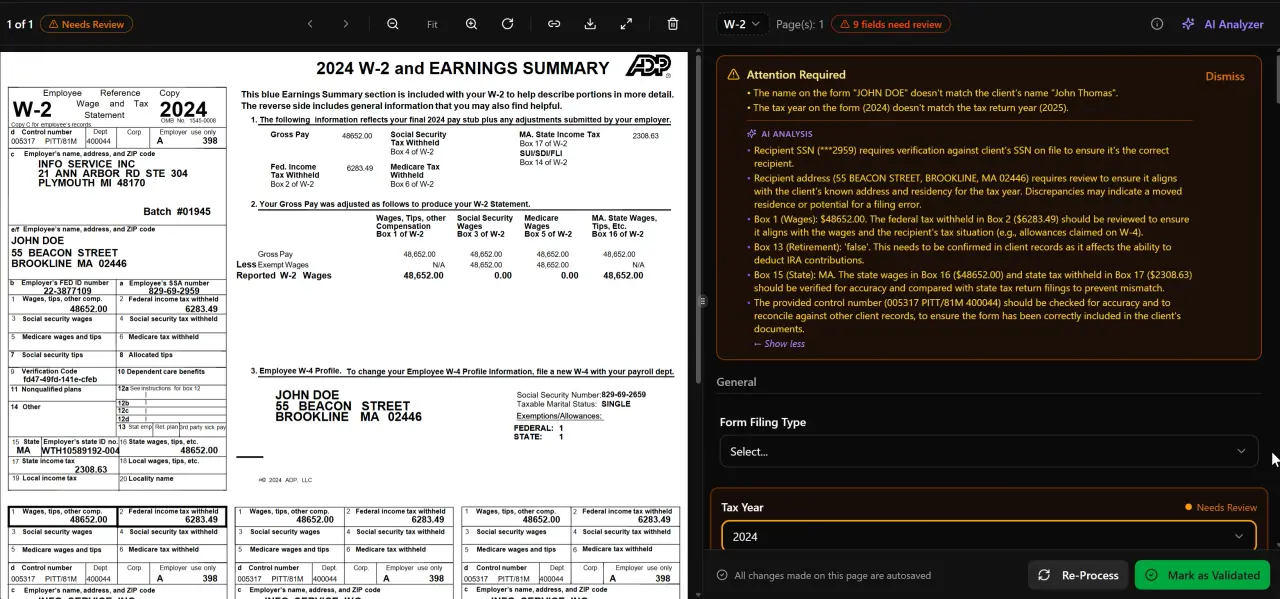
AI classifies, extracts, and validates every document automatically
Identifying CAMT-Exposed Clients Before Year-End
The practical challenge for most CPA firms is not understanding CAMT in theory — it is systematically identifying which clients in their book of business are at risk before the filing deadline arrives. A client that discovers a CAMT liability during return preparation has no room for planning; the opportunity is entirely in Q3 and Q4 of the tax year. Firms that treat AMT planning for CPAs as a year-round discipline rather than a filing-season task consistently deliver better outcomes for clients in this situation.
Start with a simple screening question on your annual engagement setup: does this C-corp belong to a controlled group whose worldwide GAAP revenue exceeds $1 billion? If yes, request the consolidating financial statements, not just the standalone client financials. If the client is a subsidiary without direct access to group-level financials, escalate to the CFO and document the request.
For clients that clear the threshold test, model AFSI early — ideally by October of the current tax year — using the prior two years' AFSI actuals and a projection for the current year. The key data points to collect from the client's finance team are: current-year book income before tax provision, accumulated bonus depreciation deductions not reflected in book depreciation, and any new capital expenditures planned before year-end. The IRS Form 4626 instructions provide the official computation framework and should be used as a checklist.
Firms managing a large volume of C-corp clients benefit from a structured pipeline to track CAMT screening status alongside other filing milestones. TaxScout's pipeline management feature supports 12 customizable stages, making it straightforward to add a CAMT screening checkpoint to your existing workflow and assign it to a team member before the return enters the preparation stage. Combined with the AI research agents that search IRS and Treasury guidance in real time, your team can surface current CAMT notices and proposed regulation updates without manually monitoring the IRS website.
You can find additional planning articles and regulatory updates across our complete CPA practice management blog, including coverage of other Inflation Reduction Act provisions that interact with CAMT planning.
CAMT vs. Prior Individual AMT: Key Differences CPAs Must Understand
| Feature | Individual AMT (Pre-IRA) | Corporate AMT / CAMT (Post-IRA) |
|---|---|---|
| Tax base | Alternative minimum taxable income (AMTI) | Adjusted financial statement income (AFSI) |
| Rate | 26% / 28% | 15% flat |
| Threshold | Phaseout of exemption (2025: ~$137K single) | Avg. AFSI > $1B over 3 years (group level) |
| Starting point | Taxable income with preference items added back | GAAP/IFRS net income before tax provision |
| Key timing driver | ISO exercises, accelerated depreciation preferences | Bonus depreciation book-tax gap, timing differences |
| Credit recovery | AMT credit carryforward against regular tax | CAMT credit carryforward against future regular tax |
| Foreign tax credit | Proportionate regular-tax FTC | Proportionate AFSI-based FTC (separate calculation) |
| Form filed | Form 6251 | Form 4626 |
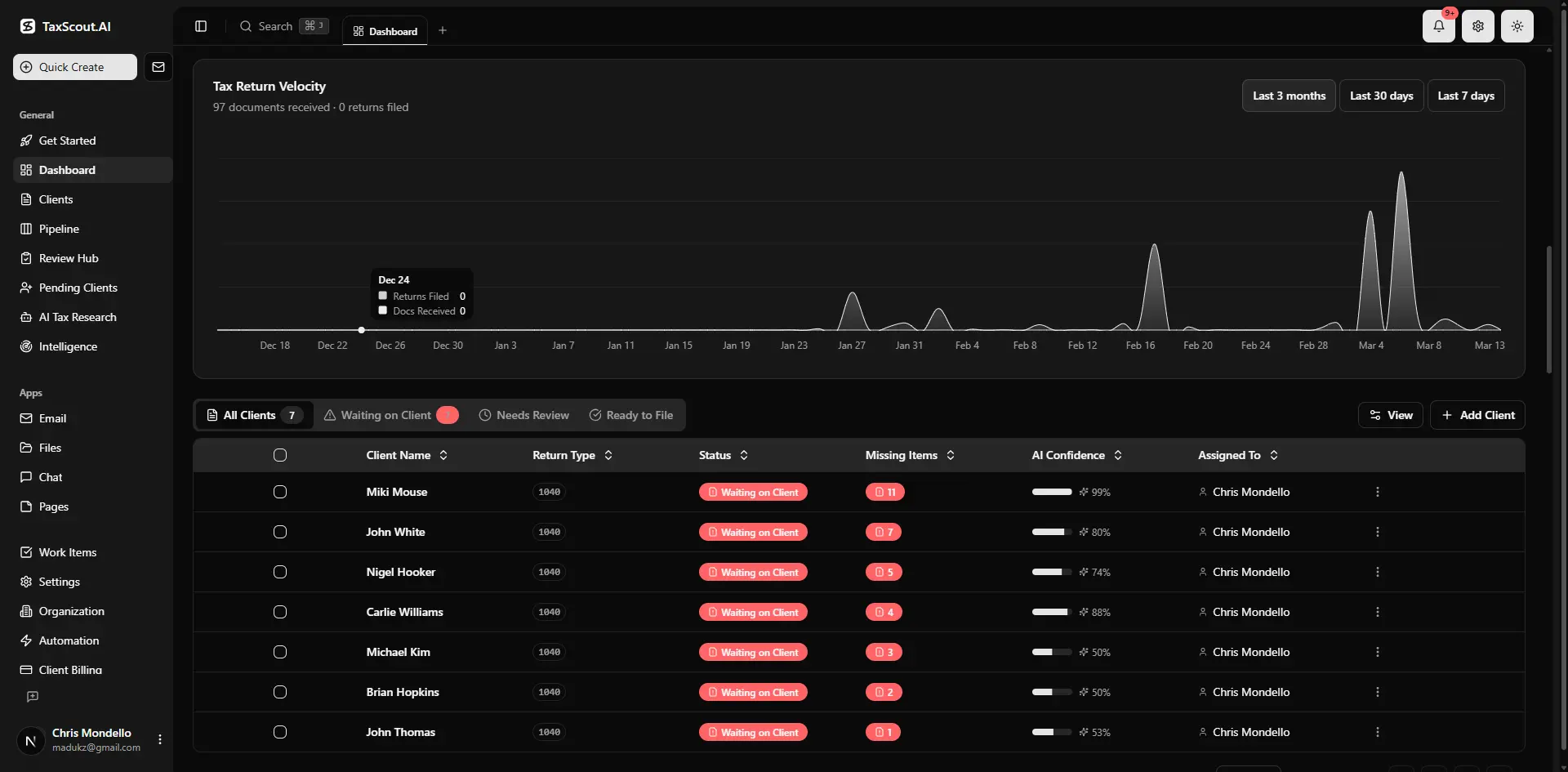
Real-time dashboard showing returns in progress, revenue, and upcoming deadlines
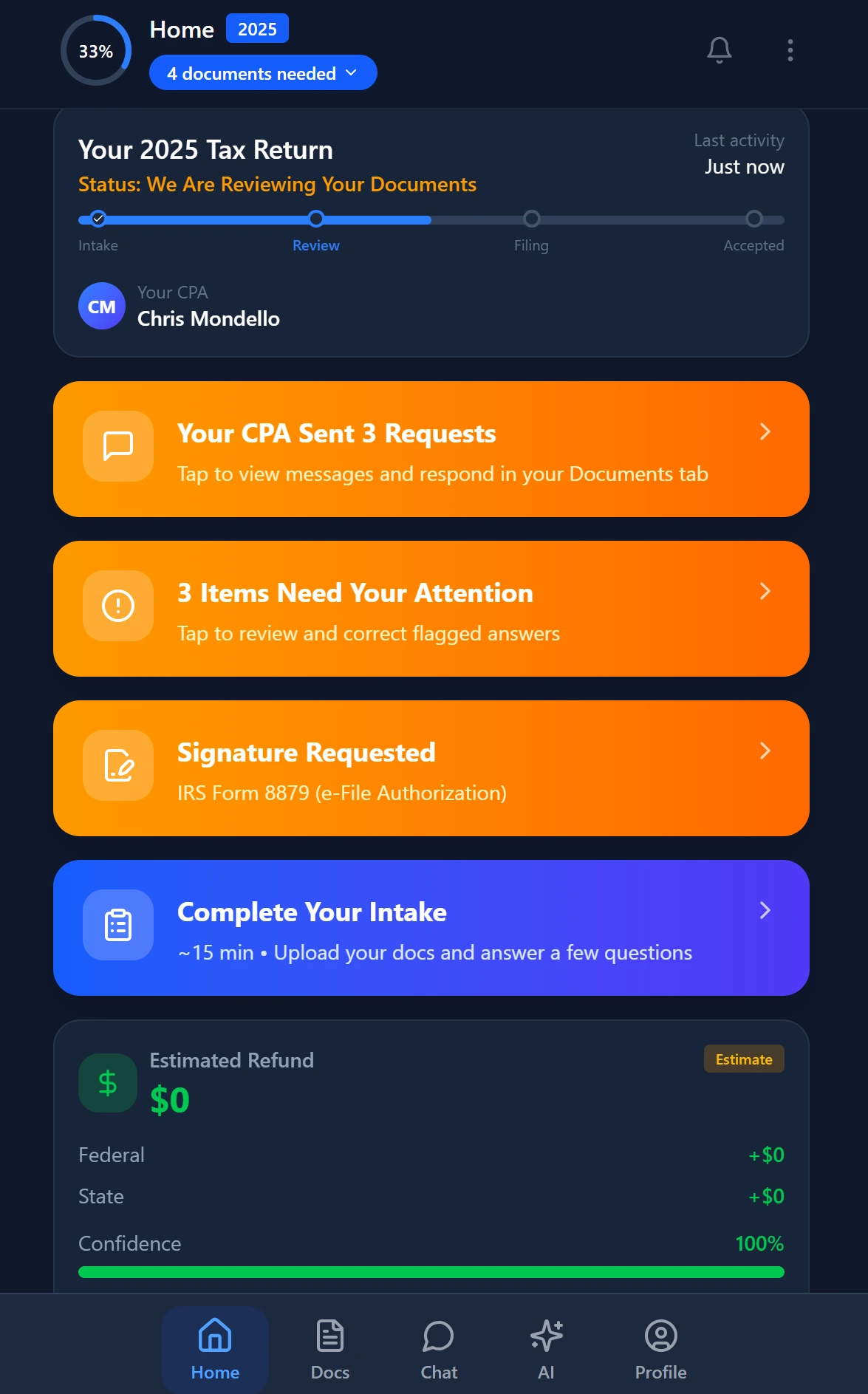
Smart intake auto-fills from uploaded documents and prior-year data
How Practice Technology Supports CAMT Compliance Workflows
CAMT compliance is document-intensive in a way that strains standard tax preparation workflows. CPAs need the client's audited financials (multiple years), the consolidating trial balance for group members, depreciation schedules reconciling book and tax, and credit documentation — all organized and accessible before a return can be completed. Firms still managing this through email threads and shared drives routinely lose time locating the right version of a financial statement or tracing which depreciation schedule was used for a prior year's AFSI computation. For these firms, building a reliable AMT planning for CPAs workflow into their technology stack is no longer optional — it is a competitive necessity.
A structured document management system that versions client documents and links them to specific return years eliminates that ambiguity. TaxScout's AI document extraction processes recognized financial document classes — including K-1s, 1040 schedules, and supporting records — and its 5-layer validation pipeline applies OCR cross-verification and 15 deterministic math rules to flag extraction errors before they reach the workpaper. For CAMT purposes, the split-screen PDF viewer with click-to-source field highlighting makes it fast to cross-reference a specific AFSI adjustment against the financial statement line from which it was derived.
Research velocity matters too. The 2024 proposed regulations for CAMT run to hundreds of pages, and IRS notices continue to update the interim rules. TaxScout's 9 specialized AI research agents search IRS, Treasury, Cornell Law, and SSA sources in real time, surfacing the most current guidance without requiring a practitioner to manually monitor the Federal Register. This keeps CAMT memos current and defensible — a requirement that will only grow as the proposed regulations move toward finalization.
For firms evaluating their current software stack against these workflow demands, our comparisons of TaxDome alternatives and Canopy alternatives walk through specific capability gaps in competitor platforms that become consequential for complex compliance work like CAMT. Explore TaxScout's full feature set and pricing to see how the platform supports the document-intensive workflows that CAMT planning requires.
Still piecing together CAMT workpapers across email, shared drives, and disconnected research tabs?
TaxScout centralizes document management, AI research, and pipeline tracking in one platform built for CPA firms — no per-user fees, unlimited team members.
Frequently Asked Questions
The CAMT applies to applicable corporations — C-corps (excluding S-corps, REITs, and RICs) whose average annual adjusted financial statement income (AFSI) exceeds $1 billion over the three prior tax years, measured at the controlled group level. Mid-market C-corps that belong to larger consolidated groups or foreign-parented structures may be subject even if their standalone revenue is well below $1 billion.
Keep reading
Schedule K-3 Reporting: How CPAs Handle International Pass-Through Items for Domestic Partners
Oct 19, 2026 · 1 min read
Uniform Capitalization Rules: How CPAs Apply UNICAP to Inventory and Self-Constructed Assets
Oct 17, 2026 · 1 min read
Non-Applicability of Section 357(c) to Consolidated Groups: What CPA Firms Must Do Now
Oct 17, 2026 · 1 min read
Stay up to date
Get the latest tax tech insights delivered to your inbox.