Energy Tax Credits for CPAs: How to Claim IRA Incentives for Business Clients
The Inflation Reduction Act created a layered stack of energy tax credits — 45L, 179D, 48E, 30C, and more — that construction, manufacturing, and real estate clients can claim starting now. This guide walks CPAs through eligibility screening, transferability elections, basis reduction…
Energy tax credits for CPAs have grown from a niche specialty into a core advisory competency. The Inflation Reduction Act of 2022 (IRA) restructured, expanded, and in many cases made permanent a stack of clean energy incentives that now reach construction contractors, commercial building owners, manufacturers, multifamily developers, and fleet operators. For firms that serve those industries, missing these credits is no longer a minor oversight — it is a measurable miss on client value.
The challenge is not awareness. Most practitioners know the names: Section 179D, 45L, 48E, 30C. The challenge is operationalizing the analysis — screening which clients qualify, sequencing the elections correctly, avoiding the basis reduction traps that interact with bonus depreciation, and filing Form 3800 without triggering passive activity ordering errors or losing carryforwards. No single published guide maps the full IRA credit stack through a CPA firm's workflow. This one does. Navigating energy tax credits for CPAs means moving beyond recognition and into systematic client screening, election sequencing, and depreciation interaction analysis.
Whether you are preparing a commercial building owner's return, advising a homebuilder on per-unit credit stacking, or helping a manufacturer evaluate the direct-pay election under new IRC §6417, this guide gives you the analytical framework and filing checklist to capture every dollar before the return is finalized. Energy tax credits for CPAs span a wide range of client types, from commercial building owners to homebuilders to manufacturers, each requiring a tailored analytical approach.
The IRA Energy Credit Stack: Which Credits Apply to Which Clients
The IRA reorganized the energy credit landscape around four major incentives that practitioners serving business clients encounter most often. Understanding the scope of each is the prerequisite to eligibility screening. Mastering energy tax credits for CPAs starts with a clear understanding of the four major IRA incentives that appear most frequently in business client engagements.
Section 179D — Energy Efficient Commercial Building Deduction. This is a deduction (not a credit), available for qualifying energy systems installed in commercial or large multifamily buildings. The IRA expanded the maximum deduction from $1.80 per square foot to up to $5.00 per square foot for projects meeting prevailing wage and apprenticeship (PWA) requirements, with a base rate of $1.00 per square foot otherwise. The allocation rule allowing tax-exempt building owners to allocate the deduction to the designer was preserved and broadened under the IRA. Confirm current rates on IRS Notice 2023-29 and the updated IRS Section 179D guidance page. For firms evaluating their energy tax credits for CPAs approach, this trade-off compounds over time.
Section 45L — New Energy Efficient Home Credit. Available to contractors who construct or substantially reconstruct dwelling units meeting Energy Star or Zero Energy Ready Home (ZERH) standards. The IRA increased the base credit to $2,500 per unit (Energy Star single family) or up to $5,000 per unit for ZERH-certified homes. Multifamily units qualify at $500–$2,500 per unit depending on PWA compliance. This is a per-unit credit, so homebuilders and multifamily developers with large pipelines face meaningful aggregate exposure if the credit is missed. Each of these factors directly shapes how energy tax credits for CPAs plays out in practice.
Section 48E — Clean Electricity Investment Tax Credit. This is the technology-neutral successor to the legacy Section 48 ITC, effective for facilities placed in service after December 31, 2024. It applies to any power generation or storage facility with a greenhouse gas emissions rate of zero. The base credit is 6%, scaling to 30% for projects meeting PWA requirements and additional bonus rates for domestic content, energy communities, or low-income community designations. See IRS Fact Sheet FS-2023-21 for updated guidance. Understanding energy tax credits for CPAs in this context is what separates firms that scale from those that stall.
Section 30C — Alternative Fuel Vehicle Refueling Property Credit. Available for qualified alternative fuel vehicle refueling property placed in service in a qualifying census tract. The IRA raised the business credit to 6% (base) or 30% (with PWA) of cost, capped at $100,000 per item of property. Fleet operators, logistics companies, and commercial real estate owners with EV charging infrastructure are the primary targets. This is precisely where a deliberate energy tax credits for CPAs strategy pays off.
For a broader map of how these incentives interact with other planning tools, see other blog resources covering IRS compliance and advisory strategies for business clients. Energy tax credits for CPAs sits at the center of this decision — get it wrong and the rest unravels.
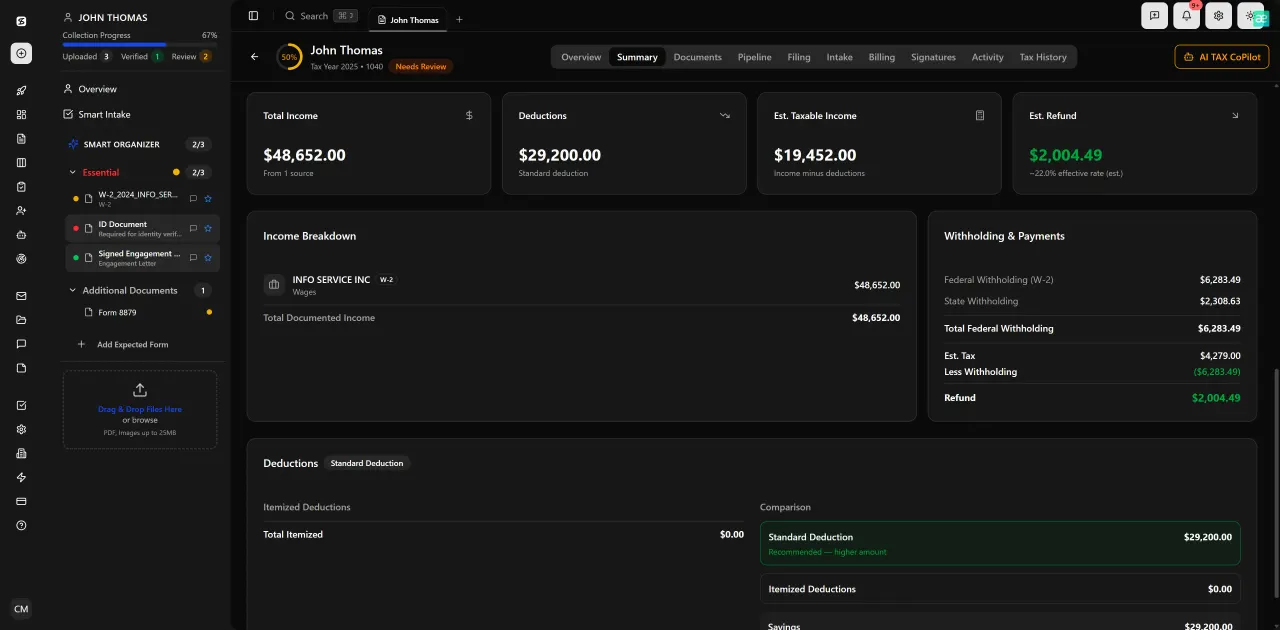
Review with AI assist — 9 agents answer questions with full client context
Eligibility Screening: A Repeatable Client Intake Process
The single highest-leverage change CPAs can make to capture IRA energy credits is building eligibility screening into the annual engagement intake — not treating it as an ad hoc afterthought when a client mentions a renovation. A structured intake process surfaces qualifying activity before year-end, while there is still time to act. When firms revisit their energy tax credits for CPAs priorities, the gaps usually surface here.
Start with four threshold questions for every construction, real estate, and manufacturing client: (1) Did the client place any commercial or residential property in service this year? (2) Did the client design, construct, or substantially reconstruct any dwelling units sold or leased? (3) Did the client install any solar, storage, wind, or alternative fuel infrastructure? (4) Did the client acquire or construct any property that qualified for the energy communities or low-income community bonus? A 'yes' to any of these triggers a deeper credit-by-credit analysis.
The smart intake engine in TaxScout's platform — modeled on IRS Form 13614-C with four-layer prefill — can be configured to flag these triggers automatically as clients complete their annual organizer, reducing the risk that qualifying activity slips through during a busy season.
Once a potential credit is identified, the practitioner needs three supporting data points before proceeding: the placed-in-service date, the square footage or unit count, and the energy certification documentation (HERS rating, Energy Star certificate, or third-party engineer's letter for 179D). Missing certifications are the most common reason IRA energy credits fail on audit — the credit is not self-certifying. Firms that build documentation checkpoints into their energy tax credits for CPAs workflow catch these gaps before they become audit exposure.
Tired of discovering energy credit opportunities after the return is already filed?
TaxScout's AI intake engine and research agents help CPA firms screen every client for IRA credits before year-end — no per-user fees, unlimited clients.
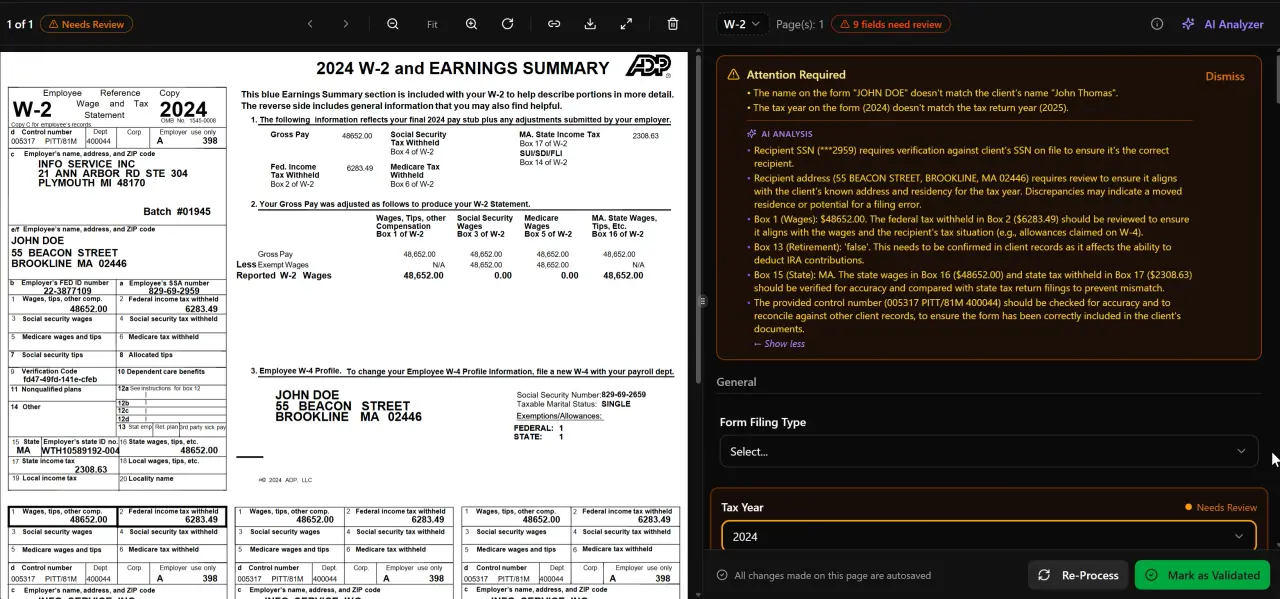
AI classifies, extracts, and validates every document automatically

Click any extracted field to see its source highlighted on the original PDF
Transferability and Direct-Pay Elections Under the IRA
Two mechanics introduced by the IRA — transferability under IRC §6418 and direct pay under IRC §6417 — fundamentally changed the economics of energy credits for business clients and created new advisory opportunities that most practitioner-facing content has not addressed in depth.
Direct Pay (IRC §6417). This election allows certain taxpayers to treat a credit as a direct payment from the IRS, effectively converting a nonrefundable credit into a refundable cash payment. As originally structured, the full direct-pay election is available only to tax-exempt organizations, state and local governments, Indian tribal governments, the Tennessee Valley Authority, rural electric cooperatives, and Alaska Native Corporations. For-profit entities can use direct pay only for the Section 45V hydrogen production credit and the Section 45Q carbon capture credit. The practical implication: most CPA clients in construction and real estate cannot use direct pay — but they may be able to use transferability instead.
Transferability (IRC §6418). This election allows eligible taxpayers to sell all or a portion of an eligible credit to an unrelated buyer for cash. The cash proceeds are excluded from gross income of the seller and are not deductible by the buyer. The buyer then claims the credit on its own return. Eligible credits for transfer include the 48E ITC, 45L, 30C, and several production credits. The election must be made on a timely filed return (including extensions) and is irrevocable for that tax year. Buyers typically pay 88–95 cents per dollar of credit, with pricing driven by credit type, transfer risk, and deal size.
The strategic value for CPA clients is significant. A homebuilder with $500,000 in 45L credits but minimal regular tax liability can sell those credits to a corporate buyer rather than waiting years for carryforward utilization. The transfer market has grown rapidly since the IRA took effect, with Treasury's transferability regulations under T.D. 10021 providing the operational framework. Firms advising clients on transferability should document the election carefully and ensure the credit registration pre-filing requirement through the IRS Energy Credits Online portal is satisfied — missing registration is a disqualifying defect. For practitioners building out their energy tax credits for CPAs advisory practice, transferability analysis is increasingly a standard deliverable rather than a premium add-on.
CPAs serving clients with passive income considerations should also note the interaction with passive activity rules. A transferred credit is still subject to the passive activity credit rules at the seller level before transfer. Review IRC §469 passive activity ordering carefully when the underlying property generates passive losses alongside passive credits — the sequencing affects how much of the credit is transferable in the current year.
Basis Reduction Rules and Bonus Depreciation Interactions
The most consequential trap in the IRA energy credit stack — and the one almost entirely absent from competitor practitioner guides — is the basis reduction interaction when a client claims both an energy credit and bonus depreciation on the same asset.
Under the general business credit rules, claiming an investment tax credit on depreciable property requires a basis reduction equal to 50% of the credit amount (or 100% for the full credit if the credit rate exceeds 30%). For Section 48E, the base credit is 6% with a 50% basis reduction; at the 30% PWA rate, the basis reduction is still 50% of the credit amount. This means a $1,000,000 solar installation qualifying for the 30% 48E credit generates a $300,000 credit but requires a $150,000 basis reduction before computing depreciation.
The interaction with current bonus depreciation rules (100% for qualified property acquired after January 19, 2025 under P.L. 119-21 §70301) is material. The depreciation base is the reduced basis, not the original cost. On a $1,000,000 installation: credit is $300,000, reduced basis is $850,000, and bonus depreciation drives an $850,000 first-year deduction rather than a $1,000,000 deduction. The net tax benefit is still favorable, but failing to apply the basis reduction before computing depreciation creates an overstatement that the IRS can identify through automated return matching. Getting this sequence right is one of the most technically demanding aspects of energy tax credits for CPAs, and one of the most consequential when it goes wrong.
For Section 45L, there is no basis reduction because the credit attaches to the constructed dwelling unit (inventory for the builder), not to a depreciable asset held by the taxpayer. This makes 45L cleaner from a depreciation interaction standpoint, though it creates different questions around cost of goods sold and the uniform capitalization rules under IRC §263A for builders with significant WIP.
Section 179D is a deduction, not a credit, and therefore does not trigger the IRC §50 basis reduction rules directly. However, 179D does reduce the depreciable basis of the building system to which it applies, which affects future depreciation calculations — a step frequently missed when cost segregation studies are updated after a 179D claim.
Practitioners working through these calculations should cross-reference the tangible property regulations guide for capitalization treatment of energy system components before determining the depreciable basis subject to credit and depreciation interactions.
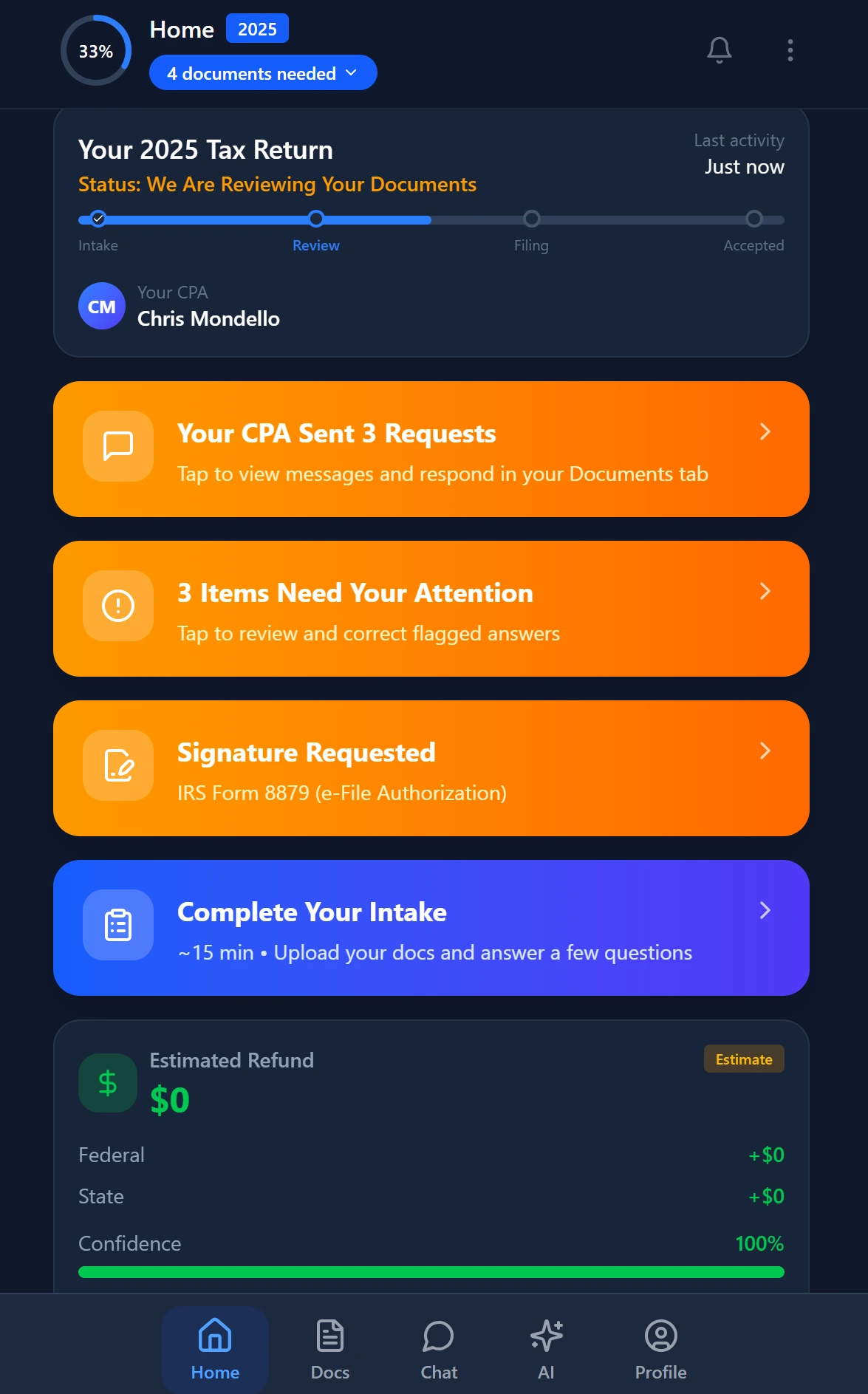
Smart intake auto-fills from uploaded documents and prior-year data
Credit Stacking Risks: What Conflicts CPAs Must Identify
Credit stacking — combining multiple IRA incentives on a single project — is legal and often optimal, but it creates compliance risks when the interaction rules are not applied in the correct sequence. The most common stacking scenarios and their risks are outlined below.
45L and 179D on the same project. A multifamily developer may qualify for 45L on a per-unit basis and 179D on the common area systems (HVAC, lighting, envelope) of the same building. These credits are not mutually exclusive, but the 179D allocation must be computed on the square footage of qualifying systems net of any dwelling unit square footage already captured under 45L. Overlapping the same square footage in both calculations will overstate the 179D deduction.
48E and Section 168 bonus depreciation on the same solar or storage asset. As described in the basis reduction section above, the sequence is: (1) compute the 48E credit amount, (2) reduce the depreciable basis by 50% of the credit, (3) apply bonus depreciation or MACRS to the reduced basis. Applying bonus depreciation first and then claiming the full credit without the basis step is a common error in first-time filings.
30C and 48E on EV charging infrastructure. Bidirectional EV charging equipment may qualify for both the 30C refueling property credit and the 48E ITC if it is connected to a qualifying storage system. Treasury guidance has not yet fully resolved this overlap. Until final regulations clarify the boundary, conservative practitioners should elect one credit per asset and document the election. Claiming both on the same item of property without clear regulatory authority creates audit exposure.
State credit stacking. Many states have enacted their own clean energy credits that parallel or supplement federal IRA credits. State conformity varies significantly — some states conform to the federal credit structure, others decouple entirely. The state conformity rules governing whether a state recognizes the federal credit basis reduction also vary. CPAs should verify state treatment before advising clients to assume that state tax benefits mirror the federal analysis. This state-level variability is one reason energy tax credits for CPAs demands ongoing monitoring rather than a one-time research effort.
For clients also navigating AMT planning, note that the general business credit (including energy credits flowing through Form 3800) is subject to the tentative minimum tax limitation for regular C corporations under the corporate AMT rules introduced by the IRA. Ensure the AMT analysis precedes the final credit utilization calculation.
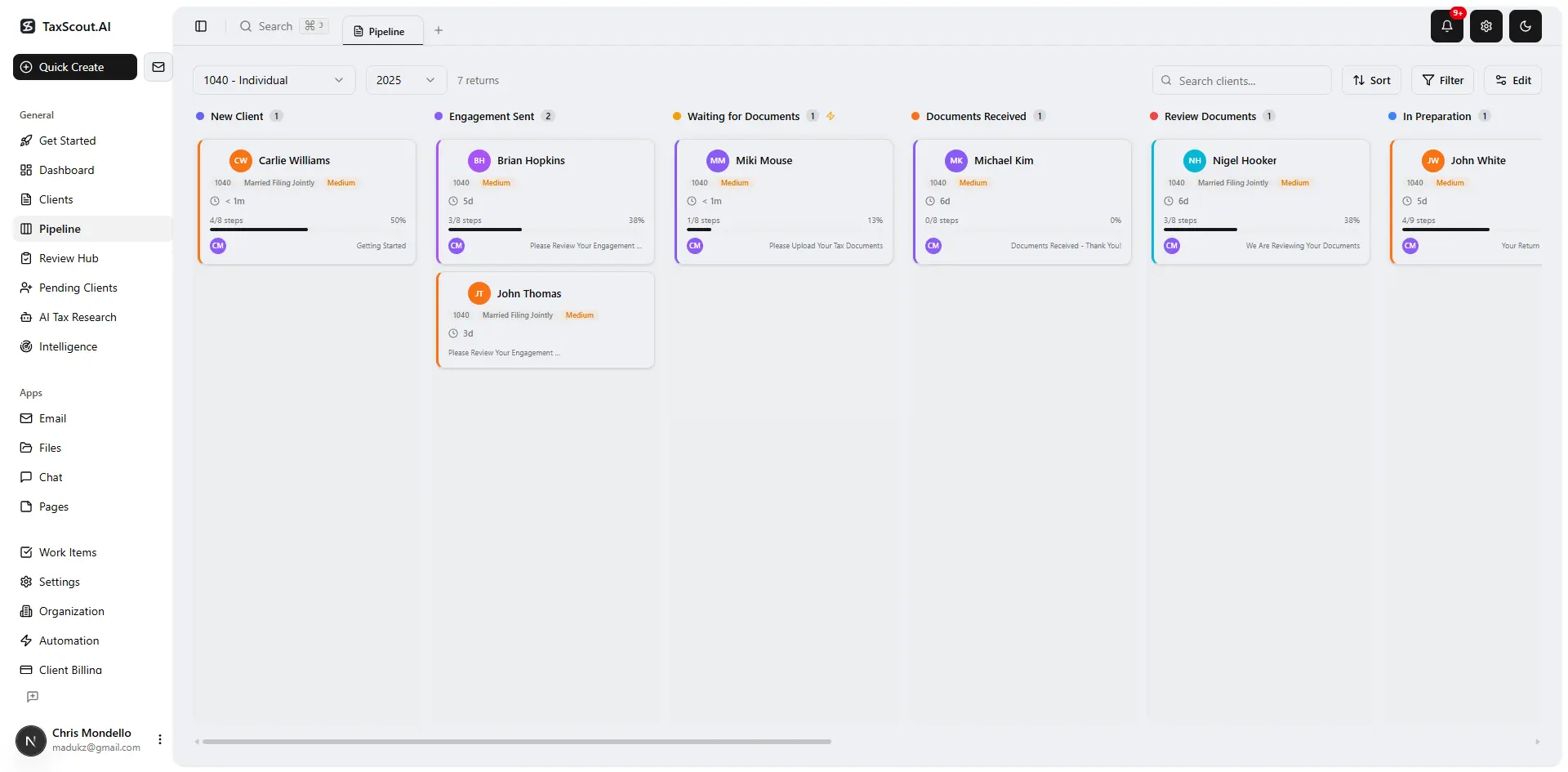
Track every return from intake to filed with drag-and-drop pipeline management
Form 3800 Workflow: General Business Credit Filing for Energy Credits
All of the energy credits discussed in this guide — 45L, 48E, 30C, and the allocated 179D for designers — flow through IRS Form 3800, the General Business Credit. Understanding the Form 3800 structure is essential to filing correctly and avoiding carryforward errors.
Form 3800 is organized into three parts. Part I computes the current-year tentative general business credit from all sources. Part II applies the tax liability limitation — the credit cannot exceed net income tax minus 25% of net regular tax above $25,000 (the 'excess' limitation). Part III tracks each credit component by year of origin, applicable carryback and carryforward periods, and current-year utilization. Energy credits under the IRA generally carry back one year and forward 20 years.
The passive activity ordering rule matters here. If an energy credit arises from a passive activity (e.g., a rental real estate partnership claiming 48E on solar installed at a rental property), the passive activity credit rules under IRC §469(d) limit current-year utilization to tax attributable to passive income. The credit is suspended — not lost — and carries forward to future years when the passive income is available or when the property is disposed of. Practitioners must track passive vs. non-passive credit components separately on Part III to avoid combining suspended passive credits with active business credits that are freely usable.
For pass-through entities, the credit is computed at the entity level and allocated to partners or shareholders on Schedule K-1. Each partner or shareholder then reports the allocated credit on their own Form 3800. The 48E credit allocated from a partnership retains its character as a passive or non-passive credit depending on the partner's level of participation — this character determination must be made at the partner level, not the entity level.
The transferability election under IRC §6418, when made, removes the transferred portion of the credit from the seller's Form 3800 entirely. The seller reports the cash proceeds from the sale but does not claim the transferred credit on its return. The buyer reports the purchased credit on its Form 3800 Part III with a notation indicating the transfer. Both parties must file the election statement and retain the credit registration confirmation from the IRS Energy Credits Online portal in their workpapers.
TaxScout's AI research agents — covering real-time IRS, Treasury, Cornell Law, and Congress search — can surface current Form 3800 instructions, Notice updates, and relevant PLRs in context during return preparation, reducing the risk that a regulatory update (such as new PWA certification requirements) is missed mid-filing season.
IRA Energy Credit Quick Reference for CPA Practitioners
| Credit / Deduction | Base Rate | PWA Enhanced Rate | Basis Reduction | Transferable |
|---|---|---|---|---|
| Section 45L (single family, Energy Star) | $2,500/unit | $5,000/unit (ZERH) | None (inventory asset) | Yes |
| Section 45L (multifamily) | $500/unit | $2,500/unit | None (inventory asset) | Yes |
| Section 179D (commercial building) | $1.00/sq ft | $5.00/sq ft | Reduces building basis | No (allocated to designer) |
| Section 48E (clean electricity ITC) | 6% of cost | 30% of cost | 50% of credit amount | Yes |
| Section 30C (alt fuel refueling) | 6% of cost | 30% of cost | 50% of credit amount | Yes |
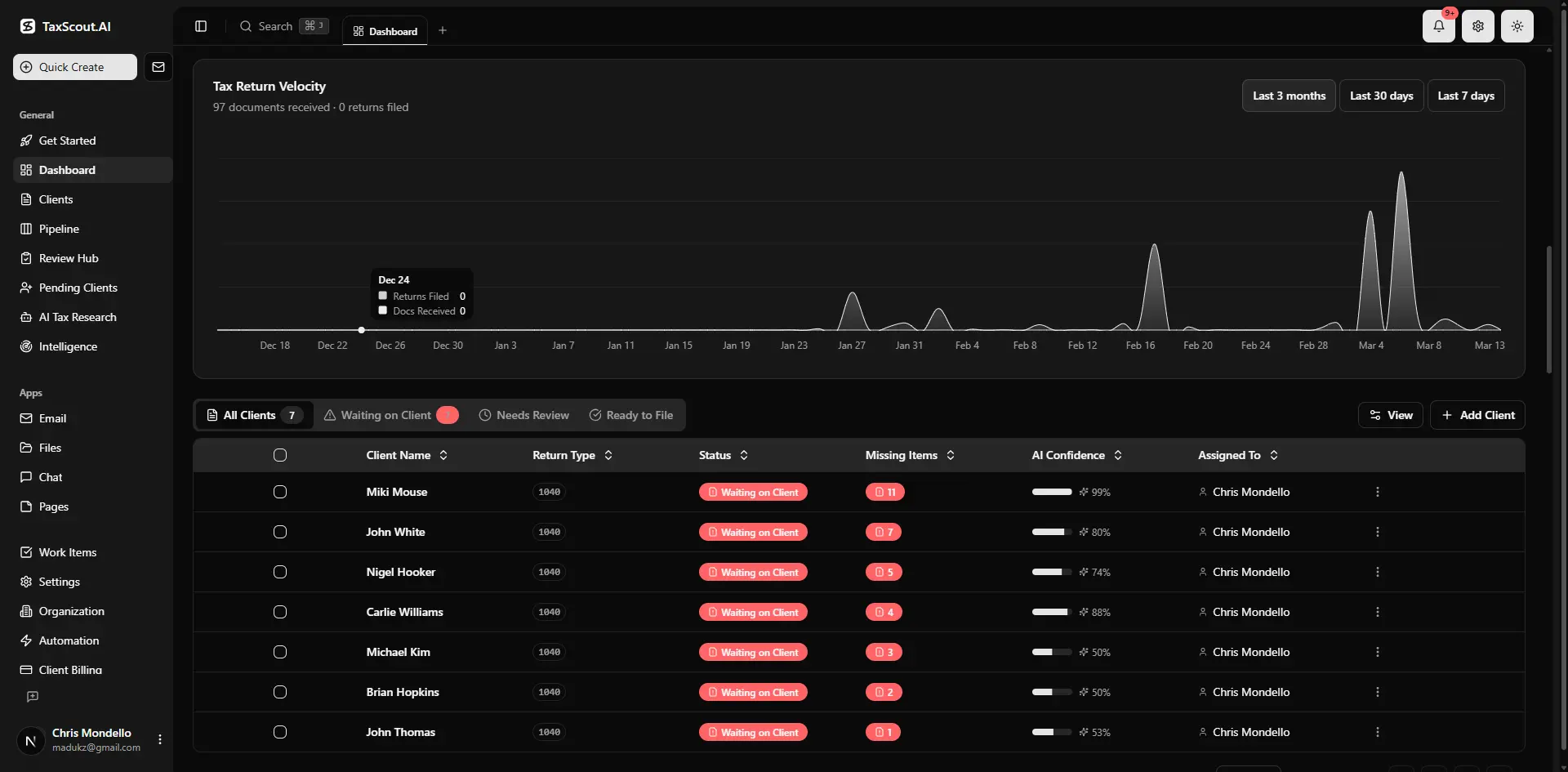
Real-time dashboard showing returns in progress, revenue, and upcoming deadlines

Track firm performance with real-time analytics and client activity monitoring
Building a Repeatable Year-End Energy Credit Process
The difference between firms that consistently capture IRA energy credits for clients and those that miss them is process, not knowledge. The credits are knowable. The failure mode is relying on clients to self-report qualifying activity on an unstructured organizer.
A repeatable process has four stages. First, embed the four eligibility trigger questions described earlier into every construction, real estate, and manufacturing client's annual intake — not as free-text fields, but as structured yes/no questions with automatic follow-up prompts for placed-in-service date, certification type, and square footage or unit count. TaxScout's AI intake engine and pipeline management tools allow firms to build these triggers into a custom stage that fires automatically for clients in qualifying industry codes.
Second, establish a certification documentation checklist that runs parallel to the return preparation workflow. For 45L, this means obtaining the Energy Star or ZERH certificate from the builder or a licensed rater before the return is finalized. For 179D, it means obtaining the qualified engineer's or contractor's certification meeting the requirements of IRS Notice 2006-52 as updated by IRA guidance. For 48E, it means confirming placed-in-service date, facility type, and whether PWA requirements were satisfied. Embedding this checklist into a firm's energy tax credits for CPAs workflow eliminates the last-minute scramble for certifications that delays filing or forces extensions.
Third, run the basis reduction and stacking analysis before computing depreciation — not after. The order of operations on any return with both an energy ITC and bonus depreciation is: compute the credit, apply the basis reduction, then apply depreciation to the reduced basis. Reversing this order overstates depreciation deductions.
Fourth, document the transferability decision for every eligible credit. Even if the client elects not to transfer the credit, the analysis of whether transfer would have been beneficial should be in the workpapers. For clients with limited tax liability relative to large credit amounts — common in early-stage renewable energy projects — transfer pricing from the secondary market (typically 88–95 cents per dollar) may yield more immediate value than a 20-year carryforward. The IRS Energy Credits Online registration portal must be used before the return is filed if transfer or direct pay is elected.
For context on how these credit mechanics interact with real property sales, the Section 1231 gain planning guide covers basis and holding period considerations that overlap when a client disposes of energy-improved property before the credit recapture period expires.
Managing IRA credit stacks, Form 3800 carryforwards, and transferability elections across dozens of clients?
TaxScout gives CPA firms AI research agents, structured intake, and pipeline tools built for complex tax workflows — flat pricing, unlimited clients, no per-seat fees.
Frequently Asked Questions
Under IRC §6418, eligible credits that can be transferred include Section 48E (clean electricity ITC), Section 45L (new energy efficient home credit), Section 30C (alternative fuel vehicle refueling property credit), and several production credits including 45Y, 45V, and 45Q. The election must be made on a timely filed original return and is irrevocable for that tax year. Both the seller and buyer must register the credit through the IRS Energy Credits Online portal before the return is filed, and the seller excludes the cash proceeds from gross income.
Keep reading
Partnership Guaranteed Payments: How CPAs Handle SE Tax and Deductibility
Oct 22, 2026 · 1 min read
Guidance Under Section 355 Concerning Device and Active Trade or Business Partial Withdrawal
Oct 22, 2026 · 1 min read
Section 1031 Boot Tax: How CPAs Calculate and Minimize Taxable Gain in Partial Exchanges
Oct 21, 2026 · 1 min read
Stay up to date
Get the latest tax tech insights delivered to your inbox.