Meals and Entertainment Deductions: How CPAs Navigate the Post-TCJA Rules for Business Clients
The Tax Cuts and Jobs Act eliminated entertainment deductions and introduced a maze of overlapping meal rules that trip up even experienced preparers. This practitioner guide breaks down which expenses remain 50% deductible, which are fully disallowed, how to handle mixed golf-and-dinner events…
Meals and entertainment deductions were already complicated before 2018. After the Tax Cuts and Jobs Act, the rules fractured into a set of overlapping categories that look deceptively simple on the surface — '50% for meals, 0% for entertainment' — but generate constant errors in practice. Client dinners, team lunches, office holiday parties, golf outings that end at a steakhouse, per diem travel days, and snacks stocked in the break room each land in a different bucket under current law, and the wrong categorization invites disallowance on examination.
For CPAs advising business clients, the challenge is threefold: knowing the current rule for each expense type, building a documentation protocol that satisfies IRC §274(d), and communicating the distinctions clearly enough that clients actually capture the right information in the field. This guide covers all three, with a decision tree for the scenarios practitioners encounter most often. Few areas create more confusion for business owners than meals and entertainment deductions, making it essential for CPAs to stay current on exactly what is and isn't allowable.
One critical framing note before the rules: P.L. 119-21, signed July 4, 2025, made virtually all TCJA individual and many business provisions permanent. The TCJA is no longer a temporary overlay — it is the baseline. There is no scheduled reversion to pre-2018 entertainment deductibility, and advisors should stop qualifying their guidance with sunset caveats when discussing these rules with business clients. This permanence has significant implications for meals and entertainment deductions, since advisors can now plan with confidence rather than bracing for a potential legislative reset.
What TCJA Actually Changed for Meals and Entertainment Deductions
Before 2018, businesses could deduct 50% of entertainment expenses — tickets to sporting events, theater, golf green fees — so long as the expense was directly related to or associated with the active conduct of a trade or business. The Tax Cuts and Jobs Act repealed that framework entirely. IRC §274(a)(1) now disallows entertainment, amusement, and recreation expenses with no partial-deduction exception surviving for most categories. Understanding that history helps clients grasp why meals and entertainment deductions no longer function as a single, unified category the way they once did.
Meals were carved out. Congress preserved a 50% deduction for ordinary and necessary business meal expenses under IRC §274(k) and §274(n), subject to substantiation requirements. But the IRS spent years clarifying which side of the meals/entertainment line specific expenditures fall on — a question the statute left ambiguous for mixed events. The agency's guidance in Notice 2018-76 and the final regulations under TD 9925 (2020) settled most of the open questions. For firms evaluating their meals and entertainment deductions approach, this trade-off compounds over time.
The practical result is a four-bucket system. Practitioners need to internalize all four to avoid under-deducting or, more commonly, over-deducting and triggering a §274 disallowance on exam. See other blog resources for additional practitioner guides on related expense topics. Each of these factors directly shapes how meals and entertainment deductions plays out in practice.
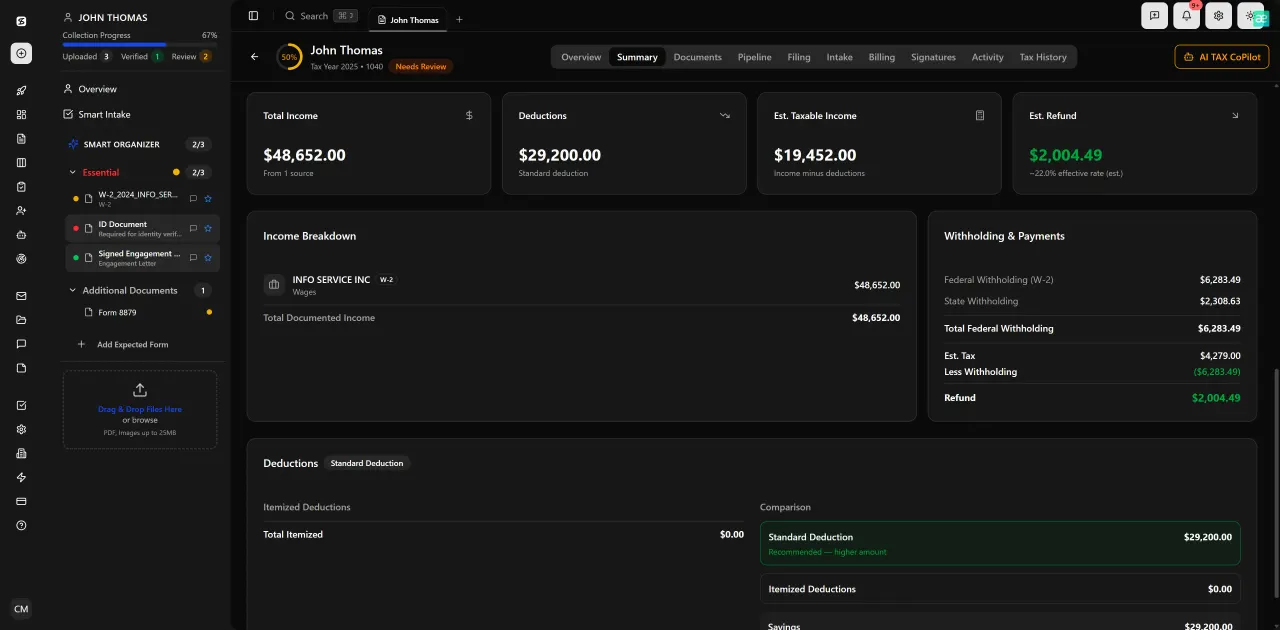
Review with AI assist — 9 agents answer questions with full client context
The Four Deductibility Buckets After TCJA
Tired of manual workflows slowing your firm down? See how TaxScout handles this with AI-powered automation. → Book a 15-Min Demo Understanding meals and entertainment deductions in this context is what separates firms that scale from those that stall.
Understanding where an expense falls starts with correctly categorizing it before applying a deduction percentage. The four buckets are: (1) fully disallowed entertainment; (2) 50% deductible business meals; (3) 100% deductible employee meals and de minimis fringe benefits; and (4) employer-provided meals on business premises. This is precisely where a deliberate meals and entertainment deductions strategy pays off.
Bucket 1 — fully disallowed entertainment — covers tickets to concerts, sporting events, theater, and cultural performances; golf green fees, club dues, and greens-access costs; hunting, fishing, and recreational activities provided to clients or prospects; and any facility costs used for entertainment. The disallowance is categorical: even if a genuine business discussion happens at the event, the entertainment cost itself is not deductible. This surprises clients who were deducting 50% of skybox seats for years before 2018. Meals and entertainment deductions sits at the center of this decision — get it wrong and the rest unravels.
Bucket 2 — 50% deductible business meals — applies when food and beverages are (a) ordinary and necessary under IRC §162, (b) not lavish or extravagant under the circumstances, (c) the taxpayer or an employee is present, and (d) the meal is with a business contact (client, prospect, vendor, referral source, or professional advisor). The 50% limit applies to both the food/beverage cost and any separately-stated taxes and tips. When firms revisit their meals and entertainment deductions priorities, the gaps usually surface here.
Bucket 3 — 100% deductible — currently covers food and beverages provided to employees at a company-wide event that is primarily for the benefit of employees generally (office holiday parties, summer picnics, annual all-hands meals). These qualify as a de minimis fringe benefit under IRC §132(e) and are 100% deductible. Note that this 100% treatment is specifically for bona fide employee-only or primarily-employee events; do not extend it to client-included events.
Bucket 4 — employer-provided meals on the employer's business premises — occupies nuanced territory. Under pre-TCJA law, these were 100% deductible as a de minimis fringe if furnished for the employer's convenience. TCJA reduced the deduction to 50% starting in 2018, and the provision would have moved to 0% after 2025 under the original statutory text. P.L. 119-21 addressed the permanence of other provisions, but CPA firms should confirm the current treatment of on-premises employer meals directly on IRS.gov employer fringe benefit guidance before advising clients, as this particular provision has moved between 50% and 0% in recent legislative cycles.
Tired of manually researching every edge case in the meals and entertainment rules?
TaxScout's 9 AI research agents search IRS, Treasury, and Cornell Law in real time — so you get a sourced answer in seconds, not hours.
Mixed-Event Problem: Golf Outings With Dinner
The scenario CPAs face most often — and that competitor content handles worst — is the mixed entertainment-meal event. A client takes a prospect to a golf club, plays 18 holes, then has dinner in the clubhouse afterward. How much is deductible?
The IRS addressed this directly in Notice 2018-76: when food and beverages are purchased separately from an entertainment activity, and the cost of the food and beverages is stated separately from the entertainment activity on one or more bills, invoices, or receipts, the taxpayer may deduct 50% of the food and beverage costs. The golf fees remain fully disallowed. Properly applying meals and entertainment deductions to these mixed-event scenarios is one of the most common planning opportunities practitioners overlook.
The key documentation requirement is that the meal must be invoiced separately — or at minimum, the food and beverage charges must be separately itemized on the same receipt. If the clubhouse charges a single bundled fee covering greens, cart, and dinner, the entire amount is presumed entertainment and is fully disallowed. Advise clients to always request an itemized bill and to decline bundled packages that obscure the food cost.
The same logic applies to sporting event suites. A skybox fee that includes food is fully disallowed unless the food portion is separately stated and identifiable. General admission tickets are never partially deductible, even if the client bought a hot dog. For clients in industries where event hospitality is a major business development tool — financial services, real estate, legal — this distinction costs significant deductions annually and deserves explicit planning guidance.
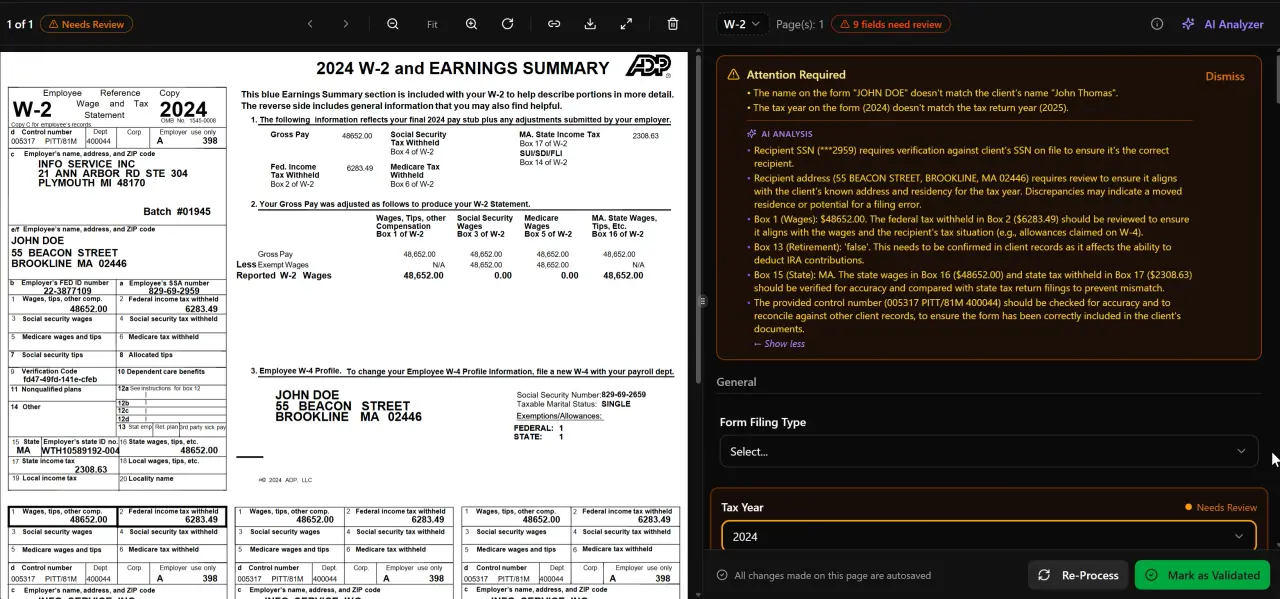
AI classifies, extracts, and validates every document automatically

Click any extracted field to see its source highlighted on the original PDF
Edge Cases CPAs Must Know: Per Diems, Snacks, and Remote Meals
Beyond the standard client dinner, several edge cases create disproportionate exam risk because they are handled inconsistently across the industry.
Per diem meal allowances paid to employees traveling away from home on business are 50% deductible by the employer using either the high-low method or the standard GSA per diem rates. The 50% limitation applies to the employer side. Employees who receive a per diem within IRS-approved limits do not include it in income, but the employer still only deducts 50% of the meal portion of the per diem. Practitioners who treat the entire travel per diem as 100% deductible are over-claiming — a mistake that frequently surfaces when firms audit their own meals and entertainment deductions positions before filing.
Snacks and beverages stocked in a break room or kitchen for employees are treated as de minimis fringe benefits under IRC §132(e) if they meet the nominal-value threshold. The IRS has not issued bright-line dollar figures for snacks specifically, but these are generally 50% deductible as employer-provided meals on premises rather than 100% — a distinction that tightened post-TCJA. The IRS Publication 15-B fringe benefits guide provides the operative framework.
Meals provided to employees required to be available for on-call work, or where the nature of the work requires employees to take a meal break on premises (certain 24-hour operations, hospital shifts), may qualify as employer-convenience meals and follow the same premises-meal treatment discussed above. The key factual question is whether the employer's business necessity drives the meal, not merely the employee's preference.
Virtual or delivery meals — increasingly common since 2020 — where a business sends a DoorDash or UberEats gift card to a client before a video meeting, or orders lunch delivered to employees' homes for a team call, follow the same substantiation rules as in-person meals. The IRS has not issued specific digital-meal guidance, but the §274(d) elements still apply. Tax practitioners should document the business purpose, attendees, and relationship of each participant at the time of the expense.
Decision Tree for Common Client Scenarios
The following framework helps practitioners — and clients you have trained to categorize in the field — quickly assign the correct treatment to the most common expense types.
Client dinner, separately invoiced food and beverages, business discussion present: 50% deductible business meal. Document: date, amount, location, business purpose, names and titles of attendees, business relationship.
Sporting event tickets (no food), client or prospect attending: 0% deductible entertainment. Do not deduct.
Sporting event with separately-stated suite food: 50% deductible for the food portion only. Retain the itemized receipt showing the food line separate from ticket/suite fee.
Golf outing, green fees and cart: 0% deductible entertainment. If dinner follows at a separate venue or on an itemized bill, dinner is 50% deductible.
Annual company holiday party for all employees: 100% deductible as de minimis fringe/employee recreation under IRC §132(e). Retain headcount, cost breakdown, and evidence it was open to all employees.
Working lunch brought in for a staff meeting: 50% deductible (employer-provided meal on premises or 50% ordinary business meal depending on facts). Do not apply 100% treatment unless it qualifies as an all-employee event.
Travel day meals, employee away from home overnight: 50% deductible. Retain receipts or per diem documentation and travel itinerary.
Client takes client to lunch, no employee present: Fails the IRC §274(k)(1)(B) presence test — generally disallowed unless a valid exception applies.
Clients who need help applying this framework in real time benefit from documented guidance in their onboarding file. TaxScout's smart intake engine allows firms to embed client-specific instructions and prior-year context, so recurring client questions about expense categories get answered consistently without reinventing the wheel each season. For related planning strategies that interact with these rules, see our guide on self-employment tax planning.
Post-TCJA meals and entertainment deductibility at a glance
| Expense Type | Deductibility | Key Condition |
|---|---|---|
| Client business meal (food/beverage only) | 50% | Employee present; separately stated; not lavish |
| Entertainment (tickets, golf, events) | 0% | Categorical disallowance under IRC §274(a) |
| Food at entertainment event (separately stated) | 50% | Food must be separately invoiced from entertainment cost |
| All-employee holiday party or picnic | 100% | Primarily for benefit of employees generally; IRC §132(e) |
| Employee travel meals (per diem or actual) | 50% | Employee away from home overnight on business |
| Break room snacks / on-premises employee meals | 50%* | *Confirm current treatment per IRS Pub. 15-B; pre-2026 rules apply 50% |
| Club dues (golf, athletic, social) | 0% | Disallowed regardless of business discussion present |
| Meals for employees during mandatory on-call shifts | 50%* | Employer convenience test; confirm under Pub. 15-B |
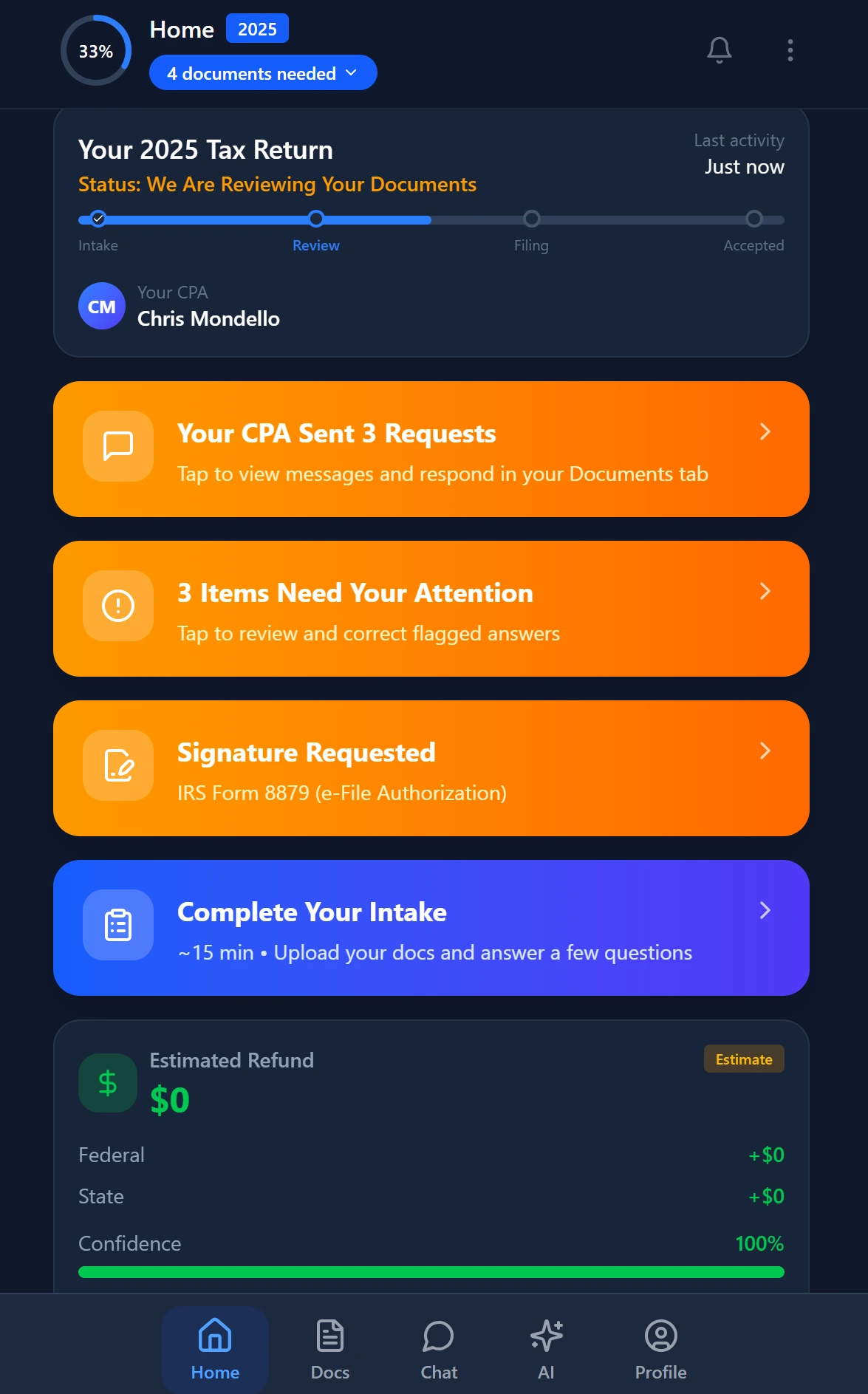
Smart intake auto-fills from uploaded documents and prior-year data

Your clients see your brand — OTP login, document upload, and real-time status
IRC 274(d) Substantiation Requirements: What Survives an IRS Audit
IRC §274(d) imposes a strict substantiation requirement for business meals that supersedes the ordinary and necessary expense standard of §162. No deduction is allowed unless the taxpayer substantiates by adequate records or sufficient corroborating evidence: (1) the amount of the expense; (2) the time and place of the meal; (3) the business purpose of the meal; and (4) the business relationship of the person(s) entertained.
In practice, 'adequate records' means contemporaneous documentation — maintained at or near the time of the expense. The IRS Tax Topic 511 on business travel expenses and the instructions to Schedule C both reinforce contemporaneous capture as the standard. A year-end reconstruction from memory or a spreadsheet the client assembled before their appointment with you does not satisfy §274(d) even if it contains accurate information. Firms that treat meals and entertainment deductions as an afterthought at year-end consistently face the greatest disallowance exposure on exam.
What actually survives audit: a combination of itemized receipts (showing the food and beverage charges separately from entertainment) and a contemporaneous log — whether a paper expense report, a mobile app entry, or even a text or email sent to an assistant noting the business purpose immediately after the meal. Credit card statements alone are insufficient because they do not capture the business purpose or the identities of attendees.
What fails audit most often: (1) a single credit card statement with no log; (2) a spreadsheet reconstructed at year-end without corroborating receipts; (3) receipts that show the restaurant and total but not the individual charges (the IRS expects the itemized receipt, not just the merchant copy with tip added); (4) vague purpose descriptions like 'business lunch' without identifying the client or the matter discussed.
CPAs preparing Schedule C, Form 1120, or Form 1065 returns should request the underlying contemporaneous records from clients, not just totals by category. When clients cannot produce contemporaneous records, the disallowance risk is high and practitioners should consider whether the §274(d) strict liability standard applies before signing the return. For guidance on how to communicate these risks to clients without triggering accuracy-related penalties, see our related guide on reasonable basis defense strategies.
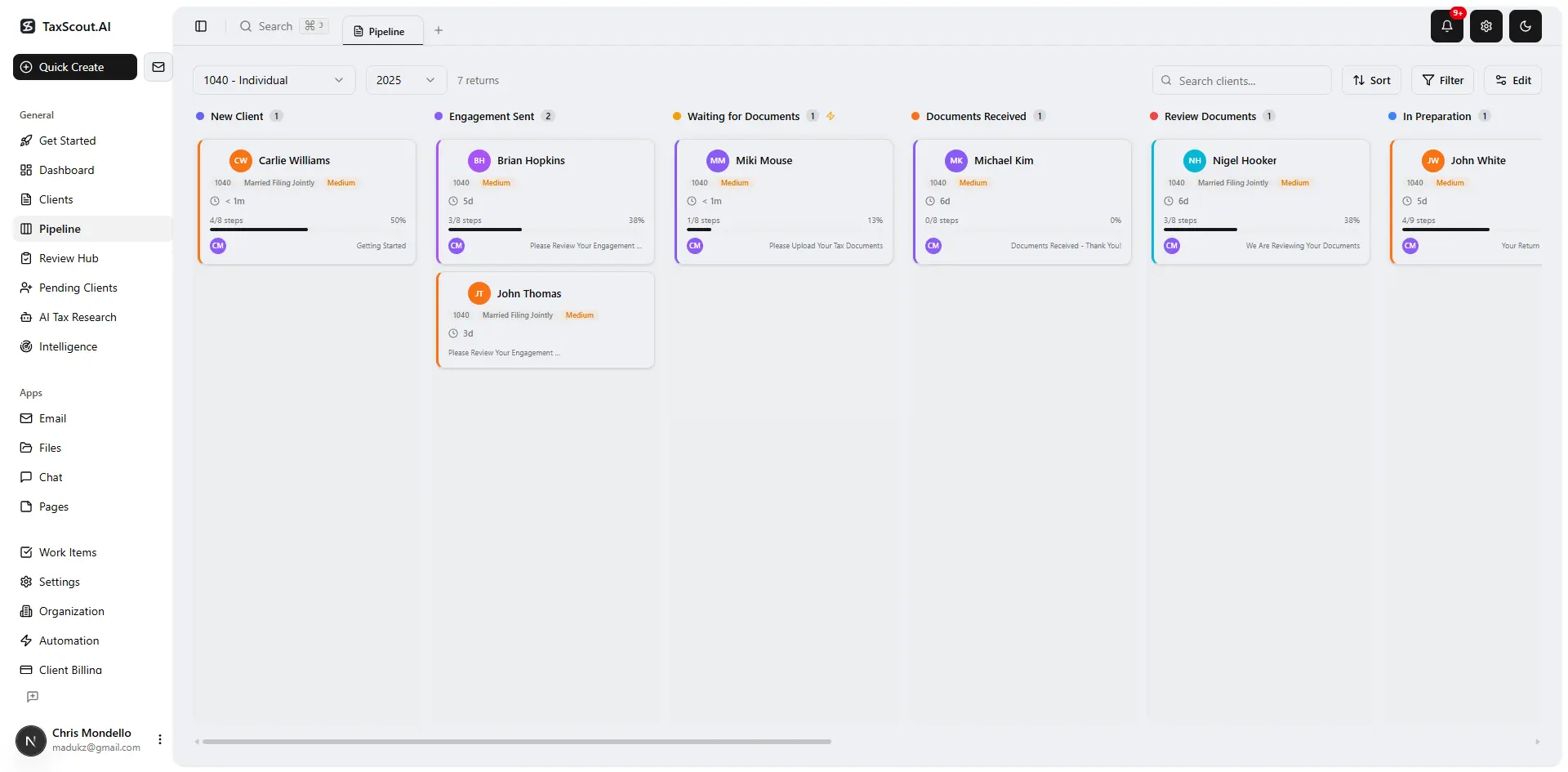
Track every return from intake to filed with drag-and-drop pipeline management
Building a Documentation Protocol Your Clients Will Actually Follow
The biggest practical problem with §274(d) compliance is behavioral, not legal. Clients know they need receipts; they do not capture business purpose and attendee information contemporaneously. The solution is to design the protocol around the least-friction path between meal and documentation.
Effective approaches used by CPA firms include: (1) a standardized email template clients send to themselves or an assistant immediately after a business meal — date, restaurant, amount, attendees, and one sentence of business purpose; (2) a mobile photo of the itemized receipt combined with a voice-to-text note capturing the same elements; (3) a firm-provided expense log that includes dedicated fields for each §274(d) element, pre-labeled so clients do not have to remember what to capture. Firms that build these habits into client onboarding find that meals and entertainment deductions claims hold up far better when questions arise on exam.
For clients with volume expense activity — sales professionals, financial advisors, real estate brokers, consultants — a quarterly review of the expense log against credit card statements catches missing documentation while memories are still fresh. Waiting until the annual return appointment makes reconstruction the only option.
On the technology side, TaxScout's AI document extraction processes receipts, expense reports, and supporting records uploaded to the client portal, and the client portal gives clients a single location to upload and organize their expense documentation throughout the year rather than assembling it all in April. Firms using the pipeline management workflow can add a dedicated 'expense document review' milestone to the return pipeline so documentation completeness is checked before the return is prepared — not after.
According to IRS examination data on Schedule C returns, meals and entertainment remain among the highest-scrutiny expense categories on exam. A documented protocol communicated to clients at onboarding and reinforced at year-end significantly reduces both disallowance risk and preparer liability.

Every client gets organized documents, status tracking, and a complete history
State Conformity: Not All States Follow the Federal Disallowance
Federal disallowance of entertainment expenses does not automatically flow through to every state return. State conformity to the TCJA's §274 amendments varies, and a number of states either did not conform to the entertainment expense disallowance or conformed only partially.
California, for example, has historically decoupled from certain federal expense limitation rules and has its own conformity date. New York and New Jersey have issued specific guidance on how their corporate and individual income tax rules treat meals and entertainment after the federal changes. Practitioners should verify the current conformity position for each state in which a client files, particularly for multi-state businesses with significant entertainment budgets. State-level treatment of meals and entertainment deductions can diverge meaningfully from the federal framework, making it essential to check each jurisdiction separately. The Journal of Accountancy tax conformity resources and individual state revenue department sites are the best current sources.
State add-backs for entertainment expenses disallowed federally — or conversely, state deductions available where the federal rule denies them — need to be tracked in the workpaper and reflected in state apportionment and allocation schedules. This is particularly important for partnership and S corporation returns where the K-1 recipient's state filing position depends on how the pass-through entity handled the deduction at the entity level. For related partnership treatment issues, see our guide on partnership guaranteed payments.
Spending too much time hunting down IRS guidance and state conformity rules for every client expense question?
TaxScout gives CPA firms AI research agents, a smart client portal, and a documented pipeline — all at a flat rate with no per-user fees.
Frequently Asked Questions
Yes. The TCJA preserved the 50% deduction for ordinary and necessary business meal expenses under IRC §274(k) and §274(n). The meal must not be lavish or extravagant, and the taxpayer or an employee must be present. P.L. 119-21, signed July 4, 2025, made these TCJA provisions permanent, so there is no scheduled reversion to pre-2018 rules.
Keep reading
Stay up to date
Get the latest tax tech insights delivered to your inbox.