754 Step-Up Basis: How CPAs Allocate Gains After a Partner Buyout
When a partner exits through a buyout, a Section 754 election lets the purchasing partner step up the inside basis of partnership assets to match what was paid — but calculating the disparity, allocating the adjustment across asset classes, and documenting everything for an IRS challenge is where…
A 754 step-up basis election is one of the most powerful tools available to CPAs managing a partner exit, but the mechanics hide a significant amount of analytical work. When a new or continuing partner pays more than the tax basis of the departing partner's interest, the purchasing partner inherits an inside basis that lags far behind what they actually paid. Without a Section 754 election, that disparity costs the incoming partner real tax dollars on future depreciation, amortization, and gain recognition.
Most practitioner guides cover the election decision in a paragraph or two, then move on. What they omit is the calculation sequence: quantifying the inside/outside basis disparity, running the Section 755 allocation across ordinary-income and capital-gain asset classes, modeling the depreciation recapture consequences on assets already deep into their recovery period, and assembling the workpaper package that survives scrutiny if the IRS ever questions the allocation methodology. Most practitioner guides treat the 754 step-up basis as a footnote rather than walking through the full calculation sequence a CPA actually needs.
This guide is written for the CPA doing the work — not the law professor explaining why the election exists. Whether you are handling a two-member LLC buyout or a complex multi-tier partnership exit, the steps below give you a repeatable workflow from election mechanics through final documentation. This guide is written for the CPA doing the work, providing a clear, repeatable workflow for applying the 754 step-up basis from election mechanics through final documentation.
754 Election Mechanics: What the Code Actually Requires
Section 754 of the Internal Revenue Code allows a partnership to elect to adjust the basis of its assets when a partner's interest is transferred or when the partnership makes a distribution that would otherwise create a disparity between a partner's outside basis and their share of inside basis. The election is made by attaching a statement to the partnership return for the tax year in which the triggering event occurs, signed by any one partner. Once made, the election is binding on all future transfers and distributions unless the IRS grants permission to revoke it under Treas. Reg. §1.754-1(c). In practice, this mechanism — commonly called the 754 step-up basis — prevents an incoming partner from being taxed on gains that economically accrued before they joined the partnership.
Under IRC §743(b), when a partnership interest is sold or exchanged, the transferee partner receives a 754 step-up basis adjustment equal to the difference between (a) the transferee's outside basis in the partnership interest immediately after the transfer and (b) the transferee's proportionate share of the partnership's inside basis in its assets. This adjustment is personal to the transferee — it does not affect the common inside basis or the other partners' tax positions. For firms evaluating their 754 step-up basis approach, this trade-off compounds over time.
The election statement must identify the transaction that triggered the adjustment, state the amount of the adjustment, and confirm the partnership's intent to adjust basis under Section 743(b) or Section 734(b). IRS Publication 541 outlines the basic requirements, and the partnership must include a statement with the Form 1065 for the year of transfer. Missing this filing deadline is a common and costly error — extensions for Form 1065 do not automatically extend the time to attach the election statement. Each of these factors directly shapes how 754 step-up basis plays out in practice.
For firms managing multiple partnership clients, TaxScout's AI research agents can search current IRS guidance and Treasury regulations in real time, reducing the risk of relying on outdated procedural rules when preparing the election attachment. Understanding 754 step-up basis in this context is what separates firms that scale from those that stall.
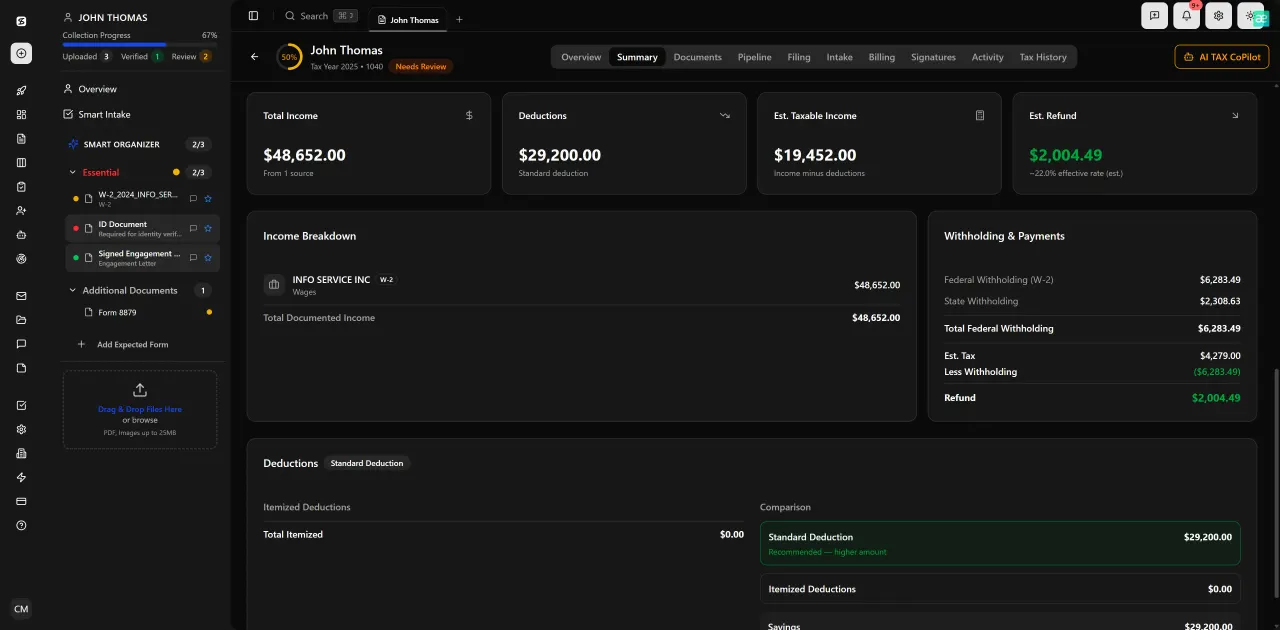
Review with AI assist — 9 agents answer questions with full client context
Calculating the Inside/Outside Basis Disparity
The inside/outside basis disparity is the engine of the entire Section 754 analysis. Outside basis is what the transferee paid for the partnership interest — cash plus assumed liabilities plus any deferred consideration. Inside basis is the transferee's proportionate share of the partnership's adjusted tax basis in its assets immediately before the transfer. This is precisely where a deliberate 754 step-up basis strategy pays off — and where failing to model the disparity carefully leads to costly errors down the road.
Here is the calculation sequence: Start with the purchase price the incoming partner paid. Add the transferee's share of partnership liabilities assumed under IRC §752 — this is often understated when the partnership carries significant recourse debt. The sum is the transferee's outside basis. Then, multiply the partnership's aggregate inside tax basis in all assets by the transferee's interest percentage. The difference — outside basis minus proportionate inside basis — is the Section 743(b) adjustment amount. The 754 step-up basis sits at the center of this decision — get it wrong and the rest unravels.
For example: a partner buys a 40% interest for $800,000 cash. The partnership has $200,000 in partnership liabilities, of which 40% ($80,000) is allocated to the incoming partner, giving an outside basis of $880,000. The partnership's total inside basis across all assets is $1,500,000; the transferee's 40% share is $600,000. The Section 743(b) adjustment is $880,000 minus $600,000 equals $280,000. That $280,000 step-up must then be allocated across specific assets using the Section 755 rules. When firms revisit their 754 step-up basis priorities, the gaps usually surface here.
For complex partnership structures with tiered entities or multiple asset classes, also review our partnership guaranteed payments guide for interacting basis implications when the departing partner received guaranteed payments in prior years that affected their outside basis.
One frequently overlooked input is built-in gain or loss at the asset level. If partnership assets carry fair market values that diverge significantly from their tax bases, the purchase price implicitly reflects those unrealized gains and losses. Documenting asset-level fair market values at the transaction date — ideally with a contemporaneous appraisal or, at minimum, a management estimate supported by comparable sales — is essential both for the Section 755 allocation and for audit defense. Properly capturing this data is a prerequisite for any credible 754 step-up basis analysis.
Managing Section 754 workpapers across multiple partnership clients in a shared drive?
TaxScout centralizes every document, workpaper, and client communication so nothing slips through during a partner exit — and your AI research agents stay current on Treasury guidance automatically.
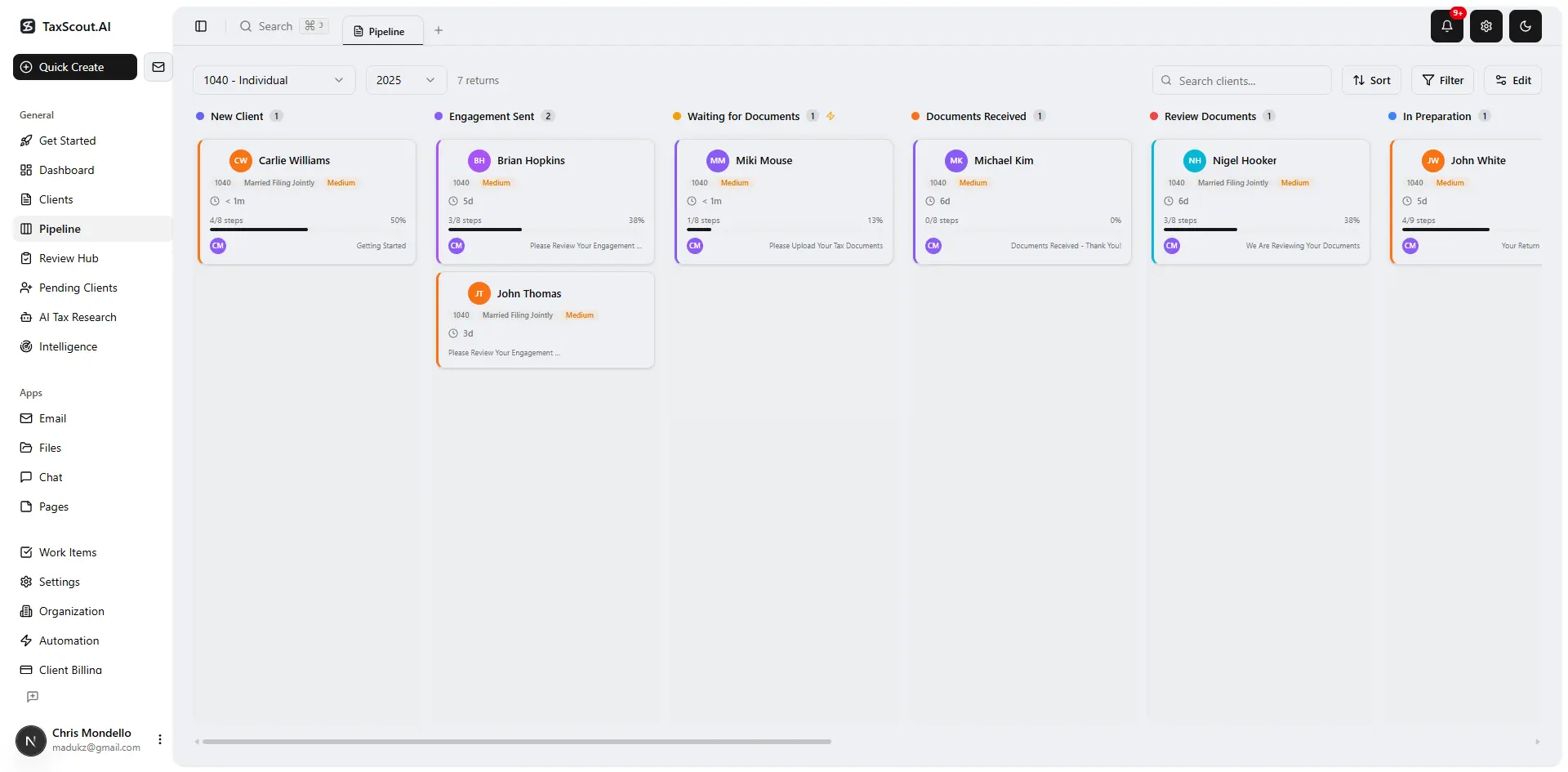
Track every return from intake to filed with drag-and-drop pipeline management
Allocating the Step-Up Under Section 755: The Asset-Class Rules
Once the total Section 743(b) adjustment is computed, IRC §755 governs how that amount is allocated across the partnership's assets. The allocation follows a two-tier structure keyed to the character of the underlying gain: ordinary-income assets (Section 1245 and Section 1250 property, inventory, receivables) absorb step-up first, with any remainder going to capital-gain assets (land, marketable securities, goodwill, Section 1231 property not otherwise categorized). Correctly characterizing each asset class is what makes a defensible 754 step-up basis allocation possible.
The Treasury regulations under Section 755 require the CPA to allocate the adjustment in proportion to the difference between each asset's fair market value and its adjusted tax basis, subject to the character constraint. Specifically, Treas. Reg. §1.755-1(b)(2) sets up a residual allocation framework: calculate the total gain or loss that would be allocated to the transferee on a hypothetical sale of all assets at fair market value immediately after the transfer; split that hypothetical gain between ordinary-income and capital-gain buckets; then allocate the Section 743(b) adjustment proportionately within each bucket.
This is where practitioner errors cluster. A common mistake is treating the step-up as a single undifferentiated amount and applying it to the highest-basis assets rather than following the character-driven methodology. Another is failing to recognize that the step-up allocated to Section 1245 property (equipment, vehicles, certain improvements) creates a future depreciation deduction for the transferee — but also means that when that property is later sold, the 754 step-up basis amount is recaptured as ordinary income under Section 1245, not capital gain. See our Section 1231 gain planning guide for the interaction between recapture and the netting rules on eventual asset dispositions.
Goodwill deserves special treatment. In a partner buyout, the excess of purchase price over the fair market value of identifiable net assets is often attributable to personal or enterprise goodwill. If the partnership agreement contains a Section 754 election and the parties agree on an allocation in a purchase price allocation schedule (analogous to a Section 1060 allocation for asset purchases), that allocation is a strong starting point — but the CPA must confirm it is consistent with the Section 755 character rules, not simply copy it over.

Click any extracted field to see its source highlighted on the original PDF
Depreciation Recapture Interaction on Specific Asset Classes
No competitor article we have reviewed addresses the depreciation recapture mechanics that attach to a 754 step-up basis — yet this is often where the purchasing partner's tax cost surprise emerges years after the buyout closes. Understanding the recapture exposure at the time of the election is part of competent partner exit tax planning.
When the Section 743(b) adjustment is allocated to depreciable Section 1245 property, the transferee may claim additional depreciation on that step-up over the asset's remaining recovery period — or, for new basis allocated to already-fully-depreciated assets, over a fresh recovery period beginning in the year of transfer. Under IRC §168 and the regulations thereunder, the additional basis is treated as newly placed-in-service property for depreciation purposes, starting in the year of the transfer. With bonus depreciation currently at 100% for qualified property acquired after January 19, 2025 under P.L. 119-21 §70301, the transferee may be able to deduct the entire Section 1245 754 step-up basis amount in the year of transfer if the underlying property qualifies.
However, accelerated deduction of the Section 1245 step-up now creates accelerated Section 1245 recapture later. When the partnership eventually sells that equipment, the transferee's share of the gain attributable to the previously stepped-up basis is ordinary income, not capital gain. The CPA must model this outcome at the time of the buyout so the incoming partner understands the full tax profile of the transaction, not just the immediate deduction.
Section 1250 property — commercial real estate — follows a slightly different path. The step-up allocated to Section 1250 property is generally depreciated over the asset's remaining straight-line recovery period (or a fresh 39-year period for fully depreciated buildings). On sale, unrecaptured Section 1250 gain applies at the 25% rate to the extent of prior depreciation, including the stepped-up depreciation, so the purchasing partner's effective rate on future real estate sale proceeds from the 754 step-up basis will be 25%, not 20%.
Documenting the asset-class allocation and the depreciation schedule for the step-up in the workpaper file at the time of the election is critical — not just for audit defense, but for the future CPA who picks up the engagement when this property is eventually sold.

Track firm performance with real-time analytics and client activity monitoring
Building the Audit Documentation Trail
An IRS challenge to a Section 754 step-up allocation typically focuses on three questions: Was the election timely made? Are the fair market values used for the Section 755 allocation supportable? Does the allocation follow the character-driven methodology required by the regulations? Your documentation must answer all three definitively.
The minimum workpaper package for a 754 step-up basis on a partner buyout should include: (1) the signed purchase and sale agreement with the stated purchase price and liability allocation; (2) a balance sheet as of the transfer date with both tax basis and fair market value columns for each asset; (3) the Section 743(b) adjustment computation with a clear tie-out to the agreement and the liability schedule; (4) the Section 755 allocation worksheet showing the hypothetical gain computation and the ordinary/capital character split; (5) the depreciation schedule for the step-up, including any bonus depreciation election for Section 1245 property; (6) the election statement as filed with Form 1065, with proof of filing date; and (7) any third-party appraisals or valuation support for significant assets, particularly goodwill and real property.
The IRS Appeals Coordinated Issue paper on Section 743(b) adjustments and the Treasury regulations at Treas. Reg. §1.743-1 both make clear that the burden is on the taxpayer to demonstrate the reasonableness of the allocation. Undocumented allocations that appear to maximize current deductions without a clear economic rationale are audit red flags.
For firms handling several partnership exits per year, consider building a standardized workpaper template that mirrors the Section 755 computation structure. TaxScout's file management tools allow you to attach, organize, and version-control all supporting documents against the client matter, so nothing is missing if an exam notice arrives three years after the return was filed.
Cross-referencing with the K-1 footnote disclosure is also essential. The partnership must disclose the transferee partner's Section 743(b) adjustment in their Schedule K-1 for each year the adjustment affects that partner's income, loss, or credit. Review our Schedule K-3 reporting guide for related disclosure obligations when the partnership has international activities that must flow through to the transferee's K-1.

Every client gets organized documents, status tracking, and a complete history
The Section 743(b) Adjustment on the Ongoing Partnership Return
Once the election is made and the adjustment is allocated, the CPA must track the transferee's separate basis account for each adjusted asset through every subsequent year. This is the operational burden that makes many preparers reluctant to recommend the election even when it is economically beneficial: the partnership's books carry one set of inside basis figures for non-transferee partners, and a parallel set reflecting the 754 step-up basis for the transferee.
In practice, this means the partnership's Form 1065 must reflect the transferee's special allocation of additional depreciation (or amortization, for intangibles) attributable to the step-up, reported on the transferee's Schedule K-1 but not on other partners' K-1s. Tax software handles this through a partner-level basis adjustment module, but the CPA must feed in the correct allocated amounts by asset class each year. Errors accumulate: a missed depreciation allocation in year two quietly increases the transferee's future recapture exposure.
When the adjusted asset is eventually sold, the partnership computes the gain in the usual way, then separately computes the transferee's Section 743(b) offset — the amount by which the step-up reduces the transferee's allocable share of the partnership's recognized gain. This offset appears on the transferee's K-1 as a negative adjustment to their distributive share. Getting this right at disposition requires pulling the original allocation workpapers and the cumulative depreciation taken on the step-up, which is exactly why contemporaneous documentation is non-negotiable.
For other blog resources on partnership tax mechanics, including basis-related issues that interact with Section 754, our full content library covers these intersecting areas in practitioner-focused detail.
Section 755 Allocation: Ordinary-Income vs. Capital-Gain Assets — Key Distinctions
| Asset Class | Character of Step-Up | Depreciation / Amortization | Recapture on Sale |
|---|---|---|---|
| Equipment / Vehicles (Sec. 1245) | Ordinary income | MACRS; bonus depreciation eligible under P.L. 119-21 if qualified | 100% Sec. 1245 recapture as ordinary income |
| Commercial Real Estate (Sec. 1250) | Capital gain (25% rate bucket) | Straight-line over remaining or new 39-yr period | Unrecaptured Sec. 1250 gain at 25% |
| Land | Capital gain | None | Long-term capital gain |
| Goodwill / Intangibles (Sec. 197) | Capital gain (residual) | 15-year straight-line amortization | Sec. 1245 recapture to extent of amortization |
| Inventory / Receivables | Ordinary income | Not depreciable; deducted on sale/collection | Ordinary income on disposition |
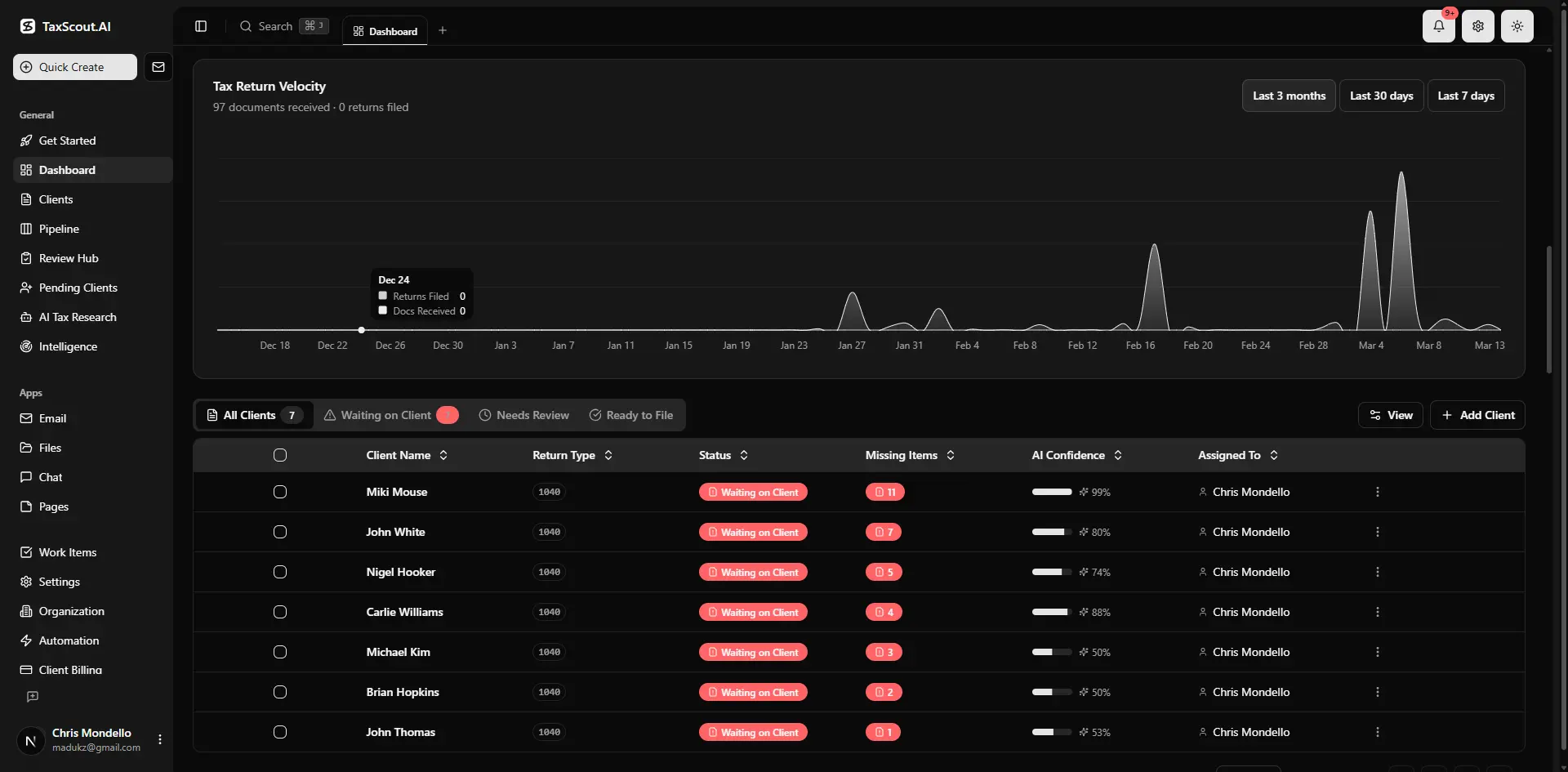
Real-time dashboard showing returns in progress, revenue, and upcoming deadlines
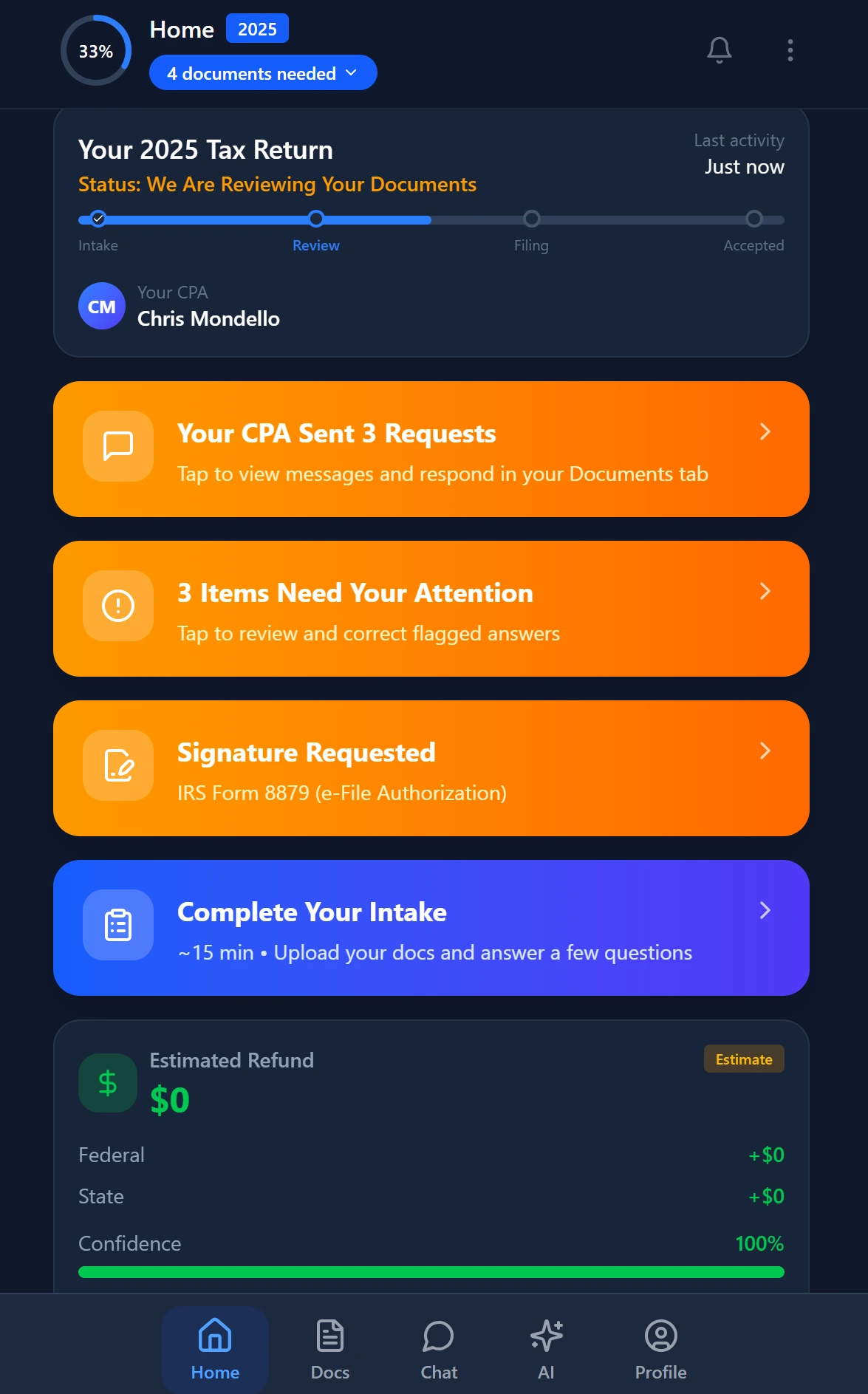
Smart intake auto-fills from uploaded documents and prior-year data
Common Errors CPAs Make on Section 754 Engagements
The most frequent error is simply missing the election deadline. The election must be attached to the partnership return for the year of transfer. If the partnership is on extension, the extended due date applies — but the extension must have been filed timely. A late election requires a private letter ruling or a request under Rev. Proc. 2009-39 for automatic relief where the failure was inadvertent, a process that takes time and adds cost. See the IRS revenue procedure guidance for the available relief pathways.
A second common error is applying the full 754 step-up basis to goodwill without first exhausting the allocation against tangible assets with fair market values exceeding their tax bases. The Section 755 residual method assigns the step-up to goodwill only after all other assets have been allocated their share — allocating to goodwill first inflates the amortizable intangible step-up at the expense of the asset classes that should absorb it under the regulations.
Third, many CPAs fail to model the step-up in the context of a potential future sale of the entire partnership. If the partners anticipate an exit within five to seven years, the stepped-up basis in Section 1245 assets may generate recapture that offsets the benefit of accelerated depreciation. Running both scenarios — electing versus not electing — before advising the client is standard practice on complex buyouts. This interaction is explored further in our divorce tax planning guide for scenarios where a partnership interest transfer is part of a marital settlement.
Finally, the partnership agreement itself sometimes contains allocation provisions that conflict with the Section 755 methodology. A tax-driven allocation clause that directs a disproportionate step-up to specific assets for non-economic reasons may not be respected under Treas. Reg. §1.755-1(b). Always reconcile the agreement language against the regulatory requirements before finalizing the allocation.
Spending hours tracking 754 step-up allocations in spreadsheets that no one else on your team can follow?
TaxScout's document management, AI research agents, and pipeline tools give every partner exit the structured workflow it deserves — so audits find a complete file, not a gap.
Frequently Asked Questions
The election statement must be attached to the partnership's Form 1065 for the tax year in which the transfer occurs. If the return is on extension, the extended due date applies. There is no standalone election form — a written statement signed by any partner and filed with the return is sufficient. Missing the deadline requires IRS relief under Rev. Proc. 2009-39 or a private letter ruling.
Keep reading
Stay up to date
Get the latest tax tech insights delivered to your inbox.