Tangible Property Regulations: How CPAs Apply Capitalization vs Expensing Rules
Determining whether a client cost is a deductible repair or a capitalized improvement under the Section 263(a) final regulations is one of the most consequential — and commonly mishandled — decisions in business tax compliance. This guide walks CPAs through every safe harbor, the three-part…
The tangible property regulations finalized under Treasury Decision 9636 represent the most significant overhaul of capitalization rules in decades, yet most business clients have no idea the framework exists. For CPAs, that gap creates both risk and opportunity: risk because missed elections and improperly expensed costs are a recurring audit trigger, and opportunity because the safe harbors — when applied correctly — can accelerate deductions that would otherwise be spread over a 39-year or 15-year depreciation schedule.
Every business client with real property, equipment, vehicles, or leasehold improvements is affected. A roofing contractor patching a warehouse, a dentist replacing a compressor, a retailer refreshing store fixtures — each scenario requires the same structured analysis before the cost lands on Schedule C, Form 1120-S, or Form 1065. Getting that analysis right means understanding which safe harbor applies, running the betterment/restoration/adaptation test when no safe harbor covers the cost, and attaching the correct election statement to the return. The tangible property regulations apply broadly, meaning virtually every business client with real property, equipment, vehicles, or leasehold improvements is affected by these rules.
This guide provides a practitioner-level workflow for each step. It covers the three primary safe harbors under the final regulations, maps the three-part improvement test with concrete examples, and explains the annual election mechanics — including how to cure a missed election under Rev. Proc. 2015-20. Whether you are advising a sole proprietor or a multi-entity real estate group, this framework belongs in your standard engagement workflow. This guide provides a practitioner-level workflow for navigating the tangible property regulations at each step, covering the three primary safe harbors under the final regulations.
The Regulatory Framework: What Section 263(a) Actually Requires
The Section 263(a) final regulations — commonly called the tangible property regulations or TPR — took effect for tax years beginning on or after January 1, 2014. They replaced decades of case law and revenue rulings with a codified, four-step hierarchy that taxpayers and their advisors must work through in sequence.
The hierarchy works like this: first, determine whether the cost qualifies for the de minimis safe harbor; second, assess whether the routine maintenance safe harbor applies; third, for real property owners with average annual gross receipts of $10 million or less, check the small taxpayer safe harbor; fourth, if no safe harbor applies, run the unit of property analysis and the betterment/restoration/adaptation test under Treas. Reg. §1.263(a)-3. Under the tangible property regulations, the hierarchy works like this: first, determine whether the cost qualifies for the de minimis safe harbor; second, assess whether the routine maintenance safe harbor applies.
A critical threshold concept is the unit of property (UOP). For buildings, the UOP is the entire building structure, but the regulations carve out eight designated structural components — HVAC, plumbing, electrical, escalators, elevators, fire protection, security, and gas distribution systems — each of which is tested as its own UOP. For non-building personal property, the UOP is generally the entire functionally interdependent assembly. Misidentifying the UOP is the most common analytical error CPAs encounter in practice, because a cost that looks minor relative to the whole building may be major relative to its UOP. You can find the IRS's own summary of the UOP rules in Publication 946. For firms evaluating their tangible property regulations approach, this trade-off compounds over time.
Understanding the regulatory structure also matters for other tax elections that interact with property decisions — for example, a client's choice of accounting method can affect whether certain TPR elections produce a tangible benefit in the first year. Each of these factors directly shapes how the tangible property regulations play out in practice.
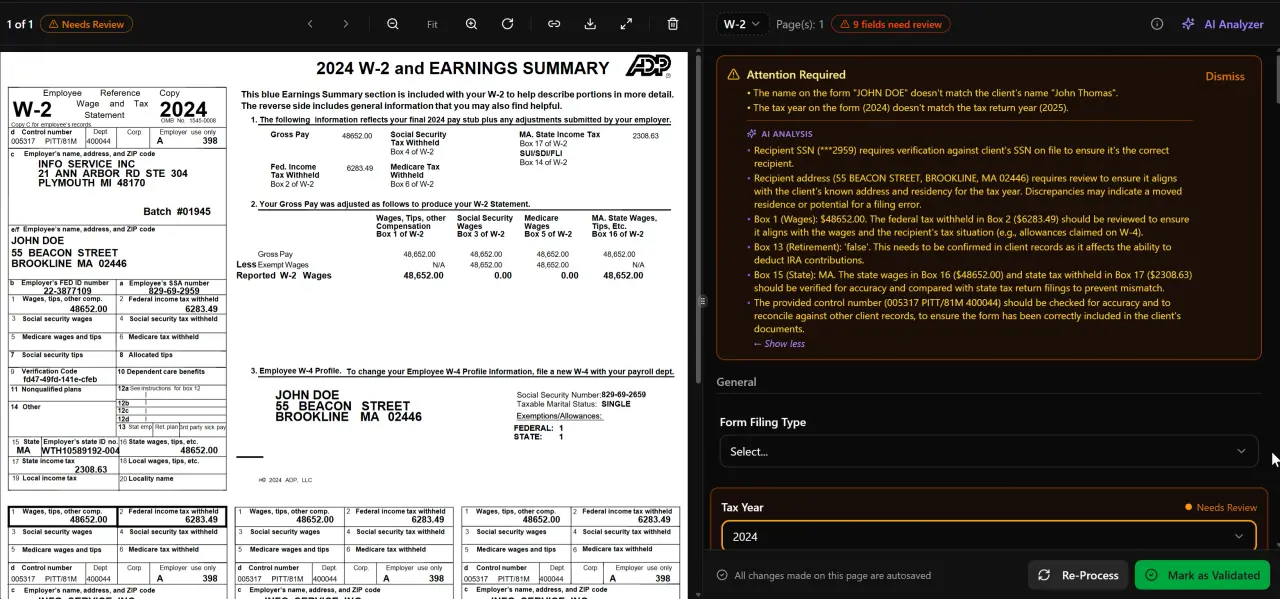
AI classifies, extracts, and validates every document automatically
De Minimis Safe Harbor: Per-Item Thresholds and Written Policy Requirements
The de minimis safe harbor under Treas. Reg. §1.263(a)-1(f) allows a taxpayer to deduct amounts paid for tangible property that would otherwise require capitalization, provided the per-item (or per-invoice) cost falls below a threshold and, for taxpayers with applicable financial statements (AFS), is consistent with a written accounting policy. A firm's working knowledge of the tangible property regulations in this context is what separates practices that scale from those that stall.
Taxpayers with an AFS — audited financial statements, for most business clients — may expense items costing $5,000 or less per item or invoice. Taxpayers without an AFS may expense items costing $2,500 or less. The $2,500 threshold increased from $500 effective January 1, 2016, following IRS guidance; confirm the current threshold in Notice 2015-82 before advising clients. This is precisely where a deliberate tangible property regulations strategy pays off.
The written policy requirement is the step most small-business clients skip. The taxpayer must have a written accounting policy in place at the beginning of the tax year stating that amounts below the threshold will be expensed for book purposes. In practice, CPAs should prepare a one-page policy document, have the client sign and date it before January 1, and retain it in the client file. Without the written policy, the IRS can assert the safe harbor was not validly elected even if the client consistently expensed small amounts. The tangible property regulations sit at the center of this decision — get it wrong and the rest unravels.
To elect the de minimis safe harbor, the taxpayer attaches a statement to the timely filed return (including extensions) that reads: 'Section 1.263(a)-1(f) de minimis safe harbor election.' No other information is required by regulation, though best practice is to include the tax year and entity name. This is an annual election — it must be re-attached every year. Tracking these annual elections is one reason a structured pipeline management workflow pays dividends during filing season, ensuring the checklist item appears for every eligible client without relying on practitioner memory. When firms revisit their tangible property regulations priorities, the gaps usually surface here.
Tracking annual TPR elections for dozens of business clients — manually?
TaxScout's pipeline management gives every client a structured checklist stage so no de minimis election, no routine maintenance statement, and no small taxpayer attachment slips through the cracks at filing.

Click any extracted field to see its source highlighted on the original PDF
Routine Maintenance Safe Harbor: When Recurring Costs Are Always Deductible
The routine maintenance safe harbor under Treas. Reg. §1.263(a)-3(i) provides that amounts paid for activities the taxpayer reasonably expects to perform more than once during the class life of the UOP — to keep the property in its ordinarily efficient operating condition — are not improvements and are therefore deductible.
For buildings, the standard is different: the taxpayer must reasonably expect to perform the maintenance more than once during a ten-year period (not the full 39-year building life). This distinction matters enormously in practice. Painting the exterior of a commercial building every seven years qualifies under the building standard. Replacing a roof that was last replaced 25 years ago almost certainly does not, because the taxpayer would not expect to replace the roof more than once in a ten-year window.
Key examples that typically qualify: regularly scheduled inspections and tune-ups on HVAC equipment, oil changes and fluid replacements on fleet vehicles, calibration of manufacturing machinery, and repainting of facilities on a recurring schedule. Key examples that typically do not qualify: replacement of a major component that has never been replaced before, restoration after casualty damage, and any activity triggered by a betterment condition (see the improvement test below).
The routine maintenance safe harbor does not require an election statement — it applies automatically if the conditions are met. However, CPAs should document in the workpapers why the safe harbor applies: the expected frequency of the maintenance, the class life or building status, and the nature of the activity. That documentation is the first thing an IRS examiner will request in a field audit. For clients with complex property portfolios, connecting this analysis to prior-year depreciation schedules — which the AI document extraction tools in modern practice platforms can surface automatically — saves significant preparation time. Properly applying the tangible property regulations to routine maintenance determinations can mean the difference between a clean audit and a costly adjustment.
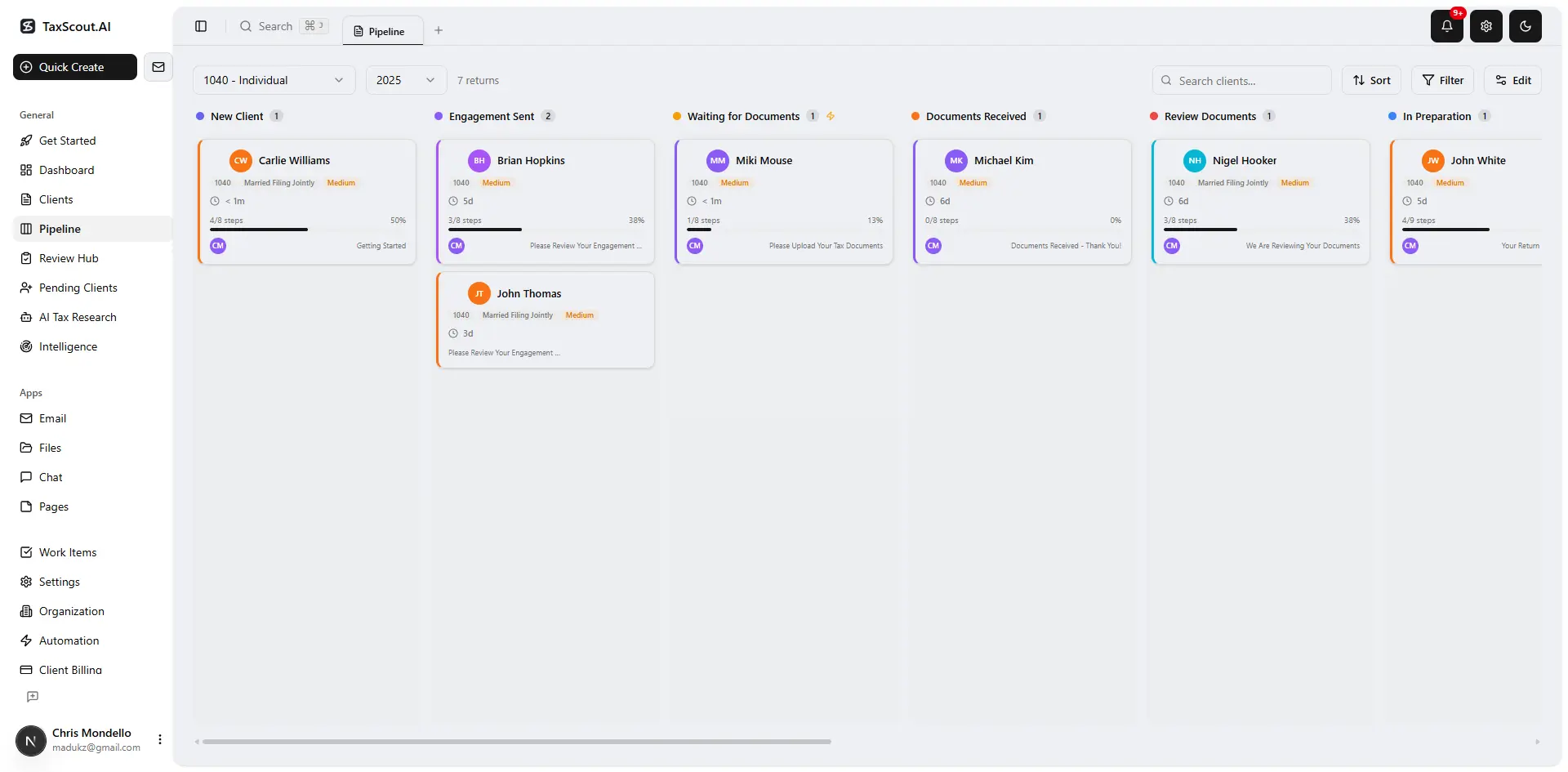
Track every return from intake to filed with drag-and-drop pipeline management
Small Taxpayer Safe Harbor: The Dollar Limit Most CPAs Underexplain
The small taxpayer safe harbor under Treas. Reg. §1.263(a)-3(h) is the least-understood of the three safe harbors, yet it protects many small-business real property owners from inadvertently triggering capitalization on routine building expenditures. The safe harbor is available to taxpayers with average annual gross receipts of $10 million or less for the three preceding tax years.
Under the safe harbor, a taxpayer may deduct amounts paid for repairs, maintenance, improvements, and similar activities performed on an eligible building property during the tax year, provided the total of those amounts does not exceed the lesser of: (1) $10,000, or (2) 2% of the unadjusted basis of the building. The unadjusted basis is the original cost of the building — not the tax basis net of depreciation, and not the fair market value.
A concrete example: a client owns a commercial building placed in service for $300,000 (unadjusted basis). Two percent of $300,000 is $6,000. The applicable limit is therefore $6,000 (less than $10,000). If the client spends $5,800 on a combination of HVAC repairs, interior painting, and plumbing fixes during the year, the entire amount is deductible under the safe harbor — no betterment/restoration/adaptation analysis needed. If the client spends $7,200 on those same activities, the safe harbor is blown and every cost must be analyzed individually under the improvement test. Knowing the precise boundaries of the tangible property regulations for each building a client owns is what allows CPAs to plan expenditure timing effectively.
The small taxpayer safe harbor election requires attaching a statement to the return that reads: 'Section 1.263(a)-3(h) safe harbor election for small taxpayers.' As with the de minimis election, it is annual. The safe harbor applies per building, per year — a client with three buildings files three separate calculations and three separate elections if all three qualify. For clients whose gross receipts fluctuate near the $10 million threshold, CPAs should check the three-year average each year rather than assuming eligibility carries forward automatically. The IRS's FAQ on the small taxpayer safe harbor provides additional guidance on qualifying building property.
This safe harbor is especially relevant when advising clients on S corporation and partnership property — topics that intersect with S corp reasonable compensation planning, since the same entity-level accounting method elections affect both compensation and capitalization strategies.
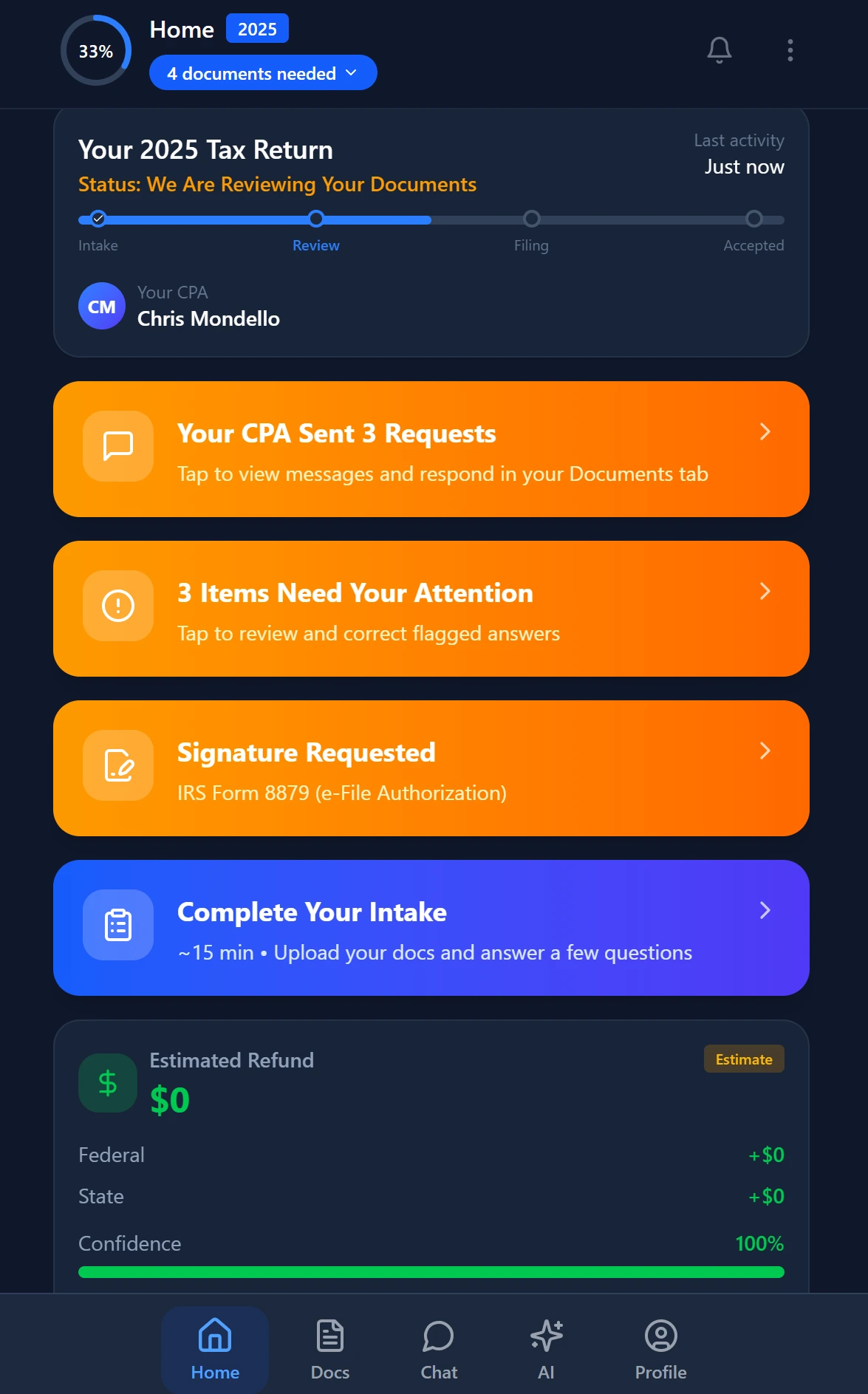
Smart intake auto-fills from uploaded documents and prior-year data
The Betterment, Restoration, and Adaptation Test for Non-Safe-Harbor Costs
When no safe harbor covers a cost, the CPA must determine whether the amount paid results in an improvement to the unit of property. Under Treas. Reg. §1.263(a)-3(d), a cost is an improvement — and must be capitalized — if it results in a betterment, a restoration, or an adaptation of the UOP to a new or different use. The presence of any one of the three conditions triggers capitalization; all three do not need to be present. Correctly applying the tangible property regulations at this stage requires careful documentation of both the UOP definition and the specific facts surrounding each expenditure.
Understanding the full TPR framework alongside other blog resources on tax law changes helps CPAs build a more integrated advisory practice for business clients.
Betterment: When the Property Is Materially Enhanced
A betterment occurs when the amount paid: (1) ameliorates a material condition or defect that existed before acquisition or arose during production; (2) results in a material addition — including a physical enlargement, expansion, or extension — to the UOP; or (3) results in a material increase in the capacity, productivity, efficiency, strength, or quality of the UOP or output.
The word 'material' carries significant weight. Replacing a broken door handle is not a betterment because it does not materially increase the building's capacity or quality. Replacing all the windows in a commercial building with energy-efficient glass that substantially reduces heating costs is likely a betterment under prong (3). The comparison baseline under the regulations is the condition of the property immediately before the event that prompted the expenditure — not the property's original construction condition. This 'appropriate comparison' rule often determines the outcome for casualty-related repairs.
Restoration: When the Property Is Returned to Operating Condition
A restoration occurs when the amount paid: replaces a component for which the taxpayer has taken a loss or a basis adjustment; restores the UOP to its ordinarily efficient operating condition after deterioration has rendered it no longer functional; replaces a major component or substantial structural part of the UOP; or returns the UOP to its former ordinary efficient operating condition after deterioration.
The 'major component or substantial structural part' prong is the most litigated in practice. The regulations define a major component as a part or combination of parts that performs a discrete and critical function in the operation of the UOP. A new roof is the classic example for a building. For a fleet vehicle, a new engine is a major component. For a restaurant's HVAC system (treated as its own UOP), a new compressor likely qualifies. CPAs should document the specific function the replaced component performed and its significance to overall UOP operation.
Adaptation: When the Property Is Converted to a New Use
A cost results in an adaptation — and must be capitalized — if it adapts the UOP to a new or different use. The test is whether the new use is inconsistent with the taxpayer's intended ordinary use of the UOP at the time the property was originally placed in service.
Converting a warehouse into office space is a textbook adaptation. Reconfiguring an open office into private offices to accommodate a different business operation can also qualify. By contrast, refreshing an office space to the same use — new carpet, fresh paint, reconfigured cubicles — is not an adaptation because the space continues to function as an office. When advising real estate clients on this test, CPAs should document the original intended use in the client file at the time of acquisition, making the later adaptation comparison straightforward.
Tangible Property Regulations: Safe Harbor and Test Quick Reference
| Provision | Eligibility | Dollar Limit | Election Required |
|---|---|---|---|
| De minimis safe harbor (with AFS) | Any taxpayer with applicable financial statement | $5,000 per item/invoice | Yes — annual statement attachment |
| De minimis safe harbor (without AFS) | Any taxpayer without AFS; written policy required | $2,500 per item/invoice | Yes — annual statement attachment |
| Routine maintenance safe harbor | Any taxpayer; activity expected more than once in class life (buildings: 10 years) | No dollar limit | No — applies automatically if conditions met |
| Small taxpayer safe harbor | Avg. gross receipts ≤ $10M; eligible building property | Lesser of $10,000 or 2% of unadjusted basis per building | Yes — annual statement attachment |
| Betterment/Restoration/Adaptation test | All costs not covered by a safe harbor | No limit — capitalize if any prong is met | No election; must capitalize if test fails |
Review with AI assist — 9 agents answer questions with full client context
Documenting Elections and Surviving an IRS Examination
Election mechanics are where TPR compliance most often breaks down in practice. The de minimis safe harbor and the small taxpayer safe harbor both require a statement attached to a timely filed return, including extensions. If the return is filed late — without a valid extension — the election window is closed for that year, and the IRS takes the position that no election was made.
The statement itself is minimal by design: it must identify the election by regulation citation, the tax year, and the taxpayer. CPAs can incorporate these statements into a standardized footnote section that populates automatically within their tax preparation software. The discipline of tracking which elections apply to which clients is a workflow problem, not a technical problem — and it is best addressed at the engagement setup stage rather than scrambled together at the printer during the filing deadline. Integrating election checklists into your firm's client management system ensures nothing falls through the cracks.
When an election has been missed, Rev. Proc. 2015-20 provided a simplified method for small businesses to change their accounting methods under the tangible property regulations without filing a Form 3115. However, this relief applied to the initial TPR adoption period, and its continuing applicability for prospective missed elections is limited. For most clients who missed an election in a prior year, the path forward involves either an amended return (if still within the statute of limitations — see the IRS's statute of limitations guidance) or a method change on Form 3115.
In an IRS examination, the examiner will request the written policy document for de minimis safe harbor claims, the gross receipts calculation and per-building cost summary for small taxpayer claims, and the workpaper documenting the UOP analysis and betterment/restoration/adaptation determination for any expensed item above the de minimis threshold. Having these documents in a well-organized client file — with version history — is the difference between a quick concession and an extended examination. The file management and AI research agents in TaxScout allow practitioners to surface prior-year elections and cross-reference IRS examination guidelines in real time, reducing the preparation burden significantly when a notice arrives.

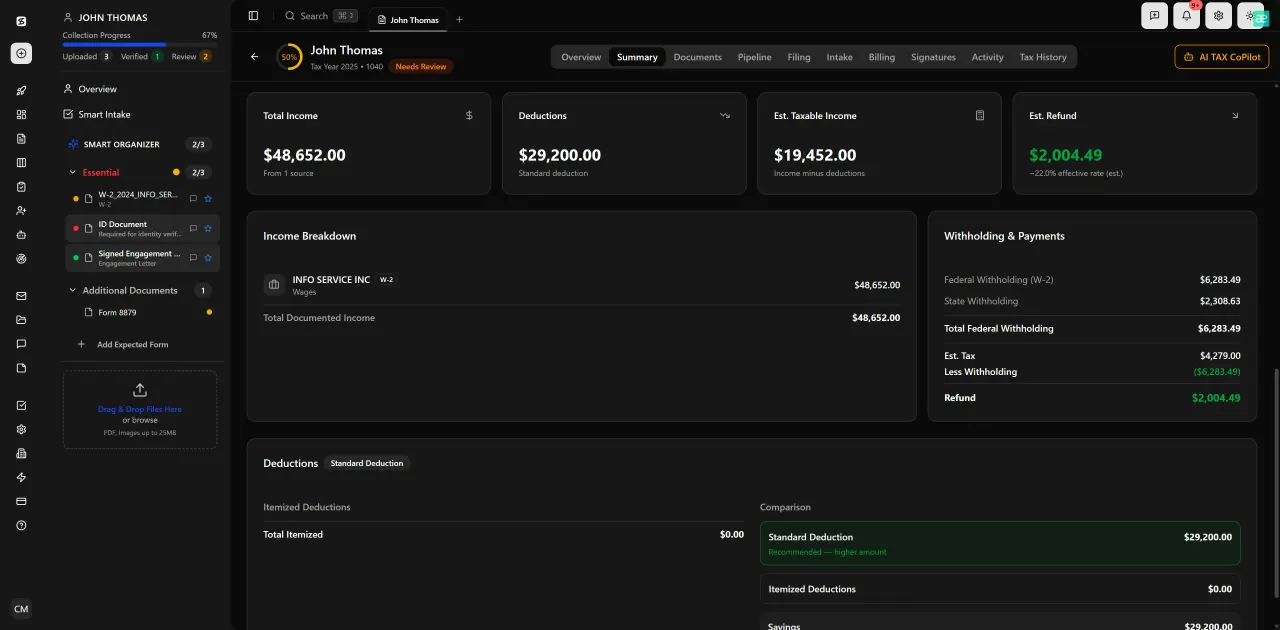
Every client gets organized documents, status tracking, and a complete history
Practical Workflow for CPA Firms Advising Business Clients
Building TPR analysis into your engagement workflow — rather than treating it as an afterthought during return preparation — is what separates firms that consistently get this right from those that face costly method changes years later. A practical client-facing workflow has four steps.
Step one: during onboarding or the annual kickoff meeting, ask every business client with real or personal property to provide a list of significant expenditures from the prior year, categorized by property. 'Significant' for this purpose should be defined as anything above your de minimis threshold, or any single project costing more than $2,500 even for clients without an AFS. The smart intake engine in TaxScout can pre-populate this request based on prior-year depreciation schedules, flagging property classes where new expenditures are likely.
Step two: for each expenditure, apply the safe harbor tests in order. De minimis first — if the per-item cost is below threshold and the written policy exists, deduct and document. Routine maintenance second — if the activity is recurring and within the class life or ten-year building window, deduct and document. Small taxpayer third — if the client qualifies and the aggregate per-building cost is within the limit, deduct and document. Only costs that survive all three safe harbor screens require the full betterment/restoration/adaptation analysis. Maintaining a consistent methodology for applying the tangible property regulations across your entire client base makes this multi-step process both reproducible and defensible.
Step three: for costs requiring the improvement test, document the UOP, the nature of the activity, and which prong — if any — of the betterment/restoration/adaptation test is triggered. The documentation should be written in plain language that a non-specialist examiner can follow. Referencing the specific regulatory provision (e.g., Treas. Reg. §1.263(a)-3(j)(1)(i)) alongside the factual basis protects the position more effectively than a conclusory statement.
Step four: prepare the election statements and confirm they are included in the return package before transmission. For firms using e-signatures for client authorization of the return, the election statements should be part of the package the client reviews and signs. This creates a contemporaneous record that the client was informed of the elections being made on their behalf — a fact pattern that supports reasonable cause if a penalty question arises later. For guidance on similar annual elections with penalty risk, our estimated tax penalty waiver guide walks through the penalty abatement framework that also applies here.
Managing TPR elections, written policies, and exam-ready workpapers across your entire client roster?
TaxScout combines AI-powered document extraction, structured pipeline stages, and built-in e-signature workflows so every election is tracked, every workpaper is filed, and every audit response is ready before the IRS asks.
Frequently Asked Questions
Taxpayers without an applicable financial statement (AFS) — meaning no audited financials — may use a de minimis safe harbor threshold of $2,500 per item or per invoice. This threshold increased from $500 effective January 1, 2016, per IRS Notice 2015-82. The taxpayer must also have a written accounting policy in place at the start of the tax year stating that amounts below the threshold will be expensed for book purposes. Without the written policy, the safe harbor is unavailable even if the costs are below the threshold.
Keep reading
QSBS Exclusion: How CPAs Maximize Section 1202 Gains for Startup Investors
Oct 15, 2026 · 1 min read
Section 1202 QSBS Exclusion: How CPAs Shelter Startup Gains for Founder Clients
Oct 15, 2026 · 1 min read
Backdoor Roth IRA: How CPAs Execute the Strategy Without Triggering Pro-Rata Tax
Oct 12, 2026 · 1 min read
Stay up to date
Get the latest tax tech insights delivered to your inbox.