Basis Tracking for S Corp Shareholders: How CPAs Prevent Deduction Losses at Year-End
When an S corporation passes through a loss, the shareholder can only deduct it against existing stock and debt basis — and the IRS now requires that math on Form 7203. This guide walks CPAs through the full year-end basis tracking workflow, the most common basis-killing mistakes, and how to build…
Basis tracking for S corp shareholders is one of the most consequential calculations a CPA runs at year-end, yet it is also one of the most frequently deferred until it is almost too late. The stakes are direct: under IRC §1366(d), a shareholder cannot deduct a pass-through loss that exceeds his or her adjusted stock basis plus the adjusted basis of any bona fide loans made to the corporation. Losses that exceed available basis are suspended indefinitely — and if the shareholder disposes of the stock before basis is restored, those losses disappear permanently.
The compliance landscape sharpened considerably when the IRS made Form 7203 mandatory starting with 2021 returns. Every S corporation shareholder who claims a loss, receives a distribution, disposes of stock, or receives a loan repayment must now attach a completed Form 7203 to their individual return. Most competitors in the CPA-content space have published articles on S corp reasonable compensation and late elections — but almost none have published an operational workflow guide for the year-end basis calculation and Form 7203 preparation that CPAs must actually run for each affected client. Accurate basis tracking for S corp shareholders has never been more critical, as the IRS now requires Form 7203 to be attached to individual returns whenever a loss is claimed, a distribution is received, stock is disposed of, or a loan repayment is made.
This guide closes that gap. You will find the step-by-step S corporation basis calculation CPAs need before December 31, the most common errors that destroy basis without warning, and a practical framework for building a repeatable tracking system inside a modern practice management stack — so you stop reinventing this process on a one-off spreadsheet every filing season. Whether you are new to basis tracking for S corp clients or looking to refine an existing workflow, this guide provides the step-by-step calculations, common pitfalls, and practice management frameworks you need before December 31.
Why S Corp Shareholder Basis Matters More Than Ever
S corporation shareholders face two distinct basis limitations. Stock basis — the first and primary layer — begins with the shareholder's initial investment, increases for income and separately stated income items allocated to the shareholder, and decreases (but never below zero) for distributions, losses, and nondeductible expenses. Debt basis — the second layer — arises only when the shareholder has personally lent money to the corporation; guarantees do not create debt basis under longstanding Treasury Regulations §1.1366-2. Effective basis tracking for S corp shareholders requires understanding both the stock basis and debt basis layers, since each follows its own ordering rules and limitations that can dramatically affect how much loss a shareholder may deduct in any given year.
When losses exceed stock basis, they can be absorbed by debt basis — but only dollar for dollar against the shareholder's adjusted basis in qualifying loans. If both layers are exhausted, the excess loss is suspended under IRC §1366(d)(2) and carries forward to future years. Given that many small S corporations operate at a loss in early years or during downturns, a shareholder who cannot prove adequate basis at year-end may lose the entire economic benefit of those losses. For firms evaluating their basis tracking for S corp approach, this trade-off compounds over time — making it essential to revisit the calculation annually rather than waiting until a loss year triggers a crisis.
The permanent 20% QBI deduction under IRC §199A (made permanent by P.L. 119-21) amplifies the planning opportunity: a shareholder who preserves deductible losses often reduces both ordinary income and the QBI phase-in calculation simultaneously. CPAs who track S corp shareholder basis proactively can surface those opportunities before the calendar year closes. Each of these factors directly shapes how basis tracking for S corp plays out in practice, particularly when shareholders have both stock and debt basis at risk in the same year.
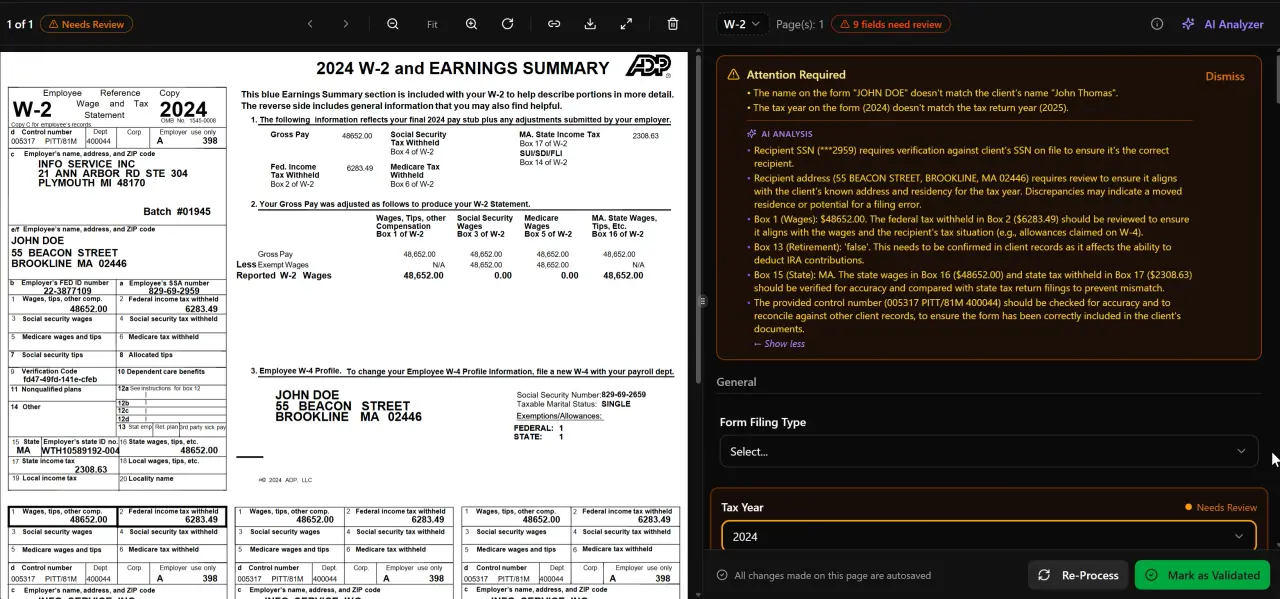
AI classifies, extracts, and validates every document automatically
Form 7203 Requirements and What CPAs Must File
The IRS released Form 7203 to replace the informal basis worksheets that practitioners had long attached to returns. Starting with 2021 tax returns, Form 7203 must be filed by any S corporation shareholder who (a) claims a deduction for their share of an S corp loss, (b) receives a nontaxable distribution, (c) disposes of S corporation stock, or (d) receives a loan repayment from the S corporation. Filing is required even when basis is positive — the form is the IRS's mechanism to verify that basis arithmetic is sound. Understanding basis tracking for S corp in this context is what separates firms that scale from those that stall, because a missing or incomplete Form 7203 can expose both the client and the preparer to accuracy-related penalties.
Form 7203 has three parts: Part I computes stock basis (beginning balance, income increases, loss and distribution decreases, ending balance), Part II computes debt basis (loan-by-loan detail for each indebtedness), and Part III allocates allowed and disallowed losses across loss categories. If a shareholder holds both voting and nonvoting stock classes, or received multiple loans from the corporation in different years, each position requires separate tracking and may require multiple iterations of the form. This is precisely where a deliberate basis tracking for S corp strategy pays off, because firms without a structured annual process will find themselves reconstructing multi-year loan histories under filing deadline pressure.
CPAs who prepare the form at the last minute frequently encounter a documentation crisis: the S corporation's books may not reconcile to the Schedule K-1 line items, or the loan agreements may be undocumented or missing. Building the Form 7203 calculation into your year-end workflow — rather than treating it as a tax-season afterthought — is the only way to avoid scrambling for records in February. Basis tracking for S corp sits at the center of this decision — get it wrong and the rest unravels.
Tired of reconstructing basis worksheets from scratch every filing season?
TaxScout.ai gives your team a centralized practice management stack with AI document extraction, client-context memory, and pipeline management — so basis documentation stays organized year-round, not just at tax time. When firms revisit their basis tracking for S corp priorities, the gaps usually surface here.
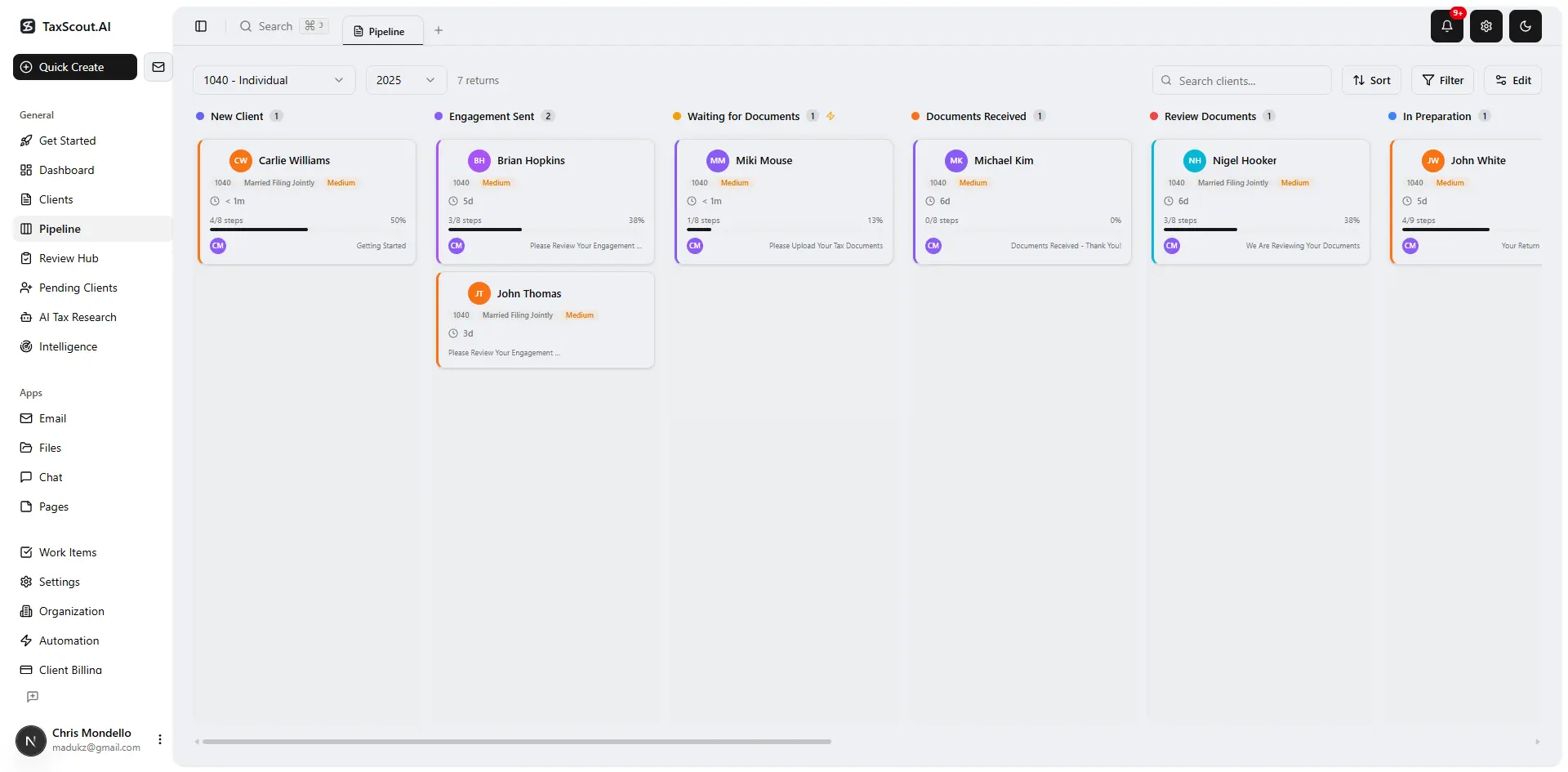
Track every return from intake to filed with drag-and-drop pipeline management

Click any extracted field to see its source highlighted on the original PDF
Step-by-Step S Corporation Basis Calculation at Year-End
The following workflow covers the mechanics CPAs should run for each S corp shareholder client before December 31. For firms managing multiple S corp clients, this sequence should be templated inside your pipeline management system so no step is skipped under deadline pressure.
Step 1: Pull the Prior-Year Ending Basis as the Opening Balance
Your prior-year workpaper — whether a Form 7203 attachment, a standalone worksheet, or a tax software carryforward — is the single source of truth for the opening stock basis and opening debt basis for each loan. If no prior-year record exists (common with new clients), reconstruct from inception by tracing Schedule K-1 history, shareholder capital account statements, and loan documentation. Consistent basis tracking for S corp clients from the very first year of engagement is far less costly than reconstructing a decade of K-1 allocations when a shareholder is about to sell. The IRS transcript service can supply K-1 allocations from prior years when the originals are missing.
Step 2: Apply Current-Year Income and Loss Allocations
Once you have the opening balance, increase stock basis by: (1) separately stated income items (tax-exempt income included), and (2) the nonseparately stated income or gain. Decrease stock basis — in the IRS-specified ordering — first for distributions, then for non-deductible/non-capital expenses, then for loss and deduction items. The ordering matters: taking distributions before losses can prematurely exhaust basis and suspend losses that would otherwise be deductible. Year-end basis tracking for S corp shareholders at this stage should include a projection of any remaining Q4 distributions or income allocations before the books close. Refer to IRC §1367(a) for the statutory ordering rules.
Step 3: Verify Debt Basis Separately for Each Qualifying Loan
Debt basis requires a separate calculation for each bona fide shareholder loan. Confirm: (a) the loan is evidenced by a written note or agreement signed before year-end, (b) the shareholder, not a related party or the corporation itself, actually advanced the funds, and (c) prior-year loss pass-throughs have not already reduced the debt basis below the current outstanding balance. When debt basis has been reduced by prior losses, subsequent repayments trigger gain recognition under IRC §1367(b)(2). Document repayment schedules in the client file.
Step 4: Determine Allowed and Suspended Losses
With final stock and debt basis figures in hand, apply losses in proportion to their character categories as specified in the Form 7203 Part III instructions. Losses allowed are limited to the sum of stock basis plus debt basis. Any excess is suspended and should be tracked in a dedicated carryforward schedule. Flag clients whose suspended losses are at risk of permanent disallowance due to pending stock dispositions — this is a year-end planning trigger that warrants a proactive advisory conversation. For related planning on pass-through basis issues, also see our guide on 754 Step-Up Basis: How CPAs Allocate Gains After a Partner Buyout.
Step 5: Reconcile to the Schedule K-1 Before Filing
The shareholder-level basis calculation must reconcile with the amounts reported on Schedule K-1 from the S corporation. Discrepancies arise when amended K-1s are issued after the return is drafted, when the corporate return and the individual return are prepared by different practitioners, or when book-to-tax adjustments are missed. Build a formal K-1-to-Form 7203 tie-out step into your quality review checklist before any individual return goes out the door.
Common Basis-Killing Mistakes CPAs Must Catch
Several recurring errors account for the majority of basis surprises at year-end. The first is treating shareholder guarantees as debt basis. A guarantee, even one that has been called, does not create basis unless the shareholder actually makes a cash payment to the lender on behalf of the corporation — a distinction the Tax Court has consistently upheld. CPAs should flag any client who plans to claim basis from a guarantee and document the actual cash flow before the year closes.
The second common error is missing the ordering rules for distributions. A shareholder who receives a distribution early in the year — before losses are allocated at year-end — reduces stock basis first, which can leave insufficient basis to absorb losses. Year-end tax planning should model the distribution amount against projected losses before any check is cut. This is particularly acute in profitable years followed by a loss year: basis built up and then distributed leaves no cushion. Rigorous basis tracking for S corp shareholders throughout the year, rather than only at filing, is the most reliable way to catch this sequencing problem before it becomes irreversible.
The third error is failing to document loans properly. The IRS scrutinizes open-account debt arrangements where multiple advances and repayments occur without a formal note. Under Treasury Regulations §1.1366-2(a)(2), an indebtedness must be a bona fide debt between the shareholder and the corporation. If a court or examiner recharacterizes the advance as a capital contribution, the shareholder loses both the debt basis and any interest deduction. Require clients to execute a promissory note for every shareholder loan before year-end, and retain it in the client file alongside the basis worksheet.
Finally, suspended loss carry-forwards are frequently lost track of when a client changes preparers or when a firm merges. Every client file should carry an explicit suspended-loss schedule keyed to each tax year, updated annually. For guidance on related accuracy-related penalty exposure when basis positions are challenged, see our Reasonable Basis Defense guide.
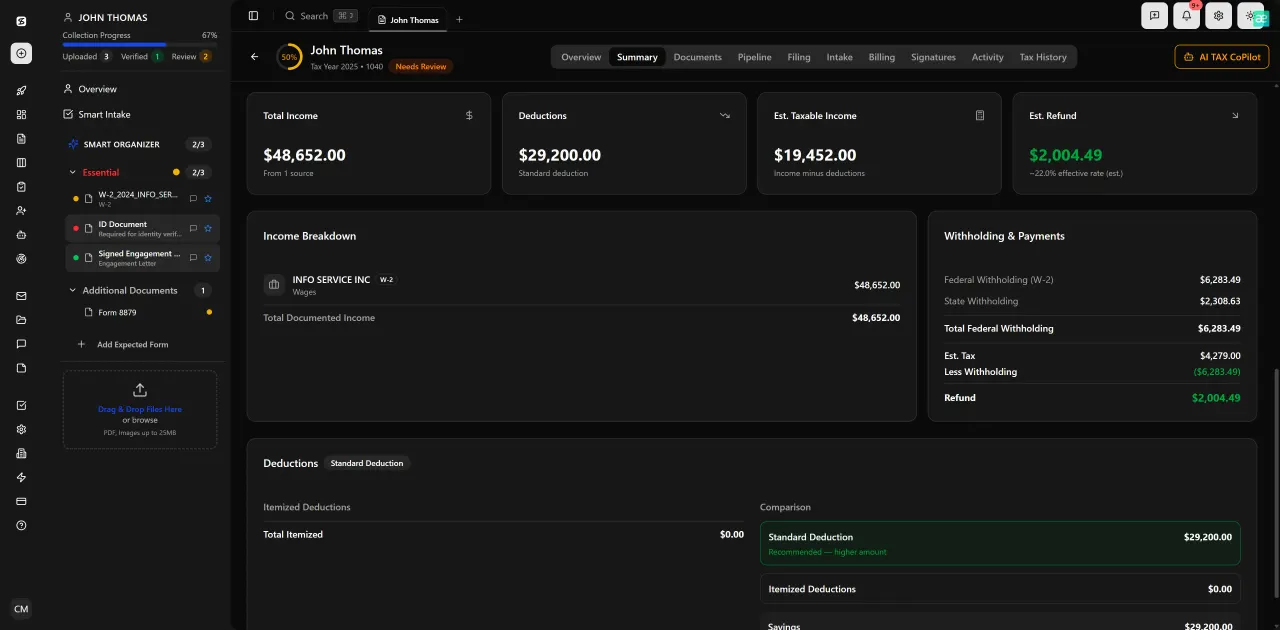
Review with AI assist — 9 agents answer questions with full client context
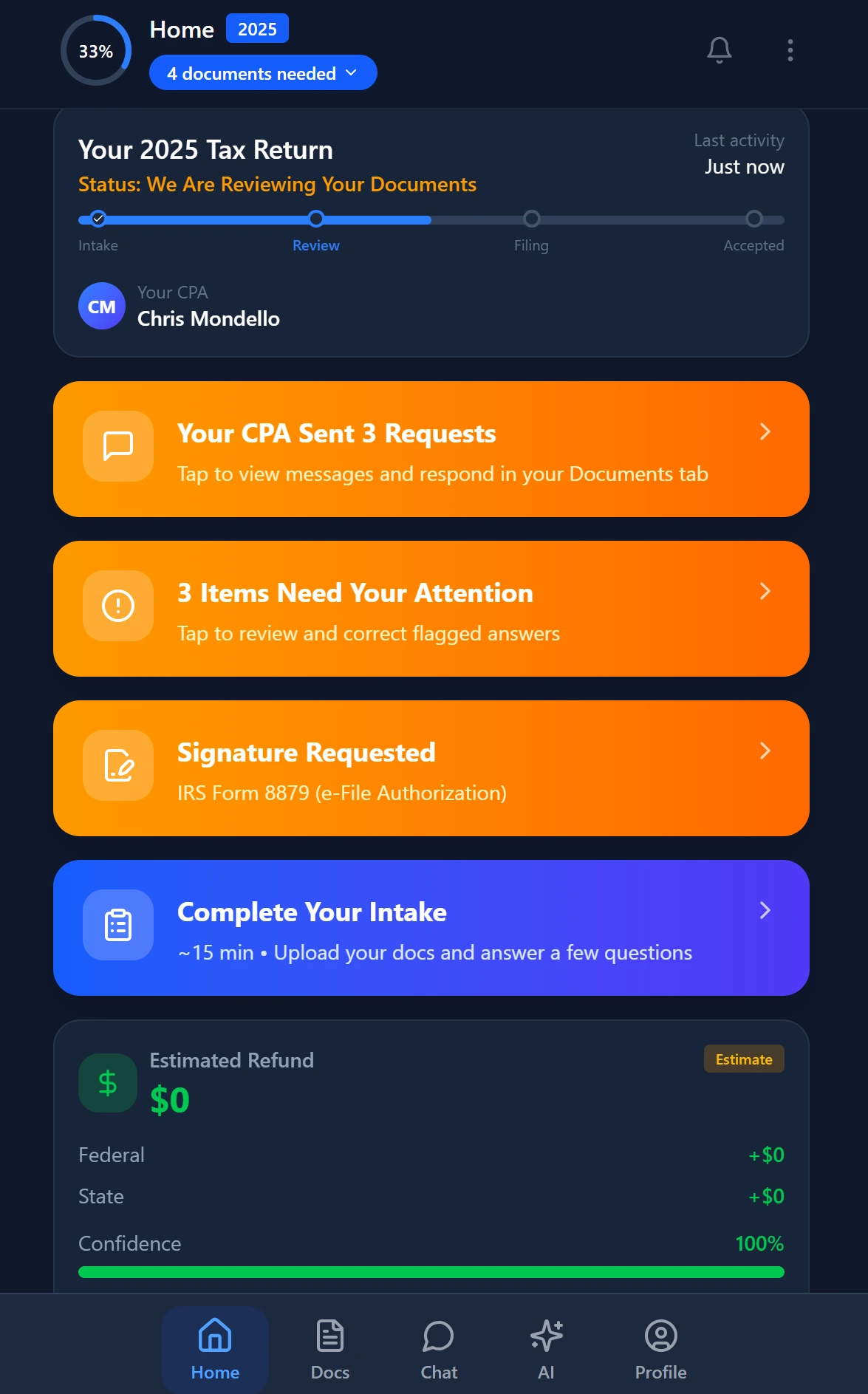
Smart intake auto-fills from uploaded documents and prior-year data
Building a Repeatable Basis Tracking System in Your Practice
A one-off basis spreadsheet created at tax time is not a system — it is a liability. When a shareholder disposes of stock mid-year, when a corporation issues a distribution in August, or when a new CPA inherits the file, a scattered collection of Excel files provides no continuity. The goal is a centralized, updated-annually basis schedule embedded in the client's permanent file inside your practice management platform. Firms that invest in a structured basis tracking for S corp process consistently report fewer year-end surprises and stronger client advisory conversations than those relying on ad hoc workpapers.
Start by creating a dedicated document folder within each S corp shareholder's client record for basis documentation: the annual Form 7203 workpaper, loan agreements, K-1 copies, and the cumulative suspended-loss schedule. With AI document extraction, K-1 line items and prior-year carryforward amounts can be pulled from PDFs automatically, reducing the manual re-keying that introduces transcription errors into basis calculations.
Next, use pipeline management with a dedicated stage for "Basis Reconciliation" that triggers each October for every S corp shareholder client. Assign the stage a checklist: pull K-1 draft, verify loan documentation, update stock basis schedule, update debt basis schedule, flag suspended losses, prepare Form 7203 draft. With 12 customizable pipeline stages and drag-and-drop kanban, you can see at a glance which clients have completed basis reconciliation and which are still pending — before the December 31 deadline creates a crisis.
The AI research agents inside TaxScout.ai can surface the latest IRS guidance on Form 7203, draft research memos on contested debt-basis questions, and query IRS.gov and law.cornell.edu in real time when a novel loan structure raises a classification question. This turns what is typically a late-night research scramble into a documented, client-context-aware process. For a broader view of how these tools fit into firm operations, browse other blog resources covering practice management workflows across the full tax calendar.
Year-End Planning Opportunities That Basis Tracking Unlocks
Firms that complete basis reconciliation before year-end — rather than at filing — can offer clients actionable strategies that are unavailable once December 31 passes. The most impactful is the capital contribution to restore basis before a large loss year closes. If a shareholder's stock basis is projected to be insufficient to absorb a current-year loss, a cash contribution made by December 31 increases stock basis dollar for dollar and allows the loss to be fully deducted. The contribution must be documented and reported on the corporate books in the year it is made.
A second strategy is timing shareholder loans. If a client intends to loan money to the S corporation anyway, structuring the loan before year-end — with a formal note in place — creates debt basis that can absorb losses allocated in the same year. CPAs should coordinate with the client's bookkeeper to ensure the transaction hits the corporate ledger before the year closes and is reflected on the Schedule K-1.
Third, basis analysis sometimes reveals that a client has inadvertently taken distributions that will be taxable because they exceeded accumulated adjustments account (AAA) and stock basis. Catching this before the K-1 is finalized allows the S corporation to reclassify the excess as a shareholder loan (if the corporate minutes and books support it) or to plan for the gain on the individual return rather than discovering it as a surprise at filing. For related planning on pass-through income and self-employment tax, our Self-Employment Tax Planning guide covers the interplay between S corp wages and owner distributions.
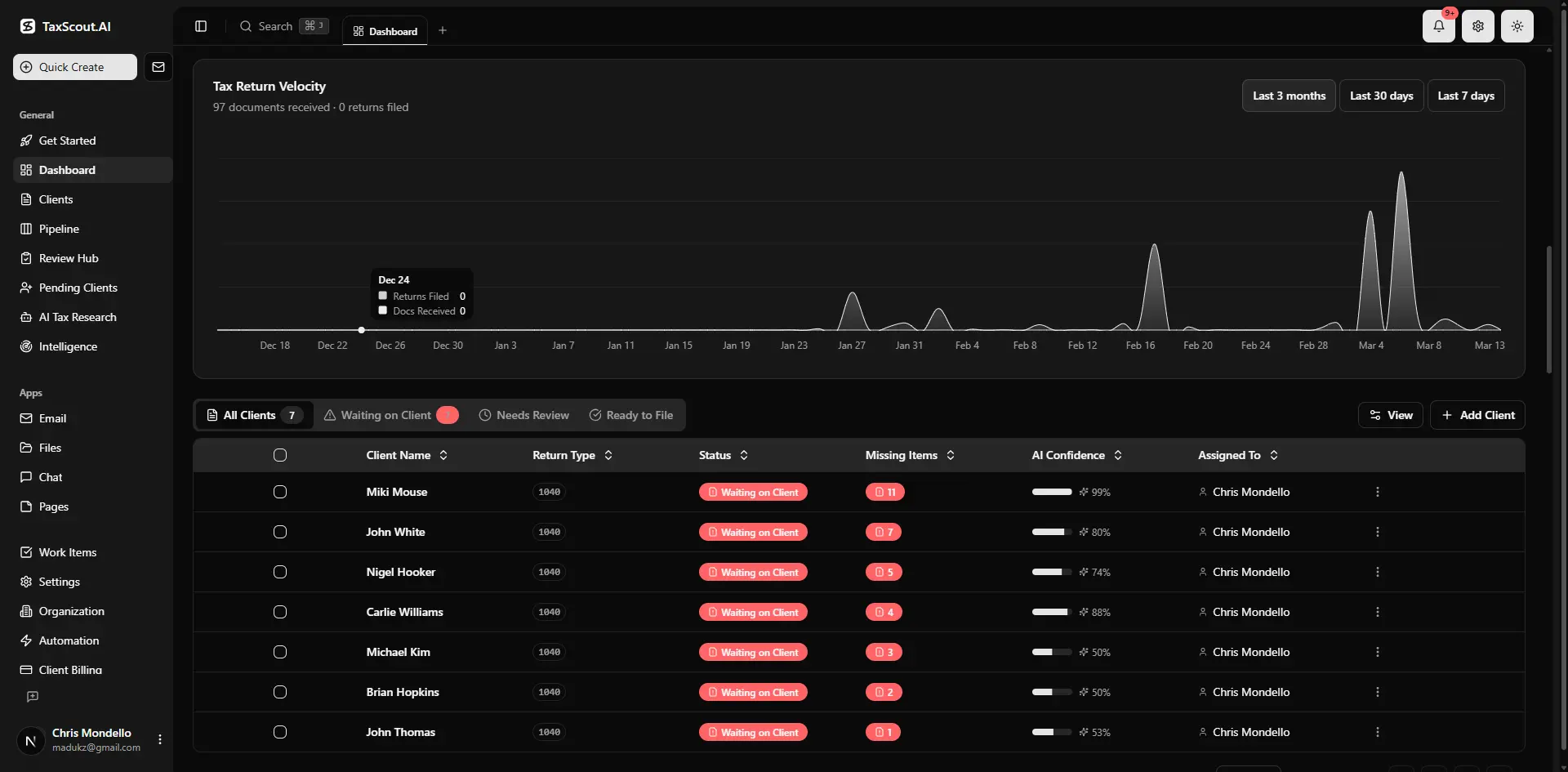
Real-time dashboard showing returns in progress, revenue, and upcoming deadlines
Key differences between stock basis and debt basis for S corp shareholders
| Attribute | Stock Basis | Debt Basis |
|---|---|---|
| Source | Initial investment + income allocations − distributions − losses | Bona fide shareholder loans to the corporation only |
| Guarantee treatment | Not increased by shareholder guarantees | Not created by guarantees; requires actual cash advance |
| Minimum floor | Cannot go below zero | Cannot go below zero |
| Ordering of losses | First layer absorbs losses after distributions | Second layer after stock basis is exhausted |
| Repayment gain risk | Distributions in excess of basis trigger capital gain | Loan repayments when debt basis < face value trigger gain |
| Form 7203 location | Part I | Part II |

Every client gets organized documents, status tracking, and a complete history
How to Handle Suspended Losses When a Client Exits
When a shareholder disposes of S corporation stock — whether by sale, gift, or death — suspended losses that have never been freed up by restored basis are permanently lost under IRC §1366(d)(2). This is one of the most costly basis errors in practice, and it is entirely preventable with advance planning.
If a client is considering a stock sale in the near term, the basis reconciliation should flag the suspended-loss balance and model whether a capital contribution prior to the sale would restore enough basis to allow the losses to offset the gain on disposition. In some cases, the after-tax math favors absorbing the contribution cost to free up the loss deductions. In other cases, the gain is preferentially taxed at long-term capital gain rates and the loss would only offset ordinary income — so the trade-off requires a full marginal-rate analysis.
When stock is transferred at death, the heir receives a stepped-up basis in the stock under IRC §1014, but suspended losses from the decedent's basis limitations are lost — they do not carry over to the estate or beneficiary. CPAs advising aging clients who are significant shareholders in S corporations should model the suspended-loss exposure as part of estate planning conversations, and should ensure that basis tracking for S corp positions is current before any transfer takes place. For context on coordinating basis issues with estate planning tools, see our Charitable Lead Trust guide.
Ready to stop losing client deductions to missed basis documentation?
TaxScout.ai combines AI document extraction, 9 specialized research agents, and customizable pipeline management so every S corp shareholder file is basis-ready before December 31 — at a flat price with no per-user fees.
Frequently Asked Questions
Any S corporation shareholder who (1) claims a deduction for a share of an S corp loss, (2) receives a nontaxable distribution, (3) disposes of S corporation stock, or (4) receives a repayment of a shareholder loan must attach Form 7203 to their Form 1040. The requirement applies starting with tax year 2021 returns. See the IRS Form 7203 instructions for the current year's specific line guidance.
Stay up to date
Get the latest tax tech insights delivered to your inbox.