Entity Selection for Startups: How CPAs Choose the Right Structure
Most entity selection articles talk to founders. This one talks to their CPAs. From LLC vs S-Corp vs C-Corp tax modeling to multi-state nexus checks and engagement templates, here is how experienced CPAs structure their new-business advisory workflow — and how AI-native tools are automating the…
Entity selection for startups is one of the highest-value advisory conversations a CPA can have with a new client — and one of the most consequential decisions that will shape every tax return, payroll obligation, and exit strategy for years to come. Yet almost every piece of published guidance on this topic is written for the founder asking 'what entity should I form?' rather than for the CPA who must actually model the trade-offs, document the recommendation, and build a sustainable engagement around it.
The CPA's vantage point is fundamentally different. Where a founder sees a binary choice between an LLC and a corporation, a CPA sees a cascade of downstream obligations: self-employment tax exposure, reasonable compensation requirements for S-Corp shareholders, accumulated earnings tax risk for C-Corps, pass-through entity SALT workarounds, multi-state nexus triggers, and the perpetual Form 2553 timing window that can slam shut before the client even books a second meeting. Entity selection for startups is rarely as simple as choosing a label — it triggers a cascade of downstream obligations that founders rarely anticipate.
This guide is written for CPAs navigating that complexity. We cover the core tax trade-offs across LLC, S-Corp, and C-Corp structures, the planning obligations that flow from each choice, the multi-state considerations that get missed at onboarding, and how AI-native practice management platforms are letting forward-leaning firms systematize entity-selection engagements at scale instead of re-creating the wheel for every new startup client. This guide is written for CPAs navigating the full complexity of entity selection for startups, covering core tax trade-offs across LLC, S-Corp, and C-Corp structures.
Why Entity Selection Is a CPA Advisory Decision, Not a Founder Google Search
Founders routinely arrive at their first CPA meeting having already formed an LLC based on a listicle they read at 11 PM. That formation may or may not align with their actual funding plans, hiring trajectory, or state of residence — and reversing a poor entity choice mid-stream is expensive and sometimes impossible without triggering recognition events. The CPA's role is to intercept this process before the paperwork is filed, or to audit it immediately after onboarding when there is still time to act. Founders routinely arrive at their first CPA meeting having already formed an LLC based on a listicle they read at 11 PM, without understanding that entity selection for startups carries long-term tax and structural consequences that are expensive to undo.
According to IRS Statistics of Income data, S-corporations now account for more than 4.7 million returns annually, while the number of partnership and multi-member LLC returns has grown even faster. CPAs are signing their names to more startup entity engagements than ever, which means the advisory framework you use — and the workflow scaffolding behind it — directly affects both your liability exposure and your firm's capacity. For firms evaluating their entity selection for startups approach, this trade-off compounds over time, making a repeatable system less optional and more essential.
Treating entity selection as a one-off consultation rather than the opening chapter of a multi-year advisory relationship is a missed opportunity. The CPA who sets up the entity is positioned to handle the initial S-Corp election, the first payroll setup, the multi-state registrations as the business scales, and eventually the exit planning. Firms that systematize this engagement from intake forward capture far more of that lifetime value. You can explore other blog resources on advisory workflows and practice management across the TaxScout knowledge base. Each of these factors directly shapes how entity selection for startups plays out in practice.
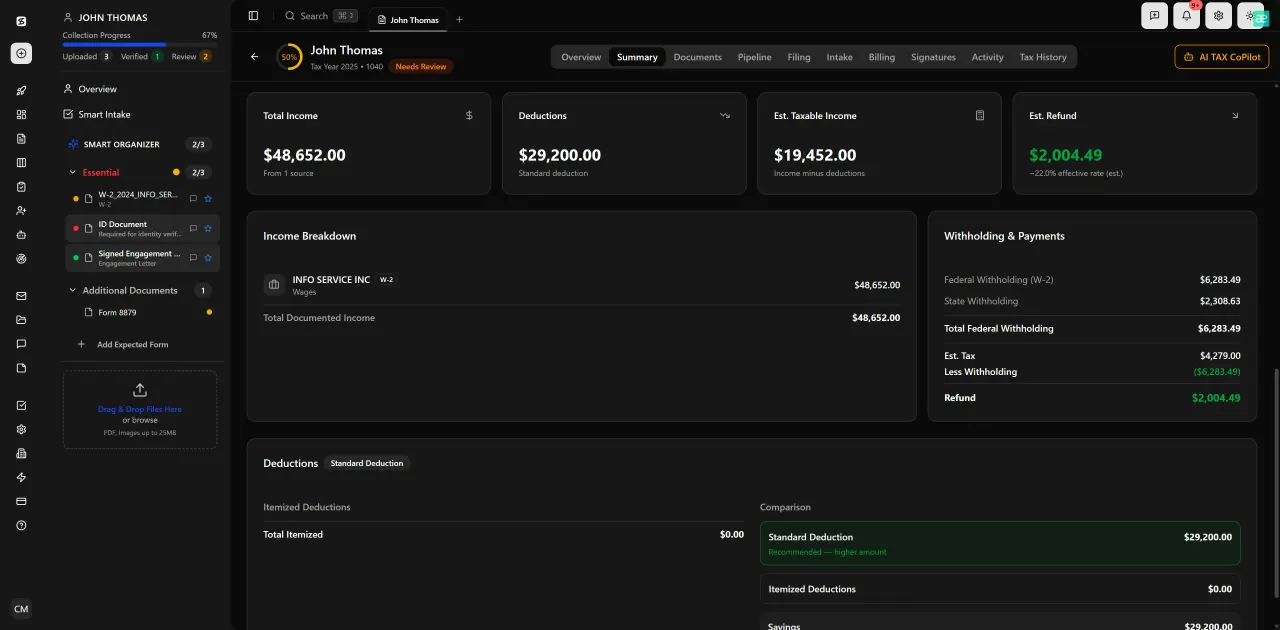
Review with AI assist — 9 agents answer questions with full client context
LLC vs S-Corp vs C-Corp: The Tax Trade-offs CPAs Must Model
The entity comparison is not a checklist — it is a dynamic model that shifts with the client's income projection, number of owners, investor plans, and state of domicile. Here is how CPAs should frame each structure for a new startup client. Understanding entity selection for startups in this context is what separates firms that scale from those that stall.
A single-member LLC taxed as a sole proprietorship is the path of least resistance and the highest self-employment tax exposure. The owner pays self-employment tax on 100% of net profit. For a founder netting $120,000, that is roughly $17,000 in SE tax before a single dollar of income tax is calculated. The QBI deduction softens the blow somewhat, but it does not eliminate the SE tax problem. This is precisely where a deliberate entity selection for startups strategy pays off — choosing the wrong default structure in year one can cost a founder tens of thousands in avoidable SE tax over a three-year horizon.
An S-Corporation election — achieved by filing Form 2553 within 75 days of formation or by March 15 of the current tax year for existing entities — splits profit between a W-2 salary subject to payroll taxes and a distribution that is not. For a founder netting the same $120,000 and drawing a defensible $60,000 salary, the SE tax savings can exceed $9,000 annually. However, the CPA must immediately flag the reasonable compensation obligation: the IRS actively scrutinizes below-market salaries in S-Corps, and underpayment is one of the most common examination triggers for small businesses, as documented in IRS Audit Technique Guides. Entity selection for startups sits at the center of this decision — get it wrong and the rest unravels.
A C-Corporation is typically the right answer only when venture capital is in the picture, the founders plan to seek Section 1202 Qualified Small Business Stock exclusions on future gain, or the business needs to retain earnings inside the entity at the lower 21% flat rate rather than passing income to owners in high personal brackets. The trade-off is double taxation at distribution: corporate earnings taxed at 21%, then dividends taxed again at qualified dividend rates. CPAs must also flag the accumulated earnings tax risk under IRC §531 when retained earnings exceed business needs without documented justification — a trap many early-stage C-Corps walk into by Year 3. When firms revisit their entity selection for startups priorities, the gaps usually surface here, often after a funding round has already locked the structure in place.
The Multi-Member LLC and Partnership Complexity
When a startup has two or more founders, the default tax treatment becomes a partnership, introducing Schedule K-1 obligations, special allocations, and the need for an operating agreement that actually matches the tax treatment. CPAs should review the operating agreement before the entity is formed, not after. Mismatches between economic arrangements and tax allocations are surprisingly common and require costly amended returns to unwind.
A multi-member LLC electing S-Corp status adds another layer: all members must be eligible S-Corp shareholders (no corporations, no non-resident aliens, no more than 100 shareholders). For startups expecting to bring in non-resident co-founders or institutional investors, an S-Corp election forecloses options. The CPA must surface this constraint at the very first engagement meeting, since it is one of the most commonly overlooked dimensions of entity selection for startups when founders have international co-founders already in the picture.
Tired of rebuilding your entity-selection engagement template from scratch for every new startup client?
TaxScout's AI-native pipeline lets you launch a fully structured new-business onboarding workflow — engagement letter, intake questionnaire, multi-state nexus checklist, and e-signature — in minutes, not hours.

Track every return from intake to filed with drag-and-drop pipeline management

Your clients see your brand — OTP login, document upload, and real-time status
Downstream Tax Obligations CPAs Must Track After Entity Formation
The entity recommendation is not the end of the engagement — it is the beginning of an obligation map the CPA must maintain. Each structure creates a distinct set of recurring compliance touchpoints that should be loaded into the firm's pipeline from day one.
For S-Corporations: annual reasonable compensation review, payroll tax deposits, Form 941 filings, W-2 issuance to shareholder-employees, K-1 preparation, basis tracking (a chronic problem area), and the built-in gains tax window if the entity converted from a C-Corp. CPAs who skip basis tracking in Year 1 routinely face malpractice exposure when clients take distributions in Year 4 that exceed their tracked basis.
For C-Corporations: quarterly estimated tax payments at the corporate level, potential AMT exposure under the CAMT rules introduced by the Inflation Reduction Act for larger entities, accumulated earnings tax documentation, and the Section 382 limitation analysis whenever new investors come in and ownership shifts by more than 50 percentage points over a rolling three-year window.
For LLCs and partnerships: self-employment tax planning, estimated tax payments for each member, state composite return obligations where applicable, and the Section 704(b) substantial economic effect analysis whenever the operating agreement includes special allocations. The IRS Partnership Audit Regime introduced by the Bipartisan Budget Act of 2015 also means CPAs must advise multi-member LLCs on electing out of BBA rules or designating a Partnership Representative — another detail that often falls through the cracks at onboarding. Firms that build entity selection for startups into a structured multi-year engagement map are far less likely to miss these obligations as the client's complexity grows.
Using pipeline management software that lets you assign these recurring obligations as checklist items tied to the entity type means nothing slips. The alternative — relying on staff memory and ad-hoc reminders — is how firms accumulate professional liability exposure one missed deadline at a time.
Multi-State Nexus Analysis: The Entity Formation Step CPAs Usually Miss
Startup founders almost universally think about entity formation in terms of their home state. CPAs have to think in terms of where the business will actually operate, hire employees, store inventory, and generate revenue — because each of those activities can trigger tax nexus and registration obligations in states the founder has never visited.
The post-Wayfair economic nexus landscape, affirmed by the Supreme Court in South Dakota v. Wayfair, Inc., means that a SaaS startup with $100,000 in annual revenue from California customers may have California income tax nexus before it has a single California employee. Add a remote developer in Texas, a contractor in Florida, and a co-founder attending trade shows in New York, and you have a multi-state filing obligation that started on Day 1 of operations. This is one reason why entity selection for startups should always include a preliminary nexus scan — the state-level consequences of the chosen structure can vary dramatically depending on where revenue is being generated.
CPAs should run a preliminary nexus analysis during the entity formation engagement — not after the first state tax notice arrives. The analysis should cover: physical presence nexus (employees, offices, inventory), economic nexus thresholds by revenue and transaction count, payroll tax registration requirements, and state-specific treatment of pass-through entities including PTE tax elections where applicable. For a deeper look at how AI tools are automating this analysis, see our post on multi-state tax returns and AI agents.
State-specific nuances matter enormously. California's LLC franchise tax minimum ($800/year) applies from the day of formation regardless of revenue. Delaware's Court of Chancery advantages are real for VC-backed C-Corps but irrelevant for a two-person service business. New York's combined reporting rules can pull a single-member LLC into a corporate tax net the owner never anticipated. CPAs advising startup clients in high-nexus states should review state-specific updates regularly to keep their analysis current.
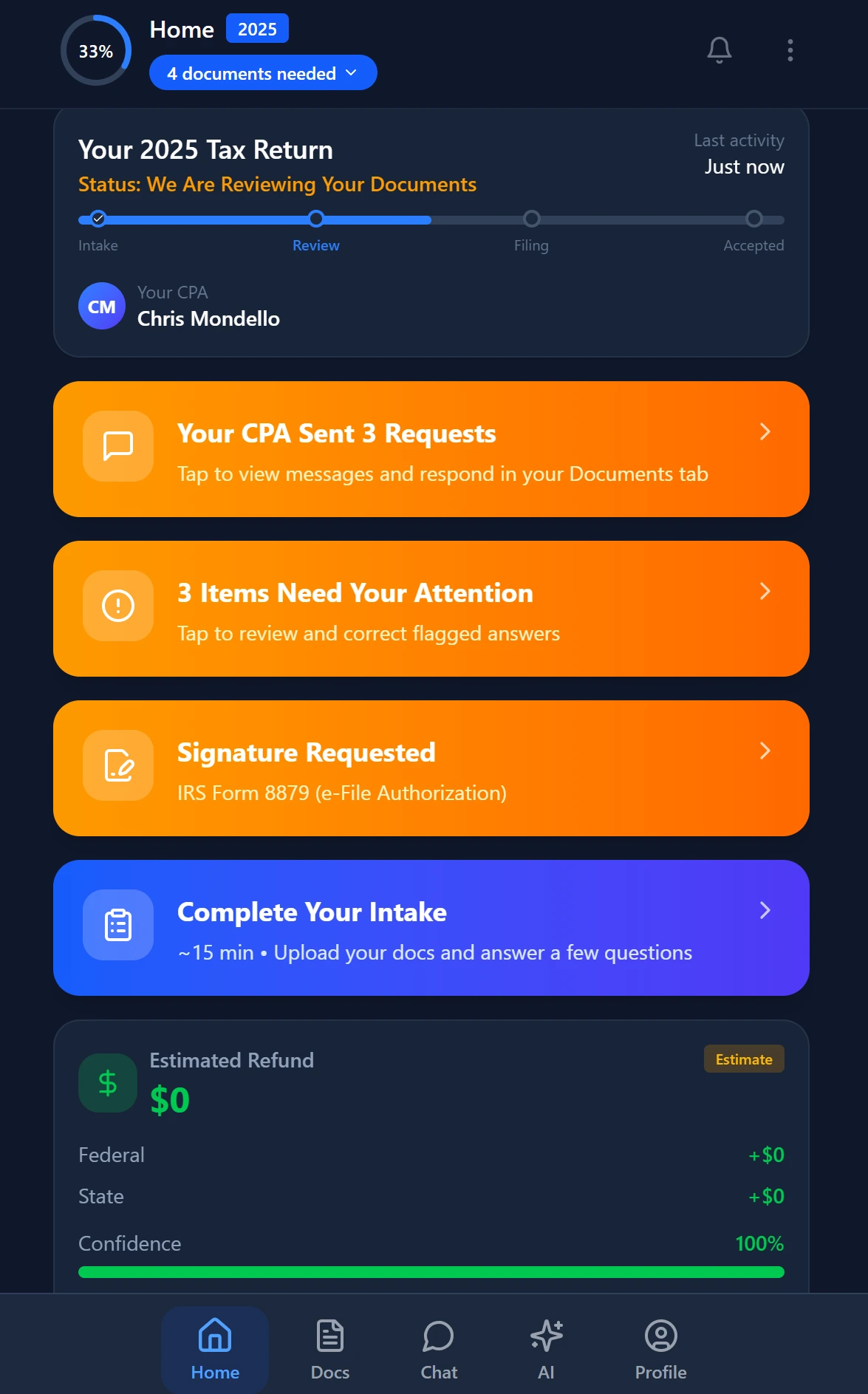
Smart intake auto-fills from uploaded documents and prior-year data

Click any extracted field to see its source highlighted on the original PDF
How AI-Native Practice Management Systematizes Entity-Selection Engagements
The entity-selection engagement has historically been one of the most labor-intensive to set up correctly — customized engagement letter, tailored intake questionnaire covering ownership structure and funding plans, multi-state nexus checklist, entity comparison memo, and a pipeline stage for the Form 2553 deadline if the S-Corp election is recommended. Most firms do this from scratch every time, which means the quality varies by which staff member is assigned.
AI-native platforms like TaxScout change this by letting firms build reusable workflow templates that trigger automatically when a new business formation client is added to the pipeline. The smart intake engine is modeled on IRS Form 13614-C and uses a four-layer prefill — document-first, prior-year data, client profile, and AI gap analysis — to surface the ownership, revenue projection, and multi-state activity questions that determine the entity recommendation before the first advisory call even happens.
The AI Research Agents available in TaxScout's platform include real-time search across IRS, Treasury, Cornell Law School, and SSA sources — meaning when a client's situation involves an unusual structure (like a C-Corp electing S status, or a foreign co-founder complicating the S-Corp eligibility), the CPA can run a guided research query against current authority rather than relying on memory or a stale internal memo. This is especially valuable for the reasonable compensation analysis, where IRS guidance, court decisions, and actuarial tables all factor into a defensible salary figure. It also means that edge cases in entity selection for startups — such as a Delaware C-Corp with remote employees in six states — can be researched and documented in the same workflow rather than handled as a separate off-platform task.
Engagement letters for entity-formation engagements can be sent and signed via the integrated e-signature module — covering the initial advisory engagement, the follow-on compliance engagement, and any state registration work — all through the client portal with OTP login so founders are not wrestling with password resets before they have even filed their first return. For context on how e-signatures work within a compliant CPA workflow, see our post on electronic signatures and compliance for accountants.
Pricing the entity-selection engagement is also more defensible when the scope is systematized. A firm that can show a new startup client exactly what is included — nexus analysis, entity comparison memo, formation documents review, S-Corp election filing if applicable, first-year compliance calendar — is in a much stronger position to charge $1,500 to $3,500 for the engagement than a firm billing two hours at an hourly rate. See our flat fee billing guide for how leading CPA firms are packaging advisory services this way.
Entity Structure Quick Reference for CPA Advisors
| Factor | Single-Member LLC | S-Corporation | C-Corporation |
|---|---|---|---|
| Default tax treatment | Sole proprietorship (Schedule C) | Pass-through (Form 1120-S + K-1) | Corporate (Form 1120, double tax) |
| SE tax on profits | Full SE tax on all net profit | SE tax only on W-2 salary portion | No SE tax; payroll taxes on salary only |
| Reasonable compensation requirement | None | Yes — IRS scrutinizes below-market salaries | Yes — but different audit profile |
| VC/investor compatibility | Limited — needs conversion | Restricted (100-shareholder cap, no foreign owners) | Preferred — supports preferred stock |
| QSBS exclusion (Sec. 1202) | Not eligible | Not eligible | Eligible if QSB criteria met |
| Multi-state registration complexity | Low to moderate | Moderate — payroll adds nexus risk | Moderate to high — corporate nexus rules apply |
| Formation timing flexibility | Very flexible | 75-day election window from formation | Flexible — but structure changes are costly later |
| Key CPA ongoing obligation | SE tax planning, QBI tracking | Reasonable comp review, basis tracking | Accumulated earnings documentation, CAMT watch |
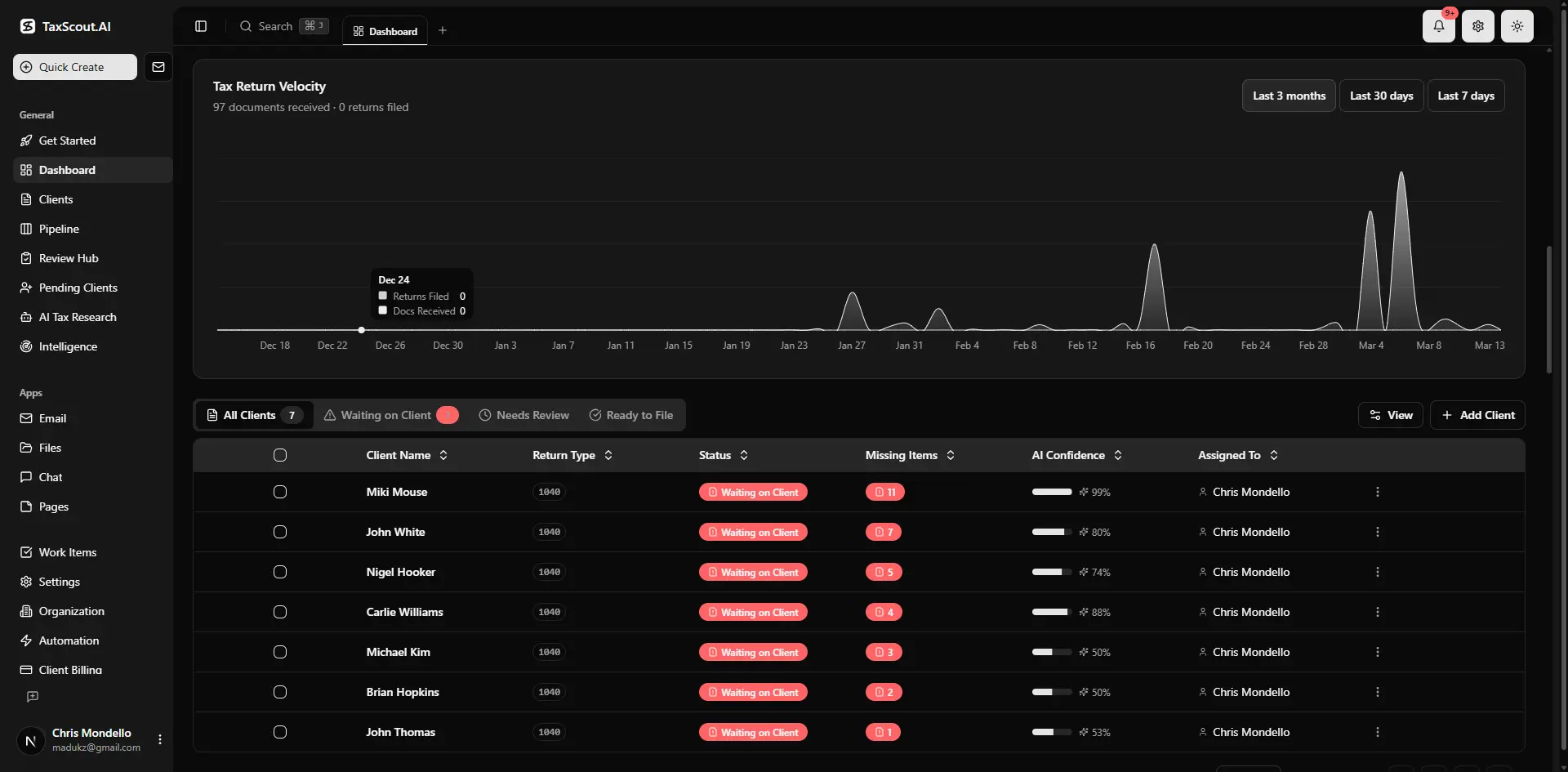
Real-time dashboard showing returns in progress, revenue, and upcoming deadlines
Building a Scalable New-Client Entity Review Process
Firms that advise more than a handful of startup clients per year need a repeatable process, not a bespoke engagement each time. The architecture of a scalable entity review workflow looks like this: a standardized intake questionnaire that captures business model, projected revenue, owner count and citizenship, state of operations, funding plans, and exit horizon; a templated entity comparison memo with the numbers filled in from the intake data; a decision tree for the S-Corp election timing; a multi-state nexus checklist; and a compliance calendar that feeds directly into the firm's pipeline management system.
The client onboarding phase is where most of this information should be captured — before the CPA invests billable hours in modeling. Using an AI-powered intake tool that pre-populates from prior-year documents (if the client is switching CPAs) or guides a brand-new business owner through the relevant questions in plain language dramatically reduces the back-and-forth that turns a one-hour engagement into a three-week email chain. Standardizing this intake process around the known decision points in entity selection for startups means junior staff can run the front-end data collection without the partner needing to be involved until the recommendation is ready to be modeled.
Document management is equally important. Entity formation engagements generate a significant paper trail: articles of organization or incorporation, operating agreements, Form 2553 and the IRS acknowledgment letter, state registration certificates, EIN confirmation, and initial resolutions. All of these need to be stored, indexed, and retrievable when the client calls three years later asking whether they ever filed the S-Corp election. A purpose-built document management system with AI-powered classification handles this automatically — a generic cloud folder does not.
For firms comparing practice management platforms to support this kind of workflow, TaxScout's flat pricing model is worth examining closely. At $149/month for up to 10 seats and 500 returns — with no per-user fees — it costs significantly less than per-user alternatives like TaxDome ($500/month for 10 users) or Karbon ($590/month for 10 users). See the full TaxScout vs Karbon comparison for a feature-by-feature breakdown relevant to advisory-focused firms.

Every client gets organized documents, status tracking, and a complete history
Professional Liability Considerations in Entity Selection Advice
Entity selection advice sits squarely in advisory services territory, which means it carries professional liability exposure that routine compliance work does not. The AICPA's Statements on Standards for Tax Services require that CPAs have a reasonable basis for tax return positions — but for advisory recommendations, the standard is arguably higher because the CPA is driving a decision the client may rely on for a decade.
CPAs should document the entity recommendation in writing, include the assumptions underlying it (projected income, state of residence, funding timeline, exit horizon), and note the risks of alternative structures that were considered and rejected. This documentation serves two purposes: it protects the CPA if the client later claims the advice was wrong, and it creates a natural touchpoint for annual advisory check-ins when any of those assumptions change. Because entity selection for startups is rarely a static decision — revenue trajectories shift, co-founders join, funding rounds change the ownership picture — that annual review conversation is also an opportunity to confirm the original structure still fits or to initiate a conversion before it becomes costly.
The engagement letter for an entity-selection engagement should explicitly scope what the CPA is and is not advising on. If the nexus analysis is limited to two states because the client represented they had no other activity, that limitation should be in writing. If the reasonable compensation figure was based on the client's own representations about their role and market, that should be documented too. Using a platform with built-in e-signature capabilities means the engagement letter is executed and archived before the work begins — not retrieved from a sent-email folder if a dispute arises two years later.
Ready to stop re-building your startup entity engagement from scratch every time a new business owner walks in?
TaxScout gives CPA firms AI-powered intake, automated pipeline stages, research agents with real-time IRS access, and e-signatures — all at a flat rate with no per-user fees.
Frequently Asked Questions
An S-Corp election typically makes financial sense when the owner's net profit consistently exceeds $40,000–$50,000 annually and a reasonable market salary for their role is meaningfully lower than total profit. The self-employment tax savings on the distribution portion often exceed the added payroll administration costs at that income level. CPAs must file Form 2553 within 75 days of formation or by March 15 of the current tax year for an existing entity, so timing the recommendation is critical.
Keep reading
Uniform Capitalization Rules: How CPAs Apply UNICAP to Inventory and Self-Constructed Assets
Oct 17, 2026 · 1 min read
Non-Applicability of Section 357(c) to Consolidated Groups: What CPA Firms Must Do Now
Oct 17, 2026 · 1 min read
Reasonable Basis Defense: How CPAs Shield Clients From Accuracy-Related Penalties
Oct 17, 2026 · 1 min read
Stay up to date
Get the latest tax tech insights delivered to your inbox.