E-Signature Accounting Compliance: Best Practices
Using DocuSign or Adobe Sign doesn't automatically mean you're compliant — e-signature rules for tax documents are far more specific than most CPAs realize. From IRS requirements on Form 8879 to state-level rejections, the gaps in your current workflow could create real liability. This guide…
Most CPAs using DocuSign or Adobe Acrobat Sign for client signatures assume they've checked the compliance box. They haven't. E-signature accounting compliance is more nuanced than clicking "send for signature" — and the gap between a legally valid e-signature and an IRS-compliant one for tax documents is where real liability lives.
The IRS has specific requirements for electronic signatures on Form 8879, Form 4868, and FBAR. State tax authorities add their own layers. And federal law under ESIGN and UETA creates a baseline that's easy to misread as permission to use any tool you want. When an audit triggers questions about authorization, or a state rejects a return because the e-signature process didn't meet its requirements, "we used DocuSign" is not a complete answer. Navigating these overlapping frameworks is precisely what makes e-signature accounting compliance so difficult to get right without a documented, jurisdiction-aware policy.
This guide covers what e-signature accounting compliance actually requires for CPA firms — the federal framework, the IRS-specific rules, the state variance problem, and how TaxScout handles all of it automatically so you're not configuring compliance into a generic tool.
The Legal Foundation: ESIGN, UETA, and What They Actually Say
The Electronic Signatures in Global and National Commerce Act (ESIGN) and the Uniform Electronic Transactions Act (UETA) established that electronic signatures carry the same legal weight as wet signatures for most transactions. Forty-nine states have adopted UETA; New York uses its own Electronic Signatures and Records Act (ESRA) with similar effect.
This federal baseline matters, but it's frequently misread. ESIGN and UETA establish general legal validity — they do not override agency-specific requirements. The IRS is a federal agency with its own regulatory framework, and its rules for electronic signatures on tax documents go beyond what ESIGN requires. That distinction — between general legal validity and agency-specific requirements — is one of the most consequential gaps in e-signature accounting compliance that practitioners routinely overlook.
Three elements must be present for a valid electronic signature under ESIGN:
- Intent to sign — the signer must affirmatively indicate agreement
- Consent to do business electronically — required and must be documented
- Association of the signature with the record — the signature must be logically linked to the document
A generic e-signature tool can satisfy all three. But IRS requirements for specific tax forms add a fourth requirement that most generic tools don't address by default: identity verification.
IRS-Specific Requirements for Electronic Signatures on Tax Documents
The IRS has issued detailed guidance on electronic signatures through Revenue Procedure 2021-3 and subsequent temporary authorizations, plus specific instructions embedded in form publications. The rules differ depending on the document type.
Form 8879: The Critical Authorization Form
IRS Form 8879 (IRS e-file Signature Authorization) is the authorization that allows a taxpayer to use a PIN instead of a wet signature on their e-filed return. When a taxpayer signs Form 8879 electronically, meeting e-signature accounting compliance standards requires:
- The ERO (that's your firm) must use an identity verification process that meets IRS standards
- For remote (unsupervised) e-signatures on Form 8879, Knowledge-Based Authentication (KBA) is required — a challenge-question process using credit bureau data to verify identity
- The taxpayer must complete KBA successfully before the signature is valid
- The signed Form 8879 must be retained for three years from the due date of the return or the date it was filed, whichever is later
This is the requirement most CPAs using generic tools are missing. A standard DocuSign or Adobe Sign workflow does NOT automatically include KBA. It can be configured — but that configuration requires additional setup, additional cost (KBA is typically a premium add-on), and ongoing maintenance to ensure it's applied correctly to 8879s specifically. If you send Form 8879 through a generic e-signature workflow without KBA and without the signer being physically present, you've created an authorization the IRS can challenge.
Form 4868: Extension Signatures
IRS Form 4868 follows similar e-signature accounting compliance requirements when signed electronically as part of an e-filed extension. The taxpayer must consent to electronic delivery and the signature must be attributable to them — but KBA requirements are less stringent than 8879 because the authorization scope is narrower.
FBAR (FinCEN 114)
The FinCEN 114 (FBAR) has its own requirements administered by the Financial Crimes Enforcement Network. Electronic signatures are accepted, but the filing platform and signature method must support FinCEN's technical specifications. Not all generic e-signature tools integrate with the BSA E-Filing System correctly, making e-signature accounting compliance particularly challenging for firms with FBAR clients.
Worried your current e-signature workflow isn't IRS-compliant for Form 8879? See how TaxScout handles KBA, form-specific authorization, and retention requirements automatically. → Book a 15-Min Demo — See It Live

Your clients see your brand — OTP login, document upload, and real-time status
The State-by-State Problem: Where Multi-State Firms Get Exposed
Federal compliance is only half the picture. State tax authorities have adopted e-signature acceptance at very different rates and with very different requirements — a significant pain point for multi-state CPA firms that the major practice management platforms mostly ignore.
Here's where the variance creates real risk:
| State | E-Signature Acceptance | Notable Requirements |
|---|---|---|
| California | Accepted for FTB returns | Consent to electronic process required; KBA recommended for remote signing |
| New York | Accepted | Must meet ESRA requirements; identity verification required for POA forms |
| Texas | Accepted for franchise tax returns | Standard ESIGN requirements apply |
| Illinois | Accepted | Specific guidance on retention requirements |
| Florida | Accepted | UETA-compliant; no state income tax returns |
| Pennsylvania | Limited acceptance | Some forms still require wet signatures — verify form-by-form |
The deeper issue: state requirements change. California's Franchise Tax Board updates its e-signature guidance, New York's Department of Taxation revises its POA requirements, and Pennsylvania periodically revisits which forms it will accept digitally. A static knowledge base — or a generic tool with no tax-specific logic — leaves your firm responsible for tracking all of this manually. Maintaining consistent e-signature accounting compliance across multiple states is one of the most labor-intensive challenges multi-state firms face.
This is exactly why the California Tax Changes 2026 CPAs Must Know include e-signature guidance as part of the compliance picture, not just income tax rate changes.
What Generic Tools Get Wrong (and the Configuration Burden They Create)
DocuSign and Adobe Acrobat Sign are excellent products for general business contracts. They can technically be configured to meet IRS requirements. That's the problem.
The configuration burden is on your firm. That means:
- Manually enabling KBA for Form 8879 workflows (and ensuring it's not accidentally disabled)
- Setting up separate signature workflows for different form types with different compliance requirements
- Configuring retention policies to meet IRS three-year requirements
- Building signing order dependencies when engagement letters, 8879s, and state authorization forms need to be signed in a specific sequence
- Manually tracking which state forms have been signed by which method to defend against state-level challenges
- Paying KBA fees as a premium add-on per transaction — costs that add up fast during tax season
None of this is automated. It requires a staff member who understands both the technical configuration of the e-signature tool AND the e-signature accounting compliance requirements — a rare combination. And when that person leaves, the configuration knowledge walks out with them.
For smaller CPA firms, this isn't realistic. For larger firms, it's a compliance gap waiting to be discovered.
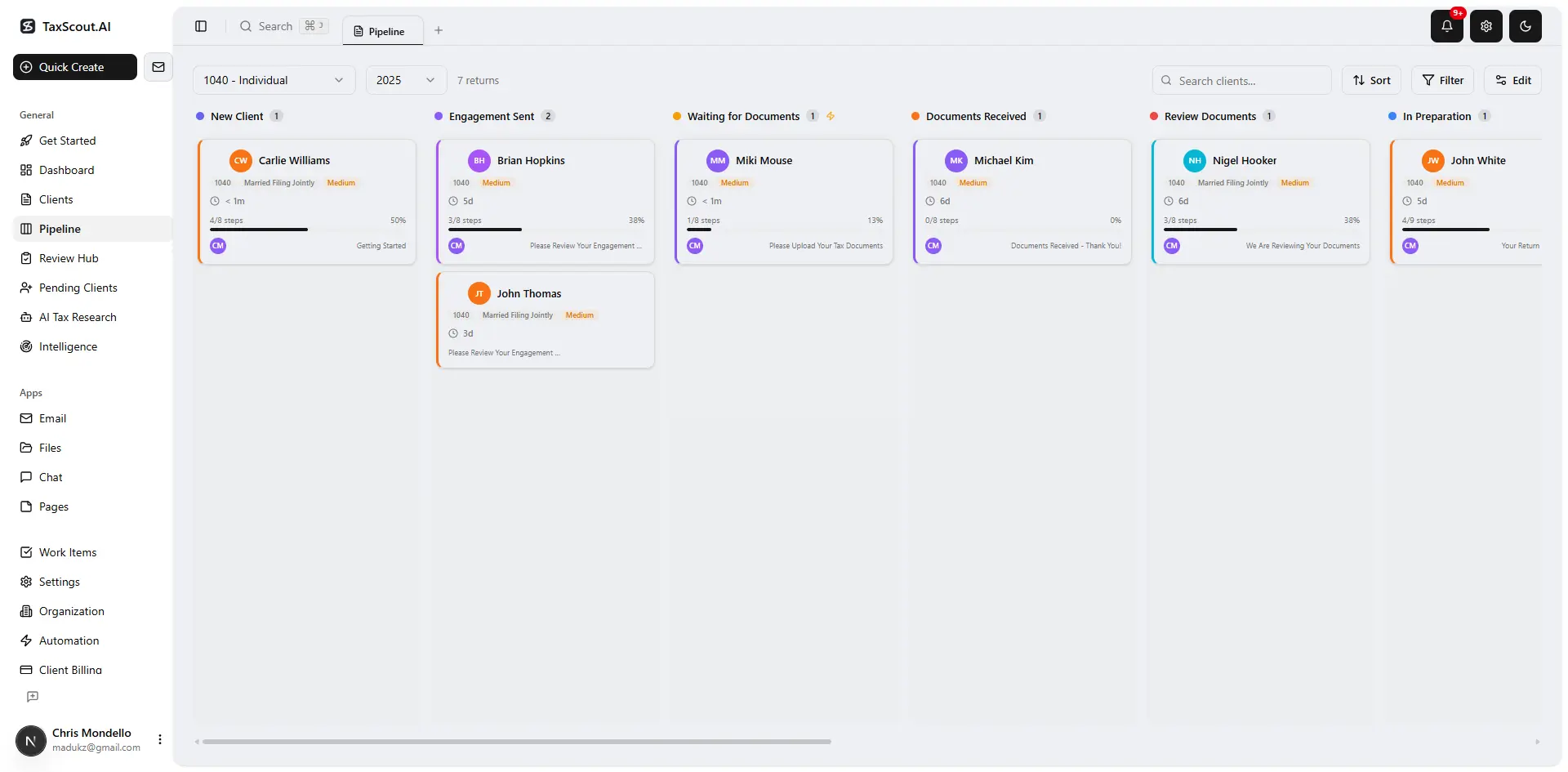
Track every return from intake to filed with drag-and-drop pipeline management
How TaxScout Handles E-Signature Accounting Compliance Automatically
TaxScout's e-signatures are built specifically for tax documents, powered by Documenso, with compliance requirements baked into the workflow rather than layered on top.
Here's what that means in practice:
Form-specific workflows. TaxScout has separate, pre-configured signature workflows for Form 8879, Form 4868, FBAR (FinCEN 114), engagement letters, W-9s, and state authorization forms. The right compliance requirements apply automatically based on which form is being signed — you don't configure it, you select the form.
KBA included for Form 8879. Knowledge-Based Authentication for remote signing of Form 8879 is built into the workflow, not a premium add-on you enable. Every remote 8879 signing automatically triggers the identity verification challenge before the signature is captured.
Signing order dependencies. When a package includes an engagement letter, a 8879, and state authorization forms, TaxScout enforces the correct signing sequence. State forms that require the engagement letter to be signed first won't be presented to the client out of order.
Retention handled automatically. Signed documents are stored in the client's entity folder in TaxScout with full audit logs — who signed, when, from what IP address, what identity verification was completed. Retention periods are tracked. You don't need a separate document retention policy for e-signatures; the platform handles e-signature accounting compliance end to end.
Branded client portal with zero friction. Clients sign through TaxScout's client portal using OTP (one-time code) login — no account creation, no password. The portal is branded with your firm's name. Documents are presented clearly, with the ability to review the full PDF before signing.
Integrated with the full workflow. Because e-signatures are part of TaxScout's pipeline management, a completed Form 8879 signature automatically advances the client's status in the pipeline. You don't check a separate system — the pipeline shows you where every client stands on authorization.
Real-World Workflow: Form 8879 From Preparation to Signed Authorization
Here's how the end-to-end process works in TaxScout for a typical 1040 client:
1. Return preparation complete. Your preparer finishes the return in Drake, Lacerte, or whichever tax software your firm uses. The return is ready to file — pending client authorization.
2. 8879 uploaded to TaxScout. The preparer uploads the completed Form 8879 to the client's folder. TaxScout automatically recognizes it as a Form 8879 based on its AI document extraction — 180+ form types are recognized.
3. Signature request sent. The preparer selects "Request Signature — Form 8879" from the document menu. TaxScout automatically applies the Form 8879 workflow: KBA required, three-year retention applied, consent to electronic process included.
4. Client completes KBA. The client receives an email with a link to the branded client portal. They log in via OTP. Before signing, they complete the KBA identity verification challenge. If they fail KBA (three attempts), TaxScout flags the signature request and notifies the preparer.
5. Signature captured and logged. Successful KBA completion triggers the signature presentation. The client reviews the 8879 and signs. TaxScout captures the timestamp, IP address, KBA completion record, and device metadata.
6. Pipeline auto-advances. The completed 8879 is stored in the client folder. The pipeline stage automatically advances from "Awaiting Authorization" to "Ready to File." The preparer sees the status change without checking a separate system.
7. Audit trail complete. If the IRS ever questions the authorization, every element of the signature event is documented and retrievable: identity verification, consent, timing, document version signed. This complete audit trail is the backbone of defensible e-signature accounting compliance.
TaxScout vs. Generic Tools for E-Signature Compliance
| Feature | TaxScout | DocuSign (generic) | TaxDome |
|---|---|---|---|
| KBA for Form 8879 | Built-in, automatic | Paid add-on, manual config | Not available |
| Form 8879 specific workflow | Pre-configured | Manual configuration required | Basic e-signature only |
| FBAR (FinCEN 114) support | Included | Requires custom setup | Not available |
| State form signing order | Automatic | Manual | Manual |
| IRS retention compliance | Automatic (3-year tracked) | Manual policy required | Not tracked |
| Pipeline integration | Automatic stage advance | Separate system | Partial |
| KBA cost | Included in plan | Per-transaction premium | N/A |
| Pricing for 10-person firm | $49/mo flat | Variable + per-KBA fees | ~$1,000/mo |
TaxDome — which 10,000+ firms use — offers e-signatures but without the form-specific compliance framework. As we covered in our detailed TaxScout vs TaxDome 2026 comparison, TaxDome's e-signature implementation handles basic document signing but doesn't address the IRS-specific requirements around KBA, form-specific workflows, and automated retention tracking that e-signature accounting compliance demands.
Best Practices: What Your Firm Should Be Doing Right Now
Even if you're not yet using TaxScout, your current e-signature workflow should meet these standards:
1. Audit your Form 8879 process immediately. If you're sending 8879s through any remote e-signature tool without KBA, you have a compliance gap. Document your current process and compare it against the IRS requirements in the current version of Form 8879 instructions.
2. Get explicit electronic consent on file. Before using any e-signature process with a client, document their consent to transact electronically. This should be part of your engagement letter — and the engagement letter itself should be signed first.
3. Establish a document retention policy for signed forms. The IRS three-year retention requirement for 8879s is a minimum. Build a policy that covers federal requirements, state requirements, and your firm's malpractice insurance carrier's recommendations.
4. Verify state acceptance for every state return. Before using electronic signatures on state-specific authorization forms, verify that the state tax authority accepts them. Don't assume federal acceptance means state acceptance.
5. Map your multi-state workflows. If your firm files in multiple states, create a reference document showing which states accept e-signatures on which forms, what their specific requirements are, and when that information was last verified. As we covered in Best Multi State Tax Software: AI Agents Explained, multi-state e-signature accounting compliance requires systematic tracking, not ad hoc research.
6. Test your audit trail. Retrieve the full audit log for a recent signature event. Confirm it includes: timestamp, signer identity verification method, IP address, document version, and consent record. If you can't retrieve this, you can't defend the signature.
The Compliance Cost of Getting It Wrong
A rejected authorization doesn't just create rework. If an e-signature on Form 8879 doesn't meet IRS requirements and the IRS disallows the e-file authorization, you may need to obtain a new authorization — which requires client re-engagement, delays filing, and potentially triggers late-filing penalties if the original deadline has passed.
State-level rejection is more common and less visible. A state tax authority that doesn't accept your e-signature process may reject the authorization form, require a paper re-submission, and create a filing delay that the client blames on your firm — regardless of whether the technical fault lies with your e-signature tool's configuration.
The liability exposure from an undocumented or non-compliant 8879 authorization is real. Your engagement letter and malpractice policy should be reviewed to ensure they address e-signature accounting compliance as part of your standard of care.
For more on building a firm-wide compliance framework, our Cybersecurity for CPA Firms guide covers how e-signature compliance fits into the broader security posture your firm should be maintaining.
Ready to Make E-Signature Compliance Automatic?
TaxScout gives your firm IRS-compliant e-signatures — with built-in KBA, form-specific workflows, automated retention, and pipeline integration — for $49/mo flat. No per-transaction KBA fees. No manual configuration. No compliance gaps to audit.
Frequently Asked Questions
DocuSign is ESIGN-compliant but is not automatically IRS-compliant for tax documents like Form 8879. The IRS requires specific identity verification, taxpayer intent documentation, and signature authorization records that generic e-signature tools don't configure by default. TaxScout is built specifically for tax document workflows, automatically applying IRS Publication 1345 requirements for Form 8879, Form 4868, and FBAR — including identity proofing and the required electronic signature PIN process — without manual configuration.
Stay up to date
Get the latest tax tech insights delivered to your inbox.