New York State Tax Updates 2026 CPAs Need to Know
New York State's 2026 tax changes are already hitting client accounts — from revised income tax brackets to updated NYC resident surcharges and corporate franchise tax shifts. For CPAs managing multi-state books, falling behind isn't an option. Get the updates that matter most before your next…
Your New York client just called. For CPAs tracking new york state tax updates 2026 cpas, this guide covers everything you need. They received a notice from the Department of Taxation and Finance about a balance due — and you're not sure whether it traces back to the new 2026 rate bracket adjustment, the updated NYC resident surcharge, or a corporate franchise tax change that quietly took effect in January. You have 47 other clients in queue, half of them multi-state. The clock is already running.
This scenario plays out in CPA firms every day. New York State's tax code is one of the most layered in the country — personal income tax brackets that diverge from federal treatment, a corporate franchise tax regime with its own apportionment rules, and a second tax layer the moment your client sets foot in the five boroughs. Staying current on New York State tax updates 2026 CPAs need to know isn't optional. Missing a rate change, a threshold adjustment, or a filing deadline doesn't just create rework — it creates liability.
This guide is a practical compliance checklist covering what changed for 2026, what deadlines matter most, and how AI-native practice management tools are helping CPA firms systematically track these obligations across their entire client base.
New York State Tax Updates 2026: The CPA Compliance Checklist
Personal Income Tax: Rate Changes and Bracket Adjustments
New York State's personal income tax structure continues to operate on a nine-bracket system that diverges meaningfully from federal rates. For tax year 2026, CPAs should confirm the following for their New York resident clients — and keeping pace with New York State tax updates 2026 CPAs face requires verifying each of these items annually:
Millionaire's Tax Extension: New York's "millionaire's tax" — the additional surcharge on income above $1 million for single filers and $2 million for married filing jointly — remains in place through 2026. The top marginal rate applicable to income above $25 million stays at 10.9%. This was originally enacted as a temporary measure but has been extended and should be treated as permanent planning territory for high-income clients.
Inflation Adjustments: New York annually adjusts its standard deduction amounts and income brackets for inflation. For 2026 returns, confirm the current thresholds directly through the New York State Department of Taxation and Finance — bracket creep remains a common source of client under-withholding surprises, particularly for clients who received income increases or bonuses. Understanding New York State tax updates 2026 CPAs need to communicate to clients starts with these inflation-adjusted thresholds.
Part-Year Residents and Nonresidents: New York's sourcing rules for nonresident income — including the "convenience of the employer" rule — continue to generate significant controversy and audit exposure. Remote work arrangements that crossed state lines in 2025 may create 2026 filing obligations that clients haven't anticipated. The convenience rule means that a Connecticut resident working remotely for a New York employer may owe New York tax on days worked from home unless the remote arrangement was employer-necessitated. Confirm this analysis for every client with cross-border employment arrangements.
PTET (Pass-Through Entity Tax): New York's optional Pass-Through Entity Tax election allows S corporations and partnerships to pay state income tax at the entity level, generating a deduction that bypasses the $10,000 SALT cap for federal purposes. For 2026, confirm that eligible entities made the annual election by the required deadline and that estimated payments are on track. The PTET election must generally be made by March 15 for calendar-year entities — missed elections forfeit the strategy for the full year.
Struggling to track NY-specific obligations across a 60-client roster? See how TaxScout's AI research agents search IRS.gov, law.cornell.edu, and New York tax authority sources live — not from a cached database. → Book a 15-Min Demo — See It Live
New York State Corporate Franchise Tax: 2026 Updates
New York's Article 9-A corporate franchise tax applies to most general business corporations doing business in the state. Among the New York State tax updates 2026 CPAs handling corporate clients must master, the following items require particular attention:
Fixed Dollar Minimum Tax: The fixed dollar minimum (FDM) tax — assessed on New York receipts when it exceeds the business income base tax — has thresholds that can catch growing businesses off guard. Confirm that your corporate clients have correctly assessed their New York receipts and selected the appropriate FDM tier. Corporations with $25 million+ in NY receipts face the highest fixed minimums.
Combined Reporting: New York requires combined reporting for unitary groups meeting the 50% common ownership test. For 2026, confirm whether any of your corporate clients added related entities, made acquisitions, or restructured — any of these can change combined reporting status and, consequently, apportionment calculations.
Capital Base Tax Sunset: New York had been phasing out its capital base tax, which was scheduled to be fully eliminated for most general business corporations. Verify the current phase-out status for your specific client entities, particularly for S corporations subject to the Article 9-A fixed dollar minimum, which operates under different rules.
Net Operating Losses: New York's treatment of NOLs diverges from federal treatment at several points. Confirm carry-forward periods, any New York-specific limitations, and whether federal NOL changes from recent legislation flow through to New York returns as expected.
As we covered in our multi-state tax software guide for CPAs, the combination of New York's separate apportionment rules, its combined reporting requirements, and the PTET overlay creates one of the most demanding multi-state profiles in the country. Firms without systematic tracking tools are managing this largely by memory.
NYC-Specific Tax Considerations: The Second Layer
If your client lives or does business in New York City, add an entirely separate tax layer on top of state obligations:
NYC Personal Income Tax: New York City residents pay a separate city personal income tax ranging from 3.078% to 3.876% on taxable income. This is in addition to state tax — not a substitute for it. For 2026, confirm that NYC resident clients have adequate withholding or are making estimated payments at both the state AND city level.
NYC Unincorporated Business Tax (UBT): Partnerships and sole proprietors conducting business in New York City owe the Unincorporated Business Tax at a rate of 4% on net income from NYC sources above $95,000. This tax applies even if the individual partners don't live in NYC — if business income is sourced to the city, UBT applies. The UBT credit against personal income tax is partial, not dollar-for-dollar, creating true additional cost that many clients underestimate.
NYC General Corporation Tax vs. Business Corporation Tax: NYC has its own separate corporate tax regime. Most general corporations are now subject to the NYC Business Corporation Tax (BCT), which was reformed in 2015 and has been the subject of ongoing administrative guidance. Verify that your corporate clients are filing under the correct NYC tax regime and applying the correct NYC apportionment factors, which may differ from state apportionment.
Resident vs. Statutory Resident Analysis: A client who maintains a permanent place of abode in NYC and spends more than 183 days in the city may be classified as a statutory resident — triggering full NYC resident tax even if their domicile is elsewhere. This catches clients who maintain NYC apartments for work convenience while claiming domicile in a no-income-tax state. Document this analysis for every client with a NYC footprint, and note that this is one of the most consequential New York State tax updates 2026 CPAs should flag during client onboarding reviews.
NY Tax Filing Requirements 2026: Key Deadlines
As we outlined in our complete IRS deadline guide for 2026, federal and state deadlines don't always align. For New York:
Individual Returns (Form IT-201/IT-203):
- Original due date: April 15, 2026 (aligns with federal)
- Automatic extension: 6 months to October 15, 2026 — file Form IT-370 by April 15
- Note: New York extension is automatic but requires the form to be filed — failure to file IT-370 means no extension
Corporate Returns (Form CT-3/CT-3-A):
- Due date: 2.5 months after fiscal year end (March 15 for calendar-year corporations)
- Automatic 6-month extension available — file Form CT-5 by the original due date
- Estimated tax payments: quarterly, due March 15, June 15, September 15, December 15
Partnership and S-Corp Returns (Form IT-204/CT-3-S):
- Due date: March 15 for calendar-year entities
- PTET payments: estimated payments due March 15, June 15, September 15, December 15
NYC Business Returns:
- NYC Business Corporation Tax (NYC-2): March 15 for calendar-year corps, with extension available
- NYC Unincorporated Business Tax (NYC-202): April 15 for individual filers, March 15 for partnerships
Estimated Tax Requirements: New York requires estimated tax payments when the prior year's New York tax liability exceeded $300. Underpayment penalties apply — confirm that clients with large 2025 income events (asset sales, business exits, large bonuses) are making adequate 2026 estimates at both the state and city level. Deadline management is one area where staying current on New York State tax updates 2026 CPAs track across their practice pays the most immediate dividends.
NY State Tax Law Changes for Businesses 2026: Legislative Developments
New York's legislative environment remains active. For 2026, CPAs should monitor:
Congestion Pricing and Business Impact: While not a direct tax change, New York's ongoing congestion pricing program affects certain deductible business transportation costs. Confirm whether affected clients are tracking tolls as business expenses appropriately.
Wage Reporting Requirements: New York has enhanced its wage theft and misclassification enforcement. Ensure that clients with New York employees have correctly classified workers and are filing quarterly NYS-45 wage reports on time. Worker misclassification is an active audit target.
Clean Energy Credits: New York has expanded several clean energy tax credit programs. Confirm whether any of your clients qualify for credits under the New York State Energy Research and Development Authority (NYSERDA) programs, which can be claimed on corporate franchise tax returns. These credits represent some of the more favorable New York State tax updates 2026 CPAs can proactively surface for business clients.
Cannabis Business Taxation: New York-licensed cannabis businesses remain subject to unique tax treatment under the state's adult-use cannabis framework. Deductibility limitations analogous to federal Section 280E considerations apply at the state level — confirm your cannabis clients are aware of the state-level impact.
How AI-Native Practice Management Helps CPAs Stay Current on State Tax Changes
Managing New York tax obligations for 50 or 100 clients isn't a calendar problem — it's a systems problem. The firms that get tripped up aren't failing to know the rules. They're failing to consistently apply the right rules to each client's specific fact pattern across an entire practice, at scale. This challenge is especially acute when it comes to New York State tax updates 2026 CPAs must apply correctly across divergent client profiles — residents, nonresidents, pass-through entities, and corporations all operating under different rule sets simultaneously.
This is where AI-native practice management software changes the workflow.
Real-Time Regulatory Research: TaxScout's AI research agents search live sources — including the New York State Department of Taxation and Finance, IRS.gov, law.cornell.edu, and treasury.gov — in real time, not from a cached database. When a New York guidance document updates, your research reflects it immediately. The platform includes 9 specialized agents, including a Filing Specialist, Risk Assessment, and Contextual Q&A agent — each with client-context memory that remembers prior-year positions, entity structures, and filing history.
Document Intelligence for NY-Specific Forms: New York has its own tax forms — IT-201, IT-203, CT-3, NYC-2, NYC-202 — that exist outside the federal tax form set. TaxScout's AI document extraction handles 180+ tax form types, including state and city-level returns, with a 5-layer validation pipeline that includes deterministic math rules and cross-document checks. If a K-1 from a PTET-electing partnership needs to match the IT-204 data, the validation logic catches mismatches before they become audit issues.
Multi-State Pipeline Visibility: For clients with both federal and multiple state obligations, TaxScout's pipeline management tracks all 12 workflow stages across every client in your practice. You can see, at a glance, which NY clients have outstanding PTET estimated payments, which are awaiting city-level tax documents, and which need extension forms filed before April 15.
Flat Pricing That Scales: Unlike practice management tools that charge per user — TaxDome runs ~$100/user/month, meaning a 10-person CPA firm pays roughly $1,000/month — TaxScout's Pro plan is $199/month flat regardless of team size. For firms managing the complexity of New York State, city, and multi-state compliance, having your entire team working within a single AI-native platform at a fixed cost matters. Check our TaxScout pricing page for current plan details.
As we explored in our guide to AI tax research agents for CPAs, the ability to query live regulatory sources against a specific client's fact pattern — rather than researching generically and hoping you're applying the right version of a rule — is the most meaningful efficiency gain available to tax professionals right now.
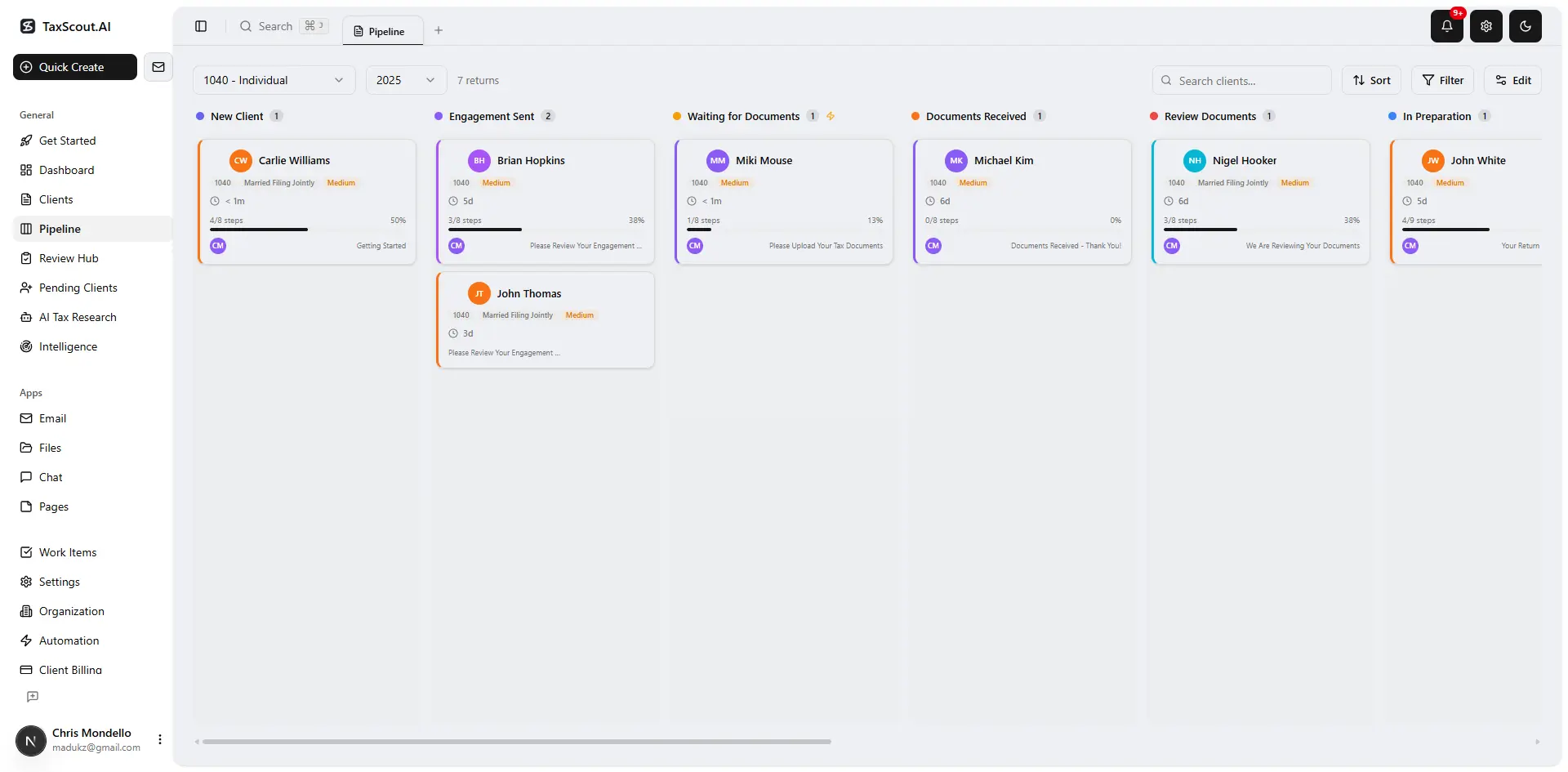
Track every return from intake to filed with drag-and-drop pipeline management
Ready to Stop Missing New York Tax Changes Across Your Client Base?
TaxScout gives your firm real-time New York State tax research, AI document extraction for 180+ form types, and full pipeline visibility — all for $49/month flat.
This article is for informational purposes and reflects publicly available guidance as of early 2026. Tax law changes frequently. Verify all thresholds, rates, and deadlines directly with the New York State Department of Taxation and Finance before filing or advising clients.
Frequently Asked Questions
For 2026, New York State introduced adjusted personal income tax brackets that diverge from federal treatment, an updated NYC resident surcharge rate, and corporate franchise tax apportionment rule changes that took effect in January. TaxScout.ai automatically flags each of these threshold adjustments across your client base, so you can identify which of your clients are affected by the new rate brackets without manually cross-referencing 47 or more client files. The platform maps NYS-specific treatment separately from federal treatment for every impacted return.
Stay up to date
Get the latest tax tech insights delivered to your inbox.