CPA Firm Pricing Models: Stop Hourly Billing and Charge More
Hourly billing quietly drains five figures from your firm every year — one unbilled 11-minute email at a time. This guide breaks down three concrete CPA firm pricing models that replace the hourly trap with predictable, profitable revenue. You'll get a floor-price formula and a transition roadmap…
Your best client — a $12,000/year business owner — just emailed you a question about their Q3 estimated tax payment. It took you 11 minutes to answer. You didn't bill for it. Under hourly billing, small tasks like that one leak revenue constantly, and the cumulative drain across a 200-client firm adds up to five-figure losses every year. CPA firm pricing models have not kept pace with how accounting work actually gets done in 2026, and the firms still defending hourly rates are competing on the wrong dimension entirely.
This article walks through three concrete alternatives to hourly billing, shows you exactly how to calculate the floor price that makes flat-fee work profitable, and gives you a transition roadmap you can act on this quarter. Understanding modern CPA firm pricing models is the first step toward building a practice that rewards expertise rather than time.
Why Hourly Billing Actively Punishes Efficiency
Hourly billing creates a structural perversity: every time you get faster — through better software, better staff training, better processes — you earn less. A return that took 4 hours in 2019 now takes 90 minutes with AI-assisted extraction. Under the hourly model, your reward for that investment is a 63% revenue cut on that return. This is one of the core reasons why forward-thinking firms are rethinking CPA firm pricing models entirely.
The AICPA's 2024 Private Companies Practice Section survey consistently identifies pricing pressure and service differentiation as top-five strategic concerns for CPA firms. Billing by the hour doesn't differentiate you — it commoditizes you. Any firm with a lower rate wins on price alone. Exploring alternative CPA firm pricing models is no longer optional for firms that want to remain competitive and clearly communicate their value.
There are three metrics that expose the real cost of hourly billing:
Realization rate — the percentage of your standard hourly rate you actually collect. Most firms run 75–85%. Every discount, write-down, and unbilled conversation drags this number down. For firms evaluating their CPA firm pricing models approach, this trade-off compounds over time.
Utilization rate — the percentage of available hours that are billable at all. Industry benchmarks hover around 60–65% for staff and 50–55% for partners. Administrative work, business development, and training eat the rest. Each of these factors directly shapes how CPA firm pricing models plays out in practice.
Revenue ceiling — the hard upper limit of a firm built on hours. A 5-person firm with 2,000 billable hours per person at $175/hour has a theoretical maximum of $1,750,000. In practice, after write-downs and non-billable time, that firm often collects $900,000–$1,100,000. Understanding CPA firm pricing models in this context is what separates firms that scale from those that stall.
CPA firm pricing models that move away from hourly billing break that ceiling because the ceiling is no longer hours — it's client capacity.
Stuck watching billable hours leak out of every client interaction? See how TaxScout's automated invoicing and fixed-fee billing infrastructure works in practice. → Book a 15-Min Demo — See It Live This is precisely where a deliberate CPA firm pricing models strategy pays off.
The Three Real Alternatives to Hourly Billing
Theoretical posts about value-based billing often stop at the philosophy. Here is what each model actually looks like in operation. CPA firm pricing models sits at the center of this decision — get it wrong and the rest unravels.
Fixed-Fee Accounting Services
A fixed fee means one price for a defined scope of work. The CPA firm assumes the delivery risk — if the return takes longer than estimated, the client doesn't pay more. If AI automation cuts delivery time in half, the firm captures that margin. When firms revisit their CPA firm pricing models priorities, the gaps usually surface here.
What it requires: Tight scope definitions and a clear out-of-scope policy (more on that below).
CPA flat fee pricing examples by entity type:
| Entity Type | Low-End Market | Mid-Market | Premium Positioning |
|---|---|---|---|
| Form 1040 (simple, W-2 only) | $350–$500 | $500–$850 | $850–$1,400 |
| Form 1040 with Schedule C | $600–$900 | $900–$1,500 | $1,500–$2,500 |
| Form 1040 with Schedule E (rentals) | $750–$1,100 | $1,100–$1,800 | $1,800–$3,000 |
| Form 1065 (partnership) | $1,200–$1,800 | $1,800–$3,000 | $3,000–$6,000 |
| Form 1120-S (S-corp) | $1,400–$2,200 | $2,200–$4,000 | $4,000–$8,000 |
| Form 1041 (trust/estate) | $900–$1,400 | $1,400–$2,500 | $2,500–$5,000 |
These ranges reflect complexity tiers within each form type, not arbitrary markups. A Schedule C with one revenue stream and no employees lives at the low end. A Schedule C with multiple income streams, home office deduction, vehicle logs, and depreciation schedules lives at the high end.
Accounting Firm Subscription Model
The subscription retainer model packages ongoing access — monthly bookkeeping, quarterly reviews, tax filings, and advisory calls — into a predictable monthly fee. This is the fastest-growing CPA pricing strategy among firms targeting business clients, because it converts lumpy annual revenue into recurring monthly revenue.
Three-tier subscription template:
| Core | Growth | Advisory | |
|---|---|---|---|
| Monthly fee | $250–$500/mo | $600–$1,200/mo | $1,500–$3,500/mo |
| Ideal client | Sole proprietors, single-member LLCs | S-corps, partnerships with 2–10 employees | Multi-entity clients, active investors |
| Includes | Annual 1040 + 1 state, 2 advisory calls/year, secure portal, digital docs | Core + quarterly bookkeeping review, entity return, payroll coordination, monthly P&L | Growth + proactive tax planning, multi-entity oversight, monthly advisory calls, CFO-lite services |
| Excludes | Bookkeeping, payroll, amended returns | Payroll processing, amended returns | Audit representation, forensic work |
Revenue math for a 50-client subscription base:
- 20 Core clients × $375/mo average = $7,500/mo
- 20 Growth clients × $900/mo average = $18,000/mo
- 10 Advisory clients × $2,500/mo average = $25,000/mo
- Total: $50,500/month recurring — $606,000/year
A 2-person firm with 50 subscription clients generating $606,000 in recurring revenue outperforms a 5-person hourly firm with 200 tax-season clients generating $750,000 in lumpy, annual revenue — with far less stress and far more predictable cash flow.
Tiered Service Packages (Value-Based Billing CPA)
Tiered packages aren't subscription retainers — they're fixed-fee options presented at the point of engagement, allowing clients to self-select their complexity tier. The structure borrows from SaaS pricing psychology: three tiers, with the middle tier designed to be the anchor.
When presenting tiered packages, sequence matters. Always present three tiers. The bottom tier anchors expectations. The top tier makes the middle tier look reasonable. Most clients choose the middle tier — that's the design.
For individual tax clients:
template Tiered Tax Package — Individual 1040 ESSENTIAL — $650/year
- Federal Form 1040 + 1 state return
- Up to 3 W-2 forms
- Standard deduction or simple itemized
- Secure document portal
- E-filing
- Response time: 5 business days
COMPLETE — $1,100/year (Most Popular)
- Federal Form 1040 + up to 2 state returns
- Unlimited W-2s and 1099s
- Schedule A, B, D (capital gains)
- Schedule C or Schedule E (one rental)
- Tax projection call (October)
- E-filing + extension if needed
- Response time: 3 business days
ADVISORY — $1,950/year
- Everything in Complete
- Schedule C AND Schedule E
- K-1 processing (up to 3)
- Quarterly estimated tax calculations
- 2 proactive advisory calls
- IRS notice response (1 notice/year included)
- Priority response: 1 business day

Click any extracted field to see its source highlighted on the original PDF
Calculating Your Floor Price: The Math Firms Skip
Most CPA pricing strategy articles skip the most important step: calculating the minimum price at which you cannot lose money. Without this floor, CPAs guess — and guessing low destroys margin.
The Floor Price Formula:
Floor Price = (Estimated Delivery Hours × Loaded Hourly Cost) ÷ Target Margin
Step 1: Calculate your loaded hourly cost
Take total firm overhead (salaries, rent, software, insurance, professional development, marketing) and divide by total available staff hours.
Example for a 3-person firm:
- Total annual overhead: $380,000 (salaries, benefits, rent, software, other)
- Total available staff hours: 3 people × 2,000 hours = 6,000 hours
- Loaded hourly cost: $380,000 ÷ 6,000 = $63.33/hour
This is what it costs you to operate, per hour of capacity — before profit.
Step 2: Estimate true delivery hours per return type
Track your actual time, not your billed time. With an AI-native platform handling document extraction and intake prefill, these numbers shift significantly:
| Return Type | Manual Workflow (hours) | With AI Assistance (hours) |
|---|---|---|
| 1040 simple | 2.5 | 1.0 |
| 1040 with Sch. C | 4.5 | 2.0 |
| 1040 with Sch. C + E | 6.0 | 2.8 |
| 1120-S | 9.0 | 4.5 |
| 1065 | 10.0 | 5.0 |
The AI-assistance column reflects firms using AI document extraction with automated intake prefill — two workflows alone that eliminate 1–2 hours per return on document handling and client follow-up.
Step 3: Apply your target margin
If you want 40% net margin (reasonable for a healthy CPA firm):
Floor Price = Delivery Hours × $63.33 ÷ (1 - 0.40)
For a 1040 with Schedule C using AI assistance:
Floor Price = 2.0 × $63.33 ÷ 0.60 = $211/return
Your market price of $900–$1,500 for this return type sits well above that floor — which means fixed-fee pricing is not a risk, it's a margin expansion opportunity.
The reason most CPA firms hesitate on flat-fee pricing is that they're implicitly using manual workflow hours to calculate their floor, then pricing as if they'll always work at manual speed. If your technology stack genuinely reduces delivery time, your floor drops — and your fixed fee becomes highly profitable. Firms that understand their CPA firm pricing models through the lens of technology-adjusted delivery costs are the ones setting fees with real confidence.
As we covered in our guide on accounting firm KPI benchmarks, firms that track realization rate and delivery time by return type have the data to price confidently. Firms that don't track these metrics price by feel — and usually leave margin on the table.
How AI-Native Practice Management Makes Fixed-Fee Profitable
The connection between CPA firm pricing models and technology stack is almost completely absent from competitor content on this topic. Here is the direct link.
Fixed-fee pricing transfers delivery risk from the client to the firm. The only way to manage that risk profitably is to reduce delivery variance — knowing that a 1040 with Schedule C will take approximately 2 hours, not somewhere between 1.5 and 5 hours depending on how organized the client is.
AI-powered practice management compresses that variance in three ways:
1. Document intake automation
TaxScout's smart intake engine pre-populates client questionnaires from uploaded documents — W-2 uploaded, employer name and wages auto-fill; prior-year return on file, most fields carry forward. The AI gap detection workflow runs in the background, generating prioritized questions for only the missing pieces. A client who previously spent 45 minutes completing an intake form now completes one in 8–12 minutes, and your team spends zero time chasing duplicate documents.
2. AI document extraction with 5-layer validation
AI document extraction handles 180+ form types with per-field confidence scoring across a 5-layer validation pipeline — including deterministic math rule checks, cross-document consistency validation, and OCR cross-verification. The result is extracted data your preparer can trust, which eliminates the review rework that makes hourly billing unpredictable. When you know extraction is accurate, you can price returns confidently because you've removed a major variable from the delivery equation.
3. Automated invoicing and billing gates
TaxScout's invoicing system supports a billing gate in the pipeline — the return does not move to delivery until the invoice is paid. For fixed-fee and subscription clients, automated invoicing via Stripe Connect Express handles the collection cycle without staff involvement. The combination of predictable pricing and automated collection means fewer write-offs, faster cash flow, and zero "I forgot to bill for that" leakage.
The firms benefiting most from CPA flat fee pricing right now are the ones where AI has compressed delivery time enough that the fixed fee sits at 2–3× the floor price rather than 1.1–1.2×. At 1.1× the floor, any scope creep destroys your margin. At 2.5–3× the floor, you have a buffer that makes fixed-fee pricing sustainable even on complex returns.
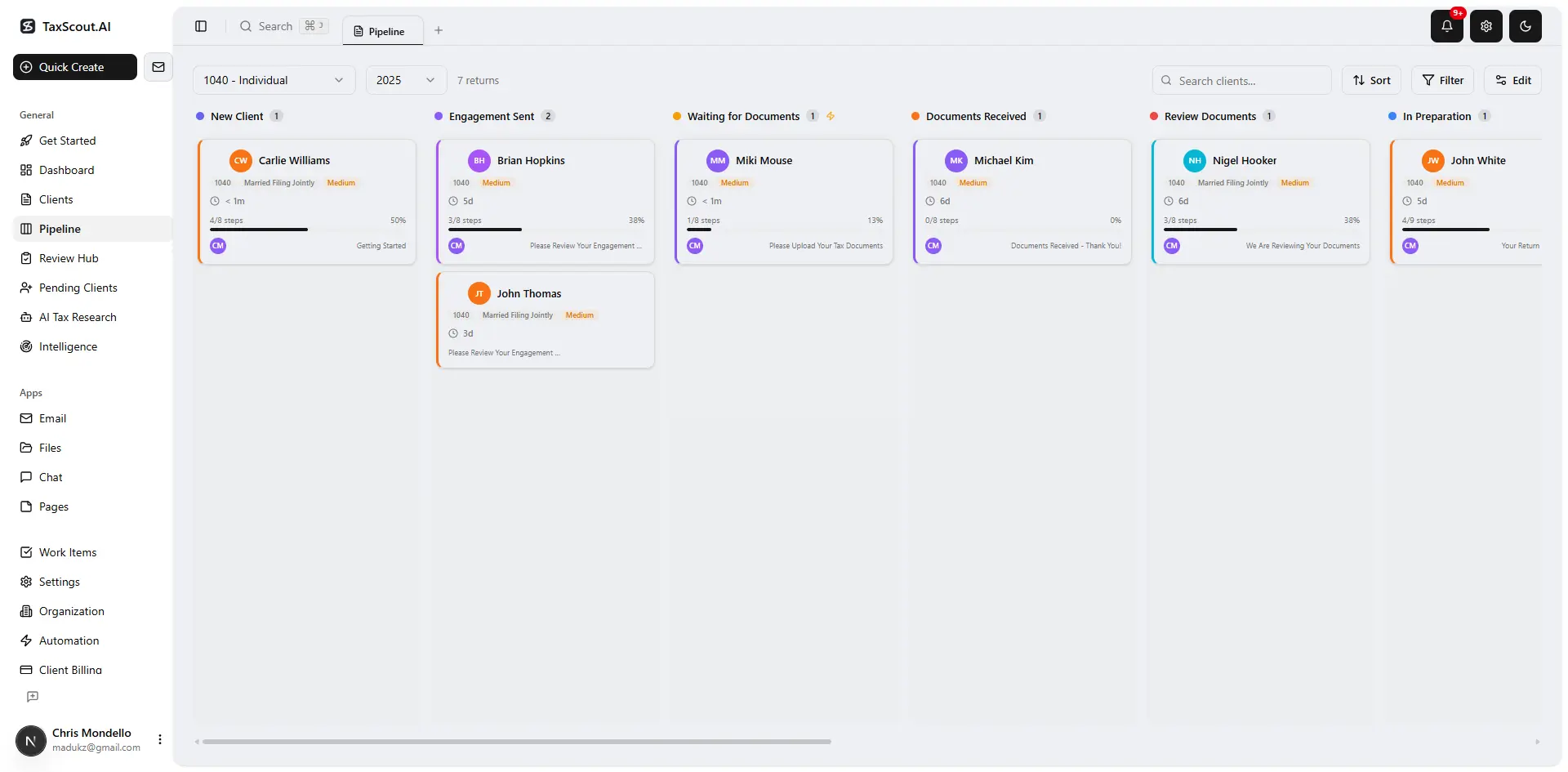
Track every return from intake to filed with drag-and-drop pipeline management
Handling Scope Creep: The #1 Objection to Fixed-Fee
Every CPA who hears "fixed-fee" immediately thinks of the client who shows up in November with a cost segregation study they forgot to mention. Scope creep is a real risk — but it's a manageable one with the right contract language and workflow design.
Scope definition is not a pricing question — it's a contract question.
Your engagement letter should list explicit inclusions and exclusions. Out-of-scope work triggers a change order (a term borrowed from project management), not an apology. The engagement letter framework for CPA firms gives you the language to operationalize this cleanly.
Three-rule scope creep protocol:
- Define inclusions precisely. Not "business tax return" — "Form 1120-S, one federal, one state, up to 5 K-1s for shareholders, no multi-state apportionment."
- Price add-ons publicly. Create a rate card for out-of-scope items — additional state returns ($350 each), IRS notice response ($250/hour), amended return ($450–$750 depending on complexity). When clients see a published add-on rate, change orders feel professional, not punitive.
- Log scope expansion in your pipeline. TaxScout's pipeline management with 12 customizable workflow stages and required notes on transitions creates a documented trail of every scope addition. If a dispute arises, you have a timestamped record.
The Pricing Transition Roadmap: Moving Clients Without Losing Them
Switching CPA firm pricing models mid-relationship is the implementation barrier most firms never get past. Here is a four-phase transition that preserves client relationships while moving your revenue model forward.
Phase 1: New Client Pricing (Immediate)
Stop quoting hourly rates to all new clients starting now. Every new engagement gets a fixed fee or subscription package. This builds your pricing muscle, generates comparative data, and creates a new-client cohort you can use as social proof when migrating existing clients.
Phase 2: Segment Your Existing Client Base (30 Days)
Divide your existing clients into three buckets:
- High-complexity, high-value — These clients likely receive advisory services beyond compliance. Package their existing work into an Advisory subscription tier. Annual fee increases of 15–25% are typically well-received when framed as "now you get year-round access, not just tax season."
- Standard compliance — Annual 1040s with moderate complexity. Convert to fixed-fee at your current effective rate (what you actually bill, not your standard rate). No sticker shock because the number is the same — only the billing structure changes.
- Low-margin or difficult clients — Fixed-fee pricing is the natural transition point to a conversation about whether these clients belong in your book at all. As covered in detail in how to fire a client professionally, the pricing transition is often the right moment to prune.
Phase 3: Client Communication Script (60 Days)
template Pricing Transition Email — Existing Clients Subject: A note about how we're working together this year
Hi [Client Name],
We're making a change to how we structure our fees starting with your [2025/2026] tax work.
Instead of billing by the hour, we're moving to a fixed annual fee. This means:
- You'll know the exact cost upfront, before we start
- There are no surprises based on how long your return takes
- Questions throughout the year are included (up to [X per quarter]) — no more worrying about whether to reach out
Based on your prior year work, your fee will be $[AMOUNT] for [SCOPE DESCRIPTION].
This is consistent with what you've paid in recent years — structured differently to give you more predictability and more access.
If you have questions about what's included or how this compares to prior billing, I'm happy to schedule a brief call.
[CPA Name] [Firm Name]
Phase 4: Enforce the New Structure (90 Days)
The only way a pricing transition fails is if you revert to hourly billing when a client pushes back. The pushback is almost always about uncertainty, not price. Clients who say "I don't want to be locked in" usually mean "I'm not sure what I get for this." The answer is a clearer scope definition, not a retreat to hourly rates.
For clients who genuinely refuse the transition, you have two options: keep them on hourly with a minimum annual engagement fee, or disengage professionally.

Your clients see your brand — OTP login, document upload, and real-time status
Tracking the Metrics That Prove It's Working
Switching CPA firm pricing models without tracking outcomes is hope, not strategy. Three metrics to monitor monthly:
Revenue per client — Should increase as you capture more value on fast returns and bundle advisory services. Tracking this alongside realization rate in the KPI framework built for CPA firms gives you the clearest picture of model performance.
Average collection period — Fixed-fee and subscription models, with upfront or automated billing, should reduce this from the industry average of 45–60 days to under 14 days.
Scope change frequency — Track how often change orders are issued per client per year. If it's more than 2–3 per client annually, your scope definitions need tightening, not your pricing model.
Ready to make fixed-fee pricing profitable at your firm? TaxScout gives you the AI extraction, automated invoicing, and pipeline infrastructure to deliver flat-fee returns with confidence — starting at $49/month flat for your entire team. → Book a 15-Min Demo
How TaxScout Fits Into a Fixed-Fee Firm
TaxScout is practice management software, not tax preparation software — it works alongside Drake, UltraTax, Lacerte, CCH Axcess, and ProConnect. The role it plays in a fixed-fee firm is upstream from filing: intake, document processing, client communication, pipeline tracking, and invoicing.
At $49/month flat for the Prep Starter plan (150 returns, 3 seats, unlimited clients) or $149/month for Prep Pro (500 returns, 10 seats, all 9 AI research agents), TaxScout pricing is itself a fixed-fee model — you pay the same whether you process 1 return this week or 25. That cost structure reinforces the economics of flat-fee pricing for your clients: your platform costs don't scale per-return, so your margin expands as volume grows.
For a firm billing 300 fixed-fee returns averaging $850 each — $255,000 in annual revenue — the practice management platform costs $1,788/year on the Pro annual plan. That's 0.7% of revenue. The AI extraction alone, eliminating manual data entry on 300 returns at 1.5 hours saved per return, represents 450 staff hours recovered — time that either reduces delivery cost or funds additional client capacity.
That is the math that makes CPA firm pricing models based on fixed fees not just viable, but strategically superior for firms willing to build the delivery infrastructure to support them.
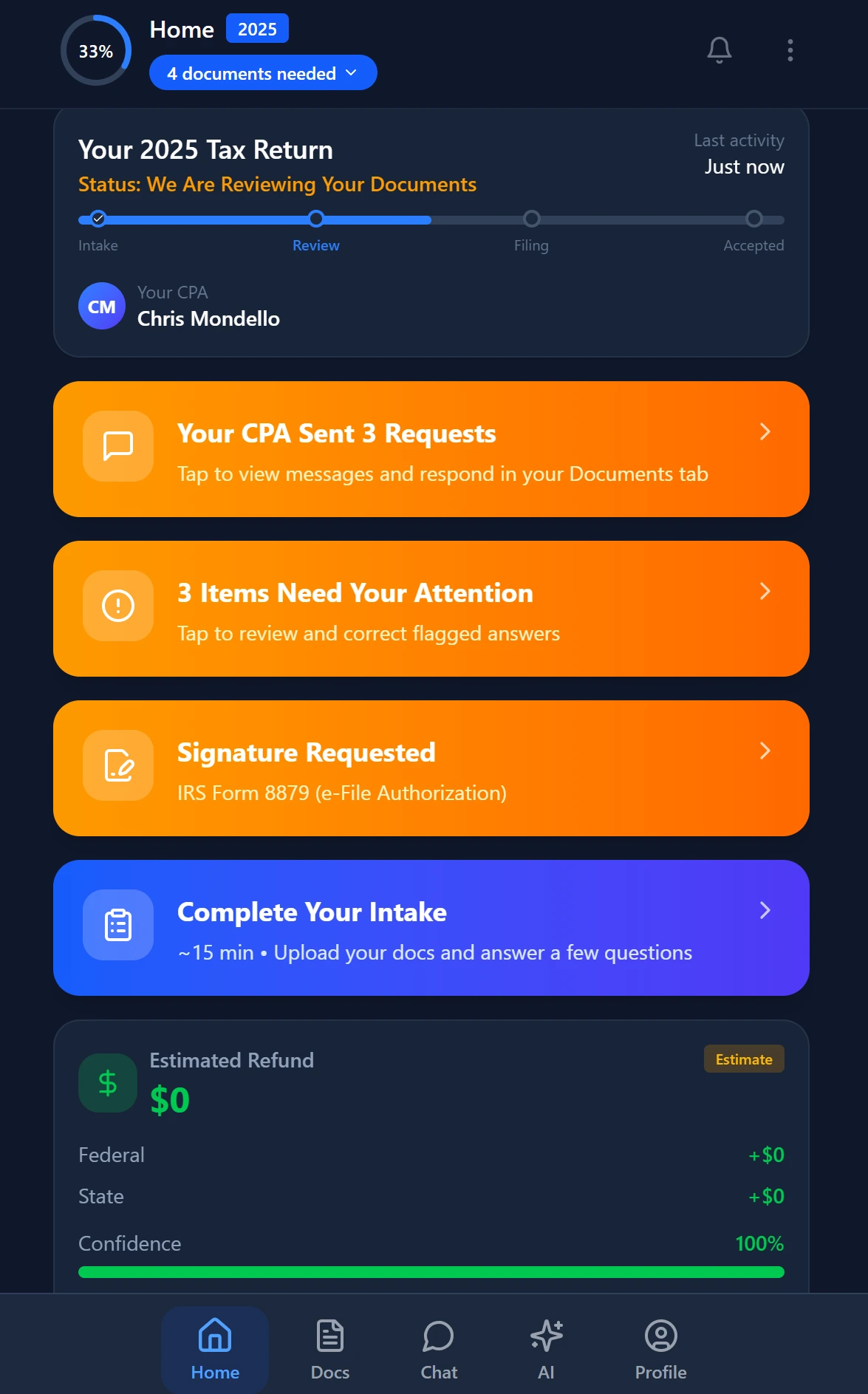
Smart intake auto-fills from uploaded documents and prior-year data
Ready to see the difference?
TaxScout gives your firm AI extraction, 5-layer validation, and complete practice management — for $49/mo flat. → Book a 15-Min Demo — See It Live
Frequently Asked Questions
The three most profitable alternatives to hourly billing for CPA firms are value-based pricing, tiered flat-fee packages, and subscription retainers. Value-based pricing anchors fees to client outcomes rather than time spent, allowing firms to capture more revenue as their efficiency improves. Tiered flat-fee packages let clients self-select service levels while giving the firm predictable revenue. Subscription retainers work especially well for ongoing advisory clients. TaxScout's pricing calculator helps firms set floor prices for each model by factoring in average completion time, overhead allocation, and target margin — so no flat fee goes out the door underpriced.
Keep reading
Late Filing Penalty Relief: How CPAs Reduce or Eliminate IRS Failure-to-File Charges
Oct 12, 2026 · 1 min read
Business Valuation for CPAs: How to Price a Client Company Without Hiring an Appraiser
Sep 18, 2026 · 1 min read
Equity Partner Compensation: How CPA Firms Structure Pay for Owners
Sep 18, 2026 · 1 min read
Stay up to date
Get the latest tax tech insights delivered to your inbox.