CPA Engagement Letter Templates & Best Practices
A missing engagement letter doesn't just create awkward client conversations — it creates real liability exposure. This guide delivers ready-to-use templates for the most common CPA engagement types, explains exactly what each clause must cover, and shows how AI automation replaces the outdated…
A missing engagement letter costs more than the fee it was supposed to protect. Every tax season, CPA firms absorb write-offs, dispute client scope, and face professional liability exposure — not because they did bad work, but because they never documented what the work actually was. The CPA engagement letter is the one document that converts a handshake into a legally defensible agreement, and yet most firms treat it as an afterthought, drafted at the last minute from a five-year-old Word template someone saved to a shared drive.
This guide covers exactly what a best-practice engagement letter contains, provides template language for three common engagement types, explains the liability risks of getting it wrong, and shows how TaxScout automates the entire workflow — from auto-generating scope language to tracking signatures — so nothing falls through the cracks at the start of each client relationship. Whether you're drafting your first CPA engagement letter or overhauling a firm-wide template, the frameworks here apply directly.
Why the CPA Engagement Letter Is Your First Line of Liability Defense
The AICPA's professional standards and most state CPA society practice guidelines strongly recommend written engagement letters for every client engagement. They are not bureaucratic formalities — they are the contractual boundary between "what we agreed to do" and "what the client thought you would do."
Without a signed engagement letter, your firm is exposed on three fronts:
Scope creep without recourse. A client who hired you to prepare a 1040 assumes you're also monitoring their quarterly estimates, reviewing their LLC operating agreement, and flagging their FBAR obligation. When you don't, they blame you. Without a written scope definition, that argument is much harder to win. A clearly worded CPA engagement letter that lists exactly what is — and is not — included in the engagement is your only reliable defense against these disputes.
Malpractice claims with no documentation. State boards of accountancy and professional liability insurers consistently identify the absence of engagement letters as an aggravating factor in malpractice claims. According to CNA's accounting professional liability research, a well-drafted CPA engagement letter is one of the single most effective risk mitigation tools available to a CPA firm.
Fee disputes with no signed agreement. If a client refuses to pay and there is no signed agreement specifying the fee, your invoice is just a number you made up. With a signed CPA engagement letter that includes a fee schedule or billing structure, you have a contract.
The accounting firm engagement letter template your firm uses should be treated with the same care as your malpractice insurance policy — because it is part of that policy's defense strategy.
Tired of chasing unsigned engagement letters while tax season is already underway? See how TaxScout auto-generates, sends, and tracks engagement letters so every client is covered before you touch their first document. → Book a 15-Min Demo — See It Live
What Every CPA Engagement Letter Must Include
Regardless of engagement type — tax preparation, advisory, or bookkeeping — a defensible CPA client agreement contains these core elements:
- Identification of parties: Full legal name of the client entity and the CPA firm
- Scope of services: Precise description of what is included and, critically, what is explicitly excluded
- Period covered: Tax year, fiscal year, or service term
- Client responsibilities: What the client must provide and by when
- Firm responsibilities: What your firm will deliver and the standard of care
- Fee structure: Fixed fee, hourly rate, or retainer — and when invoiced
- Billing and payment terms: Due date, late payment policy, and collection procedures
- Limitation of liability clause: Caps firm liability to fees paid (enforceable in most states)
- Dispute resolution: Arbitration or mediation clause
- Termination provisions: How either party can disengage
- Confidentiality: Data handling and privacy obligations
- Signature block: Client signature with date, countersigned by the engagement partner
The AICPA's sample engagement letters provide a baseline framework, but they require customization for your firm's specific services and state practice environment.

Your clients see your brand — OTP login, document upload, and real-time status
Tax Engagement Letter Template Language (1040 Preparation)
📥 Prefer these as a ready-to-edit pack? Get all three engagement letter templates as a free download — placeholder-highlighted and print-ready.
Below is professional template language for a standard individual tax preparation engagement. Adapt it to your firm's letterhead and attorney-reviewed terms.
ENGAGEMENT LETTER — Individual Income Tax Preparation
[Firm Name] ("Firm") | [Client Name] ("Client") | Tax Year: [Year]
Scope of Services The Firm agrees to prepare federal Form 1040 and the following state returns: [State(s)]. This CPA engagement letter includes preparation of all required schedules based on information you provide. This engagement does NOT include: tax planning, representation before the IRS, preparation of amended returns, FBAR or Form 8938 filings, or any state or local returns not listed above.
Client Responsibilities You agree to provide all documents, receipts, and information necessary for accurate preparation by [date]. The accuracy and completeness of your return depends on the accuracy of information you provide. The Firm is not responsible for errors resulting from incomplete or inaccurate information.
Fees Our fee for this engagement is $[amount] or estimated at $[range] based on the complexity of your return. Fees are due upon delivery of your completed return. Returns will not be transmitted for filing until payment is received in full.
Limitation of Liability The Firm's liability for any claim arising from this engagement shall not exceed the fees paid for this specific engagement.
Advisory Engagement Letter Template Language
Advisory engagements require tighter scope language because the services are more open-ended and the client expectations more ambiguous.
ENGAGEMENT LETTER — Tax Advisory Services
Scope of Services The Firm agrees to provide tax advisory services as specifically requested and described herein: [describe specific advisory project — e.g., "analysis of S corporation election for [Entity Name]"]. This engagement does NOT include implementation of recommendations, ongoing monitoring, or tax return preparation unless covered under a separate CPA engagement letter.
Deliverable The Firm will deliver a written memorandum summarizing findings and recommendations by [date]. Oral advice provided during this engagement should not be relied upon unless confirmed in the written memorandum.
Standard of Care Our advice will be based on current tax law as of the date of this letter. Tax law changes after this date may affect the conclusions in our memorandum, and we have no obligation to update our analysis.
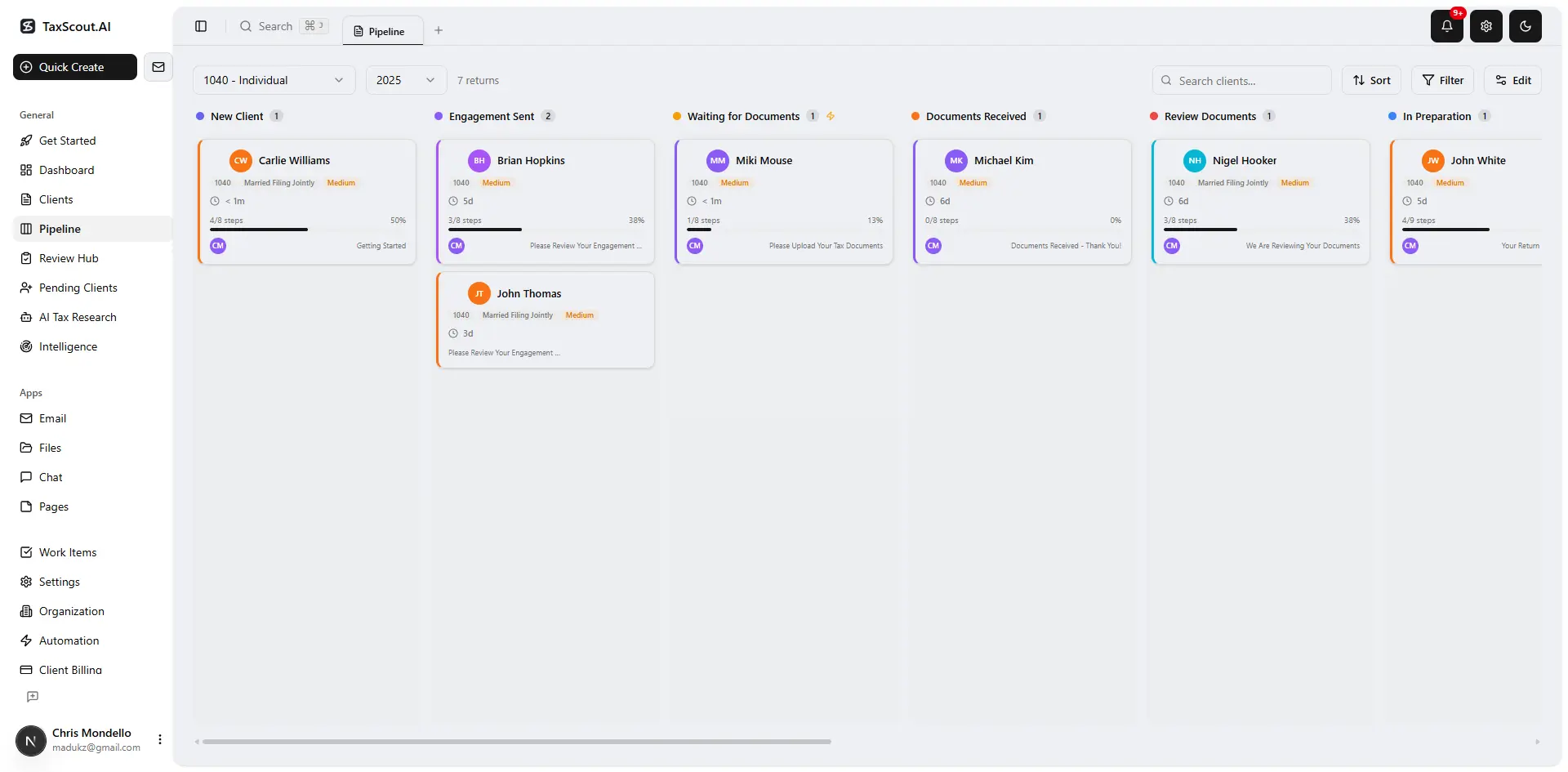
Track every return from intake to filed with drag-and-drop pipeline management
Bookkeeping Engagement Letter Template Language
Monthly bookkeeping engagements need explicit language about what "bookkeeping" means — and what it does not.
ENGAGEMENT LETTER — Monthly Bookkeeping Services
Scope of Services The Firm agrees to perform monthly bookkeeping services including: [bank reconciliation, categorization of transactions, accounts payable/receivable tracking, monthly financial statement preparation]. This engagement does NOT include tax preparation, payroll processing, or audit or review services.
Client Responsibilities You agree to provide access to [banking/credit card/accounting software] by the [Xth] day of each month. Delays in providing access may result in delayed deliverables and additional fees.
Fees Monthly retainer: $[amount], billed on the 1st of each month. This retainer covers up to [X] transactions per month. Excess transactions are billed at $[X] per transaction.
The Hidden Risk Most Firms Ignore: Unsigned Letters on Active Files
A template you never send is worthless. But a template you send and never confirm was signed is nearly as bad. The most common engagement letter failure mode in CPA firms is not the absence of a template — it is the absence of a tracking system.
Files get opened. Preparation begins. Questions get answered. And somewhere in the shuffle, the CPA engagement letter sits unsigned in someone's sent folder. The client eventually signs — or doesn't — and nobody catches it until there's a dispute.
This is where the accounting engagement management workflow breaks down for most firms. The fix is not more follow-up emails. The fix is automation.
As we covered in our client onboarding checklist guide, the engagement letter should be one of the first three steps in the onboarding workflow — not something you remember after the return is half-prepared.
How TaxScout Automates Engagement Letters End-to-End
TaxScout handles the full CPA engagement letter lifecycle as part of its integrated pipeline management system. Here is what that looks like in practice.
Auto-generation from client profile. When a new client is created in TaxScout, the platform draws on the client's entity data — legal name, entity type, filing year, services selected — to pre-populate engagement letter fields. The scope language, fee amounts (if configured), and service period populate automatically from intake data. A preparer reviews, adjusts if needed, and sends — without opening Word.
E-signature via Documenso. TaxScout's built-in e-signatures handle Form 8879, engagement letters, W-9s, FBAR authorizations, and more — with signing order dependencies and knowledge-based authentication where required. The client receives a link through the branded client portal with OTP login — no password creation, no new accounts. They sign from their phone in under two minutes.
Pipeline-gated progression. TaxScout's 12-stage pipeline can be configured to require a signed CPA engagement letter before a file advances from "New Client" to "Documents Requested." This is not a reminder — it is a hard gate. The AI won't surface document requests or intake forms until the engagement is signed. No signed letter means no work starts.
Automated follow-up. If a client hasn't signed within a configurable window, TaxScout's workflow triggers automatic reminders. The overdue follow-up system runs on a daily cron so nothing requires manual monitoring. The engagement partner sees status at a glance on the kanban board.
7-year retention. Every signed engagement letter is stored with audit-trail metadata — signed date, IP address, authentication method — and retained for seven years on S3/Glacier storage. If a malpractice claim surfaces in year three, the documentation is immediately accessible. This is the kind of infrastructure that used to require a separate document management system.
This is what distinguishes TaxScout from tools like Canopy, which promotes "Engagements & Proposals" as a feature but has no integrated AI layer that auto-generates scope language from client data. You still draft the letter manually, then send it through their workflow. With TaxScout, the intelligence lives in the platform.
Engagement Letter Best Practices: The Firm-Level Checklist
| Practice | Why It Matters |
|---|---|
| Send before any work begins | Establishes scope before expectations form |
| Annual re-execution for ongoing clients | Renews terms, captures scope changes, resets fee agreements |
| Separate letter per entity | One client, three LLCs = three letters |
| Explicit exclusion clauses | What you won't do is as important as what you will |
| Signed before any files accepted | Document request creates implied engagement without signature |
| Stored with e-signature audit trail | Required for professional liability defense |
| Attorney-reviewed template | State-specific enforceability varies |
| Pipeline-gated workflow | Prevents files from advancing without signed letter |
As we explored in our e-signature compliance guide, the e-signature itself must comply with the Electronic Signatures in Global and National Commerce Act (E-SIGN Act) to be legally binding. TaxScout's Documenso integration handles this compliance layer automatically, including the authentication record required to prove intent.
Real-World Workflow: New Client Onboarding in TaxScout
Here is what the engagement letter workflow looks like for a new 1040 client starting in early February:
Day 1 — Client created. The partner adds a new client to TaxScout and selects "Individual Tax Preparation (1040 + State)" as the service type. The platform pulls the client's legal name, SSN (stored in the AES-256-GCM encrypted vault), entity data, and the current tax year. The CPA engagement letter template populates with this data, including the fee amount pre-configured by the firm.
Day 1 — Letter sent. The partner reviews the pre-populated letter, confirms the scope exclusions, and clicks send. The client receives an email with a link to the branded portal. OTP authentication confirms identity. The client signs on their phone.
Day 2 — Pipeline advances. TaxScout detects the signed letter and automatically advances the file to "Documents Requested." The smart intake form — modeled on IRS Form 13614-C — is unlocked and sent to the client. Document upload begins.
Day 14 — Reminder triggered. A different client hasn't responded to their document request. TaxScout has already sent two automated reminders. The preparer sees the status flag on the dashboard. One click sends a personal follow-up from the CPA's Gmail account.
April 15 — Every letter accounted for. At year-end, the engagement log shows 100% of active files have signed engagement letters with timestamps, authentication records, and seven-year retention. The malpractice insurer asks. You send them a report.
This is what the firms scaling past 200 returns without adding staff are actually doing — not working harder on follow-ups, but building workflows where the software enforces the standard. For more on that operational model, see our guide on scaling from solo to multi-partner firm.
Ready to Automate Your Engagement Letter Workflow?
TaxScout gives your firm auto-generated engagement letters, pipeline-gated e-signatures, and seven-year retention — for $49/mo flat, with no per-user fees.
Get all 3 engagement letter templates as a ready-to-edit pack
Tax prep (1040), advisory, and monthly bookkeeping engagement letters — placeholder-highlighted, print-ready, and formatted to paste straight into your letterhead.
Free. We'll also send occasional practice-management insights for CPA firms — unsubscribe anytime.
Frequently Asked Questions
A legally defensible CPA engagement letter must include six core elements: (1) a precise scope of services with explicit out-of-scope exclusions, (2) client responsibilities such as document delivery deadlines and accuracy representations, (3) fee structure with billing triggers and payment terms, (4) engagement period and termination clauses, (5) a liability limitation clause capping exposure to fees paid, and (6) a dispute resolution provision. TaxScout's engagement letter templates are pre-built around all six elements and auto-populate scope language based on the specific service type selected — 1040, business return, bookkeeping, or advisory — so nothing is omitted under deadline pressure.
Keep reading
Backdoor Roth IRA: How CPAs Execute the Strategy Without Triggering Pro-Rata Tax
Oct 12, 2026 · 1 min read
Amended FBAR Procedures: How CPAs Correct Foreign Account Errors Without Triggering Penalties
Oct 12, 2026 · 1 min read
Backdoor Roth IRA: How CPAs Execute the Strategy for High-Income Clients
Oct 12, 2026 · 1 min read
Stay up to date
Get the latest tax tech insights delivered to your inbox.