The Real Cost of Tech Consolidation: Are Your Tax Software Price Hikes Actually Boosting Efficiency
Tax software renewals keep climbing, but are CPA firms actually getting more efficient — or just paying more to stay in place? This guide breaks down how to audit your tech stack, measure real ROI, and stop absorbing price hikes without accountability. If your vendors are raising rates faster than…
The Tax Software Price Hike Problem Every CPA Firm Should Audit
Your Drake renewal arrived last month — one of many tax software price hikes landing in accountants' inboxes this season. So did the notice from your practice management vendor — another 18% increase, effective next billing cycle. You open the release notes to see what you're getting for the extra $2,400 per year. Three UI tweaks, a new color scheme, and a "coming soon" badge on the AI feature your sales rep promised in January.
This is the tax software price hike problem hiding in plain sight across the profession. Vendors are raising rates aggressively. Features are moving slowly, or backward. And the firms absorbing these costs haven't stopped to ask the most important question: is this software actually making us more efficient, or are we just paying more to stay in place? Tax software price hikes have become so normalized that many firms simply absorb them year after year without questioning the return on that investment.
The answer, for a growing number of CPA firms, is the latter — and the financial damage is larger than most partners realize. When tax software price hikes outpace the value delivered, firms find themselves paying premium rates for tools that haven't meaningfully improved in years.
Why Tax Software Costs Keep Rising While Value Stagnates
The root cause isn't market dynamics in the traditional sense. It's ownership structure. To understand why tax software price hikes keep accelerating with little resistance, you have to look past surface-level competition and examine who actually owns these platforms.
Private equity has moved aggressively into accounting and tax software over the past decade. According to Accounting Today's analysis of private equity in accounting, PE-backed acquisitions in the profession consistently prioritize cost optimization and margin expansion over product investment. When a practice management platform gets acquired, the R&D budget often contracts while the pricing team expands. The result is a product that costs more to license and less to build — a transfer of value from your firm to the fund. For firms evaluating their tax software price hikes approach, this trade-off compounds over time.
This pattern shows up in the renewal letters CPA firms receive every fall. As documented by Journal of Accountancy coverage of rising software costs, CPA firms are facing price increases that outpace both inflation and the pace of meaningful feature development. The vendors know the math works in their favor: switching costs are high, tax season timing creates pressure to renew without negotiating, and the procurement process for a CPA firm rarely involves the same rigor applied to client engagements. Each of these factors directly shapes how tax software price hikes plays out in practice.
The efficiency paradox crystallizes here. Consolidation was supposed to reduce complexity — one vendor, one platform, fewer integrations. Instead, it has produced bloated platforms where legacy features accumulate without improvement, support queues stretch into tax season crunch weeks, and the "all-in-one" promise masks the reality that no single module does any one thing particularly well. Understanding tax software price hikes in this context is what separates firms that scale from those that stall.
The Real Math: What Vendor Lock-In Costs Your Firm
Most CPA firm owners think about software cost in terms of the monthly invoice. The real cost includes five categories that rarely appear on that invoice: This is precisely where a deliberate tax software price hikes strategy pays off.
1. Direct subscription costs. For a 10-person firm using TaxDome, that's approximately $100 per user per month — roughly $12,000 per year. Canopy's modular pricing starts at approximately $45 per user per month per module, and Smart Intake costs an additional $11 per client on top. A firm with 200 active clients and modest module usage can exceed $15,000 annually before adding state-specific tools. Karbon runs approximately $59 per user per month, putting the same 10-person firm at $7,080 per year — but without AI document extraction, a functioning client portal, or e-signatures built in. Tax software price hikes sits at the center of this decision — get it wrong and the rest unravels.
2. Integration overhead. When practice management doesn't talk to your document system, which doesn't talk to your e-signature tool, your staff manually bridges the gap. That gap costs real hours. A firm processing 400 returns per year that spends just 15 minutes per client on manual data handoffs burns 100 staff hours annually — hours that should be billable. When firms revisit their tax software price hikes priorities, the gaps usually surface here.
3. Support degradation. Firms that relied on live phone support from vendors pre-acquisition often find themselves routed to ticket queues post-acquisition. During tax season, a two-day support resolution window isn't an inconvenience — it's a filing risk.
4. Switching friction. The AICPA's analysis of technology consolidation identified vendor lock-in as a primary concern among member firms, specifically because data migration complexity creates a rational economic case for staying on a suboptimal platform. Vendors know this, and it removes the competitive discipline that would otherwise restrain pricing.
5. Opportunity cost. A firm paying $15,000 per year for a platform that automates 30% of its document workflow could pay $1,788 per year for a platform that automates 85% of it. The delta — both in cash and in recovered staff time — is the cost of inertia.
Every renewal cycle, the vendor is betting you won't do this math. TaxScout makes the math embarrassingly clear: flat-rate pricing, no per-user fees, and AI built to actually replace manual work. → Book a 15-Min Demo — See It Live

Click any extracted field to see its source highlighted on the original PDF
How to Conduct a Tech ROI Audit Before Your Next Renewal
A tax software ROI audit doesn't require a consultant. It requires three hours and honest answers to six questions.
Step 1: Map every tool to a specific workflow outcome.
List every software subscription your firm pays for. For each one, identify the specific workflow it is supposed to own: document collection, e-signatures, invoicing, research, pipeline tracking. If two tools nominally cover the same workflow, flag it — overlap is waste.
Step 2: Measure time, not features.
Features don't generate ROI — time savings do. For your three highest-volume workflows (document intake, client communication, invoice collection), record how many minutes per client each workflow currently takes. Then ask: has that number changed since your last major renewal? If costs went up 20% and time per client stayed flat, you paid more for nothing.
Step 3: Audit your support history.
Pull your support tickets from the last 12 months. Calculate the average resolution time and how many tickets opened during February through April — peak season. If resolution times stretch past 48 hours during critical filing weeks, that's a direct risk to client deliverables, not just an inconvenience metric.
Step 4: Price the manual gap.
Identify the workflows your software was supposed to eliminate but hasn't. Document data entry, SSN collection, intake follow-up, binder assembly — these are common gaps. Multiply the hours your staff spends on them by your average billing rate. That dollar amount is the true cost of a platform that over-promises and under-delivers.
Step 5: Run a real per-return cost analysis.
Divide your total annual software spend by the number of returns your firm files. For a firm filing 400 returns and paying $15,000 in software subscriptions, the cost is $37.50 per return before a single hour of staff time. Compare that to what a purpose-built AI-native platform would cost at the same volume.
Step 6: Evaluate what changes with a switch.
The switching cost concern is real but frequently overstated. Most modern platforms support data export, and the transition overhead — typically 4-6 weeks of parallel operations — is a one-time cost, not an ongoing one. The real question is whether year two on a better platform saves more than the migration costs. For most firms switching away from legacy per-user pricing, it does, often by the end of the first tax season.
What AI-Native Practice Management Actually Changes
The firms getting the best ROI from their tech stack in 2026 share one characteristic: they stopped paying for category coverage and started paying for outcome coverage. The distinction matters.
Category coverage means you have a tool for each function — a document tool, a portal tool, a pipeline tool, a billing tool. Outcome coverage means each tool measurably reduces time spent on a specific deliverable. The shift from the former to the latter is where actual efficiency gains live.
TaxScout was built around outcome coverage from the start. AI document extraction processes 180+ tax form types — W-2s, all 1099 variants, K-1s across partnership, S-corp, and trust structures, 1095 series, 1098s, and 30+ supporting categories — through a 5-layer validation pipeline that includes deterministic math rules, OCR cross-verification, and cross-document duplicate detection. The output isn't a renamed PDF. It's extracted, validated, confidence-scored data ready to flow into your existing Drake, Lacerte, or UltraTax workflow.
That means a return that previously required 45 minutes of manual data entry gets processed in a fraction of the time, with a split-screen PDF viewer that lets any preparer click any extracted field and see exactly where it appears in the source document. No second-guessing. No re-checking. No 2 AM W-2 transcription.
The AI research agents run a different kind of efficiency math. Nine specialized agents — covering document intelligence, gap detection, tax calculation, risk assessment, and more — search IRS.gov, law.cornell.edu, congress.gov, treasury.gov, and ssa.gov live, not from a cached database. When a preparer asks a question about a client's foreign tax credit carryover, the answer draws on the client's actual documents, filing history, and real-time regulatory sources, not a generic knowledge base that was last updated in Q3.
This is what distinguishes AI-native architecture from the AI-bolted-on approach common in legacy platforms. The difference between AI-native vs. AI-bolted software isn't marketing language — it's whether the intelligence is integrated into every workflow or just applied as a filter on top of existing manual processes.

Your clients see your brand — OTP login, document upload, and real-time status
Comparing the Real Cost: TaxScout vs. the Consolidating Market
| Feature | TaxScout Prep Pro | TaxDome (10 users) | Canopy (10 users) |
|---|---|---|---|
| Monthly cost | $149 flat | ~$1,000 | ~$660+ (modular) |
| Annual cost | $1,430 | ~$12,000 | ~$7,920+ |
| Per-user pricing | None | Yes (~$100/user) | Yes (~$45/user/module) |
| AI document extraction | 180+ form types, 5-layer validation | None | Basic rename only |
| Real-time IRS research | Yes (live URL fetch) | None | None |
| AI research agents | 9 specialized agents | None | None |
| Client portal | Branded, OTP login | Yes (strong) | Yes |
| E-signatures | Form 8879, 4868, FBAR, more | Yes | Yes |
| Smart Intake | Included | Basic | $11/client extra |
| PDF toolbox | 14+ tools built in | Basic | Basic |
| SSN vault (AES-256-GCM) | Yes | No | No |
| Unlimited clients | Yes | Yes | Yes |
| Support model | Flat-rate, included | Per-user contract | Per-user contract |
For a 10-person firm filing 400 returns annually, TaxScout Prep Pro costs $1,430 per year. TaxDome costs approximately $12,000. The $10,570 difference either stays in your firm or funds two additional team seats and a full year of continuing education — without changing a single client-facing deliverable.
A Concrete Example: What the Audit Reveals
Consider a firm with eight staff, 350 annual returns, and a current stack that includes TaxDome at $800 per month, a separate e-signature tool at $120 per month, and manual intake via email. Total annual software cost: approximately $11,040.
The ROI audit surfaces the following:
- Document intake: 25 minutes per return of manual data entry = 146 staff hours per season
- Intake follow-up: Average 3.2 email exchanges per client to collect missing documents = 1,120 emails per season
- Binder assembly: 20 minutes per return for PDF compilation = 117 hours per season
- E-signature coordination: Manual sending and tracking = 30 minutes per week, 26 hours per year
Total estimated manual overhead: approximately 289 hours per season. At a $75 blended staff rate, that's $21,675 in labor for tasks a purpose-built platform should handle automatically.
Running the same firm on TaxScout Prep Pro eliminates most of that overhead. AI document extraction handles intake. The client portal replaces email chains with OTP-authenticated secure uploads. Pipeline management with 12 customizable stages auto-advances returns when conditions are met. Auto-generated binders replace manual PDF assembly. The net result: $11,040 in subscription costs drops to $1,430, and 289 manual hours shrink substantially — with room to absorb the volume growth firms achieve when they stop being bottlenecked by manual process.
For firms thinking through the tech stack evolution from 2025 to 2026, this kind of ROI audit is the starting point — not a nice-to-have exercise.
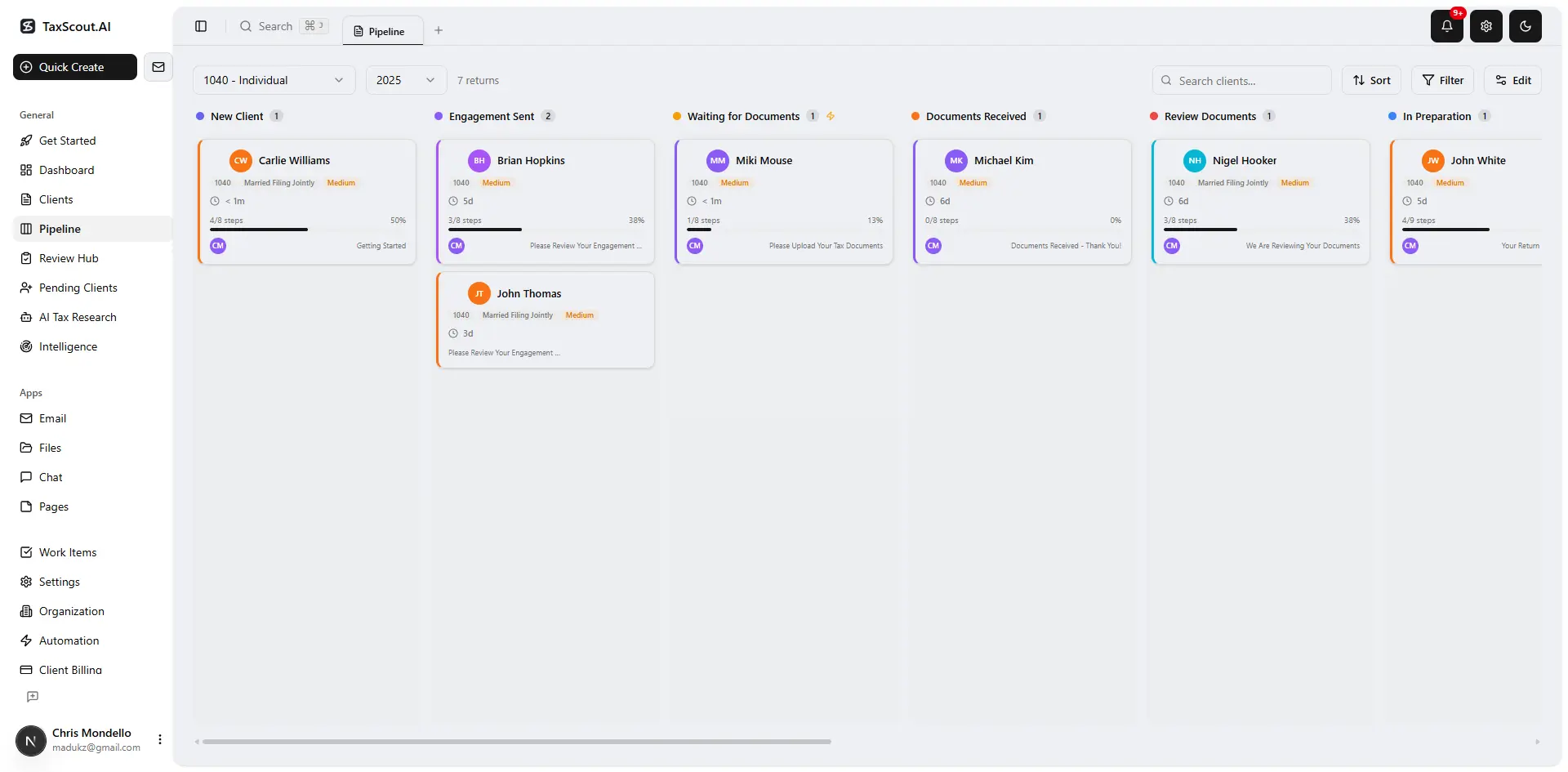
Track every return from intake to filed with drag-and-drop pipeline management
The post tax season review Is the Right Time to Do This
Most firms conduct their post tax season review in May or June — reviewing what broke, what slowed them down, what clients complained about. That review should explicitly include a line item for software ROI, not just workflow outcomes.
If your renewal is in Q3 or Q4, that May debrief is your negotiating window. You have time to run the six-step audit above, get a demo of alternatives, and make a decision with full information rather than under the pressure of a November renewal notice with a January tax season bearing down.
The firms locked into suboptimal platforms aren't staying because the platform is good. They're staying because the review never happened at a time when switching was practical.
Your next renewal shouldn't be a default. TaxScout gives your firm AI-native practice management — 180+ form types, 9 research agents, flat $149/mo — for less than most firms spend on one user seat elsewhere. → Book a 15-Min Demo
Check out our transparent flat pricing to see how much your firm can save.
Frequently Asked Questions
To audit your tax software ROI, divide your total annual software cost by the number of returns processed, then compare that per-return cost year-over-year. TaxScout.ai provides a built-in efficiency dashboard that tracks returns completed per hour, error correction time, and preparer idle time — giving you a concrete cost-per-return metric. If your per-return cost rose more than 5% without a measurable drop in preparation time, you're paying for stagnation, not improvement. TaxScout users report an average 34% reduction in per-return preparation time within the first 90 days, making the ROI calculation straightforward.
Keep reading
Wash Sale Rules: How CPAs Protect Clients From Disallowed Loss Traps
Oct 4, 2026 · 1 min read
Net Investment Income Tax: How CPAs Minimize Exposure for High-Income Clients
Sep 24, 2026 · 1 min read
Backup Withholding on Third Party Network Transactions: What CPA Firms Must Do Now
Sep 18, 2026 · 1 min read
Stay up to date
Get the latest tax tech insights delivered to your inbox.