CPA Software Price Hikes: Private Equity's Tax Practice Squeeze
Private equity acquisitions of major accounting software vendors are squeezing CPA firms with annual price hikes, punishing per-user pricing, and bundled ecosystems designed to trap you. The firms winning this battle are the ones that audit their stack before renewal season — not during it. Here's…
The Tech-Margin Trap: How CPA Firms Can Audit Their Software Stack Before PE-Driven Price Hikes Eat Their Profits
Your renewal invoice lands in February — a stark example of the CPA software price hikes private equity ownership has made routine — right at peak busy season, zero bandwidth to challenge it. The number is 22% higher than last year. You approve it because switching feels impossible right now, and because every vendor knows that. This is the private equity squeeze hitting tax practices in real time, and it is accelerating.
Private equity firms have acquired stakes in dozens of major accounting software vendors over the past three years, and the downstream effect on CPA firms is unmistakable: subscription costs rising faster than billing rates, bundled ecosystems designed to make migration painful, and per-user pricing structures that punish growth. For small and mid-sized practices, the cumulative "tech tax" on their P&L is now a material threat to profitability. For firms evaluating their CPA software price hikes private equity approach, this trade-off compounds over time.
This guide is a practical playbook for conducting a software stack audit, negotiating from a position of strength, and — where fees are unavoidable — justifying necessary increases to clients without sacrificing retention. Understanding the mechanics behind CPA software price hikes private equity deals generate is the essential first step before entering any vendor negotiation.
Why Private Equity Is Driving Software Price Inflation in Tax Practices
PE-backed acquisitions in the accounting technology space follow a predictable playbook: acquire a platform with a captive user base, consolidate competing products, then extract margin through annual price increases that exceed any meaningful improvement in functionality. The Journal of Accountancy's analysis of PE in accounting firms documents how post-acquisition structural changes centralize technology purchasing decisions while simultaneously shifting the cost burden downward to individual practitioners. Each of these factors directly shapes how CPA software price hikes private equity plays out in practice.
The mechanism is straightforward. Once a vendor controls 20–30% of a market segment, switching costs rise dramatically. Your staff is trained on it. Your workflows are built around it. Your client data lives inside it. At that point, a 15–25% annual price increase doesn't prompt cancellation — it prompts a painful cost-benefit calculation that usually ends with renewal. Understanding CPA software price hikes private equity in this context is what separates firms that scale from those that stall.
As Accounting Today notes, PE investment in accounting is a double-edged sword: capital infusion can accelerate product development, but the profit mandate almost always translates into higher costs for end users who have limited alternatives. This is precisely where a deliberate CPA software price hikes private equity strategy pays off — firms that track vendor ownership changes and anticipate renewal inflation are better positioned than those reacting to invoices after the fact.
For a 10-person CPA firm running a full stack — tax preparation software, practice management, document management, e-signatures, and a client portal — annual software costs that were $18,000 in 2021 can easily exceed $36,000 today without any meaningful expansion of capabilities. That delta has to come from somewhere. CPA software price hikes private equity sits at the center of this decision — get it wrong and the rest unravels.
How to Audit Your Software Stack for Hidden Margin Leaks
A software stack audit is not an IT exercise. It is a financial exercise. The goal is to map every subscription against actual utilization, identify where you are paying for redundant capabilities, and quantify your true cost per tax return. When firms revisit their CPA software price hikes private equity priorities, the gaps usually surface here — often in the form of line items that crept upward 15–20% annually while utilization stayed flat.
Step 1: Build a Complete Subscription Inventory
Pull every software subscription your firm pays for — monthly and annual — into a single spreadsheet. Include tax preparation software, practice management, document storage, e-signatures, invoicing, client communication, and any add-on modules. Most firm owners, when they do this exercise for the first time, discover 3–5 subscriptions they had forgotten about or assumed someone else was managing.
Step 2: Calculate Your True Cost Per Return
Divide total annual software spend by the number of returns you filed last year. If you filed 400 returns and your combined software stack costs $40,000 annually, your tech cost per return is $100 — before staff time, before overhead. For a firm charging $500 average per 1040, that is 20% of gross revenue absorbed by software before a single hour of billable work is logged.
Step 3: Map Features Against What You Actually Use
Per-user pricing structures from vendors like TaxDome ($100/user/month) and Canopy ($45/user/month per module) are designed to capture revenue from seats that go underutilized. Audit which team members are actively using which features. You may be paying for 10 seats when 6 are doing substantive work on the platform.
Step 4: Identify Redundancy
Firms that grew by layering tools tend to pay for the same capability twice. Common examples: paying for e-signature functionality inside both a document management tool and a dedicated e-sign platform; paying for client portal features in both practice management software and a separate portal product. Every redundancy is a negotiation lever — and each one represents the kind of silent margin erosion that CPA software price hikes private equity ownership accelerates over time.
Software costs eating your firm's margin? See how TaxScout consolidates your entire stack — AI extraction, portal, e-signatures, invoicing — at $49/mo flat. → Book a 15-Min Demo — See It Live
Vendor Negotiation Strategies That Actually Work
The myth that SaaS vendors don't negotiate is exactly that — a myth. They negotiate constantly; they just prefer that you don't know it.
Anchor on alternative pricing, not on your current bill. Before any renewal conversation, document what a comparable alternative would cost. When you can walk into a negotiation and say "a functionally equivalent platform is available at $149/month flat for our entire team versus $1,000/month we pay you for 10 seats," you have changed the dynamic. Our guide to per-user pricing in accounting software breaks down exactly how to build this comparison.
Use multi-year commitments as leverage, not as a trap. Vendors want annual recurring revenue certainty. If you are prepared to commit to a two or three-year term, you can often negotiate a rate freeze, a reduced annual increase cap (e.g., CPI + 2%), or additional seats at no cost. Get any agreed rate cap in writing — verbal commitments from sales representatives are not binding. This is especially important given how predictably CPA software price hikes private equity ownership produces above-market renewal increases in years two and three.
Request itemized module pricing. Canopy's modular structure, for example, charges $11 per client extra for Smart Intake alone. When you break a bundled subscription into its component parts, you can often negotiate elimination of modules you don't use. The vendor would rather keep you on a reduced package than lose you entirely.
Time your renewal negotiation deliberately. Vendors are most flexible in the final weeks of their own fiscal quarter. If your renewal falls in an awkward month, ask to move it to align with a quarter-end — then use the timing as leverage.
Escalate above the account manager. Account managers have limited pricing authority. A direct email to a VP of Customer Success or Director of Sales — citing a specific competitive alternative and a defined decision timeline — tends to produce options that never appear in the standard renewal flow.

Your clients see your brand — OTP login, document upload, and real-time status
The Risks of Over-Reliance on Bundled Ecosystems
The bundled ecosystem trap is subtle. A vendor bundles practice management, document storage, e-signatures, client portal, and billing into one platform. The individual component pricing looks competitive. The integration works smoothly. Switching any single component requires migrating all of them. Three years later, you are paying 40% more and the exit cost feels prohibitive. This is one of the most effective mechanisms through which CPA software price hikes private equity ownership sustains itself — by the time firms recognize the pattern, migration feels more painful than renewal.
Research on the structural impact of technology costs on CPA firm profitability confirms that bundled ecosystems, while initially appearing cost-efficient, create switching barriers that vendors exploit through subsequent price increases.
The strategic response is to distinguish between core platform dependencies and adjacent tool choices. Your tax preparation software — Drake, Lacerte, UltraTax — is a core dependency; migration is genuinely difficult and rarely worth it outside a major firm event. But your practice management layer, your document tools, your client portal, and your e-signature workflow are adjacent choices where competitive alternatives exist and migration is far less disruptive than vendors suggest.
Building a tech stack with deliberate interoperability — tools that connect via API or export standards rather than requiring a single-vendor lock-in — preserves your negotiating position at every renewal cycle. The CPA firm tech stack guide for 2026 covers how to structure this architecture specifically.
How Flat-Rate Pricing Changes Your Negotiating Position Permanently
The per-user pricing model is the mechanism through which most software cost inflation flows. A 10-person firm pays 10x what a 1-person firm pays. When staff headcount grows, costs scale automatically — often faster than revenue. When you hire for busy season and then release temporary staff, you are still paying for seats during the wind-down. The compounding effect of CPA software price hikes private equity firms impose on per-seat models makes this dynamic even more punishing as vendor ownership changes hands.
Flat-rate platforms eliminate this dynamic entirely. TaxScout pricing is structured as a flat monthly fee — $49/month for Prep Starter (up to 3 team seats, 150 returns) and $149/month for Prep Pro (up to 10 team seats, 500 returns) — with no per-user charges and unlimited clients on both plans. For a 10-person firm, that is $149/month versus approximately $500/month for TaxDome or $660/month for Canopy at equivalent team size.
The math compounds. Over three years, a 10-person firm on TaxScout Prep Pro pays roughly $5,400 in platform fees. The same firm on TaxDome pays approximately $18,000. That $12,600 difference funds two additional staff months, a marketing initiative, or simply flows to the bottom line.
More importantly, flat pricing insulates your firm from the primary mechanism of PE-driven cost inflation. When a per-user vendor raises rates 20%, your costs rise 20%. When a flat-rate vendor raises rates 20% on a $149 base, your cost increase is $29.80/month — not $100 per seat.
Justifying Fee Increases to Clients Without Damaging Retention
At some point, unavoidable cost increases in your tech stack, combined with inflation in staff compensation and compliance complexity, require a fee adjustment conversation with clients. The firms that handle this well do three things consistently.
Frame increases around demonstrable service upgrades, not cost pass-throughs. "Our fees are increasing because our costs went up" is the least compelling justification and the one most likely to trigger a shopping response. "Our fees reflect the addition of a real-time document portal, automated status updates, and same-day e-signature turnaround that we've built into your service" connects the increase to tangible client benefit. The technology improvements that justify your investment — an AI-native platform that extracts 180+ tax form types with 5-layer validation, a branded client portal with zero-friction OTP login, automated invoicing with ACH payment options — are real service enhancements your clients experience directly.
Segment your client base before the conversation. Not every client needs the same fee adjustment framing. High-volume, straightforward returns are most price-sensitive; advisory-heavy relationships are least. A structured client review — the kind of analysis that becomes routine after a good post tax season review — helps you identify which clients are at risk of churning versus which have deep enough relationships to absorb reasonable increases.
Give adequate notice and frame it as a one-time reset. A 60-day notice with a clear effective date signals professionalism. Coupling the increase with a written service description of what clients receive — portal access, automated reminders, secure document exchange, e-signatures — makes the value tangible. Firms that bundle a fee increase with a visible service upgrade retain 80–90% of clients; firms that send a price increase letter with no context retain far fewer.

Click any extracted field to see its source highlighted on the original PDF
A Comparison: What You Pay for What You Get
| Feature | TaxScout Prep Pro | TaxDome (10-user firm) | Canopy (10-user firm) |
|---|---|---|---|
| Monthly cost | $149 flat | ~$500/month | ~$660/month |
| Per-user pricing | None | ~$100/user/month | ~$45/user/month per module |
| AI document extraction (180+ forms) | Yes — 5-layer validation | No | Basic rename only |
| Real-time IRS research | Yes — 9 AI agents | No | No |
| Client portal | Yes | Yes (strong) | Yes |
| E-signatures | Yes (Documenso) | Yes | Yes |
| Flat pricing regardless of team size | Yes | No | No |
| Smart intake with 4-layer prefill | Yes | No | Extra $11/client |
| 3-year cost (10-person firm) | ~$5,400 | ~$18,000 | ~$23,760 |
A Realistic Workflow: From Stack Audit to Renegotiation in 30 Days
Consider a 6-person tax practice currently running TaxDome ($600/month), a separate e-sign tool ($50/month), and Canopy's Smart Intake module ($200+/month at scale). Total monthly spend: approximately $850. Annual: $10,200. Both vendors are PE-backed, and the pattern of CPA software price hikes private equity produces is already visible in their renewal history — 18% and 22% increases in consecutive years.
After completing a stack audit, the partners identify that TaxDome's AI capabilities don't meet their extraction accuracy requirements for complex K-1s and multi-state clients. The e-sign tool duplicates functionality available inside their practice management platform. Canopy's Smart Intake pricing is volume-sensitive and scales unpredictably.
They request itemized pricing from TaxDome and receive a modest discount offer — 10% for a two-year commit, bringing the TaxDome cost alone to $6,480/year. Simultaneously, they evaluate TaxScout's AI document extraction with its 5-layer validation pipeline and 180+ supported form types, finding it handles their K-1 and multi-state complexity directly.
Migrating to TaxScout Prep Pro at $149/month ($1,788/year) consolidates extraction, portal, e-signatures, pipeline management, and invoicing in a single flat-fee platform. They retain Drake as their filing engine — TaxScout works alongside Drake without replacing it. Net annual savings: approximately $8,400. The migration takes one slow week in June.
Ready to stop paying per-seat for a platform that doesn't solve your hardest problems? TaxScout gives your firm AI-native document extraction, a branded client portal, e-signatures, and pipeline management for $149/mo flat — regardless of team size. → Book a 15-Min Demo
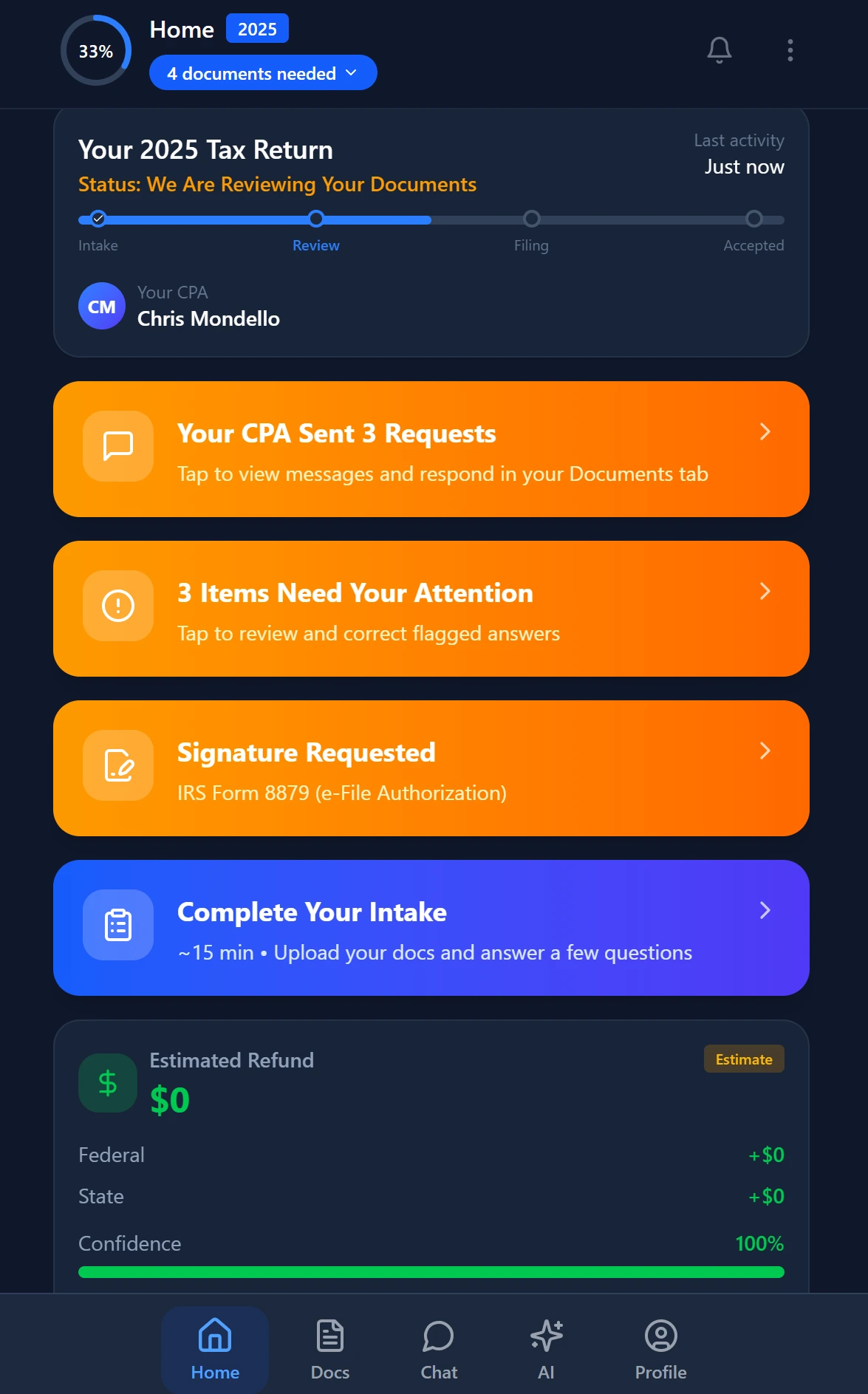
Smart intake auto-fills from uploaded documents and prior-year data
The Long-Term Strategy: Build a PE-Resistant Tech Stack
Private equity-driven price inflation in accounting software is not a temporary market condition. As consolidation continues — BLS data on accounting industry employment trends shows the competitive pressure on smaller practices intensifying — vendors with PE backing will continue to extract margin from captive customer bases. Firms that treat CPA software price hikes private equity as a permanent structural feature of the market, rather than an anomaly, are better equipped to build a stack that holds its cost profile over time.
The firms that navigate this successfully share a common architectural principle: they treat practice management as a separable layer from tax preparation software. Drake, Lacerte, UltraTax, and CCH Axcess are their filing engines — deeply embedded, worth maintaining. Everything surrounding the filing engine — client communication, document management, intake, billing, pipeline — is managed on a platform chosen for price efficiency, AI capability, and migration flexibility.
AI research agents that pull live from IRS.gov, Treasury, and Cornell Law — rather than relying on static cached databases — represent the kind of capability that actually reduces staff hours and justifies software investment. Per-field confidence scoring that flags a suspicious 1099-INT before it becomes an amended return is measurable ROI. Those are the features worth paying for. A 20% annual increase on a per-seat workflow tool that does what a $29/month general-purpose tool does is not.
Audit your stack. Negotiate your renewals. Build in exit flexibility. And when you find a platform that charges a flat $149/month and solves problems your current $500/month vendor does not, the math writes its own conclusion.
Ready to see the difference? TaxScout gives your firm AI extraction, 5-layer validation, and complete practice management — for $49/mo flat. → Book a 15-Min Demo — See It Live
Frequently Asked Questions
PE-backed vendors are pushing renewal increases averaging 15–25% annually, with some practices reporting cumulative tech stack cost increases exceeding 60% over three years. TaxScout.ai tracks your per-return software cost in real time, benchmarking it against your actual billing rates so you can see exactly when your tech spend crosses the threshold that compresses margins below your target. Practices using TaxScout's overhead allocation dashboard have identified an average of $18,400 in redundant or underutilized software licenses within their first 90-day stack audit.
Keep reading
Amended FBAR Procedures: How CPAs Correct Foreign Account Errors Without Triggering Penalties
Oct 12, 2026 · 1 min read
Transparency in Coverage Final Rules: What CPA Firms Must Do Now
Oct 12, 2026 · 1 min read
Backdoor Roth IRA: How CPAs Execute the Strategy for High-Income Clients
Oct 12, 2026 · 1 min read
Stay up to date
Get the latest tax tech insights delivered to your inbox.