How to Fire a Client: CPA Disengagement Letter Templates That Protect Your Firm
Firing a client is legally consequential if handled wrong — and most guides stop at basic formatting. These three ready-to-use CPA disengagement letter templates cover standard termination, difficult clients, and mid-engagement exits. Get the language right and protect your firm from lingering…
Firing a client is one of the most uncomfortable things a CPA does — and one of the most legally consequential if handled wrong. A CPA disengagement letter isn't just a courtesy notice. It's the document that defines when your professional obligations end, protects you from unauthorized practice claims, and establishes your liability cutoff under state board rules and AICPA ethics standards. Get the timing or language wrong and you're still on the hook for the client's next missed deadline — even after you've mentally moved on.
Most guides on disengagement stop at the letter format. This one goes further. Below you'll find three ready-to-use CPA disengagement letter templates — for standard termination, non-payment, and scope creep scenarios — plus a breakdown of the AICPA ethics rules that govern when and how you can disengage, the legal risks most firms overlook, and a practical offboarding checklist that ensures nothing falls through the cracks.
Why CPAs Need a Formal Disengagement Process — Not Just a Letter
The AICPA Code of Professional Conduct doesn't specify a mandatory disengagement procedure, but it does impose ongoing obligations that persist until the relationship is formally ended. Rule ET §1.400 covers acts discreditable to the profession, and state boards often have their own rules about client abandonment. In several states, dropping a client without adequate notice — particularly mid-engagement — can expose you to disciplinary action or civil liability. This is precisely why a properly executed CPA disengagement letter serves as the formal mechanism for severing those obligations under the code.
The risk calculus is real:
- Client abandonment claims: If you disengage during tax season without sufficient notice and the client misses a filing deadline, they have grounds for a negligence claim. Courts have found CPAs liable when disengagement letters were sent too close to filing deadlines.
- Document return obligations: Most state boards require you to return client-provided documents upon request, regardless of unpaid fees — though your own work product may be withheld. Know your state's rules before you withhold anything.
- Successor CPA requests: Under AICPA ET §1.700.040, you're generally required to respond to a successor accountant's inquiry about why the relationship ended, within the bounds of confidentiality.
- Unauthorized practice exposure: If you keep processing things informally after a verbal termination — answering questions, running numbers, signing off on anything — courts may treat you as still engaged. A well-timed CPA disengagement letter with documented delivery is your primary defense against these abandonment claims.
The disengagement letter is the formal line in the sand. It triggers the clock on your liability protection and starts the succession window. Without a CPA disengagement letter on file, that line in the sand simply doesn't exist in the eyes of a court or a malpractice insurer.
Drowning in high-maintenance clients who drain more than they pay? TaxScout's pipeline and analytics tools help you identify which clients to fire — and automate the offboarding checklist so nothing falls through the cracks. → Book a 15-Min Demo — See It Live
How to Know Which Clients to Fire First
Before the letter, there's the decision. Most CPA firms have a cohort of clients who cost far more than their revenue justifies — but without data, it's hard to make the case internally.
As we explored in Accounting Firm KPI Dashboard: Metrics That Matter, the key indicators that flag a client for review are:
- Realization rate below 60%: You're billing $1,500 but spending $2,500 worth of staff time due to disorganization, revision cycles, or scope creep.
- Average response time over 7 days: Clients who delay document submission or approval consistently compress your team's bandwidth and push work into crunch periods.
- Repeat scope violations: Three or more out-of-scope requests per engagement cycle signals either misaligned expectations or deliberate boundary-testing.
- Collections aging over 90 days: Unpaid invoices beyond 90 days have a statistical recovery rate below 40% without legal action.
- Staff escalation frequency: If a single client generates disproportionate internal escalations or complaints from your team, the hidden cost is morale and retention, not just billable hours.
The clients who score worst across these dimensions are your candidates. The next step is determining which disengagement scenario applies — and drafting a CPA disengagement letter that fits the circumstances precisely.
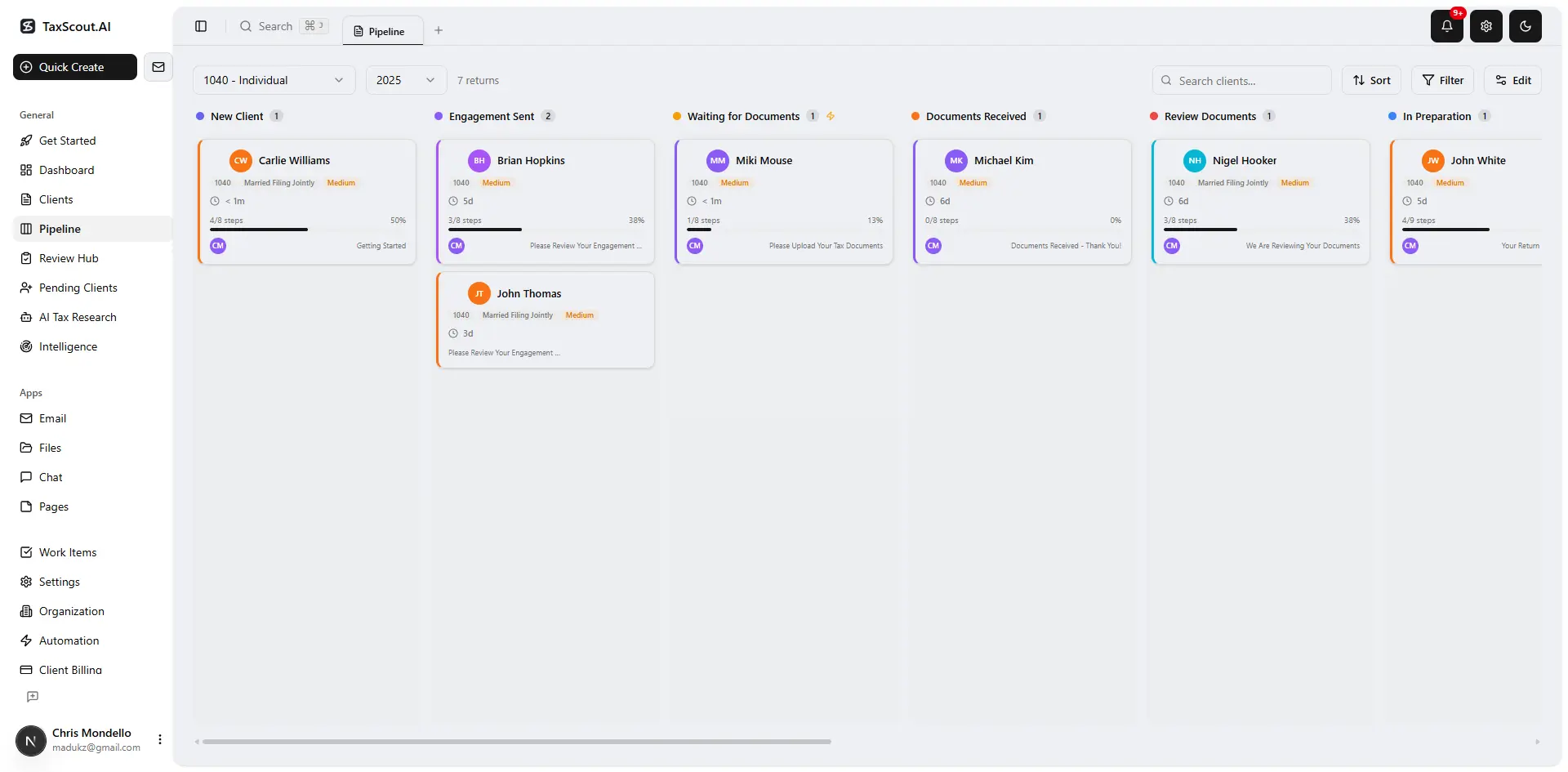
Track every return from intake to filed with drag-and-drop pipeline management
The AICPA Ethics Framework: What You Must Do Before You Send the Letter
Before sending any client termination letter, a CPA must:
- Review the engagement letter for any termination notice requirements. Many engagement letters specify 30 or 60 days' notice.
- Assess proximity to filing deadlines: Disengaging within 30 days of a client's filing deadline — without reasonable cause — is where abandonment claims originate. Either provide a reasonable transition window or document why immediate disengagement is necessary (e.g., suspected fraud, ethics violation, non-cooperation that makes engagement impossible).
- Return client-provided documents: Federal and most state rules require return of original documents promptly. Your work product is generally yours to withhold until fees are paid, but verify your state board's specific rule — California, New York, and Texas each have nuances here.
- Notify successor if requested: Under ET §1.700.040, if a successor accountant contacts you, you should confirm the disengagement and may share the reason for termination if the client has authorized it.
- Document everything: The CPA disengagement letter goes out via certified mail and email. You keep the delivery receipts.
3 Ready-to-Use CPA Disengagement Letter Templates
📥 Want all three letters as a ready-to-edit pack? Download them free — placeholder-highlighted, print-ready, with the AICPA-safe wording preserved.
Template 1: Standard Disengagement (General Termination)
Use when: The relationship has run its course, the client is a poor fit, or you're reducing your client roster.
[Your Firm Name] [Address] | [Email] | [Phone]
[Date]
[Client Name] [Client Address]
RE: Termination of Professional Engagement
Dear [Client Name],
This letter formally notifies you that [Firm Name] is terminating its professional relationship with you effective [Date — minimum 30 days from letter date]. This decision was not made lightly and does not reflect any concern about your personal character or the integrity of your financial matters.
After [Date], we will no longer be responsible for any accounting, tax preparation, advisory, or related services on your behalf. We strongly encourage you to retain a new accountant promptly to ensure continuity of your financial and tax obligations.
Between now and [termination date], we will:
- Complete any work currently in progress through [specific milestone, e.g., "completion of your 2025 federal and state returns"]
- Return all original documents you provided to us upon written request
- Transfer your client file to your designated successor accountant upon written authorization
Please note that any outstanding invoices in the amount of $[Amount] are due upon receipt. Work product prepared by our firm remains our property until all outstanding fees are settled, subject to applicable state board rules.
We wish you every success going forward.
Sincerely, [CPA Name, Credentials] [Firm Name]
[Sent via certified mail, return receipt requested, and email to [client email address]]
Template 2: Disengagement for Non-Payment
Use when: A client has an outstanding balance, repeated payment failures, or a pattern of late payments that has made the engagement economically untenable.
[Your Firm Name] [Address] | [Email] | [Phone]
[Date]
[Client Name] [Client Address]
RE: Termination of Professional Engagement — Outstanding Balance
Dear [Client Name],
Despite multiple prior communications on [Date 1], [Date 2], and [Date 3], the outstanding balance of $[Amount] for services rendered through [Date] remains unpaid. As a result, [Firm Name] is terminating its professional engagement with you effective [Date — ideally 10-14 days from letter, or immediately if outside deadline proximity].
Effective immediately, we are suspending all active work on your behalf. We will not file, submit, sign, or advise on any matters until this engagement is formally closed.
Outstanding obligations:
- Amount due: $[Amount]
- Invoice(s): [Invoice numbers and dates]
- Payment deadline to avoid referral to collections: [Date, 10-14 days out]
Upon receipt of full payment, we will provide copies of all completed work product and assist in transitioning your file to a successor accountant. Original documents you provided will be returned within [X] business days of your written request, regardless of payment status, in accordance with applicable professional standards.
Please note that if you have an approaching tax deadline, you should immediately engage a new accountant. [Firm Name] will not be responsible for any penalties, interest, or missed filings arising after the effective date of this termination.
We strongly recommend retaining a qualified CPA before [nearest applicable deadline — e.g., "October 15 extension deadline"] to avoid any compliance issues.
Sincerely, [CPA Name, Credentials] [Firm Name]
[Sent via certified mail and email. All prior correspondence attached.]
Template 3: Disengagement for Scope Creep / Unresolvable Conflict
Use when: A client consistently requests services outside the engagement, has become verbally abusive with staff, is suspected of providing false information, or creates ethical conflicts.
[Your Firm Name] [Address] | [Email] | [Phone]
[Date]
[Client Name] [Client Address]
RE: Termination of Professional Engagement
Dear [Client Name],
After careful consideration, [Firm Name] has determined that it is necessary to terminate our professional relationship, effective [Date]. Professional obligations prevent us from specifying the precise reasons for this decision in writing.
We are obligated under professional standards to provide you with adequate notice to secure alternative representation and to return your original documents promptly upon written request.
Transition timeline:
- Effective termination date: [Date]
- Document return: Original client-provided documents will be returned within [X] business days of your written request.
- Work in progress: [Describe what will and will not be completed — e.g., "We will complete preparation of your 2025 Form 1040 currently in progress and will not accept any additional assignments."]
- Successor transition: Upon your written authorization, we will respond to inquiries from your new accountant in accordance with AICPA professional standards.
We recommend you engage a new accountant promptly. Upcoming deadlines that may affect you include [list applicable deadlines from IRS Tax Deadlines 2026: What Every CPA Must Know].
Outstanding fees of $[Amount] are due within [X] days. Please remit payment to [address/portal link].
Sincerely, [CPA Name, Credentials] [Firm Name]
A note on Template 3: Avoid specificity about suspected fraud or ethics violations in the letter itself. If there's suspected fraud, consult your professional liability carrier and legal counsel before sending anything. The phrase "professional obligations prevent us from specifying the precise reasons" is deliberate — it preserves your right to decline elaboration while remaining professionally defensible. See the AICPA's guidance on confidential client information under ET §1.700.
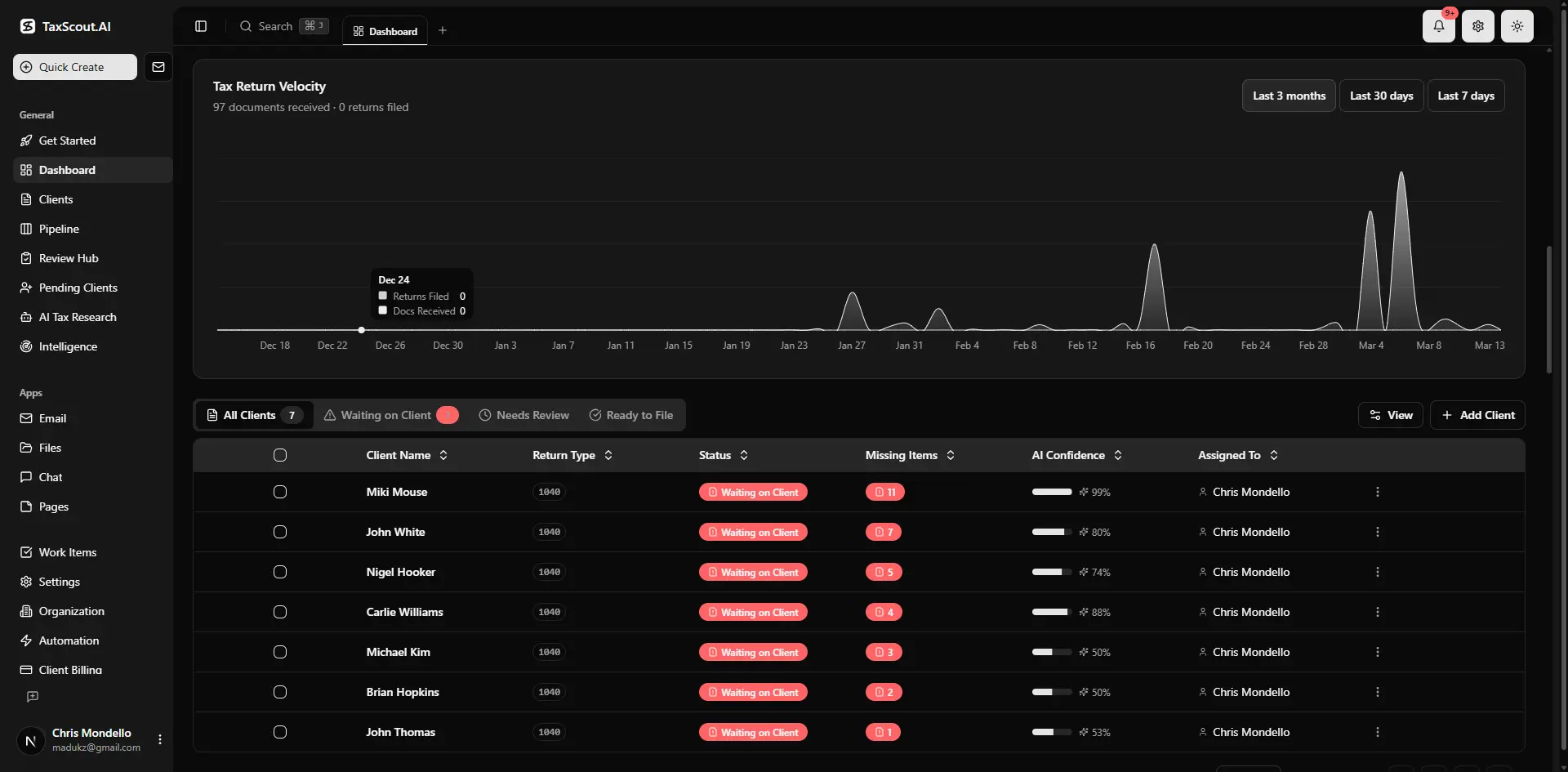
Real-time dashboard showing returns in progress, revenue, and upcoming deadlines
The Disengagement Offboarding Checklist — 12 Steps That Protect Your Firm
Sending the letter is step one. The offboarding process is where most firms fumble — and where liability exposure lingers. Here's the complete checklist:
Before sending the letter:
- Review engagement letter for notice requirements
- Check proximity to IRS or state filing deadlines
- Consult professional liability carrier if reason involves suspected fraud, disputes, or legal threat
- Confirm outstanding work in progress and what will/won't be completed
- Calculate outstanding fees and prepare final invoice
When sending the letter:
- Send via certified mail (return receipt) AND email simultaneously
- Log delivery confirmation in the client's file
- Move client to "Disengaging" stage in your pipeline
After sending:
- Return original documents within required timeframe (know your state's rule)
- Generate and retain a complete binder of all work product in the client file
- Respond to any successor accountant requests per ET §1.700.040
- Archive the client record for 7 years (IRS audit window)
- Revoke portal access on effective termination date
If that list looks like it lives in your head rather than your system, that's a process risk — not a character flaw. The best firms systematize it — and treat each completed CPA disengagement letter as a trigger for moving through this checklist step by step.
How TaxScout Automates the Disengagement Workflow
Manual client offboarding is where things get dropped. A staff member forgets to revoke portal access. The final binder never gets generated. The 7-year archive gets buried in a folder no one labels correctly. These aren't hypothetical — they're the kinds of gaps that create liability in an audit or dispute.
TaxScout's pipeline management includes 12 customizable stages from New Client to Filed. Adding a "Disengaging" stage is straightforward — with auto-advance conditions (e.g., letter sent + final invoice issued → move to "Pending Archive") and loopback transitions with required notes if the process stalls. Every CPA disengagement letter sent through the workflow automatically advances the client record and timestamps the event, so nothing slips through unnoticed.
The client portal uses OTP login — zero passwords, zero accounts to deactivate in a third-party system. Revoking access is a single action in the client record, with a timestamped audit trail that documents exactly when access was removed.
For document management, TaxScout's entity-level folder system separates the Client Folder (organized by tax year) from the Permanent Folder (identity documents, POA, W-9). When you disengage, you can generate a complete binder — with cover page, table of contents, category dividers, and bookmarks — in one step. That binder becomes your complete record of what was prepared, what was returned, and when.
And critically: TaxScout's 7-year retention is backed by S3/Glacier on US-based AWS infrastructure. If a disengaged client later faces an IRS audit and points fingers at your work, your records are intact and accessible. The Retained Archive add-on ($99/year) provides post-cancellation read-only access to those records specifically for this scenario — a safety net that costs less than one hour of attorney time.
For identifying which clients to disengage in the first place, the analytics and KPI tracking capabilities in TaxScout connect directly to the metrics we discussed earlier — realization rates, aging receivables, capacity impact. As detailed in CPA Firm KPIs to Track: Top 10 With AI Automation, having these numbers in a dashboard rather than a spreadsheet makes the client review conversation internal and data-driven rather than reactive and emotional.
Finally, for unpaid-fee situations, TaxScout's invoicing via Stripe Connect Express includes automated overdue reminders (daily cron at 9 AM EST) so you have a documented paper trail of collection attempts before you send Template 2. Courts and arbitrators respond to documented good-faith collection efforts — your Stripe billing history becomes evidence that the CPA disengagement letter was a last resort, not a first reaction.
The transition from active client management to archival should also follow the same security posture described in Cybersecurity Accounting Firm: Essential Must-Haves — AES-256-GCM SSN vault encryption, row-level security, and full audit logging ensure that even archived disengaged client data is protected against breach.
The Timing Question: When Is It Too Late to Disengage?
The general professional standard is that disengagement is inappropriate when it would leave a client without time to retain competent representation before a critical deadline. Practically:
- Outside 60+ days of a filing deadline: Disengage with standard 30-day notice. Low risk.
- 31-60 days from a deadline: Disengage with an expedited notice (10-14 days) and a strong recommendation to immediately retain new representation. Document the recommendation in the letter.
- Within 30 days of a deadline: Exercise extreme caution. If you must disengage (suspected fraud, ethical conflict, abusive behavior toward staff), document the compelling reason, consult your professional liability carrier, and consider requesting an extension on the client's behalf as part of the disengagement — or completing only the extension filing before terminating. A CPA disengagement letter issued in this window should always include an explicit list of upcoming deadlines the client needs to address with their new accountant.
- After filing: Lowest risk. Disengage after the return is filed and delivered.
The IRS extension rules are relevant here — filing a Form 4868 extension for a client you're disengaging from is sometimes the cleanest way to create transition runway without abandonment exposure.
Ready to Build a Firm That Only Keeps the Right Clients?
TaxScout gives your firm the pipeline management, analytics, and automated offboarding tools to make client disengagement a clean, documented, legally defensible process — for $49/mo flat.
This article is for informational purposes only and does not constitute legal or professional ethics advice. Consult your state board of accountancy, professional liability carrier, and legal counsel before disengaging from a client where there is suspected fraud, active litigation, or disputed fees.
Get all 3 disengagement letters as a ready-to-edit pack
Standard termination, non-payment, and scope-creep/conflict letters — placeholder-highlighted and print-ready, with the AICPA-safe wording preserved.
Free. We'll also send occasional practice-management insights for CPA firms — unsubscribe anytime.
Frequently Asked Questions
A compliant CPA disengagement letter must include: (1) a clear effective date of termination, (2) explicit statement that your firm no longer represents the client for any tax or accounting matters, (3) upcoming deadlines the client must address independently, (4) document return or retention policy, and (5) a recommendation to seek new representation promptly. Under AICPA Code of Professional Conduct rules, omitting the effective termination date is the most common error — without it, regulators may interpret your obligations as continuing. TaxScout's disengagement letter templates pre-populate all five required elements and flag any missing fields before you send.
Keep reading
Client Billing Disputes: How CPAs Resolve Fee Conflicts Without Losing the Relationship
Sep 18, 2026 · 1 min read
NACHA Phase 2 Compliance: What CPA Firms Managing ACH Payments Must Do Now
Jul 27, 2026 · 1 min read
CAS Scope Creep: How to Stop Giving Away Free Work on Monthly Engagements
Jul 18, 2026 · 1 min read
Stay up to date
Get the latest tax tech insights delivered to your inbox.