AI Implementation Roadmap for CPA Firms: Where to Start and What to Do First
Most CPA firm owners know they need an AI strategy — they just don't know where to start. This guide breaks down a proven three-phase AI roadmap for CPA firms: beginning with intake automation, advancing to workflow routing, and culminating in advisory AI. Each phase includes specific ROI…
Ask ten firm owners at any accounting conference what holds them back from adopting AI and you'll hear the same answer: 'We don't know where to start.' The AI roadmap for CPA firms question is arguably the most pressing operational challenge in public accounting right now — not whether to adopt AI, but in what order, at what pace, and with which tools. Developing a clear AI roadmap CPA firms can actually execute is arguably the most pressing operational challenge in public accounting right now — not whether to adopt AI.
The sequencing matters more than most firms realize. Firms that deploy workflow routing software before fixing their document intake process end up automating chaos. Firms that invest in advisory AI tools before their staff is comfortable with basic automation face expensive shelf-ware. The order of operations is the strategy. Any effective AI roadmap CPA firms follow must prioritize sequencing, because deploying tools in the wrong order consistently leads to costly missteps and staff frustration.
This guide gives you a concrete, phase-by-phase plan — starting with intake automation, moving through workflow management, and finishing with AI-assisted advisory services. Each phase includes the ROI milestones you should hit before advancing, plus the staff adoption tactics that actually work in accounting environments. For more resources on running a modern, efficient firm, browse our complete guide to CPA practice management. This guide gives you a concrete AI roadmap CPA firms can follow phase by phase — starting with intake automation, moving through workflow management, and finishing with AI-assisted advisory services.
Why Sequencing Your AI Roadmap Is the Whole Game
The accounting industry's AI conversation has been dominated by vendors explaining why AI matters and researchers documenting productivity gains. What's been missing is a frank discussion about sequencing — because the wrong order of implementation is the number-one reason AI initiatives stall at accounting firms. For firms evaluating their AI roadmap CPA firms approach, this trade-off compounds over time.
Consider the data: according to research from the Bureau of Labor Statistics, accountants and auditors face ongoing pressure to do more with smaller teams. AI promises relief, but only if deployed against the right bottleneck first. In most CPA firms, that bottleneck is document collection and intake — not advisory capacity. Each of these factors directly shapes how an AI roadmap CPA firms strategy plays out in practice.
A well-sequenced CPA firm automation roadmap follows a simple logic: fix the front door first. Every tax return, every advisory engagement, every client relationship starts with collecting information. If that process is manual, slow, and error-prone, no amount of downstream automation will save you. This is why Phase 1 must always be intake automation before anything else. Understanding AI roadmap CPA firms in this context is what separates firms that scale from those that stall.
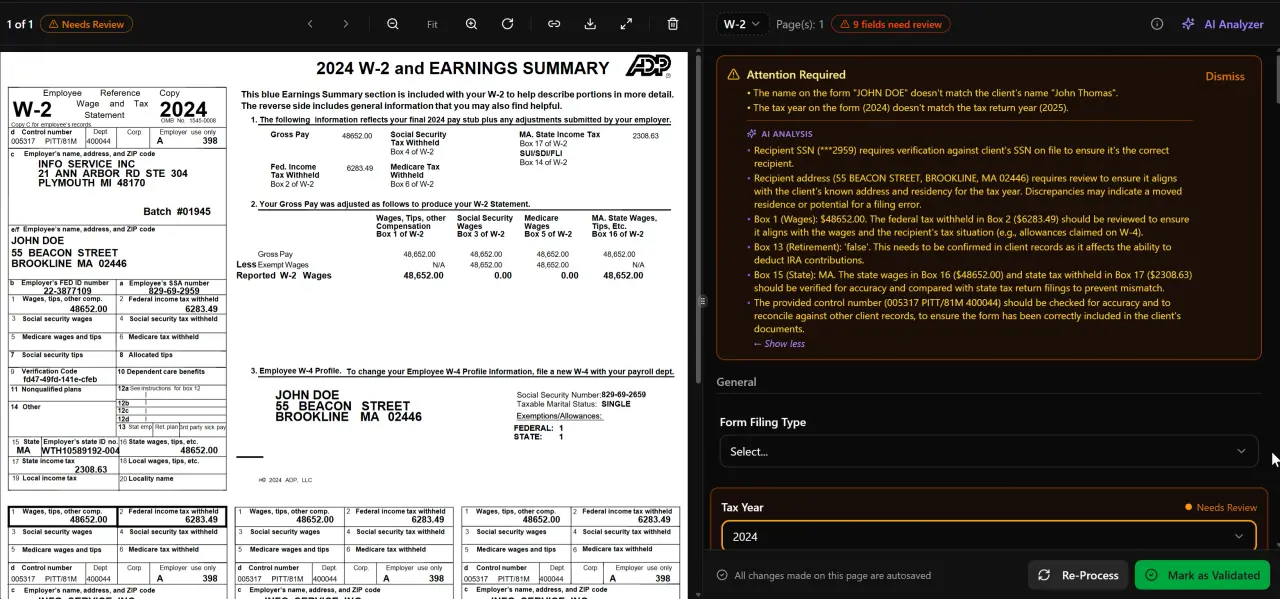
AI classifies, extracts, and validates every document automatically
Phase 1: Intake Automation and AI Document Extraction
Phase 1 of any AI implementation for accounting firms should focus on two adjacent problems: how clients submit their documents, and how your team processes them. These are the highest-volume, most time-consuming tasks in a tax practice — and they're the most automatable with today's technology. This is precisely where a deliberate AI roadmap CPA firms strategy pays off most immediately.
Start by deploying a structured client intake engine. TaxScout's smart intake feature is modeled on IRS Form 13614-C and uses four-layer prefill logic: it pulls from uploaded documents first, then prior-year data, then client profile, then runs an AI gap analysis to flag anything still missing. Clients interact with a clean portal — no passwords, just OTP login — and the system guides them to completion. Compare this to the typical approach of emailing a PDF organizer and waiting. AI roadmap CPA firms sits at the center of this decision — get it wrong and the rest unravels.
Simultaneously, deploy AI document extraction on every incoming file. TaxScout's AI document extraction processes 180+ tax form types — W-2s, all 1099 variants, K-1s, the 1098 series, and every 1040 schedule — through a 5-layer validation pipeline that cross-checks OCR output with 15 deterministic math rules and 18 post-extraction rules. For a deeper look at how this works technically, see our complete guide to AI document extraction for CPAs. When firms revisit their AI roadmap CPA firms priorities, the gaps almost always surface here first.
Phase 1 ROI milestones to hit before advancing: (1) Document collection time per return drops by at least 40%. (2) Staff spends less than 5 minutes per return on data entry verification. (3) Client portal adoption reaches 70%+ of your active client base. If you haven't hit these markers within 60 days of deployment, diagnose the adoption gap before layering on more automation.
Tired of spending your best hours chasing documents and re-keying data?
TaxScout's AI intake and document extraction make Phase 1 the easiest starting point — flat pricing, no per-user fees, and setup in under a day.
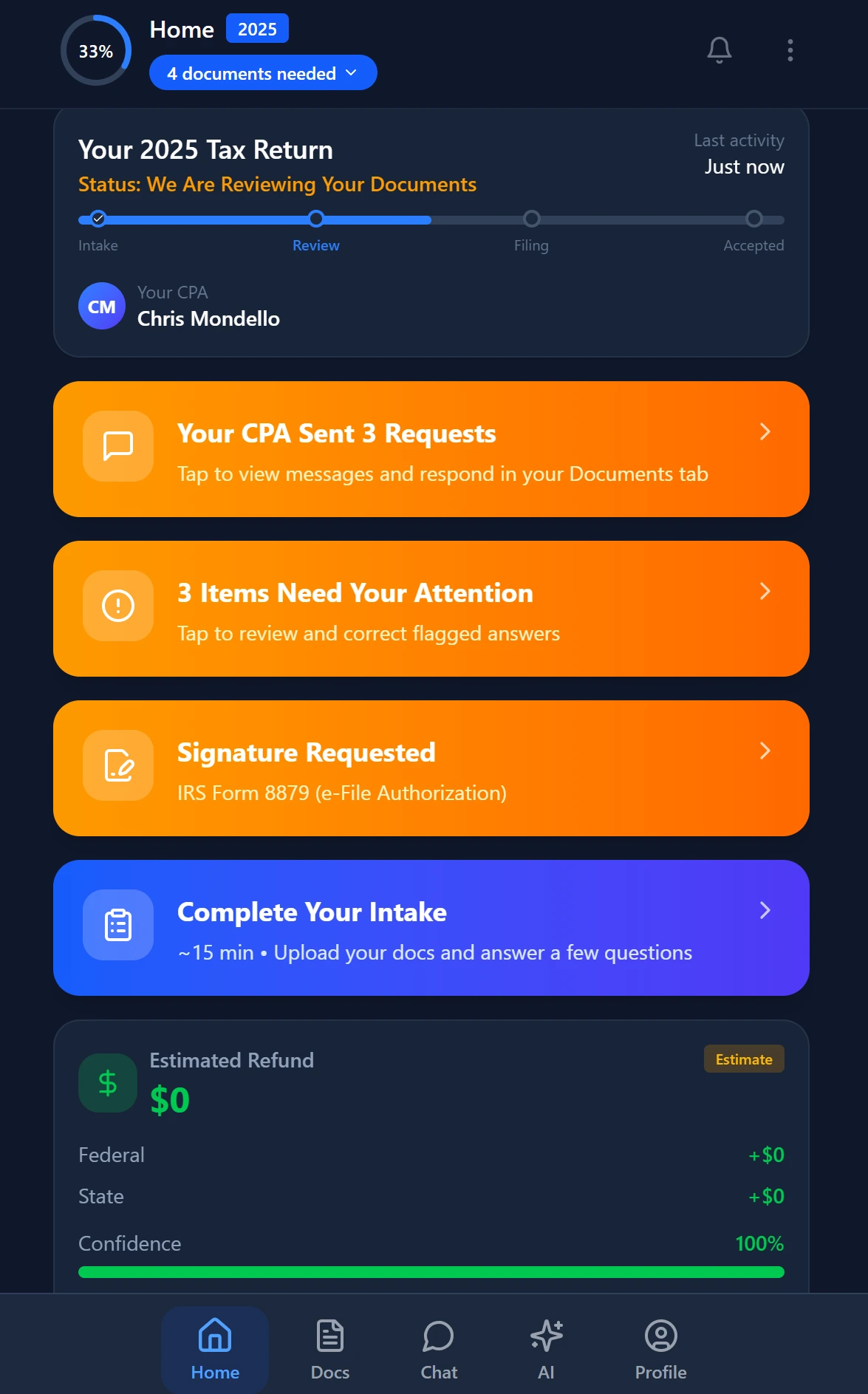
Smart intake auto-fills from uploaded documents and prior-year data

Click any extracted field to see its source highlighted on the original PDF
Staff Adoption Tactics for Phase 1
No competitor has addressed this directly, but the human side of AI adoption is where most implementations fail. When you introduce intake automation and AI extraction to a team that's been manually keying W-2 data for years, expect friction. The tactics below are specific to accounting environments.
First, reframe the narrative. Staff who fear AI replacement become resistant adopters. Reframe extraction and intake automation not as 'the AI is doing your job' but as 'the AI handles the data entry so you can focus on review and client relationships.' This is accurate — someone still needs to review AI output, and that person needs to be skilled. According to IRS Publication 4557 on safeguarding taxpayer data, firms remain responsible for the accuracy of every return filed. Review is not optional.
Second, use a champion-first rollout. Identify one staff member per team who is comfortable with technology and willing to be the internal expert on Phase 1 tools. Have them complete the first 20 returns using the new workflow before rolling out to the full team. Champions reduce peer-to-peer friction more effectively than any top-down mandate. Firms that document this process as part of their AI roadmap CPA firms plan consistently see faster full-team adoption than those that skip it.
Third, create a visible wins board. During the first 30 days, track and display the time saved per return, the number of client portal activations, and the count of documents auto-extracted without manual correction. Visible metrics create positive reinforcement loops that sustain adoption.
Phase 2: Workflow Routing and Pipeline Management
Once intake is automated and your team trusts the AI extraction output, you're ready for Phase 2: systematizing how work moves through your firm. This is where pipeline management and workflow automation become the focus.
TaxScout's pipeline gives you 12 customizable stages with drag-and-drop kanban views. The key Phase 2 goal is not just to visualize where returns sit — it's to define trigger-based routing rules so that work advances automatically based on conditions. For example: when AI extraction completes with confidence above threshold, the return automatically moves from 'Documents Received' to 'Ready for Preparer.' When a preparer marks a return complete, it routes to the reviewer queue without a single email.
Equally important in Phase 2 is integrating your email workflow. TaxScout's communication hub supports Gmail OAuth, Outlook Graph API, and IMAP/POP3 connections with AI classification — so client emails are automatically matched to the correct client file and flagged by topic. This eliminates the 'lost in inbox' problem that derails workflow in mid-size firms. See how other firms have tackled this in our post on solving email overload with a shared inbox.
Phase 2 ROI milestones to hit before advancing: (1) Average return cycle time (intake to filing) has decreased by at least 20%. (2) Preparers are not manually re-assigning work or sending internal 'is this ready?' emails. (3) Firm leadership can see real-time pipeline status without asking staff. These metrics confirm that workflow routing is functioning — not just installed. Reaching them also signals that your AI roadmap CPA firms initiative has successfully moved beyond Phase 1 foundations.
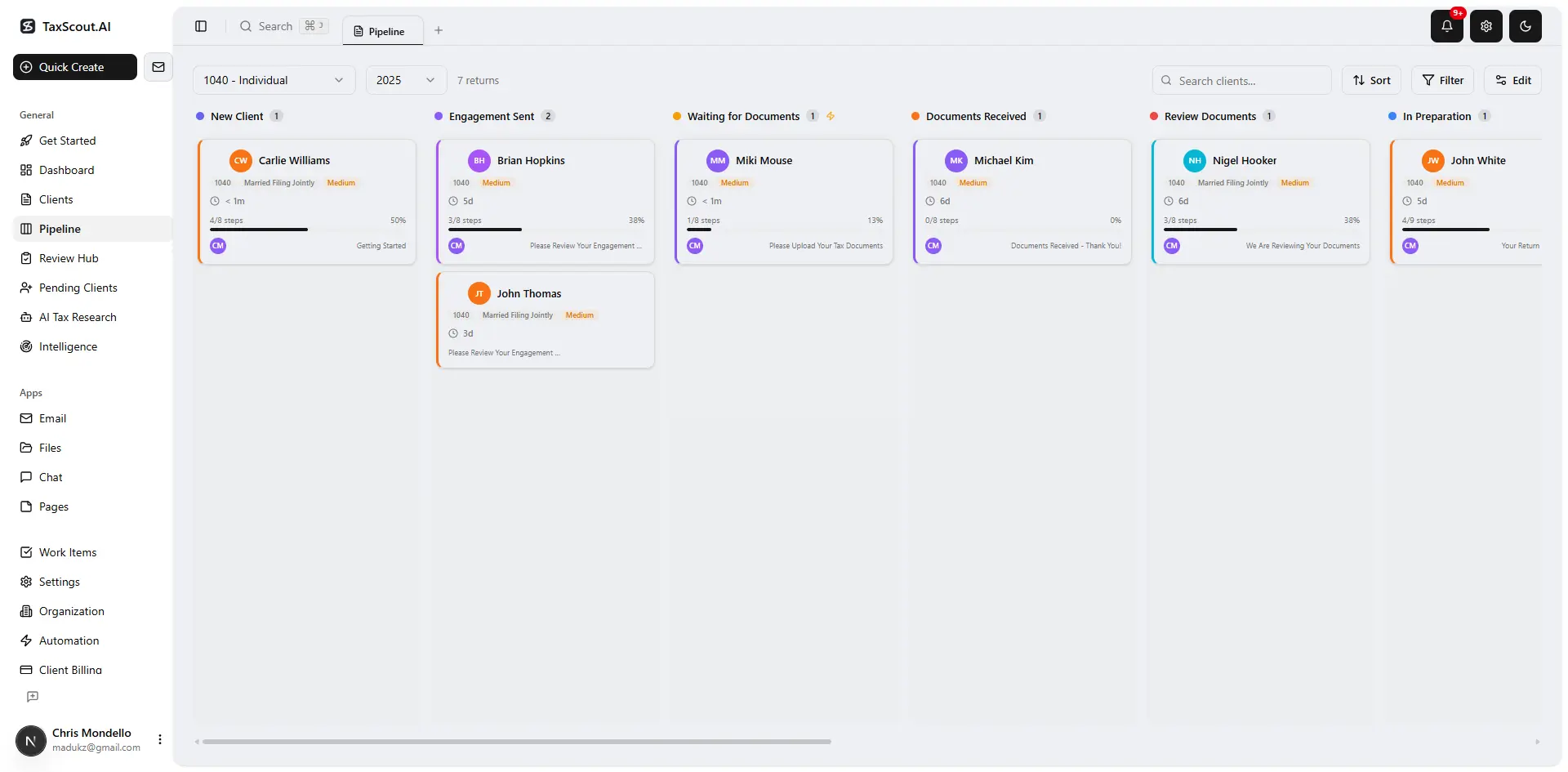
Track every return from intake to filed with drag-and-drop pipeline management
How TaxScout compares to alternatives for Phase 1 and Phase 2 capabilities (10-person firm, monthly cost)
| Capability | TaxScout Prep Pro | TaxDome | Canopy | Karbon |
|---|---|---|---|---|
| AI document extraction (180+ forms) | Included | Not available | Not available | Not available |
| 5-layer validation pipeline | Included | Not available | Not available | Not available |
| Smart intake with 4-layer prefill | Included | Basic organizer | $11/client extra | Not available |
| Pipeline management (12 stages) | Included | Included | Included | Included |
| AI research agents (9 specialized) | Included | Not available | Not available | Not available |
| Monthly cost (10-person firm) | $149 flat | ~$500 | ~$660 | ~$590 |

Your clients see your brand — OTP login, document upload, and real-time status
Phase 3: Advisory AI and Intelligent Tax Research
Phase 3 is where AI implementation for accounting firms becomes a true competitive differentiator. After your intake is clean and your pipeline is routing predictably, you have the foundation to deploy AI research agents that help staff answer complex tax questions faster — and with more confidence. For firms that have followed the full AI roadmap CPA firms framework from the start, this phase often arrives faster than expected.
TaxScout's AI research agents include nine specialized agents that query IRS.gov, Treasury.gov, Cornell's Legal Information Institute, SSA.gov, and Congressional records in real time. Rather than a preparer spending 45 minutes researching whether a client's home office qualifies under IRC Section 280A, the agent surfaces relevant authority, cites the applicable code sections, and flags conflicting guidance — in under two minutes. Critically, the agent operates with client-context memory: it knows the client's entity structure, filing history, and prior-year positions.
The Phase 3 unlock is advisory services expansion. When your team spends less time on data entry and workflow coordination, capacity opens for proactive advisory conversations. Pair AI research tools with a structured advisory service menu and you have the building blocks for value-based pricing. For a detailed look at transitioning to flat-fee billing for CPAs, that shift becomes much more defensible when advisory depth is AI-assisted.
Phase 3 ROI milestones: (1) Research time per complex return drops by 50%+. (2) At least 15% of your client base is enrolled in an advisory service tier. (3) Staff confidence in answering novel tax questions increases — measurable via internal quality review scores or client satisfaction feedback.
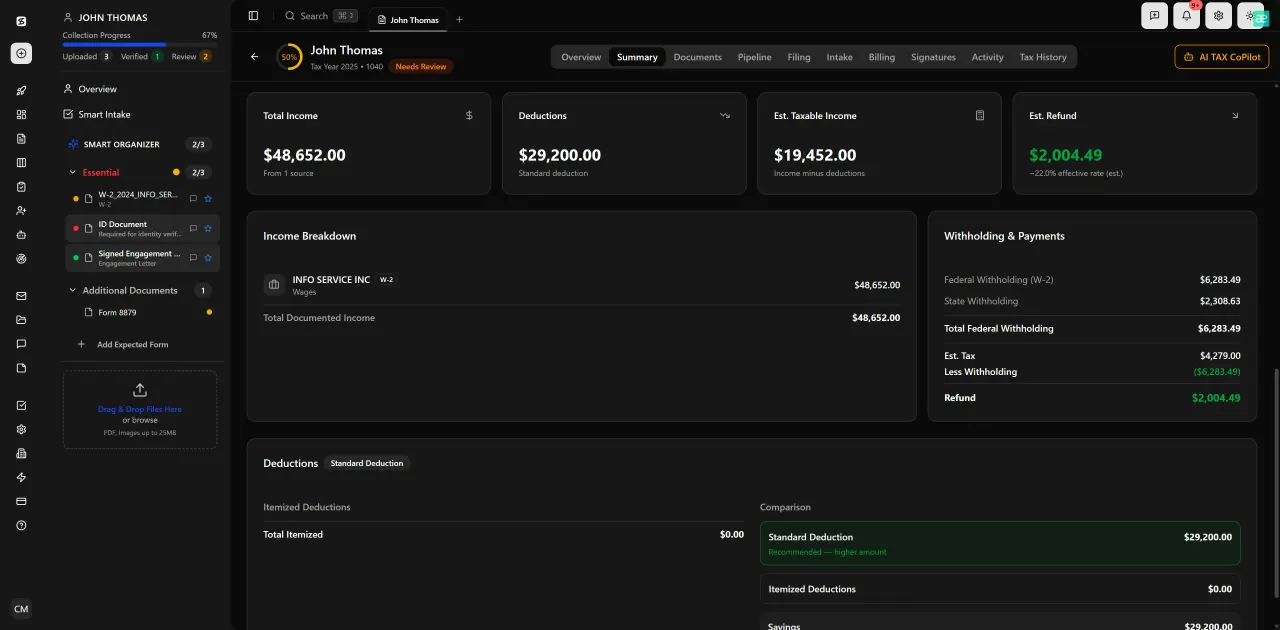
Review with AI assist — 9 agents answer questions with full client context
Evaluating Your Platform Before Committing to a Roadmap
An AI roadmap for CPA firms is only as good as the platform executing it. Before committing, evaluate any platform against these four criteria: (1) Does it handle intake, extraction, pipeline, and research on a single data model, or does it require integrations that create sync failures? (2) Is pricing per-user or flat — because per-user pricing creates adoption resistance as you scale? (3) Does it work with your existing tax preparation software rather than demanding you replace it? TaxScout works alongside Drake, CCH Axcess, UltraTax CS, Lacerte, ProConnect, and ProSeries — it's a practice management and AI layer, not a replacement for your prep software. (4) How serious is the security posture? Look for AES-256-GCM encrypted storage, RBAC, and documented DSAR procedures — requirements covered in IRS Publication 4557 and reinforced by Treasury cybersecurity guidance.
Firms comparing platforms should read our detailed breakdowns: TaxScout vs. TaxDome, TaxScout vs. Canopy, and TaxScout vs. Karbon. The short version: TaxScout Prep Pro at $149/month flat gives a 10-person firm the full Phase 1, 2, and 3 stack at roughly 25-30% of what TaxDome or Canopy would cost the same team. When the goal is building a sustainable AI roadmap CPA firms can actually afford and maintain, that cost difference matters.

Every client gets organized documents, status tracking, and a complete history
Building a Change Management Plan That Sticks
AI adoption accounting 2026 literature focuses almost entirely on the technology side. But research from the Journal of Accountancy shows that technology adoption in professional services firms succeeds or fails on the human side — specifically, whether staff feel consulted in the process and whether they understand how success is measured.
Build a simple 90-day change management calendar alongside your technical rollout. Week 1-2: champion identification and tool orientation. Week 3-4: Phase 1 live with champion cohort, metrics tracking begins. Week 5-8: full team Phase 1 rollout, weekly wins review, open Q&A sessions. Week 9-12: Phase 2 preparation — document your current workflow stages, agree on the new routing rules as a team, then flip the switch. The key is never skipping the 'agree as a team' step. Staff who helped design the workflow routing rules will defend and improve them. Staff who had the rules imposed on them will route around them. Embedding this collaborative approach into your AI roadmap CPA firms plan from day one dramatically reduces the resistance that derails most implementations.
Also consider how you'll handle the 'what if the AI is wrong?' concern — because it's legitimate. TaxScout's split-screen PDF viewer with click-to-source field highlighting means that every AI-extracted value can be traced back to the exact location in the source document in one click. That transparency eliminates the black-box objection that often stalls adoption. For a look at the broader productivity picture, see how AI boosts accounting productivity without overwhelming your team.
Ready to start Phase 1 this week without a six-month implementation project?
TaxScout Prep Pro gives you AI extraction, smart intake, pipeline management, and 9 AI research agents for $149/month flat — no per-user fees, works with Drake and all major prep software.
Frequently Asked Questions
The correct sequence is intake automation first, then workflow routing, then advisory AI. Fixing how documents are collected and processed eliminates the manual bottleneck that makes all downstream automation unreliable. Only once intake is clean and pipeline stages are routing predictably does advisory AI generate consistent ROI.
Keep reading
IRS Power of Attorney: How CPAs File Form 2848 Without Delays
Sep 22, 2026 · 1 min read
Accountant Shortage Solutions: How CPA Firms Survive the Talent Crisis Without Overpaying
Sep 18, 2026 · 1 min read
Accounting Firm Communication: How AI Eliminates the Gaps That Cost You Clients
Sep 18, 2026 · 1 min read
Stay up to date
Get the latest tax tech insights delivered to your inbox.