Like-Kind Exchange 1031: How CPAs Guide Real Estate Clients Through a Tax-Deferred Swap
Most 1031 exchange content is written for investors. This guide is for the CPA executing the transaction — covering qualifying property rules, strict 45- and 180-day deadlines, boot calculations, reverse exchanges, and how modern practice management tools keep every step documented and on track.
A like-kind exchange 1031 is one of the most powerful tax deferral tools available to real estate clients — and one of the most unforgiving transactions a CPA can manage. The rules under IRC Section 1031 are strict, the deadlines are calendar-day absolute, and a single missed step can convert a fully deferred gain into an immediate taxable event that costs a client tens or hundreds of thousands of dollars. Unlike most tax planning strategies, there is almost no room for error once the relinquished property closes.
Most published 1031 exchange content explains the mechanics to investors deciding whether to do a swap. This guide is written for the CPA on the other side of that conversation — the professional who must identify qualifying replacement property, calculate boot exposure, coordinate with the qualified intermediary, prepare Form 8824, and track every deadline with the precision of a closing attorney. The operational complexity is significant, and the liability exposure for missing a deadline is real. Understanding the like-kind exchange 1031 process from the CPA's perspective requires a fundamentally different focus than the investor-facing guides that dominate most tax literature.
This walkthrough covers the end-to-end CPA workflow: from the initial client conversation through property identification, deadline management, boot calculations, reverse and improvement exchange variants, and how practice management software can automate deadline tracking and document every client communication along the way. Each phase of this workflow reflects the real complexity CPAs encounter when guiding clients through a like-kind exchange 1031 transaction from start to finish.
What Qualifies as Like-Kind Property Under Section 1031
Before any exchange mechanics matter, you need to confirm the transaction actually qualifies. Under IRC Section 1031 as amended by the Tax Cuts and Jobs Act of 2017, like-kind exchange treatment is now limited exclusively to real property held for productive use in a trade or business or for investment. Personal property — equipment, vehicles, artwork, collectibles — no longer qualifies. If a client asks whether their commercial printing press can be swapped, the answer since 2018 is no. Confirming eligibility is the critical first gate, since a failed like-kind exchange 1031 can result in immediate recognition of deferred gain that the client was counting on avoiding.
For real property, the 'like-kind' standard is broader than most clients assume. A rental home can be exchanged for a commercial warehouse. A farmland parcel can be exchanged for an apartment building. The IRS does not require the properties to be the same type; they simply must both be real property held for investment or business purposes. Primary residences do not qualify. A property held primarily for sale (dealer property or fix-and-flip inventory) does not qualify. Your engagement intake process should confirm holding intent before the relinquished property goes under contract. For firms evaluating their like-kind exchange 1031 approach, this trade-off compounds over time.
The IRS guidance on like-kind exchanges in Publication 544 provides additional detail on what constitutes real property for 1031 purposes, including whether certain intangible interests in real property (such as leaseholds of 30 years or more) can qualify. State law characterization of the property also matters — a few states have their own like-kind exchange rules that diverge from the federal standard. If your client holds property in a state like California or New York, review the applicable state overlay early in the process; see our posts on California Tax Changes 2026 CPAs Must Know and New York State Tax Updates 2026 for recent developments that can affect how these transactions are reported at the state level. Each of these factors directly shapes how a like-kind exchange 1031 plays out in practice.
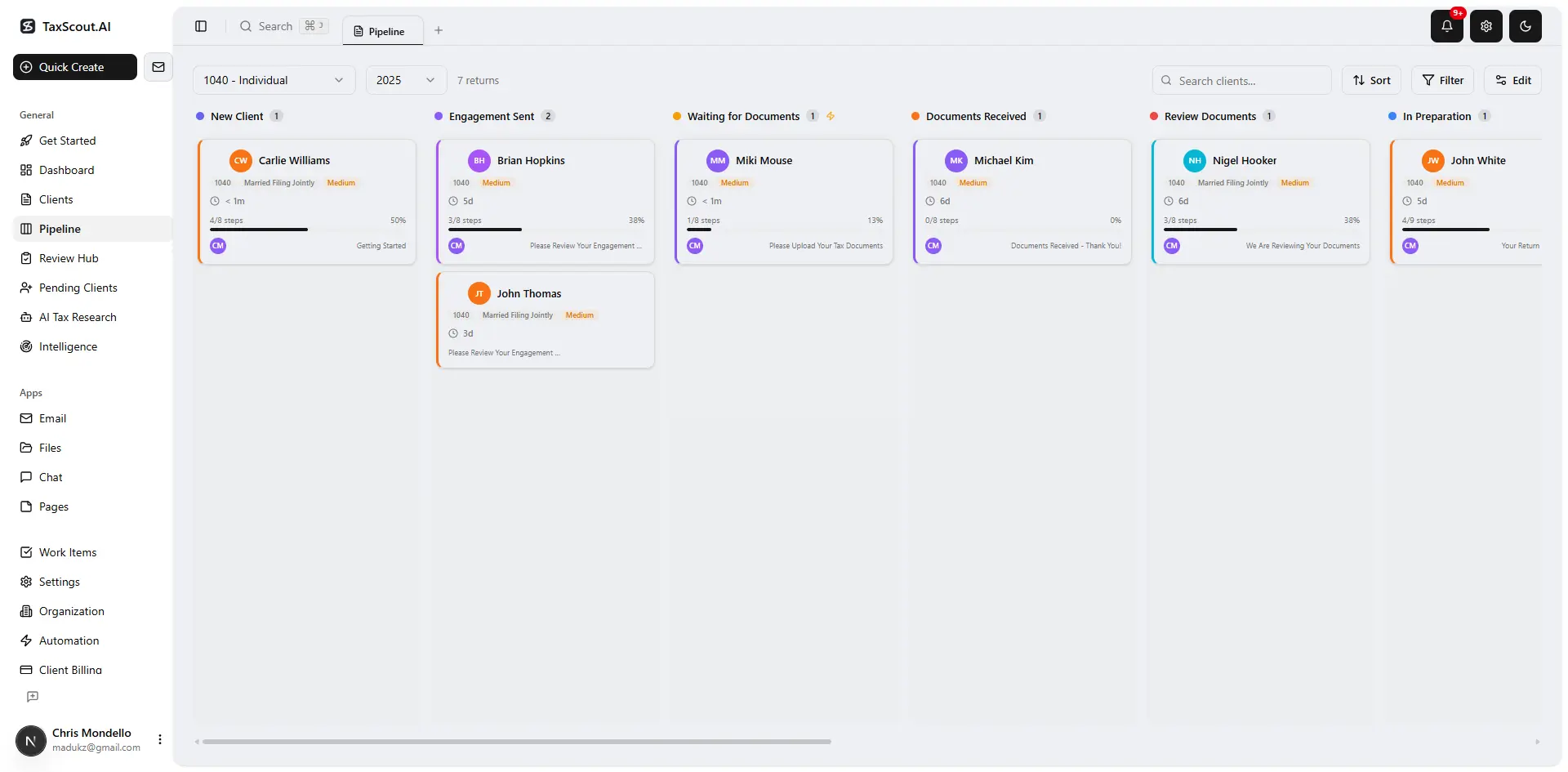
Track every return from intake to filed with drag-and-drop pipeline management
The 45-Day Identification and 180-Day Closing Deadlines Explained
The two absolute deadlines in a like-kind exchange 1031 are the 45-day identification window and the 180-day exchange period. Both are calendar-day counts from the date the relinquished property closes — not business days, not adjusted for weekends, not extended by extensions (with a narrow disaster-relief exception under IRS Notice 2020-23 and similar notices). These deadlines are statutory. No QPE, no court, no hardship provision can extend them outside of a Presidentially declared major disaster.
The 45-day rule: Within 45 days of closing the relinquished property, the taxpayer must provide written identification of potential replacement properties to the qualified intermediary (QI). The identification must be unambiguous — typically a legal address or property description. There are three identification rules to choose from: the Three-Property Rule (identify up to three properties regardless of value), the 200% Rule (identify any number of properties whose combined FMV does not exceed 200% of the relinquished property's FMV), or the 95% Rule (identify any number of properties if the taxpayer acquires 95% or more of their aggregate FMV). Most practitioners default to the Three-Property Rule to keep the identification defensible. Understanding like-kind exchange 1031 in this context is what separates firms that scale from those that stall.
The 180-day rule: The taxpayer must actually close on the replacement property within 180 days of the relinquished property closing, or by the due date of the federal return for the year of the sale (including extensions), whichever is earlier. This last point is critical: if your client closes the relinquished property in November, their 180-day period could be cut short by the April 15 return due date unless you file an extension. Always file Form 4868 as a protective measure when the exchange period overlaps a return due date. This is precisely where a deliberate like-kind exchange 1031 strategy pays off.
Tracking these deadlines manually across a portfolio of clients is a significant operational risk. A single calendar error can destroy deferral on millions in gain. The pipeline management module in a purpose-built CPA platform lets you create a dedicated 1031 exchange stage with automated deadline reminders tied to the relinquished property closing date, so neither the 45-day nor the 180-day deadline slips through. Like-kind exchange 1031 sits at the center of this decision — get it wrong and the rest unravels.
Tracking 45- and 180-day 1031 deadlines in a spreadsheet?
TaxScout's pipeline management lets you build a dedicated 1031 exchange workflow with automated deadline alerts, client document collection, and communication logs — all in one place. When firms revisit their like-kind exchange 1031 priorities, the gaps usually surface here.

Click any extracted field to see its source highlighted on the original PDF
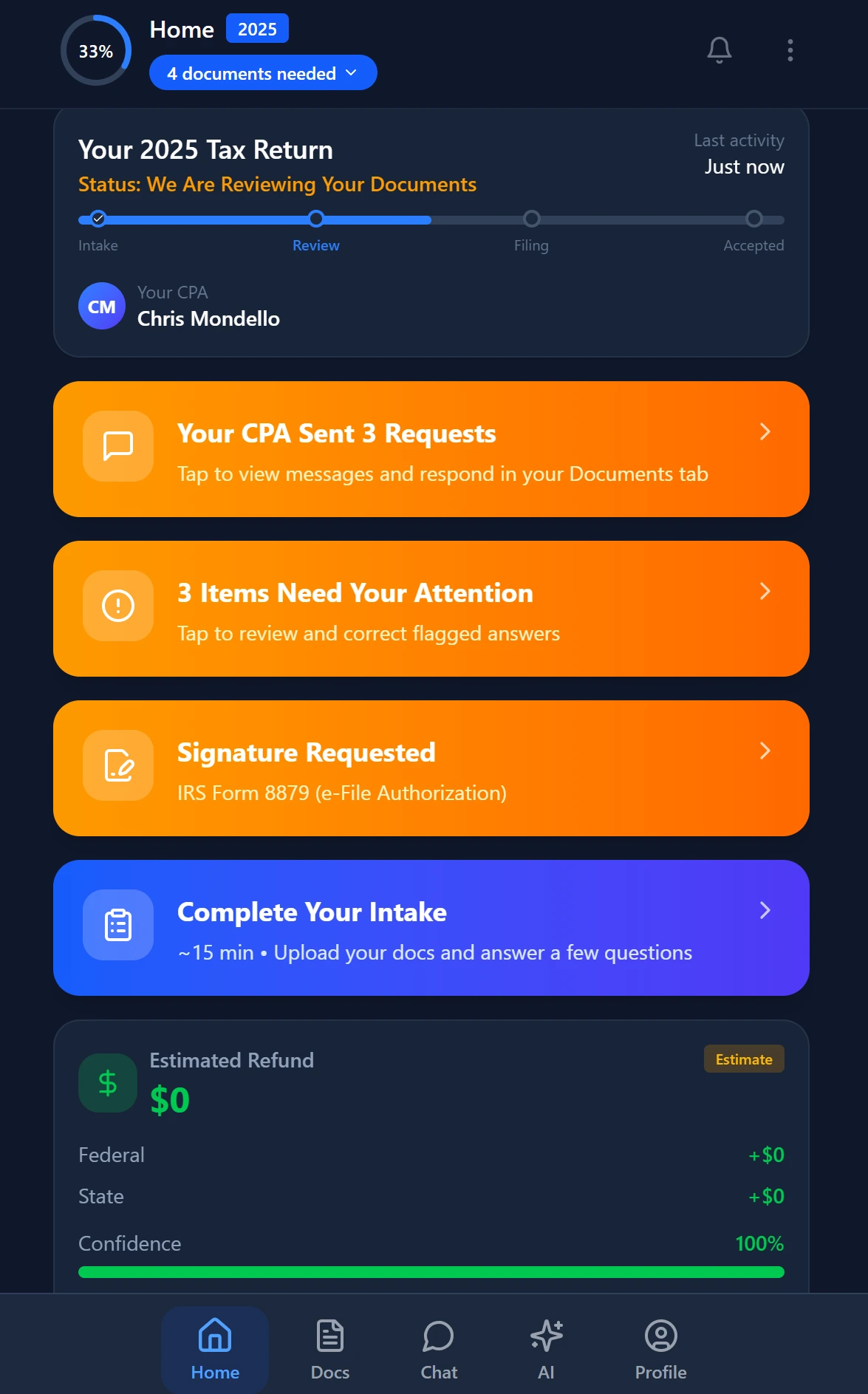
Smart intake auto-fills from uploaded documents and prior-year data
Calculating Boot and Its Tax Consequences on Form 8824
Boot is any non-like-kind property received in an exchange — most commonly cash (mortgage boot or equity boot) but also personal property, net debt relief, or unlike-real-property assets. When a client receives boot, that portion of the gain is recognized immediately and taxable in the year of the exchange. The tax deferral is not total; it is deferred only on the portion of gain not covered by boot. Understanding boot in a like-kind exchange 1031 transaction is one of the most important technical competencies a CPA advising real estate clients must have.
Cash boot arises when the taxpayer receives cash from the exchange — typically when the replacement property costs less than the relinquished property's net sale price. If the relinquished property sells for $1,200,000 and the replacement property costs $1,000,000, the $200,000 difference is cash boot, recognized as taxable gain (up to the total realized gain).
Mortgage boot (also called debt relief boot) arises when the mortgage on the relinquished property exceeds the mortgage on the replacement property. If your client had a $500,000 mortgage on the relinquished property and takes on only a $300,000 mortgage on the replacement, the $200,000 of net debt relief is treated as boot received. You can offset mortgage boot with additional cash invested, but you cannot offset cash boot with additional mortgage — the calculation is directional.
Form 8824 is the return you file to report the exchange. It requires the realized gain, the boot received, the recognized gain, and the cost basis of the replacement property (which is the FMV of the replacement minus the deferred gain, plus any boot paid). The IRS Form 8824 instructions walk through the calculation, but the practical challenge is assembling the correct settlement statement figures from both the relinquished and replacement closings, the QI records, and any additional cash contributions. AI document extraction can accelerate the intake of HUD-1 or ALTA settlement statements, identifying the relevant line items for boot calculation rather than requiring manual re-keying.
One planning note: if a client intends to take some cash out of the transaction, it is better to plan for that intentionally before the exchange closes rather than discover boot retroactively at tax time. Your engagement should include a pre-closing boot projection so the client understands what they will owe before they commit to a replacement property price.
Depreciation Recapture and Boot Interaction
Boot recognized in a like-kind exchange 1031 is subject to capital gains tax, but if the relinquished property included depreciable improvements, depreciation recapture under Section 1250 is recognized first — before any Section 1231 or long-term capital gain. This means even a relatively small amount of boot can trigger a meaningful ordinary income tax hit if the property had significant accumulated depreciation. CPAs preparing the return should always compute recapture exposure before finalizing the exchange structure. The deferred gain also carries the accumulated depreciation into the replacement property's basis, which affects future depreciation deductions and the eventual gain on sale.
Reverse and Improvement 1031 Exchange Mechanics for CPAs
A standard forward exchange requires the relinquished property to close before the replacement property is acquired. But clients often find their ideal replacement property first — and in a competitive real estate market, waiting to close the relinquished property before purchasing the replacement is not always practical. The reverse exchange structure, authorized under IRS Revenue Procedure 2000-37, addresses this problem by having an Exchange Accommodation Titleholder (EAT) — a special-purpose entity — hold legal title to either the replacement or relinquished property while the exchange is being arranged.
In a reverse exchange, the EAT acquires the replacement property using funds the client provides (since the client cannot hold title). The client then has 45 days to identify which property will be relinquished and 180 days to complete the like-kind exchange 1031. The EAT holds title during this period and transfers it to the client at closing. These structures are more expensive and legally complex than forward exchanges — they require the client to fund the replacement property acquisition out of pocket temporarily, and the EAT arrangement carries additional legal fees. As the CPA, your role is to confirm the QI and EAT are properly structured, that the timeline is feasible, and that Form 8824 is prepared correctly once the exchange is complete.
An improvement exchange (also called a construction or build-to-suit exchange) allows the client to use exchange proceeds to improve the replacement property before it is transferred out of the EAT. The improvements must be completed and the improved property transferred to the taxpayer within the 180-day exchange period. The FMV of the property received — including improvements — must equal or exceed the FMV of the relinquished property to achieve full deferral. Any shortfall is boot. The coordination between the EAT, contractor, and closing timeline is operationally intensive, and CPAs should document every communication and payment in writing throughout the improvement period.
For both reverse and improvement exchanges, client communication logging inside your practice management platform is not optional — it is your liability protection. Every instruction to the QI, every timeline update to the client, and every document received from the EAT should be recorded and timestamped in the client file. If the exchange is ever challenged by the IRS, that documentation trail is your defense.

Every client gets organized documents, status tracking, and a complete history
The Qualified Intermediary Role and What CPAs Must Watch For
A qualified intermediary (QI) is a mandatory party in any like-kind exchange 1031 — the taxpayer cannot receive the sale proceeds directly without disqualifying the exchange. The QI holds the exchange funds between the relinquished and replacement property closings and facilitates the transfer. Under Treasury Regulation 1.1031(k)-1-1), the QI must not be a disqualified person — meaning the taxpayer's attorney, accountant, investment broker, or any agent within the prior two years cannot serve as QI. This creates a specific rule: if your CPA firm provided services to the client within the prior two years, you cannot serve as the QI for this exchange. You must remain in an advisory role only.
As the CPA, your QI-adjacent responsibilities include: verifying that the QI has bonded and insured funds (QI insolvency has resulted in exchange fund losses — notably the Derivium Capital collapse in the 2000s), reviewing the exchange agreement before it is signed to confirm the identification and closing deadline language is correct, confirming that exchange funds are held in a segregated account and not commingled with the QI's operating funds, and reconciling the QI's closing statement with the settlement statements from both closings when you prepare Form 8824.
The IRS has proposed (but not yet finalized) federal licensing requirements for QIs. Until those are in place, QI quality varies significantly. Recommend QIs with demonstrated real estate exchange experience and verifiable bonding. Document your recommendation in the client file, including any disclosures about limitations on your role. See other blog resources in our advisory services category for additional guidance on structuring complex real estate engagements.

Your clients see your brand — OTP login, document upload, and real-time status
CPA Workflow: Forward Exchange vs. Reverse Exchange vs. Improvement Exchange
| Feature | Forward Exchange | Reverse Exchange | Improvement Exchange |
|---|---|---|---|
| Order of events | Relinquished closes first | Replacement acquired first via EAT | Replacement acquired and improved via EAT |
| EAT required | No | Yes | Yes |
| 45-day ID deadline | From relinquished close | From EAT acquisition | From EAT acquisition |
| 180-day close deadline | From relinquished close | From EAT acquisition | Improvements must complete within 180 days |
| Boot risk | Equity and debt differential | Cash advanced to EAT | Improvement cost shortfall vs. relinquished FMV |
| Form 8824 complexity | Moderate | High | High |
| Client cash requirement | Low (QI holds funds) | High (funds replacement acquisition) | High (funds acquisition plus construction) |
How Practice Management Software Tracks 1031 Exchange Deadlines
The operational risk in a like-kind exchange 1031 engagement is concentrated in two places: deadline tracking and document completeness. Both are addressable with the right practice management infrastructure. A CPA firm handling even a handful of 1031 exchanges per year needs a repeatable system — not a shared spreadsheet with manual date entries.
TaxScout's pipeline management module supports 12 customizable stages with drag-and-drop kanban workflow. For 1031 exchanges, you can configure a dedicated pipeline that includes stages for: relinquished property closing confirmation (triggers the 45/180-day countdown), QI agreement review, 45-day identification submission, replacement property due diligence, 180-day close confirmation, and Form 8824 preparation. Each stage can carry automated task reminders so the responsible staff member receives an alert at 30 days, 10 days, and 3 days before each deadline. No mental calendar required.
On the document side, the client portal provides a branded, OTP-secured interface where clients upload settlement statements, QI closing confirmations, property identification letters, and replacement property purchase agreements. The AI document extraction engine processes 180+ form types including settlement statements, automatically pulling relevant figures into the client record. Combined with AI document extraction for CPAs workflows, this reduces the manual data entry burden on your team significantly.
For client communications — including instructions to the QI, identification letters, and closing confirmations — the communication hub logs all email correspondence automatically via Gmail OAuth or Outlook Graph integration, creating a timestamped audit trail inside the client file. This is exactly the documentation you need if the IRS ever audits the exchange or questions the timeline. You can also see how IRS Deadlines 2026 fit into your broader deadline tracking strategy across the firm's full calendar.
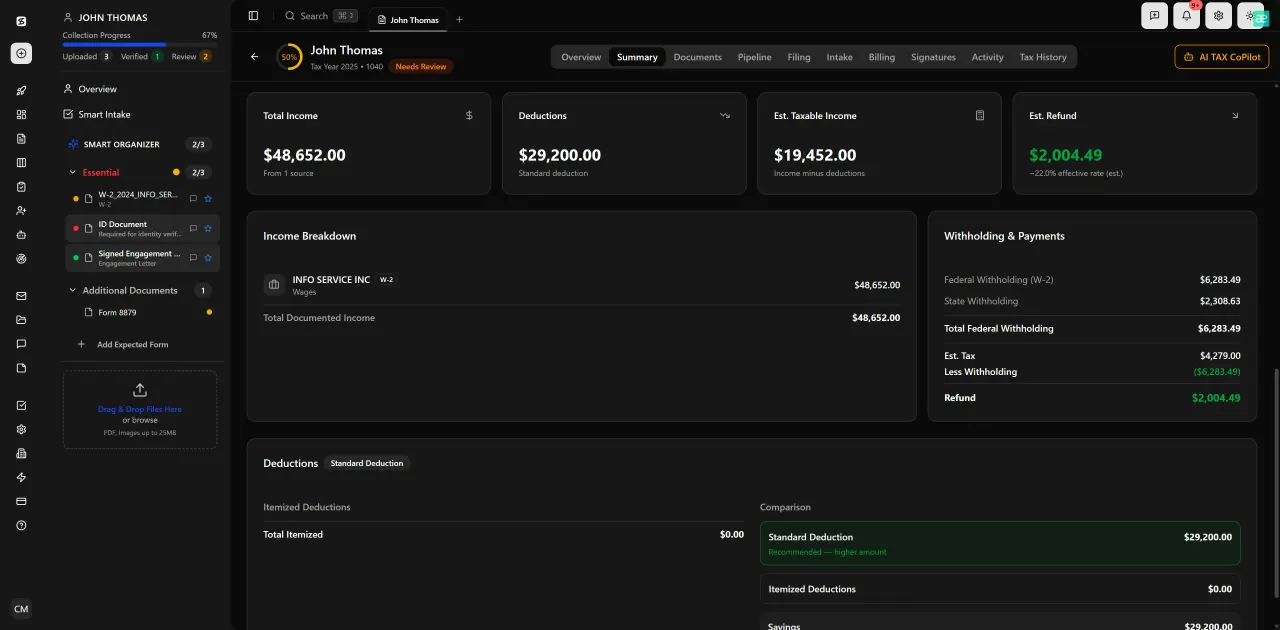
Review with AI assist — 9 agents answer questions with full client context
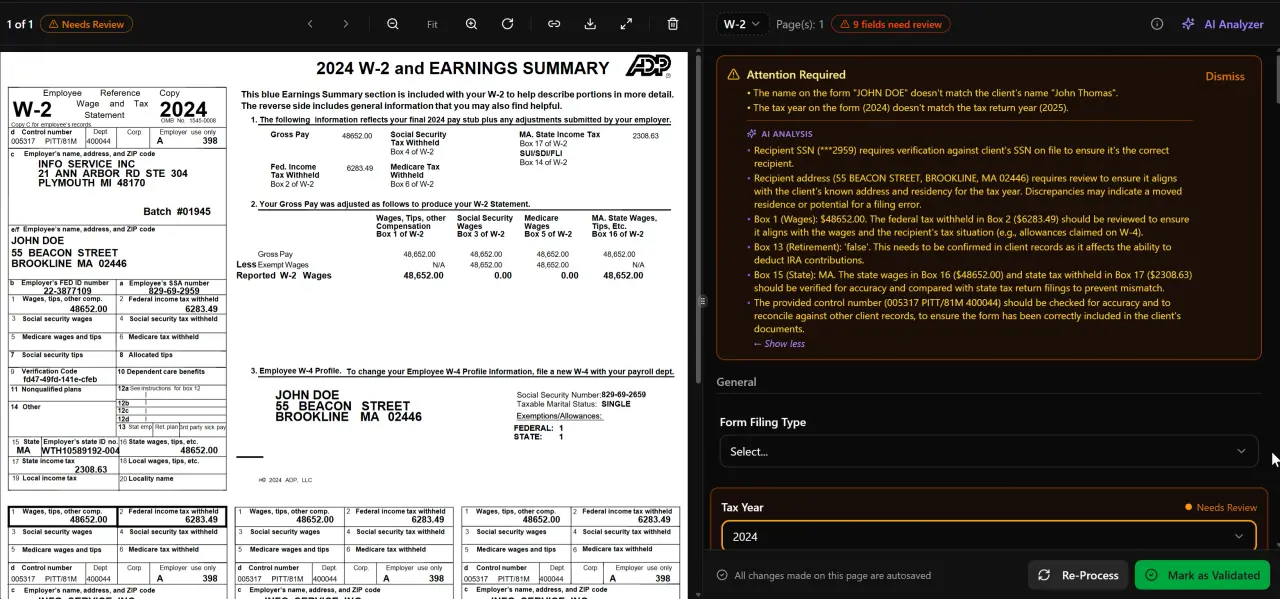
AI classifies, extracts, and validates every document automatically
Preparing Form 8824 and Completing the 1031 Exchange Return
Form 8824 is filed with the federal return for the year in which the relinquished property was transferred. If the exchange is not complete by the filing deadline (including extension), the Form 8824 instructions allow the taxpayer to report the exchange as open if the 180-day period has not yet expired — but you must still file on time. Once the exchange is complete in a subsequent year, you may need to amend or file a second Form 8824.
The form itself has four parts: Part I covers the like-kind exchange details (description of properties, dates, QI information); Part II covers multi-asset exchanges (rarely applicable for straightforward real estate swaps); Part III calculates the realized and recognized gain and the basis of the replacement property; and Part IV applies only to related-party exchanges. For related-party exchanges — where the client buys the replacement property from or sells the relinquished property to a related party — the two-year holding rule applies, and both parties must file Form 8824 for two years following the exchange.
The cost basis of the replacement property is a critical calculation that carries forward permanently. It is computed as the FMV of the replacement property minus the deferred gain, adjusted for boot paid and transaction costs. Getting this number right at the time of the like-kind exchange 1031 prevents incorrect depreciation schedules and incorrect gain calculations when the property is eventually sold. Many CPAs document the basis calculation in a permanent workpaper that travels with the client file — a practice worth building into your document management system so it is retrievable years later.
TaxScout works alongside Drake, CCH Axcess, UltraTax CS, Lacerte, ProConnect, and ProSeries — meaning you prepare Form 8824 in your existing tax software while using TaxScout for document collection, deadline tracking, and client communication. The platforms are complementary, not duplicative. See our post on Drake Tax Software Integration: How TaxScout Works for the technical details on how the workflow connects.
Building a 1031 Exchange Service as a CPA Advisory Offering
For CPA firms with real estate clients, 1031 exchange advisory is a natural expansion of the tax return preparation relationship — and a meaningful revenue opportunity. Clients who own investment property and are approaching a sale need a trusted advisor who understands the rules, can model the gain-deferral scenario versus an outright sale, and can coordinate the entire transaction workflow. That is a much higher-value engagement than simply preparing Form 8824 after the fact.
Structuring the engagement correctly matters. Your engagement letter for a like-kind exchange 1031 should clearly define your scope: tax advice and return preparation, not QI services. It should disclose the disqualified-person rule so there is no ambiguity about your role. It should specify that you are not responsible for QI selection or the security of QI-held funds. TaxScout's e-signatures via Documenso allow you to send and collect signed engagement letters digitally — including Form 8879 for the year-end return — without paper or separate signature platforms.
From a pricing perspective, flat-fee billing works well for 1031 exchange engagements because the workflow is predictable once you have done a few. You know the documents you need, the milestones to hit, and the Form 8824 preparation time. See our guide on Flat Fee Billing for CPAs: Ditch Hourly and Earn More for a framework you can adapt to exchange engagements. At TaxScout's Prep Pro tier at $149/month with unlimited clients and no per-user fees, the platform economics make it easy to absorb 1031 exchange clients without per-client cost spikes that squeeze advisory margins.
The real estate tax deferral strategy conversation also opens doors to related advisory work: cost segregation on the replacement property (see our guide on Cost Segregation Studies: How CPAs Unlock Hidden Depreciation), opportunity zone investing for any boot recognized, and estate planning for property that may ultimately be stepped up in basis at death rather than sold. Real estate clients who trust you to navigate a like-kind exchange 1031 correctly are among the most loyal and highest-value clients a firm can have.
Managing 1031 exchange deadlines, document collection, and client communications across multiple tools?
TaxScout consolidates your 1031 workflow — pipeline tracking, client portal, AI document extraction, and communication logs — in one platform built for CPA firms.
Frequently Asked Questions
The two deadlines are both counted in calendar days from the close of the relinquished property. The taxpayer must identify potential replacement properties in writing to the qualified intermediary within 45 days, and must close on the replacement property within 180 days (or by the federal return due date including extension, if earlier). Both deadlines are statutory — they cannot be extended except in a Presidentially declared major disaster.
Keep reading
Agency Information Collection Activities Requesting Comment
Oct 26, 2026 · 1 min read
Section 1244 Stock Loss: How CPAs Turn Failed Startup Investments Into Ordinary Deductions
Oct 26, 2026 · 1 min read
Divorce Tax Planning for CPAs: How to Split Assets Without Triggering Unexpected Liability
Oct 25, 2026 · 1 min read
Stay up to date
Get the latest tax tech insights delivered to your inbox.