Retirement Plan Options for Self-Employed CPAs: SEP-IRA vs Solo 401k
Most retirement planning content for CPAs focuses on advising clients — not on the CPA as a business owner with variable income and no employer match. This guide breaks down SEP-IRA vs Solo 401k vs SIMPLE IRA contribution limits, tax deduction mechanics, and how solo and small-firm owners can…
The irony is not lost on anyone in the profession: CPAs spend the bulk of tax season optimizing retirement contributions for clients — maxing out Solo 401(k)s, timing SEP-IRA deposits, modeling defined benefit plan deductions — while their own retirement accounts sit underfunded or, in some cases, unopened. The retirement plan self-employed CPA needs for their own financial security is almost never the topic of a webinar or a conference breakout session.
Solo practitioners and small-firm owners face a genuinely different set of constraints than their W-2 clients. Income is lumpy, quarterly estimated taxes compete with contribution dollars, and there is no HR department setting up automatic enrollment. The decision between a SEP-IRA, a Solo 401(k), and a SIMPLE IRA is not just a math problem — it is a cash-flow management problem that has to be solved inside the context of running a firm. Choosing the right retirement plan self-employed CPA owners can actually use requires accounting for that income variability from the very start.
This guide is written specifically for CPAs as business owners: the tax deduction mechanics for each plan type, side-by-side contribution limits under current IRS rules, a realistic look at how variable income affects strategy, and — critically — how to build the administrative discipline to actually fund the account each year rather than scrambling in March. Understanding every retirement plan self-employed CPA practitioners have available is the foundation for making a truly informed comparison.
Why Self-Employed CPAs Underinvest in Their Own Retirement
Survey data from the Bureau of Labor Statistics consistently shows that self-employed workers participate in retirement plans at roughly half the rate of private-sector employees with access to employer-sponsored plans. For CPAs who understand the tax advantages intellectually, the gap is more about execution than knowledge. For firms evaluating their retirement plan self-employed CPA approach, this trade-off compounds over time.
Three friction points dominate. First, estimated quarterly tax payments — due in April, June, September, and January — consume cash exactly when a contribution decision should be made. Second, the self-employed CPA's self-employment tax burden (15.3% on the first $168,600 of net earnings for 2024) already feels punishing, making an additional outflow psychologically difficult even when the math is favorable. Third, plan setup requires a deliberate administrative act that simply does not happen during a 70-hour tax season. Each of these factors directly shapes how retirement plan self-employed CPA plays out in practice.
The result: retirement savings get treated as a residual — whatever is left after taxes, payroll, and operating expenses — rather than a first-line deduction. That is precisely backwards, because the contribution itself reduces taxable income and lowers the estimated tax obligation. Funding the plan first and adjusting estimated payments accordingly is the correct sequence, and it requires planning that most CPAs apply only to their clients. Understanding retirement plan self-employed CPA in this context is what separates firms that scale from those that stall.
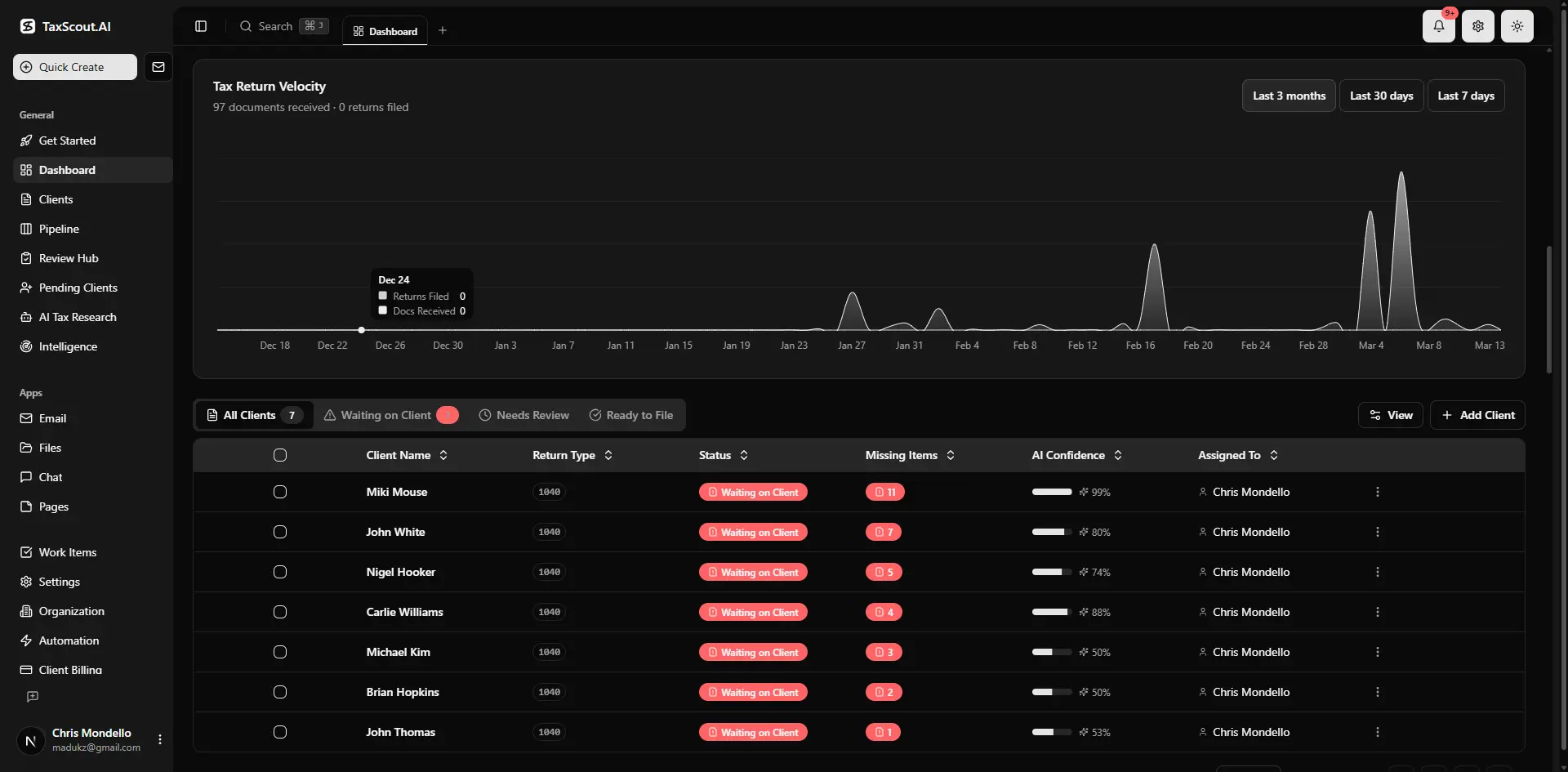
Real-time dashboard showing returns in progress, revenue, and upcoming deadlines
SEP-IRA for CPA Firm Owners: Contribution Limits and Mechanics
The Simplified Employee Pension IRA is the most commonly used retirement vehicle among self-employed accountants, largely because of its simplicity. There is no annual IRS filing requirement, setup can happen as late as the extended due date of the return, and contributions are discretionary year to year — a meaningful advantage when income is volatile. This is precisely where a deliberate retirement plan self-employed CPA strategy pays off.
For 2024, a self-employed CPA can contribute up to 25% of net self-employment income (after deducting half of self-employment tax), capped at $69,000. On $200,000 of net Schedule C profit, the adjusted net earnings for SEP purposes are approximately $185,678, making the maximum contribution roughly $46,419. The full amount is deductible on Schedule 1 as an adjustment to adjusted gross income, not on Schedule C itself — an important distinction for qualified business income deduction calculations. Retirement plan self-employed CPA sits at the center of this decision — get it wrong and the rest unravels.
The SEP-IRA's weakness for higher-earning solos is that it only allows traditional (pre-tax) contributions. There is no Roth option, no catch-up contribution for participants over 50, and — critically — if you have even one employee, you must contribute the same percentage of compensation for them that you contribute for yourself. A solo CPA with a W-2 staff member faces a meaningful cost multiplier that can make the SEP-IRA prohibitively expensive compared to alternatives. The IRS SEP-IRA overview provides the full eligibility and contribution rules. When firms revisit their retirement plan self-employed CPA priorities, the gaps usually surface here.

Click any extracted field to see its source highlighted on the original PDF
Solo 401k for Self-Employed CPAs: Higher Limits and Roth Access
The Individual 401(k) — commonly called the Solo 401(k) or one-participant 401(k) — is almost always the superior vehicle for a CPA who has no full-time W-2 employees other than a spouse. The contribution math works in two layers: an employee elective deferral of up to $23,000 in 2024 (plus $7,500 catch-up if age 50 or older), and a profit-sharing employer contribution of up to 25% of W-2 compensation or 20% of net self-employment earnings. Combined, the total cannot exceed $69,000 (or $76,500 with catch-up). Selecting the right retirement plan self-employed CPA owners can sustain through lean years is just as important as maximizing the contribution ceiling.
The practical advantage over the SEP-IRA becomes clear at lower income levels. A CPA with $100,000 of net self-employment earnings can contribute only about $18,587 to a SEP-IRA (25% of adjusted earnings). The same CPA with a Solo 401(k) can contribute the full $23,000 employee deferral plus a profit-sharing amount of roughly $18,587, for a total approaching $41,587 — more than double the SEP limit at the same income. This gap narrows as income rises toward the compensation cap.
Many Solo 401(k) plan documents now support a Roth elective deferral option. For a CPA whose income exceeds the Roth IRA phase-out thresholds ($161,000 single / $240,000 MFJ in 2024), the Solo 401(k) Roth bucket is often the only accessible Roth savings vehicle. The SECURE 2.0 Act also added Roth catch-up contribution requirements for high earners starting in 2026 — changes detailed on the IRS SECURE 2.0 Act summary page that any retirement plan self-employed CPA owner should model now.
The administrative cost of a Solo 401(k) is the annual Form 5500-EZ filing once plan assets exceed $250,000 — a trivial burden for any CPA but worth noting. Plans must also be established (though not necessarily funded) by December 31 of the tax year, unlike the SEP-IRA's extended deadline.
Spending tax season optimizing clients' retirement accounts while yours goes unfunded?
TaxScout.ai helps CPA firm owners get visibility into firm cash flow, automate invoicing, and free up the bandwidth to plan their own finances. See the platform built for solo and small-firm CPAs.
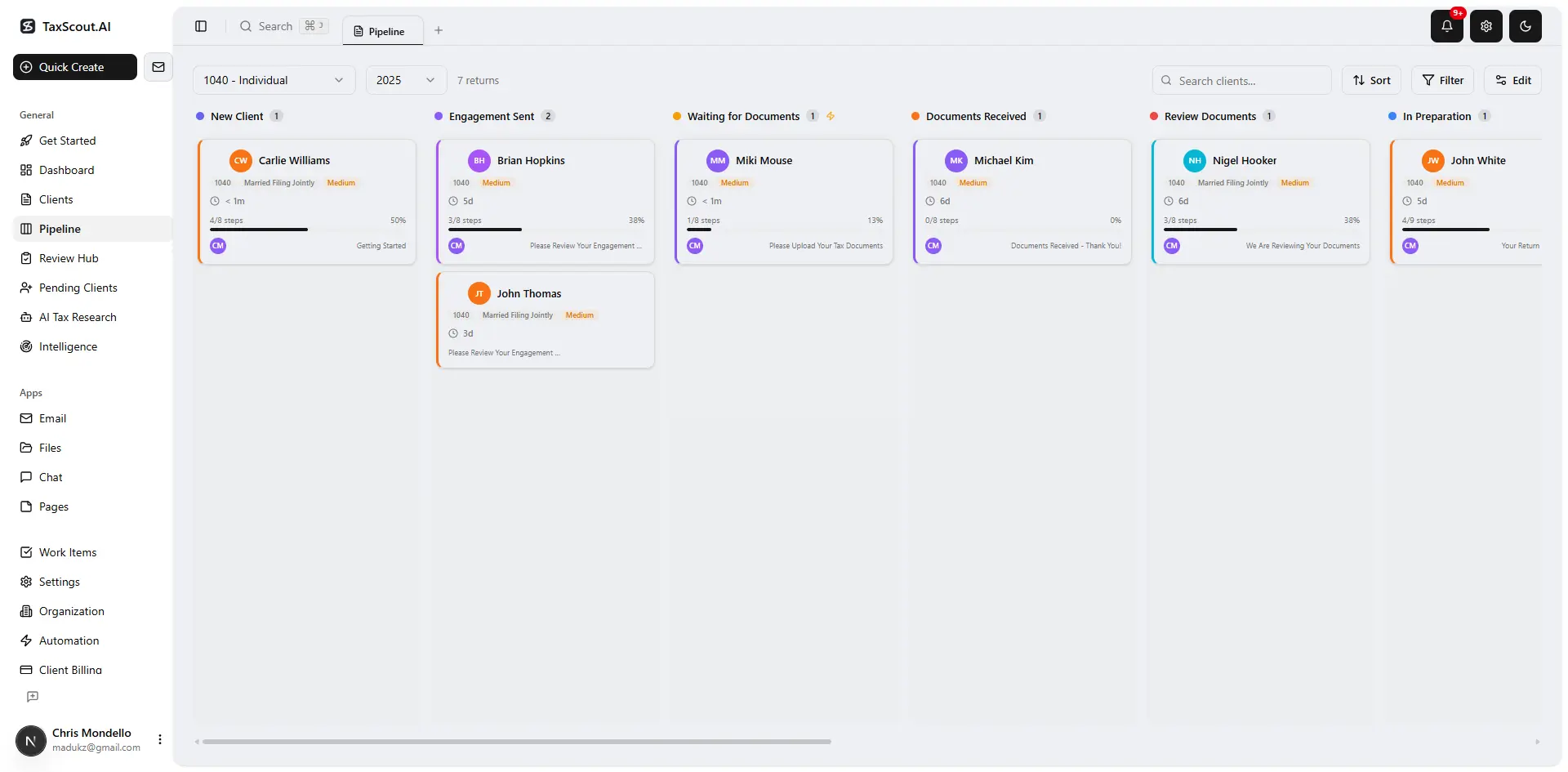
Track every return from intake to filed with drag-and-drop pipeline management
SIMPLE IRA and Defined Benefit Plans: When They Apply
The SIMPLE IRA occupies a niche: it works best for CPA firms with 2-10 employees where the owner wants to offer a plan without the complexity of a full 401(k). Employee deferrals are capped at $16,000 in 2024 ($19,500 with catch-up at 50+), and the employer must make either a 2% non-elective contribution for all eligible employees or a matching contribution of up to 3%. The mandatory employer contribution is the trade-off for the simpler administration — which makes the SIMPLE IRA rarely optimal for a solo CPA owner.
At the opposite end of the spectrum, a defined benefit plan (cash balance or traditional pension) allows some high-earning solo CPAs to shelter $200,000 or more per year — far exceeding defined contribution limits. The deductible contribution is actuarially determined based on age, income, and the benefit target. A CPA in their late 50s with consistent high earnings can use a DB plan (sometimes layered over a Solo 401(k)) to dramatically compress taxable income in the final decade before retirement. The trade-off is mandatory minimum contributions regardless of a bad revenue year, which is a real risk in a service business with lumpy income. Evaluating this option as part of a broader retirement plan self-employed CPA framework is especially important before committing to the actuarial minimums.
For a comprehensive look at how these decisions interact with your firm's pass-through entity structure and the QBI deduction, the Cornell Law School overview of qualified plan types provides a solid legal framework that complements IRS guidance.
Retirement Plan Comparison for Self-Employed CPA Firm Owners (2024)
| Feature | SEP-IRA | Solo 401(k) | SIMPLE IRA | Defined Benefit |
|---|---|---|---|---|
| 2024 Max Contribution | $69,000 | $69,000 ($76,500 w/ catch-up) | $16,000 ($19,500 w/ catch-up) | $200,000+ (actuarial) |
| Catch-Up (Age 50+) | None | $7,500 | $3,500 | Varies |
| Roth Option | No | Yes (elective deferrals) | No | No |
| Employees Allowed | Yes (expensive) | Spouse only | Up to 100 | Yes |
| Setup Deadline | Tax return due date (extended) | December 31 | October 1 | December 31 |
| Annual IRS Filing | None | Form 5500-EZ (>$250K) | None | Form 5500 required |
| Best For | Simplicity, late filers | Solo/high earners, Roth access | Small teams | High earners 50+ |

Every client gets organized documents, status tracking, and a complete history
Contribution Timing and CPA Firm Cash Flow
The single most effective change a self-employed CPA can make is to treat retirement contributions as a recurring firm expense — not a year-end tax maneuver. This requires aligning contribution timing with the firm's actual cash flow cycle, which for most tax practices peaks sharply in February through April and again in September through October.
A practical approach: make a partial Solo 401(k) employee deferral in Q2 (post-tax-season flush) and Q4 (post-extension-season flush), then finalize the employer profit-sharing contribution in Q1 of the following year once net income is known. This spreads the cash impact and avoids the March scramble. Coordinate this calendar with your estimated tax payments schedule — the contribution reduces adjusted gross income, which directly reduces the safe harbor calculation for subsequent quarterly payments.
Automating your firm's invoicing and collection cycle is a prerequisite for this kind of planning. When client billing is inconsistent and receivables are unpredictable, contribution timing decisions become guesswork. Platforms like TaxScout.ai include automated recurring invoicing and pipeline management that give firm owners real visibility into expected cash inflows — making it far easier to commit to a contribution schedule rather than waiting to see what is left at year-end. For a detailed walkthrough of automating firm billing, see our guide on recurring invoicing for accounting firms.
Firms that have moved to a more systematic approach to their own finances often describe the same inflection point: the year they treated their own retirement plan self-employed CPA contribution like a client deliverable with a deadline, rather than a personal finance afterthought.

Track firm performance with real-time analytics and client activity monitoring
Tax Deduction Mechanics Every Sole Practitioner Should Model
Self-employed retirement contributions reduce income at the adjusted gross income level, which has compounding effects that most CPAs are aware of theoretically but rarely model for themselves. A $46,000 SEP-IRA contribution for a CPA in the 32% federal bracket generates roughly $14,720 in federal tax savings alone — before state income tax. In a state like California (13.3% top marginal rate), the combined benefit can approach $20,000 on a single contribution.
The interaction with the QBI deduction is more nuanced. For a sole proprietor, the QBI deduction is 20% of qualified business income, which is net profit before the retirement contribution deduction. However, the contribution itself reduces W-2 income considerations for S-corp structures and does not reduce QBI directly for Schedule C filers. For a CPA operating as a sole proprietor, the retirement contribution deduction and the QBI deduction are largely independent — both stack against ordinary income. For S-corporation election structures, the interplay is different and worth modeling separately as part of a complete retirement plan self-employed CPA analysis.
One frequently overlooked detail: the employer portion of the Solo 401(k) profit-sharing contribution is deducted on Schedule C (line 19, pension and profit-sharing plans), while the employee elective deferral reduces W-2 wages if the CPA pays themselves through payroll. This distinction matters both for accurate reporting and for ensuring the deduction lands in the right place on the return. The IRS Publication 560 covers these mechanics in detail and is worth reviewing alongside your own return preparation.
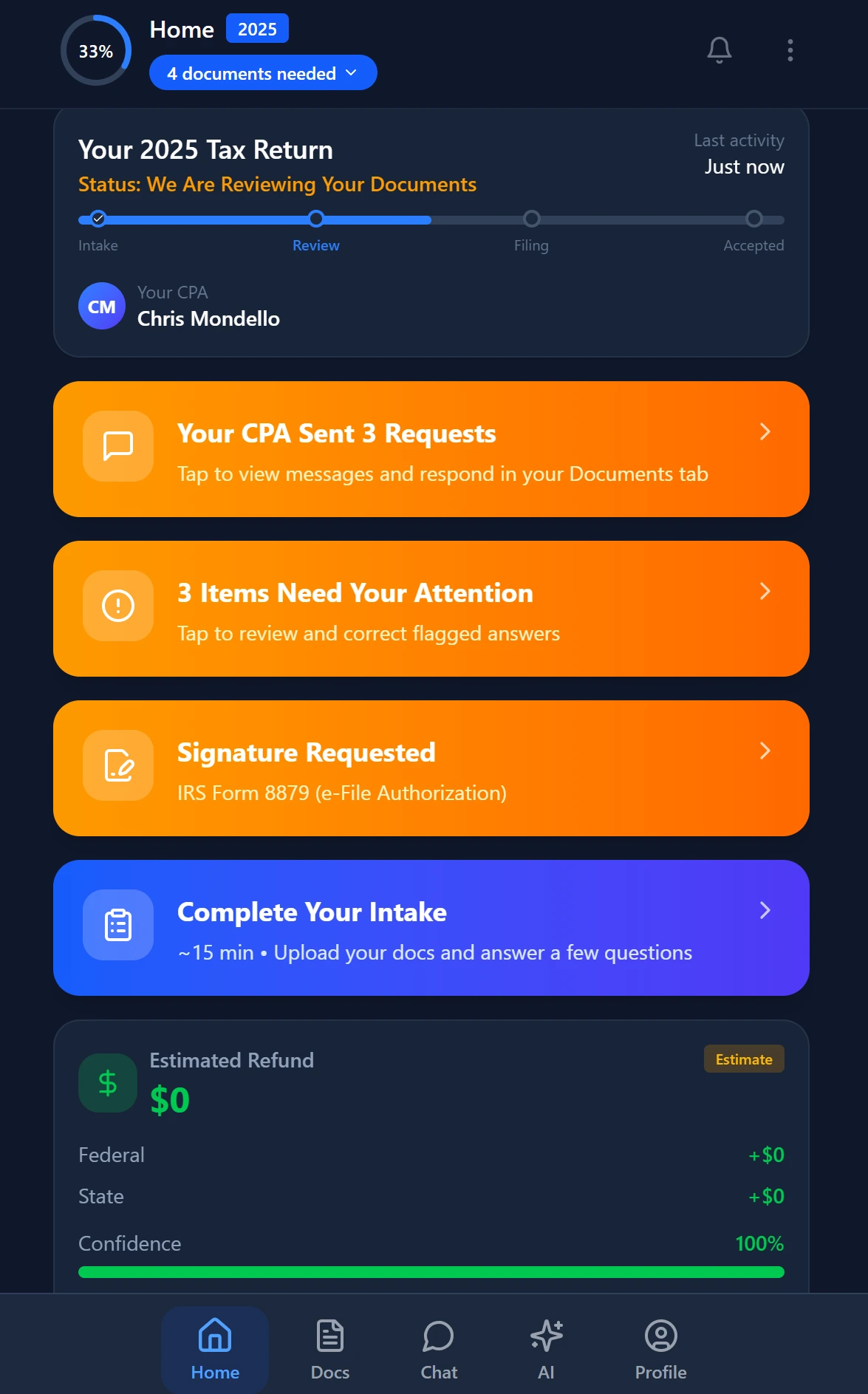
Smart intake auto-fills from uploaded documents and prior-year data
Scaling From Solo to Small Firm: How Plan Choice Evolves
A retirement plan that works perfectly for a solo CPA can become a liability the moment a full-time employee is hired. The SEP-IRA's mandatory equal-percentage contribution rule is the most common surprise: a CPA contributing 25% of their own compensation must contribute 25% of each eligible employee's compensation as well. On a $60,000 administrative salary, that is $15,000 per employee per year — an immediate, significant cost that needs to factor into the hiring decision. Revisiting your retirement plan self-employed CPA structure before bringing on staff can prevent this from becoming an unwelcome surprise.
The transition path that most growing firms follow: start with a Solo 401(k) as a sole practitioner, switch to a Safe Harbor 401(k) when adding the first non-spouse employee (which satisfies nondiscrimination testing automatically), and consider layering a defined benefit plan if profitability and income stability justify the actuarial commitment. Each transition involves a plan termination, rollover, or conversion — all manageable but requiring advance planning and ideally handled before the hire date, not after.
For CPAs managing this growth transition, the operational complexity of the firm also scales. Managing a growing team's workflow, client pipeline, and billing in a single system reduces the administrative overhead that competes with owner-level financial planning. Resources like our guide on scaling from solo to multi-partner firm address the operational side of this transition in detail.
The Social Security Administration's self-employment earnings coverage is also worth revisiting as firms grow — Social Security benefits are tied to covered earnings, and the interaction between retirement plan contributions and self-employment earnings affects long-term Social Security income projections in ways that are easy to overlook during a high-growth phase.
Helping clients build wealth while your own retirement plan sits on the back burner?
TaxScout.ai gives CPA firm owners the practice management infrastructure to run a tighter, more predictable firm — so you can finally treat your own finances with the same rigor you apply to your clients. Flat pricing, no per-user fees, and built for the way tax firms actually work.
Frequently Asked Questions
A self-employed CPA using a Solo 401(k) can contribute up to $69,000 in 2024 — or $76,500 if age 50 or older — through a combination of employee elective deferrals ($23,000 plus $7,500 catch-up) and employer profit-sharing contributions (up to 20% of net self-employment earnings). A SEP-IRA caps at the same $69,000 ceiling but offers no catch-up contributions and generally reaches the limit only at higher income levels.
Keep reading
Backdoor Roth IRA: How CPAs Execute the Strategy Without Triggering Pro-Rata Tax
Oct 12, 2026 · 1 min read
Transparency in Coverage Final Rules: What CPA Firms Must Do Now
Oct 12, 2026 · 1 min read
Late Filing Penalty Relief: How CPAs Reduce or Eliminate IRS Failure-to-File Charges
Oct 12, 2026 · 1 min read
Stay up to date
Get the latest tax tech insights delivered to your inbox.