Amended Tax Return Workflow: How CPAs Fix Client Errors Without Chaos
Amended returns are a profit-draining blind spot for most CPA firms — handled reactively, scoped poorly, and almost never priced correctly. This guide maps a repeatable amended tax return workflow covering intake triage, QA delegation, IRS tracking, and billing so every 1040-X your firm processes…
Every CPA firm handles amended returns, but almost none have a documented amended tax return workflow. The call comes in — a client got a corrected K-1, a broker issued a revised 1099-B, or an overlooked deduction surfaced in December — and the firm scrambles. A staff accountant pulls the prior-year file, the partner reviews changes on a marked-up PDF, the client waits three weeks for an update, and the invoice never quite covers the time spent. Repeat this pattern a dozen times each spring and you've quietly handed back thousands of dollars in unrecovered fees.
The problem is structural, not seasonal. Amended returns don't fit neatly into the original-return production pipeline, so they fall between the cracks of practice management. Firms that do original-return workflow well still treat Form 1040-X — and amended business returns — as one-off exceptions rather than a repeatable service line. That creates capacity drag and billing ambiguity at exactly the moments when client trust is already strained. Building a dedicated amended tax return workflow is the structural fix that prevents these returns from becoming an afterthought.
This guide is a practice-management deep dive, not a tax-law primer. We'll cover how to triage amendment triggers, build a delegation-safe QA process, communicate with clients without scope creep, track submissions through the IRS Where's My Amended Return portal, and price the work so your firm earns a fair margin. We'll also show how AI-assisted tools inside TaxScout can automate the document collection and validation steps that eat most of the clock time in a typical amendment engagement. By the end, you'll have a repeatable amended tax return workflow you can implement across your entire team.
Why Amendment Engagements Break Standard Firm Workflows
Original-return workflows are optimized for volume and velocity. Documents arrive, AI extraction runs, a preparer builds the return, a reviewer signs off, e-signatures go out, and the file closes. Amendments break this model at every stage. The trigger is unpredictable, the scope is undefined at intake, the prior return is a fixed dependency that must be re-examined, and the billing conversation is awkward because clients often believe error correction is a warranty obligation rather than a new engagement. Understanding exactly where amendments diverge from original returns is the first step toward designing an amended tax return workflow that actually holds up under pressure.
The IRS reports processing times for amended returns can reach 16 weeks or longer, which extends the client relationship well beyond the original filing cycle. That long tail means your firm needs a communication cadence — not just a one-time submission. Without a structured amended tax return workflow that accounting firm staff can track, follow-ups fall on whoever last touched the file rather than whoever owns the client relationship. For firms evaluating their amended tax return workflow approach, this trade-off compounds over time.
There is also a delegation risk specific to amendments. Because the preparer must compare the original return line-by-line to the corrected figures, it is easy to introduce new errors in the amendment that were not present in the original. A staff-level preparer fixing a Schedule D adjustment may not notice a ripple effect on the QBI deduction, NIIT threshold, or state return. Quality-assurance checkpoints for amendments therefore need to be more stringent than those for original returns — not less. Each of these factors directly shapes how amended tax return workflow plays out in practice.
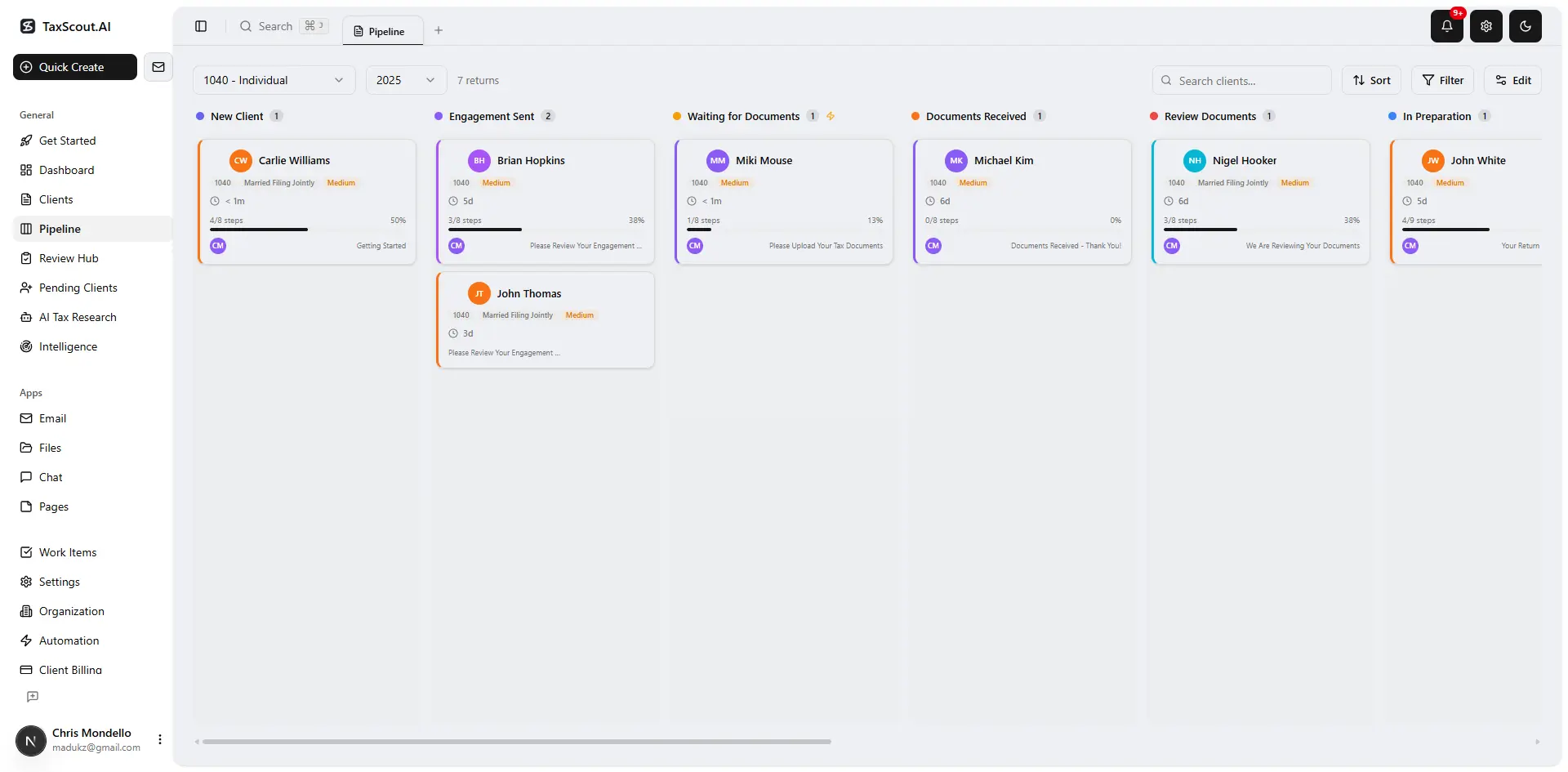
Track every return from intake to filed with drag-and-drop pipeline management
Step 1: Amendment Intake Triage — Scope Before You Start
The most expensive mistake in amendment work is beginning preparation before scoping. When a client emails a corrected 1099-R, the immediate instinct is to open the prior return and start adjusting. Resist this. Instead, route the request through a formal intake triage that answers four questions before any work begins: (1) What specifically changed? (2) What tax years are affected? (3) What is the materiality threshold — is it worth amending at all? (4) Who else might be impacted (spouse, business entity, state returns)? A well-documented amended tax return workflow makes answering these questions a routine step rather than a judgment call left to individual preparers. Understanding amended tax return workflow in this context is what separates firms that scale from those that stall.
TaxScout's AI intake engine, modeled on IRS Form 13614-C, can serve double-duty here. Build a short amendment-specific intake form in the client portal that captures the triggering document, the tax year in question, and any additional changes the client recalls. The AI gap analysis layer will flag missing information before the preparer ever opens a file — eliminating the back-and-forth that normally adds a week to amendment timelines. This is precisely where a deliberate amended tax return workflow strategy pays off.
Once intake is complete, create a dedicated pipeline stage for amendments in your practice management pipeline. TaxScout supports 12 customizable kanban stages, so you can create a parallel amendment lane — separate from original-return production — with stages like Triage, Scope Approved, In Preparation, QA Review, Client Approval, Filed, and Tracking. This separation prevents amendment files from aging invisibly inside a general "In Progress" column. Amended tax return workflow sits at the center of this decision — get it wrong and the rest unravels.
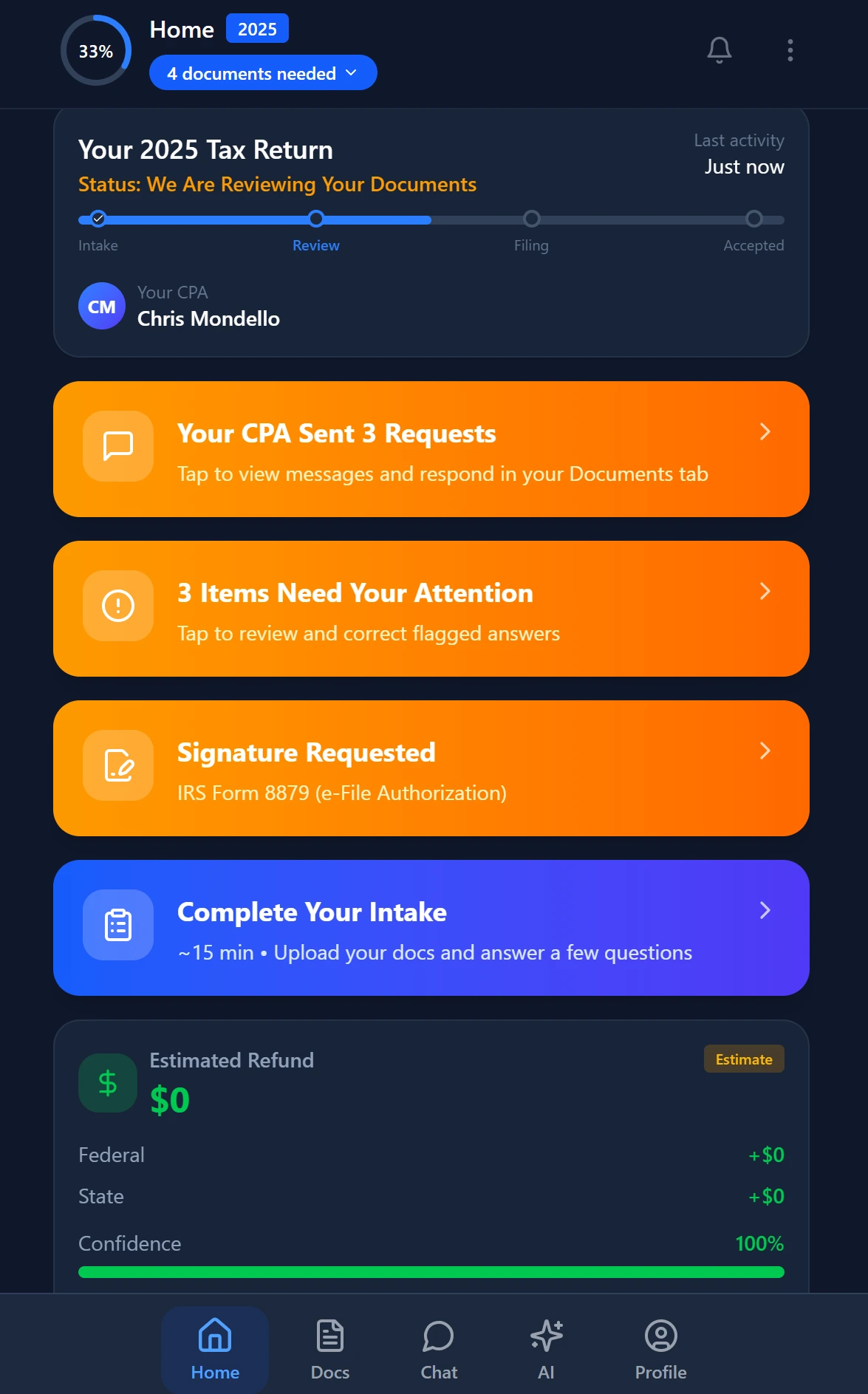
Smart intake auto-fills from uploaded documents and prior-year data
Step 2: Document Collection and AI-Assisted Comparison
Every amendment requires two sets of documents: the corrected source documents driving the change and the original return itself. Both need to be version-controlled. Use your firm's document management system to create a subfolder structure that distinguishes original-return documents from amendment-cycle documents — this matters if the IRS later requests a copy of what was filed. Firms that have formalized their amended tax return workflow typically build this folder convention into their engagement templates so no one has to make a judgment call mid-engagement. When firms revisit their amended tax return workflow priorities, the gaps usually surface here.
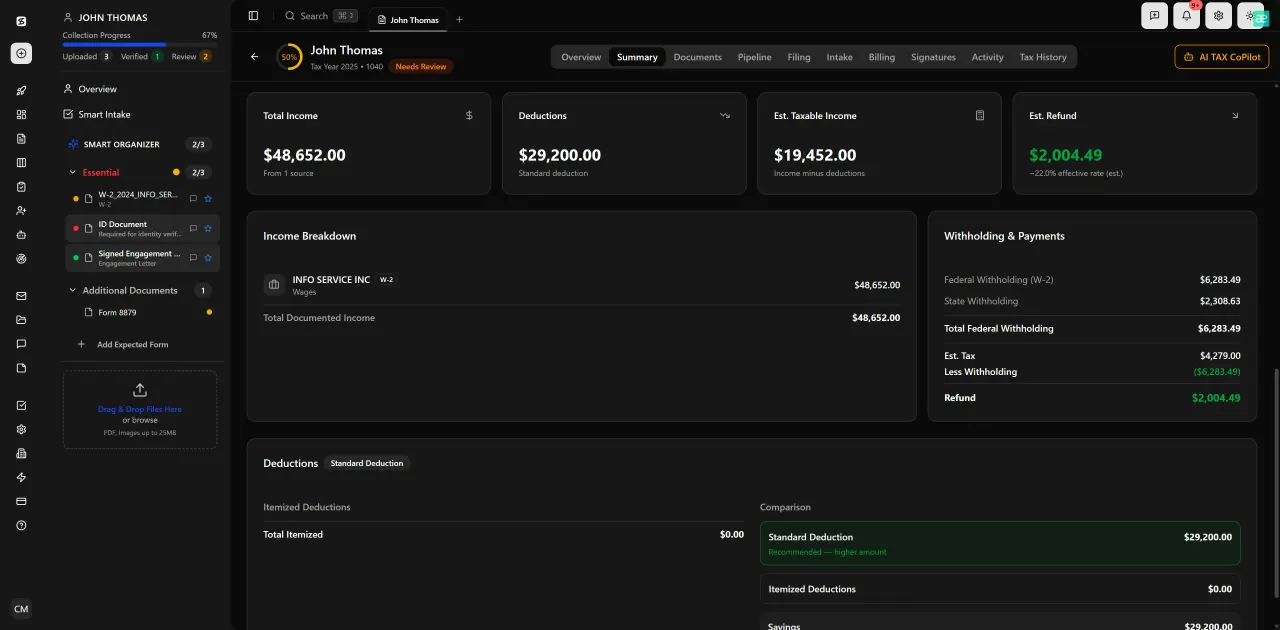
TaxScout's AI document extraction processes corrected W-2s, revised 1099 series, amended K-1s, and corrected 1098 forms through the same 5-layer validation pipeline used for original returns: document quality routing, AI extraction with confidence scoring, OCR cross-verification, 15 deterministic math rules, 18 post-extraction rules, and cross-document validation. That means a corrected 1099-B doesn't just get read — it gets cross-checked against prior extracted data for consistency, and the split-screen PDF viewer lets the reviewer click any field to see the exact source line in the document.
For a deeper look at how AI extraction reduces manual transcription errors across the full return cycle, see our guide to AI document extraction for CPAs. The same accuracy gains that matter for original returns matter more for amendments, where a transcription error on a corrected figure invalidates the entire amendment.
The IRS instructions for Form 1040-X require that column A reflect the originally reported figures, column B show the net change, and column C reflect the corrected amounts. AI extraction that pulls both the original and corrected document values into a structured comparison gives preparers a reliable starting point for populating columns A and B without manual re-entry.

Click any extracted field to see its source highlighted on the original PDF
Tired of amendments eating firm capacity because intake and document collection are still manual?
TaxScout automates document triage, AI extraction, and pipeline tracking so your amended return workflow runs like a production line, not a fire drill.
Step 3: QA Delegation for Amended Returns
Because amendments carry a higher error-propagation risk than original returns, the delegation model must reflect that risk. A practical rule: amendments should always be reviewed by a preparer one level senior to the one who made the changes. A staff accountant's correction gets reviewed by a senior; a senior's amendment gets partner review. This is not about distrust — it is about catching the ripple effects that the original preparer is too close to the changes to spot. Embedding this escalation standard into your amended tax return workflow ensures it happens consistently rather than only when a partner happens to notice.
Build a QA checklist specific to Form 1040-X that goes beyond the changed lines. Review items should include: Does the AGI change affect eligibility for any credit or deduction on other schedules? Does the change push the client above or below a threshold for NIIT, AMT, or the QBI deduction under Section 199A? Does the federal amendment trigger a state amended return? Are there estimated payment implications? Each yes creates a new line item in the scope — and potentially in the invoice.
TaxScout's pipeline management supports task assignment per stage, so you can assign the QA Review stage to a specific reviewer and set a due date. Combined with the team chat feature, reviewers can leave inline notes on the pipeline card without switching to email — keeping the amendment's audit trail inside the engagement record rather than scattered across inboxes. For broader ideas on keeping team delegation clean, see our post on AI accounting productivity.
Review with AI assist — 9 agents answer questions with full client context
Step 4: Client Communication Scripts for Amendment Engagements
Client communication during an amendment is high-stakes. Clients are already anxious — they've either made an error or received a corrected document that makes them feel exposed. Your communication needs to reassure without overpromising, set timeline expectations without quoting the IRS's worst-case processing window as a certainty, and introduce the billing conversation without triggering defensiveness.
A three-message script works well for most amendment engagements. Message one (sent within 24 hours of intake approval): confirm what the firm received, state the scope as you understand it, note that an engagement letter and fee estimate will follow. Message two (sent with the engagement letter): reiterate scope, attach the fee estimate, explain that the amendment will be filed electronically or by mail depending on the tax year, and set the expected timeline. Message three (sent at filing): confirm the filing date, provide the confirmation number or tracking reference, and explain how to use the IRS Where's My Amended Return tool — noting that updates typically appear within three weeks of filing and processing can take up to 16 weeks. Firms with a defined amended tax return workflow find that templating these three messages reduces the time staff spend drafting client updates from scratch on every engagement.
TaxScout's client portal supports OTP-authenticated document delivery, so you can send the engagement letter for e-signature and the fee invoice in a single portal notification rather than juggling email attachments. Clients respond faster when the action is one click in a branded portal than when they're hunting through email for a PDF. For compliance guidance on electronic engagement letters, see our post on e-signatures for accountants.

Your clients see your brand — OTP login, document upload, and real-time status
Step 5: IRS Tracking and State Return Coordination
After filing Form 1040-X, the amended return tracking obligation doesn't end — it shifts to a monitoring task. The IRS amended return tracking tool (Where's My Amended Return) accepts inputs after three weeks from the filing date and covers returns filed within the last three years. Paper-filed amendments — still required for certain prior-year returns — take longer to appear in the system.
Build an IRS tracking checkpoint into your pipeline at week four post-filing: a staff member checks the portal, updates the pipeline card with the current status (Received, Adjusted, or Completed), and triggers a client update message. This process looks simple but is routinely skipped, leading to clients calling the firm asking for status updates that the firm then has to research reactively. A proactive four-week check converts that reactive interruption into a scheduled five-minute task. When this checkpoint is built directly into your amended tax return workflow, it becomes a standard deliverable rather than an optional follow-up.
State amended returns are the most commonly overlooked component of the form 1040-X CPA workflow. Most states require a separate amended state return when the federal return changes, and many have their own forms rather than accepting a copy of the 1040-X. Your amendment scope checklist should include a state-return line item for every client with multi-state obligations. For firms with clients in high-complexity states, our post on state tax nexus for growing clients provides a useful framework for mapping which state filings a federal amendment triggers.
If a client's amendment involves a statute of limitations concern — for example, a carryback claim or a refund claim for a year approaching the three-year window — flag it at intake and escalate immediately. The IRS generally allows three years from the original filing date or two years from payment, whichever is later, to claim a refund through an amendment. Missing that window turns a recoverable situation into an unrecoverable one.

Every client gets organized documents, status tracking, and a complete history
How to Price and Scope Amendment Work
Amended return pricing CPA conversations fail when firms treat amendments as warranty repairs on the original return. They are not. An amendment is a separate engagement with its own intake, research, preparation, review, filing, and tracking components. The fact that the original return contained an error — whether caused by the firm, the client, or a third-party document issuer — does not obligate the firm to provide correction work at no charge, unless the engagement letter explicitly makes that commitment for firm-caused errors.
A tiered pricing model works well for amendments. A simple, single-document correction (one corrected 1099-DIV affecting one schedule) can be priced as a flat fee at the low end — many firms charge $150–$350 for this tier. A moderate amendment (corrected K-1 with Schedule E ripple, state return required) lands in a mid-tier flat fee. A complex amendment (multiple years, business entity impact, multi-state implications, potential underpayment penalty calculation) should be scoped by the hour or as a custom flat fee after a paid discovery call. Documenting these tiers as part of your amended tax return workflow gives staff a clear starting point for fee conversations rather than escalating every pricing question to a partner. For a broader framework on moving away from hourly billing across the firm, see our guide on flat fee billing for CPAs.
The engagement letter for an amendment should explicitly define: (1) the specific tax year and return type being amended, (2) the change(s) in scope, (3) whether state amended returns are included, (4) IRS tracking and follow-up communication (and whether that's included or billed separately), and (5) the trigger for out-of-scope billing if additional issues surface during preparation. Send this letter through TaxScout's e-signature workflow — Documenso-powered, supporting Form 8879 and engagement letters — before any preparation work begins.
One pricing insight that most firms underutilize: if the amendment results in a refund, consider a success fee component in addition to the base preparation fee. The IRS allows preparers to charge a fee for amended return preparation, but explicitly prohibits contingent fees based solely on the refund amount for original returns. Amended return contingency arrangements have different rules under Treasury Circular 230 — review those rules before structuring any success-fee arrangement. For additional reading on pricing models across service lines, see other blog resources on the TaxScout resource hub.
Amendment Workflow: Ad Hoc vs. Structured Process
| Workflow Component | Ad Hoc Approach | Structured TaxScout Workflow |
|---|---|---|
| Intake triage | Email or phone call, no standard questions | Client portal intake form with AI gap analysis |
| Document collection | Email attachments, manual re-entry | AI extraction with 5-layer validation and confidence scoring |
| QA delegation | Same preparer reviews own work | Pipeline stage assigned to senior reviewer with task due dates |
| Client communication | Reactive, as questions come in | 3-message script at intake, filing, and 4-week tracking check |
| IRS tracking | Client calls firm; firm checks ad hoc | Scheduled 4-week pipeline checkpoint with status update to client |
| Billing | Discussed after work is done, often awkward | Engagement letter and fee estimate sent before preparation begins |
| State amended returns | Often forgotten until client asks | Scope checklist flags state obligations at intake |
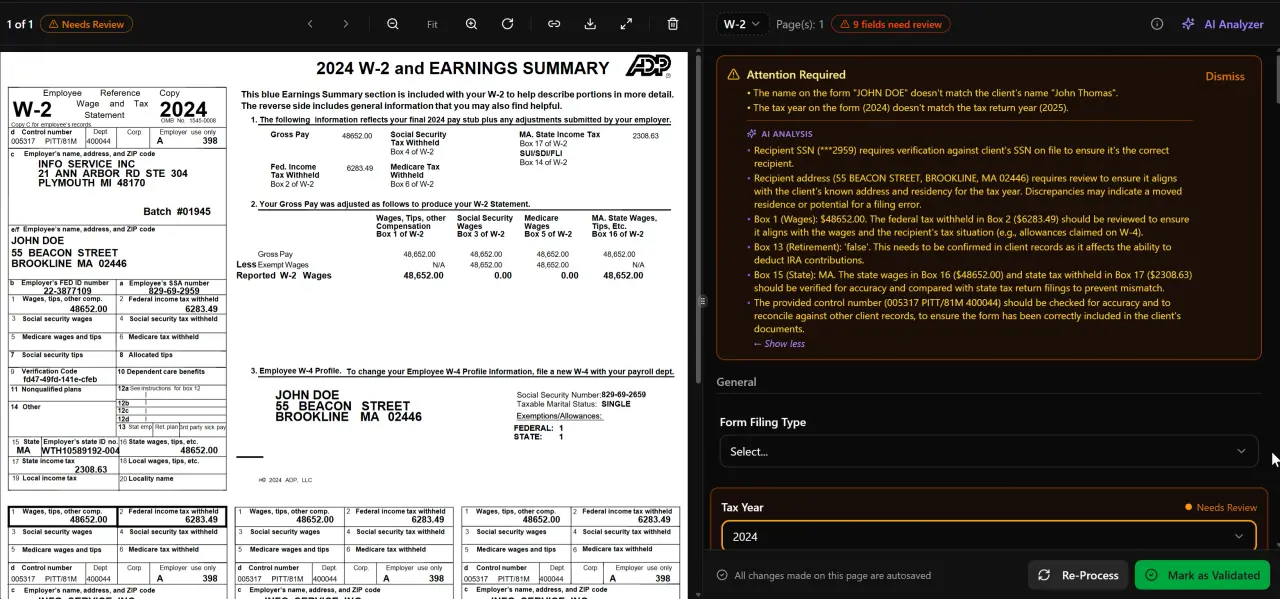
AI classifies, extracts, and validates every document automatically
Building a Repeatable Amendment Service Line with AI Assistance
Treating amendments as a defined service line — rather than a reactive cleanup task — changes everything about how the work flows through the firm. A service line has a documented intake process, a pipeline template, a pricing menu, a QA protocol, and assigned ownership. When the next corrected K-1 arrives in your inbox, any team member can initiate the engagement without waiting for a partner to triage it. That is the practical definition of a mature amended tax return workflow: the process runs the engagement, not the individual.
TaxScout's AI research agents — nine specialized agents with real-time search across IRS, Treasury, Cornell, SSA, and Congress sources — are particularly useful during the scoping phase of complex amendments. If a corrected document raises a question about whether a carryback election is available, or whether a specific penalty exception applies to an underpayment triggered by the amendment, an AI research agent can surface the relevant authority in seconds rather than requiring a partner to conduct manual research. That research speed compresses the time between intake and scope approval, which is where most of the calendar delay in amendment work actually lives.
For workflow management across all service lines — original returns, extensions, amendments, advisory — TaxScout's pipeline, AI extraction, client portal, and invoicing tools work together as a unified system rather than a stack of disconnected point solutions. Firms migrating from tools like TaxDome or Canopy often find that amendment work specifically benefits from the switch, because those platforms lack the AI document extraction and validation pipeline that makes comparison-based amendment preparation reliable. See how TaxScout compares at /compare/taxdome-alternative and /compare/canopy-alternative.
The Bureau of Labor Statistics reports that CPA and accounting services firms employ over 1.4 million people in the U.S., and the firms that grow sustainably are those that systematize every service line rather than relying on individual heroics. Amendment work is small enough per engagement that it is easy to dismiss as unworthy of systemization — but the aggregate impact of 30–50 poorly scoped amendments per year is real capacity drain and meaningful revenue leakage. Firms that invest in a structured amended tax return workflow recover that capacity and convert it into margin.
Ready to stop letting amended returns drain firm capacity and margin?
TaxScout gives your team AI-powered intake, extraction, pipeline tracking, and e-signature tools to run amendments as a structured, profitable service line — starting at $49/month with no per-user fees.
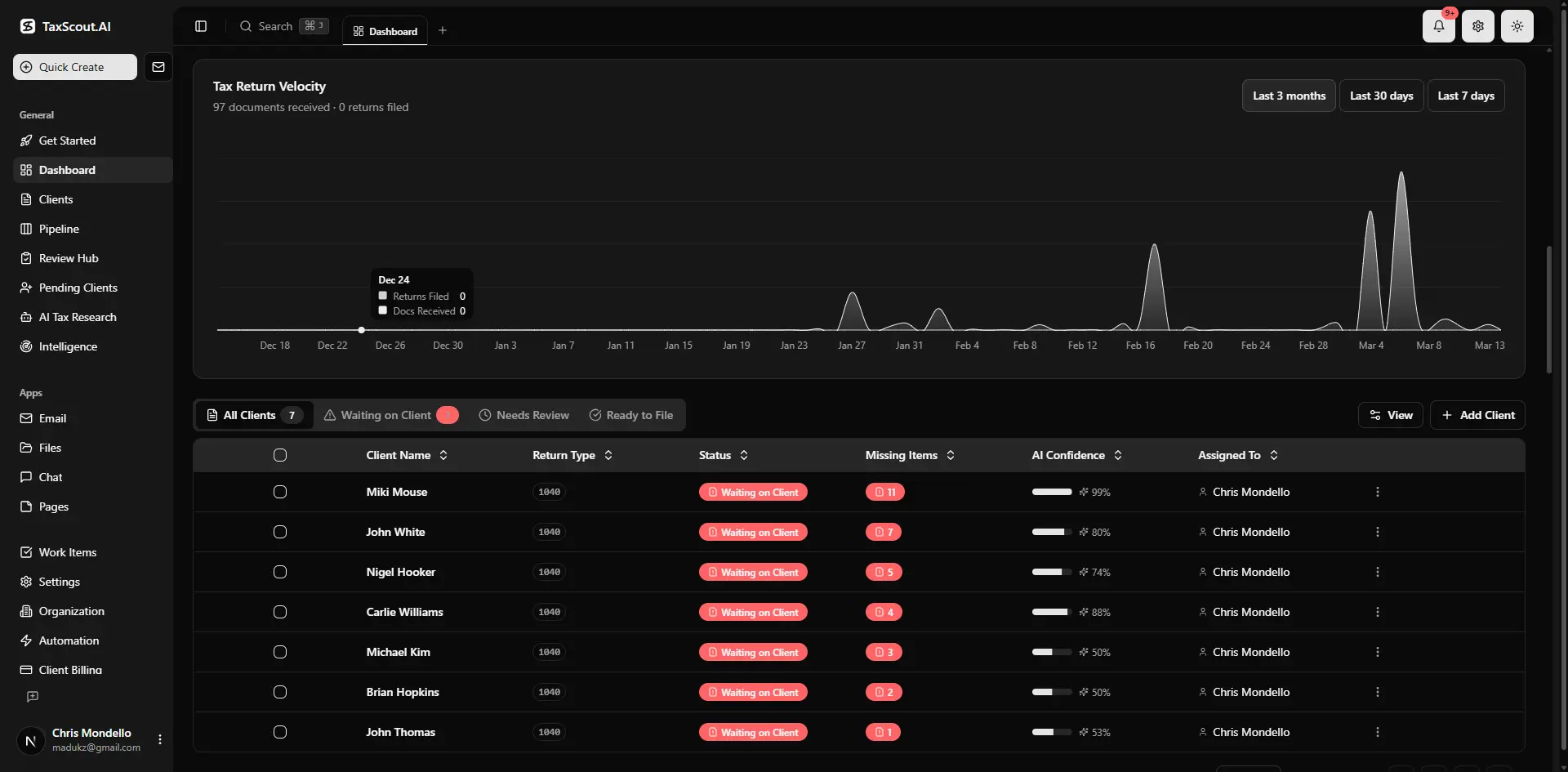
Real-time dashboard showing returns in progress, revenue, and upcoming deadlines
Frequently Asked Questions
The IRS typically takes up to 16 weeks to process an amended return, though processing times can vary. The IRS Where's My Amended Return tool (available at irs.gov) begins showing status updates approximately three weeks after filing. Paper-filed amendments for older tax years may take longer to appear in the system.
Keep reading
Amended FBAR Procedures: How CPAs Correct Foreign Account Errors Without Triggering Penalties
Oct 12, 2026 · 1 min read
Transparency in Coverage Final Rules: What CPA Firms Must Do Now
Oct 12, 2026 · 1 min read
Backdoor Roth IRA: How CPAs Execute the Strategy for High-Income Clients
Oct 12, 2026 · 1 min read
Stay up to date
Get the latest tax tech insights delivered to your inbox.