Backdoor Roth IRA: How CPAs Execute the Strategy for High-Income Clients
High-income clients are phased out of direct Roth IRA contributions, but the backdoor Roth IRA mechanic keeps the door open — if their CPA executes it correctly. This guide walks through Form 8606 line-by-line mechanics, the pro-rata rule trap, SEP and SIMPLE IRA aggregation issues, and multi-year…
For clients whose modified adjusted gross income exceeds the Roth IRA income limits — $161,000 for single filers and $240,000 for married filing jointly in 2024 — the direct Roth IRA contribution route is closed. The backdoor Roth IRA is the congressionally permitted workaround: make a non-deductible contribution to a traditional IRA, then convert it to Roth. Simple in concept, consequential in execution.
The real risk is not the strategy itself but the compliance steps most consumer-facing articles skip entirely. CPAs advising high-income clients need to get Form 8606 right every year, identify whether the pro-rata rule will generate unexpected taxable income, assess whether the client's SEP-IRA or SIMPLE IRA balance triggers the aggregation rule, and decide whether to complete the conversion in the same tax year or carry basis forward. Each of those decisions has different documentation requirements and different exposure if the IRS inquires.
This guide addresses every one of those CPA-specific operational decisions — the mechanics that separate a clean backdoor Roth IRA execution from a costly mistake. For the related question of how to fold Roth conversions into year-end tax planning, see our Roth Conversion Strategy guide.
Roth IRA Income Limits and Who the Backdoor Roth IRA Serves
The IRS phases out direct Roth IRA contributions based on MAGI. For 2024, the phase-out range is $146,000–$161,000 for single filers and $230,000–$240,000 for married filing jointly, per IRS Publication 590-A. Clients above the top of the range cannot make any direct Roth contribution regardless of earned income.
A non-deductible traditional IRA contribution has no income limit under IRC § 219, and a conversion from traditional to Roth IRA has no income limit since the Tax Increase Prevention and Reconciliation Act of 2005 removed the $100,000 MAGI ceiling effective 2010. That two-step mechanic — contribute non-deductible, then convert — is what practitioners call the backdoor Roth IRA.
The annual contribution limit for 2024 is $7,000 ($8,000 for clients age 50 or older). Note that earned income must equal or exceed the contribution amount; a client whose only income is investment income cannot contribute. CPAs working with clients who also have passive income concerns should review our Net Investment Income Tax guide alongside this strategy.
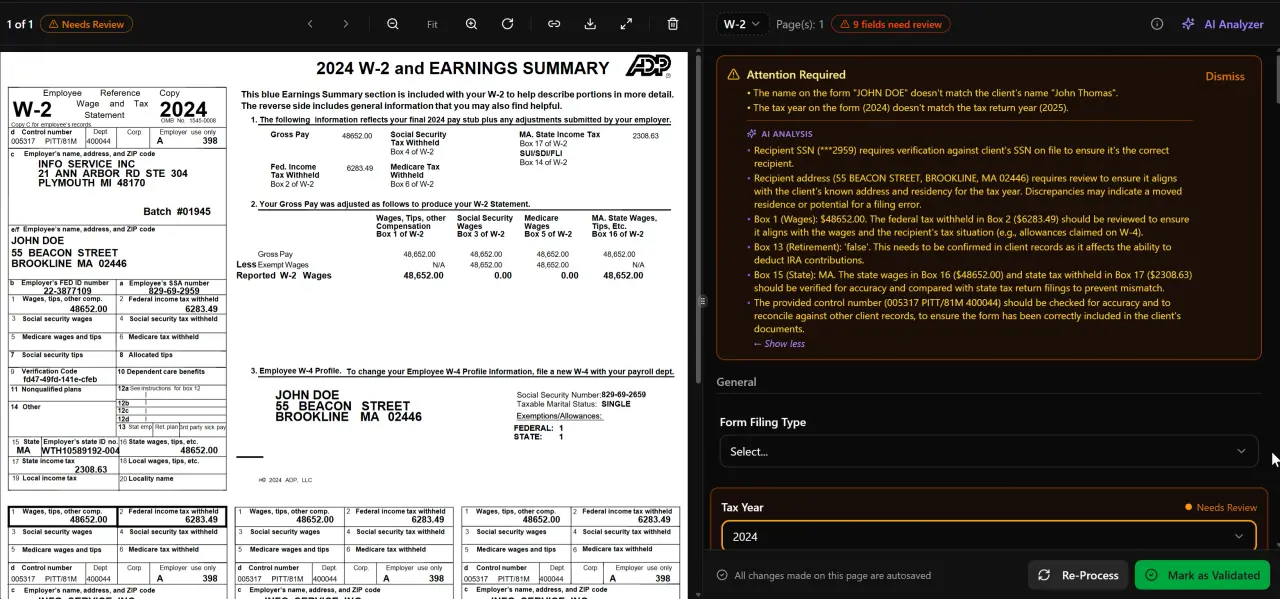
AI classifies, extracts, and validates every document automatically
Form 8606 Line-by-Line Filing Mechanics
Form 8606 is the compliance backbone of every backdoor Roth IRA execution. It serves two distinct purposes: reporting the non-deductible contribution (Part I) and computing the taxable portion of the conversion (Part II). Failing to file it — or filing it incorrectly — causes IRS matching problems and erodes the basis record that protects the client from double taxation.
Part I covers non-deductible contributions. Line 1 captures the current-year non-deductible contribution amount. Line 2 carries forward the total basis from all prior Form 8606 filings — this is the cumulative record that tracks dollars already taxed before they entered the IRA. Line 3 is the sum of lines 1 and 2. Line 14 is the ending basis after accounting for any distributions or conversions during the year. The IRS Form 8606 instructions contain worked examples, but they do not address the pro-rata complication in plain terms.
Part II handles the conversion itself. Line 16 reports the total amount converted to Roth. Line 17 reports the non-taxable portion — computed using the ratio of the client's total IRA basis to the aggregate value of all traditional, SEP, and SIMPLE IRAs as of December 31 of the conversion year. Line 18 is the taxable portion of the conversion (line 16 minus line 17). This line flows directly to Form 1040, Schedule 1, line 4b as ordinary income.
A precision point many preparers miss: the denominator in the line 17 ratio uses the December 31 fair market value of all the client's IRAs plus the amount converted, not the value at the time of conversion. If a client converts in March and the account value changes before year-end, the final ratio — and therefore the taxable income — is not knowable until December 31. This is one reason some practitioners prefer to complete the conversion and close the IRA in the same transaction.
Tired of tracking IRA basis across five years of client files with nothing but a spreadsheet?
TaxScout's AI document extraction and client-context memory keep every Form 8606, contribution record, and conversion statement organized and searchable — so you never lose a client's IRA basis again.

Your clients see your brand — OTP login, document upload, and real-time status
The Pro-Rata Rule: The Biggest Trap in Backdoor Roth Execution
The pro-rata rule under IRC § 72(e) treats all of a client's traditional IRA balances as a single pool when computing the taxable portion of any conversion or distribution. It does not matter which account the money came from or how recently the non-deductible contribution was made. If the client has $94,000 in pre-tax IRA funds (from prior deductible contributions or rollovers) and makes a $6,000 non-deductible contribution, their total basis is $6,000 out of a $100,000 pool — meaning only 6% of any conversion is tax-free.
On a $6,000 conversion in that scenario, only $360 would escape tax; the remaining $5,640 would be ordinary income. The client paid income tax on $6,000 to contribute and then pays tax on $5,640 more to convert it. That is near-total double taxation on the non-deductible portion — the opposite of what high-income retirement planning CPAs intend to achieve.
The solution is to eliminate or roll out the pre-tax IRA balance before executing the backdoor Roth IRA. The most common approach is rolling the pre-tax funds into the client's 401(k) or other qualified plan before year-end. Most 401(k) plans accept incoming IRA rollovers of pre-tax funds; the client's HR or plan administrator should confirm rollover eligibility. Once the pre-tax balance is zero, a new non-deductible contribution converts with zero pro-rata dilution. Confirm that the rollover is completed by December 31 of the conversion year, because the denominator in the Form 8606 Part II ratio is measured at year-end.
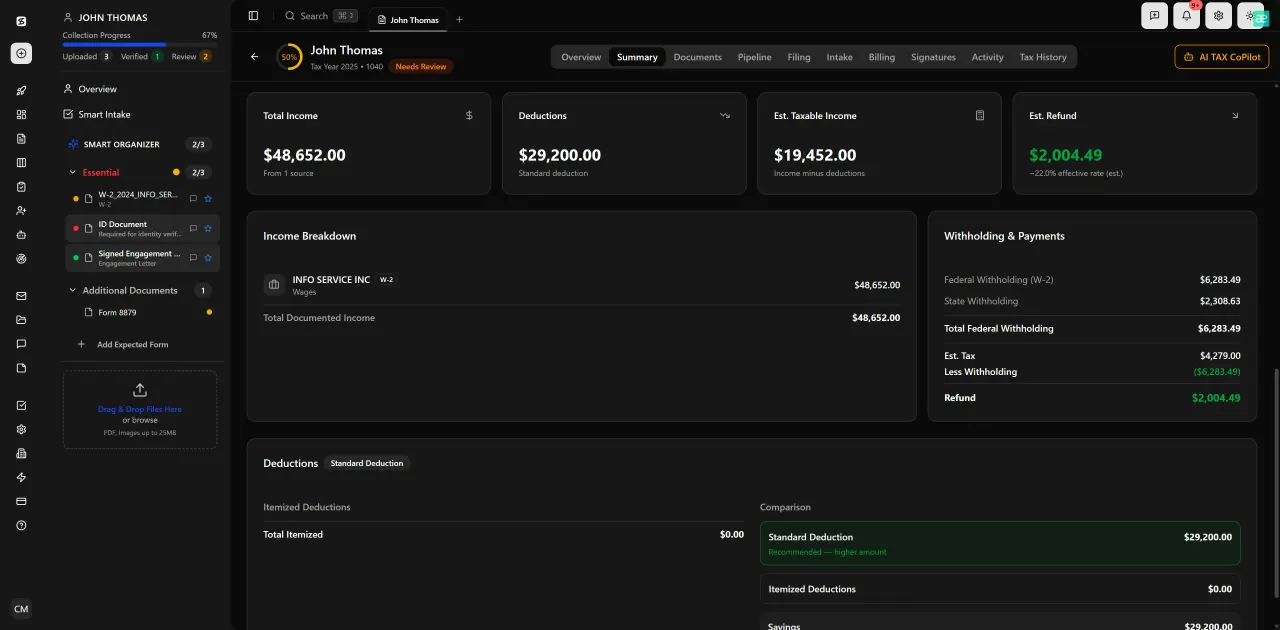
Review with AI assist — 9 agents answer questions with full client context
SEP-IRA and SIMPLE IRA Aggregation: The Rule Competitors Miss
Many CPAs correctly check for pre-tax traditional IRA balances but overlook one critical detail in the aggregation rule: SEP-IRA and SIMPLE IRA balances are included in the pro-rata denominator under IRC § 408(d)(2). A self-employed client who funds a SEP-IRA generously every year — potentially up to $69,000 in 2024 under IRS SEP-IRA limits — may have a six-figure pre-tax IRA balance that completely overwhelms any non-deductible contribution.
For example: a sole proprietor client has $200,000 in a SEP-IRA and makes a $7,000 non-deductible traditional IRA contribution. Their basis fraction is $7,000 / $207,000 = 3.4%. On a $7,000 conversion, only $238 is tax-free. The remaining $6,762 is taxable income. The backdoor Roth IRA math is deeply unfavorable in this scenario.
SIMPLE IRA balances are equally included. However, there is one important planning note: SIMPLE IRA balances cannot be rolled into a 401(k) until the employee has participated for at least two years. A client who just opened a SIMPLE IRA cannot immediately solve the aggregation problem the way a traditional IRA holder can. CPAs should identify SEP and SIMPLE balances early in the high-income retirement planning CPA conversation — ideally at onboarding — before advising on backdoor Roth execution.
One-participant 401(k) and Keogh plan balances are NOT aggregated under the IRA pro-rata rule. A client who has consolidated pre-tax funds into a solo 401(k) rather than an IRA-based plan can proceed with a clean backdoor Roth IRA. See our Solo 401(k) glossary entry for more on this account type.

Click any extracted field to see its source highlighted on the original PDF
Timing the Conversion: Same Tax Year or Carry Basis Forward
A common operational question is whether to convert in the same calendar year as the non-deductible contribution or wait until the following year. Both are legally valid; they differ in documentation complexity and exposure risk.
Converting in the same calendar year as the contribution is administratively cleaner. The non-deductible contribution hits the traditional IRA, the conversion occurs within weeks, and a single Form 8606 reports both the contribution basis and the conversion on one return. If the client's pre-tax IRA balance is already zero, the entire conversion is tax-free and the math is straightforward. The IRS sees a clear transaction trail.
Carrying basis forward — making the contribution in December of year 1 and converting in January of year 2 — introduces a multi-year documentation dependency. The year 1 Form 8606 reports the non-deductible contribution and records the basis on line 14. The year 2 Form 8606 reports the conversion and carries that basis forward on line 2. If the year 1 return is not filed or the basis is not carried correctly, the client risks being taxed again on the same dollars. The Traditional IRA glossary entry explains basis tracking concepts in plain terms for client-facing communications.
There is one scenario where waiting can be advantageous: if the client is near the income phase-out threshold and MAGI is uncertain late in the year, waiting until January to convert gives time to confirm the client is actually phased out of direct Roth contributions. If MAGI comes in below the threshold and the client qualifies for a direct Roth contribution, the non-deductible contribution can be recharacterized before the filing deadline.
Multi-Year Backdoor Roth Sequences and IRA Basis Documentation
For clients who execute the backdoor Roth IRA year after year — which most high-income clients should — the basis tracking obligation compounds. Each year's Form 8606 must correctly carry the prior year's ending basis on line 2. A single missed or incorrect filing creates a chain error that is difficult to unwind years later, especially if the CPA who prepared that return is no longer available.
Best practice is to maintain a dedicated IRA basis workpaper for each affected client. The workpaper should document: the contribution year, contribution amount, account used, date of conversion, conversion amount, taxable and non-taxable portions, ending basis per Form 8606, and the IRA fair market values at December 31. This is separate from the tax return workpapers — it functions as a rolling multi-year log. You can review our full approach to tax workpaper package documentation practices in the glossary.
If a client arrives with a gap in their Form 8606 history — contributions made but forms not filed — the CPA must reconstruct the basis. IRS Revenue Procedure 2016-47 allows late or corrected Form 8606 filings to establish basis, and there is a $50 penalty for failure to file that can be waived for reasonable cause. Amended returns may be needed. For other penalty waiver approaches relevant to high-income clients, see our Estimated Tax Penalty Waiver guide.
Document every step of the backdoor Roth IRA process in the client's engagement file: the contribution confirmation, the conversion statement, the IRA custodian's year-end fair market value statement (Form 5498), and the completed Form 8606. Form 5498 is issued by May 31 following the tax year and should be cross-checked against what was reported on Form 8606 before the file is closed. TaxScout's AI document extraction automatically classifies Form 5498s and other IRA-related documents on intake, reducing the chance that a year-end FMV statement gets missed in a pile of client uploads.
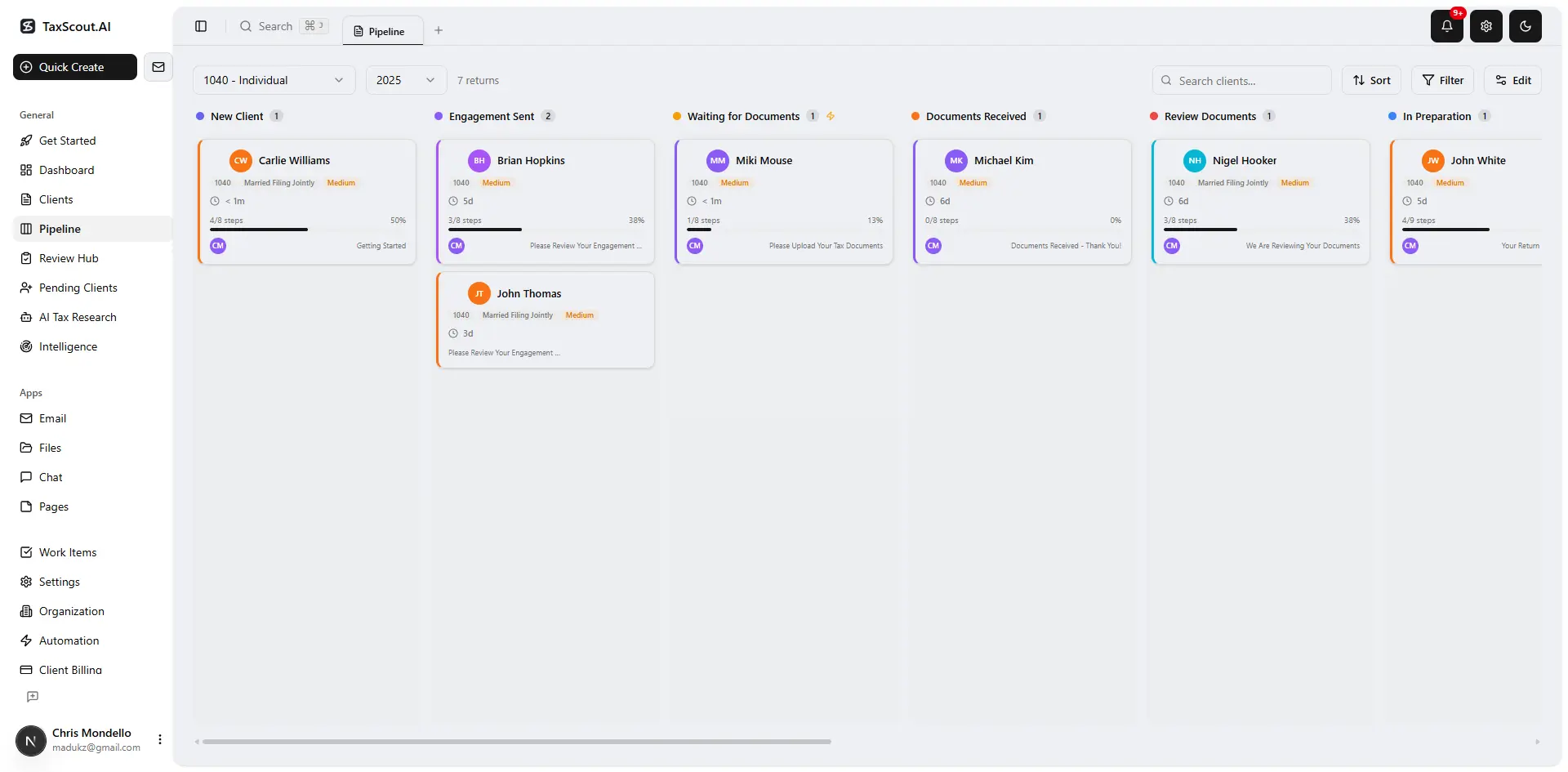
Track every return from intake to filed with drag-and-drop pipeline management
Backdoor Roth IRA Execution Checklist for CPAs
| Step | Action Required | Common Failure Mode |
|---|---|---|
| 1. Confirm income eligibility | Verify client MAGI exceeds Roth phase-out ceiling | Advising backdoor when direct contribution is still available |
| 2. Check aggregation exposure | Identify all traditional, SEP, and SIMPLE IRA balances | Overlooking SEP-IRA that neutralizes tax-free benefit |
| 3. Clear pre-tax IRA balance | Roll pre-tax funds to 401(k) or qualified plan before Dec 31 | Leaving rollover incomplete past year-end |
| 4. Make non-deductible contribution | Contribute to traditional IRA; confirm NOT deducted on Schedule 1 | Preparer marks contribution as deductible by default |
| 5. Execute conversion | Transfer from traditional to Roth IRA at custodian | Conversion not completed before Dec 31 when same-year approach is intended |
| 6. File Form 8606 — Part I | Report basis on lines 1-3 and 14; carry from prior year on line 2 | Failure to carry prior-year basis; treating as zero |
| 7. File Form 8606 — Part II | Compute taxable conversion using Dec 31 FMV denominator | Using conversion-date FMV instead of Dec 31 FMV |
| 8. Cross-check Form 5498 | Reconcile custodian statement to Form 8606 line 16 | Form 5498 arrives after filing; never reconciled |
| 9. Update basis workpaper | Record ending basis for next-year carryforward | Basis stored only in tax software; lost on software migration |

Every client gets organized documents, status tracking, and a complete history
Backdoor Roth IRA in the Context of Broader High-Income Retirement Planning
The backdoor Roth IRA rarely stands alone in a high-income client's retirement plan. CPAs should position it as one component of a coordinated strategy that may also include maximizing pre-tax 401(k) and HSA contributions, evaluating qualified plan audit requirements if the client sponsors a plan, and managing Roth conversion ladders through lower-income years. For clients with business income, an S corporation structure with reasonable compensation planning also interacts with IRA contribution eligibility; see our S Corp Reasonable Compensation guide for that dimension.
State tax treatment is another variable. Most states follow federal treatment of IRA contributions and conversions, but not all. California, for example, does not conform to the federal exemption that allows penalty-free conversions before age 59½ in certain circumstances. CPAs should verify state conformity rules before advising clients in states with idiosyncratic IRA tax treatment.
The law.cornell.edu Legal Information Institute summary of IRC § 408A is a useful reference for the statutory basis of Roth IRA rules, including the conversion provisions that underpin the backdoor strategy. The IRS Roth Comparison Chart can also support client-facing education for practice members who want to explain the mechanics at a high level. For a broader view of advisory content your firm can deliver to high-income clients, browse other blog resources covering tax planning, compliance, and firm operations.
TaxScout's AI Research Agents can run real-time IRS, Treasury, and Cornell Law searches on specific IRC provisions relevant to backdoor Roth IRA planning — useful when a client's situation involves a less common IRA type or a state conformity question that requires current-year verification.
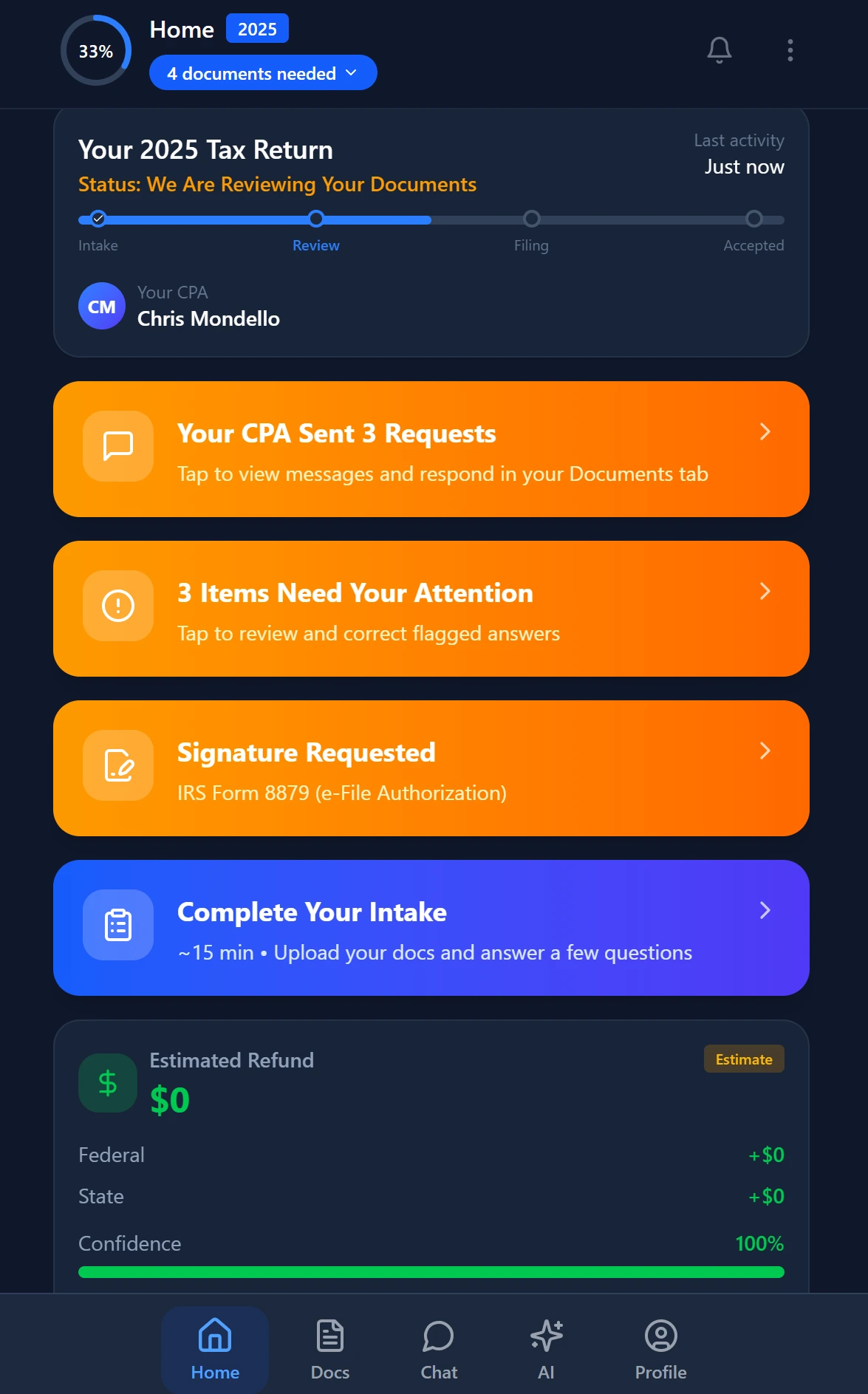
Smart intake auto-fills from uploaded documents and prior-year data
Organizing Backdoor Roth IRA Files in a CPA Practice
Practice management discipline matters as much as tax knowledge in executing the backdoor Roth IRA for a multi-year client roster. Because the strategy requires consistent year-over-year execution and basis carryforward, a client who misses a year or switches preparers carries real compliance risk. CPAs need systems that surface these obligations reliably.
A dedicated pipeline stage for IRA contribution and conversion verification — populated each fall before year-end — ensures no client falls through. TaxScout's pipeline management supports 12 customizable stages with drag-and-drop kanban, which can include stages for 'confirm non-deductible contribution made,' 'confirm rollover completed,' and 'reconcile Form 5498 to draft return.' Pairing that with the client management context memory — which stores entity structures and filing history — means the next preparer on the account sees the prior-year basis immediately without digging through folders.
Document requests through the client portal can prompt clients for their IRA custodian year-end statements and conversion confirmations before the filing window opens. Combining smart document intake with AI document extraction means Form 5498s, IRA contribution confirmations, and conversion statements are parsed and matched to the correct client file automatically — removing the manual reconciliation step that creates basis tracking errors in busy practices. Review our pricing page to see how TaxScout's flat-fee model fits CPA firms that manage this level of advisory depth across a full client roster.
Ready to stop rebuilding IRA basis records from scratch every tax season?
TaxScout centralizes client filing history, classifies IRA documents automatically, and keeps your Form 8606 basis trail intact year after year — with flat pricing that never charges per user.
Frequently Asked Questions
The backdoor Roth IRA is a two-step strategy: a taxpayer makes a non-deductible contribution to a traditional IRA (which has no income limit), then converts that balance to a Roth IRA. It is used by high-income taxpayers whose modified adjusted gross income exceeds the Roth IRA phase-out thresholds — $161,000 for single filers and $240,000 for married filing jointly in 2024 — which bar them from making direct Roth contributions.
Keep reading
Backdoor Roth IRA: How CPAs Execute the Strategy Without Triggering Pro-Rata Tax
Oct 12, 2026 · 1 min read
Amended FBAR Procedures: How CPAs Correct Foreign Account Errors Without Triggering Penalties
Oct 12, 2026 · 1 min read
Transparency in Coverage Final Rules: What CPA Firms Must Do Now
Oct 12, 2026 · 1 min read
Stay up to date
Get the latest tax tech insights delivered to your inbox.