Accounting Firm Service Packages: How to Bundle, Price, and Sell Them
Flat fees from 2019 and unspoken scope creep conversations are quietly discounting your firm out of its own growth. Accounting firm service packages solve the problem structurally — by defining deliverables, client tiers, and pricing anchors before any engagement begins. This guide gives you a…
Every April 16th, most CPA firm owners face the same moment of clarity: the revenue from the last four months looked impressive, but the hourly math didn't. Clients paid flat fees that made sense in 2019, the same fees that haven't moved since — and the firm effectively discounted itself through every scope creep conversation it never had. Accounting firm service packages fix that problem at the structural level, not by charging more for the same thing, but by defining what you deliver, to whom, and at what price before the engagement starts.
This guide gives you a tactical framework — naming conventions, scope boundaries, pricing anchors, and a three-tier architecture — for building accounting firm service packages that hold up under real client conversations.
Why Most CPA Firms Avoid Packaging (and What It Costs Them)
The conventional reason CPAs stick with hourly billing is flexibility. Every client is different, the logic goes, so how could a fixed package possibly fit? The real reason is usually simpler: packaging requires decisions that feel uncomfortable. You have to draw scope lines. You have to say no to out-of-scope requests. You have to publish prices or at least defend them. Designing accounting firm service packages forces exactly those decisions, which is why so many firms delay the process indefinitely.
The cost of that discomfort is measurable. Consider a five-person firm with 150 individual and business returns, 40 bookkeeping clients, and a handful of advisory engagements. If the average return fee hasn't been updated in three years and inflation has run 15-20% in that period, the firm has silently given back $30,000–$60,000 in purchasing power. Add untracked advisory time — the 11-minute emails, the "quick questions" on new entity structures — and you're looking at a five-figure annual revenue leak from unscoped work. Structured accounting firm service packages would have locked in annual price adjustments, preventing that silent revenue erosion from the start.
Our analysis of CPA firm pricing models shows that the shift from hourly to fixed-fee is not primarily about raising prices. It is about making the value visible before work begins, so clients choose their tier rather than debating your invoice after the fact. Well-constructed accounting firm service packages make that value tangible by presenting clear deliverables and outcomes at each tier before a client ever signs an engagement letter.
The Bureau of Labor Statistics projects steady demand growth for accounting professionals through 2032. Firms that productize now capture that demand on better margin terms. Firms that don't are competing on availability and lowest price. For firms evaluating their accounting firm service packages approach, this trade-off compounds over time.
The Three-Tier Architecture: Essential, Growth, Advisory
The most durable structure for accounting firm service packages is a three-tier model anchored to the client's stage and the firm's desired mix. Name the tiers to reflect client outcomes, not service features.
Tier 1 — Essential: Compliance coverage for individuals and small businesses that primarily need accurate, on-time filings. Each of these factors directly shapes how accounting firm service packages plays out in practice.
Tier 2 — Growth: Everything in Essential plus proactive analysis, bookkeeping integration, and structured communication touchpoints for clients scaling their business. Understanding accounting firm service packages in this context is what separates firms that scale from those that stall.
Tier 3 — Advisory: Full-service relationship with unlimited access, strategic planning, and entity-level advisory for complex or high-net-worth clients. This is precisely where a deliberate accounting firm service packages strategy pays off.
This structure does four things simultaneously: it creates natural upgrade paths, it lets you price anchor with the middle tier, it separates your transactional clients from your relationship clients, and it gives your team clarity on what work is in and out of scope for any given client. Accounting firm service packages sits at the center of this decision — get it wrong and the rest unravels.

Click any extracted field to see its source highlighted on the original PDF
Step 1: Define Scope Boundaries Before Setting Price
The most common mistake in CPA service bundling is setting the price first and then reverse-engineering the scope. Clients will exploit any ambiguity in your scope definition during the engagement. Start by listing every discrete deliverable your firm produces, then assign each one to a tier. When firms revisit their accounting firm service packages priorities, the gaps usually surface here.
Here is a working scope map for a tax-focused firm:
Essential tier scope:
- Federal 1040 preparation and e-filing
- One state return
- Up to three K-1s from passive partnerships
- Standard deductions review
- Document collection via client portal
- One round of follow-up questions
- Signed 8879 and filing confirmation
Growth tier scope (includes all Essential items, plus):
- Up to two additional state returns
- Schedule C or Schedule E with up to five rental properties
- Annual tax planning call (one hour, scheduled post-filing)
- Estimated quarterly payment calculations with reminders
- Bookkeeping review (up to 150 transactions/month)
- Priority response window (48-hour turnaround on questions)
- K-1s up to eight
- Business entity return (1120-S or 1065) bundled at reduced rate
Advisory tier scope (includes all Growth items, plus):
- Unlimited advisory calls and questions
- Multi-entity consolidation planning
- RSU/option exercise planning
- Proactive IRS notice monitoring and response
- Retirement plan contribution optimization
- Annual business financial review with written summary
- Entity structure analysis and recommendations
- FBAR and foreign information return coordination
Write each scope item as a deliverable, not an activity. "One tax planning call" is a deliverable. "Tax planning conversations as needed" is a recipe for scope creep.
Tired of clients debating your invoice after the fact? TaxScout's pipeline management and smart intake tools automate the workflow behind fixed-fee packages — so your team executes consistently, every time. → Book a 15-Min Demo — See It Live
Step 2: Set Pricing Anchors Using Market Data and Your Own Costs
Value pricing for accounting firms does not mean charging whatever you want. It means anchoring price to client value rather than your time. Use this three-input method:
Input 1 — Your cost floor. Calculate your fully loaded cost per return or per month, including staff time, software, and overhead allocation. This is your floor. Price below it and you lose money regardless of client satisfaction.
Input 2 — Market range. Individual 1040 preparation in metro markets ranges from $350 to $1,200 depending on complexity. Business returns run $1,500 to $5,000+. Monthly bookkeeping for a sub-$1M revenue business typically falls between $400 and $1,200. These are not targets — they are boundaries. When evaluating your accounting firm service packages against these ranges, treat them as guardrails rather than targets.
Input 3 — Value anchor. What does this work save or earn the client? An S-corp election saves $5,000–$20,000 in self-employment tax for the right client. A quarterly estimated payment calculation prevents penalties that often run $1,000–$3,000. Pricing your Growth tier at $3,000–$5,000 annually looks very different when the client can see $7,000 in quantified value.
Here are illustrative pricing anchors for a mid-market metro firm. Adjust by geography, complexity mix, and your realization rate targets.
| Package | Target Client | Annual Price Range | Avg Margin Target |
|---|---|---|---|
| Essential | W-2 individual, simple 1040 | $500 – $900/year | 55–65% |
| Growth | Self-employed, small LLC | $2,500 – $5,000/year | 50–60% |
| Advisory | Multi-entity, high-net-worth | $8,000 – $18,000/year | 45–55% |
The middle tier (Growth) is intentionally anchored as your revenue engine. Most of your ideal clients should fall here. Tier 3 (Advisory) is higher-margin per client but lower volume. Tier 1 keeps you accessible to referrals and simple filers without polluting your team's capacity with underpriced complexity.

Your clients see your brand — OTP login, document upload, and real-time status
Step 3: Name Your Packages to Reflect Outcomes, Not Services
"Silver, Gold, Platinum" is the lazy default and it fails for one reason: it signals commodity competition. Clients default to Silver because it sounds safe. Name your tiers after the client outcome they deliver.
Consider these alternatives:
- Filed, Optimized, Advised — direct, outcome-oriented, communicates the progression
- Compliance, Strategy, Partnership — professional framing that matches how CPAs already think
- Foundation, Growth, Concierge — works well for firms with a premium positioning in advisory
Avoid naming tiers after effort ("Basic," "Standard," "Comprehensive") — these invite clients to pick the cheapest option and assume your standard work is basic.
Your engagement letter should reference the tier by name. When a client asks for something outside scope, the conversation becomes: "That is an Advisory service. You are currently on the Growth plan. Would you like to upgrade, or I can quote it as a standalone project?" That framing is far easier than explaining an hourly charge on an invoice. Firms with clearly defined accounting firm service packages find this conversation happens naturally and without friction.
Our CPA engagement letter templates include scope language you can adapt directly to this tier structure.
Step 4: Build the Intake Workflow That Enforces the Scope
A package structure is only as durable as the intake process that collects the right information upfront to assign clients to the correct tier. If your intake process cannot determine within the first 15 minutes whether a client has a Schedule C, foreign accounts, or multiple entities, you will consistently underprice complex clients into your Essential tier. This is one of the most operationally important reasons to get your accounting firm service packages design right before you start onboarding clients at scale.
TaxScout's smart intake engine is modeled on IRS Form 13614-C and uses four-layer prefill to surface complexity before you quote. When a client uploads their prior-year return, the system pre-populates income sources, flags foreign activity, and identifies K-1s — automatically. An AI gap analysis runs in the background, generating prioritized questions for anything missing.
!TaxScout smart intake engine showing four-layer prefill populating tax data from prior-year documents to support accounting firm service packages tier assignment
That means by the time you have your first call with a prospect, you already know whether they belong in your Growth or Advisory tier. You are not guessing. You are confirming.
Pair this with TaxScout's pipeline management — which includes 12 customizable stages from New Client through Filed — and you can enforce scope boundaries operationally. A client on the Essential plan should never reach the advisory-call stage without a plan upgrade trigger in the workflow.
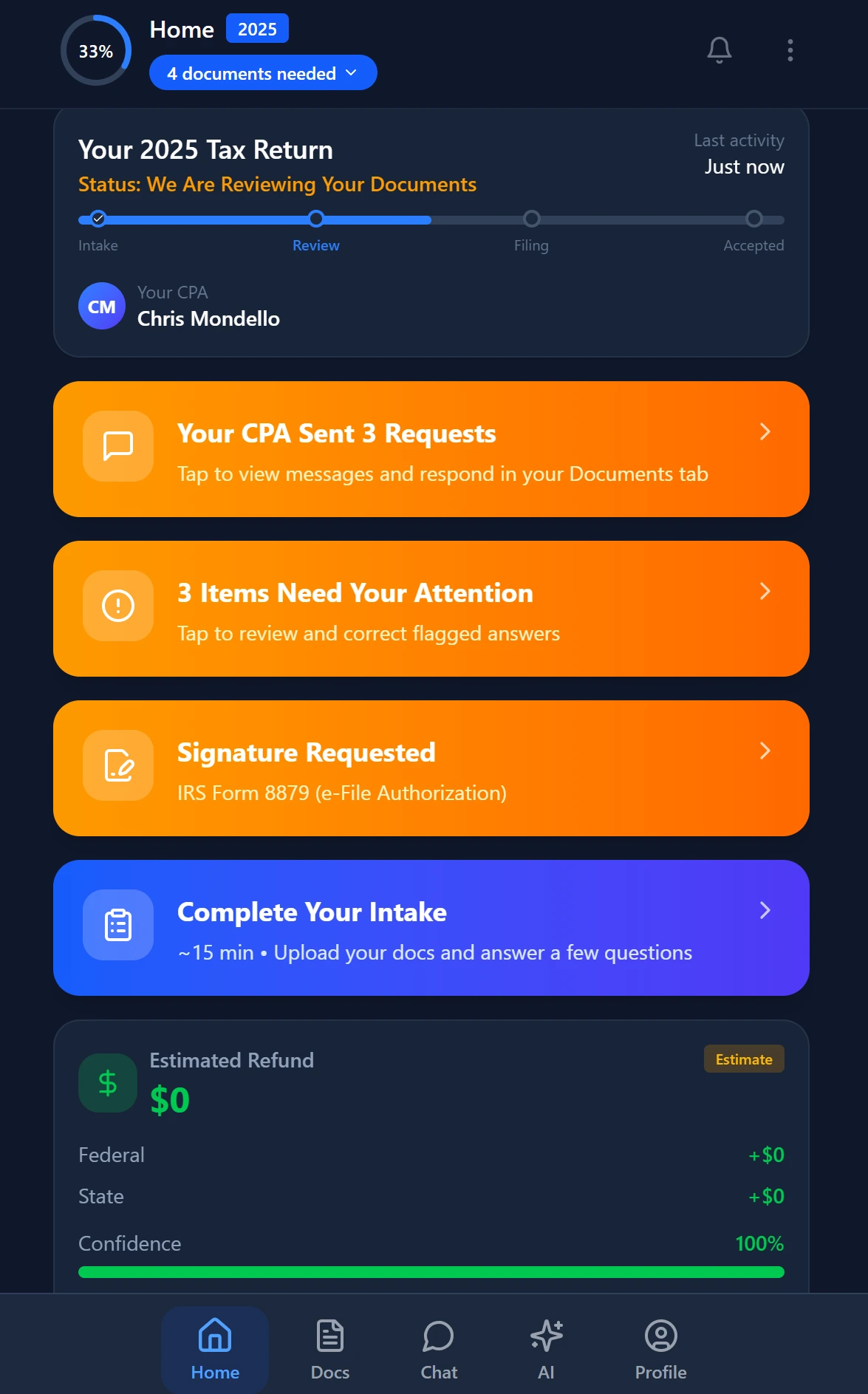
Smart intake auto-fills from uploaded documents and prior-year data
Step 5: Handle the Upgrade and Upsell Conversation
The upgrade conversation is where CPA service bundling either pays off or breaks down. Most CPAs avoid it because it feels like a sales pitch. Reframe it: you are not upselling, you are re-scoping.
When a Growth-tier client asks for an entity restructuring analysis, your response is not "that will be extra." It is: "Entity structuring is part of our Advisory package. A lot of clients in your situation move to that plan around this point because the S-corp election alone typically covers the difference in fees. Would you like me to run that analysis for you as part of a plan upgrade?"
That response requires three things to work: you have to know what plan the client is on, you have to know what the upgrade includes, and you have to have a rough value estimate ready. TaxScout's client-context AI memory retains each client's full profile — entity structures, filing history, prior-year returns — across all sessions, so your team can surface these opportunities without digging through files.
The advisory services pricing guide on this site covers the specific framing and pricing structures for CFO-level advisory engagements that often sit above even the Advisory tier.
Step 6: Automate Billing to Match the Package Structure
Fixed-fee packages produce predictable revenue — but only if billing is automated to match. A CPA firm that charges fixed fees but still sends manual invoices at the end of each engagement has not actually fixed its revenue model. It has just changed the pricing calculation. Well-designed accounting firm service packages should be paired with equally well-designed billing automation so the two halves of the model reinforce each other.
TaxScout's invoicing integrates Stripe Connect Express with the client portal, supporting both credit card and ACH payment. You can configure packages as recurring monthly or annual billing, set automated overdue reminders, and track collection status inside the same pipeline view where you manage work. Clients pay through the branded portal — no account creation, no passwords, just a one-time code sent via email.
For firms transitioning from hourly to fixed-fee, the recurring invoicing automation guide walks through exactly how to set up billing gates so invoices go out automatically when a workflow stage is reached — not when someone remembers to send them.
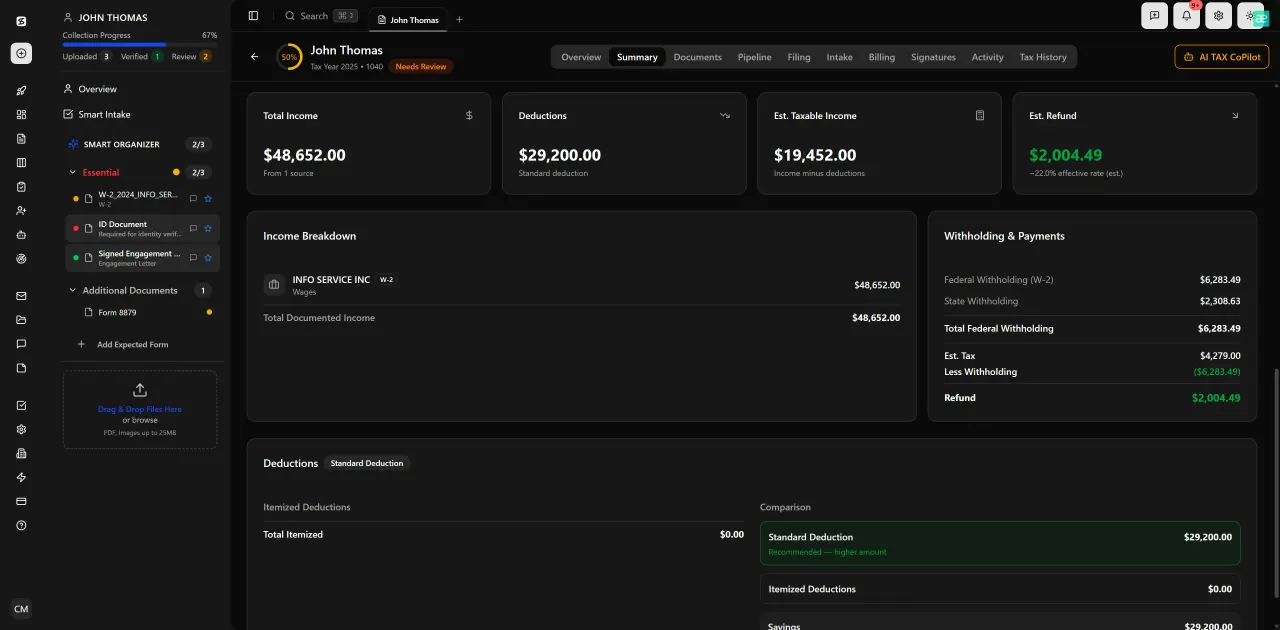
Review with AI assist — 9 agents answer questions with full client context
Real-World Workflow Example: Onboarding a Growth-Tier Client
Here is what the package framework looks like end-to-end for a new self-employed client being placed on the Growth tier.
The prospect submits an inquiry through the firm's website. TaxScout routes them into the New Client pipeline stage and sends an intake link via the branded client portal — no account creation required. The client uploads their prior-year 1040 and W-2s. Within minutes, TaxScout's AI document extraction has processed 180+ potential form types, identified the Schedule C income, flagged a home office deduction from the prior year, and pre-populated the intake form with wages, employer names, and withholding amounts.
The AI gap analysis runs in the background and surfaces two questions: the client has a 1099-NEC from a second business that did not appear in prior-year documents, and there is a potential estimated payment shortfall based on the income trajectory.
The CPA reviews the intake summary in under five minutes and confirms the client belongs in the Growth tier. A scoped engagement letter is sent for e-signature via Documenso — directly from the platform. The invoice is generated for the annual Growth package fee and sent through the client portal. The client signs and pays before the first working call.
That entire sequence, which previously took two to three days of back-and-forth email, takes under 30 minutes of active CPA time.
Comparison: TaxScout vs Canopy for Package-Driven Firm Operations
| Feature | TaxScout | Canopy |
|---|---|---|
| Smart intake with AI prefill | Included, 4-layer prefill | Smart Intake costs $11/client extra |
| AI document extraction (180+ forms) | Included in all plans | Basic document rename only |
| Pipeline management | 12-stage customizable workflow | Available, but complex setup |
| E-signatures | Included (8879, 4868, FBAR) | Available |
| Invoicing with Stripe | Included, recurring billing | Available |
| Flat pricing (no per-user fees) | Yes — $149/mo for 10 seats | ~$45/user/month per module |
| AI research agents | 9 specialized agents included in Pro | Not available |
| 10-person firm monthly cost | $149/mo | ~$660/mo |
Canopy's blog post on post-season scaling has motivational framing but no tactical package design framework. The platform itself charges extra for the intake tooling that makes package-tier assignment work. For a firm rebuilding its service model around fixed-fee accounting firm service packages, those intake and automation capabilities need to be economical to use at volume — not metered per client.
For a full breakdown, see the TaxScout vs Canopy comparison.
The Transition Plan: Moving Existing Clients to Packages
The most common objection to packaging is: "My existing clients are on hourly billing and they'll push back." Here is the practical sequencing:
- Apply packages to all new clients immediately. No legacy clients to manage, clean baseline data.
- Tier-assign your current book of business using last year's actual time records. Most clients will sort naturally into Essential or Growth.
- Send re-engagement letters to current clients at renewal, presenting the package structure as a "clarity update" — same service, defined scope, predictable pricing.
- Price existing clients at 80-90% of new-client package rates for the first year. Frame it as a loyalty rate.
- Identify your top 10-15 highest-value clients for an Advisory-tier conversation. These clients are almost certainly underpriced on hourly billing.
This sequencing works because it does not require you to change everything at once. The client onboarding checklist for accounting firms includes re-engagement letter language you can adapt for the tier transition conversation.
Ready to run a package-based firm without adding headcount? TaxScout gives your firm smart intake, automated billing, e-signatures, and AI document extraction for $49/mo flat — so the infrastructure matches your pricing model. → Book a 15-Min Demo
Pricing Your Packages for Long-Term Margin Health
One final principle for accounting firm service packages that most frameworks omit: build in an annual escalator. Fixed-fee pricing should not be fixed forever. Include language in your engagement letter that fees are reviewed annually and typically adjust by CPI or a fixed percentage (3–5%). Clients who understand your pricing structure accept this gracefully. Clients who resist an annual 4% adjustment are probably underpriced and resentful of the value they receive — which is useful information about whether they belong in your client base at all.
The Journal of Accountancy has published extensively on value pricing transitions at CPA firms. The consistent finding: firms that complete the transition report higher revenue per client, lower write-offs, and significantly lower administrative burden within 18 months. The packaging framework is not a pricing experiment. It is a structural decision about the kind of firm you want to run.
For the regulatory side — knowing which services require separate engagement letters or carry specific disclosure requirements — the Internal Revenue Code Section 7216 governs use and disclosure of tax return information, and your package descriptions should be drafted with that boundary in mind. For foreign-related services in your Advisory tier, IRS Publication 54 covers the scope of foreign tax obligations that typically fall in that category.
The post-tax season window is the best time to build this structure. Your team has just processed a full year of work. You know exactly which clients underused their scope, which ones constantly pushed boundaries, and which ones you would price differently if you were starting the relationship today. Use that data. Build the tiers around what you actually deliver, price them to reflect the value you actually create, and put the intake and billing infrastructure in place so the model runs without relying on anyone remembering to send an invoice.
Ready to see the difference? TaxScout gives your firm AI extraction, 5-layer validation, and complete practice management — for $49/mo flat. → Book a 15-Min Demo — See It Live
Frequently Asked Questions
TaxScout recommends anchoring your middle tier at roughly 60-70% of your top package price, not 50%, because most clients self-select into the middle when it feels like a genuine upgrade rather than a compromise. Define the middle tier by adding one high-perceived-value deliverable — such as quarterly advisory calls or cash flow forecasting — that costs you less than 2 hours per month but commands a $300-$500 monthly premium. TaxScout's package builder lets you map deliverable time costs against proposed price points so you can see margin per tier before you publish a single proposal.
Keep reading
Late Filing Penalty Relief: How CPAs Reduce or Eliminate IRS Failure-to-File Charges
Oct 12, 2026 · 1 min read
Business Valuation for CPAs: How to Price a Client Company Without Hiring an Appraiser
Sep 18, 2026 · 1 min read
Equity Partner Compensation: How CPA Firms Structure Pay for Owners
Sep 18, 2026 · 1 min read
Stay up to date
Get the latest tax tech insights delivered to your inbox.