Client Onboarding Accounting Firm Checklist Guide
Tax season ends, but the onboarding work doesn't. Many accounting firms finish the sprint with a stack of new clients who were never formally brought into the fold — no engagement letters, no document systems, no defined process. This checklist gives modern accounting firms a repeatable framework…
Tax season just ended. You survived the sprint — but somewhere in those 90 days, you picked up a handful of new clients who came in through referrals, extensions, or last-minute walk-ins. Now it's late April or May, and those clients are in a kind of limbo: they filed, but they've never been formally onboarded. No signed engagement letter. No organized document folder. No clearly defined relationship. The client onboarding accounting firm process got buried under deadline pressure, and now you're staring at a stack of new names with no system behind them. For any client onboarding accounting firm process worth its salt, those limbo clients represent your highest-leverage opportunity of the year.
This is the post-tax-season reset problem — and almost no one talks about it. Karbon published their tax season aftercare content focused entirely on staff burnout and retention. Canopy covered advisory strategy. None of them gave you an operational checklist for converting those new clients into a proper, repeatable workflow. That's exactly what this guide does. There's a real gap in the market for a practical client onboarding accounting firm guide built specifically for the post-April scramble.
Why the Post-Tax-Season Onboarding Gap Costs CPA Firms Real Money
Most firms treat April 16th as a finish line. It isn't. It's the starting gun for your next engagement cycle — and how you onboard clients you just acquired determines whether they return next year, refer their friends, or quietly find someone else. Getting your client onboarding accounting firm workflow locked in before May hits is what separates practices that grow year-over-year from those that perpetually restart from zero.
Here's what the manual version of this looks like in practice: Your admin emails a new client a PDF engagement letter. The client prints it, signs it, and either scans it back (if you're lucky) or mails it (if you're not). Your preparer emails a document request list. The client responds with a Dropbox link full of unsorted files with names like "scan001.pdf" and "last year stuff." Someone on your team spends two hours organizing, renaming, and manually entering data from those files. Meanwhile, the client emails three more documents directly to the preparer's inbox, bypassing the system entirely.
By the time you've collected everything, three weeks have passed. The client is frustrated. Your preparer is frustrated. And you've spent somewhere between four and eight hours of unbillable admin time just getting to the starting line.
The CPA client onboarding process at most firms runs entirely on email, PDF forms, and manual data entry — a workflow that made sense in 2012 but creates serious drag in 2026. For a 10-person firm onboarding 40 new clients post-tax-season, that translates to 160–320 hours of administrative work that produces no billable output. A well-structured client onboarding accounting firm system is the only way to reclaim that time.
Tired of rebuilding your onboarding process from scratch every May? See how TaxScout automates the entire CPA client onboarding process — from intake to e-signature to document extraction — in a single workflow. → Book a 15-Min Demo — See It Live
The Complete Client Onboarding Checklist for Accounting Firms (AI-Native Version)
This checklist is organized into six phases. Each phase shows you what the manual approach looks like, what an automated accounting firm onboarding workflow does instead, and exactly how TaxScout handles it.
Phase 1: New Client Setup and Profile Creation
Manual approach: Admin creates a new folder in your file server, manually enters the client's name, address, SSN, and entity type into your practice management tool, and sends a welcome email with login instructions for your client portal.
What goes wrong: Typos in SSN entries. Duplicate client records. SSNs stored in spreadsheets or email threads with no encryption.
AI-native approach with TaxScout: When a new client is added, TaxScout creates a structured client profile with an AES-256-GCM encrypted SSN vault — a dedicated encryption key per client with rate-limited reveal and full audit logging. No SSN ever lives in a spreadsheet. The client profile includes entity structures, filing history, and a permanent folder for identity documents, POA, and W-9 — automatically organized from day one.
The client gets access to a branded client portal with OTP login. No password creation. No account setup friction. They receive a one-time email code, click it, and they're in. This first touchpoint sets the tone for a smooth client onboarding accounting firm experience from the very start.
Checklist items:
- Create client profile with entity type, filing status, state(s)
- Upload identity documents to permanent folder
- Confirm SSN is stored in encrypted vault, not in spreadsheet
- Send client portal access link
- Assign preparer and manager in RBAC system
Phase 2: Engagement Letter and Initial Agreements
Manual approach: Email a PDF engagement letter. Wait. Chase. Wait more. Store the signed copy somewhere.
What goes wrong: Unsigned engagement letters sitting in inboxes. No signing order enforcement. No audit trail. IRS Publication 470 makes clear that defined representation scope matters — an unsigned letter is an undefined relationship.
AI-native approach with TaxScout: E-signatures are built directly into the pipeline management workflow. TaxScout sends the engagement letter, tracks signing status in real time, and automatically advances the client to the next pipeline stage when it's signed — no manual follow-up, no checking email threads.
Signing order dependencies are enforced: if a business return requires both the owner and spouse to sign an IRS Form 8879, TaxScout routes sequentially with KBA (knowledge-based authentication) where required.
Checklist items:
- Generate engagement letter from template
- Send via e-signature with defined signing order
- Confirm pipeline stage auto-advances on completion
- Archive executed letter in client folder
Phase 3: Smart Intake — Collecting What You Actually Need
This is where the biggest efficiency gap lives in most firms. The intake process for a new CPA client typically involves a generic questionnaire, a document request list, and a prayer that the client sends the right things. Streamlining this step is central to any effective client onboarding accounting firm strategy.
Manual approach: Email a PDF version of something loosely modeled on IRS Form 13614-C. Client fills it out partially. You follow up for the missing pieces. You compare it to last year's return manually to see what changed.
AI-native approach with TaxScout: TaxScout's smart intake engine is modeled directly on IRS Form 13614-C and uses a 4-layer prefill system that eliminates most of the back-and-forth:
- Document-first prefill: Client uploads a W-2 → employer name, wages, and withholding auto-fill into the intake form. They never manually type what's already on a document.
- Prior-year prefill: If you have last year's return, the relevant data pre-populates automatically.
- Profile prefill: Entity data from the client profile fills in automatically.
- AI gap analysis: A background workflow scans what's been collected, detects missing information, and generates a prioritized list of specific questions — not a generic checklist.
The result: clients answer fewer questions, you collect more accurate data, and your preparer starts with a completed intake instead of hunting for missing pieces.
Checklist items:
- Send smart intake link through client portal
- Confirm 4-layer prefill is pulling from prior-year return if available
- Review AI-generated gap analysis for missing items
- Request only the documents the system flagged as absent
As we explored in our guide to automating client onboarding for CPA firms, the firms that see the biggest time savings aren't the ones who digitized their PDF forms — they're the ones who eliminated the form-filling step almost entirely.
Phase 4: Document Collection and AI Extraction
Manual approach: Client emails documents. Preparer downloads attachments, renames files, uploads to folder, opens each document, manually keys data into tax software. For a typical individual return with a W-2, three 1099s, a K-1, and mortgage interest statement, that's 30–60 minutes of data entry per client.
AI-native approach with TaxScout: Once documents land in TaxScout — whether uploaded by the client through the portal or received via email integration — the AI document extraction engine processes them automatically.
TaxScout handles 180+ tax form types: every W-2, all 1099 variants (A through SA), K-1s for partnerships, S-corps, and trusts, the full 1098 series, 1095 series, 1040 with all schedules, plus 30+ supporting categories.
Extraction runs through a 5-layer validation pipeline:
- Layer 0: Document quality routing — confidence triage to identify recognized forms, unrecognized documents, and junk
- Layer 1: AI extraction with per-field confidence scoring (0.0–1.0)
- Layer 1.5: OCR cross-verification using four matching strategies including fuzzy name matching
- Layer 2: 15 deterministic math rules, including phantom 1099-INT hallucination detection
- Layer 3: 18 post-extraction validation rules covering tax math, cross-field checks, and foreign activity flags
For a detailed breakdown of how this works technically, see our complete guide to AI document extraction for CPAs.
The split-screen PDF viewer lets any team member click an extracted field and see it highlighted on the original document with pixel-precise coordinates — so your reviewer can verify extracted data against source documents in seconds, not minutes.
Checklist items:
- Confirm all documents are uploaded to client folder (not email inbox)
- Run AI extraction on all uploaded documents
- Review per-field confidence scores — flag anything below threshold
- Use split-screen viewer to spot-check high-value fields (wages, withholding, capital gains)
- Cross-reference AI gap analysis for any form types still missing
Phase 5: Workflow Assignment and Pipeline Tracking
Manual approach: A spreadsheet or sticky note system. Partners check in on status verbally. "Where is the Johnson return?" is a question asked out loud in your office at least twice a week.
AI-native approach with TaxScout: TaxScout's pipeline management includes 12 customizable stages from New Client to Filed, with drag-and-drop kanban, auto-advance when conditions are met, and loopback transitions with required notes. When an engagement letter is signed, the client automatically moves from "Awaiting Signature" to "Document Collection." When all documents are extracted and validated, the stage can auto-advance to "In Preparation."
No one needs to manually update a status. No one needs to check a spreadsheet. Your accounting firm KPI dashboard shows real-time throughput across the entire pipeline. This kind of visibility is what makes a modern client onboarding accounting firm workflow scalable across a growing book of business.
Checklist items:
- Assign client to correct pipeline stage (post-signing: Document Collection)
- Assign preparer with role-based access
- Set auto-advance conditions for pipeline stage transitions
- Confirm client appears in correct dashboard view
Phase 6: Fee Setup and Invoice Generation
Manual approach: Send a PDF invoice via email. Wait for a check. Chase payment. Send a reminder. Receive a check with a different amount because the client had a question about the fee.
AI-native approach with TaxScout: Invoicing is built into TaxScout via Stripe Connect Express. Branded PDF invoices are generated from within the platform and delivered through the client portal. Clients pay by credit card or ACH directly in the portal. Automated overdue reminders run on a daily cron at 9 AM EST — you don't chase anyone.
Two fee modes are available: CPA absorbs processing fees or passes them to the client. Either way, no paper checks, no "did you get my invoice?" emails. Completing this step closes the loop on the entire client onboarding accounting firm cycle — from first contact to collected payment.
Checklist items:
- Generate invoice from client profile
- Confirm fee mode (CPA absorbs vs. client pays processing fees)
- Send invoice through client portal
- Verify auto-reminder is active for overdue tracking

Click any extracted field to see its source highlighted on the original PDF
Manual vs. AI-Native Onboarding: Side-by-Side Comparison
| Onboarding Step | Manual Process | TaxScout AI-Native |
|---|---|---|
| Client profile creation | Admin manually enters data | Auto-populated from documents and prior returns |
| SSN storage | Spreadsheet or email | AES-256-GCM encrypted vault, rate-limited access |
| Engagement letter | Email PDF, wait, chase | E-signature with auto pipeline advance |
| Intake questionnaire | Generic PDF emailed to client | Smart intake with 4-layer prefill, AI gap detection |
| Document collection | Email attachments, manual rename | Client portal upload with AI organization |
| Data extraction | Manual entry into tax software | AI extraction for 180+ forms, 5-layer validation |
| Pipeline status | Spreadsheet or verbal check-in | 12-stage kanban with auto-advance |
| Invoice delivery | PDF via email | Branded portal invoice, card/ACH, auto-reminders |
| Pricing (10-person firm) | Tool cost: varies | $49/mo flat, no per-user fees |
The Pricing Reality for 10-Person Firms
The manual workflow isn't just slow — it's expensive even before you factor in tool costs. But tool costs matter too. If you're currently using TaxDome, you're paying approximately $100/user/month, which means roughly $1,000/month for a 10-person team. Canopy's modular pricing adds up similarly — especially since their smart intake charges $11 per client as an add-on.
TaxScout Pro is $199/month flat for up to 25 team members. All 9 AI research agents, real-time IRS research, the full 5-layer validation pipeline, all PDF tools, email integration, and everything in the onboarding checklist above — included.
That's a $800/month difference against TaxDome for a 10-person firm. For context, that's the salary cost of roughly 15–20 hours of staff time per month. If TaxScout saves your team four hours of manual onboarding per new client, it pays for itself with the second client you onboard each month.
For a full pricing breakdown, see TaxScout pricing. For a detailed feature comparison, the TaxScout vs TaxDome comparison covers the AI capability gap in depth.
You might also find it useful to review how to choose CPA practice management software before committing to any platform — particularly the seven questions on AI-native vs. AI-bolted-on architecture.
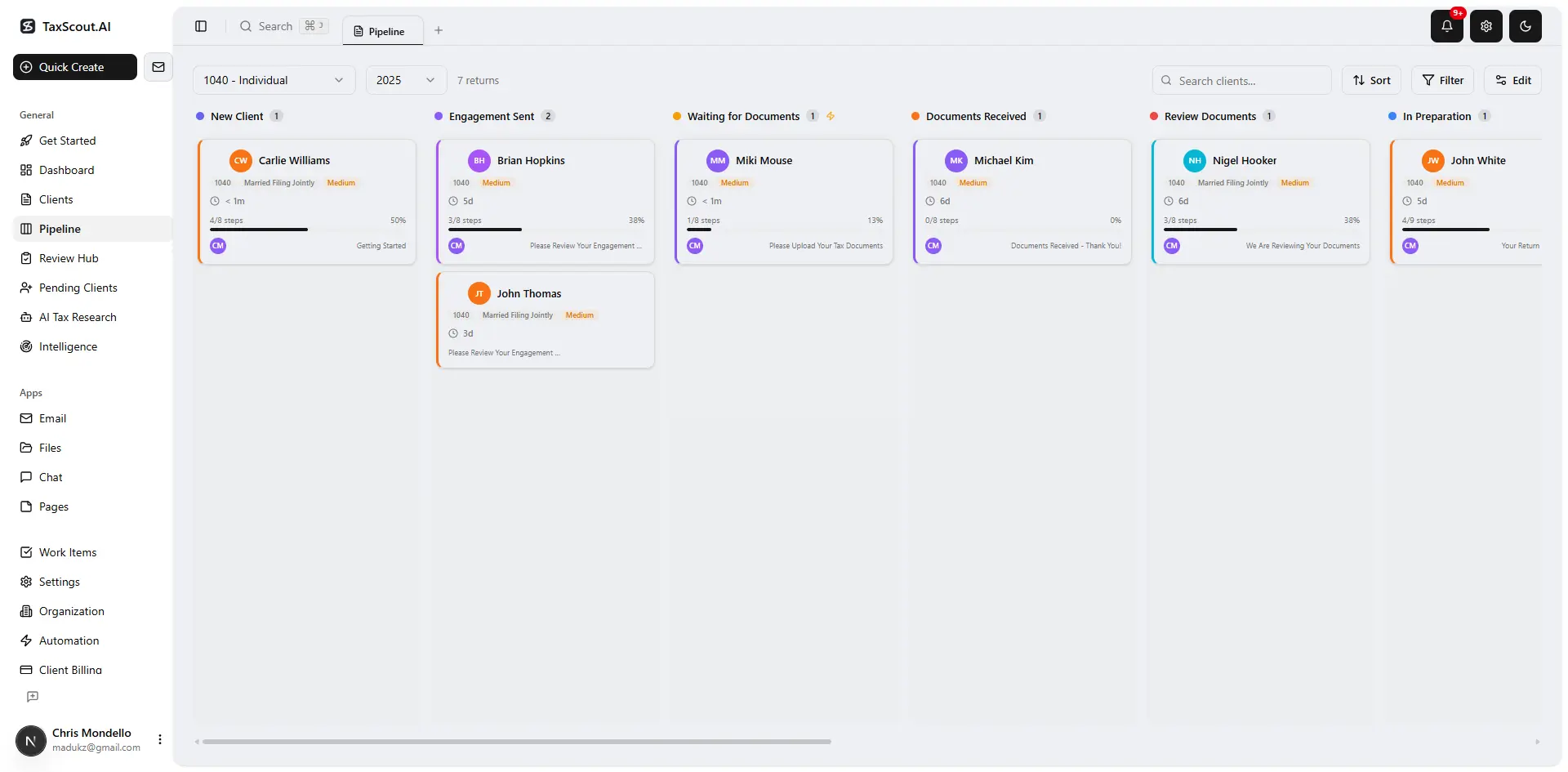
Track every return from intake to filed with drag-and-drop pipeline management
Ready to Turn Post-Tax-Season Into a Growth Engine?
TaxScout gives your firm a complete client onboarding accounting firm workflow — from encrypted client setup to AI extraction to e-signature to invoice — for $49/mo flat for your entire team.
Frequently Asked Questions
A complete post-tax-season client onboarding checklist for accounting firms should include: (1) a signed engagement letter with clearly defined scope, (2) a secure document collection folder with standardized naming conventions, (3) a client intake form capturing contact details, entity type, and prior-year filing history, (4) defined communication preferences and response-time expectations, and (5) a kickoff meeting or welcome sequence. TaxScout automates steps 2–5 by triggering a structured onboarding workflow the moment a new client record is created, reducing manual setup time by up to 80% per client.
Keep reading
Stay up to date
Get the latest tax tech insights delivered to your inbox.