CPA Advisory Services Pricing: A Practical Guide
Closing the advisory gap starts with a pricing architecture, not a philosophy. This guide breaks down exactly how to package, structure, and present advisory service fees so clients invest confidently. Stop leaving revenue on the table after every tax return.
Your best advisory client just handed you a shoebox of documents and apologized for being "a lot of work." You prepared their return, found $14,000 in missed deductions, and charged them $800. They thanked you, left, and made zero changes to their business structure — because you never had the conversation about why those deductions existed or how to engineer more of them next year. That's the advisory gap. And closing it starts with a pricing architecture, not a philosophy. This gap — between value delivered and fees charged — is exactly the problem that advisory services pricing CPA firms need to solve before tax season ends.
Canopy's Mark Kohler podcast nails the why — tax season is the perfect time to pitch advisory. But when CPAs go to actually implement that advice, they hit a wall: what do you charge? How do you structure it? How do you package it so clients say yes instead of asking if it's "included"? This guide answers those exact questions — with specific dollar amounts, tiering logic, and the delivery model that makes advisory margins work even at competitive price points. Think of this guide as the missing implementation layer: the practical framework for advisory services pricing CPA firms can actually hand to a client and close on.
The Advisory Services Pricing Problem Most CPA Firms Have
Advisory services pricing for CPAs has a structural problem that compliance pricing doesn't. With compliance work, scope is bounded — a 1040 is a 1040. Advisory scope is theoretically infinite, which means CPAs either undercharge (because they can't quantify the value) or never price it at all (because they don't know where to start).
The result? Most firms leave advisory services on the table entirely. The AICPA has spent years pushing the profession toward advisory, but adoption remains inconsistent because the operational question — how do you price and deliver this profitably? — goes unanswered. Understanding advisory services pricing CPA practices can realistically implement is the first step toward closing that gap.
There are three root causes:
1. No pricing anchor. Compliance has market rates. Advisory doesn't, which creates anxiety around quoting fees.
2. No delivery system. Advisory feels like open-ended consulting, so CPAs assume it requires unlimited availability. Without a system, that assumption becomes true.
3. No margin math. If advisory requires 5 hours of research per client per month, the numbers don't work at $300/month. But with AI-powered delivery tools that reduce research time, they do.
Each problem is solvable. Let's work through them in order.
Struggling to price advisory without knowing what to charge? See how TaxScout's AI research agents and client intelligence tools reduce your delivery cost so advisory margins actually work. → Book a 15-Min Demo — See It Live
The Three Advisory Pricing Models (and When to Use Each)
Model 1: Hourly Advisory Billing
Hourly rates for CPA advisory typically range from $200–$450/hour depending on market, firm size, and specialization. Tax resolution specialists and niche advisors (real estate CPAs, medical practice CFOs) can command $500+/hour.
Hourly billing works best for:
- One-off strategy sessions (entity structure analysis, exit planning reviews)
- Clients with unpredictable, variable advisory needs
- Engagements where scope genuinely can't be defined upfront
The problem with hourly advisory is psychological: clients meter their questions to avoid the bill. You get less information, they get less value, and the relationship stays transactional. Hourly billing also caps your revenue at your available hours — and during tax season, those hours don't exist.
Use hourly billing as a gateway, not a primary model. A $400 strategy session billed hourly is the right first advisory touchpoint. Converting that client to a retainer is the goal. Before that conversion, though, every firm needs a clear approach to advisory services pricing CPA clients will accept without friction.
Model 2: Value-Based Advisory Fees
Value-based pricing accountants charge based on the outcome, not the time. If you restructure a client's entity from sole proprietor to S-corp and the projected tax savings are $22,000/year, a $5,000 engagement fee is a fraction of the value delivered.
Value-based fees apply well to:
- Entity restructuring and tax planning engagements
- Exit planning and M&A advisory
- Tax credit identification (R&D credits, 179D, cost segregation)
- Estate and gift planning engagements
The practical framework: price at 10–30% of the projected first-year value delivered. A $15,000 annual tax savings projection justifies a $1,500–$4,500 engagement fee. This feels abstract until you have the conversation — and the way to make that conversation credible is having specific numbers ready. Getting advisory services pricing CPA conversations right means walking in with a savings analysis, not a guess.
This is where AI tax research agents change the math. TaxScout's AI research agents can pull real-time guidance from IRS.gov, Treasury.gov, and law.cornell.edu — live, not from a cached database — to build out a specific savings analysis in minutes rather than hours. When you can quantify the opportunity quickly, value-based pricing becomes much easier to defend in a client conversation.
Model 3: Monthly Advisory Retainers (CAS Pricing Strategy)
Accounting retainer pricing is where advisory scales. A well-structured retainer program can generate $3,000–$15,000 per client per year in recurring revenue, with minimal scope creep if packaged correctly.
Typical CPA advisory retainer pricing by tier:
| Tier | Monthly Fee | Annual Fee | Who It's For |
|---|---|---|---|
| Foundation | $300–$500/mo | $3,600–$6,000 | Sole props, Schedule C, side businesses |
| Growth | $600–$1,000/mo | $7,200–$12,000 | S-corps, partnerships, growing businesses |
| Strategic | $1,500–$3,000/mo | $18,000–$36,000 | Multi-entity, high-net-worth, exit planning |
These aren't arbitrary numbers — they're calibrated to the complexity of the advisory relationship and the market rates CPAs successfully charge. As we discussed in Boost CPA Firm Revenue Growth Without Adding Headcount, the move to retainers is the single highest-leverage revenue decision most firms can make.
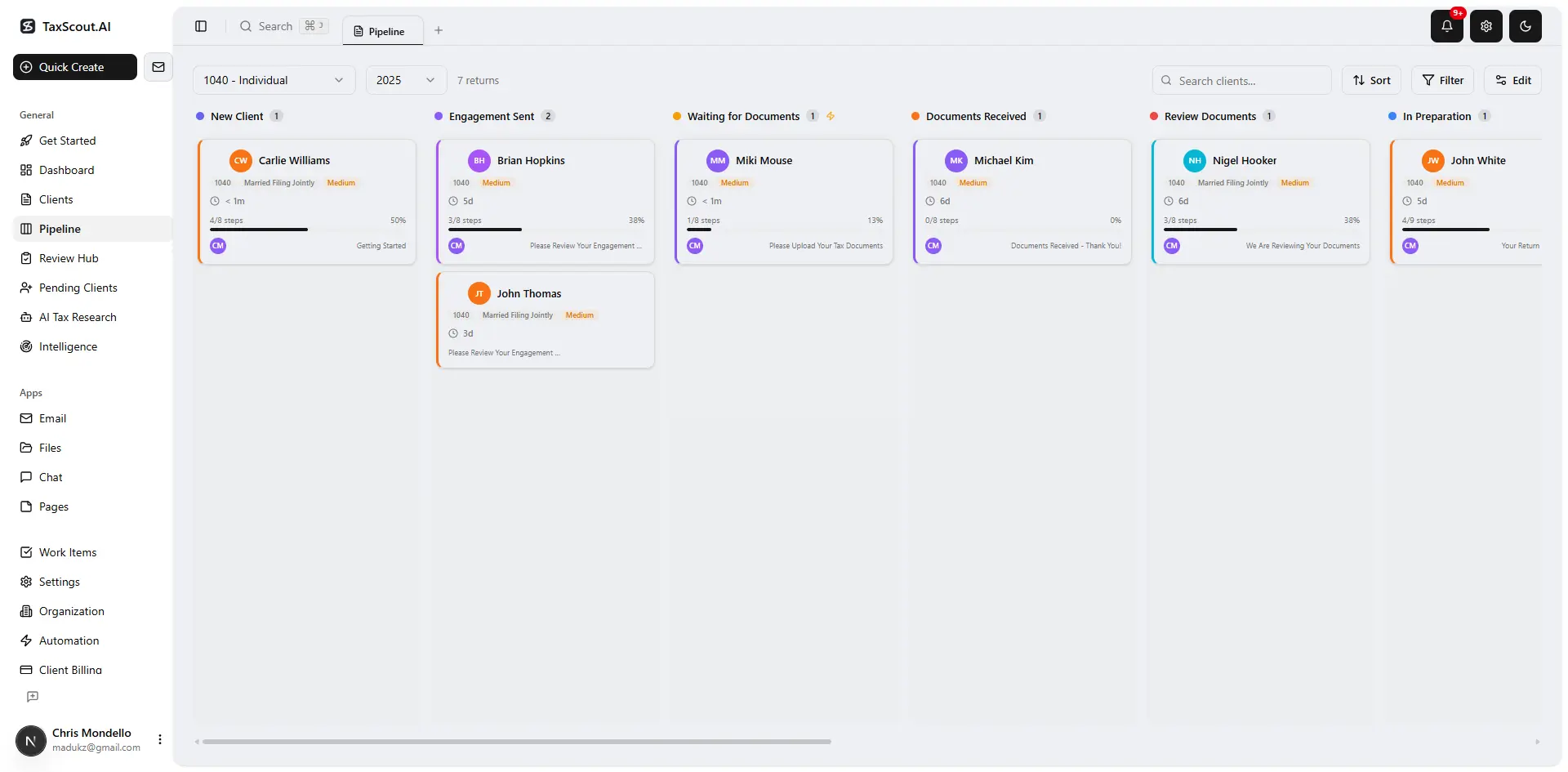
Track every return from intake to filed with drag-and-drop pipeline management
How to Tier Your Advisory Service Packages
Packaging is what turns pricing theory into client conversations that close. Clients don't buy advisory services — they buy outcomes with defined deliverables. Your packages need to name what they get, not just what you'll "be available for."
Structuring Accounting Firm Advisory Fees by Package
Foundation Advisory Package ($300–$500/month)
- Annual tax planning session (1 hour, documented recommendations)
- Quarterly check-in calls (30 minutes each)
- Ongoing email Q&A (48-hour response SLA)
- Year-end tax projection with estimated liability
- Access to client portal for document exchange and status tracking
Growth Advisory Package ($600–$1,000/month)
- Everything in Foundation
- Monthly financial review against KPIs (P&L, cash flow, owner's comp)
- S-corp reasonable compensation analysis (annually)
- Proactive tax alerts when regulations change that affect them
- Entity structure review (annually)
- Priority response SLA (24 hours)
Strategic Advisory Package ($1,500–$3,000/month)
- Everything in Growth
- Bi-weekly strategy calls
- Multi-entity tax planning and coordination
- Exit planning and valuation benchmarking
- Investment and real estate tax planning
- Coordination with client's attorney, financial advisor, and banker
- Same-day response for urgent matters
The key design principle: each tier should feel like a meaningful step up, not just "more of the same." Foundation clients are getting structured access. Growth clients are getting proactive monitoring. Strategic clients are getting a fractional CFO they can call. This tiered approach to advisory services pricing CPA firms use is also what makes it easier to upsell clients as their businesses grow.
For firms building out CAS (Client Advisory Services) practices, this tiering structure aligns with AICPA's CAS framework, which defines CAS as a spectrum from basic bookkeeping through strategic advisory.
What to Charge for Strategy Sessions (The Advisory Gateway)
The strategy session is the bridge between compliance and advisory. After delivering a return, offer a dedicated paid session — not a free consultation — to review tax planning opportunities.
Recommended strategy session pricing:
- Solo practitioner / small firm: $350–$500 for a 90-minute session
- Mid-market CPA firm: $500–$750 for a 90-minute session
- Specialized advisor (real estate, medical, exits): $750–$1,500
Charging for strategy sessions accomplishes two things: it filters for clients who value your time, and it resets the relationship from "CPA who does my taxes" to "advisor I pay for strategic guidance." It also creates a natural entry point to introduce your broader advisory services pricing CPA clients can evaluate before committing to a retainer.
Apply the fee toward the first month of a retainer if the client signs up. This removes the objection ("I already paid for a session") while rewarding the conversion.
When you walk into that session with a prepared analysis — specific savings opportunities, entity structure observations, projected liability scenarios — the conversion rate to retainer is dramatically higher. TaxScout's AI document extraction processes 180+ tax form types and pairs with client-context AI memory that retains each client's full filing history, entity structures, and prior-year data. That means you can generate a substantive pre-session briefing in minutes, not hours.
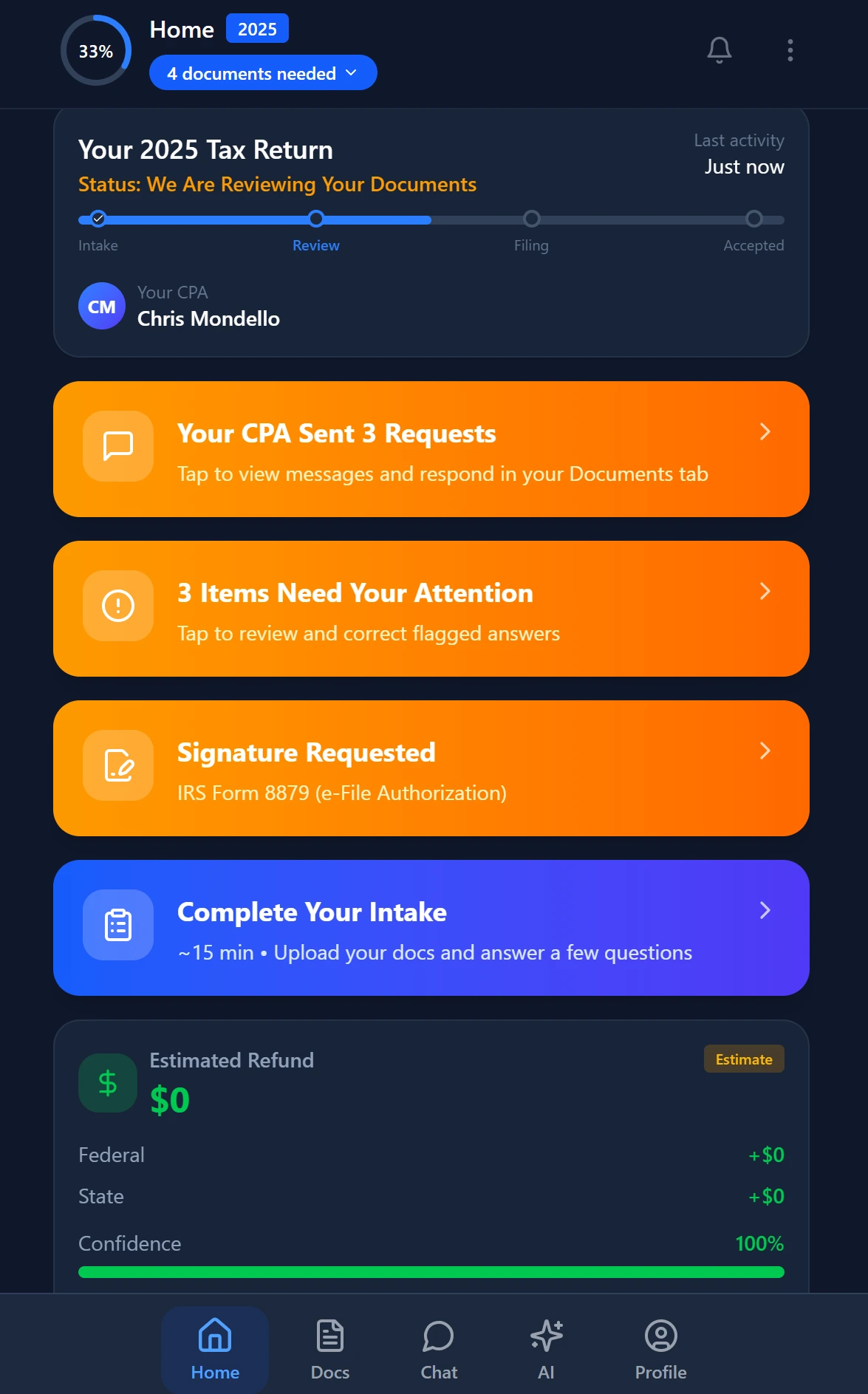
Smart intake auto-fills from uploaded documents and prior-year data
The Margin Math: Why AI Delivery Efficiency Changes Advisory Pricing
Here's where competitor content fails CPAs: they explain the strategy, then leave you to figure out delivery. The reason most advisory attempts fail isn't pricing — it's that the delivery model isn't sustainable.
Advisory at scale breaks down when:
- Each client needs 3–5 hours of research per month
- You're manually digging through prior-year returns to remember context
- Tax law questions require separate research sessions for each client
At $800/month per client and 4 hours of monthly delivery time, your effective hourly rate is $200 — before overhead. That's not much better than compliance work, and it comes without the predictability. This is why advisory services pricing CPA firms set often doesn't hold up — the delivery costs quietly eat the margin.
AI-native practice management changes that math materially.
With TaxScout's 9 specialized AI research agents, a client question about qualified opportunity zone treatment that previously took 45 minutes of research takes 4 minutes — because the Contextual Q&A agent already has the client's full profile loaded and can pull live regulatory guidance simultaneously. The Document Intelligence agent knows which documents are on file. The Risk Assessment agent flags relevant compliance exposure before you've even asked.
With client-context AI memory, every advisory session starts from a fully loaded client profile — entity structures, filing history, all extracted documents, intake data, prior-year returns — across all sessions. You're not re-orienting yourself before every client interaction.
For a 20-client advisory book at $600/month average, TaxScout's Pro plan at $199/month flat (for your entire team, not per-user) means your practice management infrastructure costs less than 2% of monthly advisory revenue. As we explored in CPA Client Advisory Services: Scaling With AI, this delivery efficiency is what lets smaller firms price advisory competitively without sacrificing margin.
Compare that to managing advisory on Canopy, where modular pricing means smart intake alone costs $11/client extra. On top of the base per-user fee, the cost structure works against you as you add advisory clients. See the full breakdown in our TaxScout vs Canopy comparison.
Real-World Advisory Pricing Workflow: End-to-End Example
Here's how this plays out in practice for a two-CPA firm with 80 compliance clients.
January: Tax season intake. TaxScout's AI automatically extracts documents, identifies missing information, and pre-populates smart intake forms. No manual data entry.
March (during return delivery): For 15 business-owner clients, the CPA books a paid strategy session at $500. The session prep — pulling prior-year comparison, identifying advisory opportunities, checking entity structure against current law — takes 20 minutes using TaxScout's AI agents instead of 90 minutes of manual review.
April–May: 10 of 15 clients convert to Growth Advisory retainers at $750/month. That's $7,500/month in new recurring revenue from clients the firm already had. The advisory services pricing CPA partners agreed on at the start of the year paid off — defined tiers and clear deliverables made the close straightforward.
Ongoing delivery: Monthly advisory check-ins are informed by real-time AI research, not manual lookups. The client portal handles document exchange and status visibility. E-signatures through Documenso handle any engagement letters or updated retainer agreements. Invoicing runs through Stripe Connect — monthly retainer charges automated, overdue reminders handled by a daily cron, no manual follow-up.
The CPA spends less time on logistics and more time on the high-value advisory conversation. The effective hourly rate on advisory climbs toward $300–$400 because delivery time drops, not because fees go up.
Advisory Pricing Comparison: TaxScout vs. Canopy for Advisory Delivery
| Capability | TaxScout | Canopy |
|---|---|---|
| AI research for advisory prep | 9 specialized agents, real-time IRS search | None |
| Client context memory | Full profile across all sessions | None |
| Smart intake (advisory discovery) | Built-in, AI gap analysis included | $11/client extra |
| Pipeline management for advisory stages | 12 customizable stages, drag-and-drop | Included but no AI automation |
| E-signatures for retainer agreements | Documenso, built-in | Available |
| Invoicing for retainers | Stripe Connect, automated reminders | Separate module pricing |
| Pricing for 10-person firm | $199/mo flat | ~$660/mo+ per user |
Ready to Build an Advisory Practice That Actually Prices Itself?
TaxScout gives your firm the AI delivery infrastructure to make advisory margin-positive from day one — for $199/month flat, no per-user fees.
If you've been waiting to launch an advisory practice because the delivery model felt unsustainable, the AI infrastructure now exists to change that math. The pricing framework is above. The tiering logic is above. What's left is the decision to start.
Frequently Asked Questions
Most CPA firms successfully price advisory service tiers in three bands: a foundational tier at $2,500–$5,000/year covering quarterly check-ins and basic tax planning, a mid-tier at $6,000–$12,000/year covering proactive strategy sessions and entity structuring reviews, and a premium tier at $15,000–$30,000/year for high-net-worth clients needing wealth integration and ongoing CFO-level guidance. TaxScout's advisory workflow templates include pre-built scope definitions for each tier, helping firms avoid scope creep that erodes margins on flat-fee engagements.
Stay up to date
Get the latest tax tech insights delivered to your inbox.